Every manager has faced the quiet frustration of an employee who seems to possess all the raw ingredients for success yet never quite delivers, or the perplexing case of a team member whose enthusiasm is boundless but whose actual output falls short. This divergence between capability and performance is one of the most persistent challenges in organizational leadership. The Skill Will Matrix offers a remarkably intuitive yet analytically powerful lens for understanding this gap and, more importantly, closing it. By mapping an individual’s skill level against their willingness or motivation, the Skill Will Matrix transforms vague observations into a clear, actionable framework that guides coaching conversations, delegation decisions, and development plans. It moves leaders away from one-size-fits-all management toward a precisely tailored approach that can unlock star potential in employees who might otherwise remain trapped in mediocrity, listlessness, or frustration. For leaders navigating high-stakes situations, this diagnostic clarity is essential, much like the principles outlined in Navigating Turmoil: The Art of Crisis Communication.
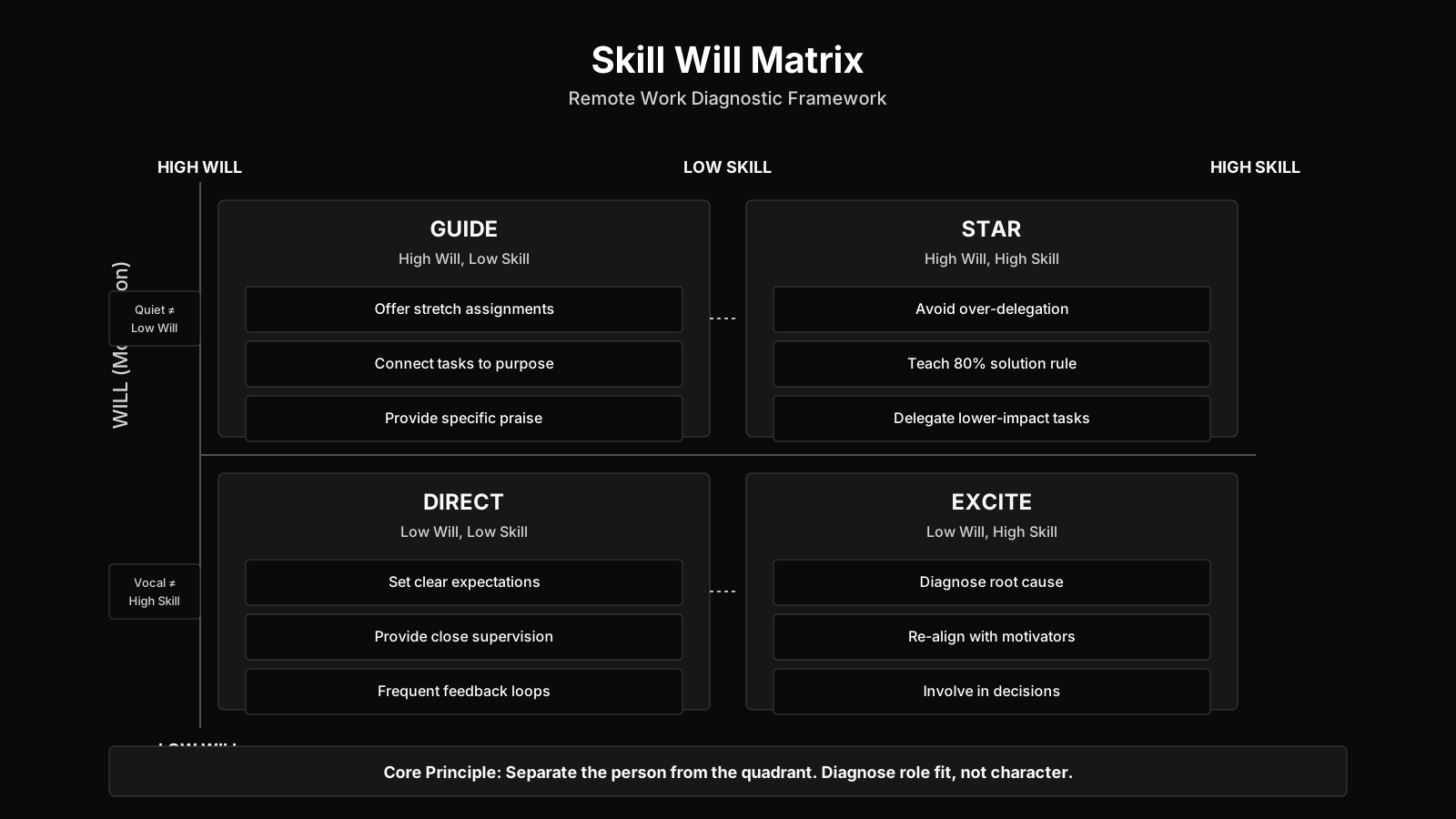
Skill Will Matrix: At-a-Glance Summary
| Key Concept | Summary |
|---|---|
| Skill Will Matrix | A diagnostic framework that maps an individual's capability against their motivation to reveal performance gaps and guide precise management interventions. |
| Skill Dimension | Skill encompasses technical proficiency, functional expertise, problem-solving ability, communication effectiveness, and the practical experience required to perform a specific task or role competently. |
| Will Dimension | Will captures intrinsic motivation, self-efficacy, achievement drive, and psychological resilience, all of which can be eroded by burnout, repeated setbacks, or misalignment with personal values and organizational purpose. |
| Star Quadrant | High-skill, high-will employees excel with autonomy, stretch assignments, and mentoring opportunities; effective management involves removing obstacles and providing strategic context rather than close oversight. |
| Disillusioned Expert | High-skill, low-will individuals typically grapple with burnout, stagnation, or values misalignment; they require candid conversations to surface root causes and rekindle a sense of purpose and impact. |
| Enthusiastic Beginner | Low-skill, high-will employees bring eagerness and energy but need directive coaching, structured guidance, frequent feedback loops, and early wins to build competence and sustain momentum. |
| Low Skill Low Will | Individuals in this quadrant may be overwhelmed, disengaged, or misplaced; managers must establish clear expectations, develop foundational skills, and address motivational barriers before expecting substantive contribution. |
| Contextual Nature | An employee's matrix position is fluid, shifting across tasks, projects, and timeframes in response to changes in environment, team composition, leadership style, or personal circumstances. |
| Diagnostic Clarity | The matrix compels leaders to distinguish observable evidence from assumption, establishing a shared vocabulary for performance discussions that avoids charged labels like "lazy" or "incompetent." |
| Tailored Management | Effective application demands that leaders calibrate the balance between guidance and autonomy, adapting their coaching stance to each quadrant to unlock individual potential and drive performance outcomes. |
Understanding the Skill Will Matrix as a Leadership Compass
The Skill Will Matrix is a diagnostic tool that categorizes individuals into four quadrants based on two fundamental dimensions: their competence to perform a specific task or role, and their motivation, confidence, or willingness to execute it. These two axes intersect to reveal a performance profile that is always contextual. An employee is not stamped with a permanent label; rather, their position on the Skill Will Matrix can shift from task to task, project to project, and even day to day depending on changes in their environment, personal life, or team dynamics. The simplicity of the grid belies its depth, because it forces leaders to separate observation from assumption and to ask better questions about what truly drives or hinders performance. Creating a culture where team members feel safe to express their struggles is a prerequisite for accurate diagnosis, which aligns with the insights in Cultivating Courageous Teams: A Leader’s Roadmap to Psychological Safety. Furthermore, applying the matrix effectively often requires leaders to balance guidance with autonomy, a dynamic explored in Navigating the New Office: Performance Without Sacrificing Freedom. When coaching a low-skill, low-will employee, managers may also benefit from the communication techniques found in Speak Less, Connect More: Why Silence Wins Conversations to draw out underlying issues without overwhelming the individual.
Skill, as defined within this framework, is not limited to technical proficiency alone. It encompasses the full spectrum of abilities required to complete a task or fulfill a role, including domain knowledge, problem-solving aptitude, communication deftness, and practical experience. A junior developer might be highly skilled in writing clean code but lack the skill of presenting that code to a non-technical stakeholder. Will, on the other hand, captures the psychological fuel behind action: intrinsic motivation, self-belief, the desire to achieve, and the resilience to push through obstacles. Will can be depleted by burnout, eroded by repeated failure, or diminished by a mismatch between an individual’s values and the task at hand. The Skill Will Matrix recognizes that both dimensions are dynamic and interdependent, and that a manager’s primary role is to accurately diagnose where an individual stands on both axes before intervening. This nuanced understanding of motivation can be deepened by exploring Speak Less, Connect More: Why Silence Wins Conversations, which offers techniques for listening to what drives your team.
The matrix traditionally presents four quadrants. The first is the “high skill, high will” intersection, often called the Star quadrant. The second is “high skill, low will,” where capable individuals lack motivation or confidence, sometimes labelled as the Disillusioned Learner or the Reluctant Expert. The third is “low skill, high will,” home to the Enthusiastic Beginner who is brimming with energy but lacks the know-how to translate that energy into results. The fourth is “low skill, low will,” a difficult space that can house individuals who are either very new and overwhelmed or deeply disengaged and uncertain where to begin. These quadrant labels are not pejorative but diagnostic; they provide a shared vocabulary for discussing performance without the emotional charge of words like “lazy” or “incompetent.”
Core Insights on the Skill Will Matrix
- Diagnostic tool for performance
- The Skill Will Matrix places individuals into four quadrants based on their current competence and motivation, recognizing that these attributes are fluid and shaped by context rather than fixed traits.
- Skill and will dimensions defined
- Skill reflects both technical proficiency and interpersonal capabilities, while will captures internal drive and the capacity to persevere. Both dimensions can shift due to factors such as burnout, setbacks, or misalignment with personal values.
- Four quadrant framework explained
- The quadrants span from the high-skill, high-will "Star" to the low-skill, low-will individual, creating a neutral vocabulary for performance diagnosis that avoids reductive labels like "lazy."
The Strategic Logic Behind Every Quadrant of the Skill Will Matrix
How the Skill Will Matrix Distinguishes Stars from the Merely Competent
The Star quadrant demands a management approach that is often counterintuitive to leaders who equate oversight with control. When an employee exhibits both high skill and high will, the primary risk is not underperformance but disengagement due to micromanagement or lack of challenge. These individuals thrive when given autonomy, stretch assignments, and the opportunity to mentor others. A manager’s role with a Star is to clear obstacles from their path, provide them with strategic context rather than tactical instruction, and ensure that their contributions are visible and recognized. It is not enough to simply leave them alone; neglect can breed a sense of isolation. The most effective strategy involves delegating entire outcomes rather than prescribing tasks, asking the Star how they plan to achieve a goal rather than telling them, and involving them in decisions that shape the team’s direction. This approach deepens their commitment and often reveals hidden leadership capabilities.
Diagnosing the Hidden Causes of Low Will in Highly Skilled Employees
When a deeply competent professional slides into low will, the surface behavior can mimic laziness or resistance, but the roots are almost always more complex. The high skill, low will quadrant is where burnout, boredom, and misalignment live. The individual may have mastered their role to the point where it no longer offers intellectual stimulation, or they may be recovering from a failed project that bruised their confidence despite their evident ability. In some cases, their will is depleted because they feel their expertise is undervalued or that their career path has plateaued. Diagnosing the precise cause of low will is the critical first step, and this diagnosis requires a conversation grounded in psychological safety, not a performance review focused on output metrics. A manager must ask open, curious questions: “What part of your work used to excite you that no longer does?” or “If you could redesign your role, what would you change?” The answers will point toward solutions that involve reconnection to purpose, skill variety, or a temporary shift in responsibilities.
The Enthusiastic Beginner and the Power of Structured Guidance
The low skill, high will quadrant is perhaps the most energizing to manage because it is filled with potential that can be rapidly converted into capability with the right support. These individuals are primed sponge-like learners who need direction, hands-on training, and a clear roadmap. The risk here is twofold: first, that their enthusiasm will be crushed by early failure without adequate scaffolding, and second, that they will be given too much autonomy too soon, leading to costly mistakes. The Skill Will Matrix prescribes a directive coaching style for this group, one that breaks complex tasks into manageable components, offers frequent feedback, and celebrates incremental wins. Pairing them with a patient mentor or establishing a structured onboarding plan that gradually reduces supervision works far better than throwing them into the deep end. The manager’s tone must remain encouraging but precise, focusing on the “how” without dampening the intrinsic motivation that brought them to the quadrant in the first place.
Re-engaging the Low Skill, Low Will Employee Without Resorting to Threat
Confronting an individual who scores low on both axes can feel like staring at a locked door without a key. The natural managerial impulse is often frustration, which can lead to ultimatums or performance improvement plans that demoralize further. The Skill Will Matrix instead suggests a dual-track intervention that addresses both dimensions simultaneously and sequentially. Because low will can poison the learning process, the first priority is usually to ignite a spark of motivation by connecting the individual’s work to a personal goal, a team win, or a recognition moment that feels within reach. Simultaneously, the skill gap must be broken down into the smallest possible increments so that early success is statistically likely. This might mean assigning a two-hour task with a very clear template and offering in-the-moment praise upon completion. The goal is to create a positive feedback loop where a small demonstration of competence fuels a marginal increase in confidence, which then fuels a willingness to tackle a slightly larger task. This is a patient, incremental process that challenges the common myth that underperforming employees are simply uncoachable.
Mastering the Diagnostic Conversation for the Skill Will Matrix
Separating Objective Assessment from Managerial Bias
A manager’s ability to place someone accurately on the Skill Will Matrix is only as good as their capacity to observe without projecting. Cognitive biases routinely corrupt this process. The halo effect can cause a leader to overestimate an employee’s skill simply because they are likeable, while the recency effect can cause a single recent failure to obscure months of steady competence. To counteract these biases, the diagnostic process must incorporate multiple data sources: objective performance metrics, 360-degree feedback, self-assessments, and direct observation of the employee in different contexts. A useful discipline is to write down specific, behavioral evidence for both the skill and will ratings before arriving at a quadrant. For instance, instead of noting “low will,” a manager might record “declined three opportunities to present work to leadership in the last quarter, despite having strong results.” Such behavioral documentation prevents the diagnosis from becoming a subjective label and makes it a concrete starting point for a coaching conversation.
Skill Will Matrix in One-on-One Meetings: Question Sequences that Reveal Truth
The regular one-on-one meeting is the ideal setting for dynamic Skill Will Matrix diagnosis, provided the manager comes armed with diagnostic questions rather than statements. For the skill axis, questions like “On a scale of one to ten, how equipped do you feel to handle this project independently, and what would it take to move that number up by one point?” encourage self-awareness without defensiveness. For the will axis, questions like “Which part of this next quarter’s work are you most looking forward to, and which part feels heavy or draining?” surface motivational currents that might otherwise stay hidden. The key is to listen for patterns across multiple conversations. A single low-will answer might be a bad day; a series of them reveals a trend. This ongoing diagnostic practice transforms the Skill Will Matrix from a static label applied during annual review cycles into a real-time leadership radar that picks up subtle shifts before they become performance crises.
Core Takeaways on Diagnostic Conversations
- Countering cognitive biases
- To prevent the halo and recency effects from distorting Skill Will Matrix placements, managers need to draw on multiple data sources such as performance metrics, 360-degree feedback, and self-assessments.
- Behavioral evidence over labels
- Documenting concrete behaviors, for instance logging missed stretch assignments rather than defaulting to a "low will" tag, turns subjective assumptions into a factual foundation for developmental dialogue.
- Diagnostic questions for skill axis
- Inviting employees to self-assess their autonomy on a numeric scale and pinpoint what would raise that number fosters candid self-reflection on competence while sidestepping defensive reactions.
- Patterns reveal true will
- Tracking motivational themes across a series of one-on-ones instead of overindexing on a single low-will remark converts the Skill Will Matrix from a static snapshot into a dynamic radar that signals emerging performance trends.
Tailored Development Strategies Rooted in the Skill Will Matrix
Developing High Skill, High Will Employees: The Art of the Stretch Assignment
Stars have a voracious appetite for growth, and the Skill Will Matrix suggests that their development should focus on expanding their sphere of influence rather than deepening a narrow band of technical expertise. Stretch assignments that involve cross-functional collaboration, public speaking, strategic planning, or mentoring peers not only sustain their motivation but also prepare them for future leadership roles. The manager’s contribution is to frame the assignment not as a reward but as an experiment: “I believe this will stretch you in a new direction. Let’s check in after two weeks to see what you are learning.” This framing protects the Star from the pressure of perfectionism that often accompanies high performers, allowing them to approach the challenge with a learning mindset. It also reinforces the idea that growth, not flawless execution, is the primary objective. When a Star occasionally fails, the manager must treat that failure as a valuable data point and resist the urge to swoop in with rescue solutions, which would inadvertently signal that autonomy is conditional.
The Skill Will Matrix Approach to Motivating the Disengaged Expert
The high skill, low will individual is the most expensive leak in the talent pipeline, representing deep institutional knowledge that has become inert. Standard motivational talks and generic recognition rarely work here because the individual is often already aware of their value and may feel that the organization is the one not holding up its end of the bargain. A more effective intervention from the Skill Will Matrix playbook involves job crafting. Job crafting allows the employee to reshape their role at the margins, swapping a demotivating task with a colleague who finds it engaging, or negotiating a small side project that reconnects them with their original passion. Even a ten percent alteration in job content can produce a disproportionate lift in will because it restores a sense of agency. In parallel, the manager should explore whether the low will stems from a deep-seated confidence issue disguised as apathy. Sometimes experts who have been the go-to person for years develop a quiet terror of being exposed as a fraud, particularly when new technologies emerge. In such cases, offering confidential access to advanced training or a sabbatical for skill refresh can unlock a dramatic return to the Star quadrant.
Accelerating the Growth of Low Skill, High Will Team Members
The Skill Will Matrix provides a clear prescription for this group: high direction paired with high emotional support. This is not the time for laissez-faire leadership. The manager should create a deliberate learning path with progressive milestones that are ambitious enough to honor the individual’s enthusiasm but attainable enough to build genuine competence. Pairing this individual with a senior team member who embodies both skill and a coaching mindset can accelerate growth exponentially, but the pairing must be monitored to ensure that the mentor actually transfers skill rather than simply completing the work on behalf of the learner. Weekly reviews that focus on “what I learned” rather than “what I did” help to cement skill acquisition. Celebrating competency gains, such as the first time the employee handles a difficult customer call solo, reinforces the intrinsic motivation that brought them to this quadrant and makes the hard work of skill-building feel worthwhile.
Rehabilitation Strategies for the Low Skill, Low Will Quadrant
This quadrant requires the most sophisticated managerial touch because it is easy to fall into the twin traps of punitiveness and neglect. The Skill Will Matrix tells us that a simultaneous push on both axes is necessary, but the sequence matters immensely. Beginning with a will intervention is typically more productive because skill development efforts launched into a motivational void will simply bounce off. A will intervention might start with a candid conversation about the employee’s personal aspirations and how their current role connects, or does not connect, to those aspirations. It might involve identifying a single, deeply valued outcome that the team depends on and framing the employee’s contribution to that outcome in vivid, human terms. For example, “When you file these reports accurately, it means our frontline staff can serve customers without delay.” Once even a faint ember of will is glowing, skill interventions can be introduced in the form of repetitive practice with immediate feedback, perhaps using job aids that reduce the cognitive load of the task. The manager’s emotional steadiness is paramount; any sign of frustration or disappointment can extinguish the fragile will that is being rebuilt. Progress is measured in increments of days, not quarters.
Integrating the Skill Will Matrix into Core Management Rhythms
Skill Will Matrix and Delegation: Matching Task Complexity with Readiness
Delegation is one of the most misused tools in management, often reduced to simply handing off tasks to whoever has capacity. The Skill Will Matrix adds a critical readiness dimension to delegation decisions. A complex, high-visibility task should only be delegated to someone who sits in the high skill, high will quadrant for that specific domain. When a task requires delegation to a low skill, high will individual, the manager must simultaneously delegate the outcome and the structured support, perhaps scheduling a weekly checkpoint before the final deadline. Delegating a task to a high skill, low will individual without a conversation about motivation is a recipe for mediocrity; the work will likely be completed but without the spark of innovation. The matrix suggests that the leader should preface the delegation with a motivating context: “This task matters because…” before outlining the expectation. For low skill, low will individuals, delegation should initially be limited to tasks that can be accomplished with minimal independent judgment, not as a punishment but as a scaffolded stepping stone toward greater autonomy down the road. This nuanced approach to delegation ensures that assignments are developmental rather than merely operational.
Using the Skill Will Matrix for Team-Level Diagnosis and Resource Allocation
While the Skill Will Matrix is most commonly used on an individual basis, its power multiplies when applied to an entire team. A team map, created by placing each team member’s name in the appropriate quadrant for their primary responsibilities, can reveal systemic issues that are invisible at the individual level. A cluster of names in the high skill, low will quadrant might indicate an engagement issue linked to a recent organizational change or a bottleneck in career progression. A predominance of low skill, high will members could signal that the team is overly dependent on a single expert or that hiring practices favor potential over proven competence. This macro view allows leaders to allocate coaching time more strategically and to plan team composition for upcoming projects. If a critical initiative demands speed and innovation, the leader can consciously assemble a team weighted toward the Star and Enthusiastic Beginner quadrants, while ensuring that there is sufficient mentoring capacity to support the latter. The Skill Will Matrix thus becomes not just a coaching tool but a strategic workforce planning instrument.
Aligning the Skill Will Matrix with Performance Review Cycles
Traditional performance reviews tend to collapse skill and will into a single scale, producing ratings that obscure more than they reveal. An employee rated as “meets expectations” could be a high skill, low will expert who is coasting, or a low skill, high will newcomer who is improving rapidly. These two profiles demand radically different development investments, yet a monolithic rating system treats them identically. By embedding the Skill Will Matrix into the review process, managers can supplement overall ratings with a quadrant designation and, crucially, an action plan tailored to that quadrant. The conversation shifts from backward-looking judgment to forward-looking development. The employee and manager can co-create a plan: for a Star, the plan might center on expanded influence; for a disillusioned expert, it might center on role enrichment; for an enthusiastic beginner, it might center on capability building; and for the low skill, low will individual, it might center on reconnection to purpose and progressive skill mastery. This approach transforms performance review from a dreaded annual ritual into a meaningful strategic dialogue.
Core Insights on Embedding the Matrix
- Delegation with a Readiness Lens
- The matrix compels managers to align task complexity with an employee's quadrant, placing high-stakes responsibilities only on high-skill, high-will individuals, while employing structured guidance or motivational context when delegating across other readiness profiles.
- Strategic Team Diagnosis
- Plotting the entire team onto the matrix exposes systemic weaknesses such as waning engagement or dependency on a lone expert, empowering leaders to distribute coaching resources and assemble project teams with greater strategic foresight.
- Transforming Performance Reviews
- Weaving the matrix into performance reviews transforms vague evaluations into quadrant-based development roadmaps, turning retrospectives into proactive dialogues that align individual growth with organizational strategy.
Common Misapplications of the Skill Will Matrix and How to Sidestep Them
The Permanence Fallacy: Why the Skill Will Matrix Is a Snapshot, Not a Stamp
One of the most damaging mistakes a manager can make is to treat an employee’s quadrant placement as a fixed personality trait. The Skill Will Matrix is a dynamic map of a moving landscape. An employee who is a Star in executing daily operations may drop into low will when asked to lead a strategic planning session for the first time. A trauma in their personal life can temporarily collapse will across all domains. Misapplying the matrix as a permanent label leads to the Pygmalion effect in reverse: if a manager believes someone is perpetually low skill, low will, they will cease to invest in that person, creating a self-fulfilling prophecy. The antidote is to prefix every quadrant diagnosis with the phrase “in relation to this specific task at this moment.” This linguistic discipline forces the manager to constantly re-evaluate and to remain open to the possibility of rapid movement, particularly when the environment changes or the person receives targeted support.
Avoiding the Blame Game: Systemic Factors That Mimic Low Will
Before concluding that an employee has low will, a wise manager will first examine the system that the employee operates within. Unclear expectations, conflicting priorities, inadequate tools, toxic team dynamics, and suffocating bureaucracy can all produce behaviors that look like low motivation but are actually rational responses to a demotivating environment. The Skill Will Matrix loses its utility if it becomes a way to attribute all performance problems to individual deficits while ignoring organizational pathology. A rigorous diagnosis should include a systems audit: “If I transplanted this employee into a role with clear goals, a supportive manager, and modern resources, would their will likely increase?” If the honest answer is yes, then the intervention should target the environment, not the individual. This systemic perspective aligns with evidence-based management and prevents the Skill Will Matrix from becoming a tool of scapegoating. It also reminds leaders that they are responsible for creating the conditions in which will can flourish.
The Cult of the Star: Why Over-focusing on High Performers Damages Teams
It is natural for managers to gravitate toward the Stars, because interacting with them is rewarding and their output confirms the manager’s own competence. However, an over-investment in the high skill, high will quadrant at the expense of the other three quadrants is a strategic error. The Skill Will Matrix is a portfolio tool, and a portfolio that is not rebalanced will eventually degrade. Enthusiastic Beginners who are neglected may never develop into Stars, Disillusioned Experts may quit or become actively disengaged saboteurs, and low skill, low will individuals may consume disproportionate management time through crises that could have been prevented through earlier investment. A disciplined manager deliberately allocates a portion of their coaching time to each quadrant, recognizing that the biggest marginal gains often come from moving someone out of the low will, high skill quadrant, where a small motivational spark can reignite a vast store of capability. The matrix invites leaders to see the whole talent landscape, not just the peaks.
Case Explorations: The Skill Will Matrix in Action
The Sales Veteran Who Stopped Selling
Consider a senior salesperson with a decade of outstanding quota attainment who, over six months, slipped into a pattern of missed targets, low prospecting activity, and a quiet cynicism that infected team meetings. A traditional response might have been a performance improvement plan, grounded in the assumption that the salesperson had lost skill or discipline. A Skill Will Matrix analysis revealed a very different story. The salesperson retained deep product knowledge and a masterful closing technique, placing them squarely in the high skill quadrant. The will dimension, however, had collapsed. Through a series of private, psychologically safe conversations, the manager learned that the organization had changed its compensation structure to heavily favor new logo acquisition at the expense of existing account growth. The salesperson, who had built a career on cultivating long-term client partnerships, felt their core professional identity was devalued. The manager’s intervention was not a retraining program but a deliberate effort to reposition the salesperson as a strategic account manager, a role that aligned with their intrinsic motivation and rewarded the very skills they had perfected. Will rebounded within weeks, and the individual returned to Star performance, simultaneously mentoring two junior hires. The Skill Will Matrix had redirected the conversation from “how to fix the employee” to “how to fix the fit.”
The Eager Associate Who Couldn’t Deliver
A newly hired marketing associate arrived with a portfolio of creative ideas, a hunger to learn, and an energy that was palpable across the office. Assigned to a complex campaign coordination project, she quickly became overwhelmed, missing deadlines and producing subpar content. Her manager’s initial frustration gave way to a Skill Will Matrix diagnosis that clearly showed low skill in project management and organizational navigation, paired with extremely high will. The manager switched from a hands-off “let me see what you come up with” style to a structured, direct coaching approach. Together, they built a one-page project timeline template, role-played stakeholder update meetings, and scheduled a ten-minute end-of-day debrief for the first three weeks. The associate’s innate enthusiasm, rather than being dampened by the extra structure, was amplified because she could finally see her ideas turning into completed deliverables. Within two months, she had developed sufficient skill to operate independently, and the manager gradually withdrew the scaffolding. She had moved from low skill, high will to a solid Star quadrant for the campaign coordination domain, all because the Skill Will Matrix prevented the manager from mistakenly attributing her initial struggles to a lack of effort.
The Burnt-Out Team Lead and the Will Intervention That Worked
A technical team lead who had been a pillar of reliability for years suddenly began exhibiting avoidance behaviors: delaying code reviews, skipping one-on-ones with junior developers, and pushing back against new feature requests with unusual hostility. The rest of the leadership team was ready to label him as resistant and difficult, but the Skill Will Matrix diagnostic process slowed everyone down. The lead was undeniably high skill; his architecture decisions were sound, and his deep codebase knowledge was irreplaceable. The will dimension had plummeted, and the root cause was uncovered during a long walk-and-talk with his manager: he had been carrying the emotional weight of a failed product launch that had been cancelled due to factors outside his control, and he felt personally responsible for the disappointment of his team. His will had not disappeared; it had been inverted into a protective withdrawal. The manager’s intervention involved acknowledging the grief publicly in a team retrospective, reframing the cancelled launch as a valuable learning repository, and temporarily shifting some of the lead’s mentoring duties to a senior developer while he focused on a single, highly visible new initiative. The will slowly returned, and with it, his characteristic energy. The Skill Will Matrix had distinguished between a character flaw and a situational collapse, enabling a compassionate and effective response.
Core Insights from Real-World Applications
- Diagnosing the root cause
- Applying the matrix revealed that a top salesperson’s drop in performance originated from eroded motivation due to a misaligned compensation structure, rather than a decline in selling skills.
- Matching intervention to need
- A marketing associate with high will but low skill flourished when her manager moved from a hands-off approach to providing structured coaching and clear project templates.
- Distinguishing character from situation
- A burned-out team lead’s avoidance was accurately identified as a situational collapse in motivation after a failed project, not a character flaw, allowing for a compassionate and effective response.
- Redirecting the conversation
- Using the Skill Will Matrix shifts management’s focus from correcting the individual to optimizing the alignment between the role and the employee’s intrinsic motivation.
Skill Will Matrix in the Context of Remote and Hybrid Teams
The shift to distributed work has made accurate Skill Will Matrix diagnosis more challenging and more essential. In an office environment, a manager can pick up effortless cues about will: energy in meetings, spontaneous collaboration, body language during challenging discussions. In a remote setting, these signals are heavily filtered through narrow video windows and asynchronous text. An employee who appears to have low will because they are quiet on video calls may actually be deeply engaged but exhausted by the cognitive demands of virtual interaction. Conversely, an employee who is highly vocal and appears motivated may be skill-deficient in independent time management, a vulnerability that is easy to mask with constant digital presence. Remote diagnosis demands that managers supplement video observations with written check-ins that ask direct questions about energy, focus, and obstacles. It also demands a more deliberate approach to capturing skill evidence, such as reviewing work artifacts rather than relying on in-person demonstrations. The Skill Will Matrix remains equally valid in a virtual context, but the data-gathering process must be intentionally adapted. Managers who fail to adapt risk misdiagnosing the constraints of the remote environment as personal deficiencies, leading to interventions that feel unfair and demotivate further.
Building a Coaching Culture Around the Skill Will Matrix
The Skill Will Matrix is not a tool reserved for HR business partners or executive coaches; it is a foundational mental model that can be taught to every people manager and even to individual contributors who wish to manage themselves more effectively. When an entire leadership team shares the language of the matrix, performance discussions become more precise and less emotionally charged. A manager can say, “I think this particular project puts you in the high skill, low will zone,” and the employee can nod in recognition rather than bristle at a perceived attack on their character. Building this culture starts with workshops where managers practice diagnosing case studies and role-playing coaching conversations specific to each quadrant. It is sustained by incorporating the Skill Will Matrix into talent review meetings, where calibration discussions focus not on whether someone is “good” or “bad” but on what quadrant they occupy for their current role and what development path will serve them best. Over time, the matrix becomes a shared taxonomy that normalizes performance fluctuations and reduces the stigma around seeking help. It supports honesty because both skill gaps and will dips are framed as surmountable challenges, not immutable labels.
Organizational success with the Skill Will Matrix ultimately depends on a leadership philosophy that treats talent as fluid and context-dependent. No tool can compensate for a culture that punishes failure or ignores individual aspirations. The matrix performs best in environments where psychological safety is high, where employees are encouraged to self-diagnose their own skill and will without fear of reprisal, and where development is seen as an ongoing partnership between manager and employee. When these conditions are met, the Skill Will Matrix ceases to be merely a quadrant chart and becomes a living, breathing compass that guides every coaching conversation, delegation decision, and development plan toward the ultimate goal: unlocking the star potential that exists in every individual, waiting for the right combination of challenge, support, and purpose to emerge.
Core Insights on Coaching Culture
- Shared Language Reduces Emotional Charge
- When the entire leadership team adopts the Skill Will Matrix, performance discussions become more precise and less emotionally charged because managers can reference specific quadrants instead of making personal character judgments.
- Sustained Integration into Talent Reviews
- Embedded in talent review meetings, the matrix becomes a living tool that elevates calibration conversations from simplistic good-or-bad labels to identifying each person's current quadrant and a targeted development path.
- Psychological Safety Enables Self-Diagnosis
- The matrix flourishes in psychologically safe cultures, where employees confidently self-diagnose their skill and will, recognizing that talent is fluid and context-dependent.
Diagnosing the Reasons Behind the Will Before You Intervene
The elegance of the matrix can become its biggest weakness if managers start treating quadrant placement as a personality trait rather than a snapshot in time. I have watched competent leaders label someone as low will and then, without realizing it, manage that person through that lens for months, even after the underlying cause disappeared. Skill and motivation both fluctuate with the specifics of the assignment, the team around the person, and what is happening outside work. A useful habit is to revisit the matrix at the start of every new project and ask two separate questions: what evidence do I have about current skill, and what evidence do I have about current will, not what I observed six months ago.
The high-skill, low-will combination is especially easy to misread. Because the person has delivered before, a drop in output can look like a sudden attitude problem when it is usually something more specific. They may be bored, overloaded, under-recognized, or wrestling with unclear priorities that make effort feel pointless. Before pushing harder or adding performance pressure, it pays to find out what changed. Conducting stay interviews with this type of employee often surfaces information that normal status meetings miss, such as a loss of confidence after a failed initiative or frustration that their expertise is being ignored. Once the real driver is named, the intervention is much cheaper and more humane than a development plan built on guesses.
For the low-skill, high-will employee, the temptation is to over-instruct because their energy feels easy to direct. The smarter approach is to pair that enthusiasm with tight, observable practice loops. Give them a narrow problem, a clear example of what done looks like, and a short feedback cycle. If you leave them to figure it out alone, their motivation will curdle into anxiety. If you script every step, they never build judgment. The manager's job is to supply structure without removing the chance to recover from small mistakes. That balance changes quickly, which is why the matrix is most valuable when it is used as a recurring conversation tool rather than a static sorting device.
Advance Your Career with Professional Certification
Earning a professional project management certification validates your expertise in standardized methodologies and best practices, making you a more competitive candidate for leadership roles and higher salaries. Employers increasingly seek certified professionals who can drive projects to successful completion while minimizing risks and optimizing resources, directly impacting organizational success. For those balancing busy schedules, PM certification online offers a flexible pathway to acquire these in-demand skills without disrupting your career. This credential not only enhances your credibility but also equips you with versatile tools to lead cross-functional teams and adapt to evolving industry demands, ultimately boosting both personal growth and your company's bottom line.
Earning a professional product management certification validates your expertise in modern frameworks and strategic thinking, setting you apart in a competitive job market. It equips you with proven methodologies to drive product success, from ideation to launch, directly boosting organizational outcomes. A dedicated product management certification also builds a common vocabulary and process discipline across teams, reducing costly misalignment and accelerating time-to-value. Ultimately, this credential signals a commitment to continuous learning and leadership, opening doors to senior roles and higher earning potential.
Mastering tools like the Skill Will Matrix to unlock star potential requires more than intuition—it demands structured HR expertise. Through HR training and certification, professionals gain the strategic insight to accurately diagnose capability and commitment levels, then tailor coaching interventions that truly elevate performance. This formal credential not only sharpens your ability to develop talent but also signals to leadership that you possess the validated skills to drive organizational growth, making it an indispensable career accelerator.
Applying the Matrix in Real-Time Leadership
The true power of the Skill Will Matrix emerges when leaders use it not as a static classification tool but as a dynamic guide for daily interactions. A team member who is a high-skill, high-will "Star" today may drift into the high-skill, low-will "Maverick" quadrant after a period of unchallenging work or a personal setback. Rather than treating the matrix as a permanent label, effective leaders conduct brief, informal reassessments during one-on-one meetings or project retrospectives. They ask themselves whether recent feedback, shifting priorities, or changes in team dynamics have altered the individual's position on the grid. This continuous recalibration prevents the frustration of applying the wrong leadership style to a situation that has already evolved, ensuring that coaching remains relevant and delegation remains effective.
Equally important is the leader's willingness to examine their own assumptions when mapping a team member. A common pitfall occurs when a manager interprets a lack of visible enthusiasm as low will, when in reality the employee is quietly struggling with a skill gap they are too embarrassed to disclose. Conversely, a flurry of activity may be mistaken for high will, masking a deeper deficit in technical competence that will surface under pressure. By pairing the matrix with open, non-judgmental questions—such as "What part of this project feels most uncertain to you?" or "What would make this work feel more meaningful?"—leaders can validate their quadrant placement before acting. This practice transforms the matrix from a diagnostic shortcut into a conversation starter, building trust while sharpening the accuracy of developmental interventions.
When leaders commit to this iterative, inquiry-based application of the Skill Will Matrix, they unlock its greatest benefit: the ability to tailor their own behavior to what each situation demands. A high-skill, low-will employee may need autonomy and a renewed sense of purpose, while a low-skill, high-will employee requires structured guidance and psychological safety to learn. By resisting the urge to treat all team members uniformly, and by continually updating their mental map of each person's skill and will combination, managers create a responsive environment where potential is not just recognized but systematically developed. This nuanced approach turns the matrix from a simple framework into a living practice that elevates both individual performance and team cohesion over time.
