Every organization today operates in a marketplace where customers and talent alike demand consistency between what a company says it stands for and what it actually does. The gap between external brand promises and internal employee experience has become a critical vulnerability, one that erodes trust, fuels turnover, and undercuts strategic growth. Internal branding, the systematic process of aligning an organization’s workforce with its core purpose, values, and brand identity, closes that gap. Internal branding is not merely a communications campaign or a set of onboarding slides; it is a strategic management discipline that shapes how employees understand, internalize, and live the company’s purpose in every decision, interaction, and customer touchpoint.
When internal branding is executed effectively, employees stop seeing corporate values as abstract wall art and start using them as a compass for daily action. This alignment transforms disengaged staff into purpose-driven advocates, enabling the organization to deliver a consistent brand experience externally while fostering resilience, innovation, and a deep sense of belonging internally. Leaders can build this environment by applying the principles in Cultivating Courageous Teams: A Leader’s Roadmap to Psychological Safety . Yet far too many leaders treat internal branding as a secondary marketing function, disconnected from core business operations and human resources strategy. This article explores the full scope of internal branding, how it aligns your workforce with core purpose, the frameworks that make it actionable, the measurement systems that prove its impact, and the long-term disciplines required to sustain it in an era of constant change, principles that are reinforced in Agile Essentials: A Manager's Guide to Core Concepts .
The following topics are examined in detail:
| Key Concept | Summary |
|---|---|
| Internal Branding | Internal branding is the strategic practice of aligning employee behavior and organizational systems with core purpose, transforming the gap between external brand promises and internal workplace reality into a cohesive, authentic experience. |
| Strategic Imperative | As a strategic imperative, internal branding fuses brand identity with organizational culture by weaving core values into daily actions, leadership behaviors, and the unwritten psychological contract, turning brand intent into lived cultural reality. |
| Purpose Alignment | Internal branding converts abstract organizational purpose into specific, repeatable behaviors and shared rituals, giving each employee a personal stake in the mission and transforming values into a daily source of meaning and motivation. |
| Business Case | A robust internal branding strategy generates quantifiable returns: lower voluntary attrition, stronger customer satisfaction scores, heightened productivity, and a multiplier effect on external marketing spend by making every employee a credible brand ambassador. |
| Cultural Driver | Internal branding operationalizes purpose by defining role-specific, observable behaviors embedded in performance reviews and recognition programs, turning organizational culture from an intangible concept into a measurable and manageable asset. |
| Employee Experience | When employees internalize brand values, discretionary effort rises, service delivery becomes more consistent and empathetic, and individuals evolve into purpose-driven brand advocates who champion the organization internally and externally. |
| Leadership Practice | Internal branding is fundamentally a leadership discipline that converts organizational culture into a durable competitive advantage by ensuring that daily decisions, resource allocation, and talent processes consistently reflect long-term strategic intent. |
| Measurement Systems | Effective internal branding requires robust measurement systems that link brand-aligned behaviors to engagement scores, retention rates, and customer loyalty metrics, providing real-time feedback to sustain alignment as the organization evolves. |
| Talent Attraction | A strong internal brand acts as a magnet for top-tier candidates who self-select for cultural fit, increasing the proportion of value-aligned hires, lowering cost-per-hire, and shortening the ramp-up to full productivity. |
| Consistent Experience | Internal branding powers a uniform customer experience by aligning employee behavior behind the external brand promise at every touchpoint, creating a reinforcing loop of trust, repeat business, and advocacy rooted in a unified internal culture. |
The Strategic Imperative of Internal Branding in Modern Organizations
What Internal Branding Truly Means in Today’s Organizations
Internal branding is the managerial practice of ensuring that every member of the workforce understands, embraces, and consistently expresses the organization’s brand essence and purpose. It bridges the gap between external brand identity and internal culture by embedding brand values into employee behaviors, management systems, leveraging tools like the Unlock Star Potential: The Skill Will Matrix Guide to align employee capabilities with brand expression, and the psychological contract between employer and employee. Unlike employer branding, which focuses on attracting talent through an external employment value proposition, internal branding operates within the organization to activate brand-led thinking across all functions, from product development to customer service and finance. Its goal is not simply to make employees happy but to create a shared sense of why the organization exists and how each person contributes to that mission.
The concept has evolved far beyond distributing brand guidelines or running internal newsletters. Contemporary internal branding draws on organizational behavior, change management, and strategic human resource management to shape mental models. Research in service management consistently shows that when employees internalize brand values, their discretionary effort increases, service quality improves, and customer loyalty strengthens. In knowledge work, internal branding serves as a cognitive anchor that guides autonomous decision-making in the absence of direct supervision, aligning everyday choices with long-term strategic intent. It is, fundamentally, a leadership practice that turns culture into a competitive capability rather than a set of vague aspirations.
Why Aligning Employees with Core Purpose Requires Internal Branding
A company’s core purpose is the reason it exists beyond generating profit. Purpose answers the question of what positive difference the organization aims to make in the world. However, purpose alone does not create alignment; it becomes a differentiator only when it is translated into the lived experience of employees. Internal branding achieves that translation by connecting purpose to tangible behaviors, rituals, recognition systems, performance expectations, and the daily narrative within teams. Without internal branding, purpose statements remain in glossy annual reports while front-line employees wonder how their mundane tasks connect to a grand vision articulated by executives.
When internal branding systematically links purpose to employee experience, people develop a personal stake in the organization’s success. They perceive their work as meaningful because they understand the cause they serve, not merely the tasks they complete. This is a decisive factor in employee engagement, as extensive meta-analyses confirm that meaning at work predicts job satisfaction, retention, and performance more powerfully than compensation alone. Internal branding provides the interpretive framework through which employees see themselves as custodians of the brand promise, making purpose a practical decision filter rather than an abstract ideal.
The Business Case for Investing in Internal Branding
The economic argument for internal branding rests on measurable reductions in turnover, improvements in customer satisfaction, and increases in productivity that flow from an aligned workforce. Organizations with highly engaged, purpose-aligned employees consistently report lower absenteeism, fewer safety incidents, and higher profitability than their peers. Internal branding reduces the costly friction that arises when different departments interpret brand values differently, leading to inconsistent customer experiences that damage reputation and revenue. When every employee, regardless of role, acts in accordance with a shared understanding of the brand, the organization spends less on crisis management, corrective supervision, and onboarding replacements.
Furthermore, internal branding increases the return on external marketing investments. A compelling advertising campaign loses its power the moment a customer interacts with an employee who does not embody the brand’s promised values. By aligning internal culture with external messaging, internal branding ensures that the brand is reinforced at every touchpoint, creating a virtuous cycle of trust and loyalty. In talent markets, companies known for strong internal branding and authentic purpose alignment attract higher-quality applicants who self-select for cultural fit, reducing recruitment costs and accelerating time-to-productivity. The business case is not about making people feel good as a soft initiative; it is about building the organizational capability to deliver on the brand promise reliably and at scale.
Key Insight Snapshot
- Internal branding defined
- Internal branding aligns every employee's understanding and daily expression of the organization's brand essence, creating a seamless connection between external identity and internal culture through shared values, systematic reinforcement, and a psychological contract that encourages genuine advocacy.
- Purpose alignment through branding
- Internal branding converts core purpose into observable behaviors and everyday experiences, giving employees a personal stake that transforms work into a source of meaning far beyond profit generation.
- Measurable business outcomes
- Prioritizing internal branding produces tangible metrics: lower turnover, improved customer satisfaction, heightened workforce productivity, and decreased absenteeism and safety incidents.
- External marketing multiplier effect
- Internal branding multiplies external marketing impact by ensuring employees consistently live the brand promise at every touchpoint, building trust and loyalty while attracting top-tier talent.
Building a Culture of Shared Purpose Through Internal Branding
From Mission Statements to Behavioral Commitment: Internal Branding as a Cultural Driver
Many organizations mistake the existence of a mission statement for alignment, but words on a document do not change behavior unless they are embedded into the mechanisms that shape daily work. Internal branding operationalizes purpose by defining the specific, observable behaviors that embody brand values in each department and role. For example, a healthcare company that claims compassion as a core value must define what compassionate behavior looks like at the reception desk, in billing calls, and during surgical consultations, and then reinforce those behaviors through training, feedback, and recognition programs. This behavioral specificity transforms culture from an intangible concept into a measurable management system.
Internal branding acts as a cultural driver by creating shared narratives, symbols, and rituals that make purpose tangible. Storytelling that highlights how employees have brought brand values to life, regular celebrations of purpose-driven achievements, and onboarding experiences that immerse new hires in the organization’s heritage all serve to reinforce the connection between individual action and collective mission. Over time, these practices build a strong cultural fabric where purpose feels organic rather than imposed, and employees voluntarily hold one another accountable to brand standards. The result is a self-reinforcing culture where internal branding becomes less about top-down communication and more about peer-driven consistency.
Leadership’s Role in Internal Branding and Purpose Alignment
Leaders are the most visible embodiment of internal branding, and their behavior sets the standard for what is truly valued in the organization. When senior leaders consistently model brand-aligned decision-making, openly connect strategic choices to purpose, and hold themselves accountable to the same values they ask of others, the workforce internalizes those expectations as authentic. Conversely, when leaders behave in ways that contradict the brand’s purpose, internal branding efforts collapse because employees trust what they observe far more than what they are told. Leadership modeling is the single most powerful lever in internal branding, and it demands a level of self-awareness and consistency that requires deliberate development.
Middle managers play an equally critical role as translators of purpose into frontline action. In internal branding frameworks, middle managers are expected to interpret high-level brand values for their specific team contexts, coach employees on how to apply values in complex situations, and provide real-time feedback when behavior drifts from brand expectations. Effective organizations invest in leadership development programs that equip managers not only with communication skills but also with the emotional intelligence and narrative competence to foster meaning. Empowering managers to be internal brand ambassadors turns them from passive enforcers of policy into active cultivators of purpose, dramatically extending the reach and credibility of internal branding initiatives.
Internal Branding Across the Employee Lifecycle
Alignment with core purpose does not begin after hire; it must be woven into every stage of the employee lifecycle, from attraction to separation. During recruitment, internal branding informs the realistic portrayal of the company’s culture so that candidates self-assess for fit, reducing early attrition caused by mismatched expectations. Onboarding becomes a purpose-immersion experience rather than a compliance-driven orientation, where new employees encounter stories, mentors, and initial tasks designed to connect their personal motivations to the brand’s mission. This early investment accelerates the formation of psychological ownership and helps new hires build an authentic relationship with the brand.
Throughout employment, internal branding must be reinforced through performance management, learning and development, and career progression. Goals and evaluations should incorporate brand-aligned behaviors alongside business results, signaling that how results are achieved matters as much as the numbers. Training programs can embed purpose into technical skill development by illustrating the ultimate customer impact of operational excellence. Even when employees leave the organization, a strong internal brand creates alumni advocates who carry positive brand associations into the wider world, potentially returning as boomerang hires or referring future talent. Managing the employee lifecycle through the lens of internal branding transforms each touchpoint into an opportunity to deepen purpose alignment.
Designing and Implementing an Internal Branding Strategy That Drives Alignment
Conducting an Internal Brand Audit to Identify Gaps
A rigorous internal brand audit is the essential first step in understanding the current state of employee alignment with core purpose. This audit goes beyond engagement surveys to examine the lived experience of the brand at multiple organizational levels, using methods such as in-depth interviews, focus groups, ethnographic observation, and analysis of internal communications and decision-making processes. The goal is to map gaps between the intended brand identity, the employer brand as perceived by employees, and the external brand as experienced by customers. Common gaps include inconsistencies between stated values and reward structures, disconnects between leadership rhetoric and resource allocation, and local interpretations of brand values that diverge significantly from the intended meaning.
Internal brand audits should also assess the alignment of formal systems such as compensation, promotion criteria, and recognition programs with the desired brand behaviors. If an organization claims innovation as a core value but punishes failure and rewards only safe incremental improvements, the audit will expose that contradiction as a critical barrier to internal branding. The findings provide an evidence-based foundation for prioritizing interventions and building a business case for change. Rather than guessing why purpose alignment is weak, leaders gain a data-driven understanding of the cultural, structural, and symbolic levers that must be realigned.
Crafting a Compelling Employee Value Proposition Linked to Core Purpose
The employee value proposition, or EVP, is the set of tangible and intangible benefits that employees receive in return for their contribution, and it must be grounded in the brand’s core purpose to fuel internal branding. A purpose-linked EVP articulates not only what the organization offers in terms of compensation, growth, and work environment but also the larger mission that gives work its significance. When candidates and employees perceive that their personal values align with the company’s purpose, the EVP functions as a powerful retention and engagement tool because it appeals to intrinsic motivation. It transforms employment from a transactional exchange into a psychological partnership oriented toward shared meaning.
Developing an effective EVP for internal branding requires collaboration between human resources, marketing, and senior leadership. The process must be informed by the employee voice through surveys and co-creation workshops to ensure authenticity and relevance. The EVP should be segment-specific where necessary, recognizing that what a software engineer finds meaningful may differ from what resonates with a field sales representative, yet both must connect back to the same overarching purpose. Once defined, the EVP becomes the anchor for all internal branding communications, leadership messaging, and people practices, serving as a consistent reference point against which every employee experience is evaluated.
Communication Channels and Storytelling That Bring Internal Branding to Life
Effective internal branding communication is not about broadcasting polished corporate messages from the top. It is about creating a credible, ongoing conversation that uses multiple channels and narrative formats to weave purpose into the fabric of everyday organizational life. Town halls and video messages from leaders are important but insufficient on their own. The most powerful internal branding communications occur in team meetings where managers connect project objectives to brand purpose, in peer recognition platforms where employees celebrate examples of values in action, and in physical or digital workspaces that display real stories, not generic slogans. The principle is to embed purpose in the informal communication systems that employees already trust.
Storytelling is a core competency of internal branding because narratives create emotional connection and memorable learning far more effectively than abstract principles. When organizations systematically collect, curate, and share stories of employees making decisions that exemplify the brand’s purpose, they provide behavioral models that others can emulate. These stories should be diverse in source, representing different levels, geographies, and roles so that every person can see themselves reflected. Leadership storytelling, where executives describe their own struggles and learning moments related to living the purpose, further humanizes the brand and reduces the perception of a disconnect between the boardroom and the break room.
Empowering Managers as Brand Ambassadors Through Internal Branding
Managers are the linchpin of internal branding alignment because they translate organizational purpose into the everyday context of their teams. Empowering managers to act as brand ambassadors requires more than a training session on the company values; it calls for a comprehensive enablement strategy that builds their capability, confidence, and motivation. Organizations must provide clear frameworks that help managers discuss purpose meaningfully, guide difficult conversations when an employee’s behavior conflicts with brand values, and link recognition and development feedback to purpose-driven contributions. Without such tools, well-intentioned managers may inadvertently dilute the brand by prioritizing immediate operational pressures over purpose.
Recognition and incentive systems must also support managers in their internal branding role. If a manager’s performance is evaluated exclusively on short-term output metrics, they will rationally deprioritize the time-consuming work of coaching for purpose alignment. Progressive companies include purpose-related competencies in managerial performance appraisals and provide resources such as coaching circles, peer learning communities, and access to brand culture experts. When the organization visibly invests in helping managers succeed as brand ambassadors, it signals that internal branding is a genuine strategic priority, which in turn gives managers the permission and psychological safety to engage wholeheartedly.
Essential Insight Summary
- Internal Brand Audit Foundation
- A rigorous internal brand audit deploys qualitative methods such as in-depth interviews and ethnographic observation to surface misalignments among intended brand identity, employees’ lived perceptions, and actual customer experiences, often exposing critical contradictions like reward systems that directly undermine stated values.
- Purpose-Linked Employee Value Proposition
- An employee value proposition anchored in the brand’s core purpose appeals to intrinsic motivation, transforming employment from a transactional exchange into a psychological partnership built on shared meaning.
- Embedding Purpose Through Storytelling
- Effective internal branding embeds purpose into daily operations through a blend of channels and narrative formats, including team meetings and peer recognition, leveraging storytelling to foster emotional connection and provide employees with tangible behavioral models.
- Managers as Brand Ambassadors
- Managers function as the linchpin of internal branding, translating organizational purpose into the everyday reality of their teams, a role that demands deliberate empowerment and support to sustain their credibility as brand ambassadors.
Measuring the Impact of Internal Branding on Purpose Alignment
Metrics That Reflect Internal Branding Success
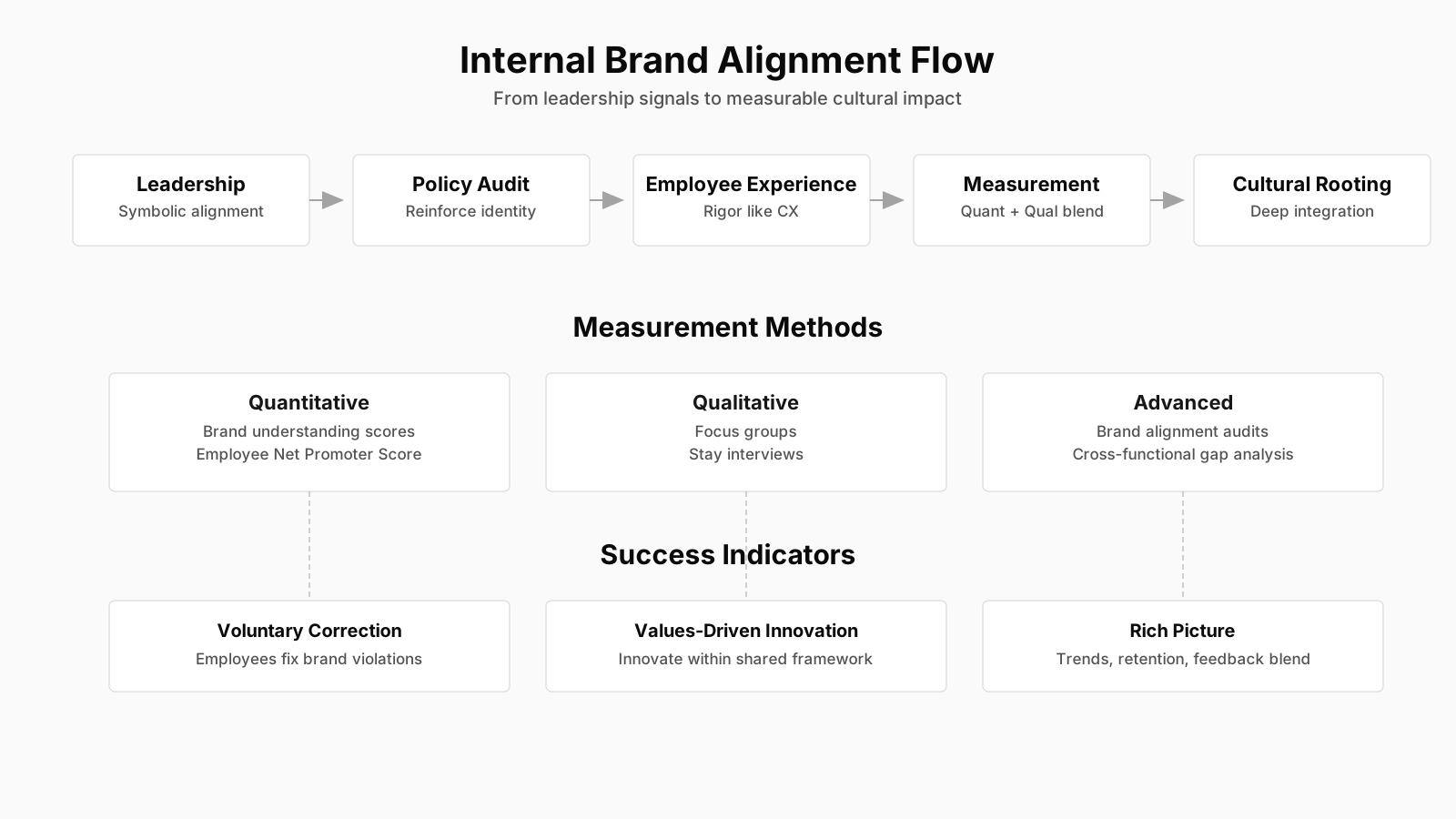
Measuring internal branding requires moving beyond simple engagement scores to a dashboard of indicators that capture the depth of purpose alignment across the organization. Brand understanding metrics assess whether employees can accurately articulate the core purpose, brand values, and how their role contributes to the brand promise. More advanced measures gauge brand commitment, the emotional connection employees feel to the purpose, and brand citizenship behavior, the discretionary actions employees take to advance the brand’s mission outside their formal job descriptions. These metrics can be gathered through pulse surveys, embedded in performance management systems, and validated against external customer perception data to establish a link between internal alignment and market outcomes.
Additionally, organizations should track behavioral indicators that serve as leading measures of internal branding effectiveness. These include rates of employee referral of potential hires, participation in internal brand communities or ambassador programs, and the frequency with which purpose-related language appears in internal collaboration platforms. Turnover rates analyzed by reason for leaving can reveal whether misalignment with values is driving attrition among high performers. Over time, correlating internal branding metrics with customer satisfaction scores, net promoter scores, and revenue growth provides compelling evidence of return on investment and guides continuous refinement of the internal branding strategy.
Linking Internal Branding to Employee Engagement and Retention
While engagement and retention are distinct from internal branding, a well-executed internal branding strategy creates the psychological conditions that make sustained engagement possible. Employees who understand and believe in the organization’s purpose are more likely to find meaning in their work, to feel a sense of belonging, and to invest discretionary effort. This relationship is supported by self-determination theory, which posits that relatedness, autonomy, and competence are fundamental human needs; internal branding that articulates a compelling purpose strengthens relatedness by connecting individual effort to a collective mission. Consequently, engagement scores become an indirect but valuable indicator of internal branding health.
In terms of retention, internal branding reduces voluntary turnover by fostering a deep sense of identity fit. Employees who have internalized the brand purpose experience psychological switching costs that go beyond financial considerations; leaving would mean losing a valued part of their professional identity. Organizations with strong internal branding often see lower regret among exiting employees and higher rates of boomerang rehires because the relationship remains positive even after departure. To capture this link, exit interview protocols should explicitly probe the role of purpose and brand alignment in the employee’s decision, generating qualitative data that complements quantitative retention metrics.
Feedback Loops and Continuous Improvement in Internal Branding
Internal branding is not a one-time transformation; it requires ongoing sensing and adaptation to remain relevant as the business environment, workforce demographics, and societal expectations evolve. Establishing closed-loop feedback systems enables organizations to listen systematically to the workforce, identify emerging misalignments, and adjust internal branding practices before they become entrenched problems. Digital listening tools that analyze sentiment in internal social channels, regular manager feedback sessions, and annual brand culture audits all contribute to a real-time picture of how purpose is being lived. The key is to treat internal branding as a dynamic capability rather than a static set of messages.
Continuous improvement in internal branding also involves conducting root cause analysis when metrics indicate weakening alignment. For example, if a particular business unit shows declining brand commitment, leaders should investigate whether changes in local leadership, work design, or recognition practices have diluted purpose. Collaborative action planning with employees ensures that solutions are contextually appropriate and that the workforce feels genuine ownership over the internal branding journey. This commitment to learning and adaptation reinforces the authenticity of the organization’s purpose because employees see that leaders are willing to confront inconsistencies and make real changes, which in turn deepens trust and alignment.
Overcoming Common Pitfalls and Sustaining Internal Branding Momentum
Avoiding Disconnect Between External Branding and Internal Reality
One of the most damaging failures in internal branding occurs when an organization’s external marketing campaigns communicate values and promises that employees know are not reflected in their daily experience. This gap between external brand image and internal employee experience breeds cynicism, undermines trust in leadership, and can trigger public criticism through social media and employer review platforms. Internal branding acts as the bridge between marketing and operations, ensuring that the external brand promise is grounded in organizational reality. When internal branding is absent or cosmetic, the external brand becomes a hollow claim that employees disown, and customer-perceived authenticity rapidly erodes.
To prevent this disconnect, internal branding must be integrated into the strategic planning process from the outset, not appended after the marketing team has developed a new campaign. Cross-functional governance structures that bring together brand marketing, human resources, operations, and corporate communications help ensure that any external positioning is vetted against internal readiness. Pilot testing brand messages with employee groups before public launch can surface potential credibility gaps and provide insights for internal readiness initiatives. Ultimately, internal branding functions as the organization’s conscience, constantly asking whether the company is living up to what it is asking customers to believe.
Navigating Change and Maintaining Authenticity During Organizational Shifts
Mergers, acquisitions, restructuring, and leadership transitions pose significant threats to internal branding because they disrupt the continuity of purpose and can introduce competing value systems. During such periods of change, employees naturally question whether the organization’s stated purpose remains genuine or whether it has become a casualty of new strategic priorities. Internal branding becomes critically important as a stabilising force, requiring leaders to reaffirm the non-negotiable elements of brand identity while honestly acknowledging what is evolving. Silence or ambiguity during change allows alternative narratives, often negative ones, to fill the vacuum and erode the hard-won alignment.
Maintaining authenticity through change involves transparent communication that connects the rationale for transformation with the enduring purpose of the organization. Leaders should explain how the change, even when difficult, ultimately serves the mission that employees care about. Involving employee representatives in co-creating the post-change internal branding narrative builds credibility and reduces resistance. Equally important is the alignment of new systems, structures, and leaders with the brand’s values, because employees will scrutinize appointments, promotions, and resource allocations for evidence that the purpose remains intact. Change is a test of internal branding integrity, and passing it requires deliberate, value-consistent action at every level.
Long-Term Evolution of Internal Branding Programs for a Lasting Purpose-Driven Culture
Sustaining internal branding over time requires treating it as a living organisational function rather than a project with a fixed endpoint. Purpose itself may evolve as markets shift and societal expectations change, and internal branding must evolve in parallel to keep alignment relevant. Forward-thinking organizations periodically refresh their brand purpose with input from a broad cross-section of employees, ensuring that it resonates with a new generation of talent while remaining true to the organization’s heritage. This evolutionary approach prevents the purpose from becoming stale or disconnected from contemporary employee and customer realities.
Institutionalizing internal branding means embedding it into governance structures, such as a brand culture council with cross-functional representation and executive sponsorship. Budgets for internal branding activities should be sustained, not treated as discretionary spend that can be cut during cost pressures. Developing internal branding competencies in future leaders through mentoring, leadership development programs, and succession planning ensures generational continuity. The ultimate objective is to reach a state where internal branding is so deeply woven into the organisation’s fabric that it operates as an implicit guide, visible in thousands of everyday decisions, and no longer requires external enforcement because it has become the organisation’s instinctive way of being.
Key Insights
- Bridging external promises and internal reality
- Internal branding mitigates the risk of employee cynicism by aligning external marketing commitments with the organization's actual readiness and the authentic daily experiences of its workforce.
- Maintaining authenticity during organizational change
- During mergers, restructuring, or leadership transitions, leaders must transparently reaffirm the enduring core brand identity while clearly articulating what is evolving, thereby preventing harmful speculation and negative narratives from filling the information void.
- Treating internal branding as a living function
- To sustain internal branding, organizations must periodically revitalize the brand purpose through inclusive employee input, keeping it aligned with the expectations of new talent and the demands of an evolving market.
- Institutionalizing branding for lasting culture
- Institutionalizing internal branding within governance structures, sustained budget allocations, and leadership development programs transforms it into an implicit cultural guide that informs everyday decision-making at all levels.
The Future of Internal Branding in a Purpose-Driven Business Landscape
As the boundaries between work and life continue to blur and employees increasingly seek meaning from their professional lives, internal branding will grow in strategic relevance. The rise of remote and hybrid work models makes the deliberate cultivation of shared purpose even more crucial because the informal, osmotic cultural transmission of office environments is no longer reliable. In distributed teams, internal branding must become intentional, leveraging digital collaboration tools, virtual rituals, and asynchronous storytelling to ensure that purpose reaches every corner of the organization regardless of physical location. Companies that master purpose-driven internal branding in a distributed context will build a competitive advantage in talent attraction and resilience that is difficult for others to replicate.
Looking ahead, technology such as employee experience platforms and artificial intelligence will offer new ways to personalize internal branding at scale, delivering tailored purpose narratives and learning moments based on role, tenure, and individual motivators. The ethical use of such tools will require a steadfast commitment to employee privacy and psychological safety. Ultimately, the most successful organizations will be those that treat internal branding not as a management technique to extract more effort from people, but as a genuine expression of a purpose that enriches the lives of employees, customers, and communities. When purpose is sincere and internal branding is authentic, the alignment of a workforce with its core reason for being becomes one of the most powerful forces in modern business.
Why Middle Managers Make or Break Internal Branding
Most internal branding efforts get designed in the executive suite and then handed to middle managers as a rollout plan. That is exactly where the friction starts. A regional operations lead, a customer service supervisor, or a product line director does not simply relay corporate values; they interpret them through the daily pressures of targets, staffing shortages, and customer complaints. If those managers have not worked through what the brand means for their specific decisions, employees will hear one set of words from headquarters and see a completely different set of behaviors from their immediate boss. In practice, internal branding lives or dies in the distance between a town hall slide and a Tuesday morning team huddle.
The solution is not more training decks. It is giving middle managers structured room to translate the brand into local routines, trade-offs, and rituals. For example, a logistics team might translate a value like customer obsession into a rule about how late a shipment can be before the customer gets a proactive call. A finance team might express ownership as the willingness to flag a bad forecast early instead of waiting for variance reviews. These translations feel small, but they are what make the brand tangible. You might recognize this as the alignment paradox at the team level: everyone agrees on the value in principle, yet functional incentives still pull behavior in opposite directions until someone names the conflict out loud.
Wise senior leaders therefore treat internal branding as an ongoing management conversation, not a one-time launch. They ask middle managers what parts of the brand they find hard to model, where they get caught between competing expectations, and what local language would make the purpose real for their people. That kind of candor surfaces the gaps that glossy employee value propositions usually hide. Over time, this approach builds a brand that employees do not just recite but actually use when making choices under pressure.
Advance Your Career with Professional Certification
Earning a project management certification gives professionals a structured framework to lead complex initiatives, reducing costly risks and improving team alignment with strategic goals. Beyond personal career advancement, certified project managers bring standardized practices that boost organizational performance and stakeholder confidence. This credential signals a commitment to continuous improvement and ethical responsibility, making you a trusted force in driving meaningful change.
Earning a professional product management certification is a strategic career move that validates your expertise in guiding products from conception to market success. It equips you with a standardized framework of best practices, making you a more effective leader who can align cross-functional teams with a unified vision. For those looking to deepen their skills, comprehensive product management training provides the tools to drive innovation and deliver measurable business outcomes. This formal recognition not only accelerates personal career growth but also directly contributes to organizational success by ensuring products meet genuine customer needs and support the company’s core purpose.
Obtaining a professional HR management certification is a strategic investment that elevates your ability to lead people-centric initiatives, directly impacting both your career trajectory and your organization's cohesion. A recognized human resources certification validates your mastery of modern practices—from talent development to change management—which are essential for embedding core purpose into daily operations and strengthening internal branding. As certified professionals, you become better equipped to bridge the gap between leadership vision and employee experience, driving engagement and sustainable business results while standing out in a competitive job market.