In the quest to build organizations that can outpace disruption and innovate fearlessly, a pervasive leadership myth often steers us wrong. Many leaders believe that courage under fire is a static personality trait, something you either hire for or you do not. They envision the ideal team as a collection of rugged individualists who naturally challenge the status quo without any support or structure. However, decades of evidence-based management research, most notably the pioneering work of Dr. Amy Edmondson at Harvard Business School, paint a radically different picture. The most courageous teams are not those free from internal social friction, but those that consciously inhabit an environment of profound psychological safety. This is a shared belief held by members of a team that the group is safe for interpersonal risk-taking. Cultivating Courageous Teams: A Leader’s Roadmap to Psychological Safety requires a deliberate leadership roadmap, a structured departure from command-and-control dogma toward a culture where speaking up is not just permitted but expected. In such a culture, a junior developer can halt a multi-million dollar launch, a nurse can correct a senior surgeon, and a marketing assistant can tell a vice president that their campaign concept is culturally tone-deaf, all without fear of retaliation or humiliation.
This journey is not about creating a comfortable utopia where standards slip and accountability vanishes. On the contrary, psychologically safe environments are characterized by rigorous candor, high expectations, and intense accountability. The discomfort of challenging a dominant idea remains, but the social threat of being marginalized for doing so is removed. In a world defined by volatility, uncertainty, complexity, and ambiguity, the capacity of a team to leverage its full cognitive diversity determines its survival. When silence reigns, organizational blind spots multiply until they become fatal. This comprehensive leader’s roadmap will dissect the anatomy of team courage, debunk the myths that conflate safety with weakness, and provide a systemic implementation guide for embedding psychological safety into the operational DNA of your organization. It serves as a practical guide to building fearless teams that can navigate the pressures of modern knowledge work, from the boardroom to the factory floor, and from co-located scrums to globally distributed remote pods. For leaders navigating turbulent times, mastering Navigating Turmoil: The Art of Crisis Communication is essential to maintaining trust and clarity during high-stakes moments. Additionally, understanding Speak Less, Connect More: Why Silence Wins Conversations can help leaders create space for team members to voice concerns and contribute ideas without interruption. To further support team performance, leaders can also explore Unlock Star Potential: The Skill Will Matrix Guide for aligning individual capabilities with team goals. Finally, balancing structure with autonomy through Navigating the New Office: Performance Without Sacrificing Freedom can reinforce the psychological safety needed for courageous collaboration.
Psychological Safety Roadmap: Key Topics at a Glance
| Key Concept | Summary |
|---|---|
| Leadership Myth | Many leaders wrongly assume courage is an innate individual trait, overlooking that it can be systematically cultivated as a team environment. |
| Psychological Safety | Psychological safety is the shared conviction that a team welcomes interpersonal risk taking, empowering members to speak candidly, admit errors, and challenge ideas without fear of blame or reprisal. |
| Strategic Imperative | In the knowledge economy, competitive advantage hinges on how quickly organizations learn and how soundly they decide, both of which demand that teams actively surface dissenting data and conflicting perspectives. |
| Project Aristotle | Google's Project Aristotle revealed that psychological safety was the single strongest predictor of high performing teams, surpassing individual talent, seniority, and team composition. |
| Team Norms | Effective teams embed norms such as balanced conversational turn taking and high social sensitivity, ensuring that every member's perspective is consistently invited and valued. |
| Organizational Silence | When teams lack the safety to speak truth to power, organizations become vulnerable to catastrophic failures, as evidenced by the Boeing 737 MAX crisis and the Volkswagen emissions scandal. |
| Accountability | Psychologically safe environments pair high standards with rigorous candor, removing social threats without ever relaxing demanding performance expectations. |
| Leader Role | Rather than merely hiring for boldness, leaders must intentionally shape conversational routines and consistently signal that honest input is welcomed and rewarded. |
The Strategic Imperative of Cultivating Courageous Teams
There is a stubborn misconception that psychological safety is a soft skill initiative belonging to the human resources department, separate from the hard mechanics of business strategy. This division is dangerously obsolete. In the modern knowledge economy, competitive advantage flows not from access to capital or labor arbitrage but from the speed of learning and the quality of decision-making. Both of these metrics are fundamentally dependent on a team’s willingness to surface information that contradicts established beliefs. A team devoid of psychological safety cannot learn quickly because it cannot openly discuss errors. It cannot make high-quality decisions because it lacks access to the dissenting data points held by its own members. The strategic imperative of cultivating courageous teams lies in the stark reality that silent teams optimize for the status quo while loud teams optimize for reality.
Project Aristotle and the Primacy of Team Norms
Google’s extensive internal research initiative, Project Aristotle, stands as a watershed moment for evidence-based leadership. The study analyzed hundreds of Google’s internal teams to determine why some flourished while others, filled with equally brilliant individuals, stumbled. The researchers looked at personality types, co-location versus remote distribution, individual performance metrics, and demographic backgrounds. Initially, they found no discernible pattern. It was not until they began analyzing group norms, the unwritten rules of engagement, that a clear hierarchy of effectiveness emerged. The number one predictor of high-performing teams was not who was on the team, but how the team worked together, specifically regarding psychological safety. Teams that rated high on psychological safety were more likely to exceed their goals, generate more revenue, and be rated as highly effective by senior leadership.
The mechanism behind this is elegantly simple. In a high-safety team, members exhibit more equal conversational turn-taking. This means the introverted data scientist who rarely speaks up over the boisterous extroverts still has her critical insights heard and utilized. Furthermore, these teams average higher in social sensitivity, meaning members are better at reading the emotional states of their colleagues. Data that is unspoken because it is awkward or anxiety-provoking still gets surfaced because the team notices that someone is hesitating and actively draws them out. For a leader embarking on a roadmap to psychological safety, the implication is profound. You are not hiring your way to a courageous culture; you are structuring your way there through the deliberate installation of specific conversational norms that signal safety.
The Catastrophic Cost of Organizational Silence
To fully appreciate the roadmap to psychological safety, one must first internalize the cost of its absence. The corporate landscape is littered with the wreckage of organizations that possessed deep pockets, famous brands, and brilliant engineers, yet collapsed because they could not create a culture where truth was spoken to power. The Boeing 737 MAX tragedy is a stark case study in the normalization of deviance enforced by a climate of fear. Engineers and test pilots had data indicating dangerous flight characteristics, yet the hierarchical pressure to avoid certification delays and maintain a narrative of pilot-friendly platforms suppressed vital safety concerns. This was not a single moment of malpractice but a systematic failure of psychological safety. Professionals who had dedicated their lives to safety engineering felt unable to raise the red flag without risking their careers.
Similarly, the Volkswagen emissions scandal, often framed as a rogue engineering choice, was fundamentally a failure of leadership to invite and respond productively to bad news. In an environment where an authoritarian leadership style demands "awesome" results without tolerance for market setbacks, engineers face a toxic binary choice: fail honestly and be punished for poor performance, or cheat silently and survive. When the psychological weight of speaking up exceeds the professional weight of falsifying data, the system is broken. These are not merely ethics violations; they are the direct outcomes of an unsafe team dynamic. The leader’s roadmap to cultivating courageous teams must begin with this sobering acknowledgment: the absence of dissent is not a sign of harmony; it is a sign of suppressed data that will eventually manifest as a catastrophic failure.
Core Insights on Courageous Team Strategy
- Psychological safety as competitive advantage
- High psychological safety fuels competitive advantage by accelerating learning and improving decision quality, as team members freely voice dissenting perspectives, thereby directly enhancing performance in knowledge-intensive industries.
- Project Aristotle's key finding on norms
- Project Aristotle demonstrated that team effectiveness hinges less on individual brilliance and more on norms fostering equitable speaking time and acute social perception, underscoring the primacy of inclusive dynamics over raw talent.
- Catastrophic cost of suppressed dissent
- The Boeing and Volkswagen crises illustrate how fear-driven silence cultivates normalized deviance, ultimately triggering systemic failure; a paucity of dissent reveals suppressed information, not alignment.
The Leader’s Roadmap to Psychological Safety: The Three Pillars
Amy Edmondson’s framework provides a sequential roadmap for leaders seeking to build fearless teams. Unlike complex change management models that require certifications and consultants to decode, Edmondson’s approach distills psychological safety into three overlapping leadership actions: Setting the Stage, Inviting Participation, and Responding Productively. Many leaders attempt to jump straight to inviting participation by putting an anonymous suggestion box on the digital wall, without first setting the cognitive frame that makes such suggestions welcome. This is why superficial attempts at culture change often fail. The leader’s roadmap is a logical chain; each pillar supports the next, and a breakdown at any node collapses the entire feedback loop. Cultivating courageous teams demands a disciplined, intentional integration of these three distinct but intertwined behaviors into daily management practice.
Setting the Stage by Framing the Work as a Learning Problem
The first mistake a leader makes on this journey is failing to articulate the nature of the challenge. When a team believes a task is purely a matter of flawless execution, any deviation or error appears as a competence failure. Consequently, team members hide mistakes to protect their professional image. To short-circuit this, leaders must explicitly frame the work. If the work is complex and uncertain, where the path forward is unknown, the leader must state loudly and repeatedly: “We are in a learning environment, not just an execution environment. The errors we make here are intelligent failures that will teach us the path to the right answer.” This reframing is a powerful antidote to the silence-inducing fear of looking bad. It grants permission to be a work-in-progress, which is the essential cognitive shift behind any truly fearless team.
This framing must be specific to be believed. Generalized corporate platitudes about embracing failure are meaningless if they are not attached to the current sprint or campaign. A skilled leader will look at the upcoming roadmap for a product launch and separate it into execution zones, where standard operating procedures and zero-defect targets apply, and learning zones, where discovery, customer interviews, and prototyping will inevitably generate invalidated hypotheses. By saying, “In this discovery phase, we expect to be wrong eighty percent of the time, so let’s be wrong fast and share what we found,” the leader directly neutralizes the anxiety that causes people to bury inconvenient market data until it’s too late. This is a pragmatic application of Lean and Agile principles that goes beyond backlogs and burndown charts to address the human emotion of scientific inquiry.
Inviting Participation Through Humble Inquiry
Once the stage is set, the leader must actively facilitate the flow of information. Because of the hierarchical structures inherent in most organizations, subordinates withhold critical information as a default survival mechanism. They assume that if the leader wanted to know something, they would ask. Therefore, a leader cannot rely on the passive hope that people will volunteer their concerns. They must practice what organizational culture expert Edgar Schein termed “Humble Inquiry.” This is the art of asking questions to which you genuinely do not know the answer, refraining from leading the witness or embedding the “correct” answer in the question. The roadmap to psychological safety is paved with questions like, “What do you see that I might be missing here?” and “If we were to fail at this initiative six months from now, what would the cause likely be?”
The physical and temporal structure of meetings must also be engineered for courage. In a standard brainstorming session, the first voice to speak often sets the anchoring bias, and the rest of the group conforms around it, especially if that first voice is the highest-ranking person in the room. A fearless leader rewires this dynamic. They might invoke an “even-over” protocol, where authority to speak is distributed inversely to rank, ensuring the most junior members voice their raw data before the experts filter it. Alternatively, they may enforce silent brainstorming via digital tools, compiling anonymous input before any influence can be exerted. These are simple coordination hacks, but they represent a profound cultural message: the leader values the truth content of the idea more than the authority of the person speaking it. Over time, these rituals routinize courage, transforming the frightening act of dissent into a normal operational cadence.
Responding Productively to the Voice of the Team
The most fragile moment in the journey of cultivating courageous teams is the immediate aftermath of a risky admission. A product manager finally admits a deadline is blown; a safety officer finally halts the line; an analyst finally criticizes the CEO’s pet project. The entire future of psychological safety on that team hinges on the leader’s reaction in the following five seconds. Neuroscience tells us that the observing team members are experiencing a vicarious threat response; their amygdala is watching closely to see if the messenger is rewarded with curiosity or punished with aggression. If the leader gets defensive, sighs with annoyance, or, worse, attacks the credibility of the speaker, psychological safety collapses instantly, and it cannot be rebuilt with a follow-up email or a pizza party. The social contract is broken.
A productive response has three components. First, an immediate and authentic expression of appreciation: “Thank you for speaking up. I know that couldn’t have been easy to say.” This separates the content of the bad news from the value of the reporting act. Second, a shift to forward-looking accountability. Instead of asking the retroactive shame-based question, “Whose fault is this?” the leader asks the forward-learning question, “What can we salvage from this situation, and what process change can prevent us from being surprised like this again?” This treats the failure as a systemic puzzle to be solved rather than a character flaw to be exposed. Third, the leader must close the loop. Nothing erodes safety faster than a leader who thanks someone for speaking up and then takes zero visible action. The team must see that the courage of their colleague resulted in a material change to the project, the product, or the policy. This closes the learning loop and rewards the courageous act.
The Currency of Vulnerability in Leadership
A leader cannot demand cognitive risk-taking from their followers if they display zero cognitive risk-taking themselves. One of the most pervasive myths in management is that a leader must project unwavering confidence and omniscience to inspire trust. In a VUCA environment, however, performative omniscience does not build trust; it builds anxiety. When a team is struggling with a messy, unsolved problem and the leader sits there with a rigid facade of competency, the team assumes the leader is delusional, out of touch, or unwilling to listen. They stop bringing up the messy data because it doesn’t fit the leader’s fantasy narrative. True trust is built when the leader demonstrates vulnerability by admitting what they do not know. This is the leader’s superpower on the roadmap to psychological safety because it models the very behavior they wish to see.
From "Know-It-All" to "Learn-It-All" Leadership
The transition from a fixed mindset to a growth mindset is not just a personal development tool; it is a team performance strategy. When a leader shifts from "know-it-all" mode to "learn-it-all" mode, they signal that the team is a collective intelligence network, not a transmission belt for executive orders. This shift involves a deliberate linguistic pivot. Instead of stating “The plan is X,” the leader might say, “My hypothesis is X, but I have low confidence in this assumption, so I need you to stress-test it.” Instead of saying “This is a disaster,” the leader might ask, “We have a surprising outcome here. What can we learn from it?” A leader who can openly say, “I failed on that approach, and here is why,” gives every junior manager in the firm permission to surface their own failures without fear of a punitive performance rating.
However, this vulnerability must be calibrated to the context. Unfiltered emotional dumping by a leader is not vulnerability; it is a liability that creates instability. A team does not need to see their leader paralyzed by existential dread about the company’s future. They need to see the leader acknowledging the complexity of the strategic challenge while also showing a clear plan for navigating it. The optimal leadership posture is one of “confident humility.” This is the dynamic tension of believing deeply in the team’s potential to succeed while simultaneously being humble enough to accept that you are missing critical information that only the team can provide. It is in this gap between deep confidence and radical humility that courageous teams are cultivated.
Normalizing the "Sitting With the Problem" Moment
In the rush for agile velocity, leaders often jump too quickly to solutioning, suffocating the divergent thinking phase that generates true innovation. A key behavior for leaders cultivating courage is the ability to “sit with the problem.” When a team member surfaces a deeply unsettling truth, a courageous leader does not immediately try to fix it or explain it away. They sit with the discomfort, allowing the gravity of the issue to be fully felt and acknowledged. This might look like a long pause in a meeting, followed by a statement like, “I need a minute to process this. This changes my thinking.” By not rushing to closure, the leader demonstrates that the bad news is safe enough to hold without emotional punishment. This creates a holding environment where complex, painful truths can be detoxified and integrated into the strategy, rather than dismissed because they are too difficult to process immediately.
Core Takeaways on Vulnerability as a Leadership Asset
- Vulnerability builds trust
- Admitting gaps in your knowledge as a leader models intellectual risk taking and builds authentic trust, whereas a pretense of omniscience breeds anxiety and silences honest feedback.
- Learn-it-all leadership
- Shifting from a "know-it-all" to a "learn-it-all" mindset signals that the team is a collective intelligence network, where failures and hypotheses are openly discussed without fear of retribution.
- Confident humility
- The optimal leadership stance balances a deep belief in the team's potential with the humility to accept incomplete information, creating a productive tension that cultivates courageous, high-trust teams.
- Calibrated vulnerability
- Leaders must avoid unfiltered emotional venting, which destabilizes the environment, and instead acknowledge complexity while clearly outlining a path through the challenges.
- Sitting with the problem
- By pausing to process unsettling truths without leaping to premature solutions, leaders establish a safe holding environment where complex realities are acknowledged and thoughtfully integrated into strategy.
Embedding Psychological Safety into Operational Systems
Isolated leadership behaviors are fragile. They last only as long as the leader’s willpower and attention span hold out. To truly build fearless teams, the roadmap to psychological safety must go beyond the interpersonal and enter the institutional. It must hardwire safety into the operational systems of performance management, meeting architecture, and decision-making rights. When psychological safety is embedded in systems, it transitions from a personality-dependent variable to a cultural constant. Employees no longer have to guess if it is safe to speak up; the system explicitly requires them to do so and protects them when they do. This shift from psychological safety as a “vibe” to psychological safety as a “process” is what separates organizations that talk about innovation from those that actually achieve it at scale.
Designing Meetings for Asynchronous Courage
The standard synchronous meeting is a high-threat environment for marginalized perspectives. Cultivating courageous teams in a hybrid or remote context requires a rebalancing of the communication channels. Synchronous time, the precious window when everyone is on a video call, should be reserved for the interpretive, messy, debating work that cannot be done asynchronously. Meanwhile, the generation of raw ideas, critiques, and risk assessments should be shifted to asynchronous, persistent channels. When a junior designer can type out a critique of a senior architect’s wireframe in a shared document at their own pace, they do not have to overcome the adrenaline spike of interrupting a live conversation. The leader’s role is to curate these digital spaces, explicitly calling out profound asynchronous contributions during the live call: “Earlier in the doc, Sarah raised a critical risk about the integration API that I want us to explore in depth right now.” This signals that courage is measured by the content of the insight, not the volume of the voice or the authority of the title. This asynchronous-first approach is a crucial element of the modern leader’s roadmap, actively cultivating courageous teams by removing the structural barriers to contribution.
Retooling Performance Management for Learning Goals
Traditional performance management systems are the primary killers of psychological safety. When an employee’s compensation and promotion depend on demonstrating flawless competence and “hitting numbers,” they have every rational incentive to hide problems until they are unfixable. To reverse this, performance management must be retooled to track the process of learning alongside the process of execution. A portion of the evaluation criteria must explicitly reward behaviors that cultivate safety: “Effectively flags risks early,” “Constructively challenges strategic assumptions with data,” and “Conducts blameless post-mortems that yield actionable improvements.” By making these behaviors a non-negotiable component of what it means to be a “senior” leader, the organization stops hoping for courage and starts demanding it as a core competency.
This systemic shift requires removing the zero-sum politics of calibration sessions. In many firms, talent reviews become a gladiatorial arena where leaders must defend their direct reports against attacks from peers, incentivizing them to suppress any mention of failure or weakness. A courageous HR function must redesign these sessions to focus on the trajectory of capability rather than the absence of failure. A manager should be able to say, “This employee led a major initiative that didn’t meet its revenue targets, but they produced the most lucid and insightful post-mortem the division has ever seen. Their learning velocity is off the charts, and they saved us from repeating a $2 million mistake next quarter.” If the talent review system punishes this manager for admitting the failure, the system is broken. The leader’s roadmap must therefore include a partnership with HR to dismantle the defensive routines embedded in the talent architecture.
Structuring Decision-Making Rights to Protect Dissent
Vague decision-making processes are a petri dish for anxiety. When no one knows who has the final say, everyone defaults to political maneuvering. To build a fearless culture, leaders must clarify the “decision ecology.” Frameworks like RAPID (Recommend, Agree, Perform, Input, Decide) or DACI (Driver, Approver, Contributors, Informed) are not just process bureaucracy; they are safety contracts. They clarify that providing “Input” is not a hostile act of insubordination but a mandated responsibility. When a leader tells a team, “I am the final approver, but every person in this room has the absolute obligation to provide input based on their expertise, and I will not make the decision until I have heard an argument against it from everyone,” they create a protected space for dissent. An individual who lobs a challenging counter-argument is no longer a “troublemaker”; they are simply fulfilling their defined role in the decision ecosystem. This depersonalizes the anxiety of disagreement and routinizes the courageous act of challenging authority with data.
The Delicate Balance of Radical Candor and Psychological Safety
A common objection from hard-driving executives is that psychological safety might erode their capacity to demand excellence. They fear that in trying to build a safe team, they will end up with a comfortable team that avoids difficult truths about individual underperformance. This objection rests on a false dichotomy. Psychological safety and high standards are not opposite poles of a single continuum; they exist on two separate axes, creating a two-by-two matrix of team cultures. The leader’s roadmap targets the elusive but highly effective top-right quadrant of the matrix, often called the Learning Zone or the High-Performance Zone, where psychological safety is high and performance standards are high. This is the zone where radical candor thrives. In the other quadrants, apathy, anxiety, or comfort reign.
Practicing Radical Candor Without Triggering Defensiveness
Radical candor, the framework developed by Kim Scott, is defined as challenging directly while also caring personally. It is the direct antidote to both ruinous empathy, where standards are lowered to protect feelings, and obnoxious aggression, where standards are enforced via intimidation. The leader’s roadmap to psychological safety must include the deliberate practice of radical candor, particularly when addressing performance gaps. The key to delivering a candid critique without triggering a defensiveness response lies in the positioning of the conversation. The leader must frame the feedback as a product of deep investment in the employee’s career trajectory and the team’s mission. An effective opening might be: “I’m giving you this direct feedback because I hold a very high bar for this project, and I am utterly convinced you have the potential to clear it. I want to talk about the gap I’m seeing because I don’t want this to be the thing that holds you back from a promotion you absolutely deserve.”
This approach works because it explicitly separates the actor from the action. The behavior is the problem, not the person. In psychologically safe, high-standard teams, this separation is a deeply internalized cultural norm. It allows a leader to say, “Your presentation to the board missed the mark on financial acuity, and here is how we fix it,” without the employee spiraling into a loss of status or identity. When leaders shy away from these conversations, they silently remove the high standards axis from the culture, leaving the team in the comfortable apathy zone. Top performers who crave growth will leave these environments because they see a lack of rigorous feedback as a lack of investment in their development. Cultivating courageous teams therefore means cultivating the courage to give feedback as much as the courage to receive it.
Maintaining Trust During High-Stakes Moments
The true test of a psychological safety roadmap is not during the glory times; it is during the crises. During layoffs, a failed funding round, or a massive public relations blunder, the instinct of a threatened executive team is to retreat behind closed doors, centralize information, and demand blind optimism. This “wartime commander” posture, while temporarily reassuring to some stakeholders, can permanently annihilate psychological safety. The team immediately senses the opacity and infers the worst. In these moments, the roadmap requires a radical commitment to transparency. This does not mean the leader must share confidential legal or financial details that would harm the organization. It means the leader must critically self-assess, “What are my people worrying about right now that I can actually acknowledge?” When a leader can stand in front of a frightened team and say, “Here is our brutal reality as I see it, here is what I don’t know yet, and here is exactly how we will fight through this together, I need your eyes and ears wide open,” they mobilize the collective anxiety into collective focus. The courageous act of acknowledging uncertainty in a crisis models the resilience the team needs to survive it.
Core Insights on Radical Candor and Safety
- Separate axes for safety and standards
- Psychological safety and high performance standards are independent dimensions, not a single spectrum, so teams can simultaneously cultivate deep trust and uphold rigorous expectations within the Learning Zone.
- Radical candor defined
- Radical candor is the practice of offering direct challenges while demonstrating genuine personal care, deliberately avoiding ruinous empathy that preserves comfort at the expense of standards and obnoxious aggression that equates pressure with motivation.
- Feedback framing reduces defensiveness
- Positioning feedback as a career investment and clearly distinguishing a person’s value from their specific action enables leaders to deliver tough critiques that inspire growth without triggering defensive reactions.
- Silent removal of high standards
- Avoiding difficult feedback conversations quietly dismantles a team's high-performance culture, prompting the most growth-oriented individuals to leave in search of environments that actively invest in their development.
- Transparency during crises builds trust
- In high-stakes moments like layoffs or critical failures, leaders earn lasting trust by practicing radical transparency: openly confronting harsh realities and acknowledging what remains unknown instead of retreating into silence or spin.
Measuring the Health of Psychological Safety
What gets measured gets managed, yet because psychological safety feels intangible, many leaders abandon it to the realm of vague sentiment. This is a strategic error. Just as a financial controller would not manage a budget without a balance sheet, a modern leader cannot manage a courageous culture without a rigorous feedback loop. The measurement system must be multi-dimensional, combining quantitative pulse surveys with qualitative behavioral observation. The goal is not to create a surveillance state but to provide the leader with a diagnostic tool that reveals where the conversation is shutting down. Edmondson’s own validated seven-item survey serves as an entry point, asking the team to rate statements like “If you make a mistake on this team, it is often held against you” and “Members of this team are able to bring up problems and tough issues.” Tracking these normalized scores over time provides a clear signal of whether a culture change initiative is actually moving the needle on cultivating courageous teams.
Behavioral Indicators and Proxy Metrics
Surveys, however, only capture explicit self-reporting. They are susceptible to what is known as the “fear to speak up about speaking up” paradox, where teams so deeply engulfed in fear that they will not even truthfully answer an anonymous survey. To cut through this, leaders must observe behavioral indicators and proxy metrics. In engineering teams, a highly correlated proxy for psychological safety is the ratio of “near miss” or error reports to actual catastrophic failures. In a high-safety environment, the number of near misses voluntarily reported is exceptionally high because engineers trust that flagging a problem before it becomes a disaster will be celebrated. In a low-safety environment, near misses are hidden until a system failure exposes them publicly. For product teams, a key indicator is the ratio of internally discovered bugs or user experience friction points fixed before a launch versus those reported by angry customers after a launch. A courageous team surfaces the ugly truth internally; a fearful team ships the ugly truth to the user.
Within Agile and Lean frameworks, data from retrospectives provides a rich vein of behavioral insight. Leadership should not just look at whether retrospectives are happening but what happens inside them. Track the deviation in difficulty ratings assigned to a sprint. If the scrum master assigns a high difficulty to a task but no one on the engineering team surfaces concerns during planning, you have a dangerous silence gap. When psychological safety rises, the velocity of pull request comments that are constructive but somewhat critical also tends to rise. Leaders can physically track the “respectful pushback” in their communication channels. Are people clicking “agree” and adding hollow praise in the internal social network, or are they engaging in substantive threads of intellectual disagreement? The presence of polite, persistent cognitive friction is the audible sound of a psychologically safe team doing the messy work of thinking.
The Future Landscape for Building Fearless Teams
The roadmap to psychological safety is continually evolving as the nature of work fragments and digitizes. The casual coffee machine confessions and the serendipitous walk-and-talks that used to alert leaders to simmering discontent have vanished in distributed teams. Leaders cannot rely on adjacent physical proximity to gauge the temperature of their team. They must now engineer serendipity and emotional candor into digital architecture. The future of cultivating courageous teams lies in adapting safety protocols for asynchronous, hybrid, and increasingly AI-integrated workflows, where the fundamental nature of “speaking up” is being rewritten by technology. A leader who tries to apply a co-located safety playbook to a globally distributed team of avatars, chat bots, and remote workers will fail to bridge the psychological distance.
Psychological Safety in Hybrid and Remote Work Models
The hybrid environment creates a dangerous “two-tier” safety dynamic. Those with physical proximity to the leader, often senior staff who can afford to live near headquarters, get the informal psychological lubricant of the post-meeting debrief. The remote employee, dialing in from a laptop screen, missing the body language cues and the side conversations, experiences a higher threat level; they are less sure if their input is welcome. The leader’s roadmap for hybrid work requires a deliberate bias toward the remote participant. The default must be that if one person is remote, the meeting is remote. This means the leaders in the room stop talking to each other and start talking directly into the camera. More importantly, the leader must make the invisible labor of remote courage explicitly visible. A leader might say, “I noticed Maria unmuted three times in that debate but paused. Maria, I have a hunch you were wrestling with a point we needed to hear. Can you walk us through it?” This micro-intervention tells the remote team that the leader is scanning for courage, not just waiting for it to be served up effortlessly.
Integrating AI Without Silencing Human Intuition
As artificial intelligence becomes a ubiquitous member of the corporate team, generating code, drafting strategy memos, and analyzing medical scans, a new dimension of psychological safety emerges. Will a financial analyst feel safe challenging an AI-generated risk assessment that contradicts their own analysis, especially if the AI was commissioned by the CEO to cut costs? The looming danger is “algorithmic authority bias,” where employees assume the machine must be right and self-censor their own hard-won intuition. The leader’s roadmap must preemptively de-mystify AI output, destigmatizing the act of overriding or deeply questioning an algorithm. This involves explicitly training teams that AI is a probabilistic, pattern-matching tool trained on historical data, and it often lacks the contextual nuance or ethical reasoning of a human on the ground. The courageous team of the future will be the one that confidently says, “The inference engine is missing a critical data point in the real world right now, and here is what we need to overrule.” This level of human-machine courage will only emerge if leaders treat the AI as a junior colleague to be critiqued, rather than an oracle to be obeyed.
Sustaining the Journey Through Leadership Transition
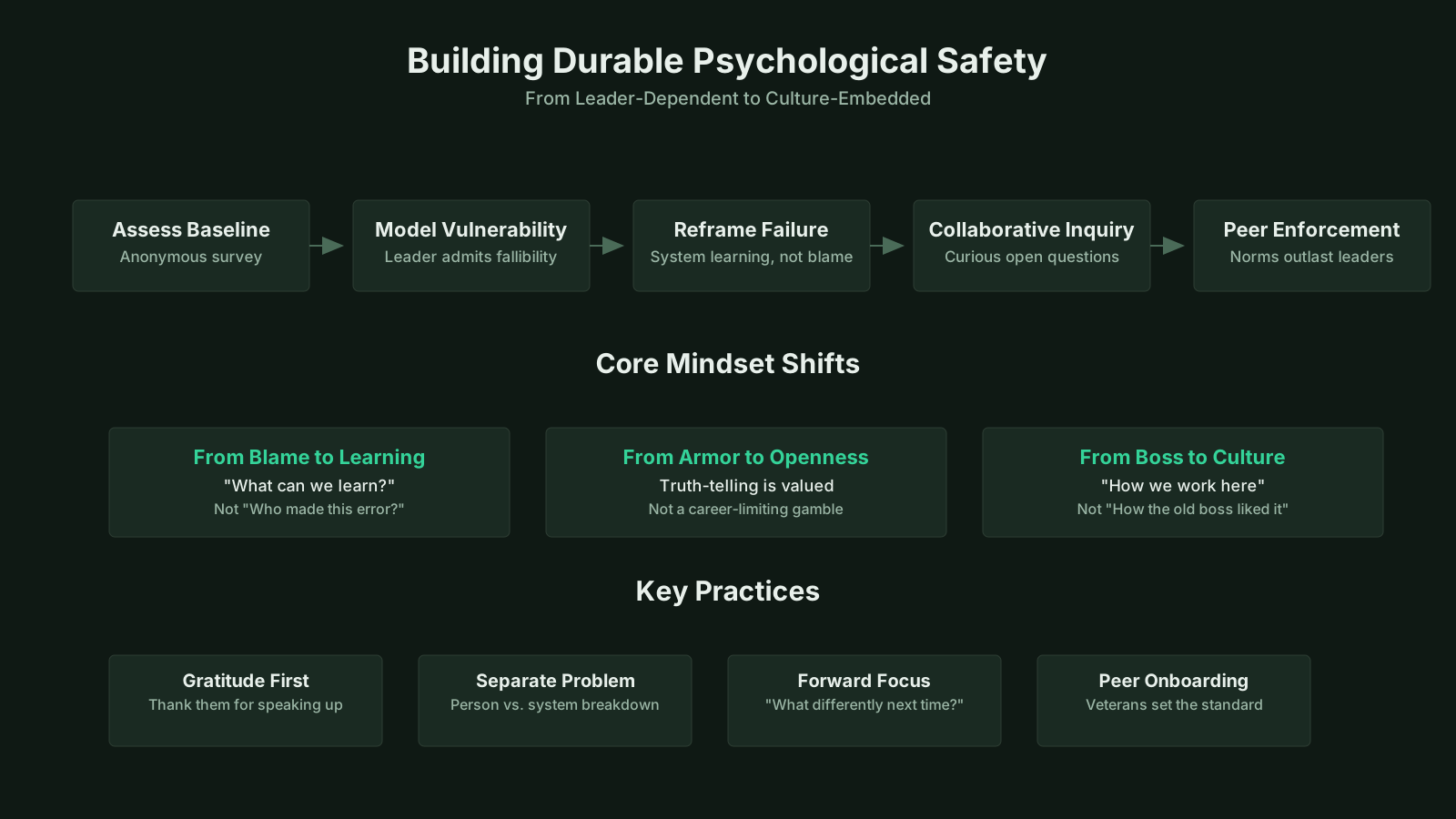
The final frontier of the roadmap addresses the fragility of culture when a leader departs. All too often, a brilliant leader spends years cultivating courageous teams, only to have the psychological safety evaporate six months after a new authoritarian manager takes over. To make fearless teams durable beyond the tenure of a single leader, the mindset of safety must be enshrined in the very identity of the team. This is the stage where safety becomes “just the way we work here” rather than “the way the old boss liked it.” It requires the peer network, not just the hierarchy, to enforce the norm. When a new leader joins and starts shutting down conversations, a highly mature team will gently and respectfully enforce the legacy. A senior peer might take the new leader aside and say, “In this culture, we have a standard of asking questions before we shoot down ideas. You might get better engagement from the team if you probe into their logic first.” This peer-to-peer enforcement is the ultimate triumph of a leader’s roadmap, proving that they have created not just a safe team, but a self-healing, self-policing, and enduringly courageous system capable of protecting its own candor long after the founder has moved on. The long-term legacy of any executive is not the products they launched, but the courageous teams they left behind, equipped with the map to navigate an uncertain world together.
Core Insights on Future Team Safety
- Engineering Digital Serendipity
- Leaders must deliberately engineer moments of emotional candor and informal connection within digital workflows to replace the physical proximity cues that vanish in distributed teams.
- Bias Toward Remote Participants
- Hybrid environments demand that leaders default meetings to a fully remote format when even one person dials in, actively scanning for and inviting input from remote team members who may be hesitant to speak.
- Challenging Algorithmic Authority
- Leaders must counteract AI’s potential to suppress human intuition by treating it as a fallible junior colleague and by removing the stigma from questioning or overriding its recommendations.
- Peer-Enforced Cultural Durability
- True psychological safety persists only when the peer network, rather than the leader alone, enforces norms of candor, allowing the team to maintain its corrective culture through any leadership change.
Advance Your Career with Professional Certification
Earning a professional project management certification demonstrates a commitment to excellence that accelerates career growth by equipping you with globally recognized standards and risk management skills. Engaging in formal project management training sharpens your ability to lead cross-functional teams, anticipate bottlenecks, and consistently deliver value within scope and budget. Certified professionals foster organizational success by embedding agile, data-driven decision-making into everyday workflows, which builds stakeholder confidence and reduces costly missteps. Ultimately, this credential transforms competent managers into strategic leaders who cultivate resilient, high-performing teams in any industry.
Earning a product management certification equips professionals with the strategic frameworks and leadership skills needed to navigate complex product lifecycles, directly enhancing team collaboration and trust—a cornerstone of psychological safety. A reputable product management certification program not only validates your expertise in agile methodologies and market analysis but also signals to employers your commitment to continuous improvement, accelerating career growth. For organizations, certified product managers drive consistent, data-informed decisions that minimize risks and foster an environment where courageous ideas can thrive, ultimately boosting innovation and team resilience.
Earning a professional HR management certification demonstrates a deep commitment to strategic people practices that directly fuel team courage and organizational resilience. A certified HR manager brings validated expertise in designing psychologically safe environments where employees feel secure to voice ideas, admit mistakes, and innovate without fear of retribution. This accreditation not only enhances your credibility and opens doors to senior leadership roles but also equips you with modern tools to align workforce culture with business goals. Ultimately, investing in certification helps you become the catalyst who transforms compliance-driven departments into hubs of trust, accountability, and sustained competitive advantage.
From Permission to Practice: Embedding Safety into Daily Rituals
Understanding psychological safety as a concept is only the first step; the real work lies in translating it from an abstract ideal into observable, repeatable behaviors. Leaders often make the mistake of declaring "everyone is safe to speak up" during a team meeting and then expecting that declaration to take root. In reality, psychological safety is not established by a single statement but by the cumulative weight of daily micro-interactions. A more effective approach involves designing specific team rituals that normalize vulnerability and inquiry. For example, implementing a structured "pre-mortem" at the start of a complex project—where the team explicitly lists all the ways the project could fail and what assumptions might be wrong—signals that doubt is not only tolerated but valued. When a leader openly participates in this exercise by admitting their own uncertainties first, they demonstrate that the cost of silence is higher than the risk of being wrong.
Another powerful ritual is the systematic debrief that focuses on learning rather than blame. In many organizations, post-project reviews become exercises in assigning fault, which directly erodes the courage to take calculated risks. A courageous team re-frames these conversations around process improvement, asking questions like "What conditions led to this outcome?" and "What did we learn that we can apply next time?" This shifts the team's focus from individual performance anxiety to collective growth. Leaders must actively model this by sharing their own mistakes and the lessons derived from them, thereby reinforcing that the team's identity is not built on a flawless record, but on its capacity to adapt and learn together. Over time, these rituals create a predictable psychological contract: the team knows that candor is the expected norm, not an exception.
The Leader's Role as a Signal Amplifier
A leader's behavior is the most powerful signal in any team environment, often outweighing formal policies or mission statements. When a leader reacts with frustration to a dissenting opinion, or subtly dismisses a junior team member's suggestion, they inadvertently broadcast that psychological safety is conditional. To cultivate genuine courage, leaders must become intentional signal amplifiers. This means actively seeking out input from the quietest voices in the room, framing questions that invite counterpoints—such as "What is the strongest argument against my proposal?"—and responding with genuine curiosity rather than defensiveness when challenged. The leader's job is not to have all the answers, but to create the conditions under which the best answers can emerge from the collective intelligence of the team.
Furthermore, leaders must be vigilant about the subtle cues that can undermine safety, such as interrupting, checking devices during discussions, or rushing to solutions before all perspectives are heard. A courageous team requires a leader who can absorb the discomfort of ambiguity and disagreement without immediately resolving it. By holding space for tension and modeling a calm, inquisitive posture, the leader demonstrates that the team's capacity to navigate uncertainty is more valuable than a quick, unexamined consensus. This approach transforms the leader from a decision-maker into a guardian of the team's collaborative process, ensuring that the courage to speak up is consistently met with respect and thoughtful consideration, thereby reinforcing the very environment it seeks to create.