In an era where talent retention defines competitive advantage, understanding what your workforce truly thinks has never been more critical. The employee engagement survey remains the single most powerful diagnostic tool for organizational health, yet most companies fail to translate its findings into meaningful change. This comprehensive guide moves beyond theory to deliver practical frameworks for designing surveys that yield honest insights, administering them in ways that maximize participation, and crafting action plans that drive measurable results.
Senior leaders often view engagement surveys as annual check-the-box exercises, but this perspective squanders immense strategic value. When properly executed, an employee engagement survey becomes a catalyst for cultural transformation, linking individual sentiment to business outcomes like performance, customer satisfaction, and profitability. The gap between data collection and decisive action is where most organizations stumble, and addressing that gap is the central theme of modern management practice.
Throughout this article, we will explore the entire lifecycle of an employee engagement survey, from initial design through to implementation of feedback loops. You will learn how to avoid common pitfalls, select appropriate metrics, and foster a culture of psychological safety to provide candid responses. The goal is not merely to measure engagement but to create a participatory system that continuously elevates organizational performance.
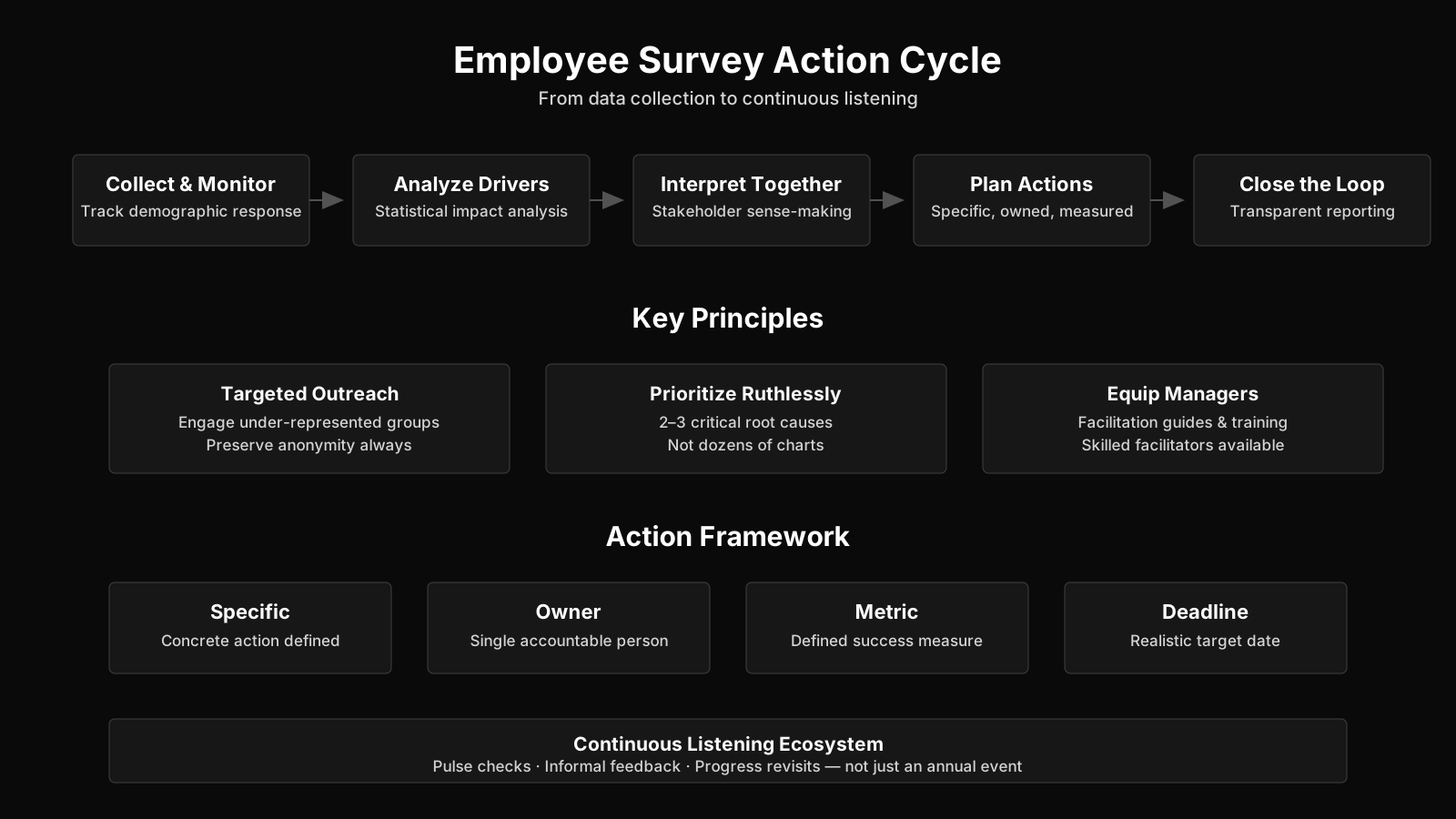
Key Steps: From Survey to Employee Engagement Success
| Key Concept | Summary |
|---|---|
| Strategic Value | When methodologically sound, employee engagement surveys translate individual perceptions into leading indicators of profitability, customer satisfaction, and talent retention. |
| Design Rigor | Survey design dictates insight depth; aligning questions with strategic priorities, the operating model, and workforce diversity prevents superficial findings. |
| Business Impact | Engagement metrics correlate robustly with operational KPIs such as productivity, turnover, and innovation, positioning surveys as early warning systems for strategic resource allocation. |
| Widespread Misconceptions | Persistent myths dismiss engagement data as subjective noise, avoid raising employee expectations, limit measurement to annual cycles, and assume that anonymity alone secures honest feedback. |
| Leadership Sponsorship | Visible CEO and senior leadership commitment transforms surveys from administrative obligations into strategic priorities, driving high participation and genuine transparency. |
| Survey Architecture | Effective architecture starts with a clearly defined purpose, then integrates benchmarked scales, custom items, and qualitative prompts to generate intelligence that informs decisive action. |
| Engagement Dimensions | Engagement comprises cognitive, emotional, and behavioral facets; capturing its full profile requires validated models adapted to the organization's specific cultural and operational context. |
| Psychological Safety | Establishing a trust foundation before survey rollout is critical for candid responses, as employees often self-censor even when anonymity protections are in place. |
| Action Planning | Most organizations fail in the transition from data collection to decisive action; robust feedback loops and visible follow-through are indispensable for converting insights into meaningful change. |
| Continuous Listening | Fast-paced environments demand quarterly or pulse surveys to track shifting perceptions, transforming engagement measurement from an annual compliance ritual into an ongoing strategic dialogue. |
The Strategic Value of Designing an Effective Employee Engagement Survey
Employee engagement is not an abstract concept; it is a measurable driver of organizational success. Gallup research consistently shows that highly engaged teams outperform their disengaged counterparts by significant margins in areas including profitability, absenteeism, and safety incidents. An employee engagement survey provides the raw data needed to diagnose the current state, but its design directly determines the quality of insights gathered.
Too many organizations rely on off-the-shelf questionnaires without considering their unique context, leading to surface-level findings that do not point toward actionable solutions. A well-designed employee engagement survey aligns with the company's strategic priorities, reflects its operating model, and accounts for the distinct psychologies of a diverse workforce. When senior leadership commits to treating engagement data with the same rigor as financial data, a profound shift occurs in how decisions are made.
Connecting Employee Engagement Survey Results to Business Outcomes
The most compelling reason to invest in a rigorous employee engagement survey process is the clear link between engagement and bottom-line results. Studies from the University of Oxford's Saïd Business School found a strong positive relationship between employee satisfaction and productivity, with effects often magnified in knowledge-intensive industries. An employee engagement survey that measures nuanced dimensions like psychological safety, role clarity, and growth opportunities yields predictors of future turnover, innovation capacity, and customer advocacy.
To make this connection tangible, organizations must move beyond asking if employees are happy and instead probe whether they have the resources, autonomy, and support to perform at their best. Frameworks such as the Job Demands-Resources model illustrate that engagement flourishes when demanding roles are balanced with sufficient organizational support. A thoughtfully constructed employee engagement survey captures both the stressors and the enablers, providing a complete picture that financial reports alone cannot offer.
When you begin to analyze employee engagement survey data through the lens of business operations, patterns emerge that inform workforce planning, succession management, and even product development. For example, a recurring theme of insufficient cross-functional collaboration in survey comments may explain delays in product launches. Thus, the employee engagement survey becomes an early warning system and a strategic planning instrument, not simply an HR initiative.
Dispelling Myths That Undermine Employee Engagement Survey Efforts
One persistent myth is that employee engagement surveys are only useful for measuring satisfaction and therefore produce "soft" data. In reality, advanced survey analytics yield hard, quantitative insights that correlate directly with operational KPIs. Another misconception holds that conducting an employee engagement survey will raise expectations and create disappointment if visible action does not follow, so it is safer not to ask. This logic is flawed because the absence of a survey does not eliminate employee expectations; it merely blinds leadership to simmering issues.
Some leaders assume that an annual employee engagement survey is sufficient to track sentiment in a fast-paced environment. However, in industries undergoing rapid digital transformation, quarterly or even pulse surveys are necessary to keep pace with shifting employee perceptions. The belief that anonymity guarantees honest responses also deserves scrutiny. If trust in leadership is low, employees may still self-censor despite technical anonymity protections, which is why building psychological safety before launching any employee engagement survey is essential.
Finally, there is a dangerous assumption that engagement is solely the responsibility of the HR department. Without visible sponsorship from the CEO and senior managers, an employee engagement survey risks being perceived as bureaucratic overhead. When leaders actively communicate the strategic importance of the survey and model transparency, participation rates rise and the quality of feedback improves dramatically.
Core Takeaways on Survey Design Strategy
- Alignment with strategic priorities
- Customizing the survey to the organization’s unique context and strategic objectives ensures the data collected is relevant and directly actionable, unlike generic off‑the‑shelf templates.
- Link to business outcomes
- Survey data provides reliable quantitative evidence that engagement levels directly drive operational outcomes such as profitability, reduced absenteeism, and innovation rates, turning soft perceptions into hard business metrics.
- Beyond satisfaction measurement
- By measuring factors like psychological safety, role clarity, and resource adequacy, effective surveys move beyond superficial satisfaction to surface actionable predictors that drive sustained performance improvements.
- Dispelling common myths
- Surveys are not merely soft HR instruments; choosing not to survey does not erase employee expectations, it only leaves leadership unaware of systemic issues and missed improvement opportunities.
- Leadership sponsorship is critical
- When the CEO and top management visibly champion the survey, it ceases to be a bureaucratic exercise and becomes a strategic planning tool, fostering candid feedback and higher participation rates.
Architecting a High-Impact Employee Engagement Survey Design
The architecture of your employee engagement survey determines whether it will generate actionable intelligence or a pile of ignored data. Effective design begins with clarity of purpose: are you diagnosing broad cultural health, evaluating specific change initiatives, or identifying drivers of retention in critical roles? Each objective requires a different blend of standardized items, custom questions, and qualitative prompts.
Survey design is simultaneously an art and a science. The science lies in statistical validity, reliable scales, and avoiding biases like leading questions or social desirability effects. The art involves phrasing queries in a way that resonates emotionally and cognitively with employees across hierarchies and functions. A well-designed employee engagement survey speaks the language of the frontline worker and the senior executive alike, striking a balance between comprehensiveness and brevity.
Defining Core Constructs in Your Employee Engagement Survey
Before drafting any questions, you must clearly define what "engagement" means for your organization. Most established models differentiate between cognitive engagement (thinking about work intensely), emotional engagement (feeling passionate about work), and behavioral engagement (going above and beyond basic duties). An employee engagement survey should encompass all three dimensions to provide a multidimensional profile rather than a single score.
Leading frameworks like the Utrecht Work Engagement Scale or Gallup's Q12 offer validated models that predict performance outcomes, but they should be adapted to local context. For instance, a technology startup might prioritize innovation-related engagement items, while a hospital might emphasize connection to patient outcomes. The key is to anchor your employee engagement survey in constructs that align with what success looks like in your sector.
Additionally, consider including items that measure potential detractors, such as burnout, incivility, or ethical conflicts. An employee engagement survey that only focuses on positive indicators may miss creeping risks until they have escalated into retention crises. By capturing a balanced set of constructs, you build a diagnostic tool capable of both identifying strengths and predicting vulnerabilities.
Crafting Questions That Elicit Honest Feedback in an Employee Engagement Survey
The wording of individual items in an employee engagement survey can profoundly influence response patterns. Questions should be specific, behaviorally anchored, and free of jargon that might confuse respondents. For example, instead of asking "Are you engaged at work?" which is abstract and subject to interpretation, a more reliable item might be "I am often so immersed in my work that I lose track of time."
Likert scales remain the industry standard for employee engagement survey items, typically ranging from "Strongly Disagree" to "Strongly Agree" across five or seven points. However, recent research suggests that appropriately framed binary or forced-choice questions can reduce acquiescence bias and yield sharper differentiations. The choice depends on your strategic intent: if you seek nuanced trends over time, Likert scales offer continuity, whereas binary formats may better highlight unequivocal areas for intervention.
Open-ended questions are the unsung heroes of any employee engagement survey, providing context that numbers cannot convey. A single well-placed prompt such as "What one thing would you change to improve your experience here?" can generate rich thematic data that illuminates the "why" behind engagement scores. These qualitative insights often carry greater emotional weight with leadership teams and are crucial during action planning workshops later in the process.
Selecting the Optimal Framework for Your Employee Engagement Survey
While custom design offers specificity, several established frameworks provide a robust starting point for your employee engagement survey. The Gallup Q12, for instance, has decades of benchmarking data and focuses on actionable manager-level items. The Great Place to Work model emphasizes trust, pride, and camaraderie. Choosing a framework facilitates external benchmarking, which can lend credibility when presenting results to your board.
That said, strict adherence to any single employee engagement survey framework may omit areas critical to your strategy, such as digital readiness or sustainability commitment. A hybrid approach often works best: adopt a core validated survey for trend analysis while adding modular sections that rotate based on current organizational priorities. This keeps the employee engagement survey fresh and minimizes survey fatigue among employees who appreciate that their time is being respected.
Before finalizing any employee engagement survey design, pilot test it with a small, diverse group of employees using cognitive interviewing techniques. This process uncovers misinterpretations, assesses emotional reactions, and estimates completion time. Adjustments made at this stage dramatically improve data quality and demonstrate to employees that their input truly shapes the process, setting a positive tone before the full launch.
Administering the Employee Engagement Survey for Honest and High Participation
Even the most brilliantly designed employee engagement survey will fail if administration is mishandled. The logistics of distribution, communication, and data collection must reinforce trust at every touchpoint. Employees are increasingly skeptical of corporate surveys due to fears of retaliation or data misuse, so the manner in which you introduce and manage the employee engagement survey is as important as its content.
Administration is not merely a technical exercise; it is a cultural intervention. The decision to use a third-party platform versus an in-house tool, the language used in invitation emails, and the physical setting where frontline workers complete the survey all send signals about leadership's intentions. A meticulously administered employee engagement survey signals that the organization values honest voice over managed impressions.
Determining the Right Timing and Frequency for an Employee Engagement Survey
Timing can dramatically skew employee engagement survey results. Launching a survey immediately after a round of layoffs, during peak operational crunch, or just before bonuses are announced will contaminate the data with situational anxiety or euphoria. The ideal window is a relatively stable period where employees can reflect on their typical experience rather than an exceptional moment.
Regarding frequency, the annual employee engagement survey remains the norm for strategic planning cycles, but it often fails to capture the dynamic nature of modern work. Many organizations now supplement with quarterly pulse surveys consisting of five to ten core items. This cadence allows managers to track the impact of interventions in near-real-time while still reserving the deeper annual employee engagement survey for comprehensive cultural assessment and benchmarking.
However, organizations should avoid over-surveying. Every employee engagement survey request represents a demand on people's cognitive and emotional bandwidth. Before adding a pulse, prune outdated items and ensure that each instrument has a clear, communicated purpose. Respecting employees' time is itself an engagement signal.
Ensuring Confidentiality and Psychological Safety in Your Employee Engagement Survey Process
Confidentiality is the bedrock of any credible employee engagement survey. If employees suspect that their individual responses can be traced back to them, they will either disengage from the process or provide sanitized answers. This is why leading organizations use external vendors to host their employee engagement survey platforms, with contractual guarantees that raw data will not be shared with management.
Small teams present a particular challenge because cross-referencing demographic data with comments can unintentionally identify individuals. Best practice for the employee engagement survey involves setting minimum group size thresholds below which results are not reported. For qualitative comments, text analytics should be used to surface themes without exposing verbatim statements that might be attributable. Clearly communicating these protocols in advance reduces fear and increases both participation and candor.
Psychological safety extends beyond data protection to the managerial response when results are revealed. Leaders must resist the urge to assign blame or become defensive when the employee engagement survey highlights uncomfortable truths. Instead, framing all feedback as valuable data for collective improvement transforms the post-survey environment into one of joint problem-solving. Training managers to receive feedback constructively is an essential preparatory step often overlooked in the rush to field the survey.
Core Insights on Survey Administration
- Timing and frequency matter greatly
- Selecting stable periods for engagement surveys prevents situational anxiety or euphoria from distorting results, and quarterly pulse checks complement annual surveys to capture real-time shifts without overwhelming employees.
- Confidentiality drives honest responses
- By engaging an external vendor to host the platform and enforcing minimum group size thresholds, organizations make individual responses untraceable, reducing employee fear and boosting both participation and honest feedback.
- Psychological safety requires managerial training
- Equipping leaders to receive input constructively, without blame or defensiveness, turns the survey follow-up into a collaborative problem-solving dialogue rather than a fault-finding exercise.
- Clear communication reduces skepticism
- Proactively disclosing data protection measures and the rationale behind each survey demonstrates respect for employees’ time and strengthens trust in leadership’s motives.
- Administration is a cultural intervention
- Every administrative detail, from the platform selected to the tone of invitation and the physical setting for completion, signals whether the organization genuinely values honest input or merely manages perceptions.
Extracting Meaningful Insights from Employee Engagement Survey Data
Data without interpretation is noise. The analysis phase of an employee engagement survey is where science meets narrative, and skilled analysts can uncover the stories that will drive organizational change. This stage requires a blend of statistical competence and business acumen to separate signal from noise and prioritize issues that have the greatest leverage on strategic outcomes.
Many organizations make the mistake of focusing exclusively on top-line engagement scores, celebrating if the number is high or panicking if it is low. Deep analysis of an employee engagement survey, however, involves disaggregating data by department, tenure, role, and demographic segments to reveal equity issues, subculture strengths, and hidden pockets of disaffection that an overall average obscures.
Quantitative Analysis Techniques for Employee Engagement Survey Results
Advanced analytics transform employee engagement survey data from a simple report card into a predictive tool. Driver analysis, for instance, uses regression or structural equation modeling to identify which survey items most strongly influence overall engagement. This allows you to pinpoint the three or four levers that, if addressed, would yield the greatest systemic improvement, avoiding the temptation to tackle every low-scoring item simultaneously.
Another powerful technique is relative importance analysis, which addresses multicollinearity among survey items and provides a more stable ranking of drivers. When presenting results from an employee engagement survey, these methods create a compelling business case by quantifying the expected return on engagement investments. For example, the analysis might reveal that improving "I have the materials and equipment to do my work right" by 10 percent correlates with a specific reduction in unplanned attrition costs.
Benchmarking against internal historical data and external industry norms adds context that raw scores lack. A score of 65 percent favorability on "I trust my senior leadership" may look alarming in isolation but could be well above the industry average for recently merged companies. Effective employee engagement survey analysis always triangulates between absolute standards, internal trends, and comparative benchmarks to inform realistic action planning.
Mining Qualitative Feedback from Your Employee Engagement Survey
Open-ended comments in an employee engagement survey are a goldmine of context that complements quantitative data. However, analyzing thousands of free-text responses manually is impractical. Natural language processing tools now enable sentiment analysis, topic modeling, and emotion detection that can surface dominant themes without hours of manual coding.
Despite the power of AI, human interpretation remains essential when analyzing employee engagement survey comments because machines can misinterpret sarcasm, cultural idioms, or nuanced suggestions. The most effective approach involves a hybrid methodology where algorithms perform initial clustering and sentiment scoring, and then a cross-functional team reviews representative quotes to validate and enrich the machine-generated themes.
When presenting qualitative findings from an employee engagement survey, it is crucial to balance anonymity with authenticity. Using generalized quotes such as "a project manager in the technology division noted..." rather than direct verbatims protects confidentiality while conveying the emotional texture of the feedback. Leaders often respond more viscerally to a well-chosen anonymous quote than to a statistical table, making this an indispensable tool in your change communication arsenal.
Bridging from Employee Engagement Survey Results to Actionable Change
Survey results that do not lead to action are worse than no survey at all because they breed cynicism and disengagement. The action planning phase is where many employee engagement survey initiatives falter, not from lack of intent but from poor process design. Transforming data into initiatives requires a structured approach that cascades ownership, allocates resources, and establishes accountability mechanisms at every organizational level.
Effective action planning after an employee engagement survey is a distributed leadership activity, not a centralized HR project. Department heads, team leads, and even informal influencers must be equipped to facilitate conversations about what the data means for their specific context and to co-create solutions with their teams. This collaborative approach builds the commitment necessary for implementation success.
Prioritizing Initiatives Based on Employee Engagement Survey Findings
One of the gravest mistakes after receiving an employee engagement survey report is attempting to fix everything at once. The resulting initiative overload exhausts managers and confuses employees about what truly matters. Instead, use an impact-feasibility matrix to rank potential actions. Initiatives that score high on impact (strongly linked to engagement drivers) and high on feasibility (within the team's direct control) should be tackled first to build momentum and visible wins.
For example, if an employee engagement survey reveals that recognition and development are key drivers but the organization lacks budget for a new learning management system, a feasible quick win might involve implementing a peer-to-peer shout-out program and instituting regular career conversations with managers. These low-cost, high-contact actions signal that leadership has heard the feedback and is responding, even while larger structural changes are being planned.
Actions emerging from the employee engagement survey must be specific, measurable, and time-bound, just like any other business objective. Vague commitments such as "improve communication" will dissipate quickly. Instead, translate them into concrete plans like "department heads will host monthly ask-me-anything sessions beginning next quarter, with at least 60 percent attendance tracked." This specificity transforms good intentions into accountable practice.
Engaging Managers and Employees in Co-Creating Post-Survey Action Plans
Top-down action plans imposed after an employee engagement survey frequently miss the mark because they lack contextual nuance. Managers who lead teams through collaborative sense-making sessions achieve higher ownership and better solutions. A productive workshop format involves presenting the team's anonymized results, asking reflective questions such as "What surprises you here?" and "What story do you think this data is telling?" and then brainstorming actionable experiments.
These sessions also serve as a powerful intervention in themselves. The act of genuinely discussing employee engagement survey results and inviting input begins to rebuild trust even before any formal actions are implemented. It signals a shift from a culture of measurement to a culture of development. Agile retrospectives adapted for engagement data can provide a structured rhythm for these conversations, fostering continuous improvement rather than episodic reactivity.
Human resources and the employee engagement survey steering committee play a support role during this phase: providing facilitator guides, data at the right level of granularity, and resources for promising grassroots initiatives. They also track progress on large-scale actions identified by senior leadership, ensuring that the organization's response to the employee engagement survey is coherent without being rigidly top-down.
Sustaining Momentum and Accountability After the Employee Engagement Survey
The weeks immediately following an employee engagement survey release are filled with energy, but this naturally decays as daily pressures return. To prevent the action plan from becoming shelfware, embed survey follow-ups into existing management rhythms such as quarterly business reviews, team stand-ups, and leadership team offsites. When engagement actions are routinely reviewed alongside financial and operational KPIs, they gain the same institutional weight.
Transparency dashboards are another effective tool for sustaining momentum. Publishing ongoing progress against employee engagement survey action items, even when the news is mixed, demonstrates that the organization is serious about listening. These dashboards should include both leading indicators like "percentage of teams that have action plans" and lagging indicators like shifts in the next engagement score, creating a continuous feedback narrative.
Finally, recognize and celebrate progress, however incremental. When a department's employee engagement survey scores improve after implementing changes, share that success story widely. Such examples create a virtuous cycle, motivating other parts of the organization and providing tangible proof that the effort invested in the survey and subsequent actions yields real rewards for people and performance alike.
Core Insights on Turning Survey Data into Action
- Distributed leadership for action planning
- Department heads and team leads must facilitate conversations and co-create solutions, positioning action planning as a distributed leadership activity rather than a centralized HR project.
- Prioritize with impact-feasibility matrix
- Prevent initiative overload by applying an impact-feasibility matrix to prioritize actions that directly influence engagement drivers and fall within the team's sphere of control, building momentum through visible early wins.
- Co-creation through collaborative sense-making
- Managers should guide teams through discussions of anonymized survey results and the design of small experiments, a collaborative process that builds ownership and trust while yielding solutions tailored to the team's specific context.
- Embed accountability into management rhythms
- Sustain momentum by embedding survey follow-ups into recurring meetings and transparency dashboards, ensuring engagement actions are reviewed alongside financial and operational KPIs to reinforce their organizational significance.
Evolving the Employee Engagement Survey into a Continuous Feedback System
The traditional model of an annual or biennial employee engagement survey is giving way to more agile, continuous feedback ecosystems. Modern organizations operate at a pace that renders long gaps between measurement cycles inadequate for real-time decision-making. While the comprehensive employee engagement survey remains vital for deep cultural assessment, it should be complemented by lighter, more frequent touchpoints that capture the evolving employee experience.
This evolution reflects broader trends in management thinking, particularly the shift from predictive planning to adaptive learning. Just as Agile methodologies have transformed project delivery, they offer principles for listening to employee voice iteratively and responding with incremental improvements rather than big-bang change programs.
Integrating Pulse Surveys with the Annual Employee Engagement Survey
Pulse surveys serve as a strategic complement to the deep annual employee engagement survey by providing rapid feedback on specific initiatives or emerging risks. A well-designed pulse survey might consist of no more than five items, one of which is the core engagement anchor question included in the annual tool. This continuity enables trending while the brevity ensures participation and timeliness.
The key to effective pulsing is connecting the data to immediate managerial action. When a pulse survey reveals a dip in team morale after a reorganization, the manager should be empowered to investigate and intervene within days, not months. However, pulses should not replace the comprehensive employee engagement survey entirely because they rarely capture the full spectrum of engagement drivers and lack the statistical power for robust segmentation and benchmarking.
Technology platforms now enable adaptive surveying where follow-up questions are triggered based on initial responses. For example, an employee who indicates high stress in a pulse might receive a short set of items exploring causes and coping resources. This dynamic approach makes the employee engagement survey experience feel more responsive and less generic, increasing perceived value among respondents.
Fostering a Culture of Feedback Beyond the Employee Engagement Survey Tool
The ultimate ambition of any employee engagement survey program should be to make the formal survey progressively less necessary as feedback becomes embedded in daily operations. This does not mean eliminating measurement but rather cultivating an environment where continuous dialogue renders the survey a confirming rather than a discovering mechanism. Leaders who are visible, approachable, and curious create this environment.
Practices such as stay interviews, skip-level meetings, and anonymous digital suggestion boxes provide ongoing qualitative input that complements quantitative employee engagement survey data. When managers are trained in coaching and active listening, the boundary between "survey season" and normal operations blurs. Employees begin to trust that their voice matters at all times, not only when leaders are preparing strategy documents.
Nevertheless, the structured employee engagement survey retains unique value in surfacing systemic patterns that daily conversation might miss. In large, geographically dispersed organizations, only a well-designed survey can aggregate individual experiences into a reliable organizational diagnosis. The goal is balance: a formal survey process rigorous enough to guide strategy, surrounded by an informal culture porous enough to ensure that no one waits a year to speak up about a fixable problem.
Charting a Path Forward with Your Employee Engagement Survey Strategy
Designing and acting on an employee engagement survey is one of the most consequential undertakings in modern organizational management. When executed thoughtfully, it aligns leadership attention with workforce reality, uncovers hidden risks and opportunities, and catalyzes changes that elevate both performance and well-being. The trajectory from survey to success is not linear, but with the frameworks outlined here, it becomes navigable.
The critical lesson is that the survey instrument itself matters less than the integrity of the process surrounding it. An average employee engagement survey implemented with genuine executive commitment, transparent communication, and rigorous follow-through will outperform a brilliant questionnaire that sits in a neglected folder. Organizational trust is the currency that determines the value of every engagement initiative.
As you reflect on your own employee engagement survey practices, consider where the weakest link lies: design clarity, administration security, analytical depth, or action accountability. Invest in strengthening that link and you will discover that the survey transforms from a periodic chore into a strategic engine. The future belongs to organizations that listen systematically and act courageously, and the employee engagement survey is your most reliable compass for that journey.
Ultimately, the measure of a successful employee engagement survey is not a high score but a more resilient, adaptive, and connected organization. When every team member feels that their honest feedback contributes to shaping a better workplace, engagement ceases to be a metric to chase and becomes a culture to live. Start today by examining your current approach, and commit to making your next employee engagement survey the beginning of a genuine conversation, not the end of one.
Essential Insights on Survey Strategy
- Process integrity over instrument quality
- A well-supported average survey backed by genuine executive commitment and transparent follow-through will always outperform a brilliantly crafted questionnaire that lacks organizational backbone.
- Trust as the core currency
- Organizational trust is the core currency that determines the value of every engagement initiative and must be cultivated through honest communication and rigorous action.
- Identify and strengthen weakest links
- To transform the survey into a strategic engine, concentrate improvement efforts on the weakest area among design clarity, administration security, analytical depth, or action accountability.
- True success is cultural, not numerical
- The real measure of an effective employee engagement survey is a more resilient, adaptive, and connected organization, where feedback continuously shapes a living culture instead of chasing a metric.
Turning Results Into Ownership Instead of Another Report
The moment results land is where most engagement programs quietly die. A common mistake is allowing HR to become the sole custodian of the data, translating scores into a polished deck that executives review once and then archive. In practice it often happens because managers were never given a clear role in interpreting their own team's results. The more effective approach is to push results out to team leaders within days, not weeks, and ask each one to lead a short conversation about what the numbers suggest. People trust their direct manager far more than a corporate summary, and they can tell immediately when a leader is reading prepared talking points rather than genuinely trying to understand a problem.
That first conversation should produce something tangible, even if it is only two or three commitments written in plain language. The interesting part is that employees do not expect every issue to be solved immediately; they expect to know that someone heard them and that priorities will be made explicit. Some leaders find it useful to sort feedback into three buckets: things we can change now, things we can influence over the next quarter, and things we cannot control but will explain honestly. That third bucket matters more than most executives assume, because unexplained inaction reads as indifference.
Finally, resist the temptation to wait a full year before checking progress. A shorter pulse cycle, even five or six questions sent quarterly, keeps the original survey from becoming a standalone event. And when turnover risk appears concentrated in specific teams or roles, supplement the quantitative data with stay interviews to improve retention. Those conversations often reveal the practical, unglamorous details behind a low score, from scheduling friction to unclear promotion criteria, which a survey alone cannot capture.
Advance Your Career with Professional Certification
Investing in professional project management certification is a strategic move that boosts both individual careers and organizational performance. For those looking to advance, becoming a certified project manager signals a deep understanding of methodologies like Agile and Waterfall, giving employers confidence in your ability to lead complex initiatives. Certified professionals often command higher salaries and enjoy faster career progression because they bring a standardized, results-driven approach to every project. At the organizational level, having certified managers reduces project failure rates, improves stakeholder satisfaction, and creates a culture of continuous improvement. Ultimately, certification isn't just a personal achievement—it's a catalyst for delivering measurable business value.
Earning a professional product management certification validates your expertise in modern frameworks and stakeholder alignment, making you a more competitive candidate for senior roles. A product management certification equips you with structured methodologies to prioritize features, reduce time-to-market, and boost ROI, directly benefiting organizational outcomes. Beyond technical skills, it signals a commitment to continuous learning and strategic thinking, which employers increasingly prioritize in fast-changing markets. Ultimately, this credential bridges the gap between tactical execution and visionary leadership, accelerating career growth while driving sustained business success.
Earning a professional HR management certification validates your expertise in modern people strategies and signals a commitment to ethical, evidence-based practices that directly impact organizational performance. Pursuing a recognized human resources certification not only sharpens your ability to design effective employee engagement surveys and translate insights into action but also positions you as a strategic partner in shaping a thriving workplace culture. For HR professionals, this credential accelerates career advancement by demonstrating mastery of compliance, talent development, and change management, while for organizations, certified leaders drive higher retention and productivity through data-driven decision-making. Ultimately, it bridges the gap between employee feedback and meaningful outcomes, turning survey data into a roadmap for sustainable success.