When a ransomware attack freezes your entire operation at 4 a.m., or a product safety scandal erupts across social media before your morning coffee, the very first asset to shatter is not your supply chain or your IT infrastructure. It is stakeholder confidence. In these moments, navigating turmoil demands far more than operational triage; it requires mastering the art of crisis communication, a discipline where every word and every silence can either contain the damage or amplify it beyond repair. For managers, executives, and aspiring leaders, the ability to communicate under extreme pressure has become a defining competency of modern organizational life, one that separates companies that recover with their reputations intact from those that become permanent case studies in failure.
Crisis Communication Summary: Key Topics to Know
| Key Concept | Summary |
|---|---|
| Crisis Communication | Crisis communication represents a foundational leadership responsibility, managing stakeholder confidence by reshaping meaning and guiding the narrative through periods of upheaval. |
| Emotional Tenor | Stakeholders recall the emotional resonance of leadership messages more vividly than precise facts, so empathy and transparency become indispensable for safeguarding reputation. |
| Psychological Impact | Under crisis conditions, the brain shifts to threat detection, and any information vacuum invites speculation; prompt acknowledgment helps restore psychological safety and a sense of control. |
| Speed-Substance Balance | Leaders must balance swift disclosure with rigorous verification, framing early communications around process and core values to minimize ambiguity and project authoritative command. |
| Defensive Posture Fallacy | Legalistic or evasive messaging backfires today because audiences quickly identify spin; human-centered transparency and genuine concern prove far more persuasive. |
| Strategic Capability | Elevating crisis communication to a strategic capability requires embedding it into leadership frameworks and building readiness through scenario rehearsals and spokesperson training. |
| Meaning-Making | Effective leaders move from broadcasting messages to co-creating meaning, centering efforts on restoring stakeholder trust instead of merely defending a position. |
| Omnichannel Approach | Contemporary crises cascade across platforms, demanding consistent messaging that is tailored to each channel yet anchored by a cohesive master narrative. |
| Stakeholder-Centric View | During crises, stakeholders become information consumers, and their needs deserve the same discipline applied to product development or service excellence. |
| Continuous Learning | Post-crisis, organizations must perform candid after-action reviews to extract lessons and fortify communication protocols against future disruptions. |
The Anatomy of a Crisis: Why Communication Sits at the Core of Leadership
A crisis is not simply a sudden negative event; it is a disruption that threatens stakeholder expectations, organizational viability, and the psychological contract between a company and its audiences. While operational response teams restore systems, supply chains, or patient safety protocols, the leadership function simultaneously performs an even more fragile task: reconstructing meaning. Humans do not process raw data during turmoil; they interpret signals, fill information voids with speculation, and judge the character of those in charge. Crisis communication, therefore, is not a downstream afterthought of crisis management. It is the primary mechanism through which leaders assert control, demonstrate empathy, and steer the narrative away from chaos and toward resolution.
Research in organizational psychology consistently shows that during high-stakes disruptions, people recall the emotional tenor of a leader's message more vividly than the factual details. A hastily delivered, defensive statement can etch a permanent scar on a brand, while a well-calibrated, transparent response can paradoxically strengthen loyalty. This reality transforms communication from a corporate function into a core leadership act. The manager who understands this becomes a stabilizer, not just a messenger. To build a team that can weather such storms, leaders must also focus on cultivating courageous teams that feel safe enough to speak up before a crisis escalates. Furthermore, knowing when to pause and listen can be as powerful as any statement—learning to speak less, connect more is a vital skill in high-pressure moments. Balancing urgent demands without sacrificing team autonomy requires a thoughtful approach to navigating the new office effectively. Finally, assessing who to trust with critical tasks during a crisis can be guided by the skill will matrix guide to unlock star potential in your team.
The Psychological Blueprint of Turmoil and the Need for Immediate Clarity
When a crisis hits, the human brain enters a heightened state of threat detection. Employees, customers, investors, and the public experience a cocktail of fear, anger, and uncertainty. In this state, cognitive processing narrows, and the demand for coherence becomes urgent. If an organization stays silent for even a few hours, the vacuum is filled by rumors, competitor spin, and viral social media speculation. The art of crisis communication begins with recognizing that speed is not a secondary virtue but a primary psychological intervention. A prompt acknowledgment, even if it is simply “We are aware of the situation and are investigating with full urgency,” restores a modest sense of control and anchors the audience to a single reliable source.
Yet speed without substance is dangerous. Leaders must walk a tightrope between rapid disclosure and verification. The delusion that one can wait until all facts are known before speaking is a frequent contributor to lasting damage. Instead, effective communicators frame the initial message around process and values: what you are doing, who is involved, and what principles guide your next moves. This initial clarity reduces ambiguity and signals that a competent authority is managing the chaos. It also buys precious time to assemble the more detailed narrative that will follow.
Debunking the Myth of the Perfectly Controlled Message
A persistent myth in many boardrooms is that crisis communication is about crafting a bulletproof legal statement that admits nothing, promises little, and protects against litigation. In practice, this defensive posture often backfires catastrophically. Audiences today, empowered by social media and cynical about institutional spin, can detect evasiveness within seconds. When an oil company responds to a major spill by stating that it is “assessing the situation in accordance with established protocols,” it signals cold indifference, not competence. The art of crisis communication demands that leaders replace legalistic shielding with human-centered transparency. You acknowledge the impact, you express authentic concern, and you commit to actions that match your words.
This does not mean abandoning legal prudence. It means integrating legal review with emotional intelligence, so that a message feels human while still being defensible. Companies that prioritize empathy in their first hour of communication recover reputational value faster than those that hide behind procedural language. The evidence is clear: stakeholders forgive mistakes when they sense genuine care, but they rarely forgive stonewalling.
Core Insights on Crisis Communication
- Crisis as meaning reconstruction
- When a crisis shatters stakeholder expectations and threatens organizational viability, the leader's primary task becomes rebuilding shared meaning through communication rather than merely coordinating an operational response.
- Emotional tone over facts
- During high-stakes disruptions, people recall the emotional tenor of a leader's message far more sharply than factual details, so transparent and empathetic communication is essential to sustaining brand loyalty.
- Human-centered transparency wins
- In today's social media landscape, defensive, legally cautious statements often backfire, whereas leaders who openly acknowledge harm, convey genuine concern, and commit to concrete actions restore reputational value far more quickly than those who default to procedural language.
Navigating Turmoil: The Art of Crisis Communication as a Strategic Capability
Too many organizations treat crisis communication as a tactical fire drill, reactive by nature and owned exclusively by the public relations department. A far more resilient approach is to elevate navigating turmoil to a strategic capability, embedding the art of crisis communication into the organization’s leadership model, governance structure, and continuous improvement cycles. When leaders view crisis messaging as a core strategic lever rather than a reputational bandage, they invest in preparation, scenario planning, and spokesperson development long before any alarm sounds.
This strategic lens reframes the communication function. Instead of asking “How do we get our side of the story out?” leaders ask “What does this crisis mean for our stakeholders, and how can our communication rebuild the trust that has been shaken?” This shift from message pushing to meaning making is the foundation of resilient leadership. It aligns perfectly with agile and lean management principles where continuous feedback loops, rapid iteration, and a deep focus on customer value drive decision making. During a crisis, your stakeholders are your customers of information, and their needs must be met with the same rigor you apply to product development or service delivery.
Why Navigating Turmoil Requires More Than a Press Release
A press release is a one-dimensional artifact in a multidimensional reality. In today’s communication ecosystem, a crisis unfolds simultaneously on Twitter, in employee Slack channels, on investor calls, and on live television. The art of crisis communication now requires an omnichannel orchestration that ensures message consistency while adapting tone and detail to each platform. A regulatory filing demands precision; a video message from the CEO requires warmth and vulnerability. The strategic leader coordinates these channels not by issuing identical content everywhere but by aligning them under a unified narrative spine.
Moreover, navigating turmoil demands that organizations communicate before, during, and after the visible crisis spike. Pre-crisis communication establishes a reservoir of goodwill and credibility. During the acute phase, communication focuses on containment, empathy, and operational clarity. Post-crisis, the narrative must shift toward learning, accountability, and systemic change. Companies that think a single carefully drafted press release will suffice are still operating under a broadcast-era mindset that no longer reflects how people consume information and judge integrity.
The Art of Crisis Communication: Building Trust When Everything Is Uncertain
Trust is the invisible currency that determines whether your organization survives a crisis with its relationships intact. Building trust under normal conditions is already challenging; building it amid turmoil requires a masterful blend of vulnerability and competence. The art lies in saying “I don’t know yet, but here is exactly how we are finding out” without appearing evasive. It lies in admitting fault early if fault is apparent, while still conveying the strength to fix the problem. Such communication contradicts the instinct to circle wagons, but it aligns with what neurological research tells us about how humans evaluate trustworthiness: they look for signs of integrity, benevolence, and capability.
When a food company discovers contamination, a statement that begins with “We are deeply sorry and our entire focus is on protecting public health” immediately establishes a moral frame. When it is followed by concrete actions like a voluntary recall, a hotline, and a transparent investigation timeline, the organization demonstrates that its words have substance. This artful communication does not eliminate the crisis, but it converts a potential trust-destroying event into a trust-testing event that, if passed, can deepen loyalty. Managers must internalize that trust building is not a one-time announcement but a series of consistent, verifiable messages that unfold over days and weeks.
Lessons from Real-World Turmoil: How Effective Communication Saved Reputations
History offers compelling evidence that the art of crisis communication can salvage reputations that seemed irreparably damaged. Consider the case of a major automotive manufacturer that faced a sudden acceleration scandal. Initial responses were defensive and bureaucratic, causing severe brand erosion. After a leadership change, the new CEO delivered a direct-to-camera apology that explicitly acknowledged the company had “lost its way” and detailed a rigorous safety overhaul. The shift was not in the facts of the defect but in the narrative frame: from denial to humility and responsibility. Although financial penalties remained, the brand’s long-term trust trajectory improved markedly.
Another instructive example comes from the hospitality industry, where a hotel chain experienced a massive data breach exposing guest information. Within hours, the CEO issued a video statement that expressed genuine regret, clearly outlined what had happened, and announced free identity protection services for all affected customers. He did not hide behind complex technical jargon or blame subcontractors. By taking ownership and showing empathy, the company retained a surprising level of customer loyalty, while a competitor that experienced a similar breach but communicated opaquely suffered a significant booking decline. These cases underscore a consistent pattern: those who master the art of crisis communication by leading with humanity, speed, and specificity emerge with their reputations not only intact but occasionally enhanced.
Frameworks That Guide the Art of Crisis Communication
While instinct and charisma matter, sustainable crisis communication relies on structured frameworks that leaders can internalize and adapt under pressure. These models, drawn from social psychology, public relations scholarship, and organizational behavior, provide mental scaffolding when the cognitive load is immense. They are not rigid recipes but decision-making aids that help managers categorize the crisis type, assess stakeholder expectations, and calibrate their response strategy with greater precision than a purely emotional reaction would allow.
One of the most influential frameworks is Situational Crisis Communication Theory, which posits that the appropriate response depends on the level of organizational responsibility the public assigns. In crises where the organization is a victim, such as a natural disaster or sabotage, communication should focus on expressing care and providing information. In accidental crises, like equipment failure, leaders should adopt a diminish posture that acknowledges the event while emphasizing lack of intent and the presence of safety measures. For preventable crises, when negligence or misconduct is involved, nothing short of a full rebuild response—apology, compensation, and systemic corrective action—can restore legitimacy. This framework helps leaders avoid the common trap of applying an identical, one-size-fits-all apology script to every situation, which can sound tone-deaf or insufficient.
Situational Awareness and the Choice Between Deny, Diminish, and Rebuild
Within this theory, the crisis communication strategy box contains four broad options: deny, diminish, rebuild, and bolster. Denying responsibility by attacking the accuser or scapegoating may work only when the accusations are truly baseless, but it often increases reputational damage if stakeholders perceive guilt. The diminish strategy seeks to reduce perceived severity by justifications or excuses, appropriate when the crisis is rooted in an unforeseen accident rather than willful neglect. The rebuild strategy, which includes public apology and tangible compensation, is reserved for high-responsibility situations. Finally, bolstering is a supplementary approach that reminds audiences of past good works and values, but it cannot stand alone when serious wrongdoing is at stake.
Managers who master the art of crisis communication learn to rapidly assess where their situation falls along this spectrum and choose a primary strategy that aligns with stakeholder attributions. Misalignment is destructive: a company facing a preventable data breach that issues a diminishing statement about “industry-wide challenges” while avoiding any apology will be seen as arrogant. Conversely, an organization that apologizes profusely for an unpredictable natural disaster may inadvertently accept responsibility it does not bear, inviting legal and financial exposure. The nuance, therefore, lies in an honest appraisal of responsibility and a matching communication posture.
Integrating Empathy, Transparency, and Accountability into Every Message
Beyond theoretical categorization, the most effective crisis communication always weaves three threads into its fabric: empathy, transparency, and accountability. Empathy means beginning every statement by recognizing the human impact, not the corporate inconvenience. Transparency involves disclosing what you know, what you do not know, and how you will fill those knowledge gaps. Accountability means naming the specific actions you are taking, the timeline, and the metrics by which the public can measure your progress. These three components form an emotional and rational scaffold that holds up under scrutiny.
Imagine a financial institution that suffers a service outage preventing millions from accessing their accounts. A message that starts with “We understand how stressful it is not to have access to your money” hits the empathy note immediately. Adding “Our engineers have identified the root cause and are restoring services region by region; we expect full recovery by 10 p.m.” supplies transparency. Committing to “a full post-mortem that we will publish on our website next week, along with steps we are taking to prevent recurrence” demonstrates accountability. This triad, repeated consistently through all channels, keeps the narrative constructive and forward-looking.
Core Takeaways on Crisis Communication Frameworks
- Situational Crisis Communication Theory
- Based on whether a crisis is perceived as victim, accidental, or preventable, this theory directs leaders to adopt deny, diminish, or rebuild strategies that match the level of responsibility stakeholders assign to the organization.
- Aligning strategy with stakeholder perception
- When a response posture misaligns with how stakeholders assign blame, the result can be damaging; diminishing a preventable crisis projects arrogance, while offering a full apology for an unpredictable event may inadvertently create legal exposure.
- Three essential message components
- Strong crisis messaging integrates empathy that acknowledges human impact, transparency that openly shares both confirmed facts and ongoing uncertainties, and accountability that specifies concrete actions, timelines, and measurable progress.
Building the Organizational Muscle for Navigating Turmoil
Exceptional crisis communication rarely materializes spontaneously in the heat of the moment. It is the product of deliberate organizational design, rigorous training, and a culture that values honest dialogue over blame. Building this muscle starts long before a crisis by creating a cross-functional crisis communication team that includes not just communication professionals, but operations, legal, human resources, and the C-suite. This team should have clear roles, authority to act without bureaucratic delay, and a regular cadence of simulation exercises that replicate the stress and speed of real events.
Scenario planning, another staple of strategic management, proves invaluable here. By imagining plausible crisis situations—product recalls, executive misconduct, cyber incidents, supply chain collapses—the team can draft holding statements, map stakeholder maps, and identify likely tough questions. While no scenario plays out exactly as envisioned, the act of preparing builds cognitive reflexes that enable faster, more composed responses. Companies that invest in just two or three half-day crisis simulations a year consistently outperform peers when the real pressure arrives, because their leaders have already experienced the visceral sensation of navigating turmoil in a controlled environment.
Designing a Crisis Communication Plan That Bends Without Breaking
A crisis communication plan is not a static binder that gathers dust. In agile organizations, this plan is a living document, regularly updated to reflect new communication channels, organizational changes, and lessons from recent incidents. At its core, the plan should define the communication chain of command, including who has the authority to publish content on social media during the first golden hour. It should contain pre-approved messages for various crisis categories, not as rigid scripts but as adaptable frameworks that can be quickly tailored. Perhaps most critically, the plan must establish protocols for internal communication, because employees are the most credible ambassadors or the most dangerous skeptics.
Modern plans also address the reality of remote and hybrid work. When a crisis erupts, a distributed crisis team must be able to convene within minutes via a pre-established virtual war room. The plan should outline collaboration tools, backup communication channels in case primary systems are compromised, and role-specific checklists that prevent critical steps from being overlooked under duress. A flexible plan also recognizes that the initial response may need to be refined as more information emerges, so it builds in review milestones at the three-hour, twelve-hour, and twenty-four-hour marks.
Training Leaders to Speak with Authenticity When the Spotlight Burns Brightest
Even the most comprehensive plan falls apart if the designated spokesperson cannot deliver the message convincingly. Media training, therefore, is not a luxury reserved for CEOs of global conglomerates; it is a necessity for any leader who may face a microphone during turmoil. The goal of such training is not to create polished robots who deflect every question, but to cultivate authentic presence under pressure. This involves practicing the difficult art of bridging from a hostile question back to your key message without sounding evasive, maintaining open body language, and using silence effectively rather than rushing to fill it with unforced errors.
Empathy rehearsals, where spokespersons practice articulating care for affected parties while still conveying competence, are particularly potent. Recording these simulations and reviewing them with a coach helps leaders see when their facial expressions contradict their words or when technical jargon alienates the audience. The investment pays off: a leader who can look into a camera and sincerely say “I am personally overseeing our response, and I will not rest until this is resolved” can move public sentiment far more than any written statement can. This is the human dimension of the art of crisis communication that no AI-generated draft can replicate.
Stakeholder Mapping and the Fine Art of Tailored Communication
During turmoil, a single message blasted to all audiences is rarely effective. Different stakeholders have distinct concerns, information needs, and emotional states. Investors want to understand the financial exposure and the plan to protect shareholder value. Employees need to know if their jobs are safe and how they should respond to customer inquiries. Regulators require formal notification and compliance assurance. Customers want to know how the crisis affects them personally and what redress is available. The art of crisis communication lies in mapping these audiences, prioritizing them, and then crafting nested messages that are consistent in core truth but adapted in tone and detail.
This stakeholder-centric approach mirrors the user-persona method from product management. Just as product teams develop empathy maps to understand user pain points, crisis communicators can create stakeholder empathy maps that capture fears, questions, and preferred communication channels for each group. During a product recall, for instance, direct consumers may first hear the news via an urgent push notification from the brand’s app, while business partners receive a personalized phone call before the public announcement. The ability to simultaneously manage this layered communication without leaking contradictions is a mark of sophisticated leadership.
Internal Audiences First: Why Employees Must Never Learn About a Crisis on the News
One of the most damaging mistakes a company can make is allowing its workforce to discover a crisis through external media. When employees feel blindsided, trust in management erodes instantly, and the organization loses its most powerful narrative channel. The first internal communication, even if brief and timed right before the external release, empowers employees to become informed defenders rather than confused speculators. An all-hands email, an emergency town hall, or a recorded message from the CEO delivered via the intranet creates a sense of inclusion and shared purpose.
The art of crisis communication with internal audiences also involves equipping them with language they can use in their own circles. Providing a short, vetted talking points document, not a script to be read robotically but a guideline for what is known and what is still under investigation, turns thousands of employees into credible amplifiers. When a customer sees a frontline employee confidently explaining that “Our leadership is on it, and here’s what we’re doing,” the crisis perception shifts from helpless outrage to patient understanding. Neglecting this internal layer is a strategic blind spot that no amount of polished press release can fix.
Navigating the Investor and Board Dialogue When Every Number Is in Flux
Financial stakeholders operate on a different logic than the general public. Their primary lens is materiality, governance, and long-term value protection. Crisis communication for investors must strike a balance between candor about immediate impacts and reassurance about the management team’s ability to steer through the turmoil. Silence breeds speculation, but overpromising leads to securities litigation. The art here is one of calibrated disclosure: you explain what the crisis means for the current quarter, outline the containment costs, and articulate the strategic rationale behind every major decision, all while staying within the bounds of regulatory fair disclosure rules.
Proactive communication with the board is equally critical. Directors hate surprises, and in a crisis, their risk antennae are on high alert. A structured, factual briefing that separates known facts from assumptions, details the communication strategy, and clarifies decision points for board approval instills confidence that the executive team is in control. Leaders who treat the board as a partner in navigating turmoil rather than a distant oversight body find that directors can become valuable sounding boards and, at times, credible external allies in the media.
Core Takeaways on Stakeholder Mapping
- Tailored messaging for each group
- Each stakeholder group demands a distinct narrative that maintains a unified core message while adapting tone and detail to address their specific priorities and concerns.
- Empathy maps for crisis communication
- Building stakeholder empathy maps, akin to user personas in product management, surfaces the fears, questions, and channel preferences of each group, informing both the cadence and the medium of crisis communications.
- Employees informed before the public
- When employees first hear about a crisis from external media, trust erodes irreparably; early internal communication is essential to equip them as informed advocates and credible ambassadors.
- Calibrated disclosure for investors
- Effective investor communications strike a delicate balance between transparently addressing near-term financial consequences and conveying management's steady control, minimizing legal exposure by steering clear of both radio silence and excessive promises.
- Board partnership through structured briefings
- Structured board briefings that rigorously distinguish verified facts from assumptions and highlight decision junctures foster trust, transforming directors into strategic sounding boards and credible external advocates.
Digital Amplification and the Battle Against Misinformation
The digital era has radically compressed the crisis communication timeline. A cellphone video from a disgruntled customer can reach a million views before the corporate communications team has convened. In this environment, the art of crisis communication includes real-time social listening, rapid rebuttal of false claims, and an understanding of how algorithms can turn a minor incident into a trending nightmare. Leaders must be prepared to use the same digital platforms where the crisis is unfolding, not to engage in flame wars, but to provide a calm, factual presence that counters misinformation with verifiable truth.
Social media teams during a crisis should shift from a broadcasting cadence to a responsive, conversational mode. Acknowledging complaints, answering questions directly, and directing users to a unified landing page with the latest updates can de-escalate tension. However, this requires a pre-approved escalation protocol: knowing when a response can be handled by a community manager and when it must be elevated to senior leadership. Equally important is the discipline not to delete negative comments, which almost always backfires by amplifying the perception of a cover-up. The transparent presence, where the organization shows it is listening and adapting, often disarms hostility more effectively than silence or censorship.
The Velocity of a Hashtag: Preparing for Viral Turmoil
Crises that go viral often develop a narrative shorthand, a hashtag or a meme that encapsulates public anger. Once established, this shorthand becomes nearly impossible to replace with the company’s preferred language. The art of crisis communication must therefore include an early detection system and the agility to enter the conversation before the dominant frame solidifies. This means having capabilities to identify the crisis signal within the first thirty minutes, convene the crisis team, and release a statement that offers a competing frame rooted in accountability and action. It is a race against a networked public, and the organization that wins the framing race often controls the trajectory of the reputational recovery.
Hashtag crises also require a high level of cultural sensitivity. A tone-deaf response that ignores the underlying societal sentiment behind the anger can accelerate the damage. If customers are sharing stories of discrimination, for example, a generic statement about “valuing diversity” is insulting. The communication must acknowledge the specific pain, show real understanding, and announce concrete measures that address the root cause. This is where the art of navigating turmoil intersects with broader corporate social responsibility, and where authenticity is non-negotiable.
Post-Crisis Reflection: Turning Communication Learning into Organizational Resilience
When the immediate flames subside and operations return to normal, the temptation to close the file and move on is immense. Yet the true art of crisis communication extends into the post-crisis phase, where systematic reflection transforms a painful experience into lasting organizational wisdom. A facilitated after-action review that specifically examines communication effectiveness—not just operational response—can uncover hidden weaknesses, such as over-reliance on a single spokesperson who was unavailable, delays caused by excessive legal review, or message fragmentation across geographies.
This review should be blameless in spirit, focusing on process improvement rather than personal failure. It should ask: Which audiences felt well-informed throughout the crisis and which did not? Did our communication rhythm match stakeholder expectations for updates? Were there moments when our tone drifted too far into defensiveness or arrogance? Did our internal communication channels hold up? By answering these questions candidly and documenting the insights, the organization strengthens its crisis communication muscle. The revised plan that emerges becomes a living asset, more robust and realistic than any hypothetical scenario exercise could produce.
Rebuilding Trust Through the Long Narrative of Recovery
Communication does not end with the crisis declaration being lifted. Stakeholders need to see a narrative of restitution and improvement over the subsequent months. This is the rebuild phase in practice, where the organization demonstrates through actions and updates that the trauma has led to meaningful change. A pharmaceutical company that experienced a contamination crisis might communicate quarterly on its upgraded quality systems and invite third-party audits, publishing the results openly. A technology firm that mishandled user data could release a transparency report that becomes a permanent feature of its stakeholder dialogue.
These sustained communication efforts do more than check a box; they rewrite the organizational story. The crisis becomes a turning point rather than a permanent stain. Managers who grasp this long arc recognize that the art of crisis communication is ultimately a form of narrative leadership. It shapes how the crisis will be remembered years later, not just how it is perceived in the heat of the moment. When the recovery narrative is authentic and documented, it can even become a competitive differentiator, signaling that the organization is one that learns and holds itself accountable.
Measuring What Matters: KPIs for Crisis Communication Effectiveness
To embed crisis communication into the management system, it must be measured. Traditional metrics like media impressions and share of voice are insufficient. Instead, leaders should track sentiment trajectory: how public sentiment shifted from the initial shock through the response and into the recovery phase. Rapid sentiment recovery is a strong indicator of effective communication. Additionally, internal metrics such as employee engagement pulse surveys conducted shortly after the crisis can reveal whether internal messaging preserved morale. Customer retention rates and net promoter score movements in the affected segments provide hard evidence of whether trust survived.
Measurement also extends to the speed and accuracy of the response itself. The time from crisis detection to first stakeholder communication, the number of message inconsistencies detected across channels, and the adherence to the planned update cadence are all process-level KPIs that management can track. By analyzing these metrics, organizations shift crisis communication from a mysterious art to a manageable management discipline, one that can be benchmarked and continuously improved just like product quality or project delivery velocity.
Key Takeaways on Building Crisis Resilience
- Blameless after-action review
- A methodical, blame-free analysis of communication performance after a crisis exposes latent weaknesses and embeds the lessons into the organization's permanent learning culture.
- Sustained recovery narrative
- Organizations must sustain communication well beyond the crisis declaration, advancing a narrative of restitution and demonstrated improvement to rebuild trust and convert the incident into a true turning point.
- Measuring sentiment and trust
- Authentic measurement of crisis communication effectiveness tracks shifts in sentiment trajectory, employee engagement, customer retention, and net promoter scores, rather than relying solely on media impression counts.
- Process-level KPIs for improvement
- Monitoring process-level KPIs such as response speed, message consistency, and update frequency transforms crisis communication from a haphazard effort into a systematic discipline that steadily improves.
The Human Element: Emotional Intelligence and the Loneliness of Crisis Leadership
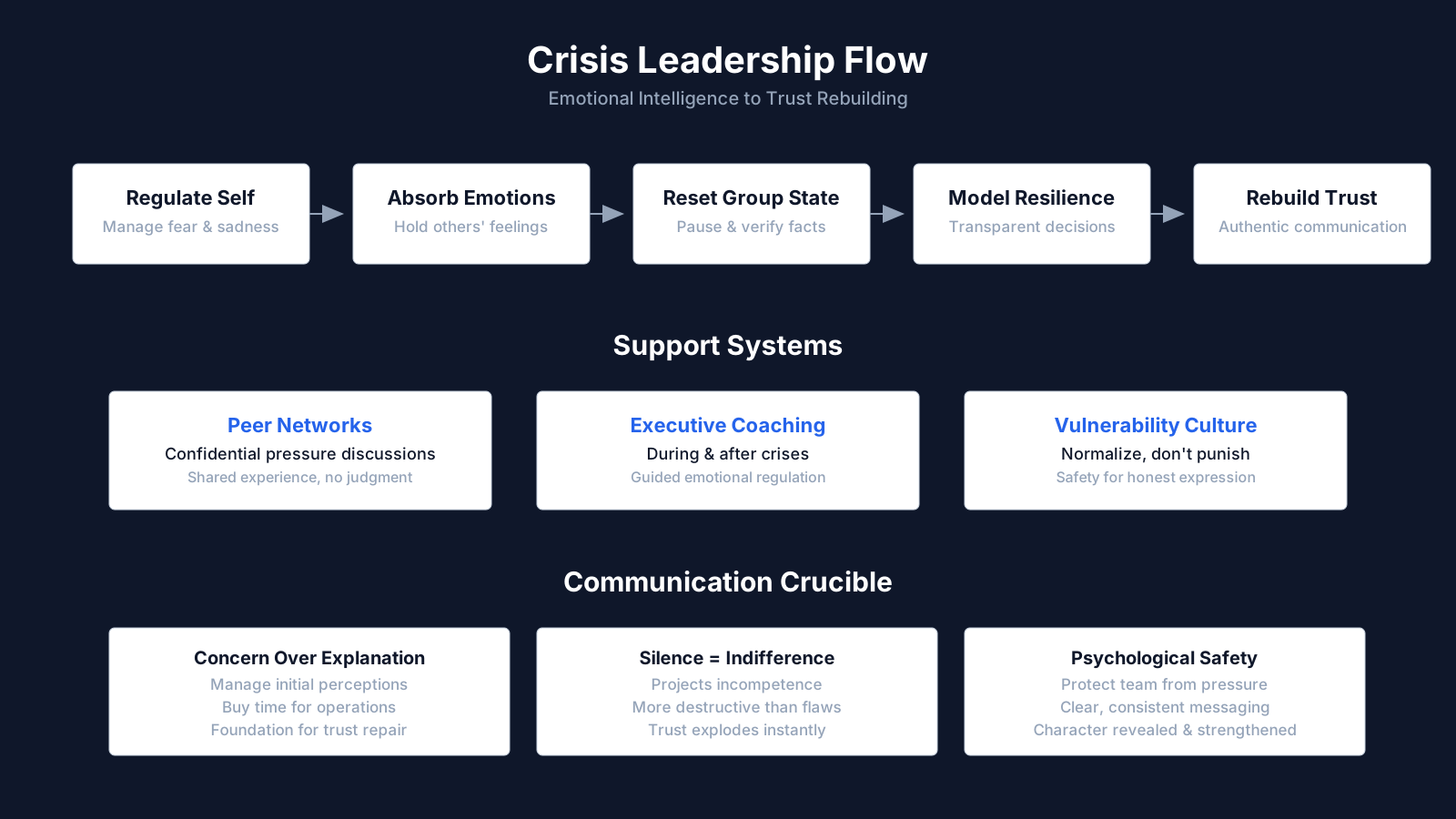
Amid all the frameworks, plans, and digital tools, the art of crisis communication remains an intensely human endeavor. The executive who must deliver a public apology after a tragedy that involved loss of life, or the plant manager who has to face a community meeting after a chemical leak, carries an immense emotional burden. Navigating turmoil at this level demands exceptional emotional intelligence: the ability to regulate one’s own fear and sadness while simultaneously absorbing the emotions of others. Leaders who neglect their own psychological preparedness risk burnout, poor decision making, and a communication style that becomes brittle or detached.
Organizations that value sustainable leadership invest in crisis leadership support systems. This includes peer networks where leaders can confidentially discuss the pressures they face, access to executive coaching during and after crises, and a culture that normalizes vulnerability rather than punishing it. After all, a leader who can genuinely express “This has been one of the hardest weeks of my career, and I am deeply sorry for the pain we have caused” without losing composure channels that authentic emotion into trust building. The sterile, robotic leader who shows no emotion is no longer credible in a world hungry for authenticity.
Managing the Emotional Contagion Within Your Team
Leaders also play a critical role in managing the emotional climate of the crisis management team itself. When anxiety, blame, and panic ripple through the war room, cognitive bandwidth collapses and communication cohesion fractures. The artful leader becomes an emotional thermostat, projecting calm curiosity rather than frantic urgency. Simple phrases like “Let’s take a breath and verify that before we respond” or “I need us to stay focused on the facts we know right now” can reset the group’s emotional state. Encouraging short breaks, ensuring people eat and hydrate, and rotating roles during prolonged crises prevent the exhaustion that leads to communication errors.
This dimension of crisis communication is often overlooked in corporate training, yet it is arguably the foundation upon which all other elements rest. A well-designed plan in the hands of a panicked team is useless. A leader who models resilience, makes decisions transparently, and protects the team from outside political pressures creates the psychological safety necessary for clear, consistent communication. In this sense, the art of crisis communication is inseparable from the art of crisis team leadership.
Conclusion: Why Mastery of This Art Defines the Next Generation of Leaders
Navigating turmoil will never be a desirable activity, but it is an inevitable aspect of organizational life in an interconnected, volatile world. The leaders who thrive in this environment are not those who have the most clever PR tricks or the largest legal budgets. They are the ones who have internalized the art of crisis communication as a deeply human, strategically nuanced competency. They prepare relentlessly, yet remain flexible. They speak with precision, yet never sacrifice warmth. They understand that every crisis is also a communication crucible, where the character of the organization is revealed and, if the moment is seized, strengthened.
The path to mastery is not mysterious. It begins with honest self-assessment, continues through structured learning and simulation, and is reinforced by a commitment to transparency, empathy, and continuous improvement. For the project manager, the HR director, the product lead, or the aspiring CEO, investing in this competency is not optional; it is a career imperative. When the next turmoil strikes, and it will, the question will not be whether you faced a crisis, but whether your communication led your stakeholders through it with their trust in you intact. That is the true art, and it is within the reach of every leader willing to practice it.
Core Insights on Crisis Leadership
- Inevitable organizational turmoil
- In today's volatile landscape, crises are not anomalies but certainties; leaders who excel in crisis communication convert these challenges into defining moments that clarify and strengthen their organization's essential character.
- Human and strategic competency
- The most effective crisis communicators merge deep empathy with strategic acumen, preparing relentlessly yet staying adaptable, and speaking with both precision and genuine warmth.
- Path to mastery
- Mastery of crisis communication starts with a candid evaluation of one's current capabilities, progresses through deliberate practice with realistic simulations, and is sustained by an unwavering commitment to transparency, empathy, and ongoing refinement.
- Career imperative for leaders
- For project managers, HR directors, product leads, and aspiring CEOs, crisis communication competency is no longer optional; it has become a defining career imperative that distinguishes resilient leaders from the rest.
- True art of communication
- The ultimate measure of a crisis leader is not the storm itself but the ability to communicate so effectively that stakeholders emerge with trust not only intact but deepened, a competency within reach of any committed leader.
Advance Your Career with Professional Certification
In an era where organizational landscapes shift unexpectedly, a project management certification equips professionals with the structured methodologies needed to steer complex initiatives through ambiguity. This credential not only validates your expertise in budget control, timeline management, and risk mitigation but also signals to employers a proven ability to deliver results under pressure—a crucial asset during crises. Certified project managers often bridge communication gaps between stakeholders, ensuring that even in turmoil, strategic objectives remain clear and achievable. Ultimately, investing in this certification accelerates career advancement while strengthening your organization’s resilience and capacity for successful change execution.
In today's fast-paced business landscape, obtaining a professional product management certification can significantly accelerate your career by validating your expertise in strategic planning, market analysis, and cross-functional leadership. Such credentials not only boost your credibility with stakeholders but also equip you with modern frameworks to drive product success, making you an invaluable asset for any organization aiming to innovate and stay competitive. Moreover, certified product managers consistently demonstrate stronger decision-making skills and are better prepared to navigate complex market challenges, ultimately leading to higher customer satisfaction and business growth.
Professional HR management certification is a pivotal investment that distinguishes you in a competitive job market, signaling deep expertise and dedication to the field. Becoming a certified HR manager not only accelerates your career trajectory but also empowers you to implement best practices that enhance workplace culture and employee engagement. This credential equips leaders to navigate legal complexities and drive strategic workforce planning, directly contributing to organizational resilience and long-term success.
Applying the Principles of High-Reliability Organizations
The most effective crisis communication strategies draw from the operational mindset of high-reliability organizations (HROs) — entities like nuclear power plants and air traffic control systems that operate under near-zero error tolerance. A core tenet of HRO theory is "preoccupation with failure," which in a crisis communication context means leaders must proactively anticipate the worst-case interpretations of their messages before they speak. When a leader issues a statement, they should mentally simulate how it would sound if every ambiguous phrase were taken out of context and magnified by a hostile audience. This foresight prevents the common pitfall of offering false reassurance or incomplete data, which erodes trust far more quickly than a candid admission of uncertainty.
Another HRO principle directly applicable to crisis communication is "deference to expertise." In the chaos of a developing crisis, the natural organizational hierarchy often slows down decision-making, as executives wait for perfect information. However, a modern crisis demands that communication authority be pushed to the front line — to the subject matter experts who understand the technical nuances of the problem. A leader’s role is not to dictate every word of the public response but to empower the engineers, data security officers, or legal counsel who can speak with precision. By deferring to these experts in press briefings and internal updates, the organization signals competence and avoids the credibility-destroying spectacle of a CEO fumbling through technical details they clearly do not grasp.
Finally, the HRO commitment to "reluctance to simplify" reminds communicators that crises are rarely caused by a single, neat failure. Stakeholders can detect when a leader is offering a simplistic narrative to deflect blame. Instead of reducing a complex system failure to a "rogue employee" or a "one-time glitch," effective crisis communicators acknowledge the layered nature of the breakdown. This nuanced honesty does not weaken the organization; it demonstrates a sophisticated understanding of risk and a genuine commitment to systemic improvement, which are the very qualities that begin to rebuild shattered confidence.