In a world where organizational agility is no longer a luxury but a necessity for survival, many professionals find themselves trapped between the simplicity of textbook Scrum and the messy reality of enterprise delivery. You have likely witnessed teams that practice all the ceremonies but still struggle with missed deadlines, conflicting stakeholder demands, and processes that feel more like a straightjacket than a support system. This is precisely where the Disciplined Agile Scrum Master (DASM) certification enters the picture, offering a pragmatic and context-sensitive approach that moves far beyond prescriptive frameworks. Unlock DASM certification and your Agile mastery roadmap will shift from following a single recipe to becoming a versatile chef who can create value with whatever ingredients the organization provides, much like the context-driven strategies in the Agile Essentials: A Manager's Guide to Core Concepts .
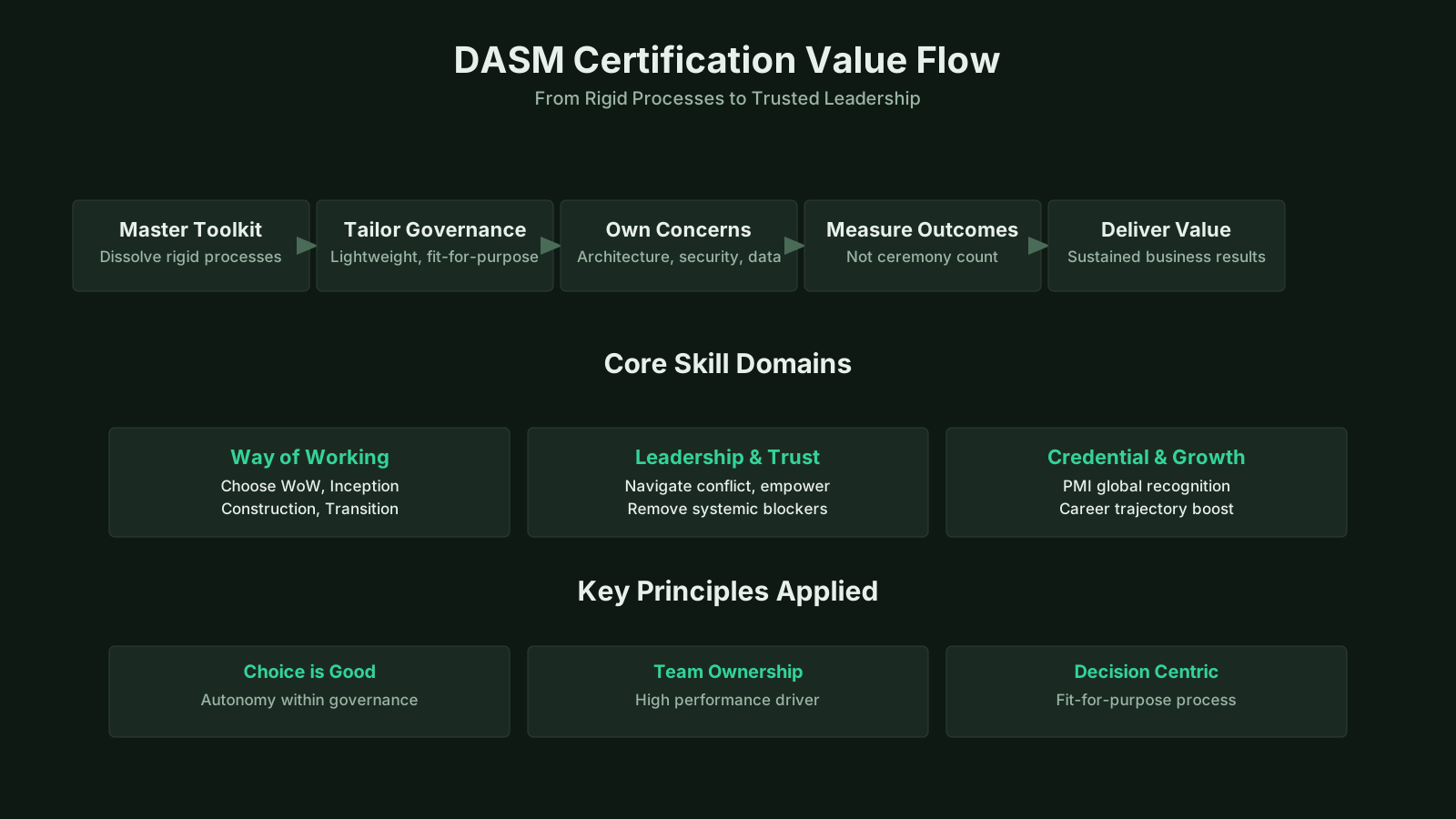
DASM Certification Roadmap: Key Topics at a Glance
| Key Concept | Summary |
|---|---|
| DASM Certification | PMI’s Disciplined Agile Scrum Master (DASM) certification equips professionals with a flexible, context-driven toolkit that transcends rigid Scrum frameworks, enabling teams to customize their delivery approach. |
| Disciplined Agile Framework | Disciplined Agile functions as a process-governance overlay, structuring proven practices into goal-oriented decision areas so teams can choose fit-for-purpose strategies without losing alignment with broader enterprise objectives. |
| Context Counts | The Disciplined Agile mindset asserts that genuine agility emerges from deliberate, context-specific decisions tailored to project dynamics, team composition, and organizational environment, rather than from dogmatic adherence to any one framework. |
| Certification Comparison | While conventional Scrum certifications concentrate narrowly on framework mechanics, DASM expands into lean principles, Kanban practices, and governance strategies, equipping practitioners to operate confidently within multifaceted enterprise settings. |
| Agile Mastery Roadmap | DASM charts a path to agile mastery by instructing professionals in contextual analysis and lifecycle selection, evolving their role from process watchdog to strategic enabler of business outcomes. |
| Choose Your WoW | The certification instills the principle of “Choose Your Way of Working” (WoW), empowering teams to select from agile, lean, exploratory, or hybrid lifecycles according to the realities of their work. |
| Enterprise Awareness | DASM confirms the holder’s capability to guide teams across the complete delivery lifecycle while maintaining enterprise-wide awareness, encompassing governance, value stream optimization, and cross-program coordination. |
| Leadership Skills | The curriculum deliberately develops interpersonal and servant leadership competencies, such as conflict resolution and exerting influence without formal authority, filling a gap commonly left by introductory certifications. |
| PMI Community | Issued by PMI, the DASM credential links professionals to a worldwide community and a respected continuing education framework, which enhances credibility with hiring decision-makers. |
| Complex Environments | DASM readies scrum masters to navigate complex environments involving multi-team coordination, legacy infrastructure, regulatory constraints, and competing stakeholder needs by instilling adaptable process decision-making. |
What Exactly Is the DASM Certification?
The Disciplined Agile Scrum Master (DASM) certification is a foundational credential from the Project Management Institute (PMI) that addresses the need for agile team leads and scrum masters to operate effectively in diverse, often non-ideal environments. Unlike certifications that focus narrowly on the Scrum guide, DASM equips you with the Disciplined Agile (DA) toolkit, which is a hybrid framework designed to help teams choose their own way of working based on the context they face. When you unlock DASM certification, you demonstrate that you understand how to tailor your approach, whether your team needs elements of lean, traditional project management, or scaled agile practices. The certification validates your ability to lead a team through the full delivery lifecycle, from inception to transition, with an enterprise awareness that many introductory agile credentials simply ignore. This includes fostering an atmosphere of psychological safety, as detailed in Cultivating Courageous Teams: A Leader’s Roadmap to Psychological Safety .
PMI launched the DASM certification to fill a growing gap in the market between knowing how to facilitate a daily standup and understanding how to make intelligent process decisions on a real project. For those refining their facilitation skills, Speak Less, Connect More: Why Silence Wins Conversations offers complimentary insights. The certification is not just about the scrum master role in isolation; it places that role within the broader context of enterprise agility, governance, and value stream management. By earning the DASM, you signal to employers that you can help a team navigate the complexities of modern software development, product management, and business transformation without getting stuck in dogmatic debates about pure Scrum. Scrum masters can also leverage the Unlock Star Potential: The Skill Will Matrix Guide to tailor their coaching to each team member’s development stage.
The Disciplined Agile Framework: A Brief Overview
To grasp the value of the DASM certification, you need to appreciate the Disciplined Agile framework itself. Disciplined Agile is not a single methodology but a decision-making process layer that sits on top of existing agile, lean, and traditional practices. It acknowledges that every team and project is unique, and that blindly applying one set of practices often leads to frustration and suboptimal results. DA organizes practices into a goal-based taxonomy, allowing teams to select strategies that fit their specific challenges while remaining aligned with organizational objectives and governance requirements. This framework was originally developed by Scott Ambler and Mark Lines and later acquired by PMI, which has since integrated it into its broader agile portfolio.
The DA mindset is built on principles like delighting customers, being awesome, context counts, and optimizing flow across the entire organization. It emphasizes that true agility emerges not from following a script but from making informed choices at every stage of the delivery lifecycle. DASM certification introduces you to this mindset and gives you the vocabulary and tools to apply it as a team facilitator. Rather than replacing Scrum, it enhances your ability to see where Scrum is sufficient and where you need to borrow from other sources, such as Kanban for service delivery or SAFe for coordinating across large programs.
How Unlock DASM Certification Differs from Other Scrum Master Certifications
Many aspiring agilists wonder how the DASM credential stacks up against well-known alternatives like the Certified ScrumMaster (CSM) from the Scrum Alliance or the Professional Scrum Master (PSM) from Scrum.org. The most significant differentiator is scope. Traditional scrum master certifications focus almost exclusively on the mechanics of Scrum: roles, events, artifacts, and the empirical process. While this provides a solid foundation, it often leaves practitioners unprepared for the reality that most organizations do not, and cannot, practice pure Scrum across all their teams. When you unlock DASM certification, you gain a roadmap that guides you beyond the Scrum guide and into the nuanced territory of tailorable agile delivery.
DASM covers Scrum in depth but also introduces lean principles, Kanban, and even lightweight governance strategies that are critical when working in regulated industries or large enterprises. Another difference lies in its treatment of the team lead role. The DASM curriculum explicitly addresses the interpersonal and leadership skills required to foster a high-performing team, manage conflict, and influence without authority, whereas some other entry-level certifications spend less time on the servant leadership dimension. Furthermore, because DASM is issued by PMI, it connects you to a massive global community and a well-established continuing education and professional development infrastructure that many hiring managers recognize instantly.
Core Insights on DASM Certification
- Foundational PMI Credential
- This foundational PMI credential introduces the Disciplined Agile toolkit, empowering team leads and scrum masters to navigate complex, diverse work environments effectively.
- Hybrid Framework Focus
- This certification promotes a hybrid mindset that enables teams to blend lean principles, traditional project management techniques, and scaled agile practices into a tailored approach, rather than enforcing a single framework.
- Enterprise Awareness Emphasis
- It validates a leader’s ability to guide teams through the entire delivery lifecycle while balancing enterprise needs, such as building psychological safety and meeting governance standards.
- Broader Scope Than Alternatives
- DASM sets itself apart by covering Scrum comprehensively and also incorporating lean, Kanban, and governance strategies, making it especially suited for regulated industries and large-scale organizations.
Why DASM Is Your Agile Mastery Roadmap for Complex Environments
Agile mastery does not mean memorizing the twelve principles and reciting them to your team; it means cultivating the judgment to know which tool to use when the textbook answer is not available. The DASM roadmap guides you toward this level of mastery by teaching you to analyze the context of your project, team, and organization before prescribing any process. Complex environments often involve multiple teams, legacy systems, demanding compliance standards, and a mix of internal and external stakeholders who have conflicting priorities. A scrum master who only knows how to run a sprint retrospective will quickly become overwhelmed when asked to help plan a release that must coordinate with a waterfall-driven procurement department.
The DASM certification positions you to handle these challenges by grounding you in the concept of “choose your WoW” (Way of Working). You learn how to facilitate a team through the decision of which lifecycle to use, whether it be an agile basic lifecycle for a straightforward product, a lean continuous delivery lifecycle for a team supporting a service, or an exploratory lifecycle for a research and development initiative. This flexibility is precisely what makes DASM so valuable as an agile mastery roadmap; it transforms you from a process enforcer into an enabler of business value.
The Shift from Prescriptive Scrum to Contextualized Agile
Prescriptive frameworks provide comfort because they eliminate ambiguity. You have a daily scrum at this time, a sprint review at that time, and a product backlog that the product owner prioritizes. However, this prescriptive approach often cracks under the pressure of real-world constraints such as fixed release dates mandated by regulatory bodies or the need to integrate with a mainframe system that operates on a quarterly update cycle. The DASM curriculum explicitly addresses these scenarios by teaching you to evaluate the trade-offs involved in different decision points, which DA calls process goals. For example, how do you handle a change request that arrives in the middle of a sprint? Do you always insist on a dedicated product owner, or is it acceptable for a business analyst to play that role in certain contexts?
When you unlock DASM certification, you internalize the idea that there is no single best practice, only practices that are appropriate for your context. This shift is the essence of contextualized agile, and it represents a maturity leap for anyone who has been practicing cookie-cutter Scrum. Instead of feeling guilty about adapting a ceremony, you become equipped to adapt it deliberately, documenting your rationale and measuring the outcome. The roadmap thus elevates your professional identity from a Scrum rule-keeper to a situationally aware team coach who understands the principles behind the practices.
Embracing Enterprise Awareness and the Full Delivery Lifecycle
Another dimension of the DASM agile mastery roadmap is its focus on enterprise awareness and the entire delivery lifecycle, not just the construction phase. Most introductory agile certifications spend almost all their time on the development cycle: sprint planning, execution, review, and retrospective. Yet a team’s success is often determined by activities that happen before the first sprint or after the last one. DASM teaches you about the inception phase, where you align the team with a shared vision and define the initial architecture and release plan, and the transition phase, where you ensure the product is successfully deployed into production and supported by operations.
This enterprise awareness also extends to understanding how your team’s work fits into the broader value stream. You will learn to identify upstream dependencies, coordinate with other teams, and align your delivery cadence with business planning cycles. In many organizations, the failure to bridge the gap between agile teams and traditional governance bodies creates friction and slows down value delivery. The DASM certification equips you with strategies to navigate this tension, making you a more effective and politically savvy leader who can advocate for agility without alienating the parts of the organization that are not yet ready to change.
Building a Pragmatic, Hybrid Mindset
The future of project management and product delivery is hybrid. Organizations will continue to blend agile, waterfall, and lean practices based on the nature of their work, regulatory constraints, and cultural preferences. A professional who rigidly adheres to a pure methodology will increasingly be seen as an obstacle rather than a solution. The DASM roadmap intentionally cultivates a pragmatic, hybrid mindset by exposing you to a wide array of practices and asking you to think critically about when to apply each one. You might use a Gantt chart to communicate a high-level milestone plan to executives while using a Kanban board to manage the team’s daily flow.
This hybrid mindset is not a compromise; it is a sophisticated response to complexity. Unlocking DASM certification gives you the language and legitimacy to operate in this hybrid world without feeling like you are betraying agile values. You learn to see agile as a philosophy of continuous improvement and customer focus that can be expressed through many different practices, some of which might include formal risk assessments, chartering documents, or even phase gates if the situation demands it. The certification validates your ability to be guided by principles rather than bound by rules, which is the hallmark of true mastery.
What the DASM Certification Covers: Core Learning Objectives
The official DASM curriculum is structured around a set of learning objectives that build upon one another to create a comprehensive understanding of agile team facilitation within a disciplined context. The training course, which is a mandatory prerequisite for the exam, takes you through the DA mindset, the fundamentals of agile and lean, how to choose the right lifecycle, and how to build and support a high-performance team. Each module is designed to be immediately applicable, so you can take the concepts back to your workplace and start experimenting with them on your current project. When you unlock DASM certification, you are not just passing a test; you are internalizing a decision-oriented approach to team leadership.
The content emphasizes practical application over theory. You will engage with case studies and scenarios that force you to make choices given limited information, much like you would on a real project. These exercises are critical because they help you develop the judgment that no multiple-choice exam can fully assess. The learning objectives are aligned with the broader PMI talent triangle, covering technical project management skills, strategic and business management, and leadership. This alignment ensures that your credential is recognized not just by agile specialists but by senior executives who think in terms of business outcomes.
Mastering the Disciplined Agile Mindset and Principles
The first major learning objective of the DASM course is internalizing the seven principles of the Disciplined Agile mindset: delight customers, be awesome, context counts, be pragmatic, choice is good, optimize flow, and enterprise awareness. These principles form the foundation for every decision you make as a Disciplined Agile Scrum Master. Delighting customers goes beyond mere satisfaction; it encourages you to actively seek out ways to exceed expectations and understand the underlying needs driving a requirement. The principle of being awesome is about personal and team accountability, inspiring you to continuously improve your skills and the team’s capabilities.
Context counts is perhaps the most revolutionary principle for those accustomed to prescriptive frameworks. It reminds you that no two situations are identical and that a practice that works for a co-located startup team might fail miserably for a distributed team in a heavily regulated industry. Being pragmatic means recognizing your own limitations and the constraints of your organization while still striving to make things better. Choice is good reinforces the DA idea that having options is a strength, not a weakness. Finally, optimize flow and enterprise awareness push you to look beyond your own team to the entire value stream, ensuring that local optimizations do not create bottlenecks elsewhere.
Choosing Your Way of Working (WoW) with Lifecycles
A significant portion of the DASM certification focuses on the various team lifecycles available within Disciplined Agile and how to select the most appropriate one. The agile lifecycle, which most closely resembles Scrum, is suitable for teams building a new product with evolving requirements. The lean lifecycle, with its emphasis on continuous delivery and Kanban, is often better for teams that work on a steady stream of enhancements or operational support. The continuous delivery lifecycle pushes the team toward extreme automation and zero-touch deployments, ideal for mature DevOps environments. The exploratory lifecycle, sometimes called the “lean startup” lifecycle, is designed for teams experimenting with a hypothesis under high uncertainty.
Choosing the right lifecycle is not a one-time event at the beginning of the project; as a Disciplined Agile Scrum Master, you will help the team revisit this choice at regular intervals or when the context shifts significantly. The DASM roadmap provides you with decision filters to make these choices objective and transparent. For example, you might consider the rate of requirement change, the criticality of the system, the team’s maturity, and the organization’s tolerance for uncertainty. By mastering this aspect of the curriculum, you become the go-to person who can explain why the team is using a particular approach and what conditions would trigger a change, thus building trust with stakeholders who are used to hearing only “that’s not Scrum.”
Understanding Roles, Teams, and the DA Toolkit
The DASM certification also delves into the specific roles on a Disciplined Agile team and how they interact to deliver value. You will revisit familiar roles such as the product owner, team member, and stakeholder, but you will see them through a more flexible lens. For instance, the product owner role might be split between a strategic product owner who defines the vision and a tactical product owner who works day-to-day with the team. The DASM role itself is defined as a leader who serves the team and the organization, removing impediments, facilitating ceremonies, and coaching others in the DA mindset. Unlike some frameworks that restrict the scrum master to a single team, DASM acknowledges that a skilled practitioner might support multiple teams or even take on additional responsibilities like agile coaching.
Beyond roles, the course introduces the extensive DA toolkit, which is a catalog of proven practices organized by process goals. You will learn how to navigate this toolkit to find options for forming the team, planning the release, managing risks, and coordinating activities. The toolkit is vast, but the DASM level equips you with the ability to access it intelligently without feeling overwhelmed. The goal is not to memorize every practice but to develop the skill of using the toolkit as a reference when your team faces a specific problem. This research-oriented approach is the opposite of being handed a one-size-fits-all checklist and is a key reason why the DASM certification serves as a true agile mastery roadmap.
Core Takeaways on DASM Learning Objectives
- Practical Application Over Theory
- The curriculum integrates immersive case studies and real-world simulations to cultivate judgment skills that directly translate into effective decision-making on workplace projects.
- Seven Disciplined Agile Principles
- Mastering principles such as 'Delight Customers,' 'Context Counts,' and 'Optimize Flow' builds the decision-making foundation that guides the Disciplined Agile Scrum Master in every situation.
- Selecting the Right Lifecycle
- The certification equips you to assess team context and the degree of project uncertainty in order to select the most suitable lifecycle from agile, lean, continuous delivery, and exploratory approaches.
- Flexible Team Roles and Toolkit
- You will develop the skill to customize roles, such as product owner and stakeholder, to match your team's unique context, leveraging the comprehensive DA toolkit to drive consistent value delivery.
How to Get DASM Certified: A Step-by-Step Roadmap
Embarking on the journey to unlock DASM certification is straightforward, but it requires a commitment to learning and a strategic plan. Unlike some certifications that allow you to study independently and schedule an exam at any time, DASM mandates a formal training component to ensure that every credential holder has a consistent baseline of knowledge and practical exercises. This structure also means that employers can trust the certification as a reliable indicator of a certain level of competence. The path involves meeting basic prerequisites, taking an authorized training course, and passing a proctored online exam.
The entire process can be completed in as little as a few weeks if you are dedicated, though many professionals spread it over a month or two to allow time for reflection and hands-on application. The investment is not just financial; you will need to set aside dedicated hours for the two-day training and at least several evenings for review before the exam. However, the return on this investment is a credential that immediately enhances your professional credibility and opens doors to roles that explicitly ask for hybrid agile experience. Let us now walk through each stage in detail so you know exactly what to expect and how to prepare.
Prerequisites and Who Should Pursue This Certification
The DASM certification has minimal formal prerequisites, which makes it accessible to a wide range of professionals. There are no mandatory years of experience or prior certifications required, though PMI recommends that candidates have a basic understanding of agile concepts. This openness is intentional, as DASM is designed to be a starting point on the Disciplined Agile pathway. It is ideal for new scrum masters who want to begin their career with a pragmatic, enterprise-ready skill set, as well as for experienced practitioners who have been using Scrum for years and want to broaden their toolkit beyond the basics. Project managers transitioning from a waterfall background will find DASM to be a gentle but comprehensive introduction to agile thinking that does not force them to abandon their hard-earned planning expertise.
Team leads, business analysts, product owners, and even technical leads often pursue the DASM certification to better understand their role within a flexible delivery ecosystem. Because the certification emphasizes team dynamics and leadership, it is also valuable for anyone who aspires to move into a management position in an agile organization. If your goal is to unlock DASM certification and use it as a stepping stone toward more advanced credentials like the Disciplined Agile Senior Scrum Master (DASSM) or the Disciplined Agile Coach (DAC), this is the logical starting point. The practical nature of the training means that even professionals with years of experience often report gaining new insights and a fresh perspective on challenges they have been facing for a long time.
The Required Training Course and Authorized Providers
A non-negotiable step in your agile mastery roadmap is completing a two-day, PMI-approved DASM training course. This course is offered by a network of PMI Authorized Training Partners (ATPs) around the world, both in live virtual classrooms and sometimes in person. The training is not just a lecture; it includes group exercises, simulations, and facilitated discussions that bring the Disciplined Agile concepts to life. In choosing a provider, you should look beyond price and consider the instructor’s real-world experience in agile transformation. An instructor who has personally navigated the messy reality of enterprise agile adoption can offer stories and insights that make the curriculum much more memorable and applicable.
During the two days, you will explore the DA mindset, the process blades, the lifecycle choices, and the structures of a Disciplined Agile team. You will likely work through a case study that simulates a team trying to deliver under challenging constraints, forcing you to make the types of contextual decisions that DASM is all about. Upon completing the course, you will receive an exam eligibility code that allows you to schedule your test. Many providers include the exam fee as part of a bundled package, which simplifies the logistics and often reduces the overall cost compared to purchasing the course and exam separately.
Navigating the DASM Exam: Format, Tips, and Sample Concepts
After your training, the next milestone on your roadmap to unlock DASM certification is the exam itself. The DASM exam is a closed-book, online proctored test that lasts up to 90 minutes. It contains fifty multiple-choice questions that cover the breadth of the learning objectives, with a focus on scenario-based items that require you to apply the DA principles rather than merely recall facts. You must answer enough questions correctly to meet the passing threshold, which PMI sets based on psychometric well thought out standards. The questions are designed to test your ability to think like a Disciplined Agile Scrum Master, so you will often be presented with a situation and asked to choose the best way forward.
To prepare effectively, do not rely solely on memorizing the slides from your training. Instead, focus on understanding why certain choices are recommended and what trade-offs they involve. Revisit the official DA website and the “Choose Your WoW” interactive guide, which lets you explore different process goals and the options available for each. Creating your own mind maps that connect principles to lifecycles to roles can solidify the relationships. On exam day, read each question carefully to identify the context clues that signal which DA principle or goal is most relevant. The scenario may describe a team in a highly controlled industry facing shifting requirements; your answer should reflect enterprise awareness and pragmatism rather than a dogmatic insistence on change. Time management is usually not an issue if you are well prepared, but flagging questions for review and returning to them can help you maintain confidence.
Maintaining Your Certification and Renewal Requirements
Once you unlock DASM certification, your commitment to ongoing learning does not end. PMI requires all certification holders to earn a certain number of professional development units (PDUs) over a three-year cycle to maintain their credential. For DASM, you must earn seven PDUs specifically in agile topics, which encourages you to stay current with evolving practices and to continue developing your skills. PDUs can be earned through a variety of activities, including attending webinars, reading books and articles, participating in conferences, completing further training, or even creating content and presenting to your local PMI chapter. This requirement ensures that the certified community remains active and knowledgeable, not resting on a credential obtained years ago.
Renewing your DASM certification also keeps you aligned with the broader PMI ecosystem, which can be advantageous if you decide to pursue additional certifications like the PMP or the Disciplined Agile Value Stream Consultant. The PDUs you earn can often be applied to multiple credentials simultaneously, making your learning efforts more efficient. From a career perspective, hiring managers and clients know that a current DASM credential signals recent engagement with the agile community, not just a one-time test-taking event. Therefore, seeing renewal not as a chore but as an integral part of your agile mastery roadmap will help you sustain the professional identity you have built.
The Career Impact of Unlocking DASM Certification
The decision to invest in DASM certification is ultimately a career decision, and it is important to understand the tangible and intangible benefits that this credential can bring. Employers across industries are increasingly looking for agile professionals who can adapt to their existing processes rather than demand a greenfield transformation. In many job postings for scrum master, agile project manager, or team coach, you will now see explicit mention of Disciplined Agile or hybrid agile experience. By holding a DASM certification, you differentiate yourself from the large pool of candidates who have only basic Scrum knowledge and you demonstrate that you can add value from day one in a complex enterprise setting.
The impact on your career extends beyond the job search. Professionals who have unlocked DASM certification frequently report greater confidence in meetings with senior stakeholders, because they can frame agile decisions in terms of business outcomes and risk mitigation rather than process dogma. This confidence translates into stronger influence, more visibility for their team’s successes, and faster career progression into roles such as agile program manager, release train engineer, or enterprise coach. The certification acts as a signal that you are not just a doer but a thinker, someone who can guide a team and an organization through the maze of modern delivery.
From Scrum Master to Disciplined Agile Leader
One of the most profound career shifts that DASM facilitates is the transition from being seen as a scrum master who runs meetings to being recognized as a Disciplined Agile leader who drives team performance and continuous improvement. Traditional scrum master roles can sometimes be marginalized in organizations that view them as administrative coordinators. The DASM certification reframes the role by connecting it to enterprise governance, value stream optimization, and strategic choice. You learn to speak the language of business leaders, making the case for agile practices in terms of return on investment, cycle time reduction, and quality improvement.
As a Disciplined Agile leader, you will be invited into conversations about team structure, tooling strategy, and how to coordinate across multiple teams. Your certification gives you the credibility to propose experiments that go beyond basic Scrum, such as introducing Kanban metrics like lead time distribution or conducting a value stream mapping exercise with the group. The leadership skills you develop through DASM, including emotional intelligence, conflict resolution, and coaching mindset, prepare you to handle the human side of agile adoption, which is often more challenging than the process side. Many DASM holders find themselves taking on internal coaching roles or leading communities of practice, further cementing their reputation as organizational change agents.
Salary Expectations and Market Demand for DASM Professionals
While certification alone does not guarantee a higher salary, market data consistently shows that professionals with agile credentials from recognized bodies like PMI command compensation premiums over their non-credentialed peers. The DASM certification signals a specialized and up-to-date skill set that is directly applicable to the challenges organizations are facing today, such as managing remote distributed teams, complying with regulations while staying nimble, and integrating agile with traditional portfolio management. According to various industry salary surveys, scrum masters and agile team leads with hybrid or disciplined agile experience often fall into a higher salary band than those with only basic scrum credentials.
Demand for DASM professionals is particularly strong in sectors like financial services, healthcare, insurance, and government, where pure Scrum is difficult to implement due to compliance and legacy infrastructure. These industries need agile practitioners who can work within constraints rather than pretend they do not exist. As more enterprises adopt the PMI ecosystem for their project management standards, the DASM certification is becoming a required or preferred qualification on a growing number of job requisitions. By unlocking DASM certification early in this trend, you position yourself to take advantage of the expanding market before the credential becomes commonplace.
Integrating DASM with Other Agile Credentials
You do not have to choose between DASM and other agile certifications; in fact, many seasoned professionals hold a combination that tells a compelling story about their development. A common and powerful pairing is to hold a Certified ScrumMaster (CSM) or PSM along with a DASM. The CSM or PSM provides deep, focused knowledge of the Scrum framework, while the DASM adds the contextual, scaling, and enterprise dimensions. Together, they demonstrate that you are both a master of the core ceremonies and an adaptive leader who knows when and how to go beyond them. Similarly, if you already have a PMP, adding DASM shows that you have updated your traditional project management expertise with modern, agile-friendly approaches.
Another integration path is to use DASM as a stepping stone to the Disciplined Agile Senior Scrum Master (DASSM) or the Disciplined Agile Coach (DAC) certifications. These advanced credentials delve into scaling, organizational transformation, and coaching stances, building on the foundation you established. From a personal branding perspective, having multiple complementary credentials allows you to tailor your resume to the specific job description. You can highlight your DASM when the role calls for enterprise awareness and your PSM when the focus is on deep Scrum mastery. This strategic layering of certifications is a hallmark of a professional who takes their agile mastery roadmap seriously.
Key Career Takeaways from DASM Certification
- Differentiation in the job market
- A DASM certification differentiates you from candidates limited to foundational Scrum skills by validating your ability to deliver measurable value in adaptive, enterprise-wide environments.
- Greater stakeholder confidence
- DASM-certified professionals gain the credibility to lead high-stakes stakeholder conversations, translating agile choices into clear business impact and risk-mitigation strategies.
- Shift to agile leadership roles
- This credential redefines your role from meeting facilitator to a Disciplined Agile leader who orchestrates team performance, fosters continuous improvement, and aligns delivery with organizational goals.
- Higher salary potential
- Industry benchmarks show that DASM certification holders earn a measurable salary premium, particularly in sectors like finance and healthcare where agile credentials carry heightened regulatory weight.
- Synergy with other certifications
- Pairing DASM with CSM or PSM constructs a compelling profile that showcases operational Scrum mastery alongside the strategic, enterprise agility competencies today's organizations demand.
Common Myths and Misconceptions About DASM
As with any credential that challenges the status quo, the DASM certification has attracted its share of myths that can mislead aspiring agilists. Some of these misconceptions arise from a superficial understanding of what Disciplined Agile is, while others stem from the natural resistance to frameworks that seem to threaten the purity of beloved methodologies. Addressing these myths head-on is essential because they can prevent you from making an informed decision about your agile mastery roadmap. Let us unpack three of the most pervasive misunderstandings and examine what the reality actually looks like in practice.
Myth 1: DASM Is Just Another Basics Course
It is tempting to look at the DASM certification and assume that it covers the same foundational material as any entry-level agile credential, just with a different badge. This myth probably originates from the fact that DASM does include Scrum fundamentals, but that is only one part of a much larger curriculum. What sets DASM apart is its relentless focus on context and decision-making. While a basic course might teach you the definition of a sprint review, DASM teaches you situations in which you might choose a different inspection cadence entirely, or how to handle a review when key stakeholders cannot attend. You come away with a framework for evaluating practices, not just a list of them.
The interactive, case-study-driven training format reinforces that DASM is not a simple lecture on agile 101. Participants are challenged to deal with ambiguous scenarios that mirror real workplace frictions, such as balancing the team’s desire for technical excellence with the product owner’s urgent request for a minimum viable product. The certification exam itself requires application-level thinking, not rote recall. So, while it is accurate to call DASM an entry point into the Disciplined Agile ecosystem, it is misleading to dismiss it as simplistic. It is foundational in the sense that a solid architectural foundation supports the entire building, not in the sense of being watered down.
Myth 2: Disciplined Agile Is Too Complicated for New Practitioners
On the opposite end of the spectrum, some people believe that the Disciplined Agile framework, with its vast toolkit and process blades, is overwhelming for someone who is new to agile. They worry that introducing concepts like the continuous delivery lifecycle or enterprise awareness too early will confuse rather than empower. This concern is understandable, but the DASM curriculum is carefully scoped to be digestible for newcomers. The training does not dump the entire DA toolkit on you at once; instead, it introduces the mindset and a manageable subset of the most applicable goals and practices. The emphasis is on learning how to use the toolkit as a reference, not on memorizing its contents.
Moreover, many new practitioners actually find it freeing to know that they do not have to be perfect at Scrum before learning about alternatives. They enter the workforce with a realistic outlook from day one, bypassing the disillusionment that often hits when pure Scrum meets corporate reality. When you unlock DASM certification as a relative newcomer to agile, you are given a mental model that accommodates complexity rather than pretending it does not exist. The result is often a faster path to competence because you are not unlearning dogma later. So rather than being too complicated, DASM provides the right level of guidance for smart newcomers who appreciate honesty about the messiness of delivery.
Myth 3: You Must Abandon Scrum to Embrace DA
Perhaps the most damaging myth is the idea that adopting Disciplined Agile and earning a DASM certification means you have to leave Scrum behind. This is entirely false and stems from a zero-sum view of frameworks. Disciplined Agile was designed to incorporate and honor Scrum, not to replace it. In fact, the DA agile lifecycle is essentially Scrum enhanced with guidance on activities outside the core sprint loop. You can, and many organizations do, use Scrum exactly as described in the Scrum Guide while using DA thinking to make decisions about how to scale, how to govern, and how to coordinate with non-agile teams.
The DASM certification explicitly respects the value of Scrum and does not require you to denounce your Scrum master credentials or practices. What it does ask is that you remain open to the possibility that Scrum might not be the perfect fit for every situation your team encounters. You might use Scrum for new product development but rely on Kanban for bug fixes and operational tasks. Your team can still hold daily standups, plan sprints, and run retrospectives, but you will now do so with an enhanced awareness of why those practices serve your specific context and what else might be needed. This is not abandonment; it is ecological integration of the best tools available.
A Pragmatic Look at the Unlock DASM Certification Roadmap: Limitations and Context
No certification, however well designed, is a silver bullet, and the DASM credential is no exception. It is important to approach this agile mastery roadmap with clear eyes about what it can and cannot do for your career and your team. The certification will equip you with a powerful decision-making framework and a vocabulary for discussing agility, but it cannot substitute for years of hands-on experience navigating organizational politics, resistant cultures, and deeply entrenched legacy processes. To get the full value, you need to view DASM as a beginning, a platform from which you will continue to learn and grow through deliberate practice, mentoring, and reflection.
There are also situations where the immediate pursuit of DASM might not be the most strategic move. If you are currently in a role that demands only execution of well-defined Scrum ceremonies under the direction of an experienced agile coach, you might benefit from first deepening your Scrum mastery and then coming back to DASM when you have the organizational exposure to appreciate the broader context. Similarly, if your organization has standardized on another framework like SAFe and has no intention of deviating, you might find more immediate career traction in a SAFe credential, though the DASM mindset will still make you a more insightful practitioner. Acknowledge these nuances and plan your roadmap accordingly.
When DASM Might Not Be the Right Immediate Step
Context, as Disciplined Agile itself teaches us, is everything. If you are a recent graduate with no work experience at all, the full value of DASM might be somewhat abstract because you lack the real-world situations in which the decision-making framework becomes vivid. In such cases, combining the certification with an internship or a junior scrum master role where you can actively practice is essential. Alternatively, you might choose to first earn a basic Scrum certification to build your confidence in the core ceremonies, then pursue DASM after six months when you have begun to see the limits of vanilla Scrum. This staged approach can make the DA concepts land more concretely because you will have your own stories of process friction to connect them to.
Another consideration is organizational recognition. While PMI certifications are globally respected, some employers may still be more familiar with the Scrum Alliance or Scrum.org brands. If your target company specifically lists a CSM or PSM as a requirement, then pursuing one of those first could be pragmatic, followed by DASM to differentiate yourself. The key is to make intentional choices about your agile mastery roadmap rather than chasing credentials for their own sake. The DASM certification is a strategic asset when deployed thoughtfully within a broader career and learning plan, not a standalone career accelerator.
The Importance of Real-World Practice Beyond Certification
Passing the DASM exam and adding the badge to your email signature is a milestone, but it is not the destination. The true value of the certification is unlocked only when you begin applying the Disciplined Agile mindset in your daily work. This means facilitating deliberate conversations with your team about why you hold certain ceremonies, whether they are still useful, and what else might serve your goals. It means creating a team charter that explicitly states your chosen way of working and the conditions under which you would revisit that choice. It also means educating stakeholders about why your team might not follow the Scrum they read about in a book and helping them see the benefits of your tailored approach.
Seek out opportunities to practice in low-risk settings first. Volunteer to map out the value stream for a small internal tool project or propose a retrospective experiment that borrows from a lean practice. Over time, you will develop the tacit knowledge that no exam can measure. This hands-on experience, combined with the structured learning from DASM, creates a powerful feedback loop. You will encounter a problem, recall a process goal from the DA toolkit, try an option, and observe the results. Iteration after iteration, you become the agile master you envisioned when you first set out to unlock DASM certification. The roadmap is only as good as the miles you travel on it.
Core Realities of the DASM Roadmap
- Certification Is Not a Silver Bullet
- The DASM certification equips you with a structured decision-making model and a common agile language, but it cannot substitute for the hands-on experience essential for navigating political landscapes, resistant cultures, and entrenched legacy processes.
- Know When to Delay Pursuing DASM
- When you have limited hands-on experience, occupy a role limited to executing Scrum ceremonies, or work in an organization fully committed to SAFe, gaining practical exposure or a more targeted credential may be the wiser first step.
- Practice Is Essential Beyond the Exam
- DASM's lasting impact depends on embedding its mindset into daily practice through team charters, persistent stakeholder education, and low-risk experiments, which cultivate the tacit knowledge no exam can measure.
Conclusion: Charting Your Agile Mastery Journey with DASM
The search for a sustainable and effective way to deliver value in a world of constant change has led many professionals to a crossroads between the simplicity of prescriptive frameworks and the complexity of enterprise reality. The Disciplined Agile Scrum Master certification offers a way forward that does not force you to abandon the practices you know but instead empowers you to wield them with wisdom and discernment. As you unlock DASM certification, your agile mastery roadmap transforms from a set of rigid directions into a compass that guides you through any terrain. You learn to navigate the gray areas, to make trade-offs transparent, and to lead your team with confidence regardless of the methodology label your organization uses.
This journey is not about collecting another digital badge; it is about internalizing a mindset that will serve you for the rest of your career. The principles of Disciplined Agile, once truly absorbed, will change how you see every project, every team dynamic, and every organizational obstacle. You will find yourself asking “what is appropriate in this context” instead of “what is the rule,” and that single shift in perspective can accelerate your growth more than years of going through the motions. Whether you are new to agile or a seasoned practitioner tired of cookie-cutter solutions, the DASM roadmap has something to offer, provided you are willing to engage with it deeply and carry its lessons into your daily practice.
Take the time to explore the curriculum, select a training provider that resonates with your learning style, and connect with the community of DASM holders who are pushing the boundaries of what agile can mean in regulated, scaled, and hybrid environments. Share your experiences, ask difficult questions, and remain open to the idea that mastery is an ongoing pursuit, not a finished state. The certification is a milestone, a credential that opens doors, but the real destination is becoming a leader who creates environments where people can do their best work, deliver value rapidly, and respond to change with resilience. Unlock DASM certification and let your agile mastery roadmap begin in earnest, one deliberate decision at a time.
Where DASM Earns Its Keep in Day-to-Day Delivery
Most scrum masters learn to facilitate standups, protect the team from interruptions, and keep the backlog visible. Those are useful skills, but they rarely address the situations that actually consume a team lead's energy: coordinating with a compliance group that still plans quarterly, negotiating scope with a product owner who has never worked in an agile environment, or deciding whether a two-week sprint makes sense for a data migration that will take six months. The DASM curriculum pushes you to treat these as design choices rather than exceptions. You learn to evaluate factors like team size, regulatory burden, technical risk, and stakeholder availability before committing to a particular way of working. That context-first mindset is what separates someone who merely runs ceremonies from someone who can lead delivery.
For example, a DASM-trained lead might look at a new initiative and recognize that a continuous delivery lifecycle fits better than a sprint-based approach because the team is maintaining a mature product with frequent, low-risk changes. Another team in the same organization might need a more plan-driven approach because it depends on a legacy release calendar controlled by another department. The interesting part is that Disciplined Agile does not ask you to defend either choice as "true agile." Instead, it gives you a shared vocabulary for explaining why the choice fits the context, which makes it far easier to gain support from executives and non-agile partners. That practicality matters more than any certification badge.
As your scope expands beyond a single team, the roadmap also helps you think about coordination across multiple delivery groups without defaulting to heavy-handed process. You might start with lightweight release synchronization, active stakeholder engagement, and visible dependencies. If the organization is attempting to scale agile across large enterprises, DASM gives you the mental model to spot where local optimization is undermining system-level flow. But it does not pretend that one framework will solve everything. You still have to do the hard work of understanding politics, history, and incentives. The certification simply makes you less likely to impose a standard template on a situation that needs something more nuanced.
What often surprises people is how much the DASM mindset improves conversations about governance. Instead of treating audits, change advisory boards, or stage gates as obstacles, you learn to engage them as constraints that can be satisfied in multiple ways. A team might satisfy a regulatory requirement with automated evidence capture rather than a manual sign-off, preserving speed without triggering a compliance exception. That shift from "we can't do that because governance" to "here are three ways to meet this requirement, and the trade-offs are..." is exactly the kind of judgment that unlocks genuine agile mastery over time.
Advance Your Career with Professional Certification
Earning a professional project management certification demonstrates your commitment to industry best practices and significantly enhances your career prospects. It equips you with standardized methodologies that boost efficiency, reduce risks, and improve stakeholder communication. For those ready to advance, pursuing a specialized project management certification can open doors to leadership roles and higher salary brackets. Organizations also benefit from certified professionals who deliver projects on time and within budget, fostering a culture of continuous improvement and strategic alignment. Ultimately, this credential validates your expertise and sets you apart in a competitive job market.
Earning a professional product management certification signals to employers your mastery of modern frameworks and customer-centric strategies, boosting both your credibility and earning potential. A structured product management training program equips you with the tools to align cross-functional teams, reduce time-to-market, and drive sustainable growth. As organizations increasingly prioritize outcome-driven roadmaps, certified professionals stand out by demonstrating the leadership and analytical skills that directly impact the bottom line.
Earning a professional HR management certification validates your expertise in modern people practices and employment law, giving you a competitive edge in the job market. As a certified HR manager , you demonstrate a commitment to ethical leadership and strategic workforce planning that drives organizational success. This credential not only accelerates career growth but also equips you to handle complex compliance challenges, making you an invaluable asset to any company.