Most project teams instinctively associate risk with negative outcomes, constantly scanning for threats that could derail a timeline or blow out a budget. Yet the formal definition of risk in professional project management includes both the downside and the upside, the possibility that something unexpectedly good might happen. When you start viewing uncertainty as a possible ally rather than an enemy, a whole new set of project management muscles comes into play. Learning how to take advantage of positive risks transforms a purely defensive mindset into a posture that actively hunts for value, something that separates seasoned project managers from those who merely follow a plan. This article unpacks the four core strategies you can use to engage with opportunities and explains how to weave them into the everyday rhythms of a project, from initial identification through to final delivery.
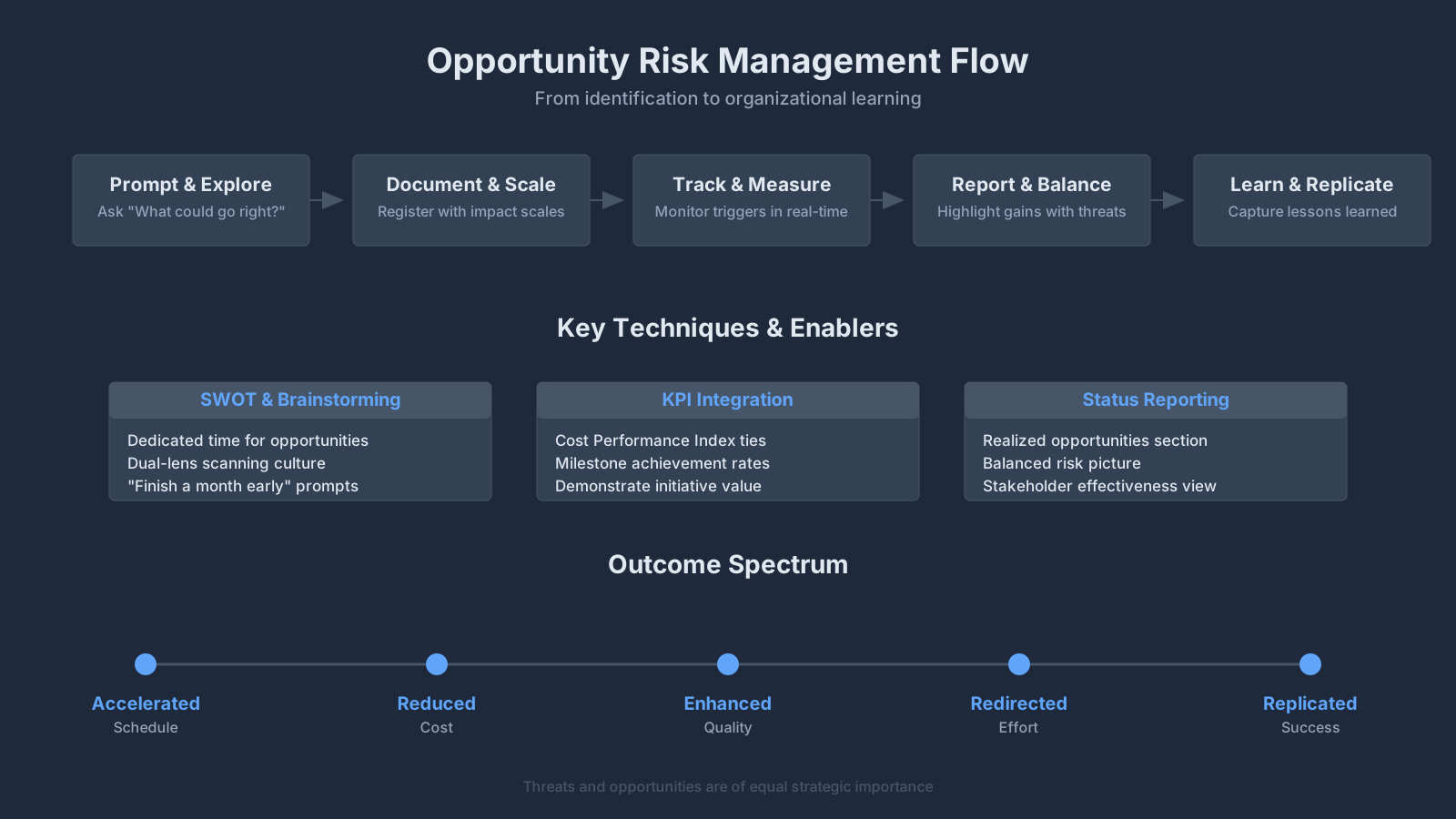
Taking Advantage of Positive Risks: Summary Table
| Key Concept | Summary |
|---|---|
| Positive Risks | Opportunities, or positive risks, are uncertain events whose occurrence would benefit project outcomes, including faster delivery, cost reduction, expanded scope, elevated quality, or strengthened stakeholder commitment. |
| Opportunity vs. Good News | True opportunities contain irreducible uncertainty and demand a deliberate pursuit choice, distinguishing them from favorable variances already absorbed into conservative baselines. |
| Mindset Shift | Because project teams habitually scan for threats, uncovering upside feels unnatural; a deliberate shift in questioning, exploring what could outperform plans, unlocks proactive value identification. |
| Exploit Strategy | Exploitation removes uncertainty entirely by deliberately engineering conditions that compel the opportunity to occur, converting a speculative benefit into a guaranteed result. |
| Share Strategy | Sharing allocates partial ownership to a partner better equipped to capture the upside, with contractual terms ensuring that realized gains flow back to the project. |
| Risk Register | Risk registers dominated by threats overlook no-cost value boosts; intentionally integrating opportunities transforms a defensive log into a mechanism that systematically creates value without expanding baseline scope or budget. |
| PMBOK Framework | The PMBOK framework mandates that opportunities receive identical structured rigor as threats, from identification through response planning, elevating risk management to a practice that maximizes project value. |
| Response Toolkit | Opportunity response strategies, exploit, share, enhance, and accept, each involve distinct trade-offs in proactive effort, resource allocation, and upside probability, requiring precise alignment with the risk context. |
| Uncertainty | Uncertainty is the hallmark of genuine opportunities; because they may not materialize, their existence necessitates assigning a risk owner and embedding them in lifecycle monitoring. |
| Value Creation | Harnessing positive risks shifts the project posture from defensive vigilance to active value hunting, distinguishing strategic leaders who mine opportunity from those who merely execute a predetermined plan. |
The Nature of Positive Risks in Project Management
Positive risks, often called opportunities, are uncertain events or conditions that, if they occur, would have a favorable impact on project objectives such as time, cost, scope, quality, or stakeholder satisfaction. They are not simply the absence of a threat but independent possibilities that you can actively cultivate or simply allow to unfold. In the PMBOK framework, the Risk Management knowledge area explicitly treats opportunities alongside threats, requiring the same disciplined identification, analysis, and response planning. Yet many project managers still populate their risk registers almost entirely with negative items, missing a critical chance to add value without increasing scope or cost in the traditional sense.
Distinguishing Opportunities from Routine Good News
A sudden drop in material prices is not an opportunity in risk management terms if it was already baked into a conservative estimate; it is just a cost underrun. A genuine opportunity carries uncertainty. It might happen, it might not, and it requires a deliberate decision about whether to pursue it. That distinction matters because it shapes whether you assign a risk owner and whether you track it through the project lifecycle, mindful of how change requests are handled in procurement administration. Without that clarity, teams often celebrate favorable variances after the fact without ever realizing they could have amplified them with a little proactive effort.
Consider a project that is dependent on a third-party regulatory approval. The approval might be scheduled to take six months, but there is a small chance the regulator could fast-track it if certain preliminary documentation is filed early. That fast-track possibility is a positive risk, it is uncertain, it is conditional on an action, and its impact is a shortened schedule. Treating it as a mere hope leaves it to chance, whereas classifying it as an opportunity triggers a series of thoughtful response activities.
Shifting the Project Team’s Collective Mindset
When you introduce the concept of positive risks in a project kickoff meeting, you often see a slight pause. Team members are so accustomed to thinking about what could go wrong that identifying what could go right feels unnatural. This cultural barrier is one of the biggest obstacles to effective opportunity management, but just as mitigating threats often involves knowing how claims and disputes are handled, equipping the team to protect realized opportunities from unraveling is equally crucial. Encouraging engineers, designers, and business leads to ask “What if this part goes better than expected?” opens up conversations that otherwise never happen. It also has a subtle motivational effect: it reminds the team that the project is not just a minefield to be navigated but a landscape with potential windfalls.
Core Takeaways on Opportunity Management
- Positive risks are overlooked opportunities
- Positive risks are uncertain events that can improve project objectives, yet many project managers populate their risk registers predominantly with threats and overlook the opportunity to gain additional value without growing scope or cost.
- Opportunities require uncertainty and action
- A genuine opportunity hinges on uncertainty and must be deliberately pursued, while a routine favorable variance such as a cost underrun already accounted for in conservative estimates requires no active management.
- Shifting to a windfall mindset
- Teams should regularly ask what could go better than expected, not only what could go wrong, thereby enabling proactive planning for windfalls such as fast-tracked regulatory approvals and creating a motivational boost across the project team.
Four Proactive Strategies to Engage with Opportunities
When a positive risk has been identified and analyzed, you have a toolkit of response strategies that parallel the threat responses but are used in reverse. The standard set draws from industry frameworks and is organized into exploit, share, enhance, and accept. Each carries its own logic, resource implications, and appropriate context. Understanding when to reach for one rather than another is what turns a conceptual understanding into practical opportunity response planning that actually moves the needle on project performance.
The Exploit Strategy: Removing Uncertainty Entirely
To exploit an opportunity means to take direct action that eliminates the uncertainty, making the upside a near certainty. You are not just hoping it happens; you are engineering the conditions so that it must happen. In a traditional construction project, this might mean assigning your most experienced crew to a critical path activity that has a chance of finishing significantly earlier than the baseline schedule. By dedicating that specialized resource, you essentially buy out the uncertainty, trading one form of expense for guaranteed schedule gain.
Exploit responses can feel aggressive because they consume resources that might otherwise be spread across the project. There’s always a trade-off. If you assign your top talent to capture a schedule opportunity on one workstream, they might not be available to mitigate a threat elsewhere. That is why exploit decisions should be made with the same rigor as any major resource allocation, balancing the potential upside against the opportunity cost. A small exploration project in an R&D environment might exploit a technical breakthrough possibility by dedicating laboratory time and a specific scientist to it, even if that means postponing a lower-priority experiment.
What often surprises newcomers is that the exploit strategy does not necessarily have to be expensive. Sometimes exploit simply means removing a bureaucratic barrier that stands between the project and a favorable outcome. If an approval process can be streamlined by pre-submitting documents, that action exploits the opportunity because it removes the uncertain wait time. The cost is minimal but the impact can be substantial.
The Share Strategy: Bringing in a Partner to Capture the Gain
Sharing an opportunity involves transferring partial ownership to a third party that is better positioned to realize the upside, while ensuring that the benefits flow back to the project. This is the mirror image of transferring a threat through insurance, but with a collaborative twist. Instead of offloading a negative risk to someone else, you are forming a kind of mini-venture with a partner who can increase the chances that the opportunity materializes. Joint ventures, special-purpose vehicles, and risk-sharing partnerships are typical vehicles for this strategy.
Imagine a software development project where an emerging technology could dramatically reduce the testing phase if integrated early. The team lacks deep expertise in that technology, but a niche consultancy does. Forming a partnership where both parties share the cost savings from earlier completion is a classic share response. The consultancy is motivated to make the opportunity happen because their compensation is partially tied to its success, and the project benefits from skills it does not possess in-house. This transforms a passive hope into an active engine for value creation.
The share strategy gets complicated when you need to negotiate the distribution of benefits. If the upside is a reduced timeline, how do you share time? Often the answer involves translating the time savings into financial terms or exchanging flexibility for preferential access in future projects. The contractual mechanisms can become dense, but the underlying principle is simple: you are aligning incentives so that someone else’s self-interest drives the opportunity toward reality. Without that alignment, a third party might have no reason to exert extra effort beyond their standard contractual obligations.
The Enhance Strategy: Boosting Probability and Impact
Enhance responses aim to increase either the likelihood that an opportunity occurs, its beneficial impact, or both. Unlike exploit, you are not trying to remove all uncertainty, you are simply tipping the scales. This is often a lighter-touch approach that can be applied incrementally. If a construction project has a chance to finish a foundation pour earlier due to favorable weather, an enhance response could be to pre-position concrete pumps and crews on standby so that when the weather window opens, the team can seize it immediately. The uncertainty remains, but the probability of capitalizing on it goes up.
The art of enhancement lies in identifying the key drivers of the positive risk. For a schedule opportunity, the driver might be resource availability, for a cost opportunity it could be bulk purchasing timing, for a quality opportunity it might be early user testing. Once you isolate those drivers, you invest small amounts of effort to nudge them in the project’s favor. This is a different analytical muscle than threat analysis, where you typically look for root causes of failure. Here you are looking for root enablers of success. It requires a certain optimism that can feel uncomfortable to detail-oriented planners, but it yields disproportionately high returns when done well.
Enhance responses pair beautifully with iterative delivery models. In an Agile environment, a product backlog might contain a feature that, if built, could attract a new customer segment. Enhancing that opportunity could mean adding a spike to investigate the feature’s feasibility earlier in the development cycle, thereby increasing the chance that the team can commit to it within the release window. The cost of the spike is tiny relative to the potential market upside, and it perfectly embodies the enhance logic. You are not committing fully to a massive scope change, you are simply moving the dial on probability.
The Accept Strategy: Keeping the Door Open Without Active Pursuit
Accepting an opportunity means acknowledging that it exists and being willing to take advantage of it if it arrives, but not investing resources to make it happen. This is the default posture for many positive risks, and it is a perfectly valid choice when the cost of other response strategies outweighs the expected benefit. Think of a project that could benefit from a competitor’s product delay. You cannot influence that event, and trying to do so would be unethical and probably illegal, so you accept the opportunity. Your plan includes a contingency reserve that can be redirected to accelerate marketing if the delay occurs, but no proactive action is taken to cause it.
Acceptance should be a conscious decision, not a passive oversight. Too many risk registers simply omit positive risks entirely, which is not acceptance, it is neglect. Formal acceptance means you have evaluated the opportunity and decided that active response strategies are not warranted, documenting the reasoning so that the project owner understands the trade-off. This protects the team from future criticism if the opportunity later materializes and someone asks why nothing was done to amplify it. The response is documented, transparent, and defensible.
A subtle danger with acceptance is that it can slide into complacency. If the environment changes and the opportunity becomes more probable or more impactful, the acceptance stance may need to be revisited. Monitoring triggers for accepted opportunities is just as important as monitoring threat triggers, though many project teams skip this because the sense of urgency is lower. A quarterly review cadence that scans the opportunity register for changed conditions helps prevent missed windows.
Weaving Opportunity Management into the Project Lifecycle
Positive risk strategies are not one-off decisions made during a planning workshop and then forgotten. They need to be integrated into everyday project processes from initiation through closing. In PMBOK terms, this means that Identify Risks, Perform Qualitative Risk Analysis, Perform Quantitative Risk Analysis, Plan Risk Responses, Implement Risk Responses, and Monitor Risks all apply to opportunities with the same procedural weight as threats. The tools shift slightly, but the disciplined cadence remains constant.
Identification: Where Opportunities Hide
Opportunities rarely announce themselves; they often lurk in the same places as threats but from a different angle. When you conduct a SWOT analysis, the opportunities quadrant explicitly calls them out, but many project managers rush through it. Brainstorming sessions that begin with “What could exceed expectations?” can surface ideas that are never mentioned in a threat-focused meeting. Assumption analysis is another rich vein: every assumption that turns out to be pessimistic conceals a potential opportunity. If you assumed vendor delivery would take four weeks but historically they sometimes deliver in two, that variance is an opportunity waiting to be exploited or enhanced.
In projects using PRINCE2 methodology, the Management of Risk theme similarly acknowledges that risk can have positive or negative effects, and the Risk Register serves as the central repository for both. The deliberate inclusion of opportunities in the register forces the project board to consider upside when making decisions about tolerances and stage boundaries, preventing an exclusively defensive posture.
Analysis: Quantifying Upside for Better Decisions
Qualitative analysis of opportunities uses probability and impact scales, often the same matrix used for threats but with a separate coloring or labeling to avoid confusion. A high-probability, high-impact opportunity might be given a risk score that mirrors a critical threat, signaling to management that it deserves executive attention and resource allocation. Quantitative methods, such as Monte Carlo simulation, can incorporate opportunity branches just as easily as threat branches, showing how aggressive opportunity pursuit shifts the overall distribution of project completion dates or costs.
This analytical step is where many opportunities die a quiet death. Without a disciplined scoring process, team members tend to overestimate threats and underestimate opportunities because of loss aversion, a well-documented cognitive bias. A simple calibration exercise where the team jointly rates a historical opportunity that actually occurred can anchor their assessments closer to reality. When a team realizes that a past chance of a supplier discount was rated as low probability but actually happened twice, they become more willing to assign fair scores to current opportunities.
Response Planning and Resource Allocation
Translating a selected response strategy into a concrete action plan requires the same level of detail as any work package. An exploit response demands a named owner, a scheduled activity, and a budget. An enhance response might involve adding a few contingency actions to the project schedule that are only triggered by an early completion of a predecessor. The risk response plan becomes part of the overall project management plan, and the corresponding activities appear in the work breakdown structure and schedule. Without this integration, opportunity responses remain aspirational notes in a document nobody reads after the planning phase.
There is a real resource tension here. Project managers are already fighting for attention and budget to address threats, and adding opportunity-related activities can feel like a luxury. But framing these activities in terms of return on investment often reshapes the conversation. An exploit action that costs $5,000 and yields a 70% chance of saving three weeks on the schedule is not a luxury, it is a bargain. Communicating in business terms rather than risk terminology helps secure stakeholder buy-in.
Core Takeaways on Opportunity Integration
- Equal procedural weight for upside
- Opportunities demand the same rigorous treatment across every stage of the risk management process, from identification through monitoring, ensuring they receive consistent attention alongside threats.
- Hidden sources of positive risk
- Leveraging SWOT opportunity quadrants, deliberate upside brainstorming, analysis of pessimistic assumptions, and structured frameworks such as PMBOK and PRINCE2 risk registers uncovers positive risks that conventional threat-focused reviews overlook.
- Calibrating analysis against bias
- Applying identical probability and impact matrices to opportunities, reinforced by historical calibration exercises, helps counteract the cognitive bias of loss aversion that systematically discounts potential gains.
- Response plans need real resources
- Executing exploit and enhance response strategies demands dedicated owners, ring-fenced budgets, and schedule-integrated actions, and framing them in ROI terms strengthens the business case for stakeholder buy-in.
Common Pitfalls When Trying to Realize Positive Risks
Even when the techniques are well understood, opportunity response execution often stumbles on predictable obstacles. Recognizing these pitfalls in advance can prevent wasted effort and disillusionment, keeping the focus on genuine value rather than on documenting opportunities for the sake of completeness.
The Over-Optimism Trap
When teams first start actively identifying opportunities, they often swing too far in the opposite direction, inflating the probability of every possible upside until the risk register looks like a lottery ticket collection. This over-optimism can lead to resource squandering as the project pursues dozens of low-probability enhancements that never materialize. The antidote is the same as for threat management: calibrate probability estimates using historical data, expert judgment, and independent review. A devil’s advocate role in the risk workshop can ask the uncomfortable question: “Has this type of opportunity ever actually happened on a project like ours?”
Opportunity Hoarding and the Sharing Paradox
Some project managers treat opportunities as proprietary advantages to be kept secret, fearing that if they share them with stakeholders or partners, the value will be diluted. This instinct often backfires because the share strategy requires transparency and collaboration. When an opportunity could benefit multiple projects in a program, hoarding it on one project suboptimizes the whole portfolio. Program offices should actively scan for shared opportunities and incentivize project managers to surface them, perhaps by giving partial credit to the originating project even if the benefits accrue elsewhere.
Neglecting Opportunity Monitoring
Risk reviews that focus exclusively on threats let positive risks fade from view. A monthly risk meeting that spends ten minutes on threats and thirty seconds asking “Any updates on the opportunities?” sends a clear cultural signal that they don’t matter. To counteract this, some organizations mandate that the top two or three opportunities be reviewed with the same rigor as the top threats, including status updates, trigger monitoring, and revised probability estimates. This simple procedural fix keeps the conversation balanced.
Framework Perspectives on Positive Risk Management
Different project management frameworks offer distinct vantage points on handling opportunities, and understanding these nuances helps practitioners apply positive risk strategies across diverse environments without methodological friction.
The PMBOK View: Opportunities as Integral to Risk Management
The PMBOK Guide’s Risk Management knowledge area weaves opportunities throughout all processes. The Plan Risk Management process calls for defining probability and impact scales that explicitly include positive impacts. The Perform Qualitative Risk Analysis process uses a probability and impact matrix that has separate zones for opportunities and threats. This structural integration means that if you are following PMBOK practices, you are already expected to treat opportunities with the same formality as threats. The omission of opportunities from a risk register is therefore not just a philosophical gap but a deviation from good practice.
PRINCE2’s Management of Risk: A Symmetrical Approach
PRINCE2 adopts the same symmetrical treatment through its Management of Risk theme and through the recommended M_o_R guidance. A PRINCE2 project’s Risk Register contains both threats and opportunities, and the risk responses include exploit, share, enhance, and accept for upside. The Project Board reviews these as part of the stage boundary process, making go/no-go decisions on opportunity pursuit alongside key threat mitigation. This governance integration is powerful because it elevates opportunity decisions to the same level of scrutiny as major change requests.
Agile Environments: Opportunities Embedded in Value Prioritization
Agile frameworks such as Scrum do not typically maintain a separate risk register, but the concept of positive risk surfaces naturally through the product backlog’s value prioritization. When a Product Owner orders backlog items based on business value, they are implicitly responding to opportunities, the chance to capture a market need or to learn something that increases value. Spike stories, which investigate uncertain technical or business questions, often serve as enhance responses by increasing the probability that a high-value feature can be delivered. The inspect-and-adapt cycle of Sprint Reviews and Retrospectives provides a frequent forum to identify emerging opportunities, far more often than a traditional monthly risk review.
The contrast is instructive. In a predictive environment, opportunity management tends to be document-centric and planned upfront. In an adaptive environment, it is embedded in the daily work of prioritizing and re-prioritizing. Neither approach is superior, but a project manager transitioning between methodologies needs to recognize where the opportunity conversations happen, which might be in a formal risk workshop or in a casual backlog refinement session.
Framework Insights on Opportunity Handling
- PMBOK formalizes opportunity processes
- The PMBOK Guide requires opportunities to be evaluated with the same discipline as threats, using positive impact scales and dedicated zones within the probability and impact matrix to ensure they receive proportionate attention.
- PRINCE2 symmetrical governance model
- PRINCE2 treats threats and opportunities symmetrically in its risk register and mandates that the Project Board formally review opportunity responses at each stage boundary, embedding upside exploration into governance rhythms.
- Agile embeds opportunities in prioritization
- Agile frameworks turn positive risk into actionable work by reordering the backlog for potential value and using spike stories to investigate uncertainties, while sprint ceremonies provide regular cadences to surface and exploit emerging opportunities.
Applying the Four Strategies in Realistic Project Scenarios
Theories become living practice when you can map them onto the kinds of situations that arise in actual project environments. Walking through a handful of real-world opportunity response scenarios, without naming specific companies, helps solidify the distinctions among the strategies.
Exploiting a Technology Breakthrough
A pharmaceutical research project has a chance to use a new laboratory automation tool that could cut testing time by 40 percent if the tool is proven reliable within the next month. The team decides to exploit this opportunity by dedicating two senior scientists exclusively to validating the tool, prioritizing their time over less critical assay development. They accept the short-term cost because the guaranteed schedule compression on a critical milestone far outweighs it. The exploit response turns a “might happen” into a “will happen” before the tool’s reliability was certain, but after their intensive effort it becomes a committed part of the project plan.
Sharing a Market Launch Opportunity
A consumer electronics company and a software firm see a mutual chance to bundle hardware and a subscription service ahead of a competitor’s expected announcement. Neither can fully capture the market window alone, so they form a joint go-to-market partnership where revenue from the bundle is shared. The share response pools their distribution channels and brand recognition, making the rapid launch far more probable. Both parties invest in the opportunity knowing that the gains will be split, but the split is calibrated so that each earns more than they would by acting alone and potentially missing the window entirely.
Enhancing a Schedule Compression Chance
A highway construction project has a chance to finish a bridge section weeks early if the supplier can deliver steel beams ahead of the contractual date. The project manager enhances this opportunity by offering a modest acceleration bonus to the supplier for early delivery, and by pre-scheduling a specialized crane that is normally booked months in advance. Neither action guarantees early delivery, but together they significantly raise the probability that if the beams arrive early, the construction team can immediately act on the window. The cost of the bonus and crane reservation is small compared to the value of early road opening.
Accepting a Favorable Currency Fluctuation
An international development project is funded in US dollars but incurs costs in the local currency. There is a possibility that the exchange rate could move favorably, reducing the project’s real cost. Because the project team has no influence over central bank policy, it chooses to accept the opportunity. The budget baseline remains unchanged, but the controller monitors the rate monthly and is prepared to redirect the savings into additional scope if the opportunity materializes. No resources are spent trying to predict or force the exchange rate movement, but the awareness ensures that if it happens, the benefit is captured rather than absorbed silently into a general contingency.
Maintaining Momentum on Opportunities Across Long Projects
Sustaining opportunity focus over a multi-year project requires intentional design of ongoing opportunity management practices that survive team turnover and shifting stakeholder priorities. Without this continuity, the initial burst of excitement around upside risks fades into the background noise of day-to-day execution.
Building an Opportunity Register That People Actually Update
Too often risk registers become static documents because updating them feels like bureaucratic overhead. For opportunities, the problem is worse because there is no crisis driving updates. A practical fix is to embed opportunity review into existing standing meetings rather than creating a separate process. During a monthly change control board meeting, the last agenda item can be a two-minute scan of the top three opportunities. This takes little time but signals to the team that these are living items, not archival entries. The risk owner is given a moment to report any changes in probability, impact, or the viability of the response strategy, keeping the item alive.
Linking Opportunities to Earned Value and Forecasting
An underused technique is to connect opportunity tracking directly to project forecasting. If an enhance response succeeds and a deliverable finishes early, the schedule forecasts should update immediately, and the related opportunity should be recorded as realized. This creates a visible link between proactive opportunity management and improved performance metrics, reinforcing the behavior. When a sponsor sees that a positive variance is not a random gift but the result of a deliberate exploit action, they become more willing to fund similar actions on future projects. The language shifts from luck to intentionality.
Celebrating Realized Opportunities Without Triggering Scope Creep
There is a delicate balance to strike when an opportunity delivers a windfall. If a team exploits an opportunity and finishes a phase under budget, the natural institutional response might be to immediately load extra scope into the project, consuming the saving. This is valid from a portfolio perspective but can demotivate the team if they feel their effort to capture the upside was punished with more work. A healthier pattern is to openly acknowledge the realized opportunity, let the team enjoy the brief buffer, and then negotiate any scope additions as new, value-driven requests rather than automatic backfills. The psychology matters as much as the accounting.
Key Insights on Opportunity Momentum
- Embed reviews in standing meetings
- Weaving a focused opportunity pulse check into the monthly change control board maintains continuous visibility of emerging upside risks and removes the overhead of parallel reporting rituals.
- Link opportunities to forecast updates
- Immediately adjusting schedule and earned value baselines when an opportunity materializes demonstrates that measurable gains flow from intentional choices, which builds sponsor confidence to fund similar proactive moves.
- Celebrate wins without triggering scope creep
- Acknowledging realized opportunities openly while confining any extra work to formally approved, value-driven requests preserves team engagement and enables portfolio recalibration without uncontrolled expansion.
Developing Organizational Maturity in Opportunity Management
Shifting from a threat-only culture to one that equally weighs opportunities is not just a project-level change; it often requires adjustments in program management and portfolio governance. Building maturity takes deliberate effort over multiple project cycles, but the cumulative effect on organizational opportunity management capability compounds into a measurable competitive edge.
The Role of Leadership in Modeling Opportunity Thinking
When a Program Director begins a steering committee meeting by asking “What is the best thing that could happen to this project in the next quarter?” they reshape the entire conversation. This simple question, asked consistently, makes opportunity thinking legitimate. Leaders who only ask about red flags and burning issues inadvertently train their teams to suppress upside discussion. Front-line project managers often need explicit permission to spend time and mental energy on opportunities, and that permission must come from above.
Training and Tools That Support Dual-Purpose Risk Management
Risk management training in many organizations still defaults to threat management, with a brief nod to opportunities at the end. Revamping templates so that the risk register has equal prominence for opportunities—perhaps by splitting the form into parallel sections—can serve as a daily reminder. Similarly, risk management software that flags when an opportunity’s probability crosses a threshold can prompt reviews that otherwise would not happen. These small design choices in tools and training materials accumulate into a cultural shift over time.
Some of the most forward-thinking project offices maintain a database of realized opportunities across historical projects, categorizing them by industry, project size, and root cause. When a new project enters planning, the team can query this database to see which types of opportunities have materialized before in similar contexts, generating a head start on identification. It’s a knowledge management practice that pays for itself many times over, yet it’s astonishingly rare.
Connecting Opportunities to Stakeholder Value and Benefits Realization
Ultimately, the reason to pursue positive risks is not to check a box on a methodology but to deliver greater stakeholder value through opportunity realization. When you map opportunities onto the project’s benefits management plan, you see them not as abstract risk items but as potential accelerators of strategic outcomes.
Translating Opportunities into Benefits Language
A schedule opportunity that shaves a month off delivery has a direct link to benefits if time-to-market drives revenue. A cost opportunity that saves budget creates room for additional scope or higher profit margins. Articulating these connections in the business case language that executives understand makes funding opportunity responses a much easier sell. Instead of saying “We want to implement an exploit response,” you say “We have a chance to bring forward the first customer shipment by six weeks, which would generate an additional $1.2 million in early revenue, at a cost of $40,000 for a dedicated team.” That conversation writes its own approval.
Measuring the Success of Opportunity Management
Organizations that are serious about upside risks eventually start tracking metrics such as the total value of realized opportunities versus planned value, the percentage of opportunities that were actively pursued rather than accepted, and the return on investment of response actions. These metrics feed into lessons learned and help refine the organization’s probability estimation accuracy over time. When a project closes, a retrospective that specifically reviews opportunity management performance, separate from threat management, yields rich insights that generic lessons-learned sessions often miss. The data might reveal, for example, that share strategies consistently outperform enhance strategies in certain supplier relationships, shaping future procurement approaches.
The journey from viewing risk as a list of things that can go wrong to seeing it as a dual-sided map of uncertainty is one of the most significant evolutions a project professional can make. It changes the emotional texture of the work and equips you to build value in ways that a purely defensive posture never can. The four response strategies, exploit, share, enhance, and accept, give you a complete vocabulary for engaging with opportunity. When you start using that vocabulary fluently, you find that positive risks are not rare events but a constant undercurrent in every project, waiting for someone with the right mindset to notice and act.
Key Insights on Opportunity Value
- Opportunities as strategic accelerators
- Mapping opportunities onto the benefits management plan positions them as concrete catalysts for strategic outcomes, not as abstract risk entries.
- Communicating in business case language
- Framing opportunities in terms of tangible revenue or margin impact, such as capturing additional income from an early shipment, significantly strengthens the business case for allocating resources to response actions.
- Tracking opportunity performance metrics
- Systematically monitoring realized value against planned value, the share of opportunities actively pursued, and the return on investment from response actions provides critical feedback for continuously improving opportunity management.
- Separate retrospective for opportunities
- A dedicated review of opportunity management performance, conducted independently of threat assessments, reveals nuanced insights that generic lessons learned sessions often fail to capture.
- Dual-sided uncertainty mindset shift
- Adopting the lexicon of exploit, share, enhance, and accept transforms positive uncertainty into a perpetual source of proactive value creation, replacing passive awareness with deliberate action.
