Managing a project team to optimize performance is not a one-time activity or a box to check during execution. It is a continuous, deliberate process that weaves through every interaction, decision, and deliverable. In the Project Management Institute’s framework, this is formally called the Manage Project Team process, and it sits squarely within the Executing process group and the Resource Management knowledge area. The process involves tracking each team member’s performance, providing constructive feedback, resolving the inevitable conflicts and issues that arise, and dynamically managing changes to people, roles, and responsibilities. The ultimate goal is to elevate the collective output, ensuring that the project not only meets its constraints but thrives. This article will explore how project managers can actively manage a project team to optimize performance by unpacking the inputs, activities, and outputs that make this process a cornerstone of project success.
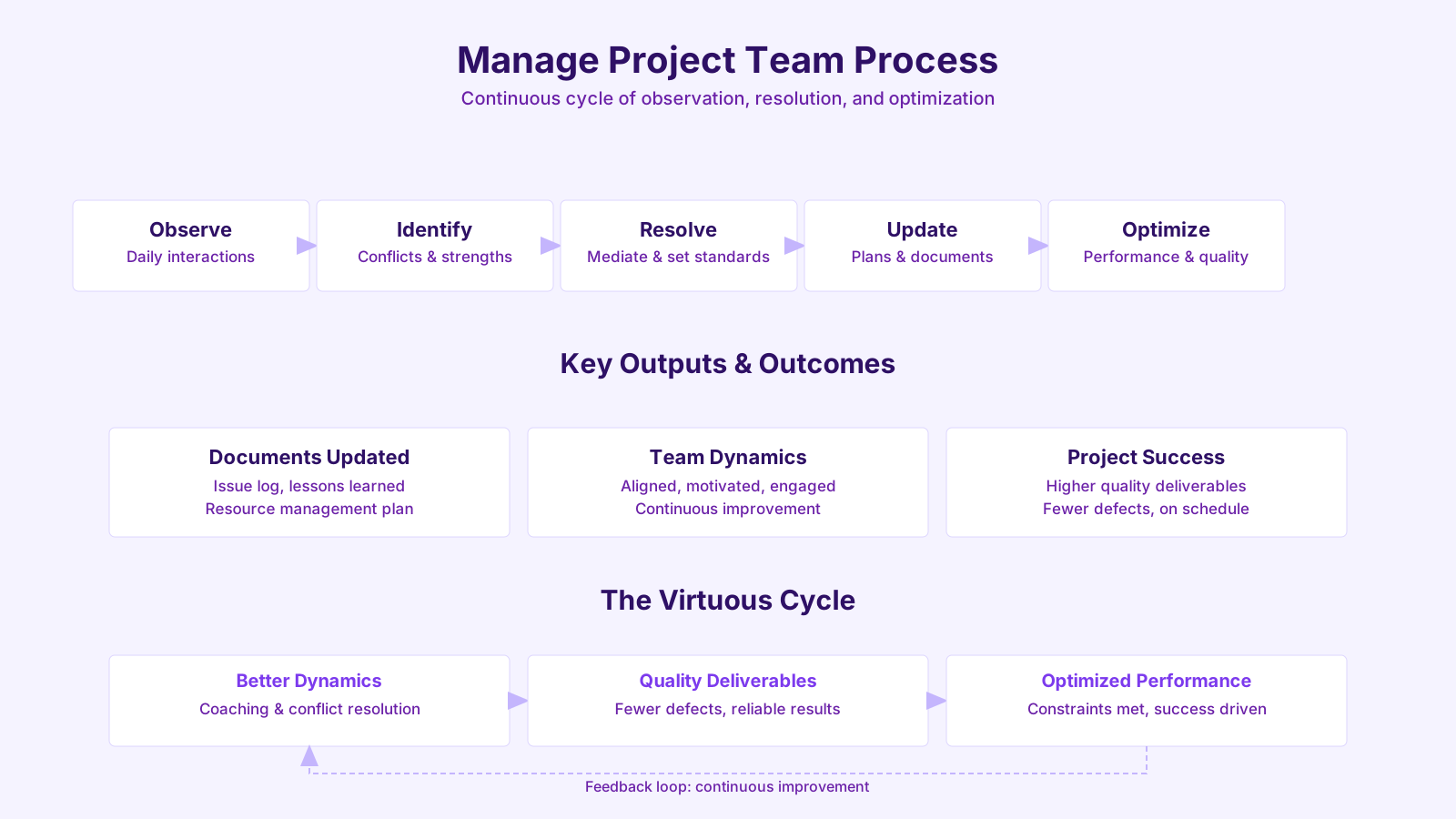
Summary: How to Optimize Project Team Performance
| Key Concept | Summary |
|---|---|
| Manage Team | Part of the Executing process group within Resource Management, this process integrates performance tracking, constructive feedback, conflict mediation, and dynamic reassignment of roles. |
| Core Activities | This process involves monitoring individual performance, delivering actionable feedback, resolving interpersonal and task-related issues, and adapting team composition and responsibilities as project needs shift. |
| Behavioral Cues | Astute project managers detect subtle behavioral shifts, such as a typically vocal tester becoming silent or small commitments slipping repeatedly, to surface underlying problems early and intervene before they escalate. |
| Resource Loading | Regularly cross-referencing resource allocation plans with actual timesheet data reveals overloading risks for shared personnel early, enabling proactive capacity rebalancing before schedule delays appear. |
| Feedback Loop | Synthesizing historical performance assessments with current metrics, for instance tracking a developer’s defect density against their known tendency to rush, creates a closed-loop insight that sharpens future coaching. |
| Targeted Coaching | These focused insights enable precision coaching, such as guiding a developer to adopt deliberate review practices under time pressure to reduce defect introduction rates. |
| Supporting Sources | Key inputs include standardized performance appraisal templates, lessons learned from prior projects regarding team dynamics, and formal human resources policies that govern disciplinary actions. |
| Conflict Resolution | Effective resolution demands that the project manager uncover underlying causes and facilitate outcomes through mediation, role clarification, or personnel reassignment when necessary. |
Breaking Down the Manage Project Team Process
The Manage Project Team process is often misinterpreted as a simple supervisory chore, but its scope is far broader. It links directly to the project management plan, particularly the resource management plan, and draws upon ongoing assessments of how individuals are actually performing. In the PMBOK Guide, this process belongs to the Executing process group, which is where the bulk of the work gets done and where the project manager’s ability to influence outcomes becomes most visible. The idea is not just to correct underperformance but to cultivate an environment where every team member can contribute at their highest possible level. A strong team management process weaves together hard data from performance reports with the softer skills of conflict resolution and motivational leadership.
What does this look like in practice? Imagine a project where two senior architects have been assigned to design a critical module. Early on, their coding styles clash, leading to integration headaches. The project manager, acting through the Manage Project Team lens, does not simply wait for the next status report. Instead, she pulls data from recent build failures, sits with both architects individually to understand their perspectives, and then facilitates a joint session where they agree on a shared coding standard. This intervention and the updated coding guidelines that result from it are not artifacts of a separate quality or scope process; they are direct outputs of actively managing the team. The process is iterative, happening weekly or even daily, not just at phase gates.
Tracking performance, the first subcomponent, relies on both quantitative and qualitative signals. Quantitative data might include velocity in an Agile context, earned value metrics, defect counts, or adherence to schedule. Qualitative signals come from one-on-one meetings, peer feedback, and observing meeting dynamics. The astute project manager watches for subtle shifts: an otherwise vocal tester who suddenly goes quiet, or a developer who starts missing small commitments. These signals often precede a measurable drop in performance metrics. By catching them early, the project manager can provide feedback before a small issue becomes a formal performance problem.
Core Takeaways on Managing Teams
- Far broader than supervision
- The Manage Project Team process integrates resource management plans and performance assessments within the Executing process group, where a project manager’s leadership has its most visible impact.
- Combines data with soft skills
- Effective team management synthesizes hard performance metrics with conflict resolution and motivational leadership to unlock each member’s full contribution potential.
- Interventions are direct outputs
- Proactive steps like establishing a shared coding standard after build failures or noticing a quiet tester’s disengagement are direct outcomes of active team management, not separate administrative tasks.
The Critical Inputs for Optimizing Team Performance
Every management process begins with what you already know, and Manage Project Team is no exception. The formal inputs listed in the PMBOK framework are Project staff assignments, the project management plan, team performance assessments, performance reports, and organizational process assets. These are not just bureaucratic checkpoints; they are the raw material for making informed people decisions. Understanding how these inputs for team management interact gives the project manager a multidimensional view of the team’s health, far beyond a simple red-yellow-green status.
Project staff assignments are the foundational document. They tell you who is supposed to be doing what, when, and for how long. But a clever project manager does not treat them as static. They are the baseline against which to compare actual involvement. When a key resource is being shared with another project, the staff assignment list, cross-referenced with timesheets, can reveal a loading risk well before the missed deadlines appear. The project management plan, particularly its resource management and communications management components, sets the rules of engagement. It defines how performance will be measured, what feedback mechanisms are authorized, and what escalation paths exist.
Team performance assessments are perhaps the most intimate input. These often originate from the preceding Develop Project Team process and provide a historical record of an individual’s competencies, leadership skills, and areas for improvement. Too many project managers file these assessments away and never look at them again. That is a missed opportunity. When a new conflict arises or a team member struggles with a task, those earlier assessments often contain clues about communication preferences, learning styles, and known triggers. Using them in conjunction with the current performance reports, which capture real-time data on schedule variance, defect rates, and cost efficiency, creates a powerful feedback loop. For instance, if a performance report shows a rising defect density in a particular module and the team performance assessment for the developer responsible notes that she tends to rush when under pressure, the project manager has a targeted coaching topic ready.
Organizational process assets round out the inputs. These include the organization’s standard performance appraisal templates, historical lessons learned about team dynamics, and even formal HR policies on progressive discipline. Far from being a constraint, these assets provide a safety net. They ensure that any corrective action, whether it is a performance improvement plan or a simple role change, follows a pattern that is legally defensible and culturally acceptable. A project manager who ignores these assets and improvises a unique approach to handling a low performer can inadvertently create an unfair precedent or, worse, expose the organization to a grievance.
The Core Activities of Tracking, Feedback, and Issue Resolution
The Manage Project Team process comes alive in the daily rhythm of observation, conversation, and adjustment. Tracking team member performance is not about surveillance; it is about maintaining a genuine pulse on how work is progressing and whether individuals are struggling or thriving. Effective tracking team performance means combining the formal metrics found in project management information systems with the informal cues gathered by simply walking around, whether physically or in a virtual team room. A sudden increase in the number of questions a team member asks about a topic they previously mastered can be as telling as a drop in their productive output.
Once performance signals are detected, the next step is providing feedback. The mechanics of feedback delivery matter immensely. Generic praise or blanket criticism does little to optimize performance. Specific, behavioral, and timely feedback—delivered one-on-one—helps an individual understand exactly what they did well and what needs to change. If a business analyst consistently delivers user stories that are missing clear acceptance criteria, the project manager might say, “In the last three sprints, your stories have had to go back for clarification twice, adding about four hours of rework each time. Let’s look at the definition of ready checklist and see where the gap is.” This is precise, it references measurable impact, and it offers a collaborative path forward. It contrasts sharply with a vague “You need to improve your documentation,” which leaves the person guessing.
Resolving issues and conflicts is where the process often gets difficult. Project teams are collections of humans with differing ambitions, communication styles, and stress tolerances. An issue might be as simple as a team member needing a more powerful laptop or as complex as a long-standing feud between a product owner and a lead developer over technical debt. The ability to distinguish between a task-based conflict, which can be healthy if channeled, and a personal conflict, which is almost always destructive, is a signature skill of high-performing project managers. Ignoring a simmering interpersonal tension in the hope it will resolve itself is a gamble that rarely pays off. More often, it metastasizes into passive-aggressive email chains, withholding of critical information, and a noticeable chill in collaboration. The Manage Project Team process explicitly calls for the project manager to step into these situations, surface the root cause, and facilitate a resolution, which may involve mediation, role clarification, or, in extreme cases, a change to the project staff assignments.
Managing changes to team composition and responsibilities is the fourth pillar. As the project progresses, the team will naturally evolve. Some members may roll off when their tasks are complete, new ones may join during a later phase, and existing members may request a change in role to develop a new skill. Handled poorly, these transitions disrupt momentum. Handled well, they inject fresh energy and capabilities. The project manager uses the Manage Project Team process to proactively identify when a role change is needed, evaluate the impact on the schedule and budget, and then formally process that change. For example, a junior developer who has shown an aptitude for architecture might be gradually moved into a design role, with his current coding tasks redistributed. This requires updating the project management plan and communicating the change to all affected parties, which brings us to the outputs of the process.
Key Takeaways on Managing Project Teams
- Tracking blends formal and informal signals
- Project managers should combine quantitative data from tracking systems with qualitative observations, such as a team member suddenly asking more clarifying questions, to detect emerging performance issues before they escalate.
- Feedback requires specificity and timing
- To be actionable, feedback must be delivered privately, grounded in specific recent behaviors, and tied directly to their effects, so the recipient understands precisely what to correct and why.
- Conflict type guides resolution strategy
- Project managers must distinguish constructive task-related conflict from destructive personal clashes, then intervene to uncover root causes and facilitate resolution through mediation or, if needed, team realignments.
Outputs That Reflect and Refine Team Performance
The outputs of the Manage Project Team process are not merely administrative paperwork. They represent real shifts in the project’s environment and knowledge base. Enterprise environmental factors updates, organizational process assets updates, change requests, and project management plan updates, together, form a feedback loop that influences future projects and even the organization itself. Recognizing how these team management outputs interact helps a project manager see the long-term value of this process, beyond immediate firefighting.
Enterprise environmental factors updates often remain invisible until you look for them. When a project manager consistently resolves conflicts using a particular cultural norm, say, a preference for direct and private feedback over public discussion, that norm gets reinforced and becomes part of the organizational culture. Personnel records get updated with new performance data, informal power structures shift, and the organization’s collective risk tolerance for team-related issues may expand or contract. While these updates are not controlled by the project manager in the same way a plan document is, they are undeniably influenced by how the team is managed. A project that successfully turns around a previously demoralized team can, over time, shift the entire department’s belief about what is possible.
Organizational process assets updates are more tangible. The lessons learned register is the obvious recipient. But the Manage Project Team process also produces more subtle assets: refined role descriptions that future projects can reuse, templates for performance improvement plans that have been tested in the field, and even new escalation procedures. If a project discovers that a weekly peer recognition session dramatically reduces turnover, that practice can be documented as a recommended team-building technique in the organization’s knowledge base. This turns the hard-won experience of one project into a lasting benefit.
Change requests are perhaps the most immediate and reactionary output. When a team member leaves, a change request might be needed to adjust the project baseline. When a new skill gap is identified, a change request could authorize training or the procurement of an external consultant. When a conflict resolution requires a formal role change, that too triggers a change request. The key point is that these requests flow out of the human dynamics of the team, not just technical or scope changes. Many project managers are adept at spotting technical deviations but slower to recognize that a deteriorating team morale warrants a formal change request for a team-building event, for example. Treating people-related changes with the same rigor as scope changes is what separates disciplined project management from guesswork.
Project management plan updates naturally follow. The resource management plan may need to reflect newly available team members or changed working hours. The staffing management plan might incorporate a new mentoring program. The communications management plan could be updated to include additional stand-ups or one-on-ones that proved effective during the project. These updates ensure that the plan remains a living document, not a relic of the planning phase. If the plan does not accurately describe how the team is actually being managed today, it becomes useless as a governance tool.
Avoiding the Common Pitfalls in Team Performance Management
Even with a solid understanding of the process, many project managers stumble into predictable traps. One of the most pervasive pitfalls in team management is treating feedback as a periodic, formal event rather than an ongoing conversation. When feedback only surfaces during a quarterly review, it is often stale and tied to long-forgotten incidents. The recipient feels ambushed, and the project manager lacks the current context to make the feedback actionable. This single mistake can erode trust faster than any technical failure.
Another common error is focusing exclusively on lagging indicators. Performance reports that show what happened last week or last month are essential, but they do not tell you what will happen next week. A team member might be working on a complex feature that will deliver immense value but shows zero earned value this week because no tangible milestone was reached. If the project manager relies solely on the performance report and questions that team member’s productivity, they demoralize a high performer and create an incentive to game the system by only working on easily measurable tasks. The best project managers blend lagging indicator review with leading indicators like the team’s engagement level, the frequency of collaborative problem-solving, and the emotional tone of retrospective discussions.
A subtler pitfall is the tendency to resolve all conflicts personally. The project manager is not a permanent mediator. When a conflict between a database administrator and a front-end developer is simply adjudicated by the project manager’s decision, the underlying tension often remains and will resurface at the next interface point. A more sustainable approach is to equip the team with conflict resolution skills, establish agreed-upon processes for technical disagreements, and only intervene when the conflict escalates beyond a certain threshold or involves a power imbalance. The Manage Project Team process should build the team’s resilience, not foster dependency on the project manager.
Overlooking the silent underperformers is another classic failing. A loud, chronic underperformer is hard to ignore and will likely absorb most of the project manager’s attention. Meanwhile, the quiet individual who consistently does just enough to avoid notice but never pushes for excellence can drag down the team’s overall velocity just as much. Addressing this requires the project manager to set clear, challenging but achievable goals for every team member, and to cross-check self-assessments with peer feedback and actual output. Without that discipline, mediocrity becomes the accepted baseline.
Finally, many project managers mismanage the transition when a team member leaves or joins. They treat it as an HR formality, updating the staff assignments list but failing to account for the knowledge transfer overhead or the impact on team morale. A sudden departure can trigger a cascade of anxiety if not communicated transparently. Likewise, a new hire thrown into the deep end without a structured onboarding process takes weeks longer to reach full productivity. The outputs of the Manage Project Team process, particularly the change requests and plan updates, are designed to institutionalize these transitions, yet they are frequently bypassed in the rush to fill a gap.
Core Takeaways on Avoiding Pitfalls
- Ongoing feedback prevents distrust
- Reserving feedback for formal quarterly reviews rather than weaving it into daily conversations strips it of immediacy, blindsides recipients, and erodes trust more quickly than any missed deliverable.
- Blend lagging and leading indicators
- Using earned value data as the sole measure of progress overlooks the nuance of complex work and can demoralize high contributors; project managers should also track engagement depth, collaborative problem-solving frequency, and the candor of retrospective discussions as forward-looking signals.
- Build team conflict resolution skills
- Instead of personally arbitrating every technical disagreement, project managers need to instill conflict-resolution techniques and agreed decision-making processes, intervening only when escalations persist or power imbalances distort the outcome.
Integrating Team Management Across Methodologies
The specific techniques of the Manage Project Team process shift considerably depending on the methodology in use, but the core intent remains identical: maximize the value generated by the people doing the work. In traditional plan-driven environments, the project manager owns the process directly and often operates through a hierarchical structure. In Agile settings, the emphasis shifts toward self-organization and servant leadership. Meanwhile, PRINCE2 defines a distinct Team Manager role. Understanding how agile team management practices and other methodological adaptations work can free a project manager to pick the right approach for the context rather than dogmatically sticking to one playbook.
Agile Approaches to Team Performance
In Scrum, for example, the responsibility for managing team performance is distributed. The Development Team collectively owns its internal dynamics and holds itself accountable for quality and velocity. The Scrum Master serves as a coach and impediment remover, facilitating the retrospective where the team inspects its own process and identifies improvements. The Product Owner, while not directly managing the team, influences performance through clear backlog prioritization and acceptance criteria. The notion of providing individual feedback still exists but often happens peer-to-peer rather than top-down. One common misconception is that Agile projects do not address underperformance because they avoid command-and-control structures. In reality, a mature Scrum team will directly confront a colleague who is not pulling their weight, perhaps during a sprint retrospective, using a blameless but candid format. If the issue persists, the Scrum Master may need to facilitate a difficult conversation or, in extreme cases, work with the organization to remove the individual from the team. The retrospective itself is arguably the most powerful tool for team performance optimization in Agile, as it bakes continuous improvement into the cadence.
The PRINCE2 Perspective on Team Management
PRINCE2 formally separates the Project Manager and Team Manager roles, which influences how performance is managed. The Project Manager focuses on managing the stage boundaries and overall progress, while the Team Manager handles the day-to-day supervision of individuals producing the specialist products. In this setup, the Manage Project Team process as described in PMBOK is partly executed by the Team Manager, who has the closest line of sight to individual performance. The Project Manager, however, remains accountable for capturing team performance assessments and for escalating issues that cannot be resolved at the team level. Work packages become the contract against which performance is measured. When a work package is late or quality is below the agreed tolerance, the Project Manager initiates a conversation with the Team Manager to determine whether the root cause is a skills gap, a resource conflict, or a process bottleneck, and then decides on corrective action. This clear demarcation can be very effective in large programs, but it risks creating a gap between the person who sees the problem and the person who authorizes the solution, so rapid communication channels are vital.
Adopting a Value-Oriented Mindset for Team Management
Current thinking in project management increasingly asks whether the team’s activities are truly aligned with delivering value, not just meeting the plan. Business Value-Oriented Project Management (BVOPM) underscores this by treating employee-created tools and open-source software as formal products and by mandating cross-functional teams as a core success factor. From a team management standpoint, this means the project manager must resolve conflicts not just for harmony but to prevent “process damage,” an invisible organizational harm akin to friction that accumulates when teams operate with unresolved tensions or unclear handoffs. A value-oriented team management approach also recognizes that perfectionism can be a form of waste, because polishing a feature beyond the point of diminishing returns consumes energy that could go to higher-priority work. The insight here is that optimizing team performance sometimes means preventing the team from overworking a solution, rather than pushing them to do more.
Building a Sustainable Culture of High Performance
Managing a project team to optimize performance is not a finite process that ends with the closing phase. It leaves a residue—either positive or negative—that affects the team members’ future collaborations and the organization’s ability to execute projects. A project manager who has done this well leaves behind a set of practices, documented lessons, and perhaps most importantly, a group of professionals who have grown during the project. Creating a truly sustainable high-performance team culture means weaving the principles of the Manage Project Team process into the fabric of everyday operations, so that feedback, issue resolution, and adaptive change become second nature even when the project manager is not in the room.
One of the simplest yet most powerful habits is the regular, structured one-on-one conversation. Not a status meeting, but a private discussion where the team member can speak openly about obstacles, career goals, and interpersonal friction. When a project manager consistently holds these meetings and prepares for them by reviewing the individual’s performance data, it signals that the person is valued. The team performance assessments that are generated over time become richer and more accurate. These assessments, in turn, feed the enterprise environmental factors by creating a narrative of growth, revealing hidden talent that the wider organization might not otherwise notice.
Equally important is the project manager’s willingness to model the behavior they demand. If you expect the team to admit mistakes early so that issues can be resolved quickly, you must share your own missteps, such as a poorly estimated task or a communication that was misjudged. When the project manager says in a team meeting, “I made a call last week that turned out to be wrong and it cost us a day. Here’s what I learned and what I’ll do differently,” it gives everyone else permission to be honest without fear of retribution. This kind of environment dramatically reduces the hidden issues that fester until they become full-blown crises.
The organizational process assets updates that emerge from a well-managed team often include refinements to the very definition of what “performance” means for different roles. On one project, a team might discover that business analysts need to be evaluated not just on user story completeness but on the number of post-sprint clarifications their stories generate. This insight, if captured and institutionalized, prevents future projects from blindly applying generic metrics. The process becomes a virtuous cycle: the project uses the assets, adjusts them based on reality, and contributes the improved assets back to the organization.
Finally, it is worth acknowledging that not every team will reach a state of frictionless high performance. Some individuals will never align, some organizational constraints will persist, and some projects will end with a sigh of relief from all involved. The Manage Project Team process is not a promise of perfection but a disciplined approach to making things better than they would otherwise be. The change requests it generates might result in talent swaps that salvage a struggling project. The plan updates it triggers might create a staffing model that reduces burnout on the next engagement. Even the enterprise environmental factor updates, which capture the cultural lessons, may slowly steer the organization toward a more mature understanding of what it takes to help smart people do great work together.
Core Takeaways on Sustainable Performance
- Performance management is continuous
- Performance management extends far beyond project completion, leaving a lasting legacy that shapes future collaborations and permanently strengthens the organization’s ability to deliver successful projects.
- Culture becomes embedded practice
- Sustainable high performance emerges when feedback, rapid issue resolution, and adaptive change are woven into daily operations, making these behaviors instinctive and self-sustaining long after the project manager has departed.
- One-on-one conversations build trust
- Regular, structured one-on-one conversations that explore obstacles, career aspirations, and interpersonal friction signal genuine investment in each team member, especially when the manager arrives prepared with specific performance data.
- Leaders model vulnerability
- When leaders openly share their own missteps, such as an inaccurate estimate or a mishandled communication, they build psychological safety that encourages the team to raise concerns early, allowing issues to be resolved quickly.
- Assessments reveal hidden talent
- Thoughtful performance assessments create a developmental narrative that enriches enterprise environmental factors, uncovering hidden capabilities the wider organization might otherwise never notice.
