Project organizational structures define how authority, responsibility, and communication flow around project work. The most common project organizational structures range from functional to projectized, with several matrix variations in between. Organizations rarely choose one model in a vacuum. The chosen structure shapes who reports to whom, how resources are allocated, and whether a project manager can make binding decisions or mostly coordinate activities. Some enterprises use a composite of these approaches at different levels, which adds another layer of complexity for project professionals trying to understand where they fit.
In project management frameworks such as PMI's PMBOK Guide, organizational structure is treated as an enterprise environmental factor. It influences how the project manager operates, the level of authority they hold, and the way project team members are supervised. A project charter may grant formal authority, but the underlying organizational design determines whether that authority actually translates into day-to-day control over people and budgets. Understanding the common structures is therefore not just an academic exercise. It directly affects project planning, resource management, stakeholder communication, and risk response.
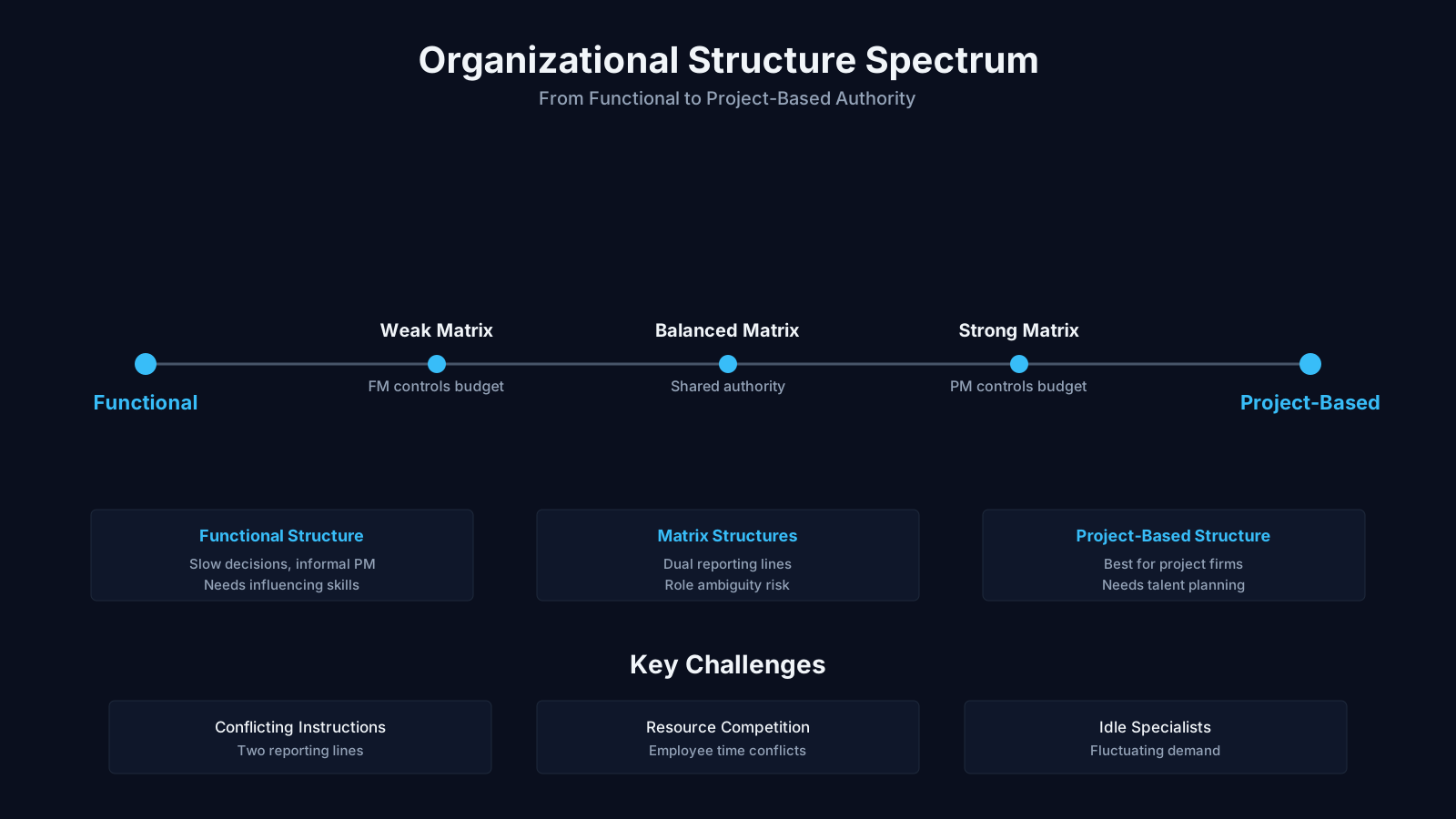
Summary of Common Project Organizational Structures
| Key Concept | Summary |
|---|---|
| Structural Impact on Authority | Organizational structure defines reporting lines, resource control, and the extent to which project managers hold binding decision authority or act primarily as coordinators. |
| Blended Organizational Models | Large enterprises often combine different structural models across business units or project types, making it harder for project professionals to identify their authority, escalation paths, and role boundaries. |
| PMBOK Classification | Under PMI's PMBOK Guide, organizational structure is classified as an enterprise environmental factor that shapes planning, resource management, and governance. |
| Charter Authority versus Operating Design | A project charter can confer formal decision rights, but the underlying operating structure determines whether those rights translate into direct control over staffing, budgets, and day to day delivery priorities. |
| Cross Functional Bottlenecks | A product launch that relies on engineering, marketing, and supply chain can stall when departments work sequentially rather than collaboratively, delaying handoffs and weakening shared accountability. |
| Accountability without Authority | Project managers frequently hold accountability for outcomes without direct line authority over the people performing the work, creating tension between responsibility and control. |
| Hybrid Functional Structures | Mature organizations often keep functional structures for operational work while adopting matrix or projectized models for strategic initiatives, preserving deep expertise while improving cross functional coordination. |
| Matrix versus Projectized Authority | In weak matrix structures, project managers monitor schedules and status but cannot assign resources or approve budget changes; projectized structures provide dedicated, co-located teams and clear ownership of delivery decisions. |
Functional Organization Structure and Its Project Implications
In a functional organizational structure, employees are grouped by specialty and each person has one clear superior within that specialty. Departments such as engineering, marketing, finance, and operations operate with a traditional hierarchy. Project work is performed within these departments, and each department manages its own projects independently of other departments. A cross-functional project in this environment often has no single full-time project manager. Coordination happens through functional managers, who hold authority over their people and budgets.
Within a functional organization, a project may look very different from what a project manager trained in PMBOK expects. The project manager role is often filled by a functional manager or a senior team member with no formal project title. Decisions about scope changes, resource allocation, and budget must travel up through the functional chain of command. This can make cross-departmental project work slow because each functional supervisor protects their own priorities. A new product launch that requires engineering, marketing, and supply chain input can stall when each department completes its part sequentially rather than collaboratively.
The advantage of this structure is depth of expertise and operational efficiency within a single discipline. Teams know their tools, processes, and quality standards. Career paths are clear, and training can be standardized. For projects contained entirely within one department, the functional structure often works very well. A facilities team upgrading a building's HVAC system can manage the project without involving other departments. The same applies to a finance department implementing a new internal reporting template. The project is localized, the scope is stable, and the functional chain of command provides sufficient oversight.
The main limitation appears when projects span multiple specialties. Functional silos can lead to communication breakdowns, duplicated work, and conflicting priorities. A project manager in a functional organization may have no direct authority over team members from other departments. They must rely on influence, negotiation, and escalation to senior management. This is a common source of frustration for project managers who are held accountable for results but cannot directly manage the people doing the work. The gap between responsibility and authority is one of the most persistent challenges in this structure.
From a PMBOK perspective, the functional organization sits at one end of the spectrum of organizational structures. It represents the lowest level of project manager authority and the highest level of functional manager control. This does not mean project management is absent. It means project management activities are embedded in functional management rather than existing as a separate discipline. Many mature organizations continue to use functional structures for internal operational projects while relying on other structures for strategic initiatives that require more cross-functional integration.
Core Insights on Functional Structures
- Specialty-based departmental hierarchy
- Employees are grouped by technical specialty and report through a single chain of command, while functional managers retain control over both staffing and budgets, allowing each department to operate with a high degree of autonomy.
- Slow cross-departmental decision-making
- Cross-departmental work stalls because scope changes, resource requests, and funding decisions must move through separate hierarchies, while department leaders often defend their own priorities instead of aligning on joint goals.
- Best suited for operational projects
- Established organizations commonly retain functional structures for stable, recurring operational work but shift to matrix or project-based models when strategic initiatives require coordinated input from multiple functions.
Matrix Organizational Structures: Weak, Balanced, and Strong
A matrix organizational structure blends elements of functional and projectized designs. Employees typically report to both a functional manager and a project manager, creating dual reporting relationships. The balance of power between these two managers varies across three recognized forms: weak matrix, balanced matrix, and strong matrix. The core idea is to retain functional expertise while giving project work more visibility and coordination than it receives in a pure functional structure. In practice, however, matrix environments generate different levels of authority, communication complexity, and conflict depending on how the balance is configured.
Weak Matrix Organization Structure
In a weak matrix, the project manager role is more of a coordinator or expediter than a true manager. Project coordination is limited, and functional managers retain most authority over resources and decisions. The project manager may be assigned part-time, often with a title such as project coordinator or project expediter. They track schedules, follow up on action items, and communicate status, but they cannot directly assign work or authorize budget changes. When a team member is not available or a task is delayed, the coordinator escalates to the functional manager.
An expediter role is typically even more restricted than a coordinator. An expediter may simply track progress and remind team members of deadlines without making any decisions. A coordinator may have some ability to influence planning but still lacks formal authority. Both roles share the same fundamental challenge. They carry the burden of project communication without the power to resolve resource conflicts. That sounds straightforward until you realize the coordinator is often the first person blamed when a functional manager misses a milestone.
This structure often appears in organizations that are just beginning to introduce formal project management practices. It allows departments to maintain their existing hierarchies while adding a light layer of project oversight. Small, low-risk projects can function adequately under a weak matrix because the need for cross-functional decision-making is limited. However, for complex projects with tight deadlines or significant interdependencies, the weak matrix tends to produce frustration. Project coordinators spend more time chasing answers than facilitating delivery, and issues pile up because no single role has the authority to resolve them.
Balanced Matrix Organization Structure
In a balanced matrix, the project manager is recognized but does not have full authority over the project and project funding. This is a shared-power arrangement. The project manager defines the project plan, manages the schedule, and communicates with stakeholders. The functional manager controls the technical work, assigns personnel, and often holds the purse strings. Both managers must negotiate to get work done. A project manager may need additional testing hours, but the functional manager decides whether a quality engineer can be released from other duties.
The word balanced can be misleading because the structure rarely feels stable in daily operations. Team members report to two managers, and when those managers disagree, the team member is caught in the middle. The project manager may demand faster progress, while the functional manager emphasizes thorough technical review. Neither manager has overriding authority, so conflicts escalate upward to a shared sponsor or steering committee. This creates a need for formal communication protocols and clear role definitions, which many organizations fail to establish when they adopt a balanced matrix.
From a practical standpoint, the balanced matrix works best in organizations where project management and functional management are both mature disciplines. The project manager has enough authority to hold people accountable to the schedule, while the functional manager ensures technical quality. It is not unusual to see this structure in product development environments where engineering leads and project managers jointly own delivery. The risk is that resource negotiations consume excessive time. Every project becomes a series of trade-offs between competing departmental priorities, and without a strong governance body, decision paralysis can set in.
Strong Matrix Organization Structure
A strong matrix gives full-time project managers considerable authority and full-time project administrative staff. Functional managers still exist, but their role shifts toward providing subject matter expertise, developing skills, and assigning resources to projects. The project manager controls the project budget, directs the work, and makes most day-to-day decisions. Team members may remain administratively under a functional department, but their project assignments and priorities come from the project manager. This structure resembles the projectized organization in many ways, except that functional departments still maintain some influence over personnel management and career development.
In a strong matrix, project managers often come from a centralized project management office or a dedicated pool of project professionals. They are trained in project management practices and are accountable for project outcomes. Project administrative staff, such as coordinators, planners, and controllers, support the project manager full-time. This reduces the administrative burden that often slows down project delivery in weaker structures. The project manager can authorize changes, reallocate resources within the project, and hold team members accountable for deliverables without waiting for functional approval.
The strong matrix is common in engineering, information technology, and professional services firms that run multiple cross-functional projects simultaneously. The structure provides clear project leadership while retaining functional expertise. However, power struggles between project managers and functional managers can still occur. A project manager may demand a key resource for a critical phase, while the functional manager needs that same person for training or operational support. When the organization lacks clear escalation rules, these disputes can damage relationships and delay projects. Additionally, team members may experience burnout from competing demands, especially if they are assigned to multiple strong matrix projects at the same time.
Projectized Organization Structure and Full Project Authority
In a projectized organizational structure, team members are often co-located, most of the organization's resources are involved in project work, and project managers have a great deal of independence and authority. Any organizational units called departments either report directly to the project manager or provide support services to the various projects. This structure treats projects as the primary business activity rather than as temporary disruptions to functional operations. The project manager controls budgets, schedules, and personnel decisions for the project team.
A projectized organization looks like a collection of project teams operating side by side, each with its own dedicated manager and staff. Team members report to the project manager, and their performance evaluations, daily assignments, and career progression are tied to project success. When a project ends, team members may be reassigned to other projects or, in contract-heavy industries, released if no new work is available. This project-by-project approach creates strong team identity and fast decision-making. The project manager does not need to negotiate with functional managers for every resource request because the team is already assigned to the project.
Co-location is a notable feature of many projectized environments. Placing the team in the same physical or virtual space enables rapid communication and informal problem-solving. It also reduces the coordination overhead that plagues matrix and functional structures. When a developer has a question about a requirement, they can walk over to the business analyst or message them directly without routing through multiple layers of management. This immediate access can shorten feedback loops and improve quality, particularly in complex, uncertain projects where requirements evolve quickly.
The cost of this structure is significant. Maintaining full-time project teams often leads to underutilization between projects. A specialized resource may be busy for three months and idle for the next two. Organizations that take on variable project volumes may struggle to keep skilled people fully engaged. Technical expertise can also become fragmented across project teams, with limited cross-project learning and mentorship. Functional departments, if they exist at all, may provide only support services rather than deep skill development. Over time, projectized organizations risk losing organizational memory because teams disband once project work is complete.
This structure is most suitable for large, high-stakes initiatives that demand dedicated focus and rapid decision-making. Construction firms, film production companies, and consulting practices often operate in a projectized or near-projectized manner. In these settings, the project is the business model. A misaligned functional hierarchy would only slow down delivery. The project manager's independence extends to procurement, vendor management, and risk response, which makes the role both powerful and demanding. That level of autonomy cuts both ways, and not every project manager is prepared for the full weight of that accountability.
Core Takeaways on Project Authority
- Project managers hold full control
- In a projectized structure, the project manager exercises direct control over budgets, schedules, and staffing decisions, which consolidates decision-making authority and removes competing functional priorities.
- Projects are the primary activity
- The organization operates with projects as its central value-creating activity, so permanent departments either report to project managers or exist solely to supply specialized support to project teams.
- Team careers tied to projects
- Team members have a single reporting line to the project manager, which means their performance reviews, task allocation, and advancement opportunities are driven by project outcomes rather than by functional department loyalty.
- Co-location enables fast feedback
- Co-locating team members in a shared physical or virtual environment promotes immediate communication and informal collaboration, accelerating feedback cycles and raising the quality of work on complex project deliverables.
Composite Organization Structure: Multiple Models in One Enterprise
A composite organizational structure arises when many organizations involve all these structures at various levels. Large enterprises, in particular, rarely operate with a single structure across every division and every project. The corporate office may remain strictly functional, while the information technology department runs a strong matrix for software delivery. A special strategic program may receive projectized treatment with a dedicated team, while smaller business improvement efforts operate as weak matrix or functional projects. The composite model reflects the reality that different types of work require different levels of project authority and resource commitment.
The composite approach develops organically rather than through a single top-down design. A company may start functionally, then introduce matrix practices in its product development group to improve cross-functional coordination. Later, a merger brings in a projectized consulting division. Over time, the organization ends up with pockets of different structures, each adapted to its specific history, leadership style, and market demands. This is not necessarily a failure of organizational design. It can be a pragmatic response to diverse project portfolios and regional differences.
The main benefit of a composite structure is flexibility. A business unit that delivers long-term infrastructure projects can adopt a strong matrix or projectized approach, while a back-office finance team continues to run its small projects functionally. This allows the organization to match the structure to the project's complexity, risk, and strategic importance. A high-impact digital transformation can receive dedicated resources and a full-time project manager, while a routine policy update can be handled within a single department without excessive overhead.
The downside is inconsistency. Project managers working in the same company may have vastly different authority, reporting lines, and governance expectations depending on where they are located. A project manager who moves from the IT division to the operations division may suddenly lose the ability to make resource decisions. Team members may be confused about who approves overtime, who controls the budget, and how to escalate issues. Standardizing project management practices becomes difficult when the underlying structures differ so much. Project management offices often struggle to impose common templates and processes because the organizational reality varies from one project to the next.
How Organizational Structure Impacts Project Management Practice
Understanding the impact of organizational structure on project management is essential for anyone expected to deliver results in a complex environment. The structure determines whether a project manager can directly assign resources or must negotiate with functional managers. It shapes communication channels, decision authority, and the practical meaning of accountability. A project manager's leadership style, stakeholder engagement approach, and risk management activities all shift depending on where the project sits on the spectrum from functional to projectized.
In a functional structure, project management often relies on informal influence and escalation. The project manager may hold a title, but the functional manager controls the team. The project manager must build strong relationships with department heads and present decisions as collaborative rather than directive. Communication tends to flow vertically within each department, so the project manager often acts as the bridge between silos. Without a formal authority base, soft skills become the primary tool for moving work forward. This is a key reason why project management training often emphasizes stakeholder engagement and communication management as much as scheduling and budgeting.
Weak matrix environments add a layer of coordination complexity. The project coordinator or expediter must track issues without the power to enforce deadlines. This creates a constant tension between project needs and departmental priorities. Effective project managers in weak matrix settings develop robust escalation mechanisms and maintain transparent status reporting so that senior leaders can see where bottlenecks occur. The risk is that the coordinator becomes a messenger rather than a manager. If the organization does not provide clear escalation paths, project delays become chronic and accountability becomes diffuse.
Balanced and strong matrix structures shift the project manager's role toward negotiation and conflict resolution. In a balanced matrix, project managers and functional managers share authority, which means almost every significant decision requires some form of bilateral agreement. In a strong matrix, the project manager has more direct control, but functional managers still influence resource availability and technical standards. Project managers in these environments need to be skilled at managing dual reporting relationships and setting clear expectations with team members. A well-developed responsibility assignment matrix, such as a RACI chart, can help reduce confusion, but it cannot replace the ongoing dialogue required to keep two managers aligned.
Projectized and strong matrix structures allow faster decision-making but also increase the project manager's administrative burden. With full authority over budget and personnel comes the responsibility for hiring, performance management, and conflict resolution. The project manager may no longer have a functional manager to handle these issues. That autonomy can be liberating, but it also exposes the project manager to greater personal accountability. If the team fails to deliver, there is no functional manager to share the blame. This is why projectized organizations often pair project managers with robust project controls, governance boards, and portfolio oversight to ensure that authority is exercised responsibly.
From a knowledge area perspective, the structure affects resource management, communication management, and stakeholder engagement most directly. Resource management plans must account for who actually controls the people. Communication plans must reflect the reporting lines and escalation paths that exist in the structure. Stakeholder engagement strategies must consider how much influence functional managers, sponsors, and portfolio managers hold over the project. Ignoring these structural realities leads to plans that look good on paper but fail during execution because the project manager assumes authority they do not actually possess.
Business value oriented project management approaches also recognize the importance of team structure. Cross-functional teams are treated as a core success factor, which aligns naturally with strong matrix and projectized structures where diverse skills are focused on a single project outcome. The emphasis is less on who reports to whom and more on whether the team has the necessary capabilities and authority to deliver value quickly. This perspective does not replace the need for formal structure, but it shifts attention toward outcomes and collaboration rather than hierarchy alone.
Core Insights on Structural Impact
- Authority determines resource control
- Organizational structure sets the boundaries of a project manager's resource authority, determining whether staffing is assigned directly or must be secured through negotiation with functional managers.
- Leadership adapts to structure
- Effective project managers calibrate their leadership style, stakeholder engagement, and risk management practices to the authority embedded in the organizational structure, ranging from functional to projectized environments.
- Soft skills bridge structural gaps
- In weak matrix environments, project managers depend on influence, relationship capital, carefully designed escalation paths, and transparent reporting to sustain progress without formal authority.
- Balanced matrix requires negotiation
- In a balanced matrix, authority is shared between project and functional managers, so significant decisions require sustained bilateral negotiation and dialogue that a RACI chart alone cannot replace.
- Projectized pairs power with oversight
- Projectized organizations pair the project manager's broad authority with rigorous project controls, governance boards, and portfolio oversight, creating accountability structures that keep decision making aligned with strategic objectives.
Choosing the Right Project Organizational Structure
Selecting the right model requires a clear-eyed view of project complexity, strategic importance, resource availability, and existing culture. There is no universal best structure, and the spectrum from functional to projectized exists precisely because different situations demand different trade-offs. A project organizational structure selection process should start with the question of what authority the project manager truly needs to deliver. Then consider what the organization can realistically support without disrupting critical operations or creating excessive overhead.
Functional structures make sense for projects that are contained within a single department or that primarily serve operational improvement. If the project does not require significant cross-functional coordination, the overhead of a dedicated project manager and matrix reporting lines adds little value. A small process improvement in accounting, for example, can be managed by the accounting manager with no need for a formal project management structure. The same logic applies to routine maintenance projects, local facility upgrades, or internal policy revisions where the specialist team can handle the work independently.
Matrix structures become valuable when projects require input from multiple departments but the organization cannot justify full-time dedicated teams. The weak matrix suits low-risk projects where a coordinator can track progress without needing formal authority. The balanced matrix works when project managers and functional managers are both mature enough to negotiate shared ownership of resources and schedules. The strong matrix is often the best fit for complex, cross-functional projects that need a full-time project manager with considerable authority but still depend on centralized technical expertise. Many organizations end up moving from weak to balanced to strong matrix as their project management maturity grows.
Projectized structures are appropriate for large strategic initiatives where speed, dedicated focus, and clear accountability matter more than resource efficiency. A multi-year digital transformation, a major product launch, or a high-stakes regulatory compliance program may require a co-located team reporting directly to a project manager. The cost of underutilization is offset by the faster delivery and reduced coordination overhead. Organizations that repeatedly take on such initiatives often maintain a core of projectized teams, even if the rest of the business operates in a matrix or functional model.
Composite structures are not a fallback option. They are often the most honest reflection of how large enterprises actually operate. The key is to make the differences intentional rather than accidental. When leadership understands that the IT division runs strong matrix teams while the supply chain division still operates functionally, they can adjust governance, reporting, and performance expectations accordingly. Without that awareness, employees experience conflict and confusion. One project manager may be expected to make decisions while another merely coordinates, and both may report to the same sponsor. Clarifying the structural rules for each project is a practical step that reduces friction and aligns expectations.
Changing an organizational structure is never just about redrawing an org chart. It requires changes in performance management, budgeting processes, communication norms, and leadership behavior. A shift from functional to matrix will fail if functional managers still hold all budget authority and are not rewarded for sharing resources. A shift to projectized will create waste if there is not enough pipeline of project work to keep full-time teams busy. Project managers can influence this transition by documenting where structural barriers hinder delivery and proposing targeted adjustments rather than wholesale reorganization.
Ultimately, the most common project organizational structures exist on a spectrum because each represents a different answer to one central question. How much authority should the project manager have relative to the functional manager? The answer depends on the work itself, the organization's risk tolerance, and the maturity of its project management practices. A project manager who understands this spectrum can adapt their approach, communicate more effectively with stakeholders, and avoid the painful mismatch between responsibility and authority that undermines so many projects. The structure is not fate, but it is a powerful force that shapes every decision a project team makes.