Projects are living entities. They shift, drift, and occasionally veer. Even the most meticulously crafted project plan begins to fray the moment execution starts, because reality has a way of introducing surprises that no amount of upfront analysis could foresee. This is why the ability to monitor and control work is not just a project management skill but the very mechanism that separates successful delivery from slow, silent failure. The process of tracking, reviewing, and regulating progress keeps a project aligned with its performance objectives, ensuring that deviations are caught early and addressed before they compound into irreversible damage. Without it, a project manager is flying blind, trusting the plan to hold itself together while forces of change chip away at its foundations.
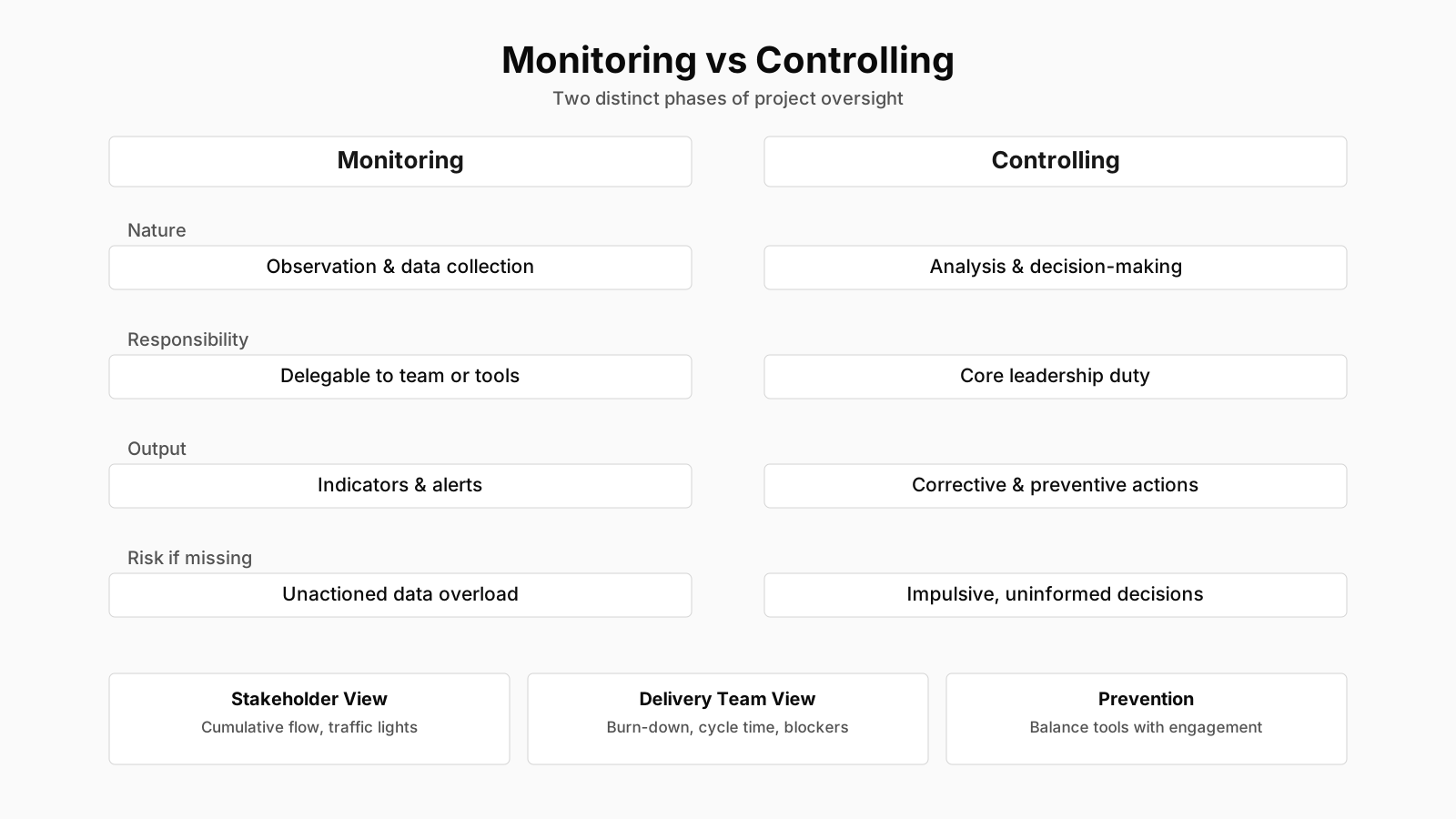
What many inexperienced practitioners overlook is that monitoring and control are not the same thing, and treating them as interchangeable causes real problems. Monitoring is the act of gathering data: collecting cost figures, schedule progress, quality metrics, risk statuses. Control is the act of interpreting that data and deciding what to do about it. A team can monitor perfectly and still fail if the control response is weak, late, or misguided. And control without proper monitoring is just guesswork dressed in authority. In the sections that follow, we will explore the Monitor and Control Project Work process in depth, from its definition and objectives to the common mistakes that derail even seasoned teams. Along the way, we will connect the concept to its place within broad frameworks like PMBOK and PRINCE2, to practical strategies that make it stick, and to modern thinking that expands what we should be monitoring in the first place.
Summary Table of Project Monitoring Techniques
| Key Concept | Summary |
|---|---|
| Foundation | The Monitor and Control Project Work process continuously compares actual progress against the approved project management plan, identifying variances that require corrective or preventive actions to maintain strategic alignment. |
| Integration Hub | This process acts as the central integration hub, synthesizing performance inputs from all knowledge areas: scope, schedule, cost, quality, resources, communications, risk, procurement, and stakeholder engagement for cohesive oversight. |
| PRINCE2 | PRINCE2 delegates monitoring and control across the Controlling a Stage and Managing Product Delivery processes, relying on highlight and checkpoint reports for progress visibility and exception plans for deviations requiring escalated attention. |
| Agile Practices | Agile teams integrate monitoring into daily ceremonies such as stand-ups and sprint reviews, using burndown charts and cumulative flow diagrams to surface impediments and maintain radical transparency. |
| Navigational Mindset | Effective project managers adopt a navigational mindset, steering the project through constant micro-corrections informed by live feedback rather than blindly following the baseline plan. |
| Trend Analysis | Small recurring variances, like a minor weekly overspend, often signal accelerating compound trends that can silently erode the cost baseline before the next phase gate review. |
| Leading Indicators | Proactive monitoring of leading indicators such as emerging risks, unresolved issues, and team morale helps preempt performance declines that lagging indicators like schedule variance only confirm later. |
The Foundation of Monitoring and Controlling Work
At its core, the Monitor and Control Project Work process is concerned with comparing actual project performance against the project management plan and determining whether corrective or preventive actions are indicated. This is the language of the Project Management Body of Knowledge, which places the process in the Monitoring and Controlling Process Group under the Integration Management Knowledge Area. It is the process that ties everything together, because performance information from every other knowledge area—scope, schedule, cost, quality, resources, communications, risk, procurement, and stakeholders—feeds into this central point of analysis. The project manager, armed with reports and observations, asks the fundamental question: Are we still on track to deliver what we promised, within the constraints we accepted?
This sounds straightforward, but in practice it is one of the most cognitively demanding parts of the job. The project manager must constantly reconcile two mental models: the plan as documented, with its baselines and assumptions, and the messy, unfolding reality of the work. That reconciliation is not just a mechanical comparison of numbers. It requires judgment about which variances matter, which trends are accelerating, and which metrics, if ignored today, will become crises tomorrow. In PRINCE2, this function is distributed across the Controlling a Stage and Managing Product Delivery processes, where the project manager reviews progress through regular highlight reports and checkpoint reports, escalating issues via exception plans when tolerances are forecast to be exceeded. In Agile environments, monitoring and control are embedded in daily ceremonies: the stand-up surfaces impediments, the sprint review inspects the increment against the sprint goal, and the burndown chart makes velocity and remaining work transparent. The rhythm differs, but the imperative is identical.
What does regulating progress actually mean? It is not about stifling the team or enforcing rigid adherence to a plan that may no longer make sense. It is about maintaining intentional direction. Think of it like steering a sailboat. The wind shifts constantly, and the water is never still. The helmsperson does not stare at a fixed compass bearing and ignore everything else; they feel the helm, read the telltales on the sail, watch the waves, and make hundreds of micro-adjustments. Monitoring is reading the telltales and checking the compass. Control is the act of moving the tiller. The goal is to reach the destination, not to hold a theoretical angle. And yet, if you never check the compass, you will drift far off course without noticing. Many project managers make the mistake of waiting for the monthly status review to see how things are going, by which time the vessel is already in a different ocean.
Monitoring as Intelligence Gathering
Monitoring includes collecting, measuring, and distributing performance information, and assessing measurements and trends to effect process improvements. This is not a passive activity. It requires designing the right data collection points early in the project, often during the planning phase when the performance measurement baseline is established. A work breakdown structure without clear measurement criteria is like a map without a scale. The project manager needs to know not just that work package X is complete, but whether it met its quality criteria, consumed its allocated budget, and finished within the planned window. That information often comes from work performance data generated by the team, aggregated into work performance information, and finally synthesized into work performance reports. The shift from raw data to decision-ready information is where insight lives.
Continuous monitoring gives the project management team insight into the health of the project and identifies areas that may require special attention. For instance, a slight weekly overspend might look trivial on its own, but when plotted over eight consecutive weeks, it reveals an accelerating trend that will breach the cost baseline well before the next phase gate. That trend would be invisible if monitoring were limited to snapshot comparisons. The most effective project managers train themselves to look for patterns rather than isolated data points. They watch for leading indicators—such as unresolved issues accumulating faster than they are closed, or team morale dipping in retrospective feedback—to anticipate problems that lagging indicators like schedule variance will only confirm later.
Control as Action Orientation
Control includes determining corrective or preventive actions or replanning and following up on action plans to determine if the actions taken resolved the performance issue. This is where many projects stall. Data is abundant; action is scarce. A project manager might send out a status report highlighting a variance, but if that report does not trigger a decision, monitoring has failed in its purpose. Corrective actions bring the project back into alignment with the plan—reallocating resources to a delayed task, for example—while preventive actions address risks before they materialize. Replanning is sometimes the only honest option, because enforcing an obsolete baseline is a form of self-deception. The control loop is not closed until the project manager verifies that the action had the intended effect. Too often, the assumption is that because a decision was made, the problem is solved, but without follow-up, the same issue resurfaces a month later under a different name.
One of the subtler aspects of control is knowing when to elevate. Not every corrective action is within the project manager’s authority. PRINCE2 formalizes this with management stages and tolerance thresholds; when a stage is forecast to exceed its tolerances, the project manager must produce an exception report and escalate to the project board. In PMBOK, this aligns with the Perform Integrated Change Control process, which ensures that any change to the baselines goes through proper governance. The line between operational control and governance-level change is critical. A project manager who tries to absorb a five percent schedule slip by working the team harder without telling stakeholders is making a decision that belongs at a higher level. That kind of silent replanning erodes trust and sets the project up for a much larger reveal later.
Core Takeaways on Work Monitoring
- Central performance comparison
- Monitor and Control Project Work continuously compares actual project performance against the project management plan, enabling timely decisions on corrective or preventive actions to keep the project aligned with its objectives.
- Hub for all knowledge areas
- Performance data from scope, schedule, cost, quality, resources, communications, risk, procurement, and stakeholder engagement converge at this central analysis point, providing the project manager with an integrated view of project health.
- Plan versus reality reconciliation
- The project manager must persistently reconcile the formal plan, its baselines, and underlying assumptions with the complex, often unpredictable realities encountered during execution.
- Adaptive method distribution
- PRINCE2 allocates monitoring responsibilities across the Controlling a Stage and Managing Product Delivery processes, whereas Agile embeds continuous oversight into daily stand-ups, sprint reviews, and the transparency of burndown charts.
- Leading indicators forecasting
- Effective monitoring focuses on leading indicators, such as mounting unresolved issues and declining team morale, to forecast problems before they manifest in lagging measures like schedule or cost variances.
Key Objectives of the Monitor and Control Process
The Monitor and Control Project Work process has a broad mandate, and understanding its specific concerns is essential for keeping projects on track. Comparing actual project performance against the project management plan is the first and most obvious objective, but it is only the starting point. The process also explicitly addresses identifying new risks and analyzing, tracking, and monitoring existing project risks to make sure the risks are identified, their status is reported, and that appropriate risk response plans are being executed. This integration with risk management is often underplayed, yet it is one of the most valuable contributions of the process. A plan is a snapshot of assumptions, and monitoring the validity of those assumptions is a form of proactive risk management. When a project manager notices that a key supplier has started delivering late on small orders, that observation is not just a schedule concern; it is a risk indicator that a full-scale delay may be imminent.
Another concern is maintaining an accurate, timely information base concerning the project’s product and their associated documentation through project completion. This sounds administrative, almost clerical, but it is a safeguard against the slow erosion of knowledge that happens when deliverables evolve and documentation lags behind. In complex software projects, for example, the as-built configuration may differ from the design documents because of late-stage bug fixes. If that gap is not tracked, the next phase of work or future maintenance will be built on incorrect assumptions. The information base is the project’s memory, and when it fades, the project becomes increasingly difficult to control. The process also covers providing information to support status reporting, progress measurement, and forecasting, which links directly to stakeholder communication. Without this structured flow, status reports become opinion pieces rather than factual accounts.
Providing forecasts to update current cost and current schedule information is another crucial objective. Forecasting is where monitoring and control shifts from reactive to anticipatory. A project manager who can say with confidence that, at the current burn rate and with the remaining work scope, the project will finish three weeks late and five percent over budget is doing more than reporting; they are giving stakeholders the information they need to make trade-off decisions before it is too late to change course. Finally, the process is concerned with monitoring implementation of approved changes as they occur. Once a change request is approved and the baseline is updated, the new plan becomes the reference point. But the team must actually adopt the new direction, and old habits can linger. Monitoring change implementation closes the loop, ensuring that decisions translate into action rather than living only in meeting minutes.
Performance Variance and the Need for Nuanced Interpretation
Assessing performance to determine whether any corrective or preventive actions are indicated, and then recommending those actions as necessary, is where the project manager’s judgment is tested most directly. A variance is not automatically a problem. Some variances are positive—completing a deliverable under budget—and others are within acceptable thresholds given the uncertainty inherent in the estimates. The danger is in treating all variances equally. A small cost overrun on a critical path activity that causes a cascading schedule delay is far more devastating than a large cost overrun on a non-critical activity with abundant float. The process requires not just detecting deviations but understanding their systemic impact. This is why earned value management, when applied, looks at schedule variance and cost variance together, and why experienced project managers learn to read the story behind the numbers.
There is a tendency in many organizations to push for quick corrective action on every red indicator. This can lead to thrashing, where the team is constantly pulled in new directions to fix micro-variances that would have self-corrected. The skill lies in distinguishing signal from noise. A single week of low productivity during a holiday season is noise. Four consecutive weeks of declining velocity with no obvious cause is signal. The project manager must resist the pressure to react to every fluctuation and instead maintain a steady focus on trends. This does not mean ignoring the data; it means placing it in context. Sometimes the best action is to do nothing and watch, but that decision must be a conscious one, not a default born of inattention.
Risk Surveillance as a Continuous Thread
The identification of new risks and the tracking of existing ones is not a separate process that happens during quarterly risk reviews. It is woven into monitoring and control. As the project progresses, the risk profile changes. Risks that were identified during planning may have passed their trigger dates without incident, meaning they can be retired. New risks emerge because of decisions made during execution, external events, or simply because more detailed design work has revealed complexities that were invisible earlier. A project manager who only looks at the risk register when the risk management process demands an update is effectively blind to half of the project’s uncertainty. The Monitor and Control Project Work process insists on this continuous vigilance. When a team member mentions in a hallway conversation that a third-party API is behaving inconsistently, a switched-on project manager logs that observation immediately and assigns a risk owner, even if no impact has yet occurred.
The follow-through on risk response plans is equally important. It is common to watch teams enthusiastically document mitigation strategies and then fail to execute them because the risk remained theoretical until it materialized. Monitoring ensures that the contingency reserves are still adequate, that the risk owners are still engaged, and that the triggers are still valid. When a risk does occur, the process supports the pivot to executing the response plan and monitoring its effectiveness. Without this link, the risk management effort is a document-production exercise rather than a protective function. The most mature project organizations treat risk surveillance as part of the daily rhythm rather than a periodic checkpoint, and the Monitor and Control process provides the structure for that integration.
Expert Judgment and the Human Element
To interpret the information from monitoring and control processes, the project management team uses expert judgment to interpret the information and determine the actions required to ensure project performance matches expectations. Expert judgment is not a euphemism for guessing; it is the application of specialized knowledge, experience, and pattern recognition that no algorithm can fully replicate. When a project manager sees that a particular contractor has submitted a change request that seems slightly inflated, their decision to investigate further is based on a dozen similar situations from past projects. That kind of judgment cannot be codified in a workflow diagram, yet it is often the difference between catching a problem early and discovering it too late.
The project manager, in collaboration with the team, makes these determinations. This collaborative aspect is crucial because the people doing the work often sense problems before the metrics register them. A developer who says “this module is taking longer because the requirements kept shifting” is providing context that a simple schedule variance cannot convey. The project manager’s role is to synthesize these inputs, weigh them against the project objectives, and decide on a course of action. Sometimes the decision is to do nothing; other times it is to escalate; occasionally it is to call a facilitated workshop to replan an entire phase. Expert judgment also means knowing the limits of one’s own knowledge. A project manager who has never managed a regulatory compliance project should not rely solely on their own judgment when interpreting variances in that domain; they should bring in subject matter experts. The process expects this humility, and when it is absent, control decisions become brittle and error-prone.
What often surprises newer project managers is the emotional discipline required. When the project is under intense pressure to meet a deadline, the temptation to interpret ambiguous data optimistically is nearly overwhelming. Expert judgment includes the ability to remain objective, to report unpleasant truths, and to resist the organizational pressures that reward good news over accurate news. In cultures where admitting a forecasted delay is seen as failure, monitoring and control becomes a theatre of sanitized reports, and the real work of steering the project goes underground. Healthy project cultures understand that the purpose of monitoring is not to assign blame but to enable informed steering, and expert judgment flourishes only in that environment.
Core Insights on Expert Judgment
- Experience-based pattern recognition
- Expert judgment relies on specialized knowledge and intuitive pattern recognition shaped by firsthand project experience, a synthesis that no algorithm or workflow diagram can ever truly replicate.
- Ground-level problem sensing
- Frontline practitioners frequently detect emerging issues long before quantitative metrics reflect them, making it essential for the project manager to integrate these early signals and balance them against broader project goals.
- Honest reporting under pressure
- Expert judgment demands strict objectivity and the courage to surface uncomfortable truths, because organizational cultures that punish bad news inevitably transform monitoring into sanitized theatre, obscuring genuine risks.
Integrating Monitoring and Control Across Frameworks
Project management methodologies all wrestle with the same challenge of keeping work on track, but they structure the monitoring and control function differently. Understanding these variations helps practitioners select the right blend for their context. In PMBOK, the Monitor and Control Project Work process sits squarely within the Monitoring and Controlling Process Group, receiving inputs from all knowledge areas and producing change requests, work performance reports, and project management plan updates. It is the integrator that pulls together performance data from scope validation, schedule control, cost control, quality control, risk monitoring, and procurement administration. Without this integration, each knowledge area would operate in a silo, and the project manager would lack a cohesive picture of health.
PRINCE2 takes a stage-based approach. The project manager controls each management stage through the Controlling a Stage process, which includes authorizing work packages, reviewing their status, capturing issues and risks, and reporting highlights to the project board. At the end of each stage, the Managing a Stage Boundary process provides a formal assessment point where the business case, risks, and plan are revisited. This structured cadence ensures that monitoring and control are not continuous in an overwhelming sense but are pulsed at intervals that match governance needs. For many organizations, this rhythmic approach is more sustainable than constant vigilance, because it aligns monitoring effort with decision-making cycles. The project board receives information at the point where they can actually do something with it.
In Agile and Scrum, monitoring and control are built into the fabric of the sprint. The Daily Scrum surfaces obstacles and progress almost in real time. The Sprint Review inspects the increment and adapts the Product Backlog, while the Sprint Retrospective examines process health. The burndown chart and cumulative flow diagram provide visual, near-real-time tracking of work remaining and throughput. This moves monitoring from a periodic manager-led activity to a team-owned, continuous feedback loop. The control action is not a directive from above but an adaptation that the team and Product Owner negotiate. The empirical approach—inspect and adapt—replaces predictive variance analysis with empirical trend analysis, but the core objective is identical: ensure the work being done aligns with the value being sought. The BVOP methodology extends this idea further by introducing Business Value Points, which quantify delivered value and act as a leading indicator of project health. When Business Value Points persistently decline, it signals that the project may need fundamental re-evaluation or even closure, a control decision that traditional earned value metrics might not trigger because they focus on cost and schedule rather than value.
Common Pitfalls That Derail Monitoring and Control
One of the most pervasive pitfalls is overreliance on lagging indicators while ignoring leading signals. Schedule variance and cost performance index tell you what has already happened. By the time they flash red, the project may have been sliding for weeks. Leading indicators—such as requirement volatility, defect injection rates, or team overtime hours—give earlier warnings. Yet many project dashboards are built around backward-looking metrics, and project managers present them in steering committee meetings as if they were predictive. A far more dangerous pattern emerges when the monitoring system itself is gamed. Teams who know they are being measured on schedule adherence will pad estimates or report tasks as complete when they are only partially done, creating a rosy but false picture that collapses at integration. The project manager must design measures that are difficult to manipulate and then cross-check them with direct observation and conversation.
Another common failure is analysis paralysis. Some project managers become so fascinated by the data that they delay decisions waiting for perfect information. Meanwhile, the project drifts. A rough trend with directional accuracy is worth far more than a precise measurement that arrives a week late. The purpose of monitoring is to enable timely control, not to produce beautiful variance analysis documents. When a project manager spends three days calculating the exact cost variance on a work package that could have been rebaselined in an hour, the process has become an obstacle rather than an enabler. The right threshold for action is when the cost of delaying a decision exceeds the cost of being slightly wrong. Projects rarely fail because of measurement imprecision; they fail because of decision latency.
A subtler pitfall is monitoring everything and controlling nothing. Some organizations have elaborate reporting requirements that generate hundreds of data points each week, but nobody reads them, and even if they did, the governance structure lacks the agility to act on them. Information that is collected but not used is waste. The first step in designing a monitoring and control system is to identify the handful of metrics that actually drive decisions, and then focus effort there. Everything else is decoration. This principle aligns with lean thinking and is reinforced by BVOP’s categorization of waste, which includes overwork, perfectionism, and rejected acceptable work. Monitoring that demands excessive data entry from the team or chases unactionable micro-details inflicts process damage that can outweigh its informational benefit. The art is in finding the vital few measures that give a true signal without drowning the project in reporting overhead.
Core Takeaways on Monitoring Pitfalls
- Overreliance on lagging indicators
- Dashboards centered on lagging indicators such as schedule variance deliver warnings only after problems have materialized, while leading indicators like defect injection rates and team overtime provide proactive signals of impending issues.
- Metrics vulnerable to manipulation
- When teams are evaluated strictly by schedule adherence, they may inflate estimates or prematurely report tasks as complete; managers should design tamper-resistant metrics and validate them through direct observation.
- Timely accuracy beats false precision
- A timely, approximate trend offers far greater decision-making value than a precise variance report that arrives a week late and demands disproportionate effort to produce.
- Excessive data entry burden
- Monitoring approaches that impose heavy data collection demands on the team or track low-value micro-details often create more process friction than the information benefits can justify.
Practical Strategies for Keeping Projects on Track
Establishing a rhythm of regular project reviews that combine metric analysis with team dialogue is one of the most effective strategies a project manager can adopt. Formal status meetings alone are insufficient because they often become recitations of what happened rather than discussions of what needs to change. The best practitioners pair a weekly metric review with a brief, focused conversation with the people doing the work. They ask questions like “What surprised you this week?” and “What would you do differently if we had to do tomorrow’s work over again?” These open-ended probes surface information that dashboards never capture. The pattern is universal: data tells you what is happening; conversation tells you why, and the combination is where control decisions become insightful rather than reactive.
Another key strategy is to treat the project management plan not as a static document but as a living baseline that is updated when reality shifts. Many project managers resist rebaselining because they fear it will be seen as failure. But sticking to an obsolete plan is a far greater failure because it destroys the credibility of all monitoring data. If the plan says a milestone is due next week but everyone knows it was delayed six weeks ago, the variance report is fiction. A controlled rebaseline, done through proper change control, resets the reference point so that monitoring can continue to provide meaningful signals. The discipline is to do this only when the project’s fundamentals have changed, not as a routine workaround for poor performance. The test is simple: would an informed stakeholder approve the rebaseline if they understood the reasons? If yes, proceed; if no, fix the performance first.
Embedding monitoring into daily work habits rather than leaving it as a separate management activity also yields better outcomes. In Agile teams, this happens naturally through the task board and daily stand-up. In traditional projects, it requires more intentional design: a five-minute checkpoint at the start of the workday to review open issues, a policy that any team member can log a risk directly into the register without managerial filtering, a shared dashboard that updates automatically from source systems rather than requiring manual compilation. The easier it is for the team to surface concerns, the earlier the project manager learns about them. When monitoring feels like a bureaucratic chore, it is done minimally and begrudgingly. When it is woven into the workflow, it becomes part of the team’s professional practice, and the quality of information flowing into the control process improves dramatically.
Finally, the most underrated strategy is to invest in the project manager’s own observational skills. The best project managers develop an almost intuitive sense of project pulse. They notice when the tone of email threads shifts from collaborative to defensive, when too many issues are being closed as “won’t fix” without discussion, when the team’s body language in status calls signals exhaustion. These qualitative signals are not captured in any product, but they are often the earliest indicators of trouble. Coupled with rigorous metric tracking, they form a 360-degree monitoring capability that no tool alone can provide. The project manager who learns to trust and interrogate these signals in equal measure is the one who most reliably keeps projects on track.