A project’s quality is not a byproduct of wishful thinking. It emerges from deliberate, systematic checks on whether planned changes have genuinely taken root and from an equally deliberate examination of the work processes themselves. Quality audits and process analysis improve project quality by closing the loop between what was approved and what was executed, and by surfacing the hidden inefficiencies that allow defects to recur. They are not peripheral box-ticking exercises; they form the backbone of a living quality management system that matures over the project lifecycle.
Key Takeaways: How Audits and Process Analysis Improve Project Quality
| Key Concept | Summary |
|---|---|
| Quality Audit | A quality audit is a structured, independent examination that confirms approved change requests, corrective actions, defect repairs, and preventive measures have been properly implemented and align with the quality management plan. |
| Evidence Collection | Auditors gather evidence through document analysis, direct observation, and stakeholder interviews to assess how closely actual practices conform to the quality management plan and the specific change requests requiring corrective or preventive action. |
| Self-Healing Culture | By closing the loop between approved changes and execution outcomes, process analysis reveals the hidden inefficiencies that allow defects to recur, fostering a culture where problems are surfaced and permanently resolved. |
| Audit Reporting | The audit report documents nonconformities and commendable practices, feeding into the project manager’s quality control data and shaping decisions on retesting, rework, and process refinements. |
| Audit Frequency | Audit frequency is risk-based: highly complex projects may warrant monthly random audits on critical subsystems, while stable projects might only require a planned audit at each phase gate. |
| Auditor Types | Internal auditors, drawn from outside the immediate project but within the same organization, leverage contextual knowledge to efficiently pinpoint process gaps and non-compliance with organizational standards. |
| Non-Value-Added Work | Non-value-added activities consume resources without directly advancing customer value, such as re-entering data across systems, producing excessive status reports, or over-engineering design features that no stakeholder requested. |
Quality Audits: Confirming Implementation and Preventing Drift
A quality audit is a structured, independent examination that quality audits confirm the implementation of approved change requests, including corrective actions, defect repairs, and preventive actions. This goes far beyond checking a final product against specifications; the audit targets whether the project team actually carried out the planned modifications. In many environments, change requests receive signatures in a meeting room, but once the decision is made, the follow-through can weaken. An auditor bridges that gap by inspecting records, interviewing team members, and reviewing documentation to see if the remedy took hold. Without this verification, projects slide into a false sense of quality where deliverables appear acceptable because nobody has checked whether the prescribed fixes were applied in full.
The Mechanics of a Quality Audit
An audit begins with defining its scope, criteria, and methodology. Auditors collect evidence through document reviews, direct observation, and interviews, comparing real practices against the quality management plan and the specific change requests that demanded corrective or preventive action. Picture a scenario where a defect was caught in a software module and the corrective action mandated a mandatory peer review gate before integration. The auditor examines whether peer review records exist, whether proper sign-offs occurred, and whether the defect rate for that module subsequently dropped. The examination is not theoretical; it reveals the friction between what was agreed upon and what genuinely happens on the ground. When a corrective action is partially implemented or bypassed under schedule pressure, the audit flags that gap before the problem compounds and creeps into downstream deliverables.
Audits are not confined to deliverables. They scrutinize supporting processes such as configuration management, testing protocols, and supplier quality controls. The auditor also seeks evidence that preventive actions, designed to stop future risks, have been operationalized. If a risk response involved retraining the team on a new tool to avoid data entry errors, the audit checks training attendance logs, subsequent error logs, and might interview team members to gauge their competence. This evidence-based approach ensures that quality efforts are tangible changes embedded in daily operations, not just promises captured in a plan document.
The rhythm of an audit can be tightly coupled with key project milestones. For instance, before a product release, an audit might target all open corrective actions to verify they were closed with appropriate proof. This linkage to the project schedule makes audits time-sensitive; a delayed audit can postpone critical sign-offs. The audit report, which lists nonconformities and positive observations, becomes an input to the project manager’s quality control data, influencing further decisions about retesting or rework.
Scheduled Versus Random Audits and Their Impact
Organizations often schedule audits at predetermined intervals or after major change implementations. A scheduled audit gives the team a predictable checkpoint, which can motivate discipline, but it can also lead to last-minute document sanitization. Random audits inject surprise, revealing the true operational state. When teams know an auditor might appear unannounced, they are more likely to sustain quality practices consistently rather than preparing for a show. However, random audits require a culture of trust. If perceived as punitive, they breed anxiety and hiding of problems. A balanced approach that mixes announced and unannounced audits usually yields the most realistic picture of quality health. The frequency is driven by the project’s risk profile; a highly complex engineering project with many volatile changes might warrant monthly random audits on critical subsystems, while a stable operational project might suffice with a single scheduled audit at each phase gate.
Internal Versus External Auditors and the Objectivity Question
Internal auditors, drawn from outside the immediate project but within the same organization, bring contextual knowledge that makes them efficient at spotting process gaps. They understand organizational jargon, legacy issues, and interpersonal dynamics. Yet their objectivity can be compromised if they have friendships with project staff or career stakes in the project’s success. External auditors deliver a fresh perspective and greater independence, which can uncover uncomfortable truths. The trade-off is that external auditors need ramp-up time and might miss subtle cultural constraints. In either case, the credibility of the audit hinges on the auditor’s integrity in reporting findings without bias and the organization’s willingness to act. A hybrid model where an internal coordinator prepares evidence for an external lead auditor can achieve both depth and independence.
How Audits Turn Findings into Tangible Quality Improvements
An audit that merely produces a report of nonconformities does little to improve quality. The real value emerges when findings trigger follow-up actions: reopening corrective actions that were improperly closed, reinforcing preventive measures that were abandoned, or updating the quality management plan to close procedural loopholes. Suppose an audit reveals that a defect repair was applied only to the immediate component but not to similar modules across the product line. The project team can then launch a broader remediation campaign. This feedback loop transforms the audit from a compliance chore into a dynamic improvement tool. Additionally, audit results feed into lessons learned repositories, equipping future projects to avoid the same missteps. Over time, patterns from multiple audits can expose systemic weaknesses, prompting enterprise-wide process overhauls.
Imagine a construction project where an audit uncovers that a reinforcing steel installation was corrected in one section after a quality inspection, but the same corrective method was not propagated to other sections because the change order was misinterpreted. The audit’s nonconformity triggers a process to verify all similar installations, preventing a structural defect from slipping through. The project manager then pushes a simple revision to the change management template to require explicit verification of replication across all impacted areas. That audit did more than point a finger; it prevented a latent risk from becoming a costly failure.
Misconceptions That Undermine Audit Effectiveness
A common pitfall is viewing audits as fault-finding exercises rather than improvement opportunities. When teams fear audits, they hide problems instead of fixing them. Another misconception is that a clean audit equates to perfect quality. A project can pass an audit because the audited area had thorough documentation while other areas harbored undetected defects. Relying solely on audits without complementary process analysis can create a checkbox mentality where compliance overshadows genuine quality outcomes. Audits are necessary but insufficient; they must be paired with deep process scrutiny to sustainably improve project quality. Some organizations compound the problem by measuring audit results as performance indicators for project managers, which encourages gaming the system rather than honest evaluation.
Key Takeaways on Quality Audits
- Audits confirm change implementation
- Quality audits provide independent assurance that approved changes, such as corrective actions, defect repairs, and preventive actions, were actually executed, confirming that the project team followed through beyond simply marking tasks as complete.
- Auditors use varied evidence methods
- By examining documents, observing processes directly, and conducting interviews, auditors validate whether actual practices align with the quality management plan and the specific change requests that prompted the action.
- Risk profile sets audit frequency
- The risk profile of a project dictates audit frequency, with complex engineering efforts often requiring monthly, random audits of critical subsystems, while stable operational projects may need only one scheduled audit at each phase gate.
Process Analysis: Uncovering Hidden Inefficiencies and Root Causes
While quality audits verify adherence to planned actions, process analysis systematically identifies non-value-added activities, constraints, and the deeper causes behind quality issues. It follows the steps laid out in the process improvement plan, a subsidiary plan that details how processes will be analyzed for efficiency and effectiveness. Process analysis does not simply check whether a process was followed; it questions whether the process itself is well-designed. It examines three critical dimensions: the problems experienced during process operation, the constraints that limit performance, and the non-value-added activities that consume resources without advancing quality. By probing these dimensions, process analysis shifts focus from surface symptoms to structural improvements that prevent defects from recurring.
Working Within the Process Improvement Plan
The process improvement plan defines the methodology, metrics, and targets for analyzing processes. It specifies which processes are in scope, how frequently they should be reviewed, and what constitutes an acceptable level of waste or defect rate. For example, a manufacturing project’s process improvement plan could target the assembly workflow, measuring cycle time and setting a target reduction of 20% in rework hours. Process analysis then uses these criteria to dissect each step, hunting for bottlenecks like redundant inspections or poorly sequenced material deliveries. Without a clear plan, analysis can become unfocused, generating interesting observations that never translate into actionable improvements. The discipline of following a predefined framework ensures that every analysis effort ties back to the project’s quality objectives and that the team does not waste energy on trivial process quirks while ignoring systemic flaws.
Unpacking Problems, Constraints, and Waste
Process analysis starts by mapping the current state of the workflow, often using flowcharts or value stream maps. It then examines each step for problems such as recurring error loops, frequent rework, or delays. In a software development project, the code review process might reveal a pattern of rejections due to inconsistent coding standards. That is a problem. Constraints could be resource bottlenecks, like a single senior reviewer who cannot handle the volume, creating a queue. Non-value-added activities are tasks that consume time but do not directly satisfy customer needs: re-entering data across systems, generating excessive status reports, or over-preparing a design feature that no stakeholder requested. Identifying these elements is the first step toward targeted improvement, but it requires honest observation and data. Teams often assume a step is necessary because it has always been there; analysis challenges that assumption.
Consider a procurement process in a large infrastructure project. Analysis might reveal that approval loops for low-value purchases take longer than the actual delivery, causing idle equipment. The constraint is not the supplier but an internal policy requiring three signatures for items under 500 dollars. The non-value-added activity is the redundant routing of paperwork. Recognizing this, the project manager can propose a streamlined approval threshold, eliminating days of wasted time without compromising control.
Root Cause Analysis: From Symptoms to Preventive Solutions
The most potent component of process analysis is root cause analysis, a structured technique that digs past symptoms to the fundamental reasons a problem occurs. Without it, teams risk applying quick fixes that only mask the issue. A typical example: a food processing project suffers from periodic contamination. The initial reaction might be to retrain cleaning crews, but root cause analysis using a “five whys” approach might reveal that the cleaning schedule misses critical touchpoints because the shift changeover documentation is incomplete. Fixing the documentation and the handover checklist is a preventive action that addresses the true cause, whereas re-training would have been a recurring expense with no lasting effect. The process analysis described in project management frameworks explicitly includes root cause analysis as a means to develop preventive actions, closing the loop between identifying a problem and ensuring it does not recur. This proactive stance distinguishes mature quality cultures from reactive ones.
Conducting root cause analysis effectively requires a cross-functional team that questions assumptions. Too often, a single project manager’s hypothesis is accepted as the root cause without data. Proper analysis uses tools like cause-and-effect diagrams, Pareto charts, and failure mode analysis, drawing on quantitative evidence. The outcome is not just a list of causes but a ranked set of preventive actions within the project’s ability to implement. When those actions are executed, process analysis verifies their impact, often through a follow-up audit or a control chart, completing the improvement cycle. Layered into this is the understanding that some root causes are beyond the immediate team’s control; they might stem from organizational policies or supplier contracts. In those cases, the analysis must generate credible evidence to escalate the issue to a program or portfolio level where the remedy can be enacted.
Here’s a plain-language way to see it: think of a doctor who treats a persistent cough with cough syrup each time. Root cause analysis is the equivalent of ordering a chest X-ray, discovering a small tumor, and treating that instead. The cough syrup addressed the symptom, not the disease. In project work, applying a patch to a recurring coding error without examining the flawed requirements translation process is exactly that kind of superficial fix.
Embedding Process Analysis into Continuous Improvement
Process analysis is not a one-off event; it thrives in iterative cycles like Plan-Do-Check-Act. During sprint retrospectives in Agile projects, the team analyzes its development process, identifies what slowed them down, and commits to enhancements. While the terminology differs, the core activity mirrors formal process analysis: examine problems, constraints, and non-value-added steps. In predictive environments, phase gate reviews might include a dedicated process analysis workshop to capture lessons before moving forward. Making analysis a habitual part of the project rhythm rather than an afterthought triggered only when deliverables fail inspection gradually refines how work is done, raising the baseline of quality across future projects. When process analysis becomes routine, teams start to internalize a questioning mindset, spontaneously asking “Why did this happen?” before a defect even appears.
When Process Analysis Fails to Deliver Value
Despite its potential, process analysis can degenerate into a bureaucratic exercise if teams go through the motions of filling out templates without genuine commitment to change. Another pitfall occurs when analysis focuses exclusively on obvious waste while ignoring deeper systemic constraints, such as organizational policies that force inefficient handoffs between departments. Without addressing these root causes, the improvements remain superficial. Analysis can also be misapplied when the team lacks the authority to implement the preventive actions derived from root cause analysis. An analysis that reveals a supplier’s quality control gap might require contractual renegotiation beyond the project’s remit. In such cases, the findings must be escalated, and the project manager must navigate organizational politics to get the right decision. Recognizing these limitations and planning for escalation pathways is essential. Additionally, analysis without a feedback mechanism to verify that improvements actually worked is little more than intellectual curiosity; it must be coupled with metrics that track defect reduction or throughput improvements over time.
The Synergy Between Quality Audits and Process Analysis
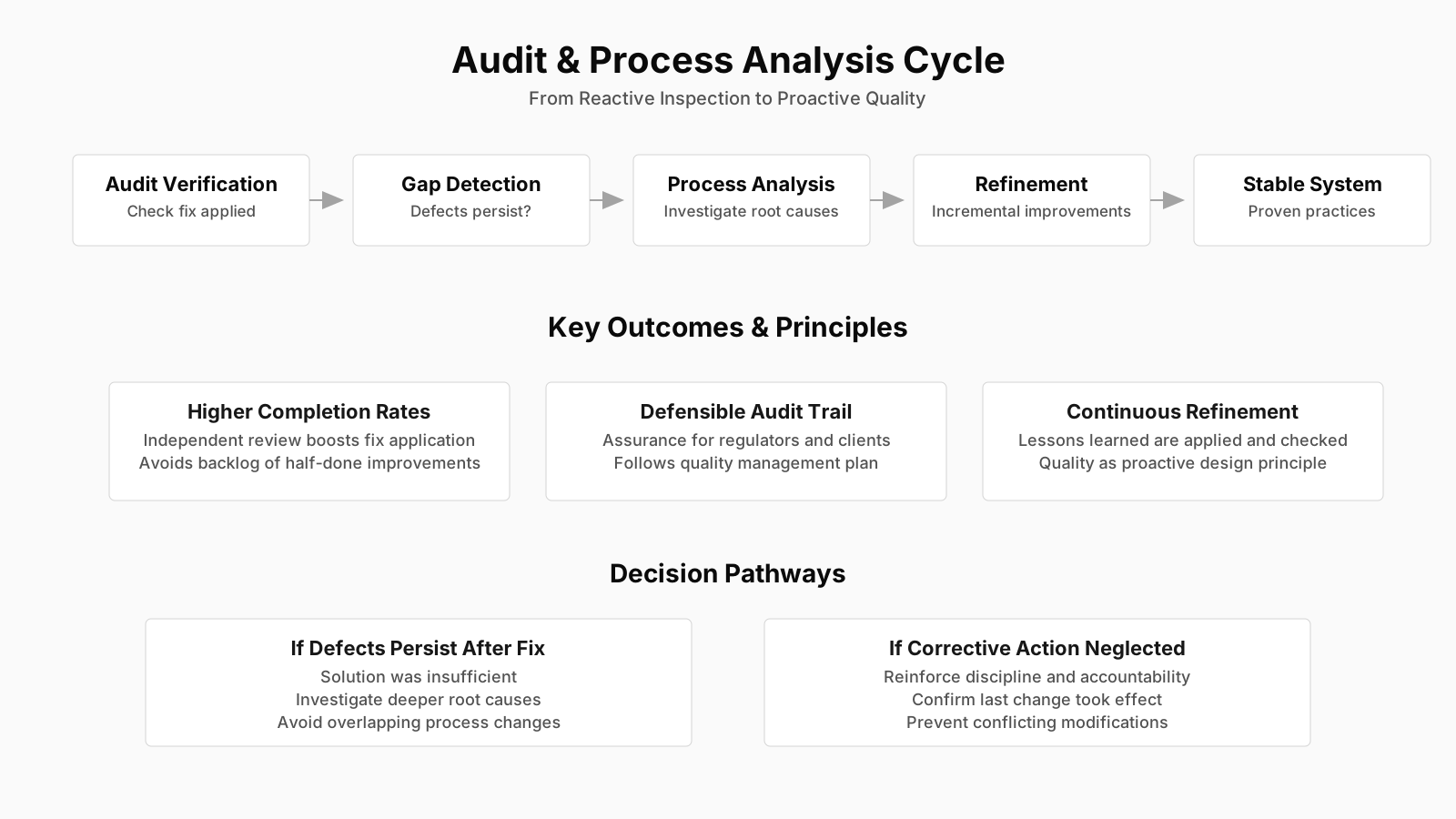
On their own, audits and process analysis address different layers of quality management. Audits ensure that what was planned is actually done; process analysis questions whether the plan itself is optimal. Combining audits with process analysis strengthens quality management by creating a closed-loop system where audits trigger analysis, and analysis prompts preventive actions that audits later verify. For example, a quality audit might reveal that a corrective action for a recurring defect was not implemented as documented. Instead of simply marking it as a nonconformity, a perceptive project manager initiates a process analysis on why the team bypassed the corrective action. The analysis might uncover that the corrective action added excessive bureaucracy, leading the team to work around it. The solution then becomes redesigning the corrective action process to be leaner, a change that can be embedded in the process improvement plan and later audited for adherence. This interplay makes quality management dynamic rather than static.
How They Complement Each Other Across the Project Lifecycle
During project execution, audits act as periodic health checks, while process analysis often kicks in when issues surface or at defined improvement intervals. At project closure, a final audit confirms that all open corrective and preventive actions have been closed, and a thorough process analysis feeds the lessons learned register with validated improvements. The information flow goes both ways: process analysis identifies process changes that affect the audit checklist itself. If analysis shows that a particular checkpoint is no longer relevant because the root cause has been eliminated, the audit protocol can be updated to stop checking for it, saving time and focusing auditors on current risks. This constant recalibration prevents quality efforts from becoming fossilized. Moreover, audit findings can highlight processes that are consistently problematic, signaling a need for deep analysis even before a major defect occurs.
Core Takeaways on Audit and Analysis Synergy
- Distinct quality management layers
- Audits confirm execution of predetermined plans, while process analysis evaluates whether the plan itself remains fit for purpose and efficient.
- Closed-loop improvement system
- Integrating audits and process analysis creates a continuous cycle where audit findings trigger targeted analysis, that analysis generates preventive actions, and subsequent audits verify sustained adherence.
- Beyond simple nonconformity marking
- When an audit uncovers a bypassed corrective action, insightful managers initiate process analysis to identify the real drivers behind team avoidance and strengthen system resilience.
- Redesigning overly bureaucratic fixes
- Process analysis often reveals that excessive bureaucracy prompted workarounds, so the solution is to streamline the corrective action into a leaner design and embed it directly into the improvement plan.
- Lifecycle and closure benefits
- During execution, audits serve as ongoing health checks; at project closure, they confirm all actions are resolved while process analysis funnels validated improvements into lessons learned and refreshes audit protocols to address current risks.
Adapting Audits and Process Analysis to Different Project Environments
The formal structures of audits and process analysis, as defined in traditional project management frameworks, may appear rigid for Agile environments, yet the underlying principles translate readily. Quality audits and process analysis apply across predictive and agile projects by adjusting cadence, formality, and ownership. In a Scrum team, the retrospective is effectively a lightweight process analysis where the team examines what went wrong, identifies constraints, and decides on process tweaks. While a formal audit might be performed by an external party at the end of a release to verify that stakeholder requirements were met and defects addressed, the spirit remains identical: verify that changes were enacted and uncover improvement opportunities. Agile projects generate abundant data from continuous integration and automated testing, which can fuel process analysis. Analyzing that data might reveal a spike in failed builds linked to a specific code integration practice, which becomes a root cause to address in the next sprint.
BVOPM and a Focus on Value-Oriented Quality
Business Value-Oriented Project Management (BVOPM) adds a distinct perspective by linking quality directly to business value and stakeholder satisfaction. In BVOPM, defect analysis uses predefined root-cause categories, streamlining process analysis by providing a consistent taxonomy that accelerates trend identification across projects. Quality audits within a BVOPM context emphasize whether corrective actions led to an increase in Business Value Points, a metric tracking value delivered, rather than merely confirming procedural adherence. When process damage, a BVOPM concept referring to invisible organizational harm from poor processes, is detected, process analysis quantifies the loss size and develops preventive actions. The methodology treats overwork and perfectionism as forms of waste, so process analysis actively seeks these patterns to eliminate non-value-added toil. This value-oriented lens reinforces the same dual approach: verify implementation, then scrutinize the process itself for value leaks.
Addressing Common Implementation Challenges
Regardless of methodology, practitioners often struggle to keep audits and process analysis relevant when project scope is fluid. In such cases, maintaining a living quality management plan that evolves with the project is crucial. Audits should not be performed against a baseline months out of date; the auditor must access the latest approved changes. Process analysis must refocus on the most critical workflows rather than trying to analyze everything. Another challenge is the human dimension. Teams may resist being audited or having their processes dissected, especially if past experiences were punitive. Building a culture where these activities are framed as collaborative improvement efforts rather than inspections makes a significant difference. Leadership must model the behavior by openly discussing their own process missteps and the improvements that followed. Regular, small-scale audits and analysis sessions that produce visible quick wins can build trust and demonstrate that quality tools exist to help, not to judge.
Sustaining Quality Through a Dual Lens
Projects rarely achieve high quality by accident. It demands consistent verification and relentless improvement. Quality audits provide the verification mechanism, shining a light on gaps between plans and reality, while process analysis supplies the improvement engine by dismantling inefficient practices and tackling root causes. One without the other leaves a blind spot. A project team that only audits might become adept at documenting conformance while overlooking process waste. A team that only analyzes processes might innovate its workflows but fail to confirm that critical corrective actions from earlier incidents remain in place. Together, they create a feedback-rich environment where quality is not a static target but a moving standard that rises with each iteration. The most effective project managers treat audits and process analysis not as isolated tools from a textbook but as complementary habits woven into daily work. When a defect appears, they ask both “Did we fix it as planned?” and “Why did our process allow it to happen in the first place?” That dual questioning drives project quality forward in a way that testing alone never can.
Dual Quality Approach Key Insights
- Verification pairs with improvement
- Quality audits confirm adherence to established plans, while process analysis uncovers improvement opportunities; neither function alone can sustain long-term quality.
- Audit-only blind spot
- An audit-only focus often builds expertise in compliance documentation, yet it leaves hidden process waste and operational inefficiencies unchallenged.
- Analysis-only blind spot
- An exclusive emphasis on process analysis can drive innovation, but without verification, earlier corrective actions may quietly unravel over time.
- Feedback-rich quality standard
- When audits and process analysis work together, they establish a high-feedback cycle in which quality standards continually advance, reinforced by daily routines and the discipline of dual questioning.