Every project manager eventually confronts a familiar gap: the distance between the collection of individuals listed on a staffing plan and the high-performing unit capable of delivering exceptional results. Closing that gap is the heart of developing a project team to enhance project performance. In PMBOK terms, the Develop Project Team process belongs to the Executing Process Group within the Resource Management Knowledge Area, and it systematically addresses competencies, team interaction, and the overall team environment. But treating this as a mere administrative checkbox is perhaps the fastest way to undermine a project. The process demands constant attention to how people grow together, how trust forms, and how the invisible norms of the team either propel work forward or slowly corrode it.
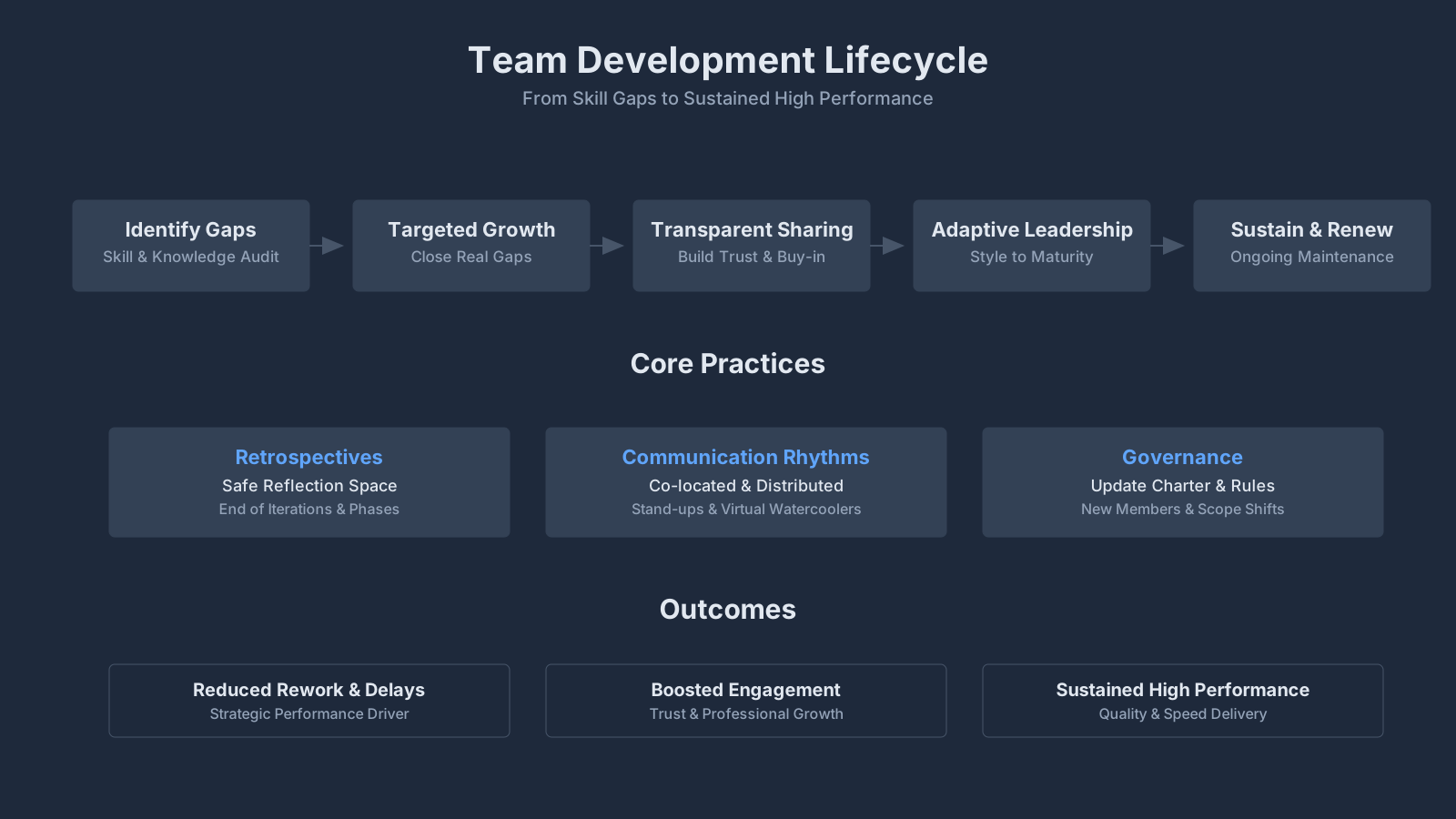
Project Team Development: Key Strategies at a Glance
| Key Concept | Summary |
|---|---|
| Team Gap | Converting a staffing spreadsheet into a cohesive, high-performing team is the foundational leadership challenge every project manager must overcome. |
| Team Dynamics | Cultivating a successful team demands deliberate attention to interpersonal growth, trust formation, and the group norms that can either amplify or quietly erode collective progress. |
| Individual Assessment | Each contributor arrives with a unique blend of skills, experience, and implicit assumptions, requiring managers to look beyond job titles and assess individual strengths and blind spots. |
| Contextual Knowledge | Effective task allocation depends on evaluating contextual fit: remote collaboration fluency, domain familiarity, and compatible communication styles, not just technical qualifications. |
| Resource Limits | Resource calendars expose finite availability; even the best team development initiatives stall when critical contributors are overloaded with overlapping high-priority work. |
| Development Plan | A credible development plan specifies concrete actions, such as pairing a developer with a mentor or scheduling targeted skills training before critical milestones begin. |
| Team Formation | New teams build trust faster through structured introductions, unambiguous role boundaries, and low-risk collaborative tasks that create early mutual confidence. |
| Constraints | Organizational mandates for on-site or remote work, together with fixed schedule and cost baselines, directly limit the range and format of team-building interventions available. |
Understanding the Develop Project Team Process as a Performance Driver
The PMBOK framework positions this process directly after acquiring the team, because having names on a roster solves nothing by itself. The real work begins when you examine project staff assignments and recognize that each person brings a unique mix of current skill levels, past experiences, and unspoken assumptions about authority and collaboration. A project manager who rushes past this analysis will soon discover that the team is not pulling in the same direction. It is not enough to know that a database specialist is assigned; you need to know whether she has ever worked on a geographically distributed team, whether she understands the business domain, and whether her communication style meshes with the lead architect.
Team development, as a structured process, pulls together three primary inputs to form a cohesive whole. The project staff assignments provide the raw material. The project management plan gives the rules, rhythms, and resource boundaries within which development happens. Resource calendars remind us that people are not infinitely available and that the best-designed team-building exercise collapses if half the team is booked on overlapping critical tasks. These inputs guard against the temptation to treat team development as a purely motivational exercise divorced from project realities.
Key Insights into Team Development
- Roster alone does not build teams
- Assigning names to a roster marks only the initial step after acquisition; without deliberate development, no inherent mechanism ensures that members will collaborate cohesively or align their efforts.
- Each member brings unique attributes
- Each individual arrives with a distinct blend of technical proficiency, professional history, and preconceptions about leadership and teamwork, all of which must be surfaced and understood before genuine development can take hold.
- Skipping analysis risks misalignment
- When a project manager bypasses this foundational analysis, the team often drifts without unified purpose, resulting in fragmented coordination and deliverables that fail to meet shared objectives.
- Deep assessment goes beyond titles
- Effective team development demands probing beyond job titles to reveal whether a specialist has experience in distributed environments, relevant domain knowledge, and a communication style compatible with the lead architect.
- Three inputs shape team development
- Project staff assignments, the project management plan, and resource calendars together anchor team development in tangible constraints, ensuring that efforts extend beyond mere motivation into actionable, resource-aware planning.
Leveraging Project Staff Assignments to Develop a Project Team
Before you schedule the first workshop or send anyone to training, you must understand the raw data inside the project staff assignments. This documentation typically lists names, roles, reporting structures, and sometimes a preliminary assessment of competence levels. The immediate step is to map those assignments against the detailed work breakdown structure and the activity attributes. If a junior developer is assigned to a module that requires deep knowledge of a legacy system she has never touched, the gap is visible at once. The team development plan then becomes not a fuzzy “improve collaboration” initiative but a targeted effort to pair that developer with a mentor or to procure a specific training course in the first two weeks.
What often gets overlooked is the emotional and social data hidden in the assignments. A team that is entirely new to each other will have a different development trajectory than one where three members have worked together for five years and two are newcomers. The group’s stage on the Tuckman ladder, whether forming, storming, norming, or performing, dictates the kind of interventions that would help. A freshly formed team needs structured introductions, clear role boundaries, and low-stakes joint tasks to build trust. An already experienced sub-group might need direct facilitation to avoid unconsciously excluding new members. These nuances live inside the staffing data if the project manager asks the right questions.
At a more granular level, the assignments often reveal hidden dependencies. A business analyst might be shared across two projects, appearing only on Tuesdays and Thursdays. That rhythm will dramatically influence when the team can hold facilitated requirement sessions. The development plan must then incorporate a communication protocol that keeps the part-time analyst fully looped in. A mistake many project managers make is to assume that all assigned staff are equally available, simply because the staffing document shows them as allocated. Pulling data from the next input, the resource calendars, corrects that assumption sharply.
Using the Project Management Plan to Guide Team Development
The project management plan is far more than a static binder of templates. The resource management plan section, often a subsidiary plan, lays out the strategy for identifying, acquiring, and developing the team over the lifecycle. It may specify whether the organization prefers co-located teams, remote work, or a hybrid model, and that preference will shape everything from communication tools to team-building events. If the plan mandates a scrum-based delivery, then the development approach must include training in scrum roles, perhaps a rotating scrum master responsibility, and retrospective facilitation skills. The plan provides the guardrails.
Within the resource management plan, there might also be a team charter that is co-created during the earlier planning phase. That charter defines acceptable behavior, decision-making processes, meeting etiquette, and conflict resolution steps. During team development, this charter becomes a living document that can be revisited in retrospectives. A team that continuously ignores its own charter on punctuality, for instance, needs a facilitated conversation, not a lecture on discipline. The project management plan also contains the overall schedule and cost baselines, and those baselines constrain how much time and money can be allocated to formal training or offsite team-building. A project manager who neglects to connect the development budget to the cost baseline may end up with a surprise non-compliance audit.
The quality management plan and the stakeholder engagement plan, though not explicitly labeled as team development inputs, also exert influence. If the project demands a very low defect rate, the team development plan must include specific quality-focused training and perhaps pair programming. If stakeholders have a history of changing requirements, the team must learn adaptive planning techniques and develop psychological resilience. Thus, the project management plan as a whole, not just the resource section, drives the development strategy.
Plan-Driven Team Development Insights
- Plan as a dynamic guide
- Rather than a static collection of templates, the project management plan actively directs staffing strategies, competency assessments, and team-building interventions.
- Resource management plan foundation
- The resource management plan establishes the systematic approach for identifying, acquiring, and cultivating the team capabilities needed throughout the project lifecycle.
- Work model shapes practices
- The location model specified in the plan directly influences communication protocols, collaboration tool selection, and the design of engagement activities.
- Charter violations require facilitation
- When a team repeatedly ignores its own charter agreements, a structured, neutral facilitation session that reinforces mutual commitments is more effective than punitive instruction.
- Baselines constrain development
- Approved schedule and cost baselines impose firm limits on the time and funding available for formal training, coaching, and offsite team-building initiatives.
Aligning Resource Calendars for Effective Team Development Activities
Even the most elegant team development roadmap shatters against the hard wall of resource calendars. These calendars show when each team member is available, accounting for holidays, other project commitments, planned vacations, and organizational events. A project manager once scheduled a two-day team charter workshop in the middle of a corporate financial closing week. Half the team was locked in month-end processing. The workshop fizzled, and the team interpreted it as leadership not caring about their real workload. The lesson is that the calendar input must be analyzed not just for obvious gaps but for workload intensity patterns.
Beyond avoidance of scheduling conflicts, resource calendars reveal windows of opportunity. If three key technical leads finish a major milestone release on Thursday, a Friday morning retrospective and a casual team lunch can exploit that natural decompression period. Development activities that feel like a reward for hard work are more effective than those that interrupt deep concentration. The calendars also help sequence training. You would not send the entire testing team to an automation bootcamp in the middle of a critical user acceptance testing phase. Instead, you might stagger training so that a core group goes first and then coaches the rest, creating a multiplier effect that fits within calendar constraints.
Resource calendars also surface individual capacity for informal leadership roles. If one senior engineer has a relatively light month, she might be an ideal candidate to mentor two new hires. The development plan can formally assign her as a mentor for that period, turning slack time into a deliberate capability investment. Without the calendar input, that opportunity would remain invisible, and the team would simply lose a valuable learning window.
Essential Techniques to Develop a Project Team and Boost Performance
The core of the Develop Project Team process lies in the selection and orchestration of team development techniques that are responsive to the team’s current challenges and future demands. There is no single recipe, but the most effective approaches weave together hard skill development and soft interpersonal dynamics. Formal training, whether classroom-based, online, or on-the-job coaching, directly lifts technical competencies. Yet an expensively trained team that does not trust each other will still fail. That is why skilled project managers deliberately mix training with structured team-building and work-environment adjustments.
Training and Skill Development
Targeted training closes identified competence gaps from the staff assignments analysis. If the team lacks experience with a new cloud platform, a certified short course in the first two sprints can prevent costly mistakes later. But training must be timed so that new knowledge is immediately applied. A developer who learns a new testing framework and then waits six weeks to use it will forget most of it. Therefore, the development plan should tether training modules to upcoming work packages. The project manager might negotiate with the product owner to align the sprint backlog with freshly acquired skills, creating a tight feedback loop that cements learning.
Not all training is technical. A team that struggles with conflict avoidance may benefit from facilitated sessions on crucial conversations. A team that makes decisions too slowly might need training in consent-based decision models. These soft-skill interventions often deliver a higher performance lift than another programming course. The mistake is to assume that because someone is a senior engineer, she automatically knows how to facilitate a meeting or give constructive feedback.
Team-Building Activities and Co-Location
The term “team-building” now carries a slight cringe factor from decades of forced trust falls and corporate rafting trips. But genuine team-building happens when people solve real problems together in a psychologically safe space. One effective technique is to start a new team with a one-day virtual chartering session where they collaboratively design their working agreements, define their definition of done, and agree on how to handle disagreements. The act of co-creating the rules builds ownership. Later, brief check-ins during retrospectives reinforce and adjust those norms.
Co-location, where feasible, remains one of the highest-return development techniques. When people sit together, the osmotic communication that happens, overhearing a phone call, sketching on a whiteboard, noticing a colleague’s frustration, creates a rapid team learning environment that remote setups struggle to replicate. However, simply putting people in the same room without addressing underlying hostilities can amplify conflict. So co-location must be paired with explicit facilitation and a deliberate design of the physical space to encourage collaboration.
Recognition, Rewards, and Individual Assessments
The PMBOK guide highlights recognition and rewards as a key tool. But the psychology of rewards in team contexts is tricky. Individual monetary bonuses for completing tasks can poison collaboration. Team-based rewards, such as a shared celebration dinner after a major release, tend to reinforce collective identity. Recognition should be behavior-specific and timely. A project manager who publicly praises someone for staying late to help a teammate debug an issue reinforces the helping norm far more effectively than an end-of-year generic “team player” award. Even a simple hand-written note matters.
Individual assessments, including personality inventories like Myers-Briggs or DISC, can help people understand their own default styles. However, these tools are misunderstood when they become labels that pigeonhole. The real value lies in the conversation that follows: “I now see that when I push for a quick decision, you need more time to process, and that’s not resistance, it’s just your preference.” That insight prevents countless misinterpretations. The team development plan might include a single facilitated session around a tool like the TKI conflict mode instrument, using real project scenarios to explore how people react under pressure. The output is not a label but a shared language for discussing differences.
Agile and Lean Influences on Team Development
In Agile environments, the Develop Project Team process morphs slightly but retains the same core intent. Scrum teams are expected to be self-organizing, which means the project manager or scrum master acts more as a coach than a director. Development then happens through retrospectives, pair programming, mob programming, and shared ownership of the sprint backlog. The team learns by doing, and the empirical inspect-and-adapt cycle is itself a continuous development engine. The input of the project management plan in Agile might be a lightweight release plan and a team working agreement rather than a thick document. The resource calendar remains just as critical, especially when team members are shared across multiple Agile teams. One additional nuance is that Agile team development often benefits from a “no-blame” culture where mistakes are treated as system failures to be fixed, not personal errors to be punished. Building that culture requires deliberate coaching and reinforcement by leaders.
In the BVOPM methodology, team development takes on a distinctly value-oriented tone. The approach insists on cross-functional teams as a structural necessity, not a nice-to-have, arguing that without marketing, operations, and customer support embedded in the team, development decisions drift away from business value. Employee-created tools and open-source software are treated as formal products, so the team development plan might include hackathon-style innovation days where team members build small automation tools to reduce their own toil. That directly enhances project performance by removing invisible waste. It’s a mindset shift: development is not just about skill workshops but about giving the team the autonomy to optimize its own work environment.
Key Insights on Team Development Techniques
- Targeted training closes skill gaps
- A certified short course on a new cloud platform, delivered within the initial sprints, directly addresses skill deficiencies surfaced in staffing assignments and prevents costly errors later.
- Chartering sessions build team alignment
- A one-day virtual chartering session at team inception lets members co-create working agreements, solidify their shared definition of done, and establish a clear conflict-resolution protocol.
- Co-location enables osmotic communication
- When team members share a physical workspace, overheard conversations, spontaneous whiteboard sketches, and real-time awareness of colleagues' frustrations create an osmotic learning environment that remote configurations rarely match.
Team Performance Assessments: Measuring the Impact of Team Development
Without measurement, team development becomes an act of faith. The output team performance assessments provides objective evidence of how well the team is evolving. These assessments examine three dimensions: individual competencies, team interaction, and the overall team environment. A common approach is to combine quantitative sprint metrics, velocity, defect rates, cycle time, with qualitative data from structured observations and confidential surveys. An assessment might reveal that test coverage has improved significantly after a test-driven development training, but that decision latency has increased because the team now avoids making decisions without full consensus, an unexpected side effect that needs its own intervention.
The assessments should happen at regular intervals, not just at project closure. A monthly health check that polls the team on psychological safety, clarity of goals, and mutual respect can surface problems before they become toxic. The project manager might use a simple traffic-light scale: green for thriving, yellow for warning signs, red for crisis. One particularly revealing metric is the “help frequency” — how often team members voluntarily assist each other without being asked. A rising trend usually signals growing trust and shared ownership. The team performance assessment then feeds back into the development plan, creating a continuous improvement loop rather than a one-time training event.
Oddly, many organizations treat team performance assessments as an HR-driven performance review exercise, completely missing their real purpose. The primary customer of these assessments is the team itself, not the functional manager. When a team sees its own growth data, it gains a sense of progress and collective agency. A frank discussion about a declining trend in morale can be the moment the team decides to change its working hours or rotate a lead role. The project manager’s job is to facilitate that conversation, not to impose a solution from above.
Updating Enterprise Environmental Factors Through Team Growth
The final output of the process, enterprise environmental factors updates, is perhaps the most undervalued. When a project team develops a new collaborative practice that demonstrably improves delivery, that practice can spread into the organization’s culture. For instance, if this team pioneers a daily 15-minute visual standup that cuts email traffic by 30 percent, the project manager can document the technique and propose it as a new organizational standard. The update to enterprise environmental factors might include revised human resource policies, new competency profiles in the skills database, or a new recognition program that other projects can adopt.
This output also captures lessons that go beyond tools and templates. If the team discovered that remote members felt isolated despite daily video calls, the insight that co-locating the team for the first two weeks of every major phase paid enormous dividends can become a formal organizational recommendation. Similarly, if a conflict between a domain expert and a data architect was resolved through a neutral facilitator, the facilitation model might be added to the organization’s approved vendor list or internal community of practice. The key is to treat environmental factors not as fixed boundaries but as malleable assets that each project can enrich.
Not every team development experiment succeeds, and those failures also feed the environmental factor update. A project that over-rotated on competitive gamification and inadvertently created a cutthroat atmosphere provides a cautionary note that can prevent other teams from making the same mistake. The update thus serves as both reinforcement and warning, a living memory that makes the organization smarter.
Core Takeaways on EEF Enrichment
- Undervalued final deliverable
- Updating enterprise environmental factors remains frequently overlooked, despite being the most consequential output of the team development process.
- Practices become organizational standards
- A team that pioneers a successful collaborative technique, like a 15-minute visual standup, gives the project manager an opportunity to codify it and advocate for its adoption as an organizational standard.
- Updates span multiple assets
- Environmental factor updates can encompass revised HR policies, updated competency profiles within the skills database, and new recognition programs available for reuse across projects.
- Failures provide cautionary value
- Failed experiments, such as a gamification initiative that fostered a hostile atmosphere, become documented warnings that shield other teams from repeating those missteps.
- Malleable organizational memory
- Environmental factors should be regarded as malleable assets that each project can enhance, creating a living organizational memory that amplifies successes and alerts teams to potential pitfalls.
Common Mistakes When Developing a Project Team
Despite the best intentions, several developing a project team mistakes recur across industries. The first is confusing activity with progress. Scheduling a series of team-building games without diagnosing the actual friction points is like prescribing medicine without an examination. A team that is struggling with role ambiguity will not benefit from a scavenger hunt. They need a clear RACI matrix and a facilitated role-negotiation session.
Another pervasive error is assuming that high technical competence eliminates the need for interpersonal development. A brilliant architect who cannot communicate her design decisions without belittling others will devastate team morale. The technical skill gets the project started, but the lack of emotional intelligence eventually stalls it. Project managers sometimes avoid confronting such individuals because they are “too valuable to upset.” The irony is that by ignoring the behavior, they lose the contributions of several other team members who quietly disengage or leave. The development plan must therefore address the whole person, not just the engineer.
Some teams over-rely on formal training as the sole development tool, neglecting the power of job shadowing, communities of practice, and deliberate stretch assignments. A mid-level developer who is assigned a small, non-critical feature to lead from design to deployment, with a senior mentor available but not intrusive, will learn far more than from a three-day course. This stretch assignment, documented and supported, accelerates growth without removing the person from productive work.
Finally, project managers often forget that team development happens during the storming phase, and they prematurely try to impose artificial harmony. Conflict is a normal and necessary part of team maturation. Suppressing it only drives it underground where it festers. The goal is not a conflict-free team but a team that can engage in productive disagreement without damaging relationships. The development plan should anticipate storming and include facilitated techniques for surfacing and resolving differences early. This might mean dedicating the first retrospective to airing frustrations about the planning process rather than discussing technical issues. A team that learns it can safely disagree will later tackle technical debates with vigor and creativity.
Connecting Team Development to Project Performance Metrics
The ultimate test of any development effort is whether it moves the needle on enhance project performance. Performance means more than on-time and on-budget delivery. It includes the reduction of rework, the speed of decision-making, the ability to absorb scope changes without collapse, and the quality of stakeholder satisfaction. A well-developed team exhibits a certain rhythm: they anticipate risks collectively, they swarm on problems without waiting for instructions, and they hold each other accountable to the shared definition of done.
Consider the metric of defect leakage. A team that has invested in rigorous code review training and pair programming often sees a sharp decline in defects that escape to production. That is a direct performance gain that can be attributed to specific development actions. Similarly, cycle time from backlog to deployment shrinks when team members have actively worked on removing handoff delays through cross-training. These metrics should be tracked not as a judgment of individuals but as a feedback signal for the development plan. If defect leakage isn’t improving despite training, perhaps the real issue is unclear acceptance criteria, and the development need shifts to collaboration with the product owner.
The often-invisible performance dimension is team resilience. When a key supplier goes bankrupt or a critical regulatory change hits, a mature team absorbs the shock and re-plans quickly. A fragile team descends into blame and paralysis. Resilience is built through deliberate exposure to controlled challenges, post-mortems that focus on systems rather than people, and leadership that models calm under pressure. The Develop Project Team process that includes scenario-based emergency drills, akin to incident command training, builds this muscle. A team that has practiced handling a simulated data breach will navigate a real one with far less cognitive overload.
Core Takeaways on Performance-Linked Development
- Performance extends beyond schedule and budget
- Effective team development must also minimize rework, accelerate decision velocity, absorb scope changes seamlessly, and lift stakeholder satisfaction across the delivery lifecycle.
- Mature teams display collective accountability rhythms
- Well-developed teams anticipate risks collectively, swarm on problems without waiting for direction, and hold one another to a shared definition of done that drives consistent quality.
- Technical training yields measurable outcomes
- Targeted investment in code review coaching and pair programming sharply reduces production defect leakage, while cross-training cuts handoff delays and compresses the cycle from backlog to deployment.
- Resilience is built through structured practice
- Teams absorb supplier failures or regulatory shocks by running scenario-based emergency drills, conducting systems-focused post-mortems, and relying on leadership that models composure under pressure.
Frameworks and Methodologies Shaping Team Development Practices
Different project team development frameworks provide complementary lenses. PMBOK offers the broad toolkit: training, team-building, colocation, recognition, and assessments. PRINCE2, while often seen as more governance-heavy, embeds team development within the work package control. The Team Manager in PRINCE2 is responsible for developing the team assigned to a work package within the tolerances agreed upon. That pushes development closer to the actual work execution, making it easier to tie skill building to immediate tasks.
Lean and Kanban approaches emphasize visual management and flow, which indirectly develops the team by making process problems transparent. When a team sees a bottleneck column on their Kanban board, they are motivated to learn new skills to clear it. This environment of constant improvement is a form of intrinsic development. The team learns because the system rewards learning with smoother flow. No formal training plan can replace the daily micro-lessons of a well-designed visual board.
Human-centered design and Design Thinking bring an empathy lens to team development. Techniques like journey mapping can be applied to the team’s own collaboration experience. The team might map the lifecycle of a user story from idea to deployment, identifying pain points in their own handoffs. The result is a empathy-driven development backlog for the team itself. It is a powerful application of the process: using the team’s own diagnostic skills to improve itself.
The Role of Leadership and Emotional Intelligence in Team Development
No amount of structured process can compensate for a project leader who lacks emotional intelligence in team development. The PMBOK process assumes that the project manager possesses the interpersonal skills to interpret assessment data, facilitate difficult conversations, and model the behaviors the team needs. A project manager who cannot read the room will miss the early signals of disengagement or simmering resentment. Emotional intelligence, the ability to recognize and manage one’s own emotions and those of others, is the essential lubricant for all the other tools.
Specific moments demand this skill acutely. When a team member makes a mistake that costs the project a week’s delay, the immediate reaction of the project manager sets the cultural norm. A public outburst teaches the team to hide errors. A private, supportive conversation that focuses on learning teaches the team that safety is real. Over time, these micro-actions accumulate into either a high-trust or a low-trust environment. Development plans that ignore the conduct of the leader are incomplete. The project manager must also have a personal development plan, perhaps including 360-degree feedback from the team, to continuously improve as the team’s coach.
Leadership also involves shielding the team from organizational noise that disrupts its development. A sudden directive from a senior executive to change the technology stack midstream can shatter the team’s confidence. The project manager’s role includes absorbing that shock, negotiating a reasonable transition plan, and reframing the change as a new challenge the team can master. When done well, the team’s trust in the leader deepens, and its ability to handle volatility grows. This is invisible team development, happening in the project manager’s one-on-one conversations and stakeholder negotiations, but it is arguably the most powerful form.
Key Insights on Emotional Intelligence
- Emotional intelligence is essential
- Even the most meticulously designed processes cannot substitute for a project leader's emotional intelligence, as team development fundamentally depends on genuine human connection and perceptiveness.
- Reading the room matters
- A project manager who cannot read the room misses the subtle early indicators of disengagement and latent resentment, letting dysfunction grow unchecked.
- Mistakes define cultural norms
- Handling a costly error with a private, supportive conversation centered on learning signals to the whole team that psychological safety is an active, lived principle.
- Micro-actions build team trust
- Small, consistent daily micro-actions compound over time, gradually cementing the team climate as either high-trust or low-trust.
- Leaders need personal growth plans
- Project managers must maintain a personal growth plan that includes 360-degree feedback from the team, allowing them to sharpen their coaching abilities and adapt to the team's evolving needs.
Practical Steps to Develop Your Project Team Today
For a project manager staring at a newly formed team and a tight deadline, the Develop Project Team process can feel like a luxury. But there are actionable steps to develop a project team that require minimal time and deliver rapid returns. Start by holding a 45-minute team chartering session, even virtually, where the team decides on three working agreements: how we communicate urgent issues, how we handle missed deadlines, and how we give each other feedback. Document those agreements and refer to them in the next retrospective. The mere act of collective rule-setting begins the development journey.
Next, shadow each team member for 30 minutes during their actual work within the first week. Not as surveillance, but to understand their real workflow and pain points. You will often discover that a database administrator spends an hour daily on a manual file transfer that could be automated. That becomes an immediate development opportunity: teach them a scripting language or allocate a developer to pair with them for a day. The performance boost is immediate, and the trust built is enormous. Then schedule a short skill-gap review against the upcoming three sprints of work, and negotiate with functional managers to free up time for just-in-time learning. Pair that learning with a mini-project that directly delivers a small feature, closing the loop.
Finally, embed a 10-minute team health pulse at the end of each retrospective using a simple anonymous scale of 1 to 5 on clarity, autonomy, and belonging. Plot the trends on a wall or a digital dashboard. When a dip occurs, have an open conversation without defensiveness. These small, consistent disciplines, grounded in the inputs of staff assignments, the project plan, and calendars, generate a cumulative development effect that far outstrips expensive one-off interventions. The team becomes the engine of its own growth, and project performance follows as a natural consequence.