How do teaming agreements work in procurement? At their core, they are legal contractual agreements between two or more entities to form a partnership or joint venture, or some other arrangement as defined by the parties. The agreement defines buyer-seller roles for each party. Whenever the new business opportunity ends, the teaming agreement also ends. Whenever a teaming agreement is in effect, the planning process for the project is significantly impacted. Thus whenever a teaming agreement is in place on a project, the roles of buyer and seller are predetermined, and such issues as scope of work, competition requirements, and other critical issues are generally predefined. This might sound rigid, but it brings a clarity that many procurement-driven projects desperately need. In the public sector especially, where acquisition regulations demand transparency and fairness, these agreements eliminate ambiguity about who does what and who carries which risk. The early binding of roles feels like a constraint, but it is also what makes the proposal credible to a client who wants to see a single, unified offer rather than a loose coalition of vendors.
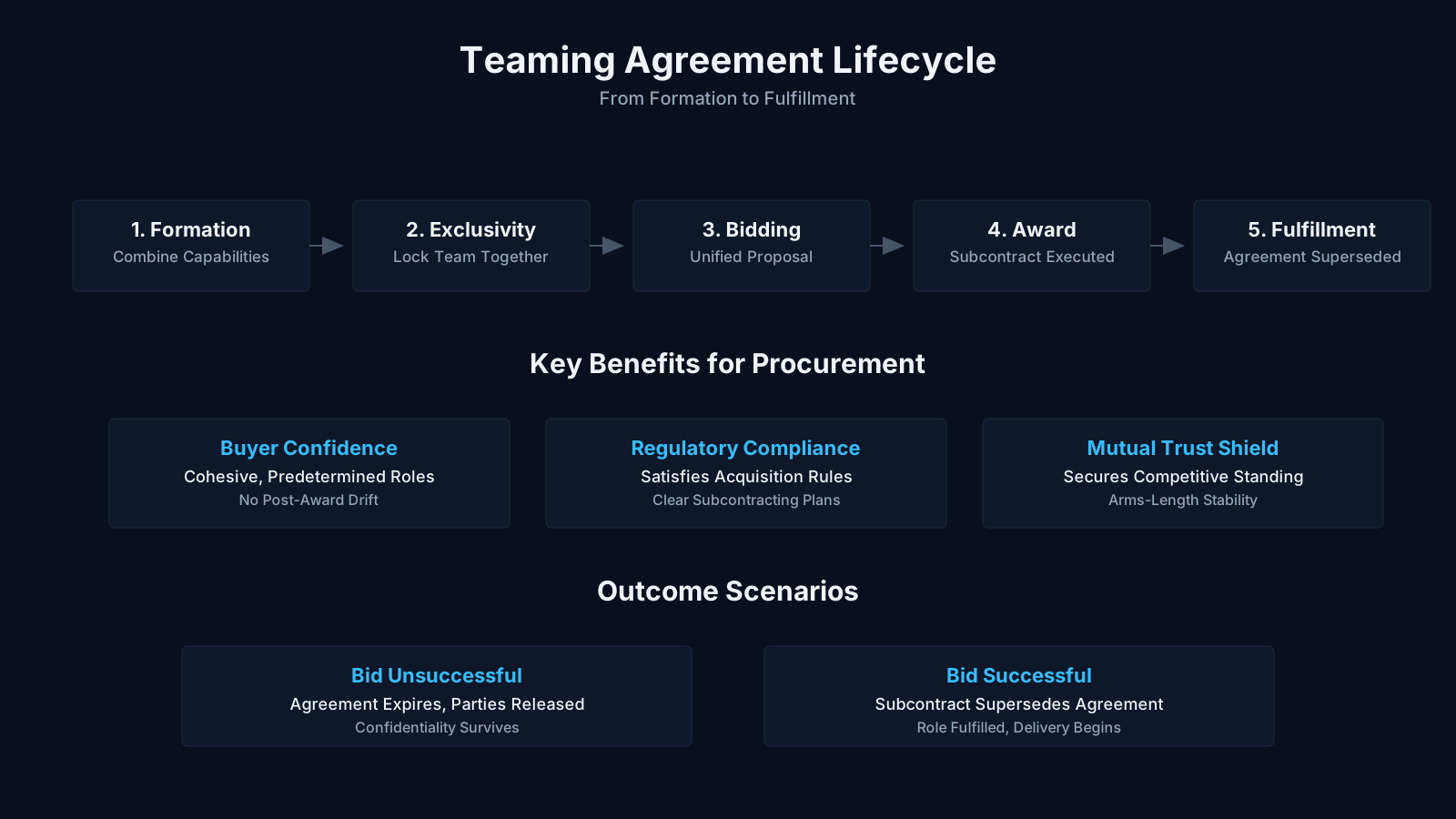
Key Topics Summary: Teaming Agreements in Procurement
| Concept | Summary |
|---|---|
| Definition | A teaming agreement is a legally enforceable contract in which two or more organizations pool complementary capabilities to jointly pursue and fulfill a specific business opportunity. |
| Role Binding | Formalizing roles at the outset may seem restrictive, yet it assures clients of a cohesive, integrated proposal rather than a fragmented vendor consortium. |
| Legal Enforceability | The agreement establishes legally binding commitments, including exclusivity, confidential data handling, and a duty to negotiate a downstream subcontract in good faith following a successful bid. |
| Procurement Process | While not explicitly named in the PMBOK Guide, teaming agreements align with the Procurement Management processes of planning, conducting, and controlling procurements. |
| Role Clarity | Clearly defining prime and subcontractor roles preempts downstream conflicts over profit sharing, payment schedules, and decision rights. |
| Asymmetry | Power imbalances are mitigated through detailed provisions governing the flow-down of requirements, structured dispute resolution, and default consequences. |
| Stakeholder Alignment | Framing negotiations as a pre-authorization phase, supported by transparent issue tracking and active stakeholder engagement, transforms the agreement into a tool for early strategic alignment. |
| Subcontract Alignment | It bridges contractual gaps by mandating a downstream subcontract that mirrors the prime contract's key provisions, including Changes and Termination for Convenience clauses. |
What Is a Teaming Agreement in Procurement?
The definition of a teaming agreement in procurement is a legally binding arrangement through which two or more organizations combine their capabilities to pursue and, if successful, deliver a specific business opportunity. Unlike a general partnership that might cover multiple projects over a long period, a teaming agreement is laser-focused on a single contract or a tightly bounded program. The document outlines the relationship between the prime contractor and subcontractors, or between co-equal joint venture members, depending on the structure the parties choose. It is not merely a letter of intent; it carries enforceable obligations, particularly around exclusivity, data sharing, and the mutual commitment to negotiate a subsequent subcontract or work‑share arrangement in good faith if the bid succeeds. Because procurement environments often involve intense competition, the agreement serves as a protective cage that keeps the team together while they invest jointly in proposal development.
One of the peculiarities of these agreements is that they function both as a shield and as a script. As a shield, they prevent team members from exploiting confidential partner information to bid independently or with other rivals. As a script, they prescribe the precise sequence of actions after an award is announced. For instance, a typical clause might state that within thirty days of contract award, the parties will execute a formal subcontract containing certain predefined terms. That subcontract will then govern the actual delivery of the work, but the teaming agreement remains the initial handshake that makes the subcontract negotiation predictable. Without it, a winning prime contractor could theoretically strong‑arm the subcontractor into unfavorable terms because the subcontractor has already contributed intellectual property or pricing intelligence to the proposal.
The temporary nature of the arrangement is something that project managers sometimes forget. The teaming agreement is born when the team decides to pursue an opportunity and dies when that opportunity ends, whether through contract completion, termination, or loss of the bid. There is no residual life. This creates a clean, project‑sized boundary that aligns neatly with the project life cycle in traditional project management frameworks. The PMBOK Guide’s Procurement Management knowledge area, which covers plan procurement management, conduct procurements, and control procurements, provides the process structure within which such an agreement would sit, even though it does not name teaming agreements explicitly. Practically, the teaming agreement is a procurement document that pre‑configures the make‑or‑buy decisions and the source selection criteria long before the project execution phase begins.
Core Takeaways on Teaming Agreements
- Legally binding single-opportunity arrangement
- A teaming agreement is an enforceable contract that commits two or more organizations to combine their strengths for pursuing and delivering a single, well-defined contract or program, rather than creating an open-ended strategic partnership.
- Flexible relationship structures
- The agreement establishes the operational relationship either as a prime contractor managing subcontractors or as a joint venture of equal partners, depending on how the parties choose to organize their collaboration.
- Enforceable obligations beyond intent
- It imposes binding duties that go beyond a statement of collaboration, including exclusivity, safeguarding shared data, and a mutual good-faith commitment to finalize a subcontract or work-sharing arrangement after the bid succeeds.
- Protective shield for sensitive information
- The agreement preserves the team’s integrity during joint proposal development by preventing any member from misusing confidential partner information to compete separately or to collaborate with rival bidders.
- Foundation for predictable subcontracting
- It locks in pre-agreed terms for post-award subcontract negotiations, eliminating the risk that a prime contractor might exploit a subcontractor who has already shared proprietary intellectual property or pricing intelligence.
The Legal and Commercial Structure of Teaming Agreements
The legal structure of teaming agreements can take various forms, and the choice shapes everything that follows. A common model is the prime‑subcontractor arrangement, where one entity acts as the prime contractor to the end client and the other as a subcontractor. In that case, the buyer‑seller roles are unambiguous: the prime is the seller to the client, and simultaneously the buyer from the subcontractor. In a joint venture model, two or more parties form a separate legal entity or an unincorporated consortium where they share the role of seller collectively. Each structure carries different implications for liability, intellectual property ownership, and resource commitment. The source material emphasizes that the agreement defines buyer‑seller roles for each party, and this definition must be precise enough to avoid later disputes about profit margins, payment terms, or decision‑making authority.
When examining these structures, procurement professionals must consider how the client views the team. Many government clients, for example, require a single point of contact and a single contractual responsibility. That inherently favors a prime‑subcontractor model, even if the parties internally refer to themselves as equal partners. The teaming agreement then becomes the mechanism that layers a subcontracting relationship on top of a cooperative strategy. In such a scenario, the prime contractor carries the performance risk toward the client, while the subcontractor carries a more limited risk toward the prime. This asymmetry can cause tension unless the teaming agreement includes detailed provisions about the flow‑down of contract requirements, dispute resolution, and the consequences of default by either party.
Another critical element is the definition of the work scope at the teaming stage. Because the planning process is significantly impacted when a teaming agreement is in place, the parties often negotiate a preliminary work breakdown structure right inside the agreement. They do not wait for the project charter or the detailed design phase. They have to, because the teaming agreement predetermines which party will perform which chunks of the deliverable. That means that long before the project management plan is baselined, a high‑level scope allocation is already locked. If the subsequent project plan diverges from that allocation, the discrepancy can trigger contractual disputes or, worse, renegotiations that erode trust exactly when the team should be rallying to deliver.
Business Value‑Oriented Project Management (BVOPM) brings a useful lens here. BVOPM’s emphasis on a transparent board of project issues, where all roles can raise concerns before formal authorization, suggests that the teaming agreement negotiation should be treated as a pre‑authorization phase that demands just as much stakeholder engagement as the project itself. If the parties fail to surface conflicting expectations about scope or roles during the teaming negotiation, those conflicts will surface later as “process damage” that silently degrades collaboration. In this sense, the teaming agreement is not just a legal instrument but a preliminary stakeholder alignment tool that, if executed poorly, wastes the relational capital that the later project will need.
Defining Buyer and Seller Roles Through Teaming Agreements
One of the most immediate operational effects of a teaming agreement is the definition of buyer and seller roles in procurement teaming. The moment the agreement is signed, each entity knows whether it will be the party that receives payments from the end client and then remits a portion to the teammate, or whether it will bill the teammate directly. This may seem trivial, but in procurement it has deep consequences for cash flow management, performance guarantees, and even the applicable legal regime. For example, a subcontractor selling services to a prime contractor might operate under a completely different set of commercial terms than the prime uses with the government client. The teaming agreement bridges that gap by requiring the parties to negotiate a subcontract that aligns with the prime contract’s constraints, including clauses like the Changes clause or the Termination for Convenience clause.
This predetermined role allocation influences the behavior of the project team during planning. The entity that acts as the buyer in the internal relationship will naturally behave like a client, imposing requirements and acceptance criteria on the seller teammate. This can create a healthy rigor if managed with respect. When it is not managed, it can devolve into a dynamic where the prime treats the subcontractor as just another vendor to be squeezed, while the subcontractor treats scope ambiguities as opportunities to claim extra work. The teaming agreement itself should contain enough behavioral guardrails, such as required collaboration milestones and joint review sessions, to prevent this adversarial drift. Oddly enough, many project managers treat the teaming agreement as a mere formality once the bid stage is over, but that’s precisely when its constraints start to bite during the first planning workshop.
In Agile environments, where self‑organizing teams and fluid roles are common, a rigid pre‑definition of buyer‑seller roles can feel antithetical. Yet even in Agile procurement, where the client may contract for a scrum team’s capacity rather than a fixed deliverable, the underlying commercial relationship still needs a clear contractual backbone. A teaming agreement in such a context would still need to define which entity holds the master services agreement with the client and which provides the delivery capacity. The difference is that the agreement might include more flexible mechanisms for adjusting work allocation sprint by sprint, provided the commercial model permits it. Without that flexibility, the planning process that the source material notes is “significantly impacted” becomes not just impacted but genuinely hobbled by the inability to adapt to emergent requirements.
Connecting this to the broader Project Management Institute practice standards, the definition of roles falls squarely within the Plan Procurement Management process, where the project manager identifies potential sellers and decides on the procurement strategy. The teaming agreement is, in essence, the output of an early, private procurement process that occurs before the main public procurement. It is a pre‑procurement, a strategy document that pre‑selects the “seller” for a particular chunk of work. That pre‑selection, if done well, saves enormous time during project execution because the team can skip lengthy competitive sourcing activities for that work package. But it also introduces a single‑source risk that the project manager must track in the risk register and mitigate through robust performance monitoring clauses in the subsequent subcontract.
Key Insights on Buyer-Seller Roles
- Roles fixed at signing
- The teaming agreement immediately determines which party invoices the end client and which party receives compensation from its teammate, directly shaping cash flow management, performance guarantee structures, and the applicable legal framework.
- Subcontract mirrors prime contract
- It requires the parties to fashion a subcontract that mirrors the prime contract's constraints, particularly critical clauses such as Changes and Termination for Convenience, thereby aligning downstream obligations with the upstream commercial terms.
- Guardrails prevent adversarial drift
- To prevent the prime from treating the subcontractor merely as a vendor to squeeze margins and to stop the subcontractor from capitalizing on scope ambiguities, the agreement should incorporate behavioral guardrails like collaboration milestones and joint review sessions.
The Temporary and Opportunity‑Specific Nature
Perhaps the most defining characteristic of teaming agreements in procurement is their temporary and opportunity‑specific character. They exist only as long as the underlying business opportunity exists. Once the contract is completed, terminated, or lost, the agreement evaporates, leaving no ongoing legal obligations except those that might survive termination by explicit clause, such as confidentiality or non‑solicitation provisions. This transience matters because it shapes how the parties invest in relationship‑specific assets. If a company knows that the partnership with a teammate will dissolve once the two‑year government project ends, it will be reluctant to share proprietary methodologies that might benefit the teammate’s future, unrelated bids. The tension then becomes how to structure the agreement so that it encourages full knowledge sharing during the project while protecting each party’s long‑term interests.
That tension often surfaces in the planning process, as the source material directly states. When the teaming agreement predetermines scope and competition requirements, the project management team starts its planning work inside a box that was built by the business development people. This can be jarring for a newly assigned project manager who discovers that the scope division between the prime and subcontractor is not optimal for efficient execution. The prime might have kept the glitzy design work for itself and handed off the low‑margin implementation tasks, creating a motivational asymmetry. The teaming agreement, however, is difficult to reopen without threatening the entire contractual chain. So the planning process has to accommodate a suboptimal structural constraint, which inevitably affects the schedule, cost estimates, and resource loading decisions.
From a program management perspective, this temporary binding introduces an interesting challenge. Programs often comprise multiple projects, some of which might involve the same set of organizations teaming repeatedly. In such cases, program managers sometimes craft umbrella teaming agreements that establish a framework for multiple opportunities, but each individual pursuit still requires a specific activation mechanism that triggers the full buyer‑seller role definitions. This layering reduces transaction costs and builds institutional trust over time. The program’s benefits realization plan must then account for the coordination overhead of managing these multi‑layer agreements, something that traditional program management benefit analyses often overlook because they focus on financial returns rather than relational efficiencies.
How Teaming Agreements Shape Project Planning
The impact of teaming agreements on project planning is one of those topics that gets far less attention than it deserves in standard project management training. When a teaming agreement is in place, the planning process does not begin with a clean sheet. Rather, it starts with a pre‑baked allocation of work packages, a fixed set of organizational interfaces, and a pre‑negotiated profit structure that may not reflect the actual cost of integrating the two organizations’ processes. The schedule, for instance, now contains an additional dependency chain that runs along the contractual seam between the parties. Any activity that requires input from both teammates has to navigate not just technical handoffs but also contractual gates, such as formal approvals, invoices, and acceptance procedures, that the teaming agreement’s subcontracting provisions impose.
Scope planning also becomes more intricate. The source material notes that the scope of work is generally predefined when a teaming agreement is active. Consequently, the work breakdown structure must not only decompose the deliverables but also map each work package to the entity that is contractually obligated to perform it. A work package that appears logically contiguous in a technical sense might have to be split into two because the teaming agreement assigned different parts to different parties. That kind of artificial fracturing can create integration risks that the project management team must actively manage through interface agreements and joint quality inspections. The project schedule network diagram will therefore show clusters of activities that are separated by procurement‑type dependencies rather than purely logical ones.
A natural way to understand this is to imagine two architects designing a building together under a teaming agreement where one will design the structure and the other will design the interiors. They can sketch together beautifully during the proposal phase, but once the contract is awarded, their collaboration must pass through formal review milestones where each approves the other’s work. If the interior architect needs a column moved, they cannot just ask; they must submit a formal change request to the prime, who then evaluates the structural impact, and if accepted, issues a modification to the subcontract. This contractual choreography exists because the teaming agreement preserved the buyer‑seller divide even though the project demands seamless teamwork. That is the planning friction that the source material refers to, and it is why the project manager must be involved in the teaming agreement negotiation, not just handed the result.
Risk planning under a teaming agreement also shifts. Traditional project risk management treats organizational interfaces as a risk source, but here the interface is contractual rather than merely organizational. That means the mitigation strategies are also contractual: penalty clauses, performance bonds, and exit rights. The risk register must capture the possibility that the teammate might default or become insolvent, and while that is a standard supplier risk, the teaming relationship makes it more acute because the defaulting party is often the only one with the specialized knowledge required for a particular workstream. Finding a replacement mid‑project is usually far more disruptive than finding a replacement for a commodity supplier. The risk response plans therefore need to include not just backup sourcing but also contingency arrangements for absorbing the defaulting party’s work into the other teammate’s scope, assuming capacity and capability exist.
Key Takeaways on Teaming Impact
- Pre-baked allocations constrain planning
- Teaming agreements impose predetermined work packages, rigid organizational interfaces, and pre-negotiated profit structures from the outset, preempting any clean-sheet planning approach and locking in early constraints.
- Contractual gates add schedule dependencies
- Activities that demand joint input must pass through contractual gates such as formal approvals, invoicing cycles, and acceptance procedures mandated by subcontracting provisions, introducing administrative lead times and schedule dependencies where none would otherwise exist.
- WBS maps to contractual obligations
- The work breakdown structure must align with contractual obligations, often fragmenting technically contiguous work packages and creating integration risks that necessitate formal interface agreements and joint inspections to maintain overall integrity.
- Teammate default is acute risk
- The risk register must account for teammate default or insolvency, a threat made more severe because the defaulting party typically holds sole possession of specialized knowledge critical to a workstream, making recovery exceptionally challenging.
Predefined Scope and Competition Requirements
Procurement professionals often fixate on competition requirements because public sector regulations demand a competitive process. The predefined scope of work and competition rules in a teaming agreement directly interact with these mandates. When two companies team, they effectively eliminate each other as competitors for the portions of work they have assigned to one another. If the client intended to see competition at the work‑package level, that intention is frustrated. That is why many government agencies require teaming agreements to be disclosed and scrutinized for anti‑competitive effects. The agreement must be structured to show that the teaming arrangement creates efficiencies or unique capabilities that outweigh the loss of competition, and that the parties did not collude to inflate prices.
On the flip side, the predetermined scope can be a huge advantage in complex procurements where the client lacks the technical expertise to carve the work into sensible chunks. By presenting a unified technical solution through a team, the bidders relieve the client of the integration risk. The scope division inside the teaming agreement becomes a technical architecture diagram, and the client evaluates it not as a procurement artifact but as a system design artifact. The project manager, later, will inherit that architecture and must build the integrated project schedule around it. The lesson here is that the teaming agreement is not a procurement back‑office document; it is a design document in disguise. Its scope clauses are, in reality, a high‑level project scope statement that will cascade into the detailed scope baseline.
There is a subtle point about how this predetermined scope affects the control process during project execution. When a change request arises, the project manager often must consult not only the project management plan but also the teaming agreement to see whether the change falls within the teammate’s allocated scope or crosses the contractual boundary. If the client asks the prime to perform work that the teaming agreement assigned to the subcontractor, a set of contractual dominoes starts to fall. The prime must either seek the subcontractor’s consent, negotiate a scope transfer, or have the prime’s own team perform the work without the subcontractor, which might violate exclusivity provisions. This extra layer of governance slows down change control, but it also ensures that no party unilaterally expands its scope at the expense of the other.
Common Pitfalls and Misconceptions
A recurring misconception about teaming agreements is that they are just glorified teaming letters that expire once a formal subcontract is signed. In reality, many of their provisions survive until the end of the underlying contract, and some, such as audit rights, non‑disparagement, and intellectual property licensing terms, can survive indefinitely. Project managers who toss the teaming agreement into a drawer once the subcontract is executed often miss ongoing obligations that affect how they manage deliverables. For instance, a clause might require that all technical documentation produced by the subcontractor be reviewed by the prime’s legal team before delivery to the client, a step that adds latency to every document submission cycle. If the project manager is unaware of that requirement, the schedule will slip without anyone understanding why.
Another common pitfall is what I call the “phantom equality” trap. The parties may speak of a 50‑50 partnership, but the teaming agreement often gives one party the tie‑breaking vote or financial control that makes it the de facto prime. This asymmetry is not necessarily bad, but if the project team believes they are in a partnership of equals while the contract says otherwise, they will make collaborative decisions that the contractual framework cannot support. The project charter, the stakeholder register, and the communications management plan must reflect the real power structure, not the aspirational one. I have seen project kick‑off meetings where the prime’s project manager assumes the subcontractor’s PM will freely share resource forecasts, only to be told that such data is commercially sensitive under the teaming agreement’s data classification clause. The clash derails team cohesion in the first week.
There is also a persistent misunderstanding about how teaming agreements interact with procurement ethics rules. Some professionals think that because the teaming partner is pre‑selected, normal procurement integrity standards do not apply internally between the teammates. That is false. The buyer‑seller relationship still demands transparent pricing, objective acceptance criteria, and fair dealing. If the prime gives the subcontractor an unfair advantage during internal performance evaluation, that can corrupt the subcontract’s incentive structure and, in public contracts, might even constitute a fraud upon the government if the government is indirectly funding the subcontract. The project’s procurement audit process must therefore extend to the intra‑team transactions, not just the prime contract with the client. This is a dimension that PMBOK’s Control Procurements process anticipates through claims administration and performance reporting against the subcontract, but it requires conscious effort to apply those formal controls to a relationship that may feel friendly and long‑standing.
Essential Insights on Teaming Agreement Pitfalls
- Provisions outlive subcontract signing
- Key provisions of a teaming agreement, including audit rights, non-disparagement clauses, and intellectual property licenses, often survive the subcontract signing and remain in force throughout the entire prime contract term, sometimes indefinitely.
- Forgotten obligations after execution
- After the subcontract is executed, project managers often neglect standing obligations, such as the mandatory legal review of subcontractor deliverables prior to client submission.
- Myth of equal partnership
- Although teaming agreements are often presented as equal partnerships, they typically grant one party a tie-breaking vote or financial control, effectively designating it as the prime contractor.
- Documentation must mirror real power
- Project documents such as the charter, stakeholder register, and communications management plan must reflect the real contractual power structure, not an aspirational notion of equality.
- Data classification blocks information sharing
- Data classification clauses in teaming agreements can prohibit subcontractors from sharing resource forecasts labeled as commercially sensitive, thereby undermining the collaborative intent of kick-off meetings.
Teaming Agreements vs. Other Procurement Relationships
To understand how teaming agreements work, it helps to compare teaming agreements with subcontracts, joint ventures, and consortia. A subcontract is the actual purchasing agreement under which work is performed and paid for after a contract award. The teaming agreement is the precursor that obligates the parties to enter into that subcontract. The subcontract contains the detailed statement of work, deliverables, price, and delivery schedule; the teaming agreement contains the commitment to create those details in good faith. A joint venture agreement, by contrast, creates a new entity or a structured collaboration that may itself bid as the prime contractor. The teaming agreement can be the instrument that forms that joint venture, or it can simply govern the relationship between a prime and a subcontractor without creating a new legal entity.
Confusion between these instruments often leads to litigation. When a teaming agreement promises that the subcontract will be negotiated “in good faith,” courts in many jurisdictions interpret that as requiring a genuine effort to reach a commercially reasonable agreement, not a blank check for the prime to impose one‑sided terms. If the prime then presents a subcontract that contradicts the scope allocation or pricing principles outlined in the teaming agreement, the subcontractor may have a claim for breach of the teaming agreement itself, even before any subcontract is signed. This is why the project manager involved in the later planning must review the teaming agreement; any unresolved tension in those good‑faith clauses will resurface as project conflict during the subcontract negotiation that runs parallel to the initial planning meetings.
Another distinction is with consortia, which are common in large infrastructure projects. A consortium often involves multiple firms coming together under a consortium agreement that is, in effect, a multi‑party teaming agreement with a governance structure. The consortium may appoint a lead firm that interacts with the client, but all members share liability jointly and severally, unless limited by contract. In a teaming agreement for a prime‑sub relationship, liability is typically several; the subcontractor is liable only to the prime, not to the client directly. That insulation can be a major reason why smaller firms prefer the teaming route over a consortium. For the project manager, the key takeaway is that the risk management plan must reflect the liability structure correctly, because the financial consequences of a default differ dramatically between a consortium’s joint liability and a subcontractor’s limited liability.
Teaming Agreements in Project Management Frameworks
In the landscape of established frameworks, the place of teaming agreements in PMBOK and Agile practices is an instructive study. The PMBOK Guide’s Procurement Management knowledge area treats the procurement strategy as a key document that outlines how procurement processes will be managed from solicitation through contract closure. A teaming agreement would be an input to the Plan Procurement Management process, specifically informing the bid documents and the source selection criteria, and also an input to the project charter and the stakeholder register because it identifies key external parties with contractual influence over scope. However, because PMBOK is a process standard, it does not prescribe the content of a teaming agreement; it merely provides the process landscape within which the agreement’s existence must be managed. Project managers who follow PMBOK should list the teaming agreement as an enterprise environmental factor that constrains the project, and they should ensure that the procurement statement of work aligns with the scope allocation it defines.
PRINCE2, with its emphasis on the business case and the management of stages, would treat the teaming agreement as a key artifact produced during the pre‑project stage (Starting Up a Project) or even earlier. The Senior User and Senior Supplier roles in PRINCE2’s project board structure would likely be held by representatives of the different teaming entities, reflecting the predetermined buyer‑seller hierarchy. The agreement would then inform the Project Brief and the Project Initiation Documentation. Because PRINCE2 stresses the separation of project management from the commercial work, the project manager would not be responsible for negotiating the teaming agreement but would inherit it as a constraint, just as in the PMBOK world. The lesson from both frameworks is that the project manager must not be the last to know about the teaming agreement’s specifics.
Agile procurement practices, though less formal, are beginning to incorporate teaming concepts in innovative ways. Some government agile projects now use a “prime integrator” model where a small boutique firm acts as the prime to the client while bringing in specialist agile squads as subcontractors. The teaming agreement between the integrator and each squad locks in the squads’ availability and defines the commercial terms for time‑and‑materials or outcome‑based contracts, but it leaves the detailed sprint‑by‑sprint scope open. This hybrid is only possible because the planning process, as the source material notes, is significantly impacted but not completely frozen; the teaming agreement pre‑determines roles and the high‑level scope boundary but lets the cadence of iterations handle the variability within. It is a more adaptive interpretation of the traditional teaming structure.
Core Insights on Teaming Agreements
- PMBOK uses agreements as procurement inputs
- Teaming agreements in the PMBOK Guide function as inputs to Plan Procurement Management, shaping the creation of bid documents, source selection criteria, and foundational artifacts such as the project charter and stakeholder register.
- PMBOK omits agreement content guidance
- Since the PMBOK Guide is a process standard and not a content guide, project managers should treat the teaming agreement as an enterprise environmental factor and ensure the procurement statement of work mirrors the scope allocation defined within it.
- PRINCE2 creates agreements pre-project
- PRINCE2 designates the teaming agreement as a critical artifact of the Starting Up a Project process, requiring the Senior User and Senior Supplier roles on the project board to be filled by representatives from each teaming organization.
- Managers inherit agreements as constraints
- Under both PMBOK and PRINCE2, the project manager inherits the teaming agreement as a fixed constraint negotiated during the commercial or pre-project phase, and is not tasked with its creation.
- Agile hybrid keeps sprint scope open
- A teaming agreement between an integrator and each squad locks in availability and commercial terms for time-and-materials or outcome-based arrangements, while purposely leaving sprint-level scope undefined so that iteration planning can adapt to emergent requirements.
Negotiating Teaming Agreements for Planning Success
The negotiation of the teaming agreement terms for successful planning is where many opportunities are either seized or squandered. Project managers are rarely invited to these negotiations, because they happen in the business development or legal department. Yet the person who will later manage the integrated schedule, the resource histograms, and the quality audits has a unique perspective on what clauses will cause practical pain. For example, a clause that requires all subcontractor deliverables to be submitted to the prime five days before the prime’s submission to the client seems harmless until you realize that those five days consume the schedule float and make the subcontractor’s late delivery instantly critical. A project manager would flag that and suggest buffer management protocols instead.
Scope exclusivity is another clause that benefits from a planner’s eye. A teaming agreement often prohibits the subcontractor from performing similar work for competitors, but if the scope is described too broadly, it can strangle the subcontractor’s ability to operate during the project. The project manager can help the legal team understand that realistic scope boundaries, not maximalist ones, are what keep the subcontractor solvent and engaged. A demoralized subcontractor that cannot take on any other work tends to starve and eventually perform poorly on the very project that feeds it. That insight crosses the usual boundary between project management and commercial negotiation, but it is precisely the kind of integrated thinking that the most successful procurement programs demand.
Intellectual property provisions also cry out for project manager input. The teaming agreement often determines who owns the foreground IP developed during the project and what licenses are granted for background IP. From a planning perspective, these terms directly affect whether the team can reuse code, design artifacts, or training materials in future phases or maintenance contracts. A project manager who is building a life‑cycle cost model will want to know whether the maintenance phase will require expensive licensing fees to the subcontractor after the teaming agreement expires. The answer lies in the IP terms negotiated during teaming. If the project manager raises these questions after the agreement is signed, it is usually too late to change the terms without reopening the entire commercial negotiation, which is a lever rarely pulled lightly.
Teaming Agreements and Value‑Oriented Procurement
When procurement is viewed through a value‑oriented lens, the role of teaming agreements in value delivery shifts from being a simple risk‑allocation tool to a mechanism for aligning incentives toward business outcomes. Business Value‑Oriented Project Management (BVOPM) would treat the teaming agreement as a pre‑project governance instrument that must be validated by the same transparent board of project issues that later governs the project. Before the agreement is finalized, each party’s stakeholders should have the opportunity to raise concerns about scope inequity, misaligned profit motives, or insufficient commitment to quality. This early validation reduces the “process damage” that occurs when suppressed disagreements later erupt as withholding of information or passive resistance.
BVOPM’s concept of relational effort points, used in planning to replace traditional cost‑based estimates with value‑driven approximations, could also inform the teaming agreement’s scope split. Instead of allocating work packages based purely on historical capabilities, the parties could estimate the relational effort required to coordinate across the teaming boundary and factor that into the decision of where to draw the line. Work that demands intense daily collaboration should perhaps sit entirely within one entity, even if the other entity is technically capable. That kind of analysis moves the teaming agreement from a rigid legal document toward a living design principle that actually reduces waste and improves flow. It is not the traditional view, but it highlights how much procurement strategy can evolve when project management thinking permeates the commercial layer.
Key Takeaways on Value-Oriented Teaming
- Value lens reshapes teaming agreements
- Under a value-oriented approach, teaming agreements shift from simple risk-allocation tools into mechanisms that finely align incentives with concrete business outcomes.
- Pre-project governance validation
- BVOPM treats the teaming agreement as a governance instrument that must be validated by the same transparent project issues board that will later govern the project.
- Early stakeholder concern review
- Stakeholders from each party should raise concerns about scope inequity, misaligned profit motives, or insufficient quality commitment before finalization, thereby preventing downstream process damage.
- Relational effort informs scope split
- Instead of solely relying on historical capabilities, parties can use relational effort points to quantify coordination costs across the teaming boundary and determine the optimal scope division.
- Living design principle emerges
- By consolidating intensely collaborative work within a single entity, the teaming agreement evolves from a rigid legal document into a living design principle that systematically reduces waste and improves flow.
Operationalizing Teaming Agreements During Execution
Once the project moves into execution, the operational integration of teaming agreements becomes a daily reality. The project manager must translate the contractual roles and scope splits into the project management plan’s subsidiary plans. The resource management plan, for instance, must distinguish between internal resources controlled directly, and subcontractor resources that are controlled through the subcontract, itself governed by the teaming agreement’s framework. The communications management plan must define how information flows across the contractual boundary. Should the subcontractor’s engineers attend the daily stand‑up, or does their presence require a formal invitation that observes commercial confidentiality? The answers lie buried in the teaming agreement’s clauses about data access and representation.
Quality management also gets a contractual twist. The prime is ultimately responsible for the quality of the entire deliverable to the client, but the subcontractor’s work often happens inside a black box that the prime cannot fully inspect without breaching the subcontractor’s proprietary practices. The teaming agreement might have specified that the parties will adopt a shared quality management system, but until that system is actually built, there is a gap. The project manager must bridge that gap by establishing joint quality audits that respect contractual boundaries while ensuring the final product integration does not fail. This requires a deep reading of both the teaming agreement and the subsequent subcontract, which in practice means the project manager becomes a quasi‑contract administrator, a role that many technical project managers find uncomfortable but essential.
The control of procurements under a teaming agreement also entails monitoring performance against the subcontract terms, which themselves are a downstream expression of the teaming agreement. Payment milestones, for example, might be tied to the achievement of certain integration test results. If those tests require both parties’ participation, a delay by one party impacts the other’s cash flow. The teaming agreement’s payment terms should have anticipated this by including offset clauses or escalation lanes, but often they do not. Then the project manager is caught between the hard contractual due date and the teammate’s legitimate complaint. Navigating that space requires not only contract knowledge but also a refined sense of when to enforce the letter and when to seek a commercial settlement that keeps the project moving.
The End of the Agreement and Transition to Closure
When the business opportunity ends, the closure of teaming agreements and project transitions becomes a distinct phase that is too frequently neglected. The agreement itself may terminate, but the relationship does not vanish. There are warranty obligations, final data handovers, and possibly lessons‑learned workshops that, if conducted well, can cement the partnership for future bids. The project manager has a role here that mirrors the Close Project or Phase process: ensuring that all contractual deliverables have been accepted, that any open claims are resolved, and that the administrative work of shutting down the subcontract is complete so that the teaming agreement’s termination does not leave dangling liabilities.
From a knowledge management perspective, the temporary team created by the teaming agreement generates a wealth of tacit knowledge about what worked and what did not in the cross‑organizational collaboration. Capturing that in a lessons‑learned register that does not violate confidentiality clauses requires finesse. The project manager should, ideally, conduct a joint retrospective with the teammate’s project team while the contractual privity still exists. This retrospective can surface process improvements for the next time the two organizations team, and it can also identify the precise clauses in the teaming agreement that proved to be obstacles. Those insights, fed back to the business development and legal departments, close the loop and elevate the organization’s teaming capability. Without that feedback, the same suboptimal clauses will be mindlessly replicated in the next agreement, and the planning process will suffer the same impacts over and over again.
Key Takeaways on Agreement Closure
- Closure demands active management
- Effective closure requires the project manager to drive final acceptance of all deliverables, settle outstanding claims, and complete every administrative shutdown task so that no residual liabilities survive the end of the agreement.
- Capture lessons while privity exists
- A joint retrospective with the teammate’s project team, conducted while contractual privity remains intact, enables the identification of process improvements and problematic clauses without breaching confidentiality obligations.
- Feedback elevates future teaming
- Retrospective insights must flow systematically to business development and legal departments to prevent suboptimal clauses from being blindly replicated in subsequent teaming agreements.
