Procurement rarely unfolds exactly as the signed contract imagined. Projects shift, requirements evolve, and somewhere between what the buyer believes was requested and what the seller believes was delivered, a gap appears. When that gap widens into a disagreement over whether a change even occurred, or over what that change is worth, you step into the realm of handling claims and disputes in procurement. These contested changes, often called claims, disputes, or appeals, are far more than administrative nuisances; they can freeze progress, drain trust, and inflate costs if the parties retreat into trenches instead of working through a structured resolution. Understanding how they are documented, processed, and ultimately settled requires looking beyond the surface of a contract and into the living processes that govern the relationship between buyer and seller from award to closeout.
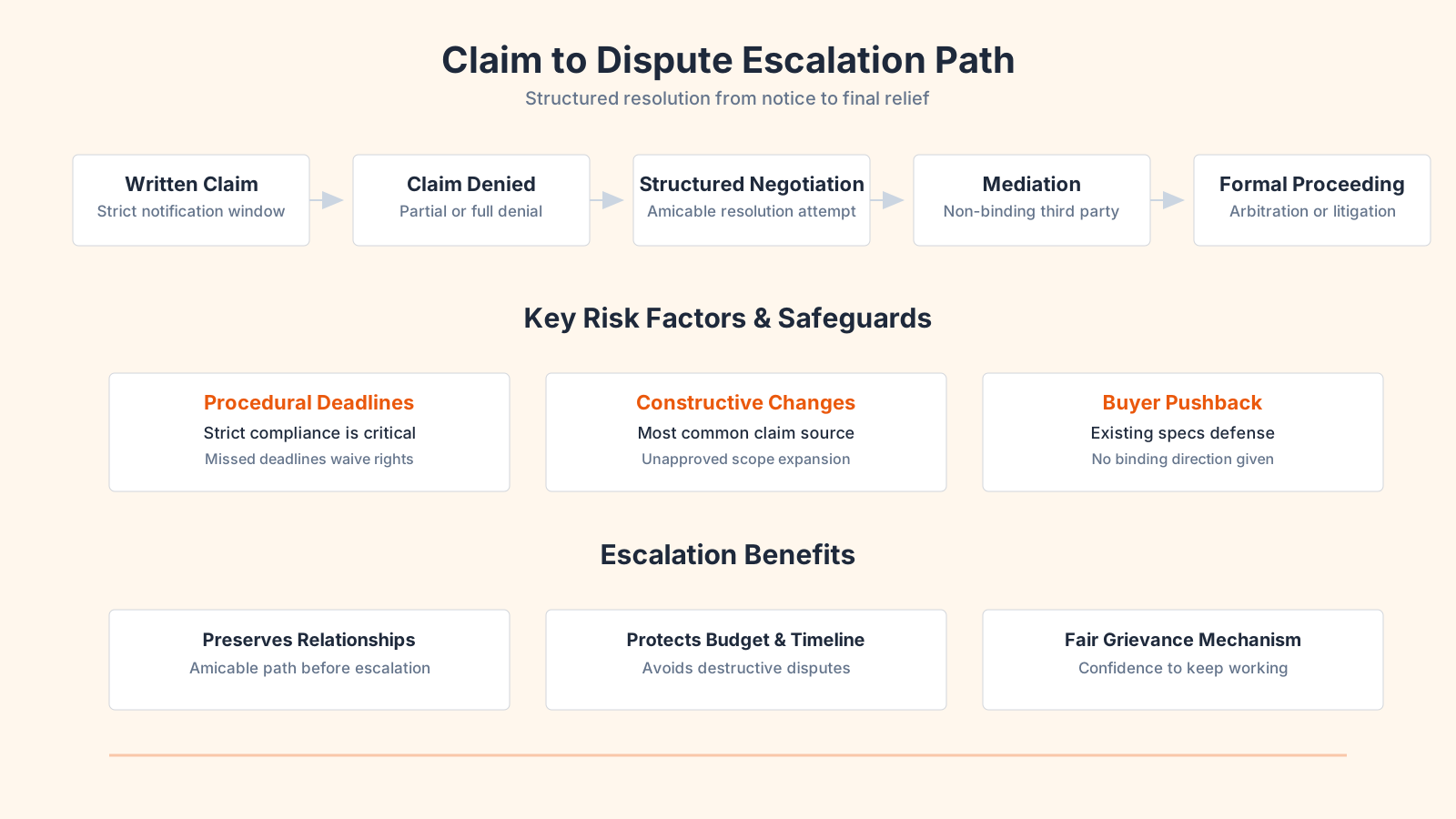
Summary: Handling Claims and Disputes in Procurement
| Key Concept | Summary |
|---|---|
| Claims & Disputes | Procurement claims emerge from disagreements over the existence or valuation of a change. Left unmanaged, these contested changes stall progress, erode trust, and inflate costs. |
| Constructive Changes | A constructive change occurs when the seller performs work beyond the original scope in response to the buyer's explicit or implicit direction, yet no formal change order is ever issued. This de facto expansion creates a valid basis for a claim. |
| Claim vs. Dispute | A claim is a documented assertion of entitlement to relief under the contract. A dispute arises when that claim is rejected or neglected, shifting the relationship from cooperative resolution to an adversarial stance. |
| Contract Rulebook | The contract serves as the procedural rulebook, setting mandatory notification timelines, required documentation, and the escalation sequence that must be exhausted before either party can pursue external remedies. |
| Routine vs. Claim | Routine change requests proceed through a cooperative process and culminate in a documented change order. A claim signals a collapse of that collaborative flow and the adoption of a unilateral position. |
| Time Bars | Contractual time bar clauses extinguish a seller's right to claim relief if the written notification is not filed within the defined period following discovery of the event. |
| Claims Lifecycle | Claims management follows a structured lifecycle: from the emergence of a potential disagreement, through formal assertion and negotiation, to resolution or escalation to a binding tribunal. |
| Monitoring & Control | A continuously updated claims register tracks each claim's status, financial exposure, and risk implications, directly feeding into performance dashboards, budget forecasts, and stakeholder communications. |
| Ambiguous Specifications | Ambiguous contract language and the absence of a common technical baseline drive many claims, as both parties interpret scope through their own operational lenses, often in good faith but with conflicting outcomes. |
| Compensation Disputes | The most prevalent contested change arises when parties agree that a change occurred but diverge on its cost impact, including pricing assumptions, productivity rates, overhead allocation, and profit margins. |
Understanding Claims and Disputes in the Procurement Context
At the heart of every procurement claim sits a contested change—something one party insists has altered the original agreement in a way that demands additional compensation, time, or both. In many cases, the concept of a constructive change in procurement contracts fuels the tension: the seller performs work it believes is outside the original scope, while the buyer insists no formal change order was ever issued. This scenario is distinct from a routine change request that both sides accept and negotiate calmly. A claim crystallizes when the parties cannot agree that a change has occurred, or when they agree it occurred but cannot reach consensus on the compensation. The unease often starts small. A contractor substitutes a component during a supply chain disruption, believing it meets the same specification, and then submits an invoice reflecting the extra cost. The buyer challenges the invoice, arguing no prior approval was given. Suddenly, a technical adjustment becomes a dispute that needs formal documentation.
While the language varies across industries, the core mechanism is consistent. A claim is a recorded assertion of a right to relief under the contract. It is typically accompanied by a request for additional payment, an extension of time, or some other adjustment. The term “dispute” surfaces when the claim is rejected or ignored and the parties enter a more adversarial phase. Smaller procurement engagements might blur these terms into a single conflict, but large-scale agreements—think infrastructure builds, IT system deployments, or long-term service contracts—usually define a clear escalation path from claim to dispute. The contract itself becomes the rulebook, specifying notification windows, required evidentiary documents, and the sequence of steps before either side can escalate further. Without that discipline, what starts as a misunderstanding can metastasize into litigation that burns through resources neither party can spare.
What makes procurement claims particularly thorny is that they rarely emerge in isolation. A single ambiguous specification can birth a string of related disagreements. For example, a software vendor delivering a customizable platform might interpret a feature request as part of standard configuration, while the client sees it as an out-of-scope enhancement. Neither side is necessarily acting in bad faith; they are applying different lenses to the same contract language. When the vendor eventually submits an invoice reflecting extra effort, the client pushes back, and a claim is born. The absence of a mutually understood baseline is often the real culprit, not a sudden act of defiance. Recognizing this dynamic early helps both parties approach the process less as a courtroom battle and more as a calibration exercise.
The Nature of Contested Changes and Constructive Changes
Constructive changes sit at the intersection of contract law and project reality. They occur when a seller is directed, either explicitly or through the buyer’s conduct, to perform work that is not within the original scope, yet no formal change order is issued. A typical micro-example would be a construction manager who verbally instructs a paving crew to widen a road shoulder because of a safety concern, then later denies that the extra width exceeded the drawings. The seller completes the work, submits an invoice for the additional materials and labor, and the buyer refuses payment. The seller files a claim alleging a constructive change. Suddenly, what was an informal site instruction becomes a documented disagreement requiring review of meeting minutes, emails, and daily logs.
Contested changes are not always constructive; sometimes both sides acknowledge a change occurred but clash over the cost impact. A buyer might request a faster delivery schedule, and the seller agrees in principle but demands a premium for overtime and expedited shipping. If the buyer considers the compensation demand excessive and the seller will not budge, they have a compensation-only contested change. These situations are statistically the most common type of claim because pricing work that was not originally planned involves assumptions, risk premiums, and market fluctuations that are notoriously difficult to standardize. The project team might find itself stuck in circular arguments over productivity rates, overhead allocation, and profit margins, all while the underlying work waits.
How Claims Differ from Routine Change Requests
A routine change request follows a cooperative path: the buyer proposes a modification, the seller estimates the impact, and both sides negotiate until they reach a mutual agreement documented in a change order. The cadence is collaborative, even when the numbers are tough. A claim, by contrast, signals a breakdown in that cadence. One party has unilaterally determined that it is owed something and has formalized that position, usually because informal discussions failed. The shift from request to claim often triggers contractual time bars: if the seller does not submit a written claim within a defined period after becoming aware of the event, the right to pursue it may be waived. This procedural dimension is what distinguishes claims from mere grumbling. A project manager who ignores a subcontractor’s offhand complaint about scope creep might later face a fully documented claim that could have been defused earlier with a simple clarification.
Key Insights on Procurement Claims
- Constructive changes drive most claims
- A constructive change arises when a seller performs work beyond the original scope based on the buyer’s conduct or verbal instructions, without a formal change order, and this divergence between authorised scope and actual performance is the primary trigger for procurement claims.
- Claim versus dispute distinction
- A claim is a formal, documented assertion of entitlement under the contract, while a dispute emerges when that claim is rejected or remains unanswered, marking the shift from cooperative problem-solving to adversarial engagement.
- Contracts set escalation rules
- Major contracts typically establish a structured escalation protocol, defining strict notification deadlines, the specific evidence required at each stage, and a sequential process that must be exhausted before either party can move to formal dispute resolution.
- Routine requests differ from claims
- A routine change request follows a collaborative process where both sides negotiate and jointly document a change order; a claim, by contrast, signals a breakdown in that cooperative rhythm, with one party unilaterally asserting its right to additional compensation or relief.
The Claims Management Lifecycle in Procurement Contracts
Managing claims is not a single event; it is a deliberate, phased lifecycle that runs parallel to the project’s execution. The procurement claims management process begins the moment a potential disagreement surfaces and does not truly end until the claim is either resolved or escalated to a binding external forum. Every contract of any substance detail, usually in a dedicated claims clause, exactly how this lifecycle must operate: what constitutes proper notice, how detailed the supporting documentation must be, who within each organization is authorized to receive and respond, and the timeframes for each step. Ignoring these contractual requirements is one of the most common and costly mistakes a project team can make, because a valid claim can be lost on a technicality even when the underlying merit is strong.
During the monitoring and controlling phase, the project manager and procurement team keep a living log of all claims, their status, and any associated risk exposure. This is not simply an administrative chore; it directly feeds into performance reporting, budget forecasting, and stakeholder communications. When a claim sits unresolved for months, the cash flow projections for both sides become fiction. The buyer might withhold payments on unrelated invoices, straining the seller’s liquidity, while the seller might divert key resources away from the project as a pressure tactic. A disciplined lifecycle approach, with regular review cadences and clear escalation triggers, keeps the commercial relationship functional even as the legal positions harden.
Contracts often segment the lifecycle into discrete stages: notification, substantiation, evaluation, and determination. During notification, the claiming party provides a factual summary of the event and its contractual basis. Substantiation requires a detailed breakdown of time and cost impacts, ideally rooted in contemporaneous records. Evaluation is the responding party’s analysis and counter-estimate. Determination is the formal decision, often issued by a contract administrator or an engineer acting as a quasi-neutral third party under the contract. At each stage, the parties have an opportunity to negotiate and settle before moving to the next. The best project teams treat these stages not as bureaucratic hurdles but as natural off-ramps from conflict, using each exchange of information to narrow the gap and test assumptions.
Documentation and Formal Notification Processes
Documentation is the oxygen a claim breathes. Anyone who has been through a major procurement dispute will confirm that the outcome rarely hinges on legal brilliance alone; it pivots on the quality and timeliness of the records kept before the conflict erupted. Daily logs, test reports, correspondence, meeting minutes, timesheets, and even weather records all become exhibits when a claim reaches a formal review. The party that can demonstrate a clear causal chain from a specific instruction or event to a measurable impact has an almost unassailable advantage. That is why seasoned project managers train their teams to document assumptions and directions in real time, even when things feel smooth. The moment a risk materializes, those notes transform from mundane paperwork into the foundation of a claim or defense.
The formal notification step is particularly delicate. If the contract says a notice of claim must be delivered in writing within fifteen days, delivering it on day sixteen can be fatal. In many legal traditions, these notice provisions are strictly enforced because they serve a vital purpose: they give the other party a fair chance to investigate the situation before evidence degrades and to take mitigating action. A buyer who learns of a supplier’s unforeseen cost overrun only six months after the fact is justified in wondering whether the problem could have been avoided with earlier communication. The notification letter itself need not be a legalistic masterpiece; it must state clearly what happened, when, and which contract provision is believed to entitle the sender to relief. Clarity at this stage prevents downstream disputes about what was actually claimed.
Monitoring and Tracking Claims Through the Contract Life Cycle
Active tracking transforms claims from a reactive headache into a manageable portfolio of outstanding items. On large programs with multiple subcontracted work streams, a single project might have twenty open claims at any given moment, each at a different stage of resolution. Losing sight of one small claim can trigger a cascade when that subcontractor passes its own unresolved issues up to the prime contractor, who then faces a compounded dispute with the buyer. Effective monitoring means maintaining a centralized register that records every claim identifier, the contractual deadline for the next action, the estimated financial exposure, and the assigned owner from each organization. This register should be reviewed in regular progress meetings not as a substitute for formal processing but as a check that nothing is slipping through the cracks.
Monitoring also serves an early-warning function. A pattern of recurring claims from the same supplier about the same specification suggests a deeper defect in the contract documents or in the supplier’s understanding of the requirements. Addressing that root cause can eliminate a whole class of future claims. Similarly, if a buyer notices that all claims are being rejected first and then slowly conceded during negotiation, it may signal that the evaluation team is applying an unreasonably rigid posture, damaging relationships and accumulating legal costs that dwarf the value of the claims themselves. These insights are only visible when the data is actively managed, not buried in an inbox.
The Role of the Contract Terms in Shaping the Claims Procedure
The specific contract model chosen during procurement award casts a long shadow over every dispute that follows. Industry-standard forms, such as those from engineering and construction bodies, contain elaborate tiered dispute resolution clauses that require direct negotiations, then referral to a standing dispute board, and only then formal arbitration. Bespoke commercial contracts can be far more skeletal, sometimes leaving the parties with no structured pathway at all, which perversely accelerates escalation to litigation. The time to shape the claims procedure is before the contract is signed, not when the first disagreement flares up. Ideally, the procurement team, with input from legal and project management, should stress-test the dispute resolution clause against realistic scenarios: what happens if the contract administrator is an employee of the buyer and a claim involves that same administrator’s own decisions? How will confidentiality of settlement discussions be preserved? Who bears the interim costs of maintaining project continuity while the dispute is pending?
When a contract is silent or ambiguous on process, the parties must fall back on default rules of the governing law, which almost always introduces greater uncertainty and cost. Even seemingly minor contractual gaps can be exploited. A seller might argue that the absence of a defined notice period means it can submit a claim at any time, even after project completion, while the buyer insists on a reasonable time standard. That ambiguity alone could become a meta-dispute layered on top of the substantive claim. The lesson is simple but repeatedly ignored: procurement professionals should negotiate the claims procedure with the same rigor they apply to pricing and scope.
Negotiation as the Preferred Method for Settling Procurement Disputes
When tensions rise, the temptation to hand everything to lawyers can be overwhelming, yet experienced practitioners know that settlement through negotiation in procurement disputes consistently outperforms adversarial alternatives in both speed and relationship preservation. Direct negotiation keeps decision-making authority with the people who actually understand the project’s technical and commercial nuances, rather than delegating it to an external adjudicator who sees only the carefully curated evidence. This does not mean negotiation is soft or naive. It is a structured, interest-based dialogue where each side tests the other’s positions against the likely outcomes of more formal proceedings and searches for a zone of possible agreement that avoids the catastrophic costs of arbitration or litigation.
The preference for negotiation is so deeply embedded in procurement practice that many contracts require it as a mandatory precursor to any other form of dispute resolution. A typical clause will obligate senior executives who were not directly involved in the day-to-day project to meet face-to-face and attempt a good-faith settlement before either party can file for arbitration. This “step negotiations” approach is designed to break the cycle of posturing by injecting fresh perspectives. The executives are less emotionally invested in defending past decisions and are more focused on the bottom-line business impact, making them more willing to explore creative compromises, such as adjusting future work scope instead of making cash payments.
Why Direct Negotiation Remains the Gold Standard
Negotiation wins because it preserves control. In a constructed micro-example, imagine a manufacturing contract where the seller claims a raw material surcharge triggered by tariffs, but the buyer argues the contract already accounts for price fluctuations. If they negotiate, the parties might agree to split the surcharge for this quarter and lock in a fixed pricing mechanism for the remainder of the contract—an outcome that pure litigation can never deliver. Courts and arbitrators can grant money awards, but they cannot redesign the commercial relationship to prevent future disputes. Only the parties themselves, through negotiation, can craft forward-looking solutions that keep the project moving. Moreover, the confidentiality of negotiation allows both sides to make pragmatic admissions without creating legal precedents that could haunt them in other contracts. A buyer might quietly acknowledge that its specification was ambiguous and offer a settlement, while publicly maintaining that the supplier should have sought clarification earlier. In a public arbitration, that nuance evaporates, and every word goes on the record.
Practical Approaches to Successful Claim Negotiation
Effective claim negotiation begins long before the meeting room door closes. It starts with a thorough mutual understanding of the data. Each side must walk in having already modeled the other’s best alternative to a negotiated agreement. If the seller knows that the buyer would face a six-figure arbitration cost and a 40 percent chance of losing, the negotiation range shifts. Armed with that analysis, negotiators can frame proposals not as demands but as risk management solutions. For example, “We believe we would win at arbitration, but we’re willing to discount our claim by 20 percent to save both of us the hassle and uncertainty.” This framing aligns the immediate dispute with the broader project objective: to get back to delivering value.
Another practical tactic is to unbundle complex claims into components that can be resolved incrementally. A claim that aggregates schedule delay costs, direct labor overruns, and rework expenses might be too monolithic to settle in one pass. Instead, the parties can agree on the undisputed facts first—perhaps the schedule delay duration—and then use that as a foundation to discuss the disputed quantum. This stepwise negotiation reduces the emotional temperature and builds a tentative collaborative rhythm, making it harder for either side to walk away. Seasoned project managers often serve as informal mediators during these sessions, reminding both sides of the original partnership intent and the reputational damage of a long-running feud.
Common Pitfalls in Claim Negotiations and How to Avoid Them
The most common pitfall is positional rigidity disguised as principled toughness. A commercial director might declare that the company will never pay a claim that is not supported by a contemporaneous written instruction, ignoring the reality that verbal instructions are routine on fast-moving projects. This hard stance may feel satisfying but often forces the other side into an equally rigid posture, guaranteeing deadlock. A better approach is to acknowledge the evidentiary weaknesses while still seeking a commercial resolution. Another trap is failing to involve the right decision-makers. A negotiation where the buyer’s representative lacks the authority to approve a settlement over a certain dollar amount wastes everyone’s time and erodes trust. The contract should specify the escalation hierarchy and ensure that each negotiating round is populated with individuals who carry sufficient delegated authority to say yes.
Chronological myopia is also pervasive. Teams negotiate as if the dispute exists in a vacuum, forgetting that the same parties will execute the remaining scope together. A heavy-handed concession extracted under duress can poison contractor motivation, leading to slow performance, inflated future change orders, or a quiet search for ways to recover the margin elsewhere. Savvy practitioners weigh the long-term relational cost alongside the immediate financial numbers. They know that a settlement that leaves both parties slightly unhappy but still willing to work together is often a better investment than a “total victory” that destroys the working relationship.
Core Takeaways on Procurement Negotiation
- Negotiation outperforms adversarial methods
- Negotiation consistently resolves procurement disputes faster than arbitration or litigation while preserving commercial relationships and placing decision-making authority in the hands of those who understand the project’s technical and financial realities.
- Step-negotiation clauses
- Such clauses require senior executives with no prior involvement to meet face-to-face in a good-faith settlement effort before arbitration can commence, bringing impartial oversight that defuses entrenched posturing and reignites constructive dialogue.
- Forward-looking confidential solutions
- Negotiation enables parties to rebuild the commercial framework through creative trade-offs and to make practical admissions without setting legal precedents that could surface in unrelated future matters.
- Data-driven incremental bargaining
- Skilled negotiators model the counterparty’s best alternative to a negotiated agreement, position proposals as targeted risk-management tools, and break down complex claims into resolvable components to secure step-by-step progress.
Alternative Dispute Resolution in Procurement
When direct negotiation stalls, the contract does not simply dump the parties into a courtroom; it typically channels them into alternative dispute resolution in procurement contracts. ADR encompasses a spectrum of processes—mediation, conciliation, adjudication, dispute review boards, and arbitration—each offering a middle ground between informal negotiation and full-blown litigation. The core idea is to introduce a neutral third party who can either facilitate settlement or render a binding decision, but in a setting that is faster, cheaper, and more confidential than public courts. Many procurement agreements now embed ADR steps so tightly that it is practically impossible to litigate a claim without first exhausting at least two tiers of resolution. In infrastructure projects, a standing dispute board might be appointed at the project’s start, meeting regularly to keep an eye on potential issues and resolving them almost in real time, long before they mature into formal disputes.
The decision about which ADR method to use is not one that should be made in the heat of conflict. The contract commonly preselects the method, specifying everything from the appointing authority for the arbitrator to the language of the proceedings. This pre-selection, ideally finalized during the procurement award phase, eliminates a major source of subsequent wrangling: procedural gamesmanship over who chooses the forum. When an ADR clause mandates mediation followed by binding arbitration under a recognized institutional rule set, both parties know exactly what the escalation looks like and can price that risk into their commercial terms from the outset. The worst situation is a contract that vaguely mentions ADR without specifics, leaving the parties to negotiate the process itself while simultaneously fighting the substantive claim.
ADR is not a magic wand. It works best when the dispute is factual and technical rather than rooted in a fundamental breakdown of trust. For instance, a disagreement about the interpretation of a geotechnical baseline can be resolved effectively by a panel of experienced engineers who understand the industry standard. A claim that is really about one party’s opportunistic behavior following a market shift may resist mediation altogether, because the underlying incentive to delay and extract concessions persists. Recognizing this distinction helps procurement professionals choose when to push hard for ADR and when to acknowledge that litigation is inevitable.
When ADR Becomes Necessary
ADR typically becomes necessary when one or both sides have lost confidence in the other’s willingness to negotiate in good faith. Maybe the buyer has ignored repeated invitations to meet, or the seller has submitted a grossly inflated claim hoping to use the resulting sticker shock to force a quick compromise. The formal trigger often lies in the contract: a defined number of days after a claim is rejected or after a deadlock is declared in negotiations, either party can invoke ADR. At that moment, the dynamic shifts. The parties are no longer simply exchanging arguments; they are now operating under a procedural clock with potential cost consequences for unreasonable behavior. In some jurisdictions, a party that unreasonably refuses to participate in mediation can face cost sanctions even if it later wins on the merits.
What makes this phase psychologically different is the introduction of an outsider’s perspective. A skilled mediator, even in a non-binding capacity, can reframe issues in a way that pricks inflated confidence. A party that has convinced itself its case is bulletproof might be startled when the mediator points out the evidentiary gaps, the inconsistent internal emails, or the damaging clause it overlooked. This reality check often produces settlements that were unimaginable during direct bilateral exchanges. It is not uncommon for a mediation session to succeed on the very day arbitration was scheduled to begin, because that looming deadline forces a final recalibration of risks.
Pre-Selection of ADR Mechanisms During Procurement Award
Thinking about disputes at the award stage can feel pessimistic, yet it is one of the most constructive acts a procurement team can perform. Pre-selecting the ADR mechanism means deciding, before the first payment is made, whether disputes will go to a single expert determiner, a three-member arbitration panel, or a tiered approach of mediation followed by expedited arbitration. This decision should flow from a candid assessment of the project’s likely dispute profile. A high-value construction project with complex technical interfaces might benefit from a standing dispute board that can issue interim binding decisions quickly, keeping work flowing. A pure services contract with low capital intensity might be better served by mediation capped at a fixed number of days, with arbitration only if that fails. The key is to match the mechanism to the pace of the project and the nature of expected disagreements.
Pre-selection also locks in important procedural details such as document disclosure rules, evidentiary privileges, and cost allocation. Parties can agree, for example, that each side will bear its own legal costs regardless of outcome, removing the chilling effect of potential adverse costs awards. Or they can agree to limit written submissions and hearing days, forcing a lean resolution process that fits the contract’s size. These choices have a direct impact on the total cost of a dispute, and making them early avoids the scenario where the stronger party later tries to impose a burdensome litigation-like procedure on the weaker one. It is a risk management exercise, no different from choosing an insurance deductible.
Integrating Claims and Dispute Handling into the Broader Project Management Framework
Procurement disputes do not live in a parallel universe; they are integral to the project management plan, touching at least three knowledge areas directly: procurement management, risk management, and stakeholder management. In the PMBOK framework, the monitoring and controlling of procurement claims falls under the Control Procurements process, where the project manager reviews seller performance, manages changes, and ensures that all claims are administered according to the contract. This is the moment where the project manager shifts from being simply a technical coordinator to a commercial steward, ensuring that claims do not distort the cost baseline or the schedule forecast without proper visibility. When a claim is settled for more than the contingency reserve can absorb, it triggers a change request that must flow through integrated change control, pulling in impacts on scope, schedule, and quality. The interconnectedness is profound.
In a PRINCE2 environment, the handling of claims aligns with the controlling a stage and managing product delivery processes, where the project manager monitors risks and issues and escalates those that exceed tolerances. A procurement claim that threatens to delay a key delivery can be logged as an issue and handled through the project board, which may direct the project manager to negotiate within certain financial limits before referring to higher authority. The method’s emphasis on defined tolerances and exception reporting provides a natural governance structure for claims, preventing a single dispute from silently unraveling the stage plan. Regardless of methodology, the project manager must integrate claims data into the communication management plan so that the right stakeholders are informed at the right level of detail, avoiding panic or political interference.
The Project Manager’s Role in Claims Prevention and Early Resolution
Far too many project managers see claims as a lawyer’s problem. The truth is that the seeds of most procurement claims are sown in daily project interactions that the project manager witnesses or influences. A vague email from a technical lead that appears to authorize something beyond scope, a site instruction given orally during a weekly walkthrough, or a meeting note that subtly shifts performance criteria—these are the raw material of future claims. The project manager’s greatest contribution is not litigation support; it is creating a culture of rigorous communication and documentation from day one. That means insisting that all scope-related discussions, even informal ones, are confirmed in writing and that any instruction that could be interpreted as a directive to perform extra work is immediately flagged for evaluation.
When a potential claim does surface, the project manager’s instinct should be to address it on the spot, not to hope it goes away. A quick call to the seller’s project lead to clarify the understanding and to explore a minor adjustment can prevent a $5,000 disagreement from becoming a $500,000 claim armed with counsel. This requires the project manager to possess enough commercial awareness to recognize a claim-triggering event and enough authority to propose a reasonable accommodation. Organizations that empower their project managers with delegated financial authority for small settlements reap enormous benefits in claim avoidance, because the alternative is an escalation bottleneck that forces every minor issue into a formal channel where it festers.
Aligning Procurement Claims with Risk Management and Change Control
Every procurement contract carries a risk that claims will arise, and that risk should be captured in the risk register from the planning stage. A program that does not explicitly list “failure to agree on scope changes” or “seller claims for constructive acceleration” as a risk is missing a critical stress point. Once captured, the risk response strategies can be pre-designed: contractual language that defines scope boundaries with extra precision, an incentive scheme that rewards early settlement, or a retained contingency line item specifically for quick negotiated settlements to avoid overblown disputes. This transforms claims from unpredictable shocks into monitored threats with active mitigation.
The integration with change control is equally vital. When a claim leads to a settlement that changes the project baseline, the formal change control board must approve the reallocation of funds, schedule buffers, or scope trade-offs. This prevents a situation where the project manager unilaterally agrees to a large claim settlement, only to discover that the budget no longer covers remaining deliverables. In organizations with mature governance, the change request that absorbs a claim settlement is reviewed alongside a lessons-learned analysis, asking why the contract failed to prevent the disagreement in the first place. That feedback loop closes the circle, improving future procurement documents and reducing the baseline risk for the next contract.
Core Takeaways on Claims Integration
- Claims embedded in standard processes
- Procurement disputes are managed through established governance frameworks such as Control Procurements in PMBOK and issue escalation procedures in PRINCE2, ensuring strict adherence to the same tolerance thresholds and reporting protocols as any other project activity.
- Prevention through disciplined communication
- Project managers prevent the majority of claims by mandating written confirmation of scope discussions, promptly flagging informal directives, and resolving potential disagreements immediately before they crystallize into formal disputes.
- Risk register and change control alignment
- Potential claims are proactively registered as risks during planning with predefined response strategies, and any settlement that alters the baseline must pass through formal change control to safeguard the budget and schedule.
Common Misconceptions and Practical Insights for Handling Procurement Disputes
A persistent myth suggests that a strong contractual claim is a guaranteed payout, but seasoned practitioners know that enforcing a procurement claim successfully depends less on legal entitlement and more on the practical stamina to see it through. The cost of proving a claim, even a solid one, can consume a significant fraction of the amount sought, especially when the other side deploys delaying tactics. Another misconception is that a robust dispute resolution clause will deter all frivolous claims. In practice, sophisticated sellers occasionally file aggressive claims as negotiation leverage, knowing that the time and disruption value to the buyer may justify a modest settlement despite weak merits. Accepting this reality early helps temper expectations and shapes a more strategic approach to claim defense.
There is also a dangerous assumption that formal ADR is always faster than litigation. Complex arbitration with multiple hearings, expert witnesses, and document-heavy proceedings can stretch over more than a year, rivaling court timelines and without the same appeal rights. Parties sometimes emerge from arbitration exhausted and with a comparable bill to litigation. The smarter move is to treat arbitration and other binding ADR mechanisms as last-resort tools, not as convenient alternatives to tough negotiation. Meanwhile, the notion that a dispute will be resolved simply by “going to the contract administrator” frequently disappoints when the administrator’s decision is challenged as biased or uninformed, spawning yet another layer of dispute about the decision itself.
Why Documenting Every Detail Early Matters More Than You Think
The most haunting mistake in claim management is the assumption that important conversations will be remembered accurately after a year of conflict. Memory distorts, loyalties shift, and personnel turnover means that the people who gave verbal instructions may be long gone by the time their words are scrutinized. Project records function as an institutional memory immune to selective recall. The party that kept a contemporaneous log of events, with timestamps and cross-references to drawings or emails, essentially freezes reality in a form that an arbitrator can reconstruct. The party that relies on after-the-fact affidavits is betting on persuasion, and that bet rarely pays off. What makes this insight so powerful is its simplicity: it requires no special legal training, only a disciplined habit of narrative note-taking on every key interaction.
Documentation also reduces the emotional charge of a dispute. When both sides can point to an agreed daily report that shows what was discussed and decided, arguments about what was “really said” lose their sting. The focus shifts to interpretation, which is a far calmer arena than credibility contests. In many mediations, the moment the mediator lays out a well-organized chronology built from both sides’ records, the room goes quiet and the settlement discussion begins in earnest, because the contested factual ground has shrunk to a manageable patch.
The Danger of Treating Claims as Adversarial from the Start
There is a reflexive instinct in some organizations to activate a war-room mentality the instant a claim arrives. External counsel is retained, communications are locked down, and every response is drafted as if for a judge. This posturing signals to the seller that the relationship is now purely transactional and that any future cooperation will be extracted under protest. The better path, when the claim is small to medium in size and the relationship still matters for ongoing work, is to treat the claim as a problem to be solved jointly, not as a betrayal to be punished. The initial response can acknowledge the claim, propose a meeting to understand the facts, and reaffirm the shared goal of project success. This does not waive any contractual defenses; it simply postpones the adversarial posture until it is genuinely needed. More claims are resolved by a shared spreadsheet and a handshake than by a war-room showdown, yet the myth of toughness persists.
A particularly damaging form of premature adversarialism is the withholding of legitimate payments on unrelated work to pressure the seller into dropping a claim. While this tactic may yield a short-term standoff advantage, it often breaches the contract and hands the seller its own valid counterclaim for non-payment, plus interest and maybe reputational damage. It also gives the seller a powerful narrative of bad faith that can influence an arbitrator or judge. The most effective procurement managers keep the claim dispute ring-fenced, continuing to satisfy contractual obligations in full while the claim is processed separately. This maintains a posture of commercial fairness that pays dividends when the claim finally reaches a settlement negotiation, because it deprives the other side of an easy grievance to leverage.