If you have ever been handed a stack of deliverables at the end of a long initiative and thought, “That’s it, we’re done,” take a moment. You are not alone, and also, you might be skipping one of the most misunderstood phases in project management. The real question, close a project properly, goes far beyond that final deliverable handoff. It involves a deliberate, structured process that confirms the work matches what was promised, captures everything the organization should remember, and transitions the outcome to those who will live with it long after the project team disbands. In practice, the closing phase often gets short shrift because teams are already eyeing the next big thing, or because stakeholders simply stop showing up. Yet skipping those formal closure steps can quietly unravel value that took months to build.
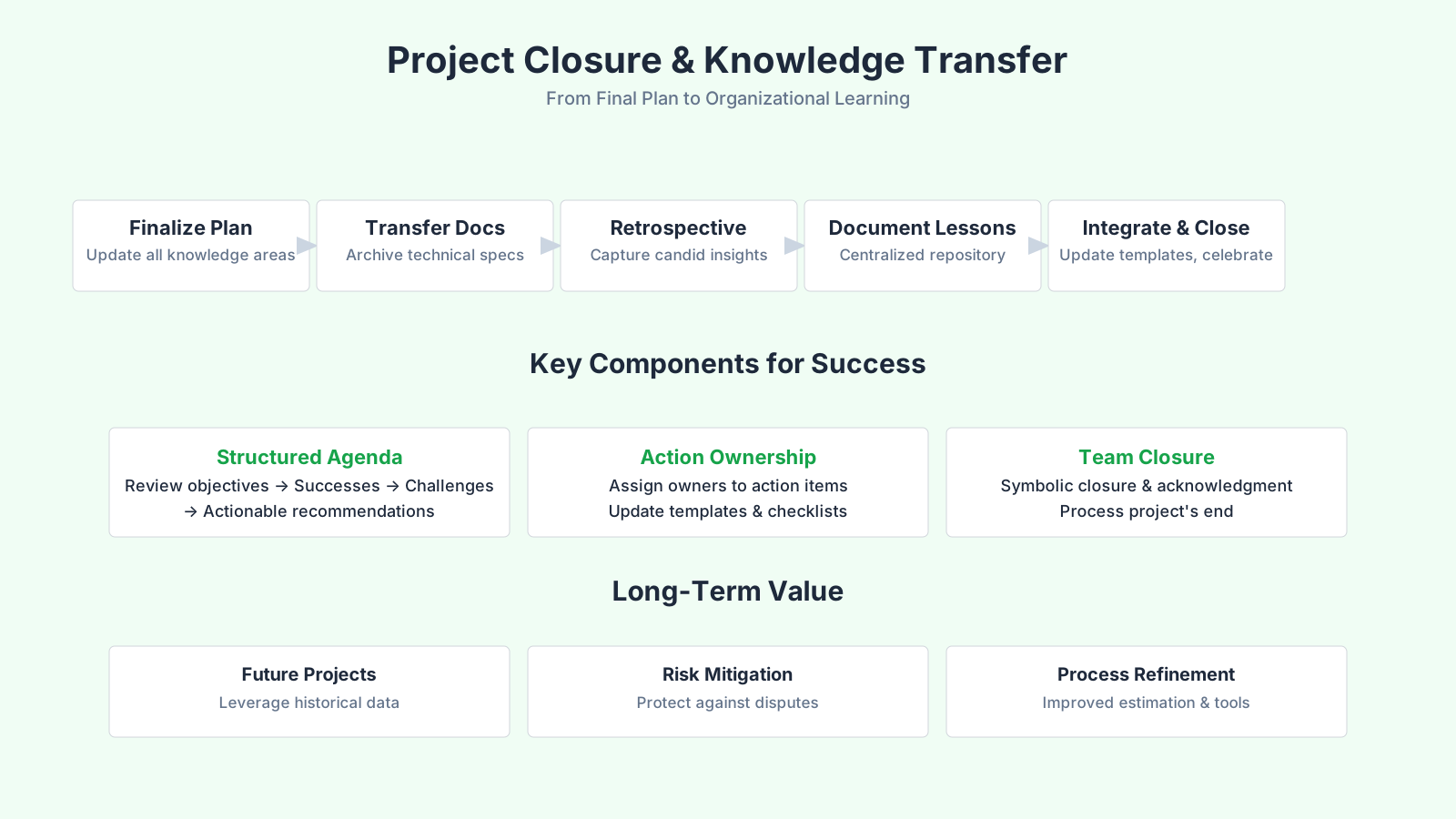
At a Glance: Steps to Close Your Project
| Key Concept | Summary |
|---|---|
| Closing Process | A methodical confirmation that deliverables meet acceptance criteria, organizational knowledge is preserved, and ownership transfers seamlessly to the operational team. |
| Benefits Realization | Project closure extends beyond delivery; true completion occurs when benefits begin to materialize, enabled by a thorough, well-structured handover that positions the organization to capture value. |
| Construction Example | Transferring a building without validated as-built documentation, registered warranties, or trained facility staff leads to operational chaos and erodes stakeholder confidence. |
| Software Example | Deploying code without documenting known anomalies, conducting a final retrospective, or verifying the support team's readiness results in after-hours escalations and accountability gaps. |
| Integration | Closure integrates outcomes across all knowledge areas, consolidating scope verification, financial reconciliation, quality acceptance, resource release, procurement closeout, risk finalization, and stakeholder communication into a unified final record. |
| Closing Ceremony | A deliberate closure event, even a brief sponsor-led acknowledgment, provides the team psychological closure and signals readiness for reassignment. |
| Project Manager Sign-off | Formal sign-off shifts accountability to the receiving organization, releasing the project manager from indefinite liability for post-transition issues beyond their influence. |
| Tools and Outputs | Relying primarily on expert judgment, closure generates the final product, service, or result transition, coupled with updates to organizational process assets such as lessons learned and project archives. |
Why Project Closure Is More Than Just a Formality
Many project managers treat administrative shutdown as a box-checking exercise, something to get through so they can move on to a new challenge. The truth is that formal project closure is the only reliable way to cement what was achieved and to prevent small, unattended issues from ballooning into expensive problems. When you close without rigor, you risk leaving loose financial obligations, unresolved contract terms, or critical knowledge trapped inside a few people’s heads. The organization might also lose the chance to harvest insights that could improve every future project. People sometimes ask why the PMBOK® Guide devotes an entire process to closing, and the answer lies in the simple observation that a project is not truly finished until its benefits begin to be realized, and that cannot happen if the handover is chaotic or incomplete.
Think of a construction project where the building is up and the keys handed over, but nobody has verified that the as-built drawings are updated, the warranties are registered, or the operations team has been trained on the new building management system. Legally the project may look done, but operationally it is still an open wound. The owners will discover gaps months later when something breaks down, and they will come looking for explanations. The project manager who cares about long-term reputation knows that closure is about leaving behind not just a product, but a stable operational reality. The same applies in software: releasing code to production without documenting the known quirks, without running a final retrospective, or without confirming that the support team understands the architecture is a recipe for midnight calls and blame games. In these scenarios, formal closure is the difference between a tidy ending and a messy aftermath.
The PMBOK® Guide places the Close Project or Phase process inside the Integration Management knowledge area, and it belongs to the Closing Process Group. That positioning is intentional. Integration management coordinates all the other knowledge areas, so the closing process must pull together threads from scope, schedule, cost, quality, resources, communications, risk, procurement, and stakeholders. You cannot close what you cannot verify, and you cannot verify without reaching back into every plan and every acceptance record. This is why the process lists the project management plan, accepted deliverables, and organizational process assets as its three inputs. They are the evidence trail that shows the project lived up to its commitments. Without them, closure becomes a hopeful assertion rather than a demonstrable fact.
Organizations that rush through closure also miss an underappreciated psychological benefit. Project teams carry a lot of stress, and a deliberate ending ceremony, even a simple meeting where the sponsor acknowledges the work, can give people a clean mental break. It signals that the relentless pressure is officially over. That symbolic closure cuts down on burnout and helps people transition to their next assignments with a sense of accomplishment rather than exhaustion. For the project manager, it is also the moment when responsibility can be formally signed over, freeing them to focus on new challenges without lingering accountability for loose ends they cannot control.
The Place of Project Closure in the PMBOK Framework
Within the PMBOK® Guide, close a project is executed through the Close Project or Phase process, which sits at the very end of the integration management continuum. It is the mirror image of the Develop Project Charter process that launched everything months or years earlier. Where the charter gave formal authorization to begin, the closure process provides formal authorization to end. This process ensures that all project work is complete, all contractual obligations are satisfied, and the final product, service, or result has been accepted. Many people confuse it with the administrative cleanup that happens after a phase review, but those are often lighter checkpoints. The final project closure is the heavyweight version that draws a permanent line under the entire endeavor.
The Closing Process Group, to which this process belongs, only contains this single process for integration. Other knowledge areas may have their own closing activities, like closing procurements or releasing resources, but the overarching Close Project or Phase integrates them all. It is the point where the project manager formally validates that every subsidiary plan has been fulfilled or properly dispositioned. If a requirement was deferred to a future phase, that must be documented; if a risk was accepted and remains, it must be handed over; if a stakeholder signed off on a partial delivery, that acceptance must be tied into the records. In other words, the closure process is a gate that says, “We have looked at this project from every angle required by our methodology, and it is now appropriate to cease charging time and budget to it.”
Why Closure Matters: Core Insights
- Closure cements project achievements
- Formal closure locks in project achievements and prevents minor unresolved issues from spiraling into costly, disruptive problems.
- Risks of closing without rigor
- Neglecting rigorous closure strands financial commitments, leaves contracts partially fulfilled, and buries critical know-how with a handful of team members who may soon depart.
- Benefits require complete handover
- Lasting project benefits only materialize when handover is complete and orderly, ensuring operations can fully capitalize on what was delivered.
- Gaps surface months later
- In both construction and software, failing to audit final documentation, register warranties, and train support teams triggers operational failures, late-night firefighting, and rounds of unproductive finger pointing.
- Integration Management coordinates closure
- The PMBOK Guide situates project closure within Integration Management, weaving together scope, schedule, cost, quality, resources, communications, risk, procurement, and stakeholder threads into a disciplined final transition.
The Close Project or Phase Process Explained
The anatomy of close project or phase process can appear deceptively simple when boiled down to three inputs, one tool, and two outputs. In the real world, those few categories hide a tremendous amount of detailed work. The three inputs are the project management plan, accepted deliverables, and organizational process assets. The single recognized tool is expert judgment, and the outputs are the final product, service, or result transition and the associated organizational process assets updates. Each of these deserves careful unpacking because they represent the entirety of the project’s legacy. A project manager who understands why each element matters will be far less likely to rush through closure with superficial checkmarks.
The project management plan is not one static document but a collection of baselines and management plans. Before you can close, you need to look at the scope baseline to confirm that what was delivered matches what was approved. You need the schedule baseline to see whether all planned work items have been completed, and the cost baseline to verify that final financial reports align with the budget. Quality metrics, resource plans, communications records, and risk registers all come into play. The Close Project or Phase process does not redo any of this planning; it merely uses the plan as the yardstick against which completion is measured. If the plan was poorly maintained, closure becomes a messy exercise in reconstructing what was actually intended. This is why seasoned project managers keep their plan updated throughout the life of the project, even when it feels like bureaucratic overhead.
Accepted deliverables form the second critical input. Acceptance is not the same as delivery. A software feature might be pushed to a test environment, but until the product owner or client formally signs off that it meets the acceptance criteria, it is not an accepted deliverable. That formal sign-off might take the form of a user acceptance test sign-off sheet, an email from a sponsor, or a formal change control board approval. The key is that there must be objective evidence that the deliverable satisfies the requirements. When you close a project, you gather all those acceptance records and file them as proof. In industries with regulatory oversight, such as pharmaceuticals or aerospace, these acceptance artifacts are not optional; they are legal requirements. Without them, the project cannot be officially closed because an auditor could later deem the product non-compliant.
Organizational process assets are the third input, and they include templates, policies, procedures, and historical information from past projects. They also include the lessons learned repository and any closure checklists the organization requires. These assets guide the project manager on what specific closure steps are mandatory in that enterprise. Some organizations demand a financial audit before closure, while others require a formal sponsor sign-off on a closure document. The assets also provide the historical context that helps the project team validate that they have met the organization’s own standards. For example, if the company’s closure policy dictates that all open risks must be transferred to an operational risk register, the team would use that policy to complete the transition.
How to Close a Project Using the Project Management Plan
When you lean on the project management plan during closure, you are essentially conducting a comprehensive review of every commitment the project ever made. You start with the scope statement and the work breakdown structure, comparing the final deliverables list against what was originally baselined. Any deviations must be accounted for through approved change requests or documented as accepted variances. This is where messy projects reveal themselves: if the team changed major functionality on the fly without updating the scope baseline, now is the moment of reckoning. The project manager must either retroactively justify those changes or flag them as incomplete. The schedule baseline tells a similar story. Activities that were planned but not performed need a clear disposition, whether they were cancelled by mutual agreement, deferred, or simply overlooked. The same goes for the cost baseline, where final actual costs must be reconciled with the budget, and any remaining contingency or management reserves must be released or reported.
Beyond the baselines, subsidiary plans also guide closure. The quality management plan tells you what acceptance criteria and quality metrics were agreed upon, so you can verify that all quality checks were performed and any outstanding non-conformities have been resolved or accepted. The resource management plan helps you confirm that all personnel and equipment have been released or properly transferred. The communications management plan provides a checklist of final reports and stakeholder notifications that must be sent. The risk management plan directs you to close out the risk register, noting which risks materialized and which did not, and transitioning any residual risks to the operational teams. The procurement management plan ensures that all contracts have been closed, final payments made, and supplier performance evaluations recorded. The stakeholder engagement plan reminds you to confirm that key stakeholders have accepted the project outcomes and have no unresolved concerns. All these threads converge in the closure activity, making the project management plan far more than a planning artifact; it becomes the ultimate audit tool.
Gathering Accepted Deliverables to Close a Project
The phrase “accepted deliverables” sounds straightforward, but the reality can be thorny. Acceptance often comes in layers: the technical team may accept a component, then the quality team, then the business owner. When you close a project, you need to ensure that the highest level of acceptance required by the project charter or contract has been obtained. For complex systems, partial acceptances can muddy the water. You might have a dozen subsystems, each with its own acceptance date and signatory. The project manager must compile all these records and verify that they collectively cover the entire scope. If a single subsystem was only conditionally accepted, that condition must be documented and handed over as an outstanding item. Failure to do so can create a gap where the customer later claims they never accepted the full product, and the project manager has no consolidated evidence to the contrary.
In some contractual environments, acceptance is tied to payment milestones, and a project cannot be closed financially until all acceptance certificates are received and cleared by the finance department. The Close Project or Phase process in such cases must involve a legal and financial review to confirm that there are no outstanding claims or disputes. Even within internal projects, informal acceptance can be a risk. If the sponsor simply nodded in a steering committee meeting but never signed anything, the project manager should produce a closure document that captures that verbal acceptance in writing, with a line for the sponsor to approve. This paper trail may feel like bureaucracy, until you land in a situation where a new executive joins six months later and questions why money was spent on something that supposedly never got properly approved. The stack of signed acceptance records becomes your shield.
Applying Expert Judgment When You Close a Project
Expert judgment is listed as the sole tool and technique, and that choice can puzzle newcomers who expect elaborate software or decision models. In practice, it means that the project manager and the team tap into the collective experience of the organization to determine whether closure criteria have really been met. This includes consulting with technical leads to assess whether any latent defects might surface, with financial controllers to ensure all accounts are balanced, with legal advisors to check contract completions, and with senior stakeholders to confirm that strategic objectives were achieved. Expert judgment is not a single meeting; it often unfolds across multiple conversations and reviews. The sponsor might want to see a demonstration of the final product one last time. The PMO director might want to verify that the project artifact repository is structured correctly. The functional managers might want to discuss how their team members transition back to operations. All of this constitutes the application of expert judgment.
What makes expert judgment so powerful in closure is its ability to spot gaps that formal checklists miss. A checklist might ask, “Have all deliverables been accepted?” and the project manager ticks the box because all acceptance forms are filed. An experienced program manager, however, might notice that the acceptance was granted on a prototype that differs slightly from the final production version. That nuance would be caught only through human insight. Similarly, an HR expert might point out that although the team has been released, their performance records have not been updated, which could affect their career progression. Good project managers cultivate a network of experts they can call upon during closure to ensure nothing slips through the cracks.
Transitioning the Final Product When You Close a Project
The first output of the Close Project or Phase process is the final product, service, or result transition. This is more than a simple handoff; it is the point at which ownership and responsibility shift from the project team to the operational entity, whether that is the customer, a maintenance group, or an internal business unit. The transition often includes physical assets like hardware, documentation like user manuals and as-built drawings, and intangible assets like knowledge transfer. An effective transition requires that the receiving party is ready and capable. If the project delivered a cutting-edge analytics platform but the operations team has never been trained on it, the transition has failed even if the boxes are checked on a form. That is why many project managers schedule a transition period where the project team provides hypercare support before fully disengaging.
Transition also involves the formal acceptance confirmation. The customer or sponsor signs a document that states the project has been completed in accordance with the agreed-upon requirements and that the product is now in their custody. That sign-off triggers the release of final payments if contracts are involved and allows the project manager to begin the administrative shutdown. Without that final acceptance, the project remains technically open and resources might still be allocated to it. In government projects, this transition can be particularly formal, requiring notarized documents and regulatory filings. The project manager must understand the exact transition protocol required by the organization and ensure every step is followed.
Common Mistakes When You Close a Project
Even seasoned professionals stumble during closure, and the most frequent closing a project mistakes fall into predictable patterns. One classic error is rushing to reassign team members before closure is truly complete, leaving the project manager alone to chase signatures and update records without the subject matter expertise needed to address last-minute questions. Another is treating the lessons learned session as an optional afterthought, scheduling it when many team members have already departed, and producing a bland summary that adds no real insight. When lessons learned are done poorly, the organization repeats the same mistakes project after project, because the raw material for improvement was never properly captured and stored in an accessible way.
Many project managers also underestimate the difficulty of closing contracts. They assume that because the work is done, the contractual obligations are satisfied. But contract closure often involves confirming that all deliverables were accepted per the statement of work, all invoices have been paid, all claims have been resolved, and the supplier’s performance evaluation has been completed. If any of these steps is missed, the organization could face legal exposure or audit findings. Even internal projects have pseudo-contracts in the form of memorandums of understanding or service level agreements that must be formally closed out. Overlooking a single procurement item can leave a financial dangling thread that haunts the PMO for years.
Another subtle mistake is failing to archive the project information in a structured, retrievable format. Projects generate enormous amounts of documentation, but if it is scattered across email, shared drives, and local laptops, future teams cannot learn from it. Organizational process assets updates are meant to address this, but if the project manager simply dumps everything into a folder and calls it done, the value of that archive is virtually zero. Proper closure means organizing the records so that five years later, someone can quickly find the design decision log, the risk register, or the acceptance certificates without spending days reconstructing the project’s history. This is a time-consuming step, but it is one of the most lasting contributions a project manager can make to the organization.
The Hidden Cost of Skipping Formal Acceptance
Skipping formal acceptance of deliverables might feel like saving time, but it sets up a slow-motion disaster. Without signed acceptance, the project team retains an implicit liability for the product’s performance long after they have moved on. I have seen cases where a customer called nine months after delivery complaining that a feature did not work as they assumed, and because no formal acceptance had been documented, the organization had to invest unbudgeted resources to resolve the dispute. Formal acceptance is not about mistrust; it is about creating a definitive moment where both parties agree that the project’s obligations have been met. That moment protects the team and the customer alike. In heavily regulated industries, this is not just best practice; it is a compliance issue that can trigger sanctions if ignored.
When you close a project, the formal acceptance document should be clear and unambiguous. It should reference the original scope statement, note any deviations that were explicitly accepted, and include a statement that the customer understands and approves the deliverables as final. Some organizations embed this acceptance within a broader project closure report that also summarizes the project’s performance against baselines. That report, once signed, becomes the definitive historical record and stops any future claims of incomplete delivery. The project manager who does not secure that signature is essentially leaving the project open to reinterpretation, which is a professional risk nobody needs.
Applying Lessons Learned Without the Theatre
Lessons learned sessions have a bad reputation because they are often conducted as a perfunctory group discussion that produces a list of generic statements like “we need better communication.” That is not what the Close Project or Phase process intends. Effective lessons learned capture specific, actionable insights tied to real events. Instead of “improve risk management,” a good lesson would document a particular risk that materialized unexpectedly, the impact it had, and what triggers should have been monitored more carefully. That granularity allows future project managers to set up concrete detection mechanisms rather than just nodding at abstract advice.
To make lessons learned valuable, the project manager should gather input throughout the project, not just at the end. Many organizations maintain a running lessons log where observations are recorded as they occur, while memory is fresh. During closure, the team reviews that log, curates the most critical items, and transfers them into the organization’s lessons learned repository. The repository becomes a searchable knowledge base that the PMO or subsequent project teams can query. This elevates closure from a historical exercise to a real performance improvement driver. And it ties directly to the organizational process assets updates output, because the repository is precisely the kind of asset that gets enriched through proper closure.
Financial Closure and the Unseen Costs
Financial closure is often delegated to the finance department, but the project manager plays a crucial role in ensuring that all project charges are accounted for and no ongoing costs remain assigned to the project code. This includes verifying that all time sheets have been submitted and approved, all supplier invoices have been processed, and any open purchase orders have been closed. If a project code remains active, team members might inadvertently charge time to it, creating phantom costs that distort future portfolio reporting. Some organizations require a final financial report that reconciles planned versus actual spending, explains variances, and releases any remaining contingency funds back to the organization. The project manager must work with the financial controller to produce this report and obtain formal sign-off before the project can be considered closed.
Failure to execute financial closure properly can have concrete career consequences. I have known project managers who moved on to new roles, only to be pulled back months later to explain an audit finding related to unclosed purchase orders or missing vendor evaluations. The few hours spent on diligent financial wrap-up during closure are trivial compared to the disruption of reconstructing old financial data under audit pressure. This is another reason why expert judgment is so important: an experienced financial analyst can spot patterns, like a recurring vendor charge that should have been stopped, much faster than a checklist can.
Key Insights on Common Closure Errors
- Premature team reassignment
- Letting team members roll off before every deliverable is formally accepted and administrative closure is complete strips away the precise subject matter expertise needed to answer last minute questions, validate final records and tie off remaining obligations properly.
- Weak lessons learned sessions
- Treating the lessons learned process as a perfunctory formality produces generic summaries devoid of actionable root causes, creating institutional amnesia that dooms subsequent projects to repeat the same oversights and cost overruns.
- Incomplete contract and procurement closure
- Omitting formal closure of contracts, MOUs or SLAs for interdepartmental work, or overlooking a single procurement line item, leaves behind loose financial threads and latent legal exposures that can resurface years later as unresolved claims, audit exceptions or disputed charges.
- Disorganized project documentation
- Scattering records across email threads, personal drives and laptops, or discarding files into an unstructured dump, undermines the archive entirely so that future teams cannot quickly trace decision logs, risk registers or acceptance certificates and instead must reconstruct critical evidence at great cost.
Adapting Project Closure for Agile and Hybrid Environments
Agile environments handle closure differently, but the underlying principles remain surprisingly consistent. In a Scrum project, the Sprint Review and Retrospective serve as micro-closures at the end of each iteration, verifying that the increment meets the Definition of Done and gathering improvement ideas. When the overall product or release is completed, a final project retrospective and a formal handover can function as the equivalent of the Close Project or Phase process. The emphasis shifts from heavy documentation to direct conversations and captured outcomes. But agile project closure still requires that the product owner formally accepts that the product backlog items have been delivered to the satisfaction of stakeholders, and that any remaining backlog items are dispositioned as either transferred to another team or explicitly cancelled.
The project management plan in an Agile context may be less document-heavy, but it still exists in the form of release plans, the Definition of Done, and the product vision. Accepted deliverables are the completed increments that have been demonstrated and accepted in sprint reviews. Organizational process assets might include burndown charts, velocity data, and the retrospective action logs. Expert judgment remains essential, often in the form of the Scrum Master, the product owner, and experienced developers who can collectively assess whether the product is truly ready for transition. One subtle difference is that in Agile, the team often stays together, so the closure of one project may simply be a pivot to new work. Yet even then, a formal closure event marks the end of a release and allows the organization to evaluate the product’s value delivery before committing to a new cycle.
In hybrid environments, where some parts of the project follow predictive planning and others use iterative development, closure becomes a blend of both worlds. The project manager must ensure that sequenced deliverables from the predictive side have their formal acceptance, while also capturing the retrospective insights from the iterative side. The trick is to not let the hybrid approach become an excuse to skip closure altogether. Too often, hybrid teams treat the final sprint review as the closure, forgetting that contracts, financials, and transition plans for the non-iterative components still need wrapping up. A hybrid closure checklist that maps both sets of obligations can prevent those gaps.
Capturing Non-Financial Benefits in Modern Closure Practices
Traditional closure focuses on deliverables and financial metrics, but many modern methodologies, including Business Value-Oriented Project Management, emphasize that the closure phase should also document non-financial program benefits. These can include improved employee engagement, skill development within the team, enhanced brand reputation, or future risk reduction that the project enabled. Documenting these benefits is important because they may not appear on a balance sheet immediately, but they represent real organizational value that decision-makers need to understand when evaluating the project’s true return. When you close a project, adding a brief section on these intangible gains provides a fuller picture of what was accomplished, and it can influence future portfolio decisions. BVOPM, for example, treats such non-financial outcomes as formal program benefits and uses realization sets that allow each project to close using its own chosen methodology, which simplifies the closure process while ensuring no value is overlooked.
In program management, the closure of a constituent project contributes to the program’s overall benefit realization. The program manager relies on each project’s closure outputs to update the program’s benefits register and to assess whether the program’s strategic objectives remain on track. That means that when a project manager diligently documents not only the final product transition but also the lessons about stakeholder dynamics, resource efficiency, and emerging capabilities, they feed critical information up to the program level. Those insights can reshape how subsequent projects are scoped or executed. So project closure is not merely an ending; it is a pivot point that fuels organizational learning and strategy refinement.
Building a Closure Checklist That Actually Works
Every organization should have a project closure checklist tailored to its specific industry and methodology, but many off-the-shelf templates become so generic that they offer little guidance. A good checklist turns the Close Project or Phase inputs and outputs into actionable steps. It starts with verifying that all deliverables are accepted, moves to financial and contractual closure, confirms resource release, conducts the lessons learned review, ensures the final product transition is accepted, and completes the archival of project records. Rather than a flat list, it should have decision points: if procurement was involved, complete the procurement closure sub-checklist; if the project is part of a program, notify the program manager and update the program benefits register; if regulatory compliance applies, obtain the necessary certifications.
The checklist should also prompt the project manager to send a final communication to all stakeholders, summarizing the project outcome, thanking the team, and providing any necessary transition contacts. That communication serves as a formal notice that the project is closed, preventing future requests from sneaking in under the old project umbrella. It is remarkable how many disputes can be avoided simply by broadcasting that the project is officially over and that all further work must be routed through operational channels. The checklist becomes the project manager’s memory aid, ensuring that no matter how chaotic the final weeks have been, nothing essential slips.
Signing Off and Moving On
The moment the sponsor signs the closure document, the project manager’s formal accountability essentially ends. That signature is the last checkpoint in the Close Project or Phase process, and it triggers the final organizational process assets updates. After that, the project transitions from an active endeavor to a historical reference. Some project managers feel a strange emptiness after the intensity of delivery, and that is perfectly natural. The key is to leave a clean, well-organized legacy. The files should be structured so that anyone can navigate them. The lessons learned should be written so that a new project manager a year from now can understand the context. The transition artifacts should make it obvious who now owns each component. When all of that is in place, the project manager can truly walk away, not just physically but mentally, knowing that the closure was done right.
Closure Checklist Key Takeaways
- Tailored checklists surpass generic ones
- Organizations gain far more value from closure checklists aligned with their specific industry and methodology, as generic templates fail to address project-specific closure risks and compliance requirements.
- Actionable step-by-step structure
- An effective closure checklist transforms the formal inputs and outputs of the Close Project process into a clear sequence of actions: verifying deliverable acceptance, completing financial reconciliation, releasing resources, capturing lessons learned, transferring the product, and archiving records.
- Conditional decision point branches
- Including conditional branches ensures that tasks such as procurement closure, program manager notification, or regulatory certification appear only when the project scope demands them, preventing unnecessary steps and confusion.
- Final stakeholder communication trigger
- A mandatory final communication step should notify all stakeholders of the project outcome, acknowledge the team's contribution, and provide contact details for ongoing support or transition, reinforcing a professional closeout.
- Official closure dispute prevention
- Issuing a formal closure notice prevents stakeholders from submitting requests under an inactive project, significantly reducing confusion and disputes, while the structured checklist safeguards against overlooked critical steps.