Collecting requirements from stakeholders sits at the heart of every successful project, yet it remains one of the most underestimated disciplines in project management. The process demands more than simply asking people what they need; it requires a structured approach to uncover latent expectations, reconcile conflicting interests, and translate vague ambitions into a clear, actionable scope. Project professionals who rush through this phase often find themselves wrestling with creeping scope, endless rework, and bitter stakeholders later on. A deliberate blend of elicitation techniques, drawn from both traditional and agile frameworks, transforms scattered wishes into a coherent set of requirements that guide design and development.
In the PMBOK framework, requirement collection falls squarely within the Planning process group as the Collect Requirements process, a bridge between stakeholder identification and the definition of the scope baseline. But beyond the process label, the real work involves a toolkit of human-centered and analytical methods, each suited to different stakeholder profiles and project environments. Some techniques, like interviews and observations, drill deep into individual perspectives; others, like facilitated workshops and group decision-making methods, synthesize multiple viewpoints into consensus. There is no single “right” technique, only a well-chosen combination that fits the culture of the organization, the complexity of the product, and the diversity of the stakeholder landscape. Modern methodologies, including Business Value-Oriented Project Management, push practitioners to validate stakeholder input early and maintain a transparent board of issues, reinforcing the notion that requirement collection is not a one-time event but an ongoing conversation.
Selecting the right approach means reading the room, so to speak. When stakeholders struggle to articulate their needs, direct observation or prototyping can expose hidden work patterns that interviews miss. When power dynamics stifle honest input, anonymous questionnaires or the Delphi technique can level the playing field. And when the project demands rapid alignment across functional silos, a facilitated workshop can compress weeks of back-and-forth into a few focused days. The following sections explore each of these methods in enough detail to move from theoretical understanding to confident application, highlighting practical pitfalls and the subtle judgments that separate mediocre requirement lists from precise, project-defining deliverables.
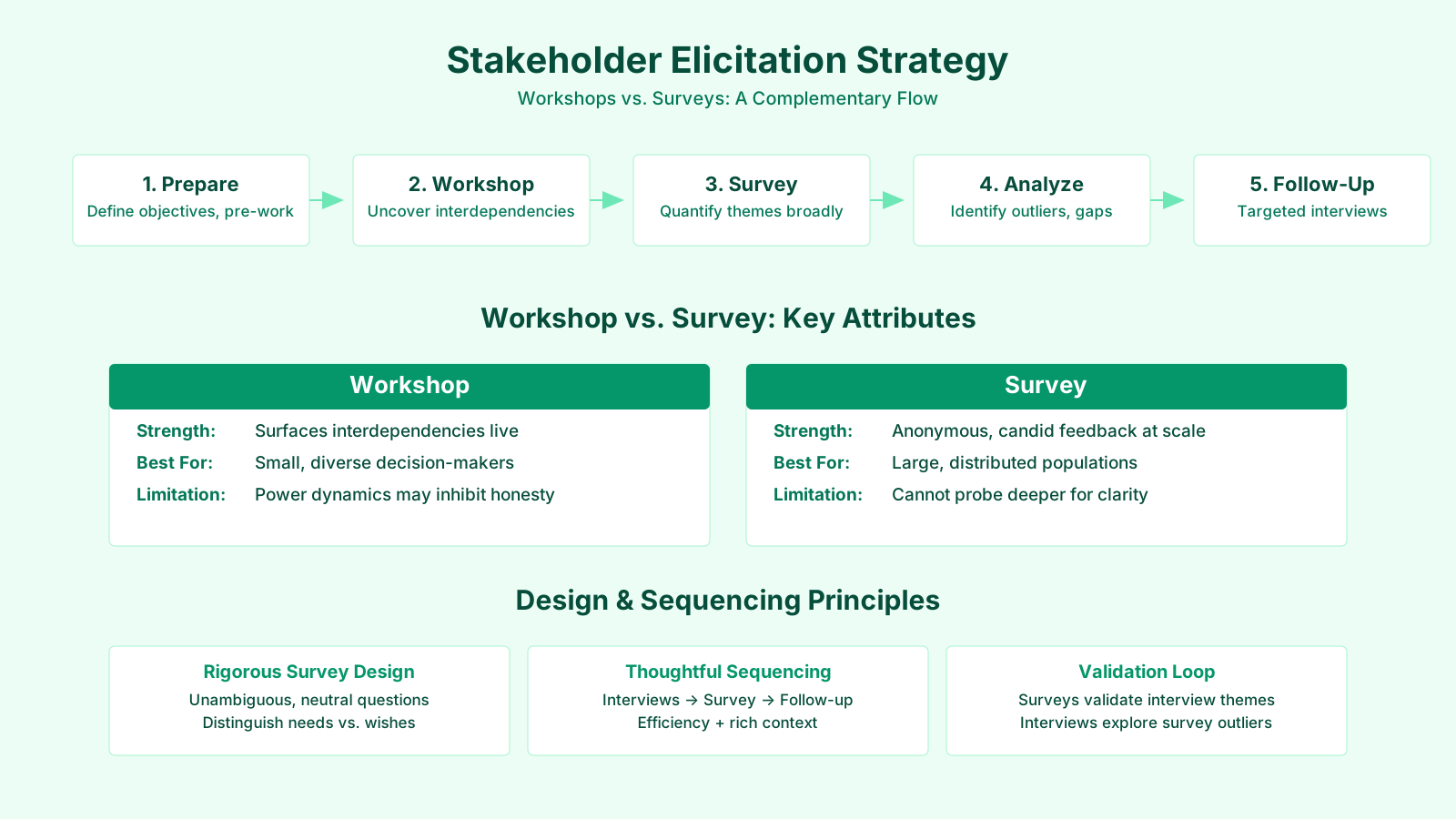
Summary: Collecting Requirements from Stakeholders
| Key Concept | Summary |
|---|---|
| Ongoing Validation | Contemporary approaches frame requirements elicitation as a continuous dialogue, validating stakeholder input early and maintaining a visible issues board that preserves alignment and transparency. |
| Interviews | Structured one-on-one interviews remain indispensable, blending precise questions with open-ended exploration to extract subtle needs from users, sponsors, and all parties affected by the solution. |
| Interview Pitfalls | Skilled practitioners sidestep leading questions and resist limiting conversations to outspoken voices, recognizing that quieter stakeholders frequently hold the deepest operational knowledge. |
| PMBOK Alignment | Aligned with the PMBOK® Guide, interviews strengthen the Collect Requirements process and deepen stakeholder engagement planning by clarifying influence, underlying attitudes, and unstated expectations. |
| Direct Observation | Observing users in their natural workspace uncovers implicit requirements through overlooked signals: workaround spreadsheets, undocumented shortcuts, and handwritten notes that expose process friction. |
| External Observation | Non-participatory observation preserves organic workflow but can make individuals self-conscious, requiring the project manager to balance unobtrusiveness with the need for authentic behavioral insight. |
Interviewing Stakeholders to Capture Clear Requirements
One-on-one interviews remain a foundational technique for requirement collection simply because they put the project manager face-to-face with the people who will use, sponsor, or be impacted by the final deliverable. Whether formal or conversational, an interview creates a private space where stakeholders can speak candidly about their pain points, wish lists, and hidden assumptions without the pressure of a group setting. The interviewer typically prepares a mix of structured questions to probe specific domains and open-ended prompts that invite stories, often recording the session or taking meticulous notes to capture the nuance behind fragmented statements. Experienced interviewers know that the most valuable requirements often emerge not from the prepared questionnaire but from the spontaneous follow-up that digs into a casual remark like “it would be nice if the system just did that automatically.”
In practice, one-on-one interviews work best when you need to understand the detailed workflows of subject matter experts or the strategic intentions of executive sponsors. A seasoned project manager might spend an hour with a financial controller to map out the exact data flows for month-end reporting, then pivot to a brief chat with the CEO to confirm that the initiative aligns with a broader digital transformation goal. The challenge lies in the fact that people frequently describe what they think they do rather than what they actually do, and their memory of exceptions, shortcuts, and workarounds tends to fade in the abstract. That is why interviews are almost never sufficient on their own; pairing them with observation or prototype reviews consistently yields richer requirements.
Common pitfalls include leading questions that plant ideas instead of eliciting genuine needs, and the trap of interviewing only the most vocal stakeholders while ignoring quieter voices who may hold critical operational knowledge. Project managers sometimes fall into confirmation bias, hearing what they want to hear and skipping over contradictions that should be explored. Another subtle danger is the power differential: a junior team member might nod along with a senior stakeholder’s description of a process even when the reality on the ground is different. So, after each interview, a quick debrief with the note-taker to triangulate inconsistencies against other sources becomes an essential hygiene habit.
From a PMBOK perspective, interviews are a key tool in the Collect Requirements process but they also feed directly into stakeholder engagement planning because each conversation deepens your understanding of influence and attitude. When performed iteratively, the questions evolve; early interviews expose unknown unknowns, and later ones confirm refined hypotheses. And while the technique sounds straightforward, it demands a mix of active listening, empathy, and the ability to paraphrase complex technical chatter back to the speaker for verification. That last step, often called reflective listening, does more to surface misinterpretations than any checklist ever could.
Key Takeaways on Stakeholder Interviews
- Interviews create candid private space
- A one-on-one format gives stakeholders the psychological safety to surface genuine pain points, unstated desires, and buried assumptions that group dynamics usually suppress.
- Spontaneous follow-ups reveal true needs
- Unscripted probes that chase casual remarks often unearth the crucial requirements a fixed questionnaire would miss entirely.
- Interviews need observation to validate
- Since stakeholders frequently describe idealized workflows instead of actual behaviour, pairing interviews with direct observation or prototype walkthroughs closes the gap between aspiration and reality, yielding requirements rooted in practice.
- Beware leading questions and power dynamics
- Biased phrasing that implants ideas and hierarchical deference that silences junior voices can distort findings, so deliberately surface input from quieter participants to uncover truths that senior assertions may obscure.
Observing Users in Action to Discover Implicit Needs
Direct observation takes requirement collectors out of the conference room and into the actual workspace, where they can see how people perform tasks, handle exceptions, and work around system limitations. Also known as job shadowing, this method is particularly powerful when stakeholders have difficulty articulating their needs because a process has become so routine that it lives in muscle memory rather than conscious thought. An observer watches a user navigate screens, shuffle documents, or coordinate with colleagues, noticing the tiny frictions that never appear in a process diagram. These micro-moments often hide the most valuable requirements: the extra spreadsheet that fills a reporting gap, the undocumented keyboard shortcut that bypasses a bug, or the Post-it note stuck to the monitor with a forgotten approval step.
There is a distinction worth drawing between external observation and participant observation, and the choice affects the quality of what you discover. In external observation, the project manager remains a silent witness, maybe taking notes from a corner of the room, which preserves the natural flow of work but can make people self-conscious. In participant observation, you actually perform the task yourself, feeling firsthand where the interface lags or the procedure bends. Imagine a project manager spending a morning processing purchase orders in the legacy system; suddenly, the requirement for a single-click approval becomes visceral rather than theoretical. That tactile understanding translates into sharper requirement statements and fewer back-and-forth clarifications with developers.
One common pitfall is the Hawthorne effect: people modify their behavior when they know they are being watched. A clerk who normally cuts corners to save time will follow every official protocol when an observer is present, masking the very workarounds that the new system should accommodate. To mitigate this, seasoned practitioners spread observation sessions over multiple days and blend them with casual conversation so the novelty wears off. Another risk is focusing too narrowly on a single role and missing the handoffs between functions that cause the most breakdowns. Following a document from creation to archive across three departments reveals interdependencies that no interview with any single person would capture.
Observation also connects naturally with process improvement initiatives, as the collected data often highlights waste and rework that can be eliminated even before new technology arrives. In agile environments, observation feeds directly into user story creation, with each observed pain point turning into a “as a user, I need to…” narrative that carries the weight of real evidence. The technique does take more time and coordination than a survey, however, so it is most appropriate when the stakes are high—complex, error-prone processes or safety-critical operations where guessing requirements is simply not an option.
Leveraging Focus Groups for Targeted Feedback
Focus groups bring together prequalified stakeholders and subject matter experts in a facilitated session designed to explore expectations and attitudes about a proposed product, service, or result. Unlike a one-on-one interview, the dynamic here is deliberately conversational, with a trained moderator guiding the group through a series of open-ended topics while encouraging participants to react to each other’s comments. That interactive spark often reveals collective assumptions and shared frustrations that individuals might not voice in isolation. For example, a focus group of customer service representatives might spontaneously agree that the number one requirement for a new claims system is not faster processing but consistent terminology across screens, something no single interview would have surfaced as a universal priority.
The composition of the group makes or breaks the session. Selecting participants who represent a cross-section of user types, hierarchical levels, and geographic locations ensures that the conversation does not veer into groupthink dominated by the loudest voice. The moderator plays a subtle but critical role, balancing participation, defusing tension, and probing beneath surface-level agreement to see if there is genuine consensus or polite nodding. Prep work includes developing a discussion guide that starts broad and progressively narrows, avoiding leading questions while still steering toward the project’s scope. Many moderators record the session, both to capture the literal words and to review later for the non-verbal cues—sighs, eye-rolls, hesitant pauses—that speak as loudly as any statement.
Focus groups excel when you need rapid qualitative feedback on a concept, such as a new dashboard layout or a proposed service workflow. They are less suited to topics involving sensitive political dynamics or deep technical detail that requires individual concentration. A common mistake is treating focus group output as quantitative data; ten people nodding in agreement does not equal a statistically valid requirement. That’s why savvy project managers use the findings to generate hypotheses that are then tested with broader surveys or prototype trials.
In the PMBOK framework, focus groups appear as a tool under the Collect Requirements process but they also serve as an early risk identification mechanism because latent conflicts between stakeholder groups often surface in the safe space of a moderated discussion. When a marketing manager and an operations director disagree openly about the definition of “customer,” the moderator can flag that as a scope risk before it derails later phases. The technique also aligns well with agile principles that value customer collaboration, though in practice an agile team might run something closer to a sprint review than a formal focus group, keeping the feedback loop tight and product-centric.
Focus Group Feedback Essentials
- Facilitated conversational dynamics
- Skilled moderators facilitate open-ended discussions among carefully selected stakeholders, creating an interactive environment that uncovers shared assumptions and frustrations often hidden in one-on-one interviews.
- Diverse selection prevents groupthink
- Ensuring a mix of user roles, seniority levels, and geographic backgrounds prevents dominant voices from skewing the discussion, and the moderator actively draws out dissent, moving past superficial consensus to reveal real agreement.
- Structured preparation and recording
- A carefully structured guide that begins with high-level themes before honing in on specifics prevents bias, and session recordings preserve not only spoken words but also nonverbal signals like hesitations, intonation shifts, and body language that reveal underlying sentiment.
- Requirements and risk identification role
- Within the PMBOK framework, focus groups support the Collect Requirements process and surface early risks by revealing conflicting expectations, while in agile contexts they supplement direct customer collaboration, though sprint reviews typically provide more immediate, iterative feedback.
Driving Consensus with Facilitated Workshops
Facilitated workshops are intensive, structured sessions that gather key cross-functional stakeholders into a single room—physical or virtual—with the explicit goal of defining product requirements and resolving differences on the spot. Unlike focus groups, which are exploratory, workshops aim for concrete deliverables like a prioritized feature list, a draft scope statement, or a validated business process model. The facilitator’s role shifts from moderator to architect of a decision-making process, using techniques like round-robin input, silent voting, and real-time documentation to move the group from divergent opinions to aligned commitments. Because everyone who holds a critical piece of the puzzle is present, issues that would normally bounce through email chains for weeks get debated and closed within hours.
Two classic examples illustrate the workshop’s versatility. Joint Application Development (JAD) sessions bring end users and the development team together to jointly design system interfaces, dramatically reducing the translation errors that happen when requirements are handed off through intermediaries. Quality Function Deployment (QFD), originally from manufacturing, begins with the Voice of the Customer—demands like “easy to clean” or “quiet operation”—and systematically translates these into technical design targets using a series of matrices. In both cases, the workshop format compresses the time between hearing a need and acting on it, building not just better requirements but also a shared ownership that reduces resistance during implementation.
The facilitator’s skill set determines whether a workshop produces breakthroughs or breakdowns. Neutrality is non-negotiable; if the facilitator has a stake in the outcome, the session quickly becomes a political negotiation rather than a collaborative design exercise. Equally important is timeboxing: without firm agendas and parking lots for off-topic discussions, workshops can devolve into endless debates. Many practitioners swear by the “ground rules” posted on the wall, covering basics like one conversation at a time and constructive disagreement, because visibly reminding adults of kindergarten norms actually works. Beyond the session, the real work involves rapidly turning flip charts and whiteboard photos into a polished requirements document while the momentum is fresh, because nothing kills consensus like a delay in confirming what was agreed.
Facilitated workshops connect to the PMBOK’s Collect Requirements process but they also ripple into scope management, risk management, and stakeholder engagement. When a workshop uncovers a previously unknown dependency between two departments, the project manager can instantly update the risk register and the scope statement, often preventing a costly downstream change. Agile practitioners run similar events, calling them “inception” or “big room planning” sessions, and the underlying ethos of face-to-face, high-bandwidth communication is identical.
Unleashing Creativity with Group Idea Generation Techniques
Group creativity techniques form a family of methods that move requirement collection beyond simple Q&A and into the realm of structured imagination. Stakeholders often struggle to envision a future state without first populating the conversation with possibilities, and that is exactly what these techniques enable. They are particularly valuable in the fuzzy front end of a project, when the scope is still fluid and the team needs to explore a wide solution space before converging on a feasible set of features. The following approaches can be used standalone or layered into workshops and focus groups, each with its own rules of engagement and ideal use cases.
Brainstorming
Classic brainstorming floods the room with ideas in a freewheeling, non-judgmental atmosphere where quantity trumps quality. Participants call out any thought that comes to mind related to the project’s objectives while a scribe captures everything on a board, the only rule being no criticism or evaluation during the ideation phase. This suspension of judgment encourages even the most hesitant stakeholders to contribute, because there is no risk of embarrassment. Once the torrent slows, the group shifts to a sorting and refining phase, clustering related items and discarding duplicates. Brainstorming works beautifully for generating a long list of potential features or paint points, but its raw output almost always requires a follow-up prioritization method to separate the sparkling gems from the fool’s gold.
Nominal Group Technique
The nominal group technique enhances classic brainstorming by adding a structured voting step that reduces the influence of dominant personalities. After individuals silently generate ideas on paper, they share them one by one in a round-robin fashion, with each idea recorded without discussion. Only after the full list is visible does the group clarify meanings and eliminate overlaps. Then each person privately ranks or votes on the ideas, and the facilitator aggregates the scores to reveal the group’s collective priorities. This method is especially useful in highly political environments where a few loud voices could otherwise skew the entire requirement set. The anonymity of the voting step gives quiet experts equal weight, often surfacing technical necessities that would otherwise be drowned out by more charismatic but less knowledgeable participants.
The Delphi Technique
The Delphi technique takes anonymity even further by using a series of questionnaires administered by a facilitator, who collates the responses and feeds back summarized results to the group after each round. Experts never meet face-to-face, so they are not influenced by status or group pressure. After several rounds of anonymous estimation, justification, and revision, the estimates or requirements converge toward a stable set. This approach is invaluable when stakeholders are geographically dispersed or when the topic is controversial enough that open debate would harden positions. In requirement collection, a Delphi panel might consist of senior architects from different business units weighing in on the viability of a proposed technical platform, with each iteration refining the baseline until a consensus emerges behind a requirement that everyone can live with.
Idea and Mind Mapping
Idea mapping, or mind mapping, translates the scattered output of individual brainstorming into a visual hierarchy of related concepts, revealing both commonalities and divergences in understanding. A facilitator starts with a central theme—say, “customer onboarding”—and draws branches for sub-themes that emerge as participants call out requirements. The resulting diagram shows at a glance how security requirements tie to data fields, which in turn depend on regulatory compliance, making gaps and misalignments immediately visible. Mind maps are particularly helpful when the requirement landscape is sprawling and interconnected, as the spatial layout helps stakeholders see the big picture without getting lost in details. The technique also fosters new ideas because seeing a visual gap often prompts someone to fill it.
Affinity Diagrams
When a brainstorming session produces dozens or even hundreds of sticky notes, affinity diagrams bring order to the chaos by sorting them into natural groupings. The team silently organizes the notes into clusters based on intuitive relationships, with no predefined categories. Only after the clusters stabilize do they label them, discovering emergent themes like “reporting flexibility” or “data migration hurdles.” This bottom-up classification method often uncovers categories that the project team never anticipated, which then become formal requirement groupings in the traceability matrix. The silent, kinesthetic nature of the exercise levels participation across ranks and roles, though it requires a skilled facilitator to prevent the emergence of a single gigantic “miscellaneous” pile that defeats the purpose.
Group Idea Generation Essentials
- Structured imagination beyond Q&A
- They transform the requirement gathering process from a series of direct questions into a structured journey of imaginative exploration, helping stakeholders uncover future possibilities that simple interviews might miss.
- Valuable in the fuzzy front end
- Group creativity methods thrive during the early project phases when requirements are still malleable, allowing teams to survey a wide solution landscape and uncover innovative directions before narrowing down to achievable features.
- Brainstorming emphasizes quantity
- By suspending judgment and encouraging free association, classic brainstorming generates a high volume of unrefined ideas that later require a structured prioritization phase to separate promising concepts from noise.
- Structured voting and Delphi consensus
- The nominal group technique uses anonymous voting to counteract the influence of dominant participants, whereas the Delphi method iteratively synthesizes expert judgments through controlled feedback, gradually converging on a consensus requirement.
Making Collective Decisions to Prioritize Requirements
Group decision making techniques provide the engine that converts long lists of candidate requirements into a manageable set of approved features. No matter how brilliant the brainstorming, at some point the team must commit to a single course of action, allocating finite budget and time. These techniques offer varying levels of inclusiveness and speed, and selecting the wrong one for the context can either stall the project in endless consensus-seeking or impose a decision that lacks genuine buy-in. The PMBOK recognizes several such methods, and each has a distinct flavor that suits different stakeholder dynamics.
Unanimity
Unanimity requires that every single member of the group actively agrees on the proposed requirement or decision. This is the gold standard for high-stakes scope decisions where the cost of later dissent is enormous, such as approving a regulatory compliance feature that will consume a quarter of the budget. Achieving unanimity takes time and demands a facilitator who can guide the group through objections without applying pressure, often by negotiating small adjustments that bring fence-sitters on board. The technique works best in small, highly collaborative teams where trust is strong and the stakeholders are deeply knowledgeable about the domain. Its risk is that it can be used to block progress indefinitely, so timeboxing the deliberation and having a fallback escalation process are practical safeguards.
Majority
A simple majority vote—more than 50% support—cuts through indecision quickly and is appropriate for requirements that, while important, do not demand universal agreement. Many project governance boards operate this way, with each member casting a vote and the chair breaking ties. The speed is attractive, but a bare majority can still leave a sizable minority feeling steamrolled, which may erode their commitment during later phases. Project managers who use majority voting often pair it with a brief post-vote discussion to acknowledge the minority viewpoint and, if possible, incorporate small elements of their concerns into the requirement as it is documented. This softens the blow and reduces the risk of passive resistance.
Plurality
When there are more than two options and no single choice wins an outright majority, plurality awards the decision to the option with the most support, even if that support represents less than half of the group. This is common in creative fields where a team might vote among five alternative design concepts, and the top concept gets 40% of the vote while the other four split the remainder. Plurality is efficient but can produce a requirement that half the stakeholders actively dislike. It works best when the stakes are moderate and the team can agree ex ante that the plurality outcome will be accepted. Pairing it with a subsequent round of refinement—taking the winning idea and tweaking it based on runner-up features—can improve buy-in significantly.
Dictatorship
In a dictatorship decision, one individual makes the call for the entire group, either because they hold ultimate accountability, possess unique expertise, or because speed is paramount and deliberation is a luxury. The project sponsor exercising veto power over a scope addition or the lead architect selecting a technical standard are practical examples. While this method is the fastest, it comes with the obvious risk of alienating the team if overused. The most effective project managers reserve dictatorship for moments where the decision is clearly reversible or deeply technical, and they explicitly communicate the rationale afterward so that the group understands the “why” even if they did not participate in the choice.
Gathering Broad Input with Questionnaires and Surveys
Questionnaires and surveys allow project teams to cast a wide net, collecting requirements from dozens or hundreds of stakeholders spread across different locations, time zones, or organizational levels. A well-designed survey that uses mostly closed-ended questions—Likert scales, rankings, multiple-choice items—can produce data that is straightforward to analyze statistically, revealing trends and priorities that might be invisible in small-group discussions. This makes surveys especially appealing when you need to validate whether a requirement that surfaced in a focus group resonates with the broader user base, or when you are prioritizing a long list of features and need a quantitative heat map of stakeholder preferences.
Designing a survey that actually yields actionable requirements is deceptively hard. Questions that are ambiguous, leading, or overloaded with jargon produce garbage data, and respondents who sense a hidden agenda will game their answers. Pilot testing the instrument with a handful of representative respondents almost always uncovers wording problems that would have skewed the entire dataset. Another practical nuance is survey fatigue; a questionnaire that takes more than ten minutes to complete will see completion rates plummet, so every question must earn its place in terms of the project’s information needs. Open-ended questions provide rich qualitative texture but are a nightmare to analyze at scale, so they are best used sparingly, focused on the single most uncertain requirement area.
In projects following the PMBOK model, surveys often feed into the Collect Requirements process as a secondary input, triangulating against interview and workshop data. They are also valuable for stakeholder analysis because response patterns can reveal segments of users with divergent needs, flagging potential conflicts early. One common misuse is treating survey results as definitive rather than indicative. A requirement that 70% of respondents rate as “important” still needs human interpretation to verify that those respondents understood the question and that their stated importance aligns with actual usage behavior. A quick follow-up call with a subset of respondents can uncover, for example, that everyone interpreted “reporting” differently, and the real requirement is something much more specific.
Key Insights on Survey-Based Requirements
- Broad Stakeholder Reach
- Surveys efficiently collect requirements at scale from stakeholders across multiple locations and organizational levels, yielding quantitative data that surfaces trends and priority patterns often invisible in small-group conversations.
- Pilot Testing Is Critical
- Ambiguous, leading, or jargon-heavy questions yield unreliable data, making it essential to pilot test the survey with a small representative sample to catch wording issues before they distort the entire dataset.
- Fatigue and Interpretation Risks
- Completion rates plummet for surveys exceeding ten minutes; open-ended responses are difficult to analyze at scale; and even robust quantitative results still require human interpretation to verify that respondents understood the questions and that their answers align with actual behavior.
Bringing Requirements to Life with Prototyping
Prototyping moves requirement collection from abstract descriptions to tangible artifacts that stakeholders can touch, click, or manipulate. Instead of debating whether a “dashboard” should include a trend chart or a table, you put a mockup in front of people and watch how they react. Prototypes can range from paper sketches to clickable wireframes to fully functional, but throwaway, code, all designed to generate early feedback before heavy investment in construction. The magic lies in the fact that users discover what they truly need only when they see what they asked for, recognize the gaps, and can point to exactly where the requirement fell short.
The iterative cycle of prototyping—build a quick version, test with users, capture feedback, revise—embeds progressive elaboration directly into the requirement process. Early iterations address broad layout and workflow questions, while later ones refine specific interactions, data validations, and exception handling. This aligns seamlessly with agile methodologies where each sprint delivers a potentially shippable increment, and the “requirement” is continuously refined through demonstration. In more traditional settings, a prototype might serve as a one-time elicitation event, with the final requirements document incorporating the lessons learned before signing off.
A common pitfall is stakeholders mistaking the prototype for the finished product; the slicker the mockup looks, the more they assume development is almost done, when in reality the backend doesn’t exist yet. Managing expectations by labeling every screen with “DRAFT—for requirements validation only” sounds bureaucratic but prevents nasty surprises later. Another risk is getting mired in endless cycles of cosmetic tweaks that do not materially affect requirements, burning budget without adding value. Timeboxing the number of iterations or focusing feedback sessions on a specific set of open questions keeps the technique productive. When done well, prototyping transforms the requirements baseline from a list of abstract statements into a shared visual memory that the entire project team can reference when making trade-off decisions later.