Project procurement requires a clear understanding of the contract types that define pricing, risk, and delivery expectations between buyers and sellers. The main contract types for project procurement fall into two broad families, fixed-price and cost-reimbursable, with a third hybrid type called time and materials. Each arrangement allocates risk differently, and choosing the wrong one can lead to cost overruns, schedule delays, or damaged relationships. This article breaks down the contract types you should know, how they work in practice, and what each means for the parties involved. Since the contract type influences the entire procurement lifecycle from planning through closure, project managers need to recognize the tradeoffs before drafting a request for proposal.
At a high level, the contract fixes the degree of risk being assumed by the buyer and the seller. Fixed-price arrangements transfer most cost risk to the seller, while cost-reimbursable arrangements leave the buyer exposed to cost uncertainty. Time and materials sits between them, sharing risk based on the actual hours and materials consumed. The specific terms and conditions further refine that risk, which is why procurement documents often combine elements from multiple types. In practice, a single procurement may blend fixed-price milestones with cost-reimbursable development work, for example. That combination is not rare, and it can create a more balanced risk profile if the scope is carefully partitioned.
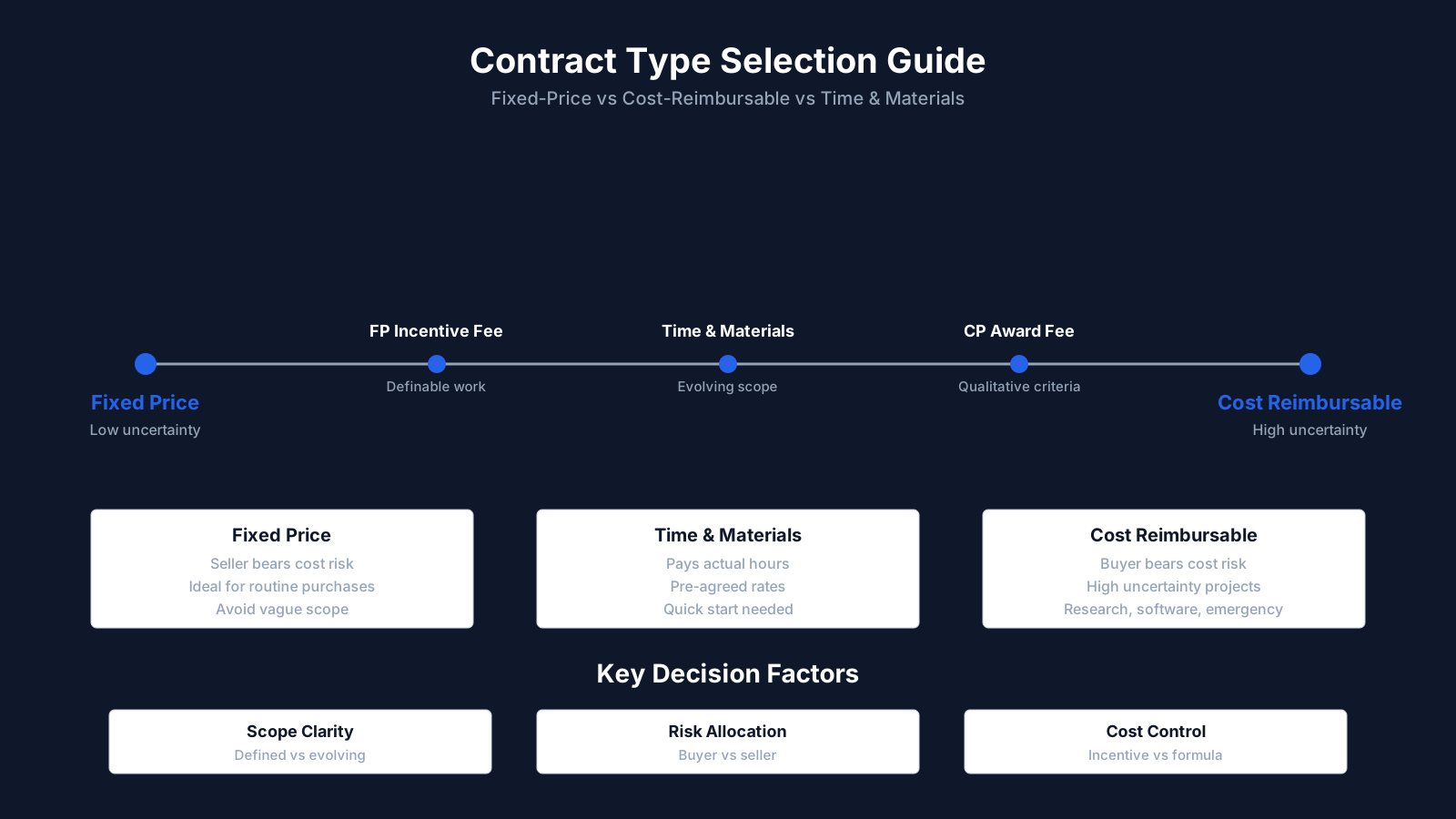
Key Contract Types in Project Procurement: Summary
| Contract Concept | Summary |
|---|---|
| Contract families | Project procurement contracts are generally categorized into two primary types: fixed-price and cost-reimbursable, with time and materials serving as a hybrid model that blends elements of both. |
| Risk allocation | Each contract type distributes risk between buyer and seller in distinct ways. Selecting the wrong allocation can lead to cost overruns, schedule delays, and strained commercial relationships. |
| Fixed-price contracts | A firm fixed price is most effective for standard hardware or clearly defined consulting engagements with measurable deliverables. However, if specifications are ambiguous, the seller may deliver a product that technically meets the contract but fails to address the buyer's actual business need. |
| Novel projects | For unique, first-of-a-kind projects, a fixed price remains feasible, but sellers typically include a substantial contingency to account for unknown technical or execution risks. |
| Incentive fees | Fixed-price contracts can incorporate incentive fees tied to specific, measurable objectives, such as schedule milestones, cost targets, or defined technical performance criteria. |
| Economic adjustment | Some fixed-price contracts include economic price adjustment clauses that permit changes based on defined indices, such as fluctuations in material costs or published inflation rates. |
| Cost plus fixed fee | Cost plus fixed fee contracts are appropriate when work must begin quickly under uncertain conditions, such as research and development initiatives where deliverables are difficult to define in advance. |
| Procurement impact | The selected contract type shapes the entire procurement lifecycle, from solicitation planning through contract closeout, so project managers should carefully evaluate tradeoffs before issuing a request for proposal. |
Fixed-Price Contract Types for Project Procurement
Fixed-price contract types involve setting a fixed total price for a defined product or service. Sellers under these contracts are legally obligated to complete the work, with possible financial damages if they fail. Buyers must precisely specify what is being procured because changes in scope generally come with an increase in contract price. From a risk standpoint, fixed-price contract types shift cost overrun risk to the seller, which is why many buying organizations prefer them. However, that preference assumes the buyer can write a clear specification at the outset, and this assumption often fails in complex or evolving projects.
The pressure on the buyer to define requirements accurately is one of the least discussed aspects of fixed-price contracting. If the specification is ambiguous, the seller will still build exactly what the contract describes, leaving the buyer to discover later that the delivered product does not meet the actual business need. Change orders then become the only mechanism to correct course, and each change order typically increases the contract price. This dynamic explains why fixed-price contracts are so common for commodity items and standard services, where the deliverable is well understood by both parties. For novel, one-of-a-kind projects, a fixed price may still be possible, but the seller will usually add a substantial contingency to cover the unknowns.
Firm Fixed Price Contract Type and Its Use
The firm fixed price contract is the most commonly used contract type. The price for goods is set at the outset and not subject to change unless the scope of work changes. Any cost increase due to adverse performance is the seller's responsibility, and the seller is obligated to complete the effort. This arrangement is favored because it provides maximum cost predictability for the buyer. It works best when the requirements are stable, the market is well understood, and the seller has experience delivering similar work. Purchasing a standard server configuration or a defined consulting engagement with clear deliverables fits well under a firm fixed price contract.
There is a common misconception that firm fixed price means the buyer has no further cost exposure. That is not true. If scope changes are introduced, the seller will typically request a contract modification with an increased price. The buyer also still carries the cost of poorly written specifications, because the seller may deliver exactly what was specified but not what was actually needed. Firm fixed price also discourages the seller from volunteering improvements unless they are compensated for the change. So while firm fixed price transfers cost risk, it does not eliminate the buyer's responsibility for scope accuracy. The buyer must still invest in detailed requirements, acceptance criteria, and change control procedures even when the price is fixed.
Fixed Price Incentive Fee Contracts
Fixed-price contracts may incorporate financial incentives for achieving or exceeding selected project objectives, such as schedule delivery dates, cost and technical performance, or anything that can be quantified and subsequently measured. In a fixed price incentive fee contract, the seller can earn additional profit by meeting or beating defined targets. The incentive structure must be carefully designed because poorly chosen metrics can drive unintended behavior. If the incentive focuses solely on schedule, the seller might rush quality to hit a date. If it focuses on cost, the seller might cut corners that harm long-term reliability. The key is to tie incentives to measurable outcomes that align with the buyer's real priorities.
This contract type is less common than firm fixed price but useful when the buyer wants to motivate the seller to exceed a baseline. The negotiation process is more complex because the target cost, target profit, and sharing ratio all need to be agreed in advance. Sellers are more willing to accept fixed price risk if there is meaningful upside potential. Buyers, on the other hand, must ensure the performance targets are realistic and verifiable. Without clear measurement criteria, the incentive becomes a source of disputes rather than alignment. In practice, this type is often used in construction or defense projects where schedule and technical performance are as important as cost.
Fixed Price with Economic Price Adjustment
Another variation within the fixed-price family is a fixed price with economic price adjustment contract. This type sets a fixed price but allows adjustments for defined economic changes, such as fluctuations in material costs or inflation indexes. It is used when the period of performance is long enough that market prices may shift significantly, making a plain firm fixed price unreasonable for the seller. The adjustment clauses must be tied to objective, published indexes to avoid ambiguity. This type transfers less risk to the seller than a pure firm fixed price because the seller is protected from external cost swings beyond its control. Buyers accept this tradeoff when they need long-term supply certainty more than they need absolute price stability.
The administrative burden of economic price adjustment clauses is often underestimated. The buyer must track the agreed indexes, verify the seller's adjustment calculations, and document changes. Disputes can arise if the chosen index does not accurately reflect the seller's actual cost changes. Still, for multiyear contracts involving commodities like fuel, steel, or specialized components, this contract type prevents the seller from padding the initial price with too much contingency. It is a pragmatic compromise that acknowledges market volatility without abandoning the fixed-price framework.
Key Insights on Fixed-Price Contracting
- Cost overrun risk shifts to seller
- By shifting financial exposure for cost overruns to the seller, fixed-price contracts give buying organizations predictable budgets and reduce the risk of unexpected expense escalation.
- Buyer must define requirements precisely
- Because pricing is fixed, any ambiguity in the specification becomes a commercial risk for the buyer: the seller will deliver only what is written, and the buyer must pay for any corrections through change orders.
- Best for commodity and standard items
- This model is ideal for commodity goods and well-defined standard services, whereas novel or complex projects force sellers to price in large contingencies, making the fixed price less competitive.
Cost-Reimbursable Contract Types in Project Procurement
Cost-reimbursable contract types work differently. Instead of setting a fixed total price, the buyer agrees to pay the seller's allowable costs incurred in performing the work, plus a fee representing profit. These contracts are used when the scope is uncertain, complex, or likely to change, because the seller cannot realistically price a fixed amount without excessive contingency. In this family, cost-reimbursable contract types shift most cost risk to the buyer, who must monitor the seller's costs closely through audits and reporting requirements. The seller has less incentive to control costs unless the fee structure includes incentives, and that difference drives many of the governance practices associated with cost-reimbursable work.
Buyers often hesitate to use cost-reimbursable contracts because they fear runaway costs. That fear is legitimate, but it overlooks the alternative. If the buyer forces a fixed-price contract on a highly uncertain scope, the seller will either refuse to bid, inflate the price dramatically, or submit a low bid and then exploit change orders. A cost-reimbursable contract, especially one with incentives, can preserve the buyer's ability to direct the work as new information emerges. The buyer retains more control over technical decisions and can adjust scope without triggering adversarial price negotiations. That flexibility is why research, development, and early-stage engineering projects frequently rely on cost-reimbursable structures.
Cost Plus Fixed Fee as a Cost-Reimbursable Contract Type
The cost plus fixed fee contract reimburses the seller for all allowable costs and pays a fixed fee that does not change based on actual performance. The fee is set at the outset and represents the seller's profit. This type is straightforward and easy to administer, but it gives the seller no financial reason to reduce costs or work faster. In fact, because the seller is paid for all costs, there is a built-in incentive to spend more, which calls for strong buyer oversight. Buyers use cost plus fixed fee when they need to start work quickly under uncertain conditions, such as research and development efforts where the final deliverables are hard to define. The lack of cost risk for the seller allows the buyer to attract qualified vendors even for risky projects, but the buyer accepts open-ended cost exposure.
One pitfall is assuming that fixed fee means the buyer's total costs are fixed. Only the profit component is fixed. The actual costs can vary widely, and the buyer is responsible for them. Therefore, cost plus fixed fee contracts usually require detailed cost reporting, allowability rules, and periodic forecasting. Without these controls, the buyer can face significant budget overruns that no amount of fixed fee protection can offset. The buyer's project team must be prepared to review invoices line by line, challenge unallowable charges, and maintain an audit trail. That administrative overhead is the price of the flexibility this contract type provides.
Cost Plus Incentive Fee and Award Fee Variations
A cost plus incentive fee contract adds a financial incentive for cost performance. The buyer and seller agree on a target cost and a target fee, along with a sharing formula for overruns and underruns. If the seller completes the work below the target cost, both parties share the savings according to a predetermined ratio. If costs exceed the target, the seller's fee is reduced, sometimes to a minimum or floor. This creates a stronger motivation for the seller to control costs than cost plus fixed fee, while still protecting the seller from bearing all cost risk. The sharing ratio is negotiable; a higher seller share increases motivation but also increases the buyer's cost.
Cost plus award fee contracts reimburse allowable costs and provide a fee that is determined by the buyer's subjective evaluation of the seller's performance against defined criteria. Unlike cost plus incentive fee, the award fee is not automatically calculated from a formula. Instead, the buyer periodically assesses performance in areas such as quality, timeliness, responsiveness, and management effectiveness, then awards a fee amount within a predetermined range. This gives the buyer flexibility to reward overall excellence rather than only cost performance. The downside is subjectivity; sellers may challenge the buyer's evaluation, and the process can become contentious if criteria are not clearly stated in advance. Both variations require more administrative effort than cost plus fixed fee, but they align incentives more closely with buyer goals when the work is complex and performance is hard to measure solely by cost.
Time and Materials Contract Type in Hybrid Procurement
The time and materials contract type is a hybrid arrangement that combines elements of fixed-price and cost-reimbursable contracts. The buyer pays for the actual hours of labor at predetermined rates plus the actual cost of materials, often with a markup or profit percentage. This type is used when the scope is not well defined enough for a fixed price but the buyer still wants some control over hourly rates and material costs. In many cases, time and materials contract type is selected for short-term engagements, maintenance work, or Agile development where requirements evolve incrementally. The seller carries less risk than under fixed price because hours and materials are reimbursed, but the buyer carries more risk than under fixed price because total cost is unknown until the work is complete.
Agile environments illustrate the practical appeal of time and materials. In iterative development, the team discovers requirements through repeated delivery and feedback. Locking a fixed price on a scope that will inevitably change produces either an inflated bid or a cascade of change requests. Time and materials lets the buyer purchase capacity at known rates and direct that capacity sprint by sprint. The buyer remains responsible for prioritizing work and controlling the burn rate, which shifts some project management burden back to the buyer. That shift is not always welcomed, especially by organizations accustomed to passing risk to the seller through fixed prices.
Administrative Burden of Time and Materials Contracts
One major pitfall with time and materials contracts is the lack of a price ceiling. Because the buyer agrees to pay for actual hours, the seller has little incentive to work efficiently unless the contract includes a maximum not-to-exceed amount. Buyers often require such a ceiling to cap their financial exposure. Another issue is the need for time tracking and material cost verification, which adds administrative overhead. Without robust controls, time and materials contracts can drift into open-ended spending. The mix of labor categories should also be clearly defined so the buyer does not pay senior rates for junior work. These practical concerns make time and materials a tradeoff between flexibility and cost control, and they explain why many procurement policies treat this type as an exception requiring justification.
From a seller's perspective, time and materials reduces the risk of unpredictable scope, but it also caps the seller's profit unless the volume of hours is high. Competitive pressure often drives sellers to lower their hourly rates, which can lead to understaffed teams or inflated hours to recover margin. Buyers must watch for patterns like excessive overtime, vague activity descriptions on timesheets, or materials marked up beyond agreed percentages. Regular audits of timesheets and invoices are not optional in this arrangement; they are the primary safeguard against cost leakage.
Time and Materials Contract Insights
- Hybrid of two contract types
- This hybrid model pairs fixed-price predictability for rates with cost-reimbursable flexibility for hours and materials. The buyer pays actual labor hours at predetermined rates, direct material costs, and a negotiated markup.
- Best for evolving or unclear scope
- Buyers select this contract for short-term engagements, maintenance work, or Agile development where requirements are not stable enough for a fixed price. Attempting to lock a price on a shifting scope often produces inflated bids or a steady flow of change requests.
- Buyer bears cost control burden
- The buyer carries the primary financial risk because total spend is unknown until completion. Effective oversight requires prioritizing the backlog, tracking the burn rate, and flagging excessive overtime, vague timesheet entries, or inflated material markups.
Selecting the Right Contract Type for Project Procurement
The process of selecting the right project procurement contract type starts with a structured analysis of scope definition, risk appetite, market conditions, and the seller's capability. Buyers should examine how well they can specify the product or service. If the requirements are clear and stable, fixed-price contract types are usually appropriate. If the work is exploratory or likely to change, cost-reimbursable or time and materials types may be better. The type of contract to be used and the specific terms fix the degree of risk being assumed by buyer and seller. Although the firm-fixed-price arrangement is typically preferred and often demanded by most organizations, there are times when another contract form is in the best interests of the project. If a contract type other than fixed-price is intended, the project team must justify its use.
That justification often includes a risk assessment, market research, and an analysis of the seller's past performance. For example, if the buyer anticipates many scope changes during execution, forcing a fixed-price contract will lead to constant change orders, each with a price increase and potential delay. The seller may also inflate the initial price to cover unknown contingencies, making the fixed price artificially high. In contrast, a cost-reimbursable contract with appropriate incentives can handle scope evolution more gracefully, but the buyer must accept more oversight responsibility. The decision is not just about cost risk; it is about who is best positioned to manage uncertainty. A seller with deep expertise in a niche technology may be better placed to absorb technical risk, while the buyer may be better placed to absorb market risk.
Organizations that mandate fixed price for every procurement often discover that the policy creates hidden costs. Sellers pad their bids, fight change orders, or decline to bid altogether. The project team then spends more time on contractual disputes than on delivering value. A smarter approach is to treat contract type selection as a risk management decision rather than a procurement default. The buyer should ask where the primary uncertainties lie, who can control those uncertainties, and how the contract can create incentives for the party best able to manage them. That framing leads to more nuanced and effective procurement strategies.
Risk Allocation Across Contract Types
Understanding how different contract types allocate risk between buyer and seller is fundamental to making sound procurement decisions. In fixed-price arrangements, the seller bears the risk of cost overruns and performance failures, which can lead to financial damages if the contract is not completed. In cost-reimbursable arrangements, the buyer bears most of the cost risk because allowable costs are reimbursed. The hybrid time and materials model splits the risk, with the buyer taking on the uncertainty of hours and quantities while the seller has some protection through guaranteed rates. Practitioners often find that risk allocation across contract types is the single most important factor in negotiating fair terms. If the risk allocation is misaligned, either the seller will walk away or the buyer will pay excessive contingency.
A frequent misconception is that fixed-price contracts always protect the buyer. They protect against cost increases caused by seller inefficiency, but not against the buyer's own scope changes or poorly written specifications. Similarly, cost-reimbursable contracts do not mean the seller has no accountability. Sellers must still perform in accordance with the contract, and allowable costs exclude waste, fraud, or unapproved scope. The contract type sets the default risk sharing, but the specific terms and conditions can significantly modify that default. For example, a fixed-price contract might include a clause for buyer-caused delays, shifting some schedule risk back to the buyer. A cost-reimbursable contract might cap allowable costs at a not-to-exceed amount, limiting the buyer's exposure.
In the PMBOK framework, contract type selection occurs during Plan Procurement Management, part of the Project Procurement Management knowledge area. The selected contract type feeds into the procurement documents and ultimately into the contract itself. Agile environments tend to favor time and materials because of evolving scope, while traditional waterfall projects with well-defined requirements lean toward fixed price. However, these are tendencies, not rules. The key is to evaluate each procurement on its own characteristics rather than applying a blanket preference. Sellers also factor contract type into their pricing, so the buyer should expect different bids depending on the risk profile offered.
Core Takeaways on Contract Risk Allocation
- Fixed-price shifts risk to seller
- Under fixed-price contracts, the seller assumes full responsibility for cost overruns and performance shortfalls, so precise, stable requirements are critical to protecting profit margins.
- Cost-reimbursable places risk on buyer
- Cost-reimbursable arrangements transfer most financial exposure to the buyer, who pays allowable costs but can mitigate inefficiency and unauthorized work through disciplined oversight and change control.
- Time and materials balances risk
- Time and materials contracts distribute risk between parties, as the buyer accepts variability in hours and quantities while the seller secures agreed rates, making this model well suited to agile projects with evolving scope.
Practical Considerations and Common Pitfalls with Project Procurement Contract Types
Even experienced project managers sometimes underestimate how deeply the contract type affects day-to-day project management. A fixed-price contract demands rigorous change control because every scope tweak has a price tag. A cost-reimbursable contract demands disciplined cost tracking and auditing. The time and materials arrangement demands meticulous time sheets and material receipts. One practical consideration for contract type selection is the administrative burden each option imposes, and that burden is never zero. The project team must plan for contract administration resources alongside the technical work itself.
Another pitfall is failing to combine contract types within a single procurement. The source notes that in practice it is not unusual to combine one or more types into a single procurement. For instance, a project might use a fixed-price contract for the delivery of standard hardware and a time and materials contract for the integration services that depend on evolving requirements. Combining types can optimize risk allocation across different work streams, but it also increases administrative complexity. The buyer must manage different invoicing, reporting, and performance measurement approaches for each portion. Clear separation of scope between the different contract segments is essential to avoid disputes about which terms apply.
From a governance standpoint, the buyer's procurement policies should define the thresholds and approval levels for non-standard contract types. If the organization requires executive approval for cost-reimbursable contracts, the project team must build that lead time into the schedule. Sellers also need to understand the selected type before submitting proposals, because their pricing strategy and risk contingency depend on it. Clear communication of the contract type in the solicitation documents prevents misunderstandings and unqualified bids. Without that clarity, the buyer may receive offers that are not comparable or that include hidden contingency assumptions.
Aligning Contract Type with Project Characteristics
Aligning the contract type with project characteristics is the ultimate goal of procurement planning. The choice should reflect the buyer's ability to define scope, the seller's willingness to accept risk, the desired flexibility, and the available administrative capacity. A fixed-price contract works best for well-understood deliverables with stable requirements. A cost-reimbursable contract suits high-uncertainty work where the buyer wants to retain control over technical direction. Time and materials is a middle ground for evolving scope with relatively short durations. There is no universally superior contract type; each has tradeoffs that must be evaluated in context. Buying organizations often prefer firm fixed price, but that preference should not override sound project judgment.
The project manager's role is to translate these tradeoffs into a recommendation that the procurement team and senior stakeholders can support. That recommendation should include the selected contract type, the rationale, the risk allocation, and the expected administrative overhead. It should also identify the warning signs that would trigger a review of the contract approach as the project unfolds. For example, if a fixed-price contract begins generating frequent change requests, the buyer may need to revisit the scope definition. If a cost-reimbursable contract shows costs drifting far above estimate, the buyer may need stronger controls or a revised target cost. The contract type is not a static afterthought; it is a management tool that must be monitored and adjusted through formal change processes.
Finally, remember that the contract type is only one part of the procurement relationship. Trust, communication, and a fair balance of risk matter just as much as the legal structure. A well-drafted fixed-price contract with an adversarial tone can fail just as easily as a poorly drafted cost-reimbursable contract. Conversely, a thoughtfully selected contract type with transparent reporting and clear escalation paths can build a productive partnership even when the work is uncertain. Project managers who invest time in understanding these contract types, their risk implications, and their administrative demands will make better procurement decisions and avoid many of the costly disputes that plague poorly structured acquisitions.
Key Insights on Contract Alignment
- Align with project characteristics
- Contract selection should align with how precisely the buyer can define scope, how much risk the seller is prepared to accept, the flexibility required, and the administrative capacity available for oversight.
- Fixed-price for stable requirements
- Fixed-price agreements are most effective when deliverables are clearly defined and requirements are unlikely to change, enabling confident pricing when scope uncertainty is low.
- Cost-reimbursable for high uncertainty
- Cost-reimbursable contracts are well suited to projects with high uncertainty because they allow the buyer to retain control over technical direction, though they require disciplined monitoring to manage cost and performance.
- Time and materials as middle ground
- Time and materials contracts offer a practical middle ground for evolving scope and relatively short timelines, balancing flexibility with an equitable distribution of risk between buyer and seller.
- Sound judgment over buyer preference
- A strong preference for firm fixed price is common among buying organizations, but it should not override sound project judgment, because misaligned contracts tend to generate change requests, budget overruns, and contentious disputes.