When a project manager first encounters a complex deliverable, the instinct might be to tackle it all at once, but that instinct rarely leads to sound planning. The key to controlling scope, schedule, and cost is to break down project deliverables into work packages – discrete, manageable chunks of work that can be accurately estimated and assigned. This process, known formally as decomposition, is not just a mechanical slicing exercise; it demands analytical thinking about the nature of the deliverable, the required work, and the level of detail that enables reliable management without drowning the team in administrative trivia. Whether you are building a bridge, rolling out a software module, or organizing a conference, the ability to decompose deliverables shapes every downstream project decision. In this article, we explore the step-by-step approach, the pitfalls, and the nuanced thinking behind turning high-level deliverables into actionable work packages.
At a Glance: How to Break Down Deliverables into Work Packages
| Key Concept | Summary |
|---|---|
| Decomposition | Decomposition is the structured technique of breaking project deliverables into discrete work packages that enable precise estimation, scheduling, and resource assignment. |
| Deliverable Analysis | The initial phase rigorously examines each major deliverable to reveal subsidiary components, compliance records, testing artifacts, and handover procedures that are frequently overlooked. |
| WBS Structure | Structuring the WBS organizes identified components into a coherent hierarchy aligned with the project’s governance framework, control accounts, and reporting nodes. |
| Decomposition Logic | Choosing a decomposition logic, whether phase-based, functional, or hybrid, directly shapes the transparency of accountability and the accuracy of progress tracking throughout the project. |
| Work Packages | A work package represents the lowest WBS level at which credible cost and duration estimates can be produced; unreliable estimates signal the need for further decomposition. |
| Cross-Functional Input | Effective deliverable analysis relies on collaboration with subject matter experts who identify hidden work such as security patches, compliance steps, and integration prerequisites. |
| Risk Identification | Decomposition naturally feeds risk identification by exposing vague requirements and ambiguous scope elements that demand clarification before detailed planning begins. |
| Level of Detail | Balancing the WBS depth is a critical skill: a shallow structure obscures visibility, while excessive granularity creates administrative overhead without proportional value. |
| Frameworks | Both PMBOK’s Create WBS process and PRINCE2’s product-based planning employ systematic decomposition to construct a scope baseline that omits no critical work. |
| Control Points | Work packages serve as control points that bundle related activities; individual task breakdown occurs later during the creation of the activity list. |
How to Break Down Project Deliverables into Work Packages: The Step-by-Step Process
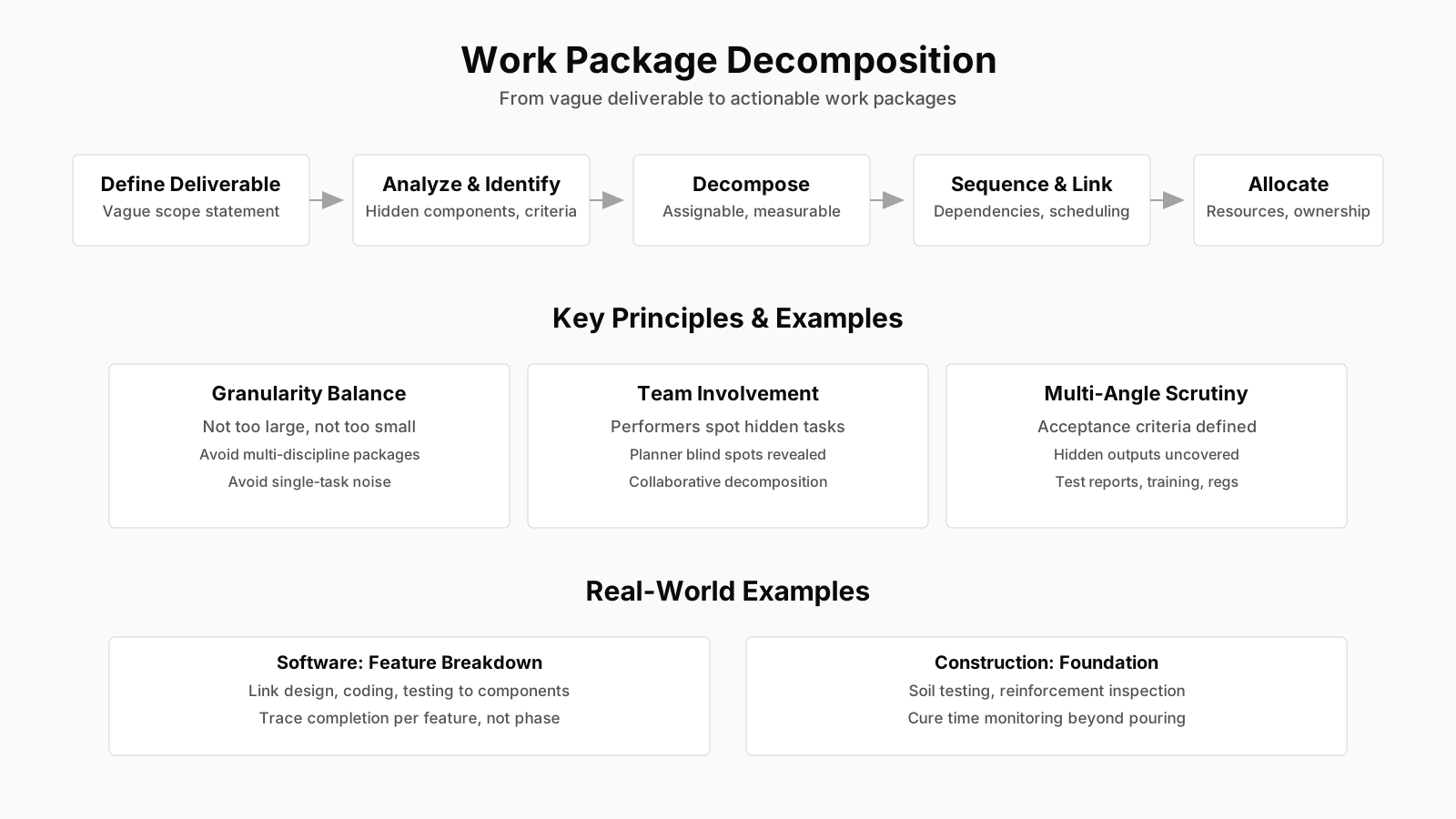
In the PMBOK Guide, decomposing project deliverables falls under the Create WBS process within Project Scope Management. It is a structured technique that takes the project’s scope baseline and progressively subdivides it until the lowest level, the work package, is defined. PRINCE2 follows a similar logic with product-based planning, where a product breakdown structure leads to work packages focused on the deliverables themselves rather than the tasks. Regardless of the framework, decomposition activities ensure that no critical work is omitted and that the final work packages are fit for purpose. The process is not simply about drawing a tree diagram; it requires a deliberate sequence of analytical steps, each building on the previous one.
Real-world projects often reveal that skipping any of these steps introduces ambiguity later. For instance, a software team that jumps straight to task assignments without first clarifying the deliverable boundaries will eventually discover gaps in integration testing or user acceptance criteria. Understanding each activity in the breakdown sequence helps the project manager avoid that reactive scramble. The following subsections walk through the core activities that turn a high-level deliverable into an ordered set of work packages the team can confidently execute.
Identifying and Analyzing Deliverables to Break Down Project Deliverables into Work Packages
The first activity begins with the project’s major deliverables themselves, often derived from the project charter, contract, or scope statement. You scrutinize each deliverable to understand what constitutes its successful completion and what supporting work is required. This is not just listing the obvious main product; it involves peeling back layers to uncover subsidiary components, compliance documentation, testing artifacts, training materials, and even handover procedures that might otherwise be missed. The analysis also considers how deliverables relate to each other. A construction project’s structural steel framework, for example, is not a standalone object. It interacts with architectural finishes, electrical conduits, and fireproofing, each of which adds its own set of sub-deliverables and related work.
Project managers often ask the question, “What must be true for this deliverable to be considered done?” The answer surfaces supplementary deliverables like quality checklists, installation manuals, or operational runbooks. This step should be done with input from subject matter experts who understand the domain. A network engineer might quickly point out that a server configuration deliverable also implies a set of security patch procedures that would otherwise go unnoticed. The deliverable analysis is not a one-person desk exercise; it thrives on cross-functional dialogue. And it’s here that the decomposition process really starts to tie into risk identification, because you simultaneously uncover areas where requirements are still fuzzy, prompting further clarification before the detail work begins.
The output of this step is a clear, verified list of all deliverable components and the work associated with each. These are the building blocks that will later be arranged into a Work Breakdown Structure. Without this foundational inventory, you risk building a WBS that has logical holes, where whole chunks of work are simply absent from the plan.
Structuring the WBS to Break Down Deliverables into Work Packages
Once the deliverable components have been identified, the next activity is to organize them into a coherent hierarchy. This is where the work breakdown structure takes shape. You decide on the decomposition logic: will it follow the phases of the lifecycle, the major functional areas, or a hybrid approach? A new product development project, for instance, might use phase-based decomposition with design, prototyping, testing, and manufacturing rollout forming the top tiers. An IT infrastructure upgrade might decompose first by location, then by system, each containing its own sub-deliverables. The choice of structure influences how easy it will be to assign accountability and track progress later.
This structuring activity demands that you think about control accounts and reporting nodes. The WBS is not only a planning tool but also a communication and governance artifact. Upper levels should map to organizational responsibilities or major milestones that stakeholders care about. Balancing between too many levels and too few is a skill. A shallow WBS fails to provide sufficient visibility, while a overly deep one creates unnecessary administrative overhead. The structuring phase is also when you begin to align the WBS with the project’s cost breakdown structure and organizational breakdown structure, setting the stage for earned value management and integrated cost and schedule control.
Even at this high-level organizing stage, you need to keep the work package in mind. The lower you go, the closer you get to that sweet spot where work can be estimated and assigned. But you don’t force the decomposition all the way down in one go; that iterative refinement happens in the next step. The structuring step is about establishing a logical container for that detail.
Decomposing Upper WBS Levels into Lower-Level Components
With the WBS framework set, the actual subdivision of higher-level elements into finer detail begins. This is where project teams often spend the most time, because the transition from a WBS element to a work package requires judgment. You keep asking, “Can this element be further decomposed into meaningful, discrete components?” The stopping rule is the work package level, defined as the point at which cost and activity durations can be reliably estimated and managed. That definition is practical: if you cannot produce a solid cost estimate or a defined schedule duration for a component, it isn’t a work package yet.
This iterative decomposition is not intended to break work down into individual tasks. That would be the next step after the WBS is complete, when you create the activity list. Work packages still contain a collection of related activities, but the package itself is the control point. A typical work package in a marketing campaign might be “printed collateral production,” which includes tasks like design approval, vendor selection, printing, and quality inspection. You can assign a single accountable person, estimate the total cost, and determine that it will take, for example, three weeks. That’s the sweet spot.
During this decomposition, you should also identify integrated deliverables that cut across multiple upper-level branches. A system integration test deliverable in a complex IT project, for instance, is not a sub-deliverable of one module but rather of the overall integration. Such cross-cutting components often need a dedicated WBS element at a separate branch to avoid double-counting or confusion. Missing them leads to later scope creep when the team realizes integration activities were never explicitly funded or scheduled.
Developing and Assigning Identification Codes to the WBS Components
Once the decomposition is reasonably stable, each component receives a unique code. These codes serve as a shorthand for tracking, reporting, and linking to other project artifacts like the risk register, cost accounts, and schedule activities. A simple numeric outline is typical: 1.0 for the project, 1.1 for the first major deliverable, 1.1.1 for its first sub-deliverable, and so forth. In larger programs, codes may incorporate elements of the organizational breakdown or geographical indicators. The key is that every work package has a distinct identifier that remains consistent across all project documents.
The code assignment is more than an administrative task. It cements the hierarchical relationships you’ve defined. When a cost report shows an overrun on element 1.2.3.4, you can immediately trace that to the specific work package. This traceability is invaluable during change control, when a stakeholder wants to add a feature. The project manager can point to the WBS dictionary entry and show exactly what work units are affected. Underestimating the importance of a solid coding scheme is a mistake many new project managers make. Re-numbering later, after baselines are approved, introduces confusion and breaks links in integrated master schedules.
Verifying the Decomposition When You Break Down Deliverables into Work Packages
The final explicit activity listed in the source material is verifying that the degree of decomposition is appropriate. Verification is not a single checkpoint at the end; it’s a continuous review as you decompose. You check whether each work package meets the criteria of estimable cost and duration, assignable responsibility, and measurable completion. The 8/80 rule, though not universally mandatory, provides a useful heuristic: a work package should not require less than eight hours of effort or more than eighty hours. If it’s under eight hours, the administrative overhead of tracking it as a separate entity likely outweighs the benefit. If it’s over eighty hours, the estimation and control risks increase.
But verification goes beyond duration checks. You also need to ensure that the decomposition is deliverables-oriented rather than task-oriented. A common error is to decompose by process steps – “design,” “code,” “test” – instead of by the actual products those steps create. The WBS is meant to define what you deliver, not how you produce it. Verifying this alignment helps prevent the creation of a to-do list disguised as a WBS. The work package description should answer what will be delivered, not how many meetings will be held.
Another aspect of verification involves confirming that all scope defined in the project scope statement is represented and that nothing extraneous has crept in. This is essentially a reverse traceability check: from the highest-level deliverables down to the smallest work package, every piece of required scope should be present. Missing scope leads to unfunded mandates; extra scope means you’re committing resources without authorization. This verification step often triggers the final updates to the WBS dictionary, which captures the detailed description, acceptance criteria, and assumptions for each work package.
Key Insights on Deliverable Breakdown
- Deliverable analysis precedes structuring
- Before structuring the WBS, a comprehensive examination of each deliverable and its underlying elements is essential to identify every necessary work component, leaving no critical task unaccounted for.
- Cross-functional dialogue uncovers hidden work
- Engaging subject matter experts brings to light often-overlooked subsidiary deliverables like compliance records, test artifacts, training modules, and transition procedures that isolated planning efforts routinely fail to capture.
- WBS structure drives accountability
- The chosen decomposition logic, whether phase-based, functional, or hybrid, directly affects the ease of control account assignment and progress monitoring; the optimal level of detail strikes a balance between oversight clarity and administrative efficiency.
Determining the Optimal Level of Detail for Work Packages
One of the most frequent questions practitioners ask is exactly how detailed work packages need to be. The source material notes that the level of detail varies with the size and complexity of the project. That’s an important nuance because a cookie-cutter approach rarely works. A small marketing event project might have work packages like “venue setup” and “catering coordination,” each spanning a few days and a few thousand dollars. A multi-year aerospace program by contrast might have work packages worth millions, lasting months, and containing dozens of subordinate control accounts. The optimal level of detail for work packages is the point where the cost and activity durations can be reliably estimated and managed. What “reliably” means changes with the project’s tolerance for uncertainty.
In practice, you often determine the appropriate granularity by considering the risk profile and the accountability structure. Work packages that involve high uncertainty, new technology, or external dependencies should be decomposed further until the uncertainty can be bounded. Conversely, well-understood repeatable work might be packaged into larger chunks without losing control. The estimation capability is also a factor. If the organization lacks historical data for a certain type of work, forcing a fine decomposition does not magically improve accuracy; it just creates more rows in the plan that are equally uncertain. Some methodologies, including Business Value-Oriented Project Management (BVOPM), address this directly by using relational effort points rather than absolute hours for uncertain work, and by acknowledging that WBS inaccuracy is natural. In BVOPM, scope changes that arise from learning during the project are treated as user feedback rather than as failure, and scope items can be classified on a five-level scale from Definite to Unlikely. This perspective shifts the verification focus from perfect decomposition to maintaining a realistic picture of what is known and unknown.
The project manager must also navigate organizational culture. Some organizations demand work packages that last no more than a standard reporting period, say two weeks, to align with sprint cadences or status reporting cycles. Others are comfortable with monthly packages. The key is consistency within the project and ensuring that each work package remains a single point of accountability. Splitting a package between two different team leads creates confusion even if the numbers look tidy on a spreadsheet. So the right level of detail blends estimation accuracy, risk control, and organizational reality into a practical judgment call.
Avoiding Common Pitfalls in Work Package Decomposition
Even experienced project managers can trip over predictable traps during decomposition. One of the common pitfalls in decomposition is creating work packages that are too granular, essentially task-level items masquerading as work packages. This happens when the team, often in a bid for false precision, decomposes all the way to activities they might perform on a single day. The result is a bloated WBS that suffocates the project with reporting overhead. Every tiny work package generates status updates, cost tracking, and variance analysis, consuming effort that should go into actual delivery. The work package level exists to group related activities, not replace the activity list.
The opposite error is work packages that are too vague. A package labeled “site preparation” without further qualification could hide a mountain of unknown excavation, permits, and utility relocations. If you cannot describe the deliverable outcome in concrete terms and assign a rough cost range, you haven’t reached the work package level yet. The verification checklist guards against this, but time pressure or a desire to lock in a baseline quickly can tempt the team into leaving ambiguity in place. Ambiguous packages inevitably become sources of later disputes and change requests.
Another trap is ignoring integration work. Projects are composed of interdependent parts, and the joinery between them often requires dedicated work. Software projects, for instance, need interface testing, data migration, and cutover planning that do not belong to any single module. If these cross-cutting concerns are not decomposed into their own work packages, they fall between the cracks until someone notices during the final weeks. Similarly, management and coordination activities—though not always visible as discrete deliverables—should still be decomposed into work packages like “project management office support” or “stakeholder communication materials” that can be estimated and tracked. Failing to do so leads to under-resourcing the coordination effort that keeps everything else on track.
A subtler pitfall is decomposing by organizational function rather than by deliverable. For example, having separate WBS branches for “engineering” and “marketing” without aligning them to the specific product features they contribute often results in a disconnect. The engineering team may deliver a component that the marketing team cannot actually position because no one defined the joint deliverable outcome. Keeping the decomposition deliverables-focused forces cross-functional collaboration and ensures that the work package represents a result that matters to the customer, not just a department’s output.
Core Takeaways on Decomposition Pitfalls
- Overly granular work packages
- Breaking work into single-day tasks inflates the work breakdown structure and generates excessive status reporting, which siphons attention away from genuine delivery progress.
- Vague or ambiguous packages
- When work packages lack clear scope boundaries and baseline cost estimates, they invite ambiguity that fuels future disputes and scope creep.
- Ignoring integration work
- Integration activities such as interface testing, data migration, and cross-team coordination require explicit work packages; otherwise, these interdependent tasks are routinely overlooked and become last-minute crises.
- Functional rather than deliverable focus
- Organizing work around departmental silos rather than end-to-end deliverables fractures accountability and obscures the customer outcomes the team is collectively responsible for.
Adapting Decomposition for Agile and Hybrid Project Environments
While the traditional WBS decomposition described above is most closely associated with predictive, waterfall-based projects, the need to break deliverables into manageable chunks persists in any project approach. In Scrum and other agile frameworks, agile project decomposition takes the form of slicing product backlog items into user stories and, where necessary, into tasks. The product backlog itself is a form of deliverable breakdown, with epic-level items decomposing into smaller user stories that a team can deliver within a sprint. These stories serve a function very similar to work packages: they must be estimable, small enough to complete in a short iteration, and testable against acceptance criteria.
The difference lies in timing and ownership. In a predictive project, decomposition is largely performed upfront and baselined. In agile, decomposition is rolling and continuous, with the product owner and team refining the backlog just-in-time. Work packages, in the form of well-groomed user stories, emerge progressively rather than being fully defined at the start. This adaptation makes the process more tolerant of uncertainty. Initial epics might remain vague until a few sprints before the work begins, at which point decomposition accelerates as more is known. That’s why the verification criteria remain relevant but are applied iteratively rather than as a one-time gate.
In hybrid projects that mix predictive and adaptive elements, the project manager may maintain a traditional WBS for the overall project but use agile sprints within certain work packages. For instance, the WBS might have a level-3 element for “mobile app frontend,” and within that work package the development team uses user story decomposition and sprint backlogs. The work package then serves as a control container, while the team inside it has the freedom to decompose further in an agile fashion. This approach leverages the governance benefits of a WBS while accommodating iterative discovery, but it demands clear boundaries and acceptance criteria at the work package handoff points to prevent chaos.
Connecting Work Packages to Project Baselines and Estimation
Decomposition does not exist in isolation. The entire purpose of reaching the work package level is to enable reliable estimation, which in turn feeds schedule and cost baselines. Each work package serves as the foundation for activity definition. Once a work package is defined, you can break it down further into the schedule activities needed to produce the deliverable. The activity list, durations, and resource assignments then roll up into the project schedule and cost estimates. In essence, the project baselines are only as robust as the work packages they are built upon. If a work package is poorly scoped, the derived estimates will carry that error through the integrated master plan.
From a cost management perspective, work packages are aggregated into control accounts where earned value measurement occurs. The control account manager uses the work package definitions to track actuals versus planned value. If decomposition hasn’t reached the estimable level, you end up with level-of-effort activities that distort performance metrics. For risk management, each work package can be assessed for threats and opportunities. A finely decomposed risk breakdown makes it easier to see where contingency reserves should be allocated, because you can tie specific risk events to the work packages they affect. This linkage between decomposition, estimation, and risk is why experienced program managers insist on thorough WBS development before locking baselines.
On larger programs, the work package also becomes the unit for procurement. A make-or-buy decision might assign a work package to an external contractor, complete with a statement of work. The identification code and WBS dictionary entry provide the contractual language framework. So a weak decomposition does not just stay within the project team; it propagates into supplier agreements and regulatory reporting. This downstream impact reinforces the need for the verification step we discussed earlier, but now with an eye toward contract management and third-party oversight.
Key Insights on Work Package Linkages
- Work packages enable estimation
- Work packages are the foundational units that structure activity definition, enabling detailed estimates to roll up accurately into cohesive schedule and cost baselines.
- Baseline quality depends on decomposition
- Project baselines are only as sound as the decomposition of their work packages. Imprecise scoping introduces errors into the integrated master plan and compromises the performance measurement baseline.
- Control accounts track earned value
- Aggregating work packages into control accounts provides a structured framework for managers to apply earned value management, comparing actual performance against planned value and highlighting variances at the account level.
- Risk mapping aids contingency allocation
- Granular decomposition of work packages allows teams to link specific threats and opportunities to discrete deliverables, sharpening the allocation of contingency reserves and strengthening risk response strategies.
- Procurement uses work package units
- On large programs, work packages often translate directly into procurement units with defined statements of work, meaning that insufficient decomposition clarity flows into supplier agreements, subcontractor obligations, and regulatory reporting requirements.
Ensuring Quality Through Work Package Verification
Even with all the best practices applied, a final layer of verification is needed before the WBS can be baselined. This goes beyond the decomposition verification that happens during the breakdown activity. Now you are conducting a holistic quality review of the entire WBS, with a focus on each work package’s completeness, consistency, and readiness for execution. Work package verification at this stage involves checking the WBS dictionary entries: do they contain clear acceptance criteria, assumptions, constraints, and measurable deliverables? A work package that simply repeats its name with no elaboration is not sufficiently verified.
You also look for orphaned elements, those that do not roll up appropriately to parent nodes, or for duplicated work across different branches. Sometimes teams on different stream decompose the same sub-deliverable independently, resulting in two near-identical work packages with different codes. This double-counting wreaks havoc on cost aggregation and resource loading. A thorough verification walkthrough with all key stakeholders, including the people who will actually do the work, catches these issues. The walkthrough also serves as a communication tool, aligning everyone’s understanding of what each work package entails before the project enters execution.
A wise practice is to apply the “would I give this work package to a new team member and trust they can deliver it without constant clarification?” test. If the answer is no, the work package probably needs further decomposition or a much richer dictionary entry. This pragmatic check blends verification with a human-centric assessment of clarity. After verification, the WBS can be formally approved and become part of the scope baseline, enabling the project to move forward with a shared, concrete picture of all the work ahead.