The critical path method, or CPM, has been a cornerstone of project scheduling for decades, and yet many practitioners still wonder exactly how it arrives at that single number we call project duration. The question "How does the critical path method calculate project duration?" opens up a fascinating dive into forward passes, backward passes, and the beautifully logical way a schedule network reveals which sequence of activities truly controls the finish date. At its heart, the method calculates theoretical early start and finish dates, and late start and finish dates, for every activity, entirely without regard for resource limitations, by performing a forward and backward pass analysis through the schedule network. It sounds technical, and it is, but once you see the mechanics unfold it becomes one of the most intuitive tools in a project manager's arsenal. The real power lies not just in the final duration number, but in what the process uncovers about flexibility, risk, and the consequences of delay .
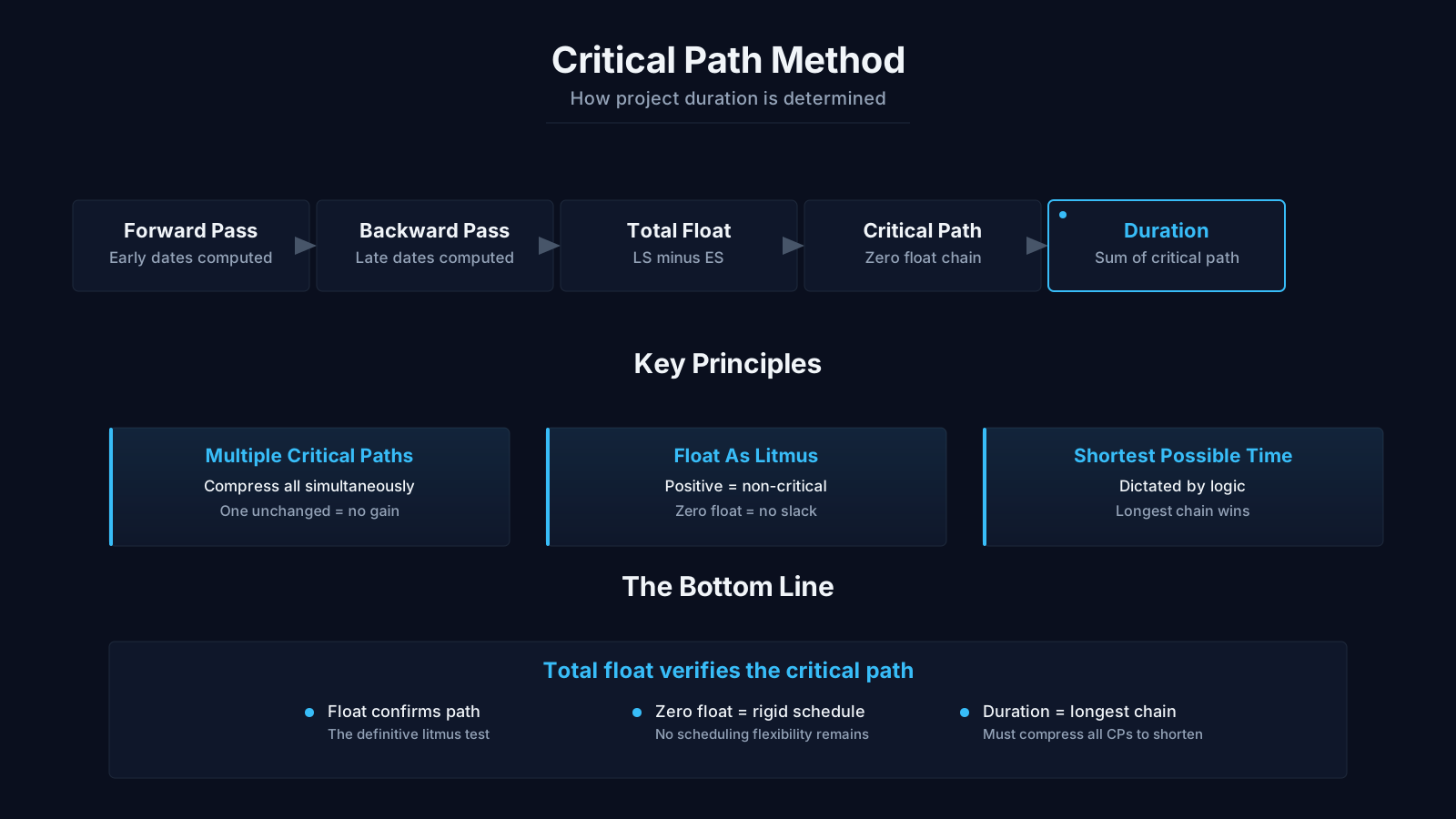
Summary of Critical Path Duration Calculation Steps
| Key Concept | Summary |
|---|---|
| Critical Path Method | CPM computes the minimum project duration by tracing forward and backward through the schedule network to identify the longest sequence of logically dependent activities. |
| Network Diagram | A directed acyclic graph with activities as nodes and dependencies as arrows provides the structural foundation upon which all CPM calculations are built. |
| Dependencies | Logical relationships, most commonly finish-to-start, serve as inviolable precedence constraints that govern when successor activities may commence. |
| Durations | The method assumes deterministic durations: each activity is assigned a single fixed estimate, disregarding uncertainty or time ranges. |
| Forward Pass | Progressing from the project’s start to its finish, the forward pass sets each activity’s early start to the latest early finish of its predecessors and adds duration to calculate its early finish. |
| Backward Pass | Moving from the project’s end back to its beginning, the backward pass subtracts durations to determine the latest permissible dates without prolonging overall completion. |
| Total Float | Total float measures the leeway within which an activity can be delayed without affecting the project finish date; activities with zero float reside on the critical path. |
| Project Duration | The project duration is the early finish of the network’s final activity after the forward pass has propagated through all dependency chains, defining the shortest feasible completion time. |
| Resource Independence | CPM intentionally excludes resource limitations, producing a logic-driven schedule baseline that later demands separate resource leveling and optimization. |
| PMBOK Context | Within the Develop Schedule process of Schedule Management, CPM yields an initial analytical baseline that serves as a starting point for elaboration, not as a committed deadline. |
The underlying mechanics of the critical path method
Before we can appreciate how the critical path method arrives at a project duration, we need to set the stage with the essential components that make up any schedule network. The method assumes you have already defined your project's activities , estimated their individual durations, and determined the logical relationships between them. These relationships, usually finish-to-start dependencies, tell us that activity B cannot begin until activity A is finished. You plot all of this out as a network diagram , a directed acyclic graph where nodes represent activities and arrows show dependencies. The critical path method calculation operates on this network as a pure mathematical model, temporarily ignoring the messy real-world constraints like how many electricians you can actually hire or whether a key piece of equipment will be available next Tuesday.
What many project managers miss is that CPM was initially developed in the late 1950s for large industrial projects where the sequence of work was paramount and resources were treated as adjustable. The method's elegance comes from its ability to tease out the longest chain of dependent activities. That chain, the critical path, determines the shortest possible time to complete the project given the logic you've defined. Any delay to any activity on that chain pushes the entire project out. Conversely, if you want to shorten the project, you must shorten some activity on that critical path. This focus on logical dependency rather than resource availability is both a strength and a limitation, something we will explore repeatedly.
To fully understand the forward and backward pass, you must first internalize the concept of early and late dates as theoretical boundaries. Early dates represent the soonest an activity can possibly start and finish if all its predecessors complete as early as possible. Late dates represent the latest an activity can start and finish without delaying the project's end date. These two sets of dates, calculated from opposite directions through the network, create a window of scheduling flexibility for each activity. The width of that window is called total float, and activities with zero total float are the ones that lie on the critical path. The project duration itself is simply the early finish date of the very last activity in the network, after the forward pass has swept through every dependency chain.
Deconstructing the schedule network diagram
When you draw a schedule network, you are essentially mapping out the project's anatomy. Each activity is a box that will later hold the calculated date values: early start, early finish, late start, late finish. The arrows represent the handoffs, the invisible threads that dictate sequence. In a well-constructed network, you have a single start point and a single end point, though you can create dummy activities to enforce this. The method assumes all durations are deterministic, meaning you know exactly how long each activity will take. Of course, in reality you have ranges and uncertainty, but the basic CPM algorithm ignores that and works with fixed numbers. This is one of the first assumptions practitioners bump against when they realize the resulting duration is a single point estimate, not a probabilistic range.
It is helpful to imagine a tiny project with only a handful of activities. Suppose you have activities A, B, C, D, and E. A and B can start immediately, C depends on A, D depends on both A and B, and E depends on C and D. Already you can sense that the longest path might be A-D-E or B-D-E, and you mentally start summing durations. That is essentially what the forward pass does automatically. The backward pass then works backwards from the project end, subtracting durations to find the latest possible start for each activity without pushing the finish date. Even before you run any numbers, the structure of dependencies is doing half the work. That is why network logic is so critical—garbage in, garbage out.
How dependencies and durations shape the critical path calculation
Every project schedule is a web of constraints, and the critical path method treats dependencies as unbreakable laws. If you say activity C cannot start until activity A is done, the algorithm respects that absolutely. This is where many scheduling errors creep in: the dependencies you define may reflect an ideal world, or they may embed hidden assumptions about resources that the method will ignore. For instance, you might set a finish-to-start dependency between painting and electrical work because the electrician needs to finish before painting begins, but that dependency may actually be resource-driven, not technically required by logic. The critical path method for project scheduling will take that at face value and potentially lengthen the critical path unnecessarily if resources could have worked in parallel.
Durations themselves are often estimated with a lot of optimism. The forward pass cheerfully adds them up, and the resulting project duration can look wonderfully short until reality hits. This is not a flaw of the method but a reflection of its purpose: to map logical dependencies, not to predict actual execution time. PMBOK places the Develop Schedule process, which includes CPM, in the Planning Process Group under Schedule Management, and it explicitly notes that resource optimization and resource leveling are separate steps that follow the initial critical path analysis. So when you calculate project duration via CPM, you are getting a resource-independent baseline that will later be adjusted. Understanding this sequence prevents the common mistake of presenting the CPM-derived date as the committed completion date.
Key Insights on CPM Mechanics
- Network diagram as project anatomy
- The network diagram models activities as nodes and dependencies as arrows in a directed acyclic graph, which the critical path method processes as a purely mathematical model that deliberately ignores real-world resource constraints.
- Critical path sets project duration
- The longest chain of dependent activities establishes the minimum possible project duration, and any delay on that critical path directly extends the overall completion date.
- Forward and backward passes
- The forward pass propagates earliest start and finish dates through all dependency chains, while the backward pass computes the latest allowable dates by tracing backward from the project's completion.
- Total float reveals scheduling flexibility
- Total float indicates scheduling flexibility by measuring how long an activity can be delayed without affecting the project finish date; activities with zero total float are precisely the critical path activities.
- Dependency logic shapes results
- The critical path method treats finish-to-start dependencies as absolute constraints, yet schedules often fail when those dependencies carry implicit resource assumptions that the algorithm cannot detect.
How the forward pass calculates early start and finish dates
The forward pass is the first sweep through the network, moving from left to right, from the project start to the project finish. At its simplest, you set the early start of the first activity to zero (or day one, depending on your convention) and then calculate its early finish by adding the activity's duration. Then, for each successor activity, the early start is the maximum of the early finish dates of all its immediate predecessors. This maximum rule is what catches people out. If an activity has multiple predecessors that finish at different times, the successor cannot start until the latest predecessor is done, logically speaking. The forward pass thus propagates the longest path forward, day by day, feeding the critical chain with its cumulative duration.
Consider that tiny project again. Suppose A takes 5 days, B takes 3 days, C takes 4 days, D takes 6 days, and E takes 2 days. Activity A and B start at day 0. A finishes at day 5, B finishes at day 3. Activity C can start at day 5 (after A) and finishes at day 9. Activity D has predecessors A and B; its early start is the maximum of 5 and 3, so 5, and it finishes at day 11. Activity E depends on C and D; C finishes at 9, D at 11, so E starts at day 11 and finishes at day 13. The project duration from this forward pass is 13 days. Already you can see the critical path forming: A-D-E, because that path has zero wiggle room. The forward pass, by pushing dates as early as possible, reveals the fastest achievable timeline if everything goes perfectly according to logic.
The step-by-step mechanics of the forward pass
Practically, you perform the forward pass by writing the early start and early finish in each activity node. You start at the beginning, ES=0 for any activity with no predecessors. Add duration to get EF. Then move to successors: for each, look at all incoming arrows, find the largest EF among predecessors, and set that as the ES. It sounds so mechanical that many project managers let scheduling software handle it, but doing it manually at least once on a whiteboard ingrains the intuition. Forward pass calculation in CPM forces you to confront the consequences of dependency sequencing. If you find a chain that seems to end too early, you know you either overestimated parallelism or missed a dependency.
One nuance that often trips up beginners is that the forward pass does not care about the project's deadline; it only cares about the logical sequence. It assumes infinite resources and no external constraints. So the early finish of the last activity is a purely theoretical best-case date. In a project with hundreds of activities, the forward pass can reveal multiple chains, but only the one with the greatest total duration at the end is the true critical path. Often there are near-critical paths with very little float, and those can become critical if slight delays occur. The forward pass illuminates all of this, even though it does not yet provide the full picture of float, which requires the backward pass.
Interpreting early start and early finish in real schedules
When you look at a completed forward pass, every activity has a pair of early dates. These dates tell the project team the soonest they could possibly work on each task if the stars align. In practice, this is often used to set aggressive internal targets or to identify activities that can be front-loaded. But here is where the absence of resource constraints bites. You might see that three different activities all have an early start on the same day, requiring three specialized crews, yet you only have one crew. CPM won't flag that conflict; it will happily assume you can clone your team. The resulting project duration is therefore an underestimate of any resource-constrained scenario. That is why the forward pass must be followed by resource analysis, but the method itself stops at the logical duration.
Yet the forward pass is indispensable because it gives you the optimistic baseline. It tells management what could be achieved if all dependencies were managed flawlessly and resources were unlimited. That's a useful starting point for discussions about what stands between the ideal and the real. Without this number, you're guessing at the minimum duration. Moreover, the forward pass feeds directly into the backward pass, which completes the picture of scheduling flexibility. The interplay of the two passes is what makes CPM such an elegant algorithm—a true gem of operations research that remains relevant even in agile environments where visual boards and sprint planning dominate.
The backward pass and the calculation of late start and finish dates
If the forward pass asks "how soon can we finish?", the backward pass asks "how late can we start without delaying the whole project?" Starting from the project's end date—which is initially set equal to the early finish of the last activity from the forward pass—you work backward through the network from right to left. For the last activity, you set its late finish equal to the project early finish (since we want to keep the same duration), and then its late start is LF minus duration. For each predecessor activity, the late finish is the minimum of the late start dates of all its immediate successors. This minimum rule is the mirror image of the maximum rule in the forward pass. It finds the latest point you can hand off work without causing a ripple delay to any downstream chain.
Using our tiny project, the project early finish is 13. Activity E has LF=13, LS=11. Activity D has successor E, so its LF=11, LS=5. Activity C also has successor E, so its LF=11, LS=7. Activity A has two successors: C and D. The late starts of those successors are 7 and 5 respectively, so A's LF is the minimum of 7 and 5, which is 5, giving LS=0. Activity B has successor D with LS=5, so B's LF=5, LS=2. Now every activity has a late start and late finish. The magic happens when you subtract the early dates from the late dates.
Uncovering total float through the backward pass
Total float, or total slack, is the amount of time an activity can be delayed without delaying the project finish date, assuming it starts at its early date and all other activities stay on schedule. Mathematically, it's LF minus EF (or LS minus ES). Activities A, D, and E have zero float—they are critical. Activity B has LF=5, EF=3, so float=2. Activity C has LF=11, EF=9, float=2. The critical path emerges as the sequence of zero-float activities: A-D-E. Backward pass in critical path method doesn't just find late dates; it exposes the hidden slack in your schedule. Without it, you wouldn't know which activities could be delayed to let resources shift around, or where you have genuine schedule risk.
This calculation reveals that project duration is not just a number; it's a property of the critical path chain. Any change to the duration of a critical activity changes the project duration directly. For non-critical activities, you have a buffer, and you can use that buffer to smooth resource demand or to accommodate minor hiccups. But be careful: if you consume all the float on one activity without adjusting others, you might create a new critical path, because the near-critical chain becomes the longest. The backward pass is therefore essential for schedule compression techniques like fast-tracking and crashing, because it shows you exactly where to focus your efforts to shorten the project.
What the late dates actually mean for project managers
Late dates are often misinterpreted as "do not start before" dates, but they are actually the latest possible start without jeopardizing the finish. In practice, you rarely want to schedule an activity at its late start, because that eliminates all its float and turns it into a critical activity. It also removes any buffer from its chain, making the project brittle. But knowing the late dates allows you to make informed decisions about resource allocation. If you need to delay hiring a subcontractor, seeing that an activity has two weeks of float gives you confidence to push its start. The backward pass, combined with the forward pass, gives you that confidence through a purely logical, repeatable process.
When you teach new project managers about CPM, one of the "aha" moments is realizing that the backward pass starts from the forward pass's end date, which means the project duration is essentially fixed by the forward pass before the backward pass even begins. The backward pass does not determine the project duration; it derives the lateness relative to that already-determined duration. This is a subtle point: the critical path method calculates project duration exclusively during the forward pass, and the backward pass confirms which activities are on the critical path and quantifies flexibility. Thus, the two passes are a single integrated algorithm, not two independent analyses.
Backward Pass Key Insights and Takeaways
- Backward pass calculates latest allowable dates
- Using the project end date derived from the forward pass’s early finish, the backward pass proceeds right-to-left to compute the latest start and finish times for every activity without extending the overall project completion.
- Late finish applies the minimum successor rule
- Each activity’s late finish is taken as the smallest late start of its immediate successors, mirroring the forward pass maximum rule and preventing delay propagation across any successor chain.
- Total float reveals critical activities
- Total float, calculated as late finish minus early finish, identifies the critical path: activities with zero float, like A, D, and E in the example, have any duration change directly affect the project end date.
- Late dates are not start targets
- A late start represents the maximum allowable start date to prevent project slippage; however, intentionally using that date consumes all float, rendering the activity critical and removing any downstream schedule cushion.
- Forward pass alone sets project duration
- The project duration is established solely by the forward pass; the backward pass then derives latest dates within that fixed horizon, and combined, they create an integrated mechanism for quantifying available schedule float.
Identifying the critical path and confirming project duration
Once both passes are complete, the critical path reveals itself as the longest path through the network in terms of duration, or equivalently, the path where every activity has zero total float. There can be more than one critical path if multiple chains share the same total duration and zero float. The project duration is the length of that critical path. In our example, 13 days. If any activity on that path slips by one day, the project slips by one day. This gives the project manager a razor-sharp focus: protect the critical path at all costs. Determining project duration with CPM is therefore a straightforward matter of identifying the chain where late equals early, but the implications are profound for how you manage daily work.
In complex projects, the critical path can shift as work progresses. An activity that had float early in the project might become critical if its predecessor delays or if a new dependency is discovered. That's why the schedule should be updated regularly and the critical path recalculated. Many organizations treat the initial baseline critical path as frozen, but that's a recipe for disaster. The method is dynamic by nature; it's a snapshot based on current progress and remaining logic. If you don't re-run the forward and backward passes after updates, your project duration calculation becomes fiction, and you lose the ability to see emerging critical chains.
The role of zero float in defining the critical sequence
Zero float is the red flag that signals an activity cannot be delayed. But it's important to distinguish total float from free float. Free float is the amount of time an activity can be delayed without delaying its immediate successor's early start. The backward pass only calculates total float directly. Free float requires a separate check: the difference between the successor's early start and the activity's early finish. An activity can have positive total float but zero free float if it is the only predecessor to a chain that has its own buffer downstream. Understanding both types helps you make smarter scheduling decisions. For instance, you might decide to consume all free float on an activity before using total float, because that won't affect any other activity's early start, only its late dates.
Yet, for the purpose of calculating project duration, total float is what matters. The critical path is defined by total float equal to zero (or some threshold if you use a near-critical tolerance). Some software packages will show "negative float" if you impose a deadline earlier than the CPM-calculated finish date. That's a warning that you are already late before you even start, and it usually triggers schedule compression or scope reduction. The forward and backward pass algorithm remains the same; it just produces negative numbers when the desired finish is sooner than the logical finish.
When more than one path determines project duration
It is not uncommon for a schedule to have multiple critical paths. In that case, a delay on any one of them will extend the project duration. This situation often occurs in projects with tight deadlines where careful planning has aligned several chains to finish simultaneously. Multiple critical paths increase risk because you have less schedule resilience. The CPM calculation identifies all of them, and the project duration is the common length. Managing such a project requires intense coordination, because you cannot afford to lose focus on any chain. This is where some practitioners turn to critical chain method, which adds buffers differently, but that's an extension, not part of basic CPM.
Additionally, a schedule may contain near-critical paths with very low float (say, one or two days). These are sometimes more dangerous than the critical path because the project manager might overlook them. The backward pass highlights them through small positive float values. When you review the schedule after each update, pay close attention to activities whose float has shrunk significantly. That indicates a path becoming critical. The method calculates project duration assuming infinite resources, but these near-critical paths become the first casualties when resources are overallocated, as people are pulled to the true critical path, potentially starving the near-critical activities and creating a brand new critical chain.
The crucial absence of resource limitations in CPM duration calculation
One of the most important and often misunderstood aspects of the critical path method is that it calculates project duration without any regard for resource limitations. The algorithm assumes that whenever an activity is logically ready to start, the necessary people, equipment, and materials are magically available. In the real world, this is rarely true. A project might have a forward-pass duration of six months, but when you load resources and level them to resolve overallocations, that duration can easily stretch to eight or nine months. Critical path method without resource constraints provides a theoretical best-case scenario that must be tempered with resource analysis before it can become a realistic schedule.
This limitation does not diminish the value of CPM; it merely defines its scope. The method's purpose is to expose the logical dependencies and their consequences, not to simulate real-world execution with resource queuing. After you have the CPM network, you can perform resource leveling, which adjusts start dates within available float to smooth demand, or you can apply resource smoothing, which may extend the project duration if float is insufficient. In PMBOK's Develop Schedule process, CPM is used first, and then resource optimization techniques are applied. The sequence is critical. Many novice project managers skip resource analysis entirely and present the CPM duration as the project plan, leading to missed deadlines and trust erosion.
Why the method treats resources as infinite during forward and backward pass
The historical reason is partly that CPM was invented in an era when large engineering projects could more easily scale labor by bringing in subcontractors, so resource constraints were less binding than today's matrix environments where key experts are perpetually overbooked. From a computational perspective, adding resource constraints transforms the scheduling problem from a simple network analysis into a much harder resource-constrained project scheduling problem, which is NP-hard. The forward and backward pass algorithm is linear and elegant precisely because it ignores resources. Once you include resources, you enter the realm of heuristics, optimization, and simulation.
Therefore, when you ask "how does the critical path method calculate project duration?", the accurate answer must include the caveat: it calculates a resource-independent, logically derived duration. That duration is a benchmark. It tells stakeholders: if we could staff every activity the moment it's ready, and there were no resource conflicts, this is how long the project would take. That's a powerful message, because it separates schedule pressure caused by dependencies from pressure caused by resource shortages. It helps you argue for additional resources on the critical path—after all, if the critical path drives the overall timeline, reducing its duration reduces project length, but you need people to do that.
From CPM duration to a resource-constrained schedule
After the initial CPM duration is calculated, the project manager typically loads resources into the schedule, assigning named individuals or generic roles to each activity. The software then checks for overallocation: a resource assigned to two activities simultaneously. You can then manually or automatically level the schedule. Leveling often pushes activities beyond their late start dates, thereby extending the project end date. The new date is the resource-constrained project duration, sometimes called the leveled duration. Compare that to the CPM duration, and you can quantify the impact of resource scarcity. In many organizations, that gap is a crucial metric for capacity planning and for negotiating project priorities.
Agile projects handle resource constraints differently, through fixed-capacity iterations and limiting work in progress, but the concept of a critical chain of dependencies still exists. Even in Scrum, if a team has a hard dependency on an external team's deliverable, that dependency essentially forms a critical path for the release. The forward pass logic, while not used formally, underlies the release planning when dependencies are mapped. The fundamental principle—that the longest dependency chain sets the minimum duration—holds across methodologies, even if the calculation method is buried under layers of story points and velocity-based forecasting.
Key Takeaways on CPM's Resource Assumptions
- CPM assumes unlimited resources
- The critical path method derives project duration exclusively from task dependencies, presupposing that personnel, equipment, and materials are freely available the instant any activity is logically ready to begin.
- Resource analysis follows CPM calculation
- After the network is constructed, resource leveling or smoothing must be applied to address overallocations, a step that frequently pushes the final timeline significantly beyond the unconstrained CPM forecast.
- Duration serves as a benchmark
- This resource-neutral duration isolates schedule tension caused by logic-driven constraints from that caused by resource shortages, equipping managers with a concrete basis to advocate for additional staffing on critical path tasks.
- Gap quantifies resource scarcity impact
- The variance between the pure CPM duration and the resource-leveled schedule measures the tangible cost of resource limits, forming an essential input for capacity planning and priority trade-offs; even Agile frameworks rely on sequential dependency chains that mirror critical path logic.
Applying the critical path method in real projects without getting lost in theory
Despite the theoretical elegance, applying critical path method correctly in a messy real-world project takes discipline. First, you need a complete and accurate activity list with realistic durations. Garbage estimates lead to a garbage critical path. Second, you need to define dependencies that reflect true logical constraints, not just habitual sequencing. Many schedules contain unnecessary dependencies that artificially lengthen the critical path and create misleading float. Third, you must resist the temptation to manipulate dates manually outside the CPM engine; if you hard-code start or finish dates, you break the forward and backward pass and turn your schedule into a static picture rather than a dynamic model.
It's also critical to perform the CPM calculation at the appropriate level of detail. If your activities are too granular, the critical path may bounce around with tiny delays that don't meaningfully affect the overall outcome. If they are too coarse, you lose the ability to see near-critical sub-chains. Many practitioners find that a work package level of detail, where activities are around 2–4 weeks in duration, provides useful float analysis without micromanagement. Applying critical path analysis in projects requires judgment about what to include and how to represent dependencies, and that judgment improves with experience and regular schedule reviews.
Common mistakes even experienced project managers make with CPM
One persistent mistake is using lags and leads extensively to mimic resource constraints. For example, adding a two-day lag between "flooring installed" and "furniture moved in" because the adhesive needs to dry. That's a legitimate logical need, but if you start adding lags to represent "we need to wait for the electrician," you are mixing logic and resources. The CPM calculation will incorporate that lag into the duration, and when resources are actually available sooner, the schedule won't reflect the opportunity because the lag is hard-coded. Instead, keep the network logical and address resource sequencing separately through constraints or leveling.
Another frequent error is forgetting to update the schedule network after changes in scope or execution. The CPM duration becomes stale the moment work starts, because actual progress deviates from planned dates, dependencies might be revised, and durations become better known. A schedule that is not regularly statussed and recalculated becomes a compliance document rather than a management tool. The forward and backward pass should be re-run after every status update to reveal the current critical path. What was critical last month might now have float, and a previously non-critical chain may be driving the finish date.
Connecting CPM to other project management frameworks and practices
Within the PMBOK Guide, the develop schedule process uses CPM alongside other techniques like critical chain method, resource optimization, and schedule compression. CPM is the foundational algorithm that underpins commercial scheduling tools like Microsoft Project, Primavera P6, and many others. In PRINCE2, product-based planning creates a product flow diagram that is essentially a network of deliverables, and the same forward and backward pass logic can be applied to calculate the project's end date and float. Even in Agile, understanding the critical path can inform release planning when multiple teams must coordinate deliverables with hard dependency chains.
A related concept is the critical chain method, which acknowledges resource constraints and uses buffers instead of float. It still relies on a forward pass, but it then optimizes resource contention and inserts a project buffer at the end. The project duration under critical chain may be longer than CPM duration but is considered more robust. This evolution shows how the basic CPM algorithm has been extended to address its resource-blindness while retaining its core logic. So while you learn CPM, you are building the mental framework to understand more advanced scheduling methods later.
Clearing up misconceptions about how CPM calculates duration
Over the years, several misconceptions have gathered around the critical path method. One is that it calculates the "most likely" project duration. It doesn't; it calculates a single deterministic duration based on single-point estimates, which may or may not be the most likely. If you use optimistic estimates, you get an optimistic duration. Another myth is that the critical path is the path with the most activities. Not necessarily—it's the longest total duration, not the highest activity count. A two-activity chain with huge durations can be critical while a dozen quick activities in parallel are not. Misconceptions about critical path method frequency lead to misinformed schedule decisions.
Some people think that once the critical path is identified, all other activities are unimportant. In truth, near-critical paths with low float are just as dangerous, and non-critical activities can become critical if they consume their float without management intervention. Also, the float values are interdependent. If you use up float on one activity, you reduce the float of all activities on the same path. It's a zero-sum game. Understanding these dynamics prevents the common pitfall of focusing exclusively on the red critical path in the Gantt chart while proximate yellow paths turn red overnight.
When the critical path might mislead you
There are situations where the CPM-calculated duration is not just optimistic but downright misleading. Consider a project with high uncertainty in durations. The forward pass sums the durations, but the variance of the sum is the sum of the variances. The CPM duration is a single number that hides the probability distribution. That's why PERT (Program Evaluation and Review Technique) adds a probabilistic layer with three-point estimates and a formula for expected duration and standard deviation. PERT still uses a forward pass, but the output is a probabilistic duration, not a single date. In highly uncertain projects, relying solely on CPM can give false confidence.
Another scenario is when resource dependencies actually drive the sequence, not technical logic. For example, if the same electrician must install wiring in three different buildings, the order of those buildings determines the project duration, but it's a resource constraint, not a logical one. CPM would show them all starting at the same time. To handle this, you either sequence them with artificial finish-to-start dependencies (which confuses logic with resource) or you use resource-leveled schedules. The CPM duration will be artifactually short, and stakeholders who see only that number will be disappointed later. Transparency about the method's assumptions is the best defense against this.
Integrating the forward and backward pass into daily project management
Despite its limitations, the forward and backward pass analysis remains one of the most teachable and repeatable ways to calculate project duration. Even in industries moving toward adaptive planning, the ability to map dependencies and find the longest chain is a core scheduling competency. When a project manager is faced with a delay, instinctively tracing the impact through the network using the backward pass logic helps determine whether the delay will hit the finish date. You don't need software for that mental chain; you need a clear model of the dependency web. That's what CPM gives you.
Ultimately, the critical path method calculates project duration by doing exactly what it was designed to do: finding the logical consequence of the sequence of work you have defined, free of resource noise. It gives you a clean, defendable number that serves as the starting point for all subsequent schedule development. The forward pass sweeps forward accumulating durations along dependent chains, the backward pass sweeps backward identifying the slack, and the zero-float activities mark the path whose length is the project duration. That process is deceptively simple, deeply logical, and incredibly useful, as long as you never mistake its ideal-world answer for the messy truth of project execution.
Core Takeaways on CPM Duration
- Deterministic, not most likely
- CPM computes a single deterministic duration from single-point estimates, so the result mirrors your input assumptions rather than a statistically most probable outcome, and optimistic inputs will produce an unrealistically short schedule.
- Longest path, not most activities
- The critical path is defined by the longest cumulative duration through the network, not by activity count; a brief chain of lengthy tasks can drive the project timeline while many quick parallel activities remain non-critical.
- Float dynamics and CPM blind spots
- Float is shared along a path, so consuming it on any one task reduces it for every activity on that same path, and because CPM ignores resource constraints and uncertainty, the computed duration may be deceptively short.