Every organization that develops products, delivers services, or brings new capabilities to market eventually confronts the same underlying puzzle: how does a project life cycle differ from a product life cycle? The two concepts are tightly interwoven yet fundamentally distinct, and confusing them leads to mismatched expectations, poor resource allocation, and initiatives that look finished on paper but stumble when the real world keeps moving. On a production floor or in a boardroom, these terms are often tossed around as if they were interchangeable, but a closer look reveals that a project life cycle has a start and an end deliberately chosen to deliver something specific, while a product life cycle stretches from the earliest concept exploration all the way to retirement, sometimes spanning decades. That difference in duration is only the surface. The very structure of phases, the triggers that move from one stage to the next, and the criteria that define success are different for each. In the following analysis, we will unpack the nature of each life cycle, examine how they intersect, explore what happens when the output isn’t a physical product at all, and see why managing multiple projects that feed into a single product demands a different kind of oversight.
Project vs. Product Life Cycles: Key Differences at a Glance
| Key Concept | Summary |
|---|---|
| Project Life Cycle | A project life cycle is a structured sequence of time-bound phases that transforms a defined concept into a tangible outcome, guided by decision gates that enforce management control and resource commitment at each transition. |
| Product Life Cycle | A product life cycle spans from initial concept through growth, maturity, and eventual retirement, persisting for years or decades and outliving any single project team that contributed to its realization. |
| PMBOK Process Groups | The five process groups, Initiating, Planning, Executing, Monitoring and Controlling, and Closing, represent logical clusters of processes that repeat within every phase of a project, not the sequential phases of the project life cycle itself. |
| Predictive vs Adaptive | Predictive life cycles progress through sequential, non-overlapping phases such as requirements, design, and testing, while adaptive life cycles deliver value in fixed-duration iterations; both approaches nonetheless culminate in a definitive project closure point. |
| Product Stage Model | The classic introduction-growth-maturity-decline model informs marketing strategy but oversimplifies the operational intricacies of a product’s internal evolution, where overlapping functional phases and continuous refinement dominate. |
| Manufacturing and Control | Internal product life cycle stages are shaped by operational imperatives that include quality assurance regimes, production engineering handoffs, regulatory compliance milestones, and supply chain integration, all of which extend beyond any single project. |
| Life Cycle Intersection | Every project is initiated to advance a specific stage of a product’s life cycle; multiple projects may sequentially or concurrently feed into one product, while the product itself endures far beyond each project’s completion. |
| Non-Physical Products | This distinction applies equally to services and digital products: continuous delivery initiatives are executed as bounded projects, yet the underlying service or software product evolves independently and persistently over time. |
| Multi-Project Oversight | Coordinating several projects that contribute to a single product demands portfolio-level governance, because each project concludes on its own timeline while the product’s ongoing value stream requires sustained, cross-project orchestration. |
| Management Implications | Conflating project and product life cycles breeds misaligned expectations, suboptimal resource allocation, and prematurely closed initiatives that leave the product exposed when real-world market and operational demands continue to surface. |
Defining the Project Life Cycle
The project life cycle phases define a structured sequence that converts a novel idea or need into a specific deliverable, result, or service. In the framework of the Project Management Institute and its PMBOK Guide, the project life cycle is the series of phases that a project passes through from its initiation to its closure. These phases are not arbitrary; they are selected by the project team and the organization to provide management control points, frequently called phase gates, where performance can be reviewed and decisions about continuing or redirecting the effort can be made. Whether the development approach is predictive, iterative, or adaptive, the underlying logic remains the same: a temporary endeavor needs a roadmap with clear beginning and ending boundaries.
Phases and Process Groups in Project Management
In predictive or waterfall-style project life cycles, phases are typically sequential and non-overlapping, such as requirements, design, development, testing, and deployment. Each phase completes before the next one begins, and the completion often involves a formal review or handoff. The PMBOK Guide’s process groups—initiating, planning, executing, monitoring and controlling, and closing—are not phases themselves but rather logical groupings of processes that occur in every phase to some degree. Many junior practitioners mistakenly call them the project life cycle, but that is a misreading. The process groups describe what you do within each phase, while the project life cycle tells you how the overall journey is divided into big chunks of focused work. PRINCE2, meanwhile, organizes project life around management stages, where each stage is a block of work authorized by the project board, and the end of a stage brings an assessment of continued business justification. This staging matches the same idea: a finite sequence of segments, each ending with a conscious decision point.
Characteristics That Shape a Project Life Cycle
What really gives a project life cycle its shape is the combination of organizational governance, the nature of the deliverable, and the uncertainty inherent in the work. A straightforward infrastructure project may have a single linear life cycle with no iterations, while a software product development project might be broken into multiple iterative cycles where each increment passes through design, build, and test mini-phases. Yet even in the most adaptive Agile environment, the project itself still has a start—perhaps the kickoff of the first sprint—and a finish, when the agreed scope is deemed sufficient, or when the timeboxed funding runs out. That temporality is non-negotiable. The project life cycle ends. When it ends, the project team may disband, resources are released, and the project’s administrative closure activities finalize the record. The outcome, however, often carries on.
Adaptive and Predictive Project Life Cycles
Adaptive life cycles, such as those found in Scrum or other Agile frameworks, replace the linear phase breakdown with a repeating cycle of fixed-duration iterations. It’s easy to assume that these iterations blur the boundary between the project life cycle and the product life cycle, because the product increment is delivered repeatedly and the backlog evolves continuously. But the project life cycle still has a defined closure point, even if that point is less obvious in a continuous delivery environment. The organization decides, based on value delivered against cost, that the investment is complete. The product, however, lives on. A product owner will continue to manage the product backlog and may eventually sponsor a new project to undertake a major overhaul or a feature extension. This cycle of project life following product need is the heartbeat of modern technology organizations.
Key Takeaways on Project Life Cycles
- Structured progression from idea to deliverable
- A project life cycle transforms an initial concept or need into a concrete deliverable by advancing through a predictable sequence of phases from initiation to closure.
- Phase gates provide management control
- Phase gates serve as formal review points where sponsors and key stakeholders assess progress, value, and risk to decide whether to continue, redirect, or terminate the project.
- Process groups versus life cycle phases
- PMBOK process groups categorize the recurring activities executed within each phase, while the project life cycle defines the overarching progression of phases from concept to completion.
- Governance and uncertainty shape the life cycle
- The selection of a predictive, iterative, or adaptive life cycle is influenced by organizational governance, the clarity of the deliverable’s characteristics, and the level of uncertainty inherent in the work.
- Project ends, product continues
- Every project reaches a definitive closure point, even in adaptive settings; the product then persists, evolving through operations and often spawning future projects.
Defining the Product Life Cycle
Unlike a project, a product does not end when the team disbands. The product life cycle stages are the distinct, generally sequential, and non-overlapping phases that a product goes through from its earliest conception to its eventual retirement. In many textbooks, these stages are illustrated using a standard curve: introduction, growth, maturity, and decline. That marketing-centric view is useful for strategy but it doesn’t capture the full operational reality. The source material emphasizes that the product life cycle consists of phases determined by the manufacturing and control needs of the organization. This is an important nuance because it grounds the life cycle in the tangible handoffs that occur inside the company—engineering handoffs, regulatory approvals, production ramp-up, end-of-life planning—rather than only in sales volume.
The Traditional Product Life Cycle Stages
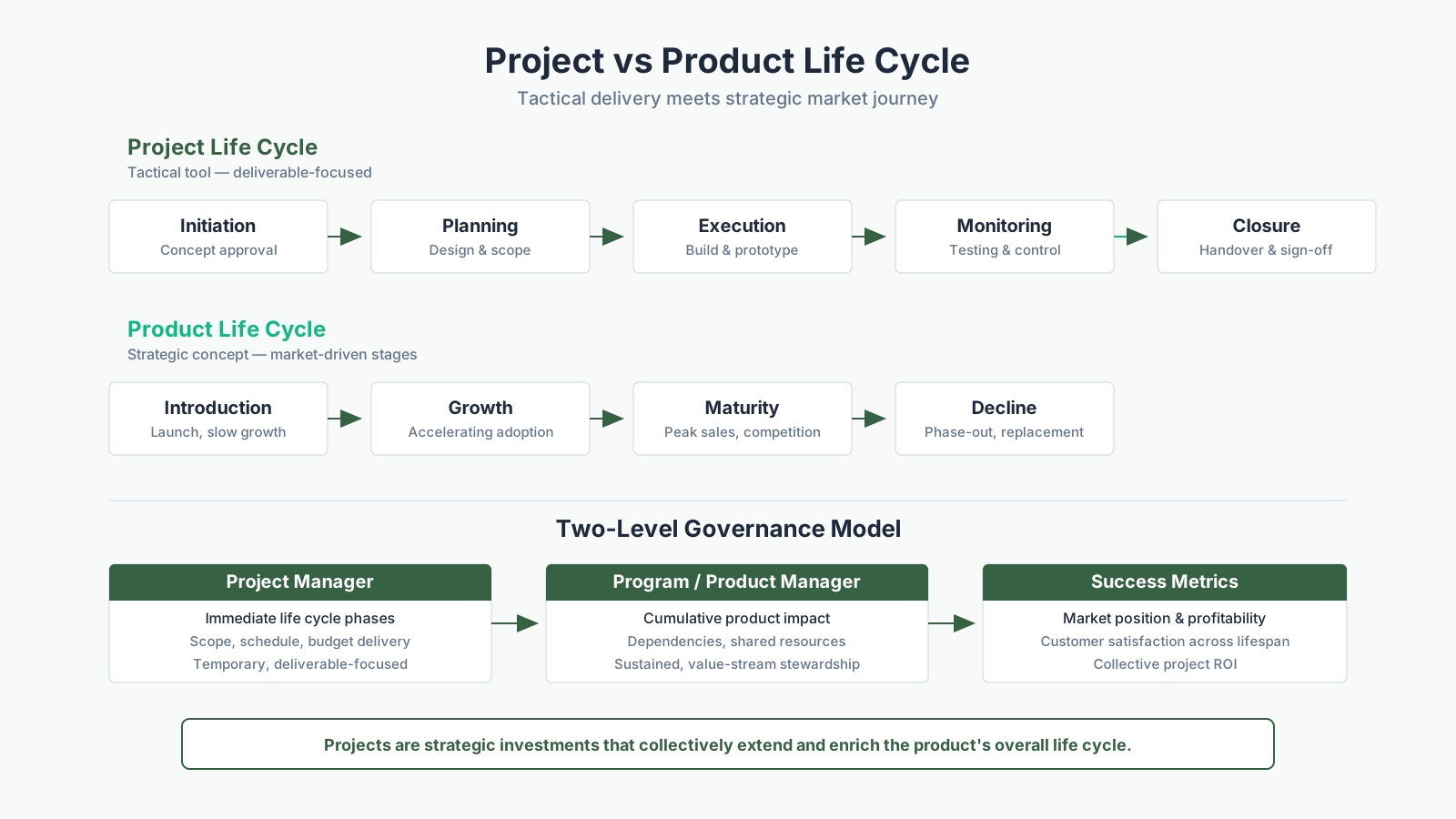
Most readers are familiar with the four-stage marketing product life cycle. Introduction is when a product is launched, sales are slow, and marketing investment is high. Growth accelerates adoption, competitors may enter, and distribution channels expand. Maturity sees a flattening of sales, intense competition, and a focus on cost control. Finally, decline brings shrinking demand and the decision to harvest, divest, or retire the product. While this model is valuable for strategic portfolio planning, it does not prescribe how each stage should be organized internally. The internal product life cycle, as understood in project management, bridges that gap by identifying the specific phases that the organization uses to move from concept to withdrawal. For a pharmaceutical company, these phases might be discovery, preclinical testing, clinical trials Phase I through III, regulatory submission, manufacturing launch, monitored release, and eventually patent expiry and generic competition. Those phases are sequential and non-overlapping by regulatory design.
Product Phases Determined by Manufacturing and Control
The phrase “determined by the manufacturing and control need of the organization” points to a reality where product phases are shaped by gatekeeping functions such as quality assurance, production engineering, and supply chain logistics. A car manufacturer, for instance, will have product phases that include clay model approval, prototype validation, pre-production pilot runs, full production ramp, running changes during the model year, and finally end-of-production when tooling is retired. Each phase transition demands sign-offs, tests, and resource decisions. The project life cycles we will discuss later slot into these product phases as focused bursts of work, but the product phase itself is larger and governed by criteria that go beyond the scope of a single project. For example, the decision to move from pilot production to full-volume production is a product life cycle decision, not a project decision, though a project may have been chartered to conduct the pilot.
How Product Life Cycles Vary Across Industries
It would be a mistake to assume that one template fits all products. Consumer goods might have a life cycle measured in months, while an aircraft model might have a life cycle spanning forty years. Industrial machinery could remain in the maturity phase for decades, supported by spare parts projects and modernization kits. Software products blur the lines further because the product itself can be continuously updated without a clear “manufacturing” phase. In cloud services, there is often no distinct production ramp-up; the service is enabled region by region. Yet even here, the organization will define internal product phases: beta availability, general availability, feature freeze, and end-of-life notification. What matters is that these phases are defined by the organization’s control needs, not by the whims of any single project manager. They enforce a cadence that all associated projects must respect.
How the Project Life Cycle Differs from the Product Life Cycle
Getting to the heart of the matter, the key differences between project lifecycle and product lifecycle center on temporality, purpose, and the nature of phase transitions. A project life cycle is inherently finite; it begins when the project is authorized and ends when the project objectives have been achieved or the project is terminated. A product life cycle begins with the recognition of a market opportunity or a new concept and persists through the product’s entire useful existence, ending only with retirement. One is designed to produce a unique output, the other to steward a sustained outcome. This distinction has real management consequences: the project manager focuses on delivering the scope within the constraints, while the product manager or product line owner focuses on the health and profitability of the product over time.
Temporal Boundaries and Duration
Projects are temporary by definition. Even a multi-year capital project will have a targeted finish date. The project life cycle provides the roadmap for getting there and includes activities like archiving project documents and releasing team members. The product life cycle, in contrast, may continue indefinitely—or at least for as long as the organization chooses to support the product. A building constructed by a project may then enter a decades-long operational phase that is part of its product life cycle (or asset life cycle, if we consider the building as a product). Throughout that operational phase, many other projects—renovations, retrofits, system upgrades—will be initiated, each with its own project life cycle. Practitioners who fail to see this nesting often ask for a project closure report that somehow also closes out product responsibilities, which creates dangerous gaps in ownership.
Focus: Outputs vs. Outcomes
A project life cycle is fundamentally output-oriented. The deliverables, the acceptance criteria, the handover documentation—all of these confirm that the project produced what it was asked to produce. The product life cycle is outcome-oriented, measured by customer satisfaction, market share, revenue, safety records, or other indicators of sustained value. An automobile development project, for instance, might have a project life cycle that ends when the first pilot vehicles roll off the line and the engineering validation is complete. The product life cycle of that automobile model, however, has barely begun at that point; it still faces launch, sales, warranty support, and eventual end-of-production. The project team might celebrate a successful closure while the product team braces for the real test. Confusing these two leads to premature declarations of victory.
Phase Transition Triggers
Project life cycle phase transitions are typically triggered by the completion of deliverables and the approval of gate reviews. You move from design to development when the design specifications are signed off. Product life cycle phase transitions are triggered by business, market, and manufacturing criteria. A product moves from introduction to growth not because a deliverable was accepted, but because sales passed a threshold or the production line demonstrated stability. These triggers are external to any single project. As the source material notes, the last product life cycle phase is generally the product’s retirement. The decision to retire a product involves market analysis, inventory levels, regulatory considerations, and customer migration plans. A project might be launched to execute the retirement, but that project is a reaction to a product life cycle decision. The project life cycle then runs inside the final product phase, managing the technical and logistical work of shutting down.
Key Insights on Life Cycle Differences
- Different temporal boundaries
- Projects are inherently temporary endeavors with predetermined finish dates, whereas a product lifecycle can extend indefinitely as long as the organization continues to support and invest in it.
- Outputs versus sustained outcomes
- Project lifecycles center on producing deliverables that satisfy formal acceptance criteria, while product lifecycles are measured by the sustained value they generate, including customer satisfaction, market share, and revenue growth.
- Distinct phase transition triggers
- Project phases advance upon deliverable completion and formal gate review approvals, whereas product lifecycle phases shift in response to business, market, and manufacturing signals such as sales performance thresholds.
- Projects nest within product cycles
- Initiatives like renovations and system upgrades function as components within broader product lifecycles, meaning project closure does not relieve the organization of its ongoing product stewardship responsibilities.
Project Life Cycles Within Product Life Cycles
One of the most practical insights for any portfolio manager is that project life cycles occur within product life cycles. The source material makes this nesting relationship explicit: project life cycles occur in one or more phases of a product life cycle. This means that a product’s entire life span becomes a container for a series of discrete, often overlapping or sequential, project life cycles. Understanding this container relationship prevents organizations from launching projects in isolation and instead encourages them to view projects as deliberate interventions at specific points in the product’s evolution. In PMBOK terms, this is where project management connects to program management and portfolio management.
Projects as Enablers of Product Evolution
Think of the product life cycle as a timeline marked by phase boundaries. At any point along that timeline, the organization may charter a project. During the early concept phase, a feasibility study project might run. During growth, a project to expand manufacturing capacity kicks off. During maturity, cost-reduction projects become frequent. And in decline, a project to migrate customers to a new platform appears. Each of those projects has its own initiation, planning, execution, and closure. Their life cycles are wholly contained within the envelope of the product’s ongoing existence. The product manager often acts as the sponsor or key stakeholder for many of these projects, ensuring that the temporary endeavor’s output aligns with the longer-term product strategy. If that linkage is weak, projects deliver technically correct outputs that nonetheless miss the market window or fail to integrate with the product’s operational reality.
Examples of Intersecting Life Cycles
A pharmaceutical research project to bring a new drug through clinical trials is a project life cycle that sits squarely in the early stages of the drug’s overall product life cycle. The project ends when regulatory submission is complete, but the drug product life cycle then enters the marketed phase, eventually reaching the maturity of patent-protected sales and the decline of generic competition. In consumer electronics, a project to design the next-generation smartphone runs from concept approval through mass production readiness; its closure may overlap with the product introduction phase. The phone as a product then lives for two or three years before being retired. During those years, smaller projects develop software updates, accessories, or localized variants. Each of these mini-projects has its own mini life cycle, all nested within the product’s still-active maturity phase. This layered reality is what makes product development organizations so complex to manage.
The Multi-Project Product Reality
Rare is the product that needs only one project. Even a simple packaged food item might require a formulation project, a packaging project, a manufacturing line setup project, and a marketing campaign project—all before the product hits shelves. After launch, a quality improvement project or a cost optimization project could follow. The source material directly addresses this by stating that many facets of the product life cycle lend themselves to being run as projects, and because one product may have many projects associated with it, additional efficiencies may be gained by managing all related projects collectively. Without that collective oversight, each project team optimizes locally, potentially at the expense of the overall product health. A packaging project that cuts costs by reducing material strength might inadvertently increase damage rates during distribution, shifting costs to a later customer service project. Someone has to see the whole.
When the Output is a Service or Result
Not every endeavor produces a tangible product with a clearly defined retirement phase. The source material wisely points out that when the objective is a service or result, there may be a life cycle for the service or result, not a product life cycle. This distinction prevents the mistake of forcing a service into a product manufacturing framework. A consulting firm that delivers an organizational restructuring project creates a new way of working, not a physical artifact. The service life cycle of that restructuring effort might include design, implementation, stabilization, benefit realization, and eventual refresh. The project’s life cycle ends when the new structure is operational and knowledge transfer is complete, but the service life cycle of the new organizational model continues as it evolves. Similarly, a disaster recovery program might be established; the project that sets up the recovery site and writes the procedures follows its project life cycle, but the ongoing readiness is a service life cycle sustained by periodic testing projects.
Many project managers feel a sense of dissonance here because their training centers on product deliverables. In IT service management, frameworks like ITIL explicitly separate the project’s life cycle from the service life cycle. The project introduces a new service or a significant change, and then the service enters the service operation stage, where it lives until it is retired or replaced. A help desk is never a “product” in the manufacturing sense, but it has a life cycle nonetheless. The discipline of distinguishing project life from service life ensures that the right people are accountable for the right outcomes at the right time. The project sponsor hands over to a service owner at the closure of the project, and the service owner then steers the service through its own life cycle phases.
Distinguishing Service from Product Life Cycles
- Service life cycle replaces product cycle
- When a project delivers a service or intangible result instead of a physical artifact, its ongoing evolution follows a service life cycle that emphasizes continual improvement over the fixed phases typical of a product life cycle.
- Project ends at operational handover
- The project life cycle concludes once the service is fully operational and knowledge transfer is complete; the service life cycle, however, persists, guiding the service through ongoing iterations and enhancements.
- Training creates product-centric mindset
- Traditional project management training is rooted in delivering tangible products, which often hinders managers from applying the service life cycle thinking required for intangible, results-oriented outcomes.
- ITIL separates project and service life
- Frameworks like ITIL draw a clear distinction between the project life cycle that introduces a new service and the service life cycle that governs its operation, continual improvement, and eventual retirement or replacement.
- Sponsor transfers to service owner
- At project closure, the sponsor transfers accountability to a service owner, who then steers the service through its unique life cycle phases, from operational management to continual enhancement and final phase-out.
Managing Related Projects Collectively
When multiple projects feed a single product or outcome, leaving them uncoordinated is a recipe for waste. The source material highlights that many separate projects may be related to the development of a new automobile, and that oversight of all projects by a higher authority could significantly increase the likelihood of success. This is the domain of program management, where the program integrates interrelated projects to achieve benefits that would be impossible if each project were managed independently. A car program, for example, encompasses body engineering, powertrain, interior design, infotainment, safety compliance, and production tooling—all distinct projects with their own project managers, risk registers, and schedules. The program manager’s chief concern is not just that each project finishes, but that the interfaces between them are aligned so that the assembled vehicle meets its cost, quality, and timing targets.
Program Management and Synergies
Program management introduces a planning and control layer above individual project life cycles. In PMI’s Standard for Program Management, a program life cycle includes phases like program definition, program benefits delivery, and program closure. Notice how these phases sit alongside and encompass the underlying project life cycles. The program is not an extra project; it’s a framework that provides strategic alignment, stakeholder management, and governance. When the product life cycle moves from development to launch, the program ensures that all the contributing projects converge at the right moment. If the engine project slips but the body project accelerates, the program manager offloads resources and adjusts the integration schedule. The product life cycle itself doesn’t contain such detailed project-to-project orchestration; program management fills that gap.
The Automobile Development Analogy
The source material uses the development of a new automobile as a clear example. Each project—chassis design, battery system, assembly line configuration, dealership training—has a distinct deliverable essential to bringing the car to market. The projects are distinct, but their life cycles intersect inside the product’s development and launch phases. A delay in crash-test validation, which is typically a sub-project within safety engineering, could force the entire program to reschedule the market introduction date, affecting the product’s growth phase window. A higher authority, typically a program manager or a vehicle line director, looks across the projects, resolves resource conflicts, and manages the cumulative risk. This collective oversight extends even beyond launch: warranty analysis projects and mid-cycle refresh projects later appear, all connecting back to the same product record.
From a Business Value-Oriented Project Management (BVOPM) standpoint, this collective oversight aligns neatly with the concept of program realization sets. In BVOPM, a program can contain multiple projects, each of which may use different methodologies and approaches, just as a car program might mix predictive engineering projects with more adaptive software development projects. The program focuses on the overall business value points, which include not only revenue and market share but also non-financial benefits such as enhanced employee engagement, a reduction in future product risks, or improved supplier relationships. The higher authority is thus measured on the total benefit realized, not merely on whether each project met its isolated targets. This perspective discourages the kind of local optimization that can erode the product’s long-term viability.
Common Pitfalls in Differentiating the Two
Even seasoned professionals occasionally collapse the distinction. One of the most frequent misconceptions about project and product life cycles is the belief that the project closure document somehow signifies the end of the product’s life. In reality, the product is often just hitting its operational stride. Another common error is assuming that the product life cycle phases are exactly the same as a project’s phases, simply rebadged. A junior planner might say, “We are in the execution phase of the product,” when they mean the product is in the growth stage. That linguistic sloppiness causes confusion in reporting and governance. Stakeholders who hear “phase” without a qualifier will interpret it through their own lens, typically the wrong one.
A different kind of pitfall emerges when organizations attempt to manage a product’s entire life as a single mega-project. A project life cycle is a poor container for something that may span a decade and involve completely different teams, technologies, and business conditions. The project management processes are not designed to stay active for the duration of a product’s market life. Instead, a series of focused projects, each with crisp boundaries and accountable leaders, is more effective. The product life cycle provides the stable long-term roadmap, and the projects provide the vehicles for change. Forcing a project structure onto the full product life cycle inevitably causes fatigue, scope anemia, and abandonment of phase controls.
Key Insights on Life Cycle Pitfalls
- Project closure does not end product
- Contrary to popular belief, a project's formal closure signals the start of the product's operational life, not its end.
- Product phases are not rebadged project phases
- Growth and maturity represent fundamentally different dynamics than project phases, and mistaking one for the other is a common and costly error.
- Imprecise phase terms cause governance confusion
- When the term "phase" is used without qualification, stakeholders default to project-centric interpretations, triggering misaligned expectations and governance breakdowns.
- Avoid one mega-project for full product life
- Forcing a product with a decade-long lifespan, shifting teams, and evolving technology into one monolithic project cycle causes fatigue and the eventual collapse of phase governance.
- Roadmap plus focused projects is optimal
- The optimal approach treats the product life cycle as a steady long-term roadmap, while executing change through a sequence of tightly scoped projects with clear boundaries and accountable leaders.
The Strategic Importance of the Distinction
Organizations that deeply understand how a project life cycle fits inside a product life cycle, and how services have their own analogous life cycles, gain a powerful capability: they can make investment decisions with clarity. When evaluating a business case, executives can ask whether the proposed initiative is a project that will end cleanly and hand over an asset, or whether it is part of an ongoing product operation that needs sustained funding. That simple question reshapes the entire conversation. A project life cycle brings the discipline of defined start and end, phase gates, and temporary team structures. The product life cycle brings the strategic perspective of market positioning, customer evolution, and long-term profitability. Neither is sufficient alone. The most mature organizations, and the most effective project and program managers, are those who can hold both life cycles in their heads simultaneously and know precisely where a given effort fits.