Human resource planning in project management often gets reduced to a mechanical exercise: identify the roles, count the people, and fill in a staffing management plan. That approach misses the deeply human, political, and behavioral undercurrents that determine whether a plan will actually work. Two distinct but complementary techniques, networking and organizational theory, shift the focus from paperwork to people. Together they help project managers anticipate the informal power structures, communication patterns, and cultural norms that make or break team performance. Understanding how networking and organizational theory support human resource planning is not just an academic concern; it is the difference between a plan that sits on a shelf and one that guides a thriving project team.
These techniques are not new. They have been embedded in the Project Management Body of Knowledge for decades, specifically within the Develop Human Resource Plan process. That process sits squarely in the Planning Process Group and belongs to the Project Human Resource Management Knowledge Area. Yet many practitioners skip over the “soft” tools in favor of Gantt charts and resource histograms. When a staffing plan fails, the root cause is rarely a miscalculated headcount. It is a failure to account for how people actually interact, who holds informal influence, and what the organizational structure does to motivation. Networking and organizational theory address precisely those gaps.
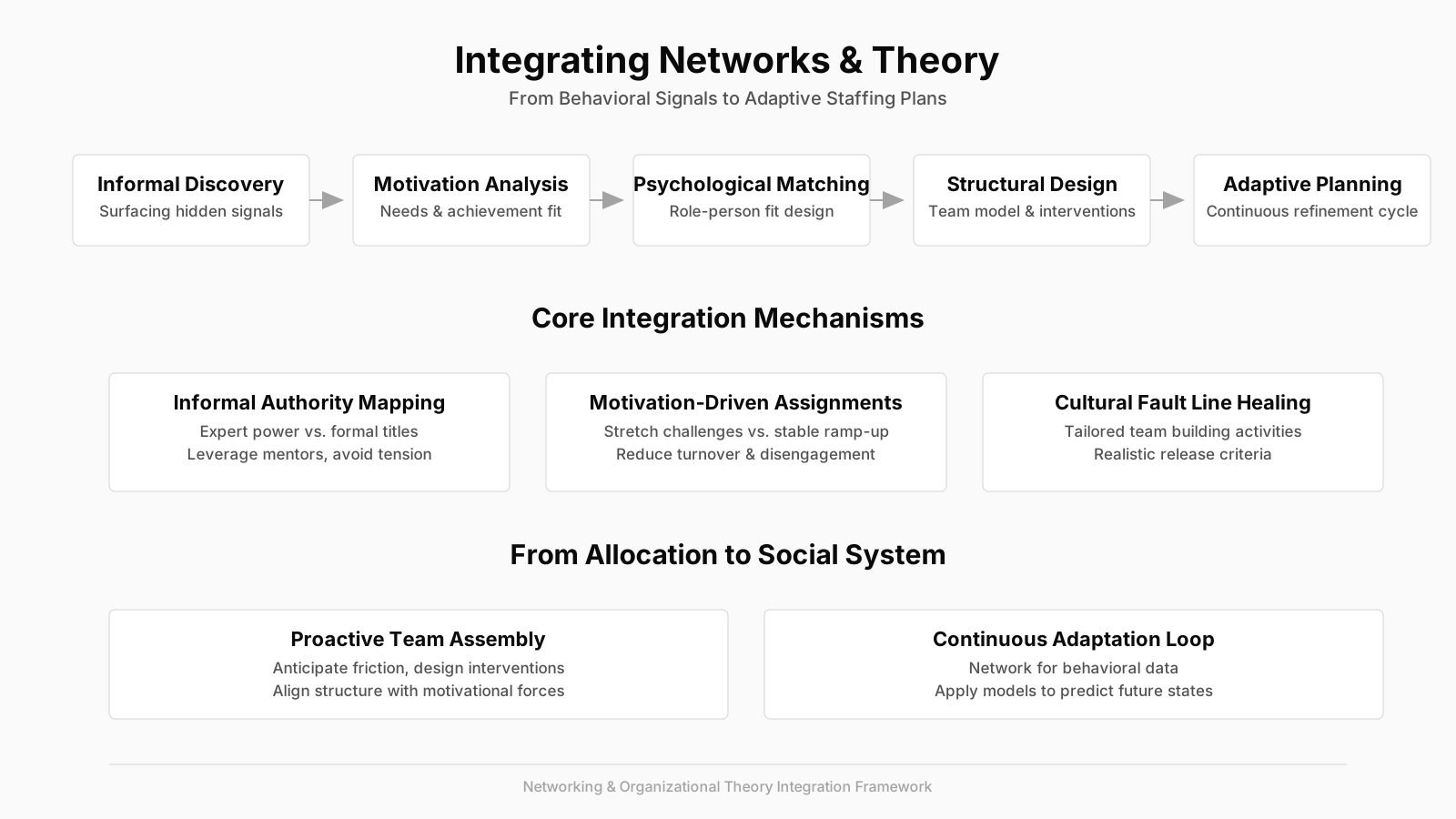
Networking & Organizational Theory in HR Planning: Summary
| Key Concept | Summary |
|---|---|
| Networking Value | Networking and organizational insight convert rigid staffing plans into adaptable strategies for building resilient, high-performing project teams. |
| Informal Channels | Informal interactions such as cafeteria chats and pre-meeting discussions surface political undercurrents, impending restructures, and employee burnout invisible on formal organization charts. |
| Political Awareness | Informal networking reveals submerged power struggles, pending relocations, and reputational vulnerabilities that shape staffing outcomes. |
| External Benchmarking | External peer benchmarking equips project managers to sidestep practices that trigger employee resentment and increase turnover. |
| Execution Monitoring | Sustained networking throughout execution keeps the project manager attuned to shifts in team morale, emergent conflicts, and the influence of unofficial leaders. |
| Career Network | Post-project networks provide mentors, new opportunities, and a community of practice that accelerates the refinement of strategic planning skills. |
| Future Staffing | In complex staffing scenarios like matrixed resource allocation, project managers can draw on their network for contextual advice rather than depending solely on generic templates. |
| Stakeholder Mapping | Project managers extend stakeholder mapping beyond official registers by orchestrating informal one-on-ones, participating in all-hands meetings, and seeking insights from former project managers. |
Networking as a Strategic HR Planning Technique
The PMBOK Guide lists networking as a formal technique for developing the human resource plan. But in practice it operates less like a process and more like an ongoing intelligence-gathering operation. Networking serves as a proactive technique for understanding staffing management options by revealing the political and interpersonal factors that remain invisible in org charts. A project manager who networks effectively does not wait until the planning phase officially starts. She begins months earlier, piecing together who knows whom, which functional managers are protective of their people, and where the unspoken loyalties lie. That information directly shapes which staffing strategies are feasible and which are doomed from the start.
Formal and Informal Networking Activities
Networking activities span a wide spectrum. Formal interactions include structured correspondence, scheduled luncheon meetings, and attendance at trade conferences or symposia. These are the visible, deliberate efforts that often get logged as “stakeholder engagement.” But the real value often comes from the informal side: a quick conversation in the cafeteria, a shared ride to a client site, or a five-minute chat before a steering committee meeting. In those unguarded moments, project managers pick up on tensions between departments, learn about impending reorganizations, or discover that a particular technical expert is burning out and about to quit. None of that appears in a resource breakdown structure, yet all of it is critical to building a realistic staffing plan.
Consider a mid-sized software development firm where the project manager needs a lead architect for a critical module. The org chart shows three available architects. Formal resource requests suggest any of them could be assigned. But through informal networking, the project manager learns that one architect is currently in a silent power struggle with the CTO, another is planning to relocate overseas, and the third has a reputation for refusing to document his work. That kind of intelligence, gathered over coffee, reshapes the entire staffing strategy. The plan now includes a backup mentor for the architect, a contingency for the relocation, and an explicit expectation-setting meeting with the chosen candidate. Without networking, the plan would have been a simple name assignment, almost certainly leading to a mid-project crisis.
Networking also extends beyond the immediate organization. Industry conferences and professional symposia bring project managers into contact with peers who have faced similar challenges. These external connections provide benchmarking opportunities and alternative staffing models. A project manager building a data center migration plan might learn from a peer at another company that the tried-and-true approach of centralizing all migration tasks under a single team leads to resentment and turnover. The peer’s alternative model, a hub-and-spoke team structure with embedded site leads, might never appear in a textbook. Yet it is exactly the sort of practical insight that transforms a theoretical plan into a workable one.
Timing and Developmental Benefits
Many people assume networking is only useful at the start of a project, when the staffing plan is being drafted. That assumption is dangerously incomplete. Early networking does indeed lay the groundwork by identifying potential team members and surfacing hidden constraints. But networking remains a powerful technique throughout the project and even after its completion. During execution, ongoing networking helps the project manager stay attuned to team morale, detect emerging conflicts, and identify informal leaders who can champion critical tasks. After the project closes, the network becomes a professional development resource, connecting the project manager to mentors, new opportunities, and a community of practice that sharpens planning skills for future initiatives.
The developmental aspect of networking is often overlooked in formal methodology descriptions. PMBOK notes that networking can enhance project management professional development during and after the project. When a project manager maintains relationships with former team members, functional managers, and external peers, she builds a reservoir of tacit knowledge. The next time she faces a staffing conundrum, say, a matrix organization where resources are shared across five projects, she can quickly tap that network for advice rather than relying solely on formal planning templates. That informal consultative process shortens the planning effort and increases its quality.
Networking Insights for HR Planning
- Formal PMBOK technique
- The PMBOK Guide lists networking as a formal tool for gathering the organizational insights needed to shape the human resource plan.
- Reveals invisible organizational factors
- Networking uncovers political and interpersonal undercurrents invisible on organization charts, revealing the real constraints that influence staffing decisions.
- Informal interactions yield greatest value
- Informal exchanges during coffee breaks, carpools, or pre-meeting small talk frequently deliver early warnings about interdepartmental friction, pending reorganizations, and rising burnout levels.
- Networking informs staffing contingencies
- Learning through networking about a candidate’s internal power struggles, impending relocation, or weak documentation discipline enables the project manager to integrate backup mentors, contingency plans, and upfront expectation-setting sessions directly into the staffing strategy.
- Peer learning guides migration strategy
- Conversations with counterparts at other organizations often highlight that concentrating all migration responsibilities within a single team breeds resentment and attrition, spurring proactive changes to the staffing model.
Organizational Theory and Its Impact on HR Planning
While networking uncovers the hidden interpersonal landscape, organizational theory provides a structured framework for understanding how people and groups behave within different structures. Organizational theory reduces the time, cost, and effort needed for human resource planning by giving project managers a predictive lens. Instead of guessing how a functional silo might react to a matrixed assignment, the project manager can draw on well-established behavioral patterns associated with various organizational forms. The direct payoff is a staffing plan that aligns with the organization’s natural grain, rather than fighting against it.
Understanding Behavioral Characteristics Across Structures
Different organizational structures produce markedly different individual responses, performance patterns, and relationship characteristics. In a classic functional hierarchy, team members tend to identify strongly with their department and may resist project-based reporting lines that dilute their functional loyalty. A project manager who understands this organizational theory insight will not simply assign a functional engineer to a full-time project role and expect seamless commitment. She will negotiate a clear protocol with the functional manager, perhaps agreeing to regular check-ins and a limit on project duration, so that the engineer does not feel abandoned by his home department. Without that theoretical understanding, the same assignment might trigger passive resistance, delayed deliverables, or outright conflict with the functional manager.
In a projectized organization, the dynamics flip. Team members are accustomed to project-based groupings and may even feel uncomfortable with long-term functional stability. Organizational theory helps the project manager anticipate that in a projectized structure, team formation can happen quickly because members are used to temporary, intense collaborations. However, the manager also needs to plan for dissolution. Team members in projectized settings often start thinking about their next project early, and if the current project’s staffing plan does not acknowledge that eventual transition, key people may leave prematurely. The planning output, therefore, includes not just role assignments but also a timeline for ramping down and knowledge transfer, informed by the organizational behavior typical of that structure.
Matrix organizations present the most complex behavioral terrain. Organizational theory illuminates the inherent tensions of dual reporting lines, conflicting priorities, and the “two-boss” problem. A project manager developing a human resource plan in a strong matrix, where project managers hold more power, must still account for the functional manager’s ongoing influence over career development, performance reviews, and daily work assignments. Effective planning here involves specifying not just the percentage of time a team member will spend on the project, but also a formal communication schedule between the project manager and functional manager. The plan might include joint goal-setting sessions, shared status updates, and a conflict escalation protocol that recognizes the dual authority. All of this flows directly from applying organizational theory, not from a resource histogram.
Individual Response and Personal Relationship Characteristics
The source material explicitly states that organizational theory provides information on the way in which people, teams, and organizational units behave. This goes beyond structural types. It encompasses what researchers often call organizational behavior: motivation patterns, group cohesion, power dynamics, and cultural norms. For human resource planning, this means looking at a proposed team composition and asking not just whether the skills are present, but whether the personalities and working styles will mesh under the given organizational design.
Take a large insurance company that is structured around product lines, each with its own IT group. The project manager is tasked with assembling a cross-product digital transformation team. Organizational theory would flag that individuals from different product silos may exhibit strong in-group loyalty and a tendency to prioritize their own product’s needs over the cross-product initiative. The staffing plan, therefore, cannot simply list team members. It must include deliberate integration mechanisms: co-location for a period, joint workshops to build shared identity, and a reward system that recognizes collective outcomes rather than silo-specific achievements. The planning process becomes shorter because the project manager does not waste time on naive assumptions that everyone will automatically cooperate. She designs the plan to actively counteract the predicted silo behavior.
Personal relationship characteristics also matter. In any organization, some pairs of people work together brilliantly while others trigger sparks. Organizational theory does not provide a checklist to predict every interpersonal dynamic, but it does sensitize the project manager to the importance of relationship history. A wise project manager, armed with this awareness, will spend time during planning to map out known positive and negative relationships, perhaps through confidential one-on-one conversations or by gently probing the network built earlier. The staffing plan can then place proven collaborators on the same sub-team and separate individuals with a history of friction, or at least set up a facilitated working agreement.
Practical Application of These Techniques in Real Projects
Translating these techniques from theory into practice requires a deliberate, almost anthropological mindset from the project manager. Practical networking and organizational theory techniques together create a robust, people-focused staffing plan that anticipates real-world friction points. It starts with a reconnaissance phase, often months before the formal planning process kicks off. The project manager identifies key stakeholders by reviewing the project charter and stakeholder register, but then goes further: she schedules informal coffees with influential functional managers, attends departmental all-hands to understand team cultures, and reaches out to former project managers who have navigated similar organizational waters. Each conversation adds a data point that will inform the staffing strategy.
During the actual planning workshops, the project manager does not rely solely on standard templates. She brings an organizational theory lens to every decision. When considering whether to co-locate the team or keep them distributed, she evaluates the structural influences: is the organization highly hierarchical, where physical proximity to the boss signals status? If so, co-locating team members away from their functional managers might be perceived as a loss of prestige, and the plan must mitigate that risk. When defining roles, she thinks beyond RACI charts. She considers the informal influencers the network revealed, and perhaps assigns them “ambassador” roles that bridge the project team with their home departments. This turns potential saboteurs into allies.
A realistic scenario might involve a pharmaceutical company launching a new drug development project. The project manager, early in planning, uses networking to discover that the head of regulatory affairs is extremely protective of her team’s time and has a history of blocking project assignments that she perceives as low priority. Organizational theory tells the project manager that in this functional-heavy structure, regulatory affairs sees itself as a gatekeeper, not a service provider. The staffing plan, therefore, does not simply request two regulatory specialists. It includes a detailed business case explaining how the project aligns with the regulatory team’s long-term goals, a schedule that avoids their peak submission periods, and a commitment to have the project sponsor personally meet with the regulatory head. The plan is tailored not to a generic organization, but to this specific behavioral reality. That is the power of combining networking and organizational theory.
Applied Networking Insights Summary
- Early informal reconnaissance pays off
- Project managers conduct informal coffees, departmental meetings, and outreach to former project managers months before formal planning begins, enabling them to map stakeholder cultures and the organizational dynamics that will shape project acceptance.
- Hierarchy shapes co-location decisions
- In highly hierarchical organizations, co-locating team members away from their functional managers may be perceived as a loss of prestige, so the staffing plan must explicitly address that risk by reinforcing formal reporting relationships and maintaining symbolic proximity.
- Ambassador roles leverage influencers
- Informal influencers identified through networking can be appointed as ambassadors who bridge the project team with their home departments, smoothing communication and securing departmental buy-in.
- Networking informs stakeholder mitigation
- Discovering a stakeholder's protective tendencies through early networking allows the project manager to craft a targeted engagement strategy, for example aligning project outcomes with the stakeholder's long-term goals and scheduling critical milestones outside their peak workload periods.
Common Pitfalls and Misconceptions
Even experienced project managers sometimes misuse these techniques. A frequent mistake is treating networking as a one-time activity, a burst of meet-and-greet sessions conducted during the planning phase and then abandoned. Networking fails as a human resource planning tool when it stops at the initiation stage because the informal dynamics of an organization shift continuously. A project manager who built a great network six months ago but has not reconnected since may miss that a key sponsor has fallen out of favor, or that a technical lead has been moved to a crisis project and is no longer available. The staffing plan grows stale, and the project manager is blindsided. Networking, to be effective, must be continuous, woven into the rhythm of the project.
Another pitfall is over-reliance on organizational theory as a deterministic predictor of behavior. The theory provides tendencies and patterns, not certainties. A project manager who assumes that every matrix organization will suffer identical power struggles will over-engineer the staffing plan with excessive governance layers. That can create bureaucratic overhead that frustrates team members and slows down decision-making. The real skill lies in using organizational theory as a starting point for inquiry, not as a substitute for direct observation. If the theory suggests that dual reporting lines cause conflict, the project manager should ask questions to verify whether that conflict actually exists in this specific unit, and how intense it is. The plan then reflects reality, not a textbook.
There is also a misconception that networking is purely about extroversion and schmoozing. Quiet project managers sometimes feel that networking is not for them. In truth, effective networking for HR planning is less about working a room and more about targeted, thoughtful conversations. Introverts can excel at this by setting up small, focused meetings or even exchanging detailed emails that build rapport over time. The goal is not to collect business cards; it is to gather insight. One deep, trust-based relationship with a well-connected functional manager can be worth more than a hundred superficial contacts.
Connections to Other PM Processes and Knowledge Areas
Networking and organizational theory do not operate in isolation. They link directly to other project management processes, often in ways that are not immediately obvious. Networking and organizational theory influence stakeholder management, risk planning, and communications throughout the project lifecycle. The Develop Human Resource Plan process, where these techniques officially reside, feeds into the Plan Communications Management process. The relationships and behavioral insights gathered through networking directly inform who needs what information, when, and through which channels. A project manager who knows, via networking, that a particular stakeholder prefers personal briefings over email will adjust the communications plan accordingly. That small adjustment can prevent misunderstandings that might otherwise derail resource commitments.
The link to risk management is equally strong. Many human resource risks, such as the departure of a critical team member or interdepartmental conflict, are predictable if the project manager has done the networking and applied organizational theory. The resulting risk register should include specific response strategies rooted in these insights. For example, if organizational theory suggests that a matrix structure increases the risk of resource contention, the project manager can plan for stand-by resources or negotiate priority agreements early. If networking reveals that a key expert is considering retirement, the staffing plan can include a transition period and knowledge transfer tasks. These are not generic risks; they are precisely identified because of the techniques used during planning.
Procurement management also connects in a subtle way. When a project involves contracted resources, understanding the client or vendor organization’s structure and informal power dynamics is just as important as understanding one’s own organization. Networking with vendor representatives and applying organizational theory to their company’s structure helps the project manager anticipate how quickly contract staff can be onboarded, how decisions will be made on their side, and where hidden bottlenecks might lurk. A staffing plan that treats vendor resources as a simple line item will stumble; one informed by networking and organizational analysis will build in realistic lead times and communication loops.
Core Takeaways on Networking's Reach
- Networking ties multiple PM processes together
- Applying networking insights and organizational theory enables project managers to anticipate stakeholder reactions, refine risk responses, and adapt communications across every project phase.
- Communications plans are shaped by relationship insights
- When stakeholder preferences are uncovered, such as a preference for face-to-face briefings over email, project managers can design communication plans that align with those preferences, increasing engagement and reducing misunderstandings.
- Human resource risks become more predictable
- Strong internal networks and a sound grasp of organizational dynamics enable project managers to detect early signs of key resignations or cross-departmental friction, turning potential disruptions into manageable risks.
- Proactive planning for key departures
- Uncovering an upcoming retirement through informal networks allows the staffing plan to incorporate structured transition periods and deliberate knowledge transfer activities, safeguarding project continuity.
- Vendor analysis averts staffing surprises
- Analyzing a vendor’s organizational structure equips the project manager to forecast approval cycles, onboarding durations, and internal bottlenecks that could delay contracted deliverables.
Organizational Theory in Agile and Hybrid Environments
The rise of Agile practices has changed how many projects handle human resource planning, but not in a way that diminishes organizational theory. In many Agile frameworks, teams are expected to be self-organizing, cross-functional, and stable over time. That seems to reduce the need for formal staffing plans. Yet beneath the surface, organizational theory becomes arguably more crucial. Organizational theory helps Agile teams navigate the hidden cultural and structural constraints that can silently undermine self-organization. A newly formed Scrum team in a traditionally hierarchical organization might technically have the autonomy to self-organize, but if the organizational culture punishes initiative from below, team members will hesitate to make decisions. The product owner, Scrum master, and team members need to understand this behavioral pattern. They can then plan interventions, such as explicit management sponsorship for the team’s autonomy, that create psychological safety.
Agile environments also highlight the importance of networking as an ongoing practice rather than an upfront planning activity. In Scrum, the daily standup, sprint reviews, and retrospectives are essentially structured networking events. They force repeated, brief interactions that build informal bonds and surface interpersonal issues quickly. A perceptive Scrum master uses these ceremonies not just for status checks but to watch for subtle shifts in relationships: who speaks to whom, who avoids whom, who dominates. Those observations feed into the team’s continuous improvement, essentially a living human resource plan that adapts sprint by sprint. This is networking turned into an operational rhythm.
Hybrid projects, where predictive planning mixes with Agile delivery, pose particular challenges. The project manager might use traditional techniques to plan the staffing for the overall project phases while allowing Agile teams to self-organize within their scopes. Organizational theory warns that this hybrid approach can create tension between the structured, plan-driven mindset of the waterfall portion and the emergent, trust-based mindset of the Agile portion. The human resource plan must bridge this gap. For instance, the plan might include a role specifically tasked with translating between the two cultures, someone respected in both worlds who can smooth over friction. That insight emerges only when the project manager analyzes the organizational behaviors each approach fosters.
The BVOPM Perspective on Networking and Organizational Theory
A modern methodology like Business Value-Oriented Project Management (BVOPM) adds fresh texture to these techniques. BVOPM emphasizes cross-functional teams as a core success factor, which aligns directly with organizational theory’s focus on how people and units behave across boundaries. Rather than assuming cross-functionality will happen by fiat, a project manager influenced by BVOPM uses networking to identify potential collaborators from different departments early, before formal resource requests go out. She then validates the feasibility of a cross-functional structure by observing informal interactions and gauging willingness to collaborate, rather than relying on a sponsor’s directive. This validation step, reminiscent of BVOPM’s emphasis on stakeholder input validation, makes the human resource plan more resilient.
BVOPM also treats employee-created tools and outputs as formal products, a concept that dovetails with networking’s developmental aspects. When project managers network to discover what informal solutions teams have built to manage their own workloads, they uncover hidden assets that can be integrated into the staffing plan. For example, a finance team might have created a shadow project tracking spreadsheet that is far more accurate than the official system. Recognizing this through networking and incorporating it into the plan aligns with BVOPM’s respect for employee-driven innovation. Organizational theory helps explain why these informal tools emerge, they often compensate for structural misalignments, and the plan can then address those root causes rather than just adopting the tool.
Essential Insights on BVOPM Networking
- Early cross-functional collaboration
- BVOPM-oriented project managers leverage networking to discover and align cross-departmental talent early, securing informal agreements that replace delayed formal resource allocation with immediate collaborative momentum.
- Validation through informal observation
- Rather than waiting for a sponsor's approval, the viability of cross-functional structures is tested by observing informal exchanges and assessing genuine willingness to cooperate, which provides a more reliable indicator of future team cohesion.
- Hidden assets discovered via networking
- Networking surfaces employee-created solutions such as a shadow project spreadsheet that offers higher accuracy; BVOPM then elevates these informal tools to formal status and embeds them into the staffing plan, capturing practical innovation that standard processes miss.
- Root cause of informal tools
- When organizational theory reveals that informal tools compensate for structural misalignments, the BVOPM method addresses the root cause of those gaps instead of merely adopting the tool, creating a more durable and strategically sound solution.
Future Trends and Evolving Practices
As organizations become more networked, virtual, and fluid, both networking and organizational theory will need to adapt. Evolving practices in networking and organizational theory reflect the growing complexity of modern project environments where remote work, gig economy talent, and flatter hierarchies change the nature of human interactions. Virtual networking, through video calls, instant messaging, and social platforms, is now a staple. Yet project managers report that the informal, serendipitous conversations that used to happen in hallways are harder to replicate online. The human resource planning process must now deliberately engineer those chance encounters. Some organizations are experimenting with virtual “coffee roulette” systems that randomly pair team members for short, unstructured chats. While not perfect, these interventions show an attempt to apply networking principles in a distributed setting.
Organizational theory is also being stretched by the proliferation of holacratic and teal organizational models, where traditional hierarchies dissolve into self-managed circles. In such environments, the classical organizational theory that assumed clear reporting lines and formal authority structures no longer applies neatly. The project manager cannot rely on old assumptions about how people respond to authority because authority is distributed. Human resource planning in these settings becomes a negotiation among peers, not a top-down assignment. Networking, therefore, shifts from uncovering power structures to building consensus across a diffuse network of equals. The staffing plan may look more like a voluntary commitment document than a staffing assignment matrix.
Artificial intelligence and people analytics are beginning to influence these techniques as well. While not a replacement for human judgment, network analysis tools can visualize communication patterns and highlight informal influencers even in large organizations. A project manager might use such a tool during planning to identify who the actual go-to people are for a given expertise, not just who the org chart says they are. Organizational theory provides the lens to interpret the resulting network maps, distinguishing between healthy collaboration patterns and signs of over-dependence on a single node. This fusion of data and behavioral insight represents the next frontier for human resource planning.
Even with all these technological shifts, the core insight remains: a staffing plan is not a document. It is a living agreement among people, shaped by their relationships, their organizational context, and their individual motivations. Networking connects the project manager to the pulse of those relationships. Organizational theory provides the language and categories to understand why people behave as they do. Together they transform human resource planning from a bureaucratic necessity into a strategic, human-centered practice that significantly improves the odds of project success.