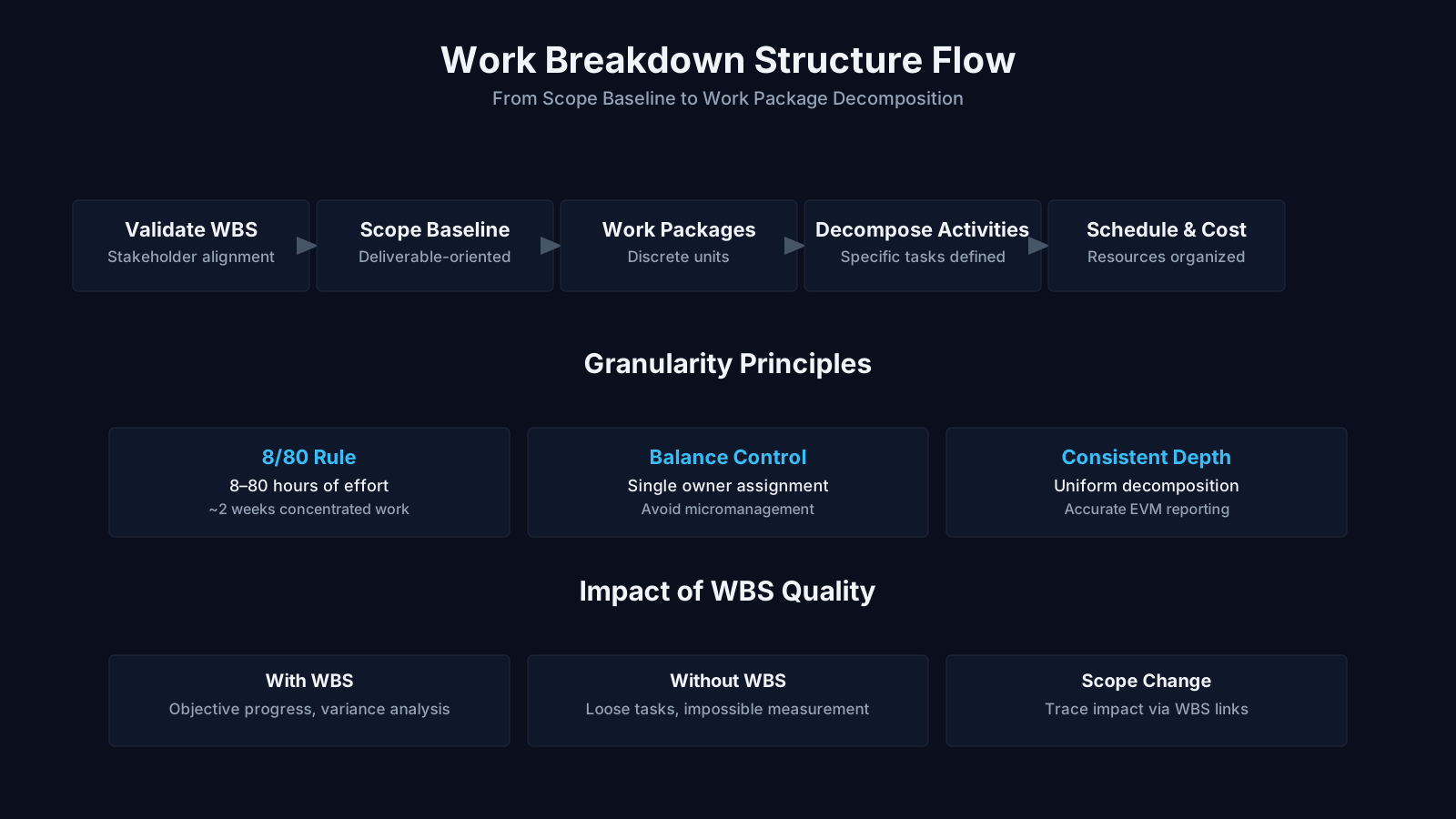
Creating a work breakdown structure might sound like an exercise in box-drawing and number-assigning, but it is actually one of the most decisive moments in project planning. When you set out to create a work breakdown structure, you are effectively drawing the boundary line between what the project will deliver and the ambiguous space of unchecked assumptions. The WBS is not a to-do list or an activity schedule, though it feeds both. It is a deliverable-oriented hierarchy that forces the team to think in terms of tangible outputs rather than busy work. Misunderstandings here ripple outward into cost overruns, schedule slips, and the kind of scope creep that makes sponsors nervous. The process demands a blend of analytical rigor and practical judgment, because not everything can be decomposed to the same depth, and trying to force perfect granularity too early often backfires.
Work Breakdown Structure: Key Topics at a Glance
| Key Concept | Summary |
|---|---|
| WBS Foundation | A well-constructed work breakdown structure anchors the project scope baseline, enabling reliable cost estimation, schedule development, and performance measurement through integrated deliverables. |
| Decomposition Approach | Effective decomposition balances analytical precision with practical judgment; imposing overly fine granularity early on creates rigidity and invites rework when requirements inevitably evolve. |
| PMBOK Role | Within the PMBOK framework, the WBS sits in the Planning Process Group under Project Scope Management, converting project objectives into a deliverable-oriented structure that forms the basis for the schedule and cost baselines. |
| PRINCE2 Alternative | PRINCE2 methodologies apply a product breakdown structure to define all required deliverables first, ensuring clarity on what must be produced before sequencing or scheduling activities. |
| Agile Parallel | Agile teams decompose features into user stories through product backlogs and release plans, reflecting WBS logic with a lighter governance model that accommodates emerging detail. |
| Common Mistake | Labelling activity lists as a WBS confuses work packages with tasks, undermining earned value calculations and complicating scope change control. |
| Scope vs Effort | Maintaining a clear distinction between deliverables and activities prevents the illusion of progress through effort tracking, ensuring only completed scope drives performance metrics. |
| WBS Inputs | Key inputs such as the project scope statement, high-level deliverables with acceptance criteria, and historical templates supply constraints, detailed specifications, and proven hierarchical patterns that reduce structural flaws. |
Understanding the Foundations of Work Breakdown Structure Creation
The WBS lives at the intersection of scope definition and execution planning, and its foundational concepts matter far more than the template you choose. When you create a work breakdown structure foundation properly, you end up with a framework that makes estimation, scheduling, and performance tracking coherent across the entire project lifecycle. The lowest-level components, called work packages, are the pivot points where planning stops being abstract and starts being actionable. Each work package can be independently scheduled, cost-estimated, and monitored, but only if the decomposition logic above it is sound. The structure above a work package determines whether the metrics you collect actually mean anything when they are rolled up to senior stakeholders.
The Role of the WBS in Project Management Frameworks
Within the PMBOK framework, creating the WBS belongs to the Planning Process Group and falls squarely inside the Project Scope Management Knowledge Area. It is the bridge between the scope statement and the detailed activity definitions that drive scheduling. This positioning is deliberate because the WBS translates the language of requirements and objectives into the mechanical structure that resource-loaded schedules and cost baselines depend on. In PRINCE2 environments the WBS appears in a slightly different form as the product breakdown structure, but the intent remains identical: to define what must be delivered before anyone worries about how or when to deliver it. Agile practitioners sometimes resist the term, preferring product backlogs and release maps, yet even there the decomposition of features into user stories mirrors the hierarchical thinking of a WBS, just with less formality and more tolerance for emergent detail.
What Defines a Deliverable-Oriented Hierarchy
The phrase "deliverable-oriented" trips up a shocking number of new project managers. Many create de facto activity lists and label them WBS, which causes all sorts of downstream headaches when accounting for earned value or managing scope changes. A proper WBS consists of nouns, not verbs. Each element names something the project produces: a module, a document, a constructed component, a validated dataset. Effort and activities are the children of these deliverables, not their parents. Think of designing a training program. The deliverable might be "approved curriculum," not "conduct stakeholder interviews" or "draft learning objectives." Those are the tasks needed to produce the deliverable, and they belong in the schedule, not the WBS. Getting this distinction right prevents the team from measuring effort instead of outcomes, a subtle but catastrophic shift that can make a project appear on track while delivering nothing of value.
Key Insights on WBS Foundations
- Foundation beats template choice
- A properly constructed WBS connects scope definition and execution planning, which keeps estimation, scheduling, and performance tracking coherent from initiation through closeout.
- Work packages drive actionability
- Work packages form the lowest tier where planning becomes actionable, enabling independent scheduling, cost estimation, and monitoring only when supported by a coherent decomposition hierarchy above them.
- Decomposition determines rollup meaning
- Performance data gathered at the work-package level retains its meaning and reliability when rolled up to senior stakeholders only if the upper decomposition layers are logically consistent.
- Framework variations share one logic
- All major frameworks, from PMBOK's WBS to PRINCE2's product breakdown and Agile's backlogs, rely on the same underlying decomposition principle, and failing to separate deliverables from activities persistently causes earned value distortions and scope change challenges.
Essential Inputs for Creating a Work Breakdown Structure
Anyone who jumps straight into decomposition without first anchoring the effort in solid inputs is essentially guessing with expensive time. The process consumes three formal input categories, each serving a distinct purpose in keeping the WBS accurate and defensible. The inputs for creating a work breakdown structure act as constraint providers, detail suppliers, and historical guides that prevent the team from reinventing flawed hierarchies that previous projects already suffered through.
Starting with the Project Scope Statement
The project scope statement is the primary source of truth for boundaries and major deliverables. It defines the product scope description, which tells you what the end result must do or be, and it lists the project deliverables at a high level, often with user acceptance criteria baked right in. Without a well-formulated scope statement, decomposition becomes arbitrary because nobody can answer the question "Does this belong here?" with any consistency. I have watched teams spend hours decomposing a deliverable only to realize it was explicitly excluded in the scope statement and nobody had read the fine print. The scope statement also carries the assumptions and constraints that shape how finely you decompose. A deliverable with tight regulatory constraints might demand decomposition down to individual verification steps, while a loosely defined prototype might intentionally stay at a higher level.
Leveraging Requirements Documentation and Organizational Assets
The requirements documentation provides the granularity that fuels decomposition decisions. A functional requirement detailing data encryption standards, for example, tells you that the software module deliverable needs subcomponents addressing cryptographic implementation, key management, and compliance testing. Organizational process assets do the heavy lifting of preventing wasted effort. Templates from past projects give you a starting structure so you are not staring at a blank page. Lessons learned files often contain warnings about where previous WBS structures broke down, perhaps because a particular subcontractor deliverable was always underestimated, or because the integration testing work package was consistently scoped too narrowly. Policies and procedures can also dictate naming conventions, coding schemes, and the mandatory depth of decomposition for certain classes of work. Ignoring these assets is like ignoring the scars of previous expedition members before you set out.
The Decomposition Technique in Work Breakdown Structure Development
Decomposition is the sole tool listed for this process, which might make it sound simpler than it is. Decomposition is an iterative, judgment-heavy exercise in progressively defining smaller and smaller chunks of project scope until each chunk lands at a point where management control becomes practical. You are not breaking work into infinite pieces. You are identifying the edge where further breakdown would cost more to manage than it saves in estimation accuracy. The decomposition technique for work breakdown structure development involves several sequential activities that move from identification to structuring to coding, and finally to verification that the level of detail is appropriate.
Step-by-Step Decomposition Activities
The first activity is identifying and analyzing the deliverables and the work associated with them. This means taking each major deliverable from the scope statement and examining it for logical sub-deliverables. A bridge might decompose into abutments, deck, traffic systems, and environmental mitigation measures. The second activity involves structuring and organizing the WBS; this is where you decide whether the top level breaks down by phase, by major component, or by subproject. Third, you actually decompose each upper-level component into lower-level components, repeating the process until every branch terminates in a work package that can be reliably estimated. Fourth, you assign identification codes, building a code of accounts that allows hierarchical roll-up of cost, schedule, and resource data. Finally, you verify that the degree of decomposition is sufficient without being excessive, a balancing act that separates experienced planners from novices.
Structuring the WBS: Phases, Deliverables, and Subprojects
There are three dominant structural forms available. The first uses phases of the project life cycle as the top-level decomposition, with product and project deliverables nested under each phase. A construction project might start with "Design Phase" and "Construction Phase" as Level 1 elements, each containing their respective deliverables. The second form uses major deliverables as the first level, which works well when the product is a complex system with distinct subsystems that can be developed in parallel. A software project might list "User Interface Module," "Database Engine," and "API Gateway" at Level 1. The third form accommodates subprojects, especially those executed by external organizations, where a contractor receives a top-level WBS element and then develops their own contract work breakdown structure underneath it. This delegation pattern is common in large infrastructure or defense programs where different vendors own different system segments and the prime contractor integrates the pieces.
Key Takeaways on Decomposition Technique
- Iterative judgment-heavy process
- The technique decomposes the project scope iteratively into increasingly manageable work pieces, stopping when the added cost of further detail outweighs the gain in estimation accuracy.
- Four sequential activities
- It proceeds through a logical sequence of four activities: identifying sub-deliverables, structuring the WBS, decomposing those components into work packages, and assigning identification codes.
- Structuring by phase or component
- Project managers select whether to decompose the top level by phase, major deliverable, or subproject; for example, a bridge might be broken down into abutments, deck, traffic systems, and environmental measures.
- Codes and external subprojects
- Assigning identification codes creates a structured code of accounts for the hierarchical consolidation of cost, schedule, and resource data, while external contractors can develop their own contract WBS beneath a designated top-level element.
Verifying and Finalizing Your Work Breakdown Structure
Verification is not a rubber-stamp exercise. The moments spent checking the logic of decomposition often reveal scope gaps that would otherwise surface during execution, when they are far more expensive to address. The verification process requires questioning whether each lower-level component is truly necessary and sufficient to complete its parent, and whether the sum of all work packages genuinely produces the stated deliverables. Verifying and finalizing a work breakdown structure also involves checking that control accounts are placed at sensible management points where scope, cost, and schedule data can be integrated for performance measurement.
Applying the 100% Rule for Completeness
The 100% rule states that the WBS must capture all the work defined in the current approved project scope, and that the sum of the work at the lowest levels rolls up perfectly to the higher levels. Nothing is left out, and no extra work is smuggled in. Practically, this means that when you decompose "Training Materials" into "Instructor Guide," "Student Workbook," and "Presentation Slides," there should be no remaining sub-deliverable of "Training Materials" that is not accounted for, and no work package that produces something not required by the approved scope. The rule extends to project management work itself. Your WBS needs elements for planning, monitoring, and closing activities, otherwise these efforts become invisible overhead that distorts cost and resource accounting. Forgetting to include project management work packages is one of the most common omissions I see in practice, and it creates an immediate credibility gap when the project manager's time suddenly appears as an unexplained variance.
Establishing Control Accounts and the Code of Accounts
Control accounts serve as management control points where the triad of scope, cost, and schedule converge for earned value analysis. Each control account sits at a selected level in the WBS hierarchy and may contain one or more work packages, though each work package belongs to exactly one control account. This one-to-many relationship ensures clean reporting lines. The code of accounts assigns a unique identifier to each WBS element, enabling hierarchical summation systems to aggregate data meaningfully. When the code structure mirrors the organizational breakdown structure and the cost accounts, cross-referencing between scope, cost, and responsibility becomes automatic. A well-designed coding scheme can signal which project phase, which subsystem, and which responsible department own a given work package, all from a glance at the identifier string.
The WBS Dictionary and Scope Baseline Outputs
The WBS itself is a visual or tabular structure, but it gains operational meaning through its companion document: the WBS dictionary. Together with the project scope statement, they form the scope baseline, a formal component of the project management plan that serves as the reference for all change control decisions. The WBS dictionary and scope baseline deliverables turn an abstract decomposition into a controlled, auditable artifact that supports monitoring and controlling processes throughout the project lifecycle.
Detailing Every Component with the WBS Dictionary
The WBS dictionary takes each work package and control account and expands it into a miniature specification. Typical entries include the code of account identifier, a description of work, the responsible organization, schedule milestones, associated schedule activities, required resources, cost estimates, quality requirements, acceptance criteria, technical references, and any contract information relevant to that scope element. Imagine a work package for a pump installation at a water treatment plant. The dictionary entry would list the pump model specification, the installation torque tolerances, the quality inspector's acceptance criteria, the milestone linkage to system commissioning, and the budget allocation against the procurement control account. Without the dictionary, the WBS is just an outline of labels that leave too much room for interpretation. With it, the team and stakeholders share a common understanding of exactly what "complete" looks like for every chunk of the project.
Integrating the Scope Baseline for Project Control
The scope baseline locks together three components: the project scope statement with its product scope description and acceptance criteria, the WBS as the structural decomposition of deliverables, and the WBS dictionary providing the detailed definitions. When a change request arrives, the change control board compares the proposed change against this baseline to determine if scope is being added, modified, or removed. Baselining creates a before-image that makes variances visible. The requirements documentation may also be updated if the create WBS process identifies ambiguities that require clarification, ensuring that scope understanding remains consistent across all artifacts. A scope baseline without an updated requirements document is like a map with contradictory legends; confusion is inevitable during execution.
Core Insights on Scope Baseline Components
- WBS dictionary specifies each work package
- The WBS dictionary transforms each work package and control account into a detailed specification, capturing unique identifiers, precise work descriptions, accountable organizations, milestones, resource requirements, cost estimates, quality standards, and acceptance criteria.
- Scope baseline integrates three core artifacts
- By fusing the project scope statement, the work breakdown structure, and the WBS dictionary, the scope baseline creates a consolidated reference that anchors every change control decision and validates scope performance.
- Baseline underpins lifecycle monitoring and control
- Together, the WBS dictionary and scope baseline codify the project’s decomposition into an auditable, governed baseline, giving all stakeholders a shared, measurable definition of completion that they rely on during monitoring and controlling.
Practical Challenges When You Create a Work Breakdown Structure
The theory is clean, but the practice is riddled with judgment calls that have no single right answer. Over-decomposition creates overhead, under-decomposition hides risk, and the human tendency to focus on what is easily definable can leave entire categories of project work unrepresented. Practical challenges when creating a work breakdown structure often stem from a misunderstanding of what "manageable" means in the context of the specific team, technology, and organizational culture involved.
Common Pitfalls in Decomposition
One recurring pitfall is confusing the WBS with a project schedule network diagram and forcing artificial dependencies into the structure. The WBS is hierarchy, not sequence; it shows composition, not order. When you start numbering work packages to imply execution sequence, you have left the WBS behind and entered scheduling territory. Another pitfall is decomposing by organization department instead of by deliverable. A WBS branch for "Engineering's Work" and another for "Manufacturing's Work" might mirror the org chart, but it obscures whether the combined effort actually produces the integrated product. The WBS should force cross-functional thinking by organizing around the deliverable itself, not around who does the work. A third common error is prematurely decomposing future-phase deliverables to the same depth as near-term work. This ties up planning resources on speculative detail that will likely be reworked once the deliverable becomes clearer. Rolling wave planning exists precisely to avoid this waste.
Rolling Wave Planning and Managing Uncertainty
When a deliverable or subproject lies far into the project timeline, the details may be so uncertain that decomposition to the work package level is either impossible or irresponsible. The project management team can deliberately leave those branches at a higher level of the WBS until the deliverable is better defined, at which point the lower-level decomposition occurs. This is rolling wave planning in action. It acknowledges that forecasting perfection at project initiation is a fantasy, and it builds adaptive capacity into the planning process. The key discipline is to flag those high-level branches clearly so stakeholders do not mistake a placeholder for a fully defined scope item. When the wave crests and the detail is filled in, change control procedures should be used to integrate the refined decomposition into the scope baseline, ensuring the baseline evolves intentionally rather than through drift.
Connecting WBS Creation to Broader Project Management Practices
A well-constructed WBS does not exist in isolation. It feeds the schedule, the cost estimates, the risk register, the resource plans, and the communication strategies. The connections between WBS creation and project management processes mean that errors in decomposition cascade into every downstream artifact, while a robust structure makes those artifacts coherent and easily cross-referenced.
Links to Cost Estimation, Scheduling, and Risk Management
The work package is the level at which cost estimates become specific enough to build a bottom-up budget. Activity durations are estimated based on the work required to produce each work package deliverable, and those durations feed the schedule model. Risk identification benefits enormously from a complete WBS because each leaf node becomes a prompt for asking "What could go wrong with producing this specific deliverable?" A risk register that references WBS identifiers is far more precise than one referencing vague project phases. When a risk event occurs, the impacted work packages are immediately known, and the schedule and cost impacts can be traced with surgical accuracy. Resource planning similarly derives its unit-level requirements from work packages, and the resource breakdown structure often aligns directly with the WBS coding system to enable cross-referenced reporting. Some practitioners, particularly those influenced by Business Value-Oriented Project Management principles, note that traditional WBS accuracy is often overstated and advocate for using relational effort points alongside the decomposition to maintain honest uncertainty ranges in early estimates.
Adapting WBS Approaches for Agile and Modern Environments
Agile environments often reject the upfront comprehensiveness that a traditional WBS demands, but the concept of decomposing deliverables into smaller, verifiable chunks persists under different names. The product backlog decomposed into epics and user stories is functionally a WBS for a product increment, albeit one that is reprioritized responsively. The difference is that an Agile WBS equivalent is intentionally incomplete at the start and fills in through iterative elaboration, which is a philosophy shift but not a rejection of hierarchical scope decomposition. Hybrid approaches sometimes freeze the high-level WBS for regulatory or contractual reasons while allowing lower-level work packages to be elaborated sprint by sprint. In program management contexts, subproject-level WBS elements often become the handoff points between different delivery teams, and the integration of sub-WBS structures into the program master schedule depends on consistent coding and shared dictionary definitions. No matter the methodology label, the fundamental need remains the same: to know, with adequate precision, what must be produced before resources are committed.
Core Insights on WBS Integration
- WBS drives downstream management artifacts
- The WBS provides the structural backbone for schedules, budgets, risk registers, resource plans, and communication strategies, so any error in its decomposition propagates across all dependent artifacts, eroding coherence and complicating cross-referencing.
- Granularity sharpens risk and resource planning
- By tying risk identification directly to each WBS leaf node, risk registers gain precision beyond broad-phase references, and aligning the resource breakdown structure with WBS codes yields integrated, cross-referenced reporting that enhances resource planning.
- WBS adapts across agile and program settings
- Although agile methods avoid exhaustive upfront planning, they still decompose deliverables into smaller, verifiable units that function like WBS components; at the program level, subproject WBS elements serve as contractual handoff points between delivery teams, and cross-team integration depends on consistent coding schemes and shared terminology definitions.