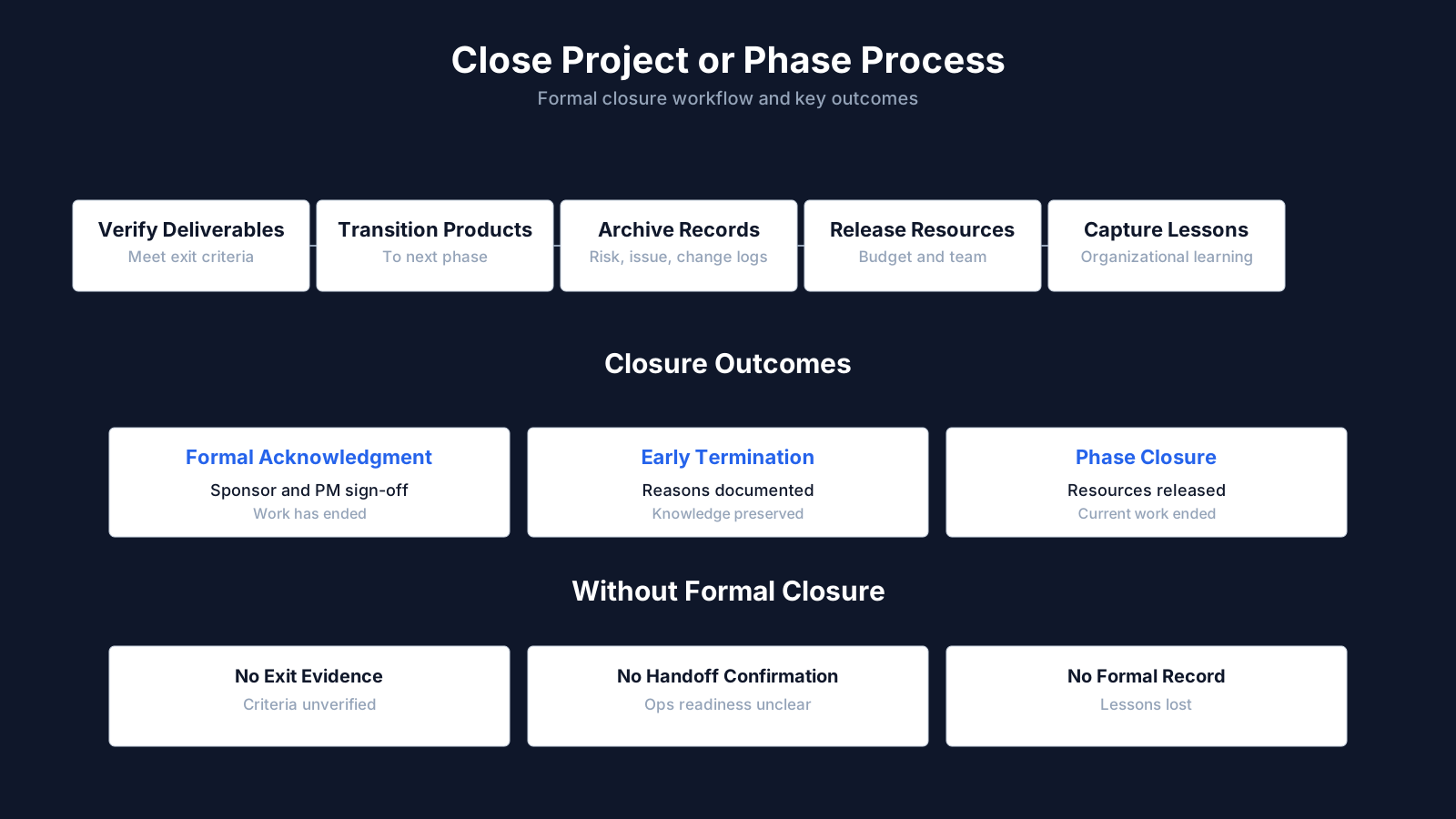
Closing a project or phase is the process of finalizing all activities across all of the Project Management Process Groups to formally complete the project or phase. In PMBOK terminology, this process is part of Project Integration Management and sits within the Closing Process Group. The project manager reviews all prior information from previous phase closures to ensure that all project work is complete and that the project has met its objectives. Since project scope is measured against the project management plan, the project manager will review that document to ensure completion before considering the project closed. The Close Project or Phase process also establishes the procedures to investigate and document the reasons for actions taken if a project is terminated before completion.
What this really means in practice is that closing is not simply a final meeting or a sign-off email. It is a structured set of administrative tasks that confirms the work is done, the outputs are accepted, and the organization has captured useful knowledge. Many project managers underestimate this process because the deliverables have already been handed over. However, without formal closure, there is no clear evidence that the exit criteria were met, no confirmation that operational teams are ready to take over, and no formal record of what went well or poorly. The closing process turns a working project into a finished asset.
Closing a Project or Phase: Key Topics Summary
| Key Concept | Summary |
|---|---|
| Closure Milestone | Project closure marks the formal checkpoint at which the project manager and sponsor confirm that allocated resources are released and the project ceases to draw on budget or team capacity. |
| Scope of Closure | Closure scope encompasses meeting completion and exit criteria, transferring products or services to operational owners, and preserving project records for future reference and audits. |
| Exit Criteria | Exit criteria are predefined conditions documented in the project management plan or phase gate reviews, typically including customer acceptance, completed testing, issue resolution, and formal sponsor sign-off. |
| Mandatory Deliverables | The project plan may mandate training materials and a documented support process. These deliverables remain non-negotiable even when the primary software system is fully operational. |
| Handover Requirements | Handover requirements may include transferring source code, completing a security audit, and migrating data to the operational database before closure can be approved. |
| Decision Documentation | The closure process requires recording the rationale for decisions, particularly when a completion criterion is partially unmet yet the project is still authorized to close. |
| Administrative Closeout Actions | Administrative actions may include closing project financial accounts, archiving project records, releasing resources, and updating organizational process assets to capture lessons and improve future delivery. |
| Closure Record Checklist | Closure checklists typically capture the final performance report, contract closeout confirmation, resource release documentation, and lessons learned workshop outputs. Later reviews may verify earlier closure records such as permits. |
The Purpose and Scope of Closing a Project or Phase
The formal project closure process serves several distinct purposes that go beyond simply ending the work. It verifies that the project has delivered what it was supposed to deliver, it transitions products to the next phase or to operations, and it captures organizational learning. In addition, it provides a formal point at which the project manager and sponsor can acknowledge that resources are released and that the project no longer consumes budget or team capacity. This process is not a single activity but a collection of administrative actions, reviews, and documentation tasks. The scope of closure includes satisfying completion or exit criteria, transferring products or services, and collecting records for future use.
One common misconception is that closing only happens at the very end of a project. In reality, closure can happen at the end of any phase. For a large program delivered in stages, each phase has its own exit criteria and its own closure review. The project manager reviews prior phase closure information before the overall project closes. This cumulative review ensures that no detail from earlier stages is lost. If a phase was closed with unresolved issues, those issues must be addressed or explicitly carried forward. Closing a phase is therefore a chance to correct course before moving into the next stage.
Why Closing a Project or Phase Matters in Project Management
Formal closure matters because it creates a single, auditable point where the project's results are measured against the project management plan. Without that measurement, a project can drift into operational use without anyone confirming that the original scope was actually achieved. The project manager reviews the project management plan, not just the final deliverable, to determine completion. This includes checking that the scope baseline, schedule, cost, quality requirements, and stakeholder expectations have been addressed. The plan is the yardstick. If the plan says the team must deliver training materials and a support process, those items cannot be skipped just because the main software system is working.
In a typical scenario, a project manager might feel that the project is finished because the product was delivered and accepted. But the project management plan may also require the handover of source code, the completion of a security audit, and the migration of data to an operational database. Those are exit criteria that must be checked before closure. If the project manager simply stops work after delivery, the formal closure process would reveal the missing items. That is why the plan is reviewed rather than relying on the team's collective feeling of completion.
Consider a construction project that is delivered in three phases: design, civil works, and interior finishing. Each phase has its own closure review. At the end of civil works, the project manager reviews the structural inspections and permits. If any permit is missing, the phase is not closed. That missing permit becomes a condition for the next phase or a formal exception. When the overall project closes months later, the project manager reviews the civil works closure record to confirm that the permit was eventually obtained. This chain of phase closures is what allows the final project closure to be credible.
Another layer of the purpose is that closure activates the administrative side of the project. The project manager must verify that contracts are closed, that financial accounts are settled, and that team members are formally released. Some of these actions may have been completed incrementally, but the closing process brings them together into a single point of accountability. Without this, an organization may continue to carry a project as active long after the work has stopped, which distorts portfolio reporting and resource allocation.
Core Insights on Project Closure
- Purpose of formal closure
- Formal closure serves as the control gate that confirms the project met its agreed objectives, transfers deliverables into operational ownership, captures lessons that benefit future initiatives, and releases committed resources and budget in a controlled manner.
- Closure as administrative process
- Project closure unfolds as a structured sequence of administrative actions, governance reviews, and documentation tasks that together satisfy exit criteria, hand over products or services to their intended owners, and preserve records for audit and organizational learning.
- Auditable measurement point
- Closure establishes a definitive audit point where actual outcomes are evaluated against the project management plan, confirming that scope, schedule, cost, quality, and stakeholder commitments have been formally reconciled and accepted.
Administrative Closure Activities and Exit Criteria
One of the first tasks in closing a project or phase is to confirm that the administrative closure activities have been completed in a systematic way. The source material describes step-by-step methodologies that address the actions necessary to satisfy completion or exit criteria for the phase or project. These exit criteria are the conditions defined in the project management plan or phase gate documentation that must be met before the work can be formally considered complete. Examples include acceptance of deliverables by the customer, completion of required testing, resolution of open issues, and sign-off from the project sponsor or steering committee.
Administrative closure is not the same as technical closure. Technical closure might mean that the product works as designed. Administrative closure means that all of the paperwork, approvals, and governance steps have been followed. A project can have a technically complete product but still be administratively open because the final acceptance form has not been signed or because a vendor contract has not been closed out. The project manager needs to track both dimensions. The step-by-step methodologies mentioned in the Close Project or Phase process are particularly useful here because they reduce the chance of missing a required sign-off or record.
Satisfying Exit Criteria When Closing a Project or Phase
Satisfying exit criteria involves checking each criterion against evidence. If the criterion is that the system passes a user acceptance test, the project manager should have the signed test report. If the criterion is that the operations team has completed training, the training attendance records should be available. The project manager does not simply rely on verbal confirmation. The process of closing a project or phase requires that the reasons for actions taken be documented, especially when a criterion is not fully met but the project is still allowed to close. That documentation becomes part of the project record.
There is a practical tension here. In some organizations, exit criteria are treated as a formality and the project manager rushes to get sign-offs without actually verifying the evidence. That undermines the entire closure process. A better approach is to treat exit criteria as contractual obligations. If the project manager can say, with evidence, that each criterion has been met, the closure becomes defensible. If not, the gap should be raised before the project is formally closed. This is particularly important in regulated industries where audit trails are mandatory.
Actions Needed Before Sign-Off
Before sign-off, the project manager will typically review the project management plan and the prior phase closure documents. The plan may specify administrative actions such as closing project accounts, archiving project files, releasing project resources, and updating organizational process assets. These actions are not optional. They ensure that the project is not left in a state where money can still be spent, people are still assigned, or documents are scattered. Without them, the organization cannot accurately report on project completion or redeploy resources to new initiatives.
A useful practice is to create a closure checklist early in the project, not at the end. When the project manager writes the project management plan, they can include the closure activities that will be required. This makes closure a planned activity rather than a reactive scramble. The checklist can include items like final performance report, contract closeout, resource release, and lessons learned workshop. Then, when the project reaches its final weeks, the team already knows what evidence they need to gather.
Transferring Products, Services, and Results to Operations
The next major area of closing a project or phase involves the actions needed to transfer project deliverables to operations or to the next phase. The source material specifies that this includes actions and activities necessary to transfer the project's products, services, or results to the next phase or to production and operations. This transfer is often the point at which the project team hands over responsibility to a different group. The project manager must ensure that the receiving group has the knowledge, documentation, and access required to use and maintain the deliverable.
Transfer is not just a matter of sending an email with a file attachment. It involves formal handover meetings, training sessions, system access, and sometimes a period of hypercare where the project team remains available to support the operational team. The project manager reviews what was delivered against the project management plan to confirm that the transfer includes everything that was promised. For example, if the project deliverable is a new software platform, the transfer might include source code, database schemas, user manuals, deployment scripts, and a support runbook. Missing any of these could create operational risk immediately after the project closes.
Planning for a Smooth Transition to Production
A smooth transition begins long before the closing process. The project manager should identify the operational owner early and involve that person or team in the development of the transition plan. The transition plan describes what will be transferred, when, and how acceptance will be confirmed. During closing, the project manager verifies that the transition plan was executed correctly. Any open items from the transition are either resolved or formally transferred as known issues with an assigned owner.
In some projects, the transition to operations is gradual. The project team may run the new process in parallel with the old one for a period to verify stability. This parallel run is part of the transfer activities. The project manager uses the close process to confirm that the parallel run has ended and that the operational team is now fully responsible. The formal handover date becomes part of the project record and is often a key milestone for the organization.
Transferring to the Next Phase
When a project is organized in phases, the transfer may be to the next phase rather than to final operations. In that case, the closing activities for the current phase include documenting what has been completed, what decisions were made, and what constraints apply to the next phase. The project manager reviews the phase closure information before starting the next phase. This prevents the next phase from inheriting unresolved issues or outdated assumptions. The phase closure record acts as a bridge between phases.
This type of transfer is common in product development where a concept phase closes and the design phase begins. The output of the concept phase might be a set of approved requirements and high-level designs. Those artifacts are formally transferred to the design team. If the concept phase is closed without transfer, the design team may start from incomplete or informal inputs, leading to rework later. The close process makes the handover explicit.
Key Takeaways on Operational Handover
- Deliverables pass to operations
- Formal project closure requires transferring deliverables, services, and results to the next operational phase or production environment, typically shifting ownership and accountability to a separate team.
- Equip receiving group fully
- The receiving team must be fully prepared with the necessary knowledge, documentation, and system access, delivered through structured handover meetings, training sessions, and where appropriate, a hypercare support period.
- Verify delivery against plan
- The project manager validates delivered outputs against the project management plan to confirm the transfer includes all committed components, such as source code, user manuals, deployment scripts, and support runbooks for a software platform.
- Involve operational owner early
- The operational owner should be identified and engaged early in transition planning, and any unresolved items must be either closed or formally transferred as known issues with clear ownership.
Collecting Project Records and Auditing Project Success or Failure
Another core component is the collection of phase or project records and the audit of project success or failure. The collection of project records and audit activities are not just about filing documents; they are about creating a factual basis for evaluating what happened. The project manager gathers project records, including plans, reports, change logs, issue logs, risk registers, and correspondence. These records are then used to audit whether the project met its objectives and where it deviated from the plan.
The audit is a formal or semi-formal review of the project's performance. It compares actual results against the project management plan and the approved baselines. The audit may examine schedule variance, cost variance, scope changes, quality metrics, and stakeholder satisfaction. The purpose is not to assign blame but to determine what worked and what did not. The output of this audit becomes input to the lessons learned process and to future project planning.
What an Audit of Project Success or Failure Actually Covers
An audit of project success or failure covers more than just whether the deliverable was produced. It looks at whether the project met its objectives, which may include business value, customer satisfaction, and compliance requirements. The project manager reviews the project management plan to see what success criteria were defined. If the original success criteria were vague, the audit will reveal that too. The audit should also examine the reasons for any actions taken, especially if the project was redirected, delayed, or terminated early. That documentation is part of the investigation requirement in the Close Project or Phase process.
For example, a project might have delivered the product on time but failed to achieve the expected operational efficiency because the training component was cut. The audit would identify that gap, even though the technical deliverable was complete. This broader view of success and failure is why the closing process includes an audit. It forces the organization to look beyond the immediate output and consider the intended outcome.
Using Records to Verify Completion During Closing a Project or Phase
Project records serve as the evidence base for closure. The project manager cannot verify completion simply by walking around and asking if the work is done. They need records that prove it. The project management plan is the primary reference, but supporting records include test results, acceptance documents, meeting minutes, and financial reports. Collecting these records during closing ensures that the project has a complete archive. If records are missing, the project manager must either locate them or document the gap.
One practical pitfall is that records may be scattered across multiple systems and personal drives. By the time closure starts, the project manager may find that some team members have already left and taken important documents with them. To avoid this, record collection should be an ongoing activity throughout the project, not a last-minute scramble. The closing process then becomes a verification step rather than a forensic exercise.
Gathering Lessons Learned and Archiving Project Information
Capturing lessons learned and archiving project information is often considered the most valuable long-term output of closing a project or phase. The lessons learned and project information archive ensures that future projects do not repeat the same mistakes and can reuse useful approaches. The source material includes activities needed to gather lessons learned and archive project information for future use by the organization. This step turns individual project experience into organizational knowledge.
Lessons learned should be gathered from a range of perspectives, not just the project manager's. Team members, sponsors, customers, and operational staff all have relevant observations. The lessons learned session can be conducted as a workshop, a survey, or a series of interviews. The project manager facilitates the session to identify what went well, what went poorly, and what should be done differently next time. The output is a documented set of lessons that are stored in the organizational process assets.
Conducting a Lessons Learned Review
A lessons learned review works best when it is structured around the project management plan and the actual performance data. The project manager can present the schedule, cost, and scope performance as a starting point. Then the group discusses the root causes of variances and the actions that contributed to successes. The goal is to move from general statements like "communication was poor" to specific recommendations like "the weekly status report did not include enough detail on risk status, so risks were escalated too late." That level of specificity makes the lessons actionable for future teams.
Timing matters. The lessons learned session should happen soon enough after the work that memories are fresh, but not so early that the team is still distracted by the transition. In a phase closure, the lessons learned from the phase can be applied immediately to the next phase. This is one of the strongest arguments for closing phases formally. The organization gets the benefit of learning before the overall project has even finished.
Archiving Project Information for Future Use
Archiving project information is not the same as collecting records for the audit. The archive is the final, organized repository of the project's documents. It includes the project management plan, baselines, change requests, status reports, issue logs, risk registers, financial records, and the final performance report. The archive may also include the project charter, stakeholder register, and communication artifacts. The project manager ensures that the archive is complete, indexed, and stored in a location accessible to authorized personnel.
A well-organized archive allows the organization to retrieve historical information for future estimates, audits, or dispute resolution. Without it, every project starts from a blank page, and the organization loses the benefit of its own experience. The archive also supports the investigation and documentation requirement if a project is terminated early. The reasons for termination and the actions taken are part of the archive, so the organization can learn from that too.
From a Business Value-Oriented Project Management perspective, closing also asks whether the project delivered non-financial program benefits such as employee engagement improvements or future risk reduction. Some programs use realization sets that allow different projects to choose their own methodology while still contributing to a shared closing review. This broader view of benefits keeps the closure discussion from focusing only on schedule and cost.
Key Insights on Lessons Learned
- Organizational knowledge conversion
- Lessons learned convert individual project experiences into reusable organizational knowledge, which helps future teams avoid repeated mistakes and apply proven approaches with greater confidence.
- Diverse stakeholder participation
- Workshops, surveys, and structured interviews allow team members, sponsors, customers, and operational staff to contribute diverse perspectives, strengthening the quality and relevance of the lessons captured.
- Specific recommendation focus
- Grounding the review in the project management plan and actual performance data turns general impressions into specific, actionable recommendations that are easier to apply on future initiatives.
- Comprehensive archive and benefits
- The project archive consolidates baselines, change requests, risk registers, and financial records, while the closing review also evaluates non-financial program benefits to capture the full value delivered.
Closing a Terminated Project Before Completion
Not every project reaches its intended conclusion. The Close Project or Phase process also applies when a project is terminated before completion. In such cases, the terminated project closure procedures are used to investigate and document the reasons for actions taken. The project manager still performs many of the same administrative closure activities, but the focus shifts from verifying success to capturing the state of the work and the rationale for stopping. This is often uncomfortable, but it is critical for organizational learning and for protecting legal and financial interests.
When a project is terminated early, the project manager must document what has been completed, what remains open, and what assets exist. The project records, including the project management plan and any change requests, are gathered and archived. The reason for termination is recorded in a factual, non-blaming manner. The project manager may also need to coordinate the release of resources and the closure of contracts, just as they would in a normal closure. The key difference is that the deliverable is not transferred to operations as a finished product, but any partial results may still have value.
Documenting Reasons for Early Termination
Documenting the reasons for early termination requires careful attention to facts. The project manager should reference the project management plan and the performance data that led to the decision. If the project was terminated because the business case no longer justified the investment, that should be stated with the supporting financial analysis. If the project was terminated because of a shift in organizational strategy, the new strategy should be referenced. The goal is to create a clear record that explains why the project stopped, so that future decision-makers can understand the context.
This documentation also serves a defensive purpose. If the organization is later asked why it spent money on a project that was cancelled, the closure record provides the answer. It shows that the decision was based on documented analysis and that the project was formally closed rather than simply abandoned. Abandoning a project without closure leaves open contracts, unresolved risks, and a confusing portfolio. Formal closure of a terminated project prevents those problems.
What Happens to Partial Deliverables
Partial deliverables from a terminated project may still have value to the organization. The project manager should assess what has been produced and determine whether any of it can be reused. Code libraries, design documents, market research, and vendor contracts may be transferable to another initiative. The closure process includes the same transfer activities, but the receiving party may be a different project or a knowledge repository rather than operations. The project manager documents what is transferred and where it goes.
If no part of the deliverable is usable, the project manager still archives the project records for future reference. The lessons learned from a terminated project can be particularly valuable because they may reveal early warning signs that other projects should watch for. The organization learns not only from projects that succeed but also from those that stop.
Common Pitfalls and Misconceptions in Project Closure
Many project managers treat closure as an afterthought, and that leads to a set of predictable project closure pitfalls. The first pitfall is assuming that project closure is just a final presentation. In reality, it requires evidence-based verification against the project management plan, formal transfer of deliverables, and collection of records. When closure is compressed into a one-hour meeting, the organization loses the audit trail and the learning. The result is a project that looks closed on the surface but remains open administratively.
Honestly, many project managers have skipped the retrospective to save time, only to see the same mistakes repeat on the next project. Another common misconception is that closing a phase is less important than closing the whole project. Phase closures set the quality of the overall project closure. If a phase is closed sloppily, the issues and missing records from that phase will haunt the project later. The project manager should treat each phase closure with the same rigor as the final closure. This includes satisfying the phase exit criteria, transferring the phase outputs, and capturing lessons learned before moving on.
Mistaking Technical Completion for Project Closure
Technical completion and project closure are often confused. A product can be technically complete when it passes its final test, but the project is not closed until the administrative, contractual, and knowledge transfer activities are done. The project manager may need to remind stakeholders that the deliverable is not the only output. The project management plan often includes obligations that go beyond the product itself. Those obligations are part of the scope, and they must be met before the project can be closed.
This distinction matters because resource release, financial closure, and operational handover depend on formal closure. If the project manager declares closure too early, resources may be reassigned before the operational team is fully ready. The result is a risky gap in support. A disciplined closure process prevents that by sequencing technical acceptance before administrative closure, but not collapsing the two into the same event.
Skipping Lessons Learned Due to Time Pressure
Time pressure is the most common reason lessons learned are skipped. At the end of a project, the team is often already moving to the next assignment. The project manager may feel that the lessons learned session is a luxury that cannot be justified. That is a false economy. Without lessons learned, the organization repeats the same mistakes on the next project, costing more time than the session would have taken. The closing process includes lessons learned for a reason.
One practical workaround is to hold lessons learned incrementally throughout the project. Instead of waiting for the final week, the project manager can capture lessons at each phase closure. This spreads the effort and makes the final lessons learned session shorter. It also means that the team can apply their insights to the next phase immediately, which improves the current project. That is a better return on the time invested.
Key Insights on Closure Pitfalls
- Closure is more than presentation
- Effective closure requires evidence based verification, formal handover of deliverables, and complete records collection rather than a single final presentation.
- Retrospectives prevent repeated mistakes
- Skipping the retrospective to save time often allows the same unresolved issues to recur in the next project, weakening team learning and delivery quality.
- Early closure creates hidden gaps
- Declaring closure before administrative, contractual, and knowledge transfer activities are finished leaves the project administratively open and the operational team without the preparation needed to sustain results.
The Discipline of Phase Closure in Multi-Phase Projects
In multi-phase projects, phase closure is the backbone of project control. The phase closure process creates a defined point between stages where the project manager reviews progress, confirms exit criteria, and authorizes the next phase. The source material states that when closing the project, the project manager will review all prior information from previous phase closures. That is only possible if each phase was closed with complete records and clear outputs. A well-run phase closure makes the overall project closure significantly easier.
Phase closure also allows the organization to make a go/no-go decision before committing more resources to the next phase. At the end of a phase, the project manager presents the phase results and the updated business case. The sponsor or steering committee decides whether the project should continue. This gate review is an integral part of the phase closure process. It ensures that the project is still aligned with organizational strategy and that the benefits justify the continued investment.
Using Phase Gates to Validate Progress
Phase gates are the formal review points at the end of a phase. They validate that the phase exit criteria have been met and that the project is ready to proceed. The project manager prepares a phase closure report that summarizes the phase performance, the deliverables produced, and any open issues or risks. The gate review panel then makes a decision. The options are typically to proceed, to proceed with conditions, to revise the plan, or to terminate the project. Each decision must be documented.
From a closure perspective, the phase gate is the moment when the phase is formally closed and the next phase can begin. If the gate review requires changes, those changes are incorporated into the project management plan before the next phase starts. The phase closure record captures the gate decision and any conditions. This becomes part of the overall project archive and is reviewed again at final closure.
Carrying Forward Issues from One Phase to the Next
Not every issue can be resolved within its phase. Some risks or defects are intentionally carried forward to a later phase. The phase closure process must document how these items are transferred. The project manager records the issue, the reason for deferral, and the phase in which it will be addressed. This prevents the issue from being lost. When the next phase begins, the project manager reviews the carried-forward items as part of the phase initiation activities.
Carrying forward issues is not a failure of closure. It is a normal part of managing phased work. However, the project manager must be transparent about it. If an exit criterion is partially met, that should be stated explicitly. The phase gate can then decide whether the gap is acceptable. This is better than pretending the criterion was fully met and leaving the next phase to discover the problem later.
Closing in Different Project Management Frameworks
The core activities of closing a project or phase remain consistent across frameworks, but the terminology and emphasis vary. In PMBOK, Close Project or Phase is a defined process in the Closing Process Group and Project Integration Management knowledge area. PRINCE2 treats closing a project as a process that confirms the acceptance of products, reviews the project against its original objectives, and prepares for a post-project benefits review. Agile environments often embed closure activities into iteration reviews and retrospectives, but they still need a final project closure to release resources and capture product-level learning.
In all frameworks, the closing activities across project management methodologies share the same basic intent: verify completion, transfer outputs, and capture knowledge. What differs is how formally these activities are structured. A highly regulated project may require formal sign-offs and audit trails, while a small internal project may close with a brief review and an archived folder. The project manager should adapt the depth of closure to the project's size and risk profile, but skipping closure entirely is rarely justified.
Agile Retrospectives and Project Closure
Agile teams hold retrospectives at the end of each iteration, which is a form of phase closure. The retrospective reviews what worked, what did not, and what to improve next. However, the end of the final iteration still requires a project-level closure. The product owner accepts the final product increment, the team reviews the product against the vision, and the organization archives the product backlog and other artifacts. The lessons learned from retrospectives are consolidated into a project-level review.
One difference in Agile is that the product may continue evolving after the project closes. The project team may hand the product to a persistent product team rather than to operations. The closure process still applies, but the transition is to the product owner and the ongoing development team. The project manager or Scrum Master ensures that the product backlog, technical documentation, and support arrangements are transferred. The closing process is not less important simply because the product lives on.
PRINCE2 Closing a Project Process
PRINCE2 has a specific process called Closing a Project. It is triggered when the project has delivered all planned products or when the project board decides to close the project prematurely. The process checks that the products have been accepted, that the project has met its objectives, and that follow-on actions are identified. PRINCE2 also includes a review of the project against its original baseline and the preparation of an end project report. This mirrors the PMBOK emphasis on reviewing the project management plan and capturing lessons learned.
The PRINCE2 approach is helpful because it makes closure a decision point, not just an activity. The project board formally authorizes closure based on evidence. The project manager presents the end project report and the lessons log. Only then is the project considered closed. This aligns with the PMBOK requirement that the project manager review prior information and confirm that the project has met its objectives before considering the project closed.
Key Insights on Project Closing
- Consistent core intent
- Across methodologies, project closing consistently serves three essential outcomes: confirming that deliverables meet agreed acceptance criteria, transferring outputs to their intended owners, and retaining lessons learned for future initiatives.
- PMBOK formalized process
- PMBOK formally establishes Close Project or Phase as a dedicated process within the Closing Process Group and under the Project Integration Management knowledge area, ensuring that all project work is systematically concluded and documented.
- PRINCE2 objective review
- PRINCE2 positions the closing process as the point where product acceptance is confirmed, actual performance is measured against the original business case, and foundations are laid for evaluating benefits after the project has been handed over.
- Agile embedded closure
- Agile environments integrate closure into recurring review and retrospective cycles, yet a formal end-of-project closure remains necessary to release resources and capture durable product-level insights for the organization.
- Adapting closure depth
- The project manager should calibrate the rigor of project closure to the project's complexity and risk exposure; highly regulated initiatives require formal sign-offs and auditable records, whereas low-risk efforts may be closed with a concise review and a well-organized archive.
Final Review Against the Project Management Plan
The final review against the project management plan is the anchor of the entire closing process. The final project management plan review requires the project manager to compare what was planned with what was delivered, including scope, schedule, cost, quality, and stakeholder expectations. The plan is not just a historical document; it is the standard for measuring completion. The project manager reviews this document to ensure completion before considering the project closed. Any deviations must be documented and either resolved or accepted through formal change control.
This review is not about finding someone to blame for variances. It is about creating an accurate record of how the project performed. The project manager examines the baselines and the change log. Approved changes are reflected in the updated plan, so the review is against the current plan, not the original one. Unapproved changes or undocumented scope additions are noted as issues. The review also confirms that all project work has been completed, not just the visible deliverable.
Verifying Scope Completion Against the Baseline
Verifying scope completion means checking that every requirement in the scope baseline has been delivered and accepted. The project manager may use a requirements traceability matrix to map each requirement to its deliverable and acceptance evidence. This is especially useful on large projects where requirements are numerous and dispersed across teams. If a requirement was deferred or changed, the change log should show the approval. If not, it is a gap that must be addressed before closure.
This level of detail can feel tedious, but it is the only way to be certain that the project has met its objectives. The scope baseline is not a suggestion. It is a formal agreement between the project team and the sponsor. The closing process gives the project manager a chance to demonstrate that the agreement has been fulfilled. That demonstration is part of the project's final record and may be reviewed by auditors or future project teams.
Confirming Administrative and Contractual Closure
Confirming administrative and contractual closure involves checking that all project accounts are closed, all contracts are settled, and all resources are released. The project manager reviews the procurement records to ensure that vendor agreements are formally closed and that any final payments are processed. The project manager also verifies that the project team has been reassigned or released according to the resource management plan. These administrative actions are part of the closure checklist and are necessary for the project to be considered fully closed.
The final review against the project management plan brings all of these threads together. It verifies scope completion, checks the performance against baselines, and confirms that administrative and contractual actions are complete. Once this review is done, the project manager can formally recommend closure to the sponsor or project board. The project is then closed, and the organization can apply the lessons learned to future work.