Every project, from the simplest marketing campaign to a multi-year infrastructure initiative, lives and breathes through the interactions of its process groups. How do the process groups interact throughout a project? The answer is far more dynamic than any linear diagram might suggest. Project management process groups are overlapping activities that occur throughout the entire endeavor, not discrete or one-time events. This reality reshapes how project managers plan, execute, and control their work, because the boundaries between initiating, planning, executing, monitoring and controlling, and closing are more like membranes than walls. A change in one area immediately ripples into others, and that continuous interplay is what keeps a project aligned with its objectives despite constant flux.
Process Group Interactions: At a Glance
| Key Concept | Summary |
|---|---|
| Process Group Dynamics | Process Groups are overlapping, interactive domains rather than linear phases, with each group's intensity ebbing and flowing throughout the project lifecycle to match evolving demands. |
| Interaction Visualization | A time-based intensity curve, analogous to Figure 3-2 in the PMBOK Guide, reveals how process activities peak and intersect, reflecting the natural rhythm of project management work. |
| Risk Feedback Loop | When a risk is identified during Executing, it flows through Monitoring and Controlling back into Planning to refine the response, transforming potential disruptions into systematic course corrections. |
| Stakeholder Feedback Integration | Stakeholder feedback that surfaces misalignment during Monitoring and Controlling triggers immediate replanning, restoring alignment in real time rather than deferring corrections to a post-project review. |
| Monitoring Cadence | Limiting Monitoring and Controlling to scheduled gate reviews enables minor deviations to escalate into major variances, ultimately forcing extensive and costly replanning efforts. |
| Concurrent Process Execution | In adaptive environments, Planning activities such as feature mapping often run concurrently with early Executing like proof-of-concept development, blurring the division between process groups. |
| Overlap as Risk Mitigation | The built-in overlap of Process Groups is a deliberate risk mitigation design, enabling early deviation detection and seamless correction flow across Planning, Executing, and Monitoring and Controlling. |
| Variance Response Mechanism | Upon detecting a variance, Monitoring and Controlling feeds data into Planning to adjust baselines while simultaneously directing Executing to implement corrective actions, forming a continuous adjustment loop. |
| Phase Transition Handoffs | In multi-phase projects, Closing outputs such as approved design documents and formal customer acceptance serve as critical inputs for Planning and Executing in subsequent phases, ensuring integrated progress. |
How Process Groups Interact Throughout a Project: The Overlapping Framework
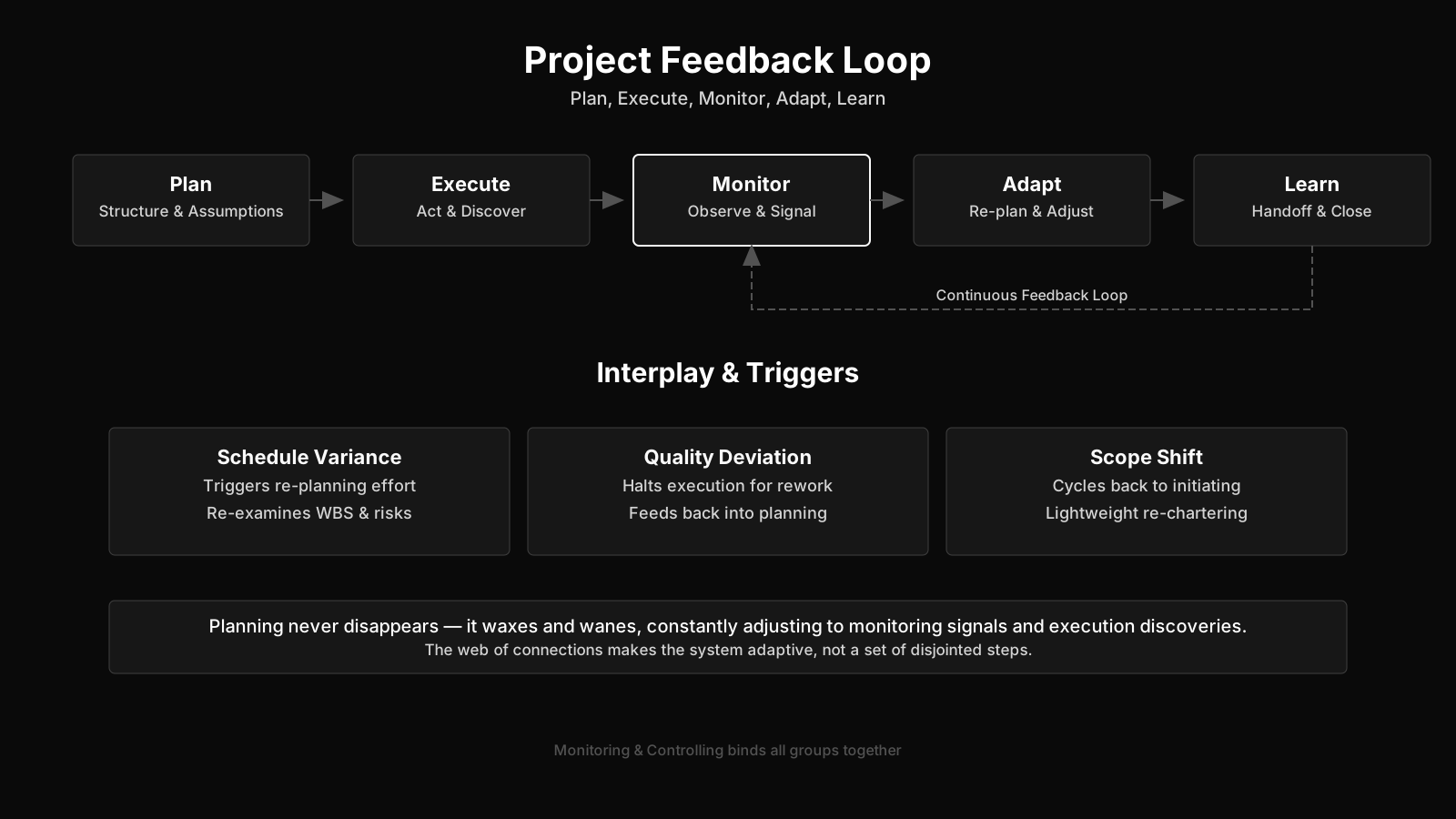
Understanding process group interactions throughout the full lifecycle begins by recognizing that they are not sequential phases but a set of interrelated activities that ebb and flow in intensity. The PMBOK Guide describes five process groups: Initiating, Planning, Executing, Monitoring and Controlling, and Closing. In practice, these groups do not wait for a formal handoff. While the Initiating Process Group formally starts the project and the Closing Process Group ends it, the other groups swirl in a continuous dance. Planning feeds Executing, Executing triggers Monitoring and Controlling, and that monitoring in turn updates Planning, which then adjusts Executing, all while the project marches toward closure. This integrative nature is what makes project management a discipline of constant rebalancing.
A common way to visualize this is through a curve chart similar to the one referenced as Figure 3-2 in the PMBOK Guide, where the level of process interaction overlaps at various times. Early in the project, Initiating and Planning dominate, but even then some Executing may kick off for early prototypes or procurement. Mid-project, Executing peaks, and Monitoring and Controlling is at its highest intensity, while Planning remains active as adjustments are made. Toward the end, Closing ramps up, yet Monitoring and Controlling stays engaged to validate final deliverables. The overlap ensures that no process ever truly sleeps; it simply waxes and wanes in urgency.
That overlap is where many junior project managers stumble. They treat the process groups like a checklist, finishing all planning before a single line of code is written or a brick is laid. In reality, the output of one process almost always becomes the input to another, and the moment Executing surfaces new information, the Planning group must re-engage. This is not a sign of poor initial planning but of a healthy feedback mechanism. A project that doggedly sticks to a plan formed in ignorance of emerging realities is a project headed for failure. So the fundamental interaction model is: no group works in isolation, and the threads between them are woven by information and deliverables flowing in multiple directions.
Why Understanding Process Group Interactions Is Critical
Grasping these interactions transforms decision-making. When a project manager understands that a risk identified during Executing must loop back through Monitoring and Controlling into Planning to update the risk response plan, they stop seeing changes as disruptions and start seeing them as natural corrections. This perspective also prevents the all-too-common habit of deferring critical stakeholder engagement to the end of Executing. If stakeholder feedback gathered during Monitoring and Controlling reveals a misalignment, the interactions demand that Planning be revisited immediately, not in a post-mortem. The process groups are designed to let such corrections happen without derailing the entire project, but only if the project manager allows them to interact.
Another less obvious reason the interactions matter is resource and time management. If Executing is asked to proceed with incomplete information because Planning is artificially frozen, rework explodes. Conversely, if Monitoring and Controlling is only practiced during scheduled gate reviews, small deviations grow into major variances that require massive replanning efforts. The overlapping nature of the groups means that continuous, smaller corrections are far more efficient. You are essentially trading a few hours of weekly replanning for weeks of crashing and firefighting. This is a deeply practical insight that separates seasoned project managers from novices.
The Dynamic Overlap Illustrated Through a Technology Project
Consider a small software development effort to build a customer portal. During initiation, the team defines the high-level scope and obtains authorization. Almost immediately, planning begins to map out features, but the team also starts executing a proof-of-concept on a core module while the full plan is still being drafted. That early execution generates technical findings that flow into the planning process and reshape the architecture. Meanwhile, monitoring and controlling tracks the proof-of-concept progress against initial sketches, feeding back into both execution and planning. Closing activities are not yet in sight, but the groundwork for acceptance criteria is already being laid in the planning documents. No single phase transition occurs; all groups are breathing together. This is the reality of how process groups interact: a messy, productive, living system.
What happens if the project manager insists on a rigid waterfall where planning must be fully signed off before any execution? The proof-of-concept disappears, and the architecture is based on assumptions that turn out to be wrong. The monitoring group, forced to wait, cannot catch the misalignment until the plan is already locked. By the time it does, the cost of change is far higher. The overlapping nature of the process groups is not just a theoretical construct; it is a risk mitigation strategy embedded into the very fabric of project management methodology.
Core Insights on Process Group Overlap
- Overlapping, not sequential phases
- Process groups form an interdependent system of activities whose intensity expands and contracts across the project lifecycle, replacing a rigid checklist mentality with a dynamic, adaptive framework.
- Continuous feedback loops drive work
- Planning outputs directly shape Executing efforts; Executing performance promptly activates Monitoring and Controlling, whose insights feed back into renewed Planning and refined Executing in a persistent cycle that continues until formal closure.
- Interactions enable adaptive management
- Seeing risks identified during Executing as inputs that move through Monitoring and Controlling back into Planning allows project managers to treat adjustments as legitimate course corrections rather than unwelcome disruptions.
The Integrative Role of the Monitoring and Controlling Process Group
The integrative nature of project management requires the Monitoring and Controlling Process Group to interact with all other Process Groups. The monitoring and controlling process group integrates with every other group without exception. It does not sit between Planning and Executing like a checkpoint; it permeates them all. While Initiating is underway, monitoring verifies that the project charter aligns with organizational strategy. During Planning, it tracks the development of the project management plan against standards and performance baselines. During Executing, it compares actual work to the plan. During Closing, it ensures that all acceptance criteria have been met and that administrative closure can occur. This omnipresence makes it arguably the most pervasive group in the entire framework.
The common image of monitoring as a passive observer is deeply misleading. The group actively generates change requests, recommends corrective actions, and triggers updates to the project management plan. When a variance is detected, the response is not simply to note it and move on; the monitoring process pushes that information into the Planning Process Group, which then adjusts the plan, and from there into the Executing Process Group to implement the change. This creates a three-way dialogue that is the beating heart of project control. It is why the PMBOK Guide emphasizes that monitoring and controlling process interactions are the integrative glue that holds the project together.
Monitoring's Constant Dialogue with Planning
Planning provides the baselines that monitoring uses to measure performance. Without those baselines, monitoring has no reference point. But the relationship is far from one-directional. As monitoring collects actual data, it feeds analysis back into planning. If the schedule performance index drops, planning is forced to revisit the schedule network, adjust resource allocations, or compress the timeline. This cyclical interaction is what makes the project management plan a living document. Some practitioners mistakenly believe that once the project management plan is approved, the planning group is essentially done. In reality, planning remains active precisely because monitoring keeps sending signals that things have changed.
There is a subtlety here that many struggle with: the same process that updates the plan is distinct from the execution of the work. You are not replanning just because a task took longer; you are revising the plan to reflect the new reality, so that the remaining work can be forecast accurately. That revision is a planning activity, triggered by monitoring, but carried out by the project team using planning processes. The line between the groups blurs intentionally, and trying to keep them artificially separate only creates communication delays that defeat the purpose of integrated control.
The Link Between Executing and Closing Through Monitoring
Monitoring and Controlling also provides a vital bridge from Executing into Closing. As deliverables are produced, monitoring verifies them against quality requirements and scope definitions. The acceptance decisions that enable phase or project closure rely on this verification. If a deliverable fails inspection, monitoring sends it back to Executing for rework, and the planning group may need to adjust the schedule or add resources. This feedback loop repeats until the criteria for completion are satisfied. Then, and only then, does Closing finalize the processes. It is an unglamorous but essential role: monitoring is the gatekeeper that ensures no premature closure slips through.
Without this integration, projects would rush to declare victory, leaving behind a trail of untested outputs that later cause operational nightmares. By embedding monitoring across all groups, the framework bakes in a quality assurance mechanism that is both proactive and reactive. The constant interplay means that quality is not inspected at the end but built in through a series of loops that touch every process.
From Initiation to Closing: How Process Groups Bridge the Lifecycle
The Initiating Process Group begins the project and the Closing Process Group ends it, but process groups bridge the full project lifecycle from initiation to closing in ways that go far beyond bookend activities. Initiation sets the foundational authorization and identifies stakeholders, but its outputs do not simply get filed away. The project charter becomes a guiding input for the Planning Process Group, and the stakeholder register feeds into Communications Planning and risk identification. Even after planning is well underway, initiating processes may re-emerge if a new high-level stakeholder is identified or if the business case shifts, requiring a revised charter. This is not a restart; it is a natural extension of the initiating group reaching into later stages.
Closing, often treated as an isolated administrative chore, actually interacts backwards into the earlier groups. The lessons learned captured during closing are supposed to inform the planning of future projects, but they also have immediate value during the project if closure is done in phases. The formal acceptance of a deliverable, a closing activity, triggers the handoff to the next phase, which relies on the output as an input for its own planning. So while the closing group does end the project, its processes are not a one-time event; they occur at the conclusion of each phase and feed forward.
Initiating Group Handoffs to Planning and Executing
The output of the Initiating Process Group is not merely a signed piece of paper. It is the constraints, assumptions, and high-level risks that will shape all subsequent planning. When the project manager and team begin to develop the project management plan, they are interpreting the charter's boundaries into specific scope, schedule, and cost frameworks. If the charter is ambiguous on key assumptions, that ambiguity will infect the plan unless the initiating processes are revisited to clarify. This is why effective governance insists on a clear charter before detailed planning, but also allows for iterative refinement as understanding deepens. The interaction is not a simple handoff; it is a negotiation.
Furthermore, initiating group outputs sometimes jump almost directly into Executing in the form of early procurements or long-lead activities. When the business case requires a quick start, the project team might begin executing a limited set of tasks under a high-level plan, while the full planning is still underway. This is only possible because the initiating processes provided enough authorization to cover that early work. Here, the interaction between Initiating and Executing is direct, bypassing the full planning group temporarily, though Monitoring and Controlling must still keep a watchful eye. It is an example of how the theoretical framework flexes to accommodate real-world time pressures.
Planning's Dynamic Relationship with Executing
The Planning Process Group provides the Executing Process Group with the project management plan and project documents, but the relationship does not stop there. As the project progresses, the Executing Process Group generates actual performance data that often forces updates to those same documents. A task's actual duration may differ from the estimated duration; a resource may leave; a risk may materialize. When any of this happens, the planning processes kick back in to adjust the plan, which then guides the next round of execution. This loop is so fundamental that thinking of them as separate stages can cripple a project. Executing without a responsive Planning group is akin to navigating without a map that can be redrawn.
Many project managers learn this the hard way. They craft an exquisite plan, present it to the team, and then expect execution to simply follow it. Within days, reality intrudes, but because the planning effort is formally "done," there is no mechanism to update the plan. The team continues executing against an outdated baseline, and monitoring metrics slowly diverge until a crisis forces a rebaseline. The interaction is supposed to be continuous: planning and executing are two sides of the same coin, constantly exchanging information. When that exchange is stifled, the coin is worthless.
Closing as a Collection of Process Handoffs
In multi-phase projects, the exit of a design phase requires customer acceptance of the design document; once available, that document provides the product description for the Planning and Executing Process Groups in one or more subsequent phases. This handoff is a closing activity that simultaneously serves as an initiating or planning input for the next phase. The Closing Process Group therefore does not merely archive records; it transforms the project's outputs into usable inputs for future work. This is where the interaction between Closing and Planning is most visible. If the customer acceptance criteria are not fully met, the closing processes cannot properly hand anything over, and the next phase will start on shaky ground.
Similarly, closing processes capture final performance metrics and archive project documents. Those artifacts can then be accessed by the Monitoring and Controlling group of a subsequent project during its planning to avoid repeating mistakes. In portfolio management, this cross-project interaction is critical, because lessons learned from one closing become the initiating inputs for another project. The process groups thus extend their interactions beyond a single project lifecycle and into the organizational fabric.
Process Groups as Lifecycle Bridges
- Initiation outputs shape downstream planning
- The project charter and stakeholder register produced during initiation serve as foundational inputs, directly shaping how the team defines scope, plans communications, and identifies risks in the Planning Process Group.
- Initiating processes can re-emerge
- Shifts in the business case or the arrival of a high-level stakeholder often prompt the team to revisit initiating processes mid-project, sometimes requiring a charter update even as detailed planning progresses in parallel.
- Closing feeds forward into planning
- Lessons learned documented during closing actively inform planning for future projects and, when closures occur at the end of each phase, they directly strengthen the planning of subsequent phases.
- Phase closure drives deliverable handoffs
- Formal acceptance of a deliverable at a phase boundary initiates its transfer to the next stage, where that approved output becomes a critical input for the planning activities of the following phase.
- Planning and execution can overlap
- Time-sensitive business cases often call for executing initial work under a high-level roadmap, allowing detailed planning to continue concurrently with the early execution of limited, low-risk tasks.
How Process Groups Interact Within Each Project Phase
If the project is divided into phases, the Process Groups interact within each phase. Within each project phase, process groups repeat and interact continuously until the criteria for phase completion are satisfied. Instead of having a single Initiating group at the beginning and a single Closing group at the end of the entire project, each phase has its own initiating, planning, executing, monitoring and controlling, and closing processes appropriate to that phase's scale. This nested interaction model is what allows large, complex projects to remain controllable. You do not try to close an entire construction project before the design phase is finished; you close the design phase, which then feeds into the construction phase.
This within-phase repetition means that the process groups are invoked as many times as there are phases. In a multi-phase project, the Planning Process Group might be called upon to create a detailed plan for Phase 2 based on the outputs of the closing of Phase 1, while Monitoring and Controlling tracks the transition itself. The interactions become fractal: the same patterns of overlapping activities exist at the project level and at each phase level. A project manager who understands this can apply the same mental model recursively, simplifying decision-making in enormously complex environments.
Phase Gate Criteria and the Repeating Loop
Processes are repeated within each phase until criteria for phase completion are satisfied, and in multi-phase projects the Process Groups are invoked as appropriate to drive the project to completion in a controlled manner. This translates into a practical rhythm. For a typical phase, you initiate by clarifying the phase's objectives and constraints. You plan the phase's work, execute it, monitor progress against phase-specific metrics, and then close the phase when the acceptance criteria are met. Then the next phase starts and the cycle repeats. The Monitoring and Controlling group never stops; it simply shifts its focus from one phase's work to the next, but the underlying processes are the same.
A common pitfall is to treat phase closures as rigid gates that require all documentation to be perfect before proceeding. In agile-influenced environments, the gate may be a review with incomplete documentation, but the monitoring data from the current phase still feeds into the planning for the next. This is why the process group interactions must be agile in spirit even within traditional frameworks. A phase exit that delays the project for weeks while reams of paperwork are compiled is often a sign that the interactions between Closing and the next phase's Initiating and Planning are broken, not that the process groups themselves are at fault.
What the Multi-Phase Model Teaches About Integration
The multi-phase repetition of process groups highlights the true integrative complexity. At any given moment, multiple phases might be overlapping: Phase 1 could be in its closing processes while Phase 2 is already in the executing processes, and Phase 3 is being initiated. The project manager must orchestrate these concurrent process groups, ensuring that outputs from one phase become inputs to the next without losing information. The Monitoring and Controlling group here plays a pivotal role by cross-referencing phase performance and triggering corrective actions that may span phases. For example, a quality issue in Phase 2 execution might require that the planning for Phase 3 incorporate additional testing activities, a decision that flows through monitoring.
This nested structure also reveals why some projects struggle with alignment. If the initiating processes for Phase 3 are done without referencing the lessons learned from the closing of Phase 1, the project inherits risks that could have been avoided. The interaction is not automatic; it requires deliberate managerial effort to ensure that the closing documentation of a phase is actually read and used by the planning team of the next phase. Without that, the process groups are merely ticking boxes, not truly interacting.
Practical Patterns of Deliverable and Information Flow Between Process Groups
Outputs of one process generally become inputs to another process or are a deliverable of the project. Deliverable and information flow between process groups forms the material substance of project management. When you strip away the terminology, a project is largely a series of transformations: an idea becomes a charter, the charter becomes a plan, the plan guides work, and the work yields a deliverable. Each transformation involves artifacts that move across process group boundaries. The charter exits Initiating and enters Planning. The project management plan transfers from Planning to Executing and to Monitoring and Controlling. Work performance data flows from Executing to Monitoring and Controlling, which transforms it into work performance information and then into change requests that re-enter Planning.
This flow is not a one-way pipeline; it loops. The main reason project documents are updated throughout a project is that executing and monitoring generate new knowledge that must be integrated back into the plan. An initial risk register created during planning is a snapshot. As the project executes, new risks emerge and identified risks materialize. The risk register updates are planning activities triggered by monitoring findings. The risk response actions then re-enter Executing. This circular flow illustrates why experienced project managers spend a surprising amount of time in planning processes even while the team is deep in execution. They are not indecisive; they are shepherding the information loop.
The Planning-to-Executing Handoff and Its Friction
The Planning Process Group provides the Executing Process Group with the project management plan and project documents. But this handoff is rarely clean. The plan might contain ambiguous requirements, unclear responsibility assignments, or optimistic durations. As execution begins, these flaws surface, and the immediate instinct is to blame the planning. However, the correct response is to use the monitoring and controlling processes to document the variance, then feed the discovery back into planning so that the plan can be corrected. In software projects, this is akin to the development team reporting that a user story is too vague, triggering a planning poker re-estimation and story refinement, which alters the sprint plan. The handoff is thus not a one-time event but a sustained negotiation.
One subtlety that often gets overlooked is the role of the project management plan's subsidiary management plans in this handoff. The cost management plan, quality management plan, and others define how execution should proceed, but they also define thresholds for when replanning must occur. For example, a cost management plan might state that any variance over 10% requires a formal change request and replanning. That threshold acts as a trigger, converting monitoring data into a planning input. So the document itself, created in Planning, specifies the rules for the interactions between groups. This self-referential property makes the project management plan far more than a static guide; it is a rulebook for process group interaction.
From Execution to Monitoring and Back to Planning
Work performance data originates in the Executing Process Group and is consumed by the Monitoring and Controlling Process Group. That data, raw metrics on costs, schedule, and technical performance, becomes meaningful only when analyzed. The monitoring processes compare it to the baseline and generate reports and forecasts. Those outputs then become inputs for the Perform Integrated Change Control process, which sits at the crossroads of Planning and Monitoring. Approved changes update the project management plan and project documents, which are then fed back to Executing. This sequence, while logical, is often delayed because teams confuse monitoring with mere reporting. They collect data, file reports, but do not trigger the planning update until a formal review meeting weeks later. The framework assumes near-real-time interaction, especially in fast-paced environments.
Of course, not all information flows are this neat. In practice, a developer discovers an unworkable design assumption and directly informs the project manager, who then updates the plan without waiting for a formal monitoring report. This is still an interaction between Executing and Planning, facilitated by the project manager acting as an integration point. The formality of the process group labels should not obscure the fact that the underlying activities are people talking to each other. The process groups simply provide the structured channels for those conversations to be documented and validated. The less formal the project, the more rapidly these interactions occur, sometimes in the mind of a single person.
Knowledge Transfer into Closing
The Closing Process Group receives both the final deliverables from Executing and the performance reports from Monitoring and Controlling. It then applies acceptance criteria to verify completion and archives the project documentation. One interaction that is frequently shortchanged is the transfer of lessons learned. The closing group is supposed to capture them and ensure they are stored in an organizational process asset repository. That repository then becomes an input for the Initiating Process Group of future projects. So closing is not just an ending; it is a conduit to the next beginning. Without this interaction, organizations repeat mistakes, and the value of project management as an organizational capability degrades.
In matrix organizations, where project teams disband quickly, closing processes often get rushed. The interaction between Monitoring and Controlling and Closing becomes an administrative checkbox rather than a thorough debrief. Important insights about risk response effectiveness or vendor performance remain trapped in emails. Recognizing the flow from monitoring to closing as a critical feedback loop can justify dedicating time and resources to proper close-out, even when the next project is screaming for attention. The process group interaction model thus has a cumulative effect: it builds institutional memory.
Key Takeaways on Process Group Flow
- Projects as transformational sequences
- A project operates as a chain of value-creating conversions: an idea crystallizes into a charter, the charter shapes a detailed plan, execution turns that plan into tangible work outputs, and coordinated effort ultimately produces the intended deliverable.
- Circular feedback into planning
- Work performance data generated during execution is routed into monitoring and controlling, where it is analyzed into work performance information; the resulting change requests flow back into the planning process group, enabling dynamic refinement of the approach.
- Planning continues during execution
- Executing and monitoring activities continuously surface new insights that must be integrated into the plan, which is why experienced project managers dedicate substantial effort to planning processes even while their teams are fully absorbed in delivering work.
Common Misconceptions About Process Group Interactions
Perhaps the most damaging myth is that process groups proceed in a tidy sequence. Common misconceptions about process group interactions often lead to rigid practices that undermine project success. New project managers sometimes draw a Gantt chart of initiating, then planning, then executing, then monitoring and controlling, then closing, as if they were phases. This linear thinking ignores the fundamental integrative nature described in the PMBOK Guide. The reality is that monitoring and controlling runs in parallel with all other groups from start to finish, and planning is continuously revisited. When an organization mandates that no execution can begin until planning is signed off, it is already violating the intended interaction pattern and delaying value delivery.
Another misconception is that the Monitoring and Controlling group is solely the project manager's responsibility, performed at weekly status meetings. In practice, monitoring processes are distributed. Team members self-monitor their work, quality assurance performs independent assessments, and the PMO may oversee compliance. The monitoring and controlling group interacts with executing at every level, not just through the project manager's dashboard. Recognizing this distributed nature prevents bottlenecks where the project manager becomes the single point of information processing, slowing the feedback loops.
The Hidden Assumption of Perfect Documents
A related fallacy is the belief that once a document moves from one process group to another, it is final. The planning team creates a work breakdown structure (WBS) and hands it to executing. But executing discovers missing tasks, and the WBS must be updated, which is a planning process. The notion of a baseline does not mean immutability; it means a controlled snapshot against which changes are managed. The constant flow of updates across process groups is not a sign of poor discipline; it is the mechanism of progressive elaboration and adaptive management. When executives scold teams for changing plans, they are misunderstanding that the very purpose of planning processes is to keep the plan aligned with reality, and that requires changes.
This tension becomes especially acute in contract-based projects, where a signed scope statement may be treated as inviolable. The selling organization's project manager knows that the executing group is uncovering scope gaps, but the formal interaction channels (monitoring to planning to formal change request) are blocked by commercial constraints. The result is hidden workarounds and eventual disputes. The process group interaction model can be used diagnostically: if the feedback loop is broken, the project will likely accumulate undiscussed variances that explode at the end.
Confusing Monitoring and Controlling with Auditing
Some organizations treat Monitoring and Controlling as a purely compliance activity, synonymous with audits and gate reviews. This narrow view severs its link to Planning and Executing. Audits tend to happen after the fact, whereas effective monitoring is continuous and forward-looking. If the monitoring data only confirms that a schedule slip has occurred and does not trigger a planning response, the group is not truly interacting. The integrative intent is for monitoring to be a source of corrective direction, not just a report card. This misconception is often reinforced by governance structures that demand detailed reports without empowering the project team to act on them.
A healthier perspective views monitoring as the conductor of an orchestra. It does not play the instruments, but it keeps time and cues the sections. When the horns are rushing, the conductor does not wait until the concert ends to mention it; they adjust immediately. Similarly, the output of monitoring should immediately feed into planning (tempo adjustment) and execution (technique adjustment). That real-time interaction is what separates a living project from a dead one.
Adaptive and Agile Perspectives on Process Group Interactions
In the broader landscape of project management, process groups interact within iterative and adaptive lifecycles in ways that challenge traditional phase-based thinking. Agile methodologies do not eliminate the process groups; they compress them into each iteration. Within a single sprint, a team initiates by selecting work from the product backlog (an initiating-like decision), plans the sprint, executes the tasks, monitors daily via standups and burndown charts, and closes with a sprint review and retrospective. The entire suite of process groups unfolds in a two-week window, and then repeats. This demonstrates that the interactions are not dependent on large-scale phases; they are universal patterns of managing work.
This compression reveals interactions that waterfall approaches often hide. For example, the shift from planning to executing happens in hours, not weeks, so the feedback loop is immediate. The monitoring and controlling activities are highly visible because they occur daily, and any impediment identified in the daily standup is immediately fed into replanning, perhaps through a sprint backlog adjustment. The closing retrospective also directly feeds the next sprint's planning, making the cross-iteration interaction extremely tight. Project managers moving from traditional to agile environments often experience this as a revelation, but they are seeing the same process group interactions operating at a finer granularity.
The BVOP methodology, which emphasizes business value delivery and waste reduction, treats scope change during execution as user feedback rather than failure. This directly impacts how the Planning and Executing groups interact. When a team receives user feedback that a feature is not delivering the expected value, the Planning group is immediately invoked to adjust the backlog, which in turn alters the upcoming Executing work. Monitoring tracks the business value points delivered, and if a persistent decline is observed, the entire project may be flagged for possible closure. In essence, the interactions become value-driven rather than plan-driven, but the underlying process group structure remains intact. The difference is in the trigger mechanisms, which shift from variance from baseline to variance from value expectations.
Agile's Demonstration of Continuous Interaction
The scrum framework, with its three roles, five events, and three artifacts, maps neatly onto the process groups. The product owner's decision to prioritize a story is an initiating-like choice for that increment. Sprint planning is planning, the sprint itself is executing, the daily scrum and sprint review are monitoring and controlling, and the retrospective and review also contain closing elements. The entire framework is a demonstration of how process groups interact at high frequency. A common observation is that teams new to agile struggle because they try to separate "definition" (planning) from "development" (executing) too rigidly. Agile forces them to accept that the two are inseparably intertwined, a lesson that applies equally to any project regardless of methodology.
This perspective also helps resolve the apparent conflict between traditional project management and agile. The process groups are not the enemy of agility; it is the misinterpretation of them as sequential phases that is the problem. When a PMO insists on a fully elaborated WBS before any sprint can begin, it is freezing the interaction, not applying the process group model correctly. Organizations that successfully blend traditional and agile approaches often do so by recognizing that the process groups are a mental model for managing complexity, not a scheduling template.
Portfolio-Level Interactions and BVOP Insights
When you zoom out to the portfolio level, process group interactions span projects. The closing of one project feeds the initiating of another through realized benefits and lessons learned. BVOP incorporates non-financial program benefits like employee engagement and future risk reduction into that loop. A program's "realization set" might allow per-project methodology choice, meaning that a traditional waterfall project and an agile project can coexist, but their process groups must still interact through shared governance. For instance, the monitoring and controlling outputs from an agile project, such as sprint velocity trends, become inputs to the planning processes of a downstream traditional project that depends on the agile team's output. This cross-methodology interaction requires careful design but is entirely feasible if the fundamental interaction patterns are respected.
The key takeaway from these adaptive approaches is that the process groups are descriptive, not prescriptive. They describe essential management activities that must occur for work to be effectively delivered. How frequently and formally those activities occur is a matter of tailoring. The interactions, however, remain constant: output flows to input, monitoring informs planning, execution feeds monitoring, and closing hands off to the next iteration or phase. Understanding these principles gives project managers the flexibility to apply them in any context, from a construction megaproject to a tech startup's sprint.
Key Insights on Agile Interactions
- Universal process group patterns
- Process group interactions are not lifecycle specific; they provide a consistent framework for orchestrating work whether the project follows a predictive, iterative, or adaptive approach.
- Daily monitoring feeds replanning
- In agile contexts, monitoring and controlling is woven into daily rhythms via standups and visual progress charts, so that any impediment detected instantly prompts a replanning of the sprint backlog, keeping the team aligned with the sprint goal.
- Retrospective links iterations tightly
- Each sprint retrospective directly informs the subsequent sprint planning session, forging a tight, continuous feedback loop that constantly refines team practices and product direction.
- Scope change treated as feedback
- In value-driven frameworks like BVOP, mid-execution scope changes are treated as valuable user feedback rather than failure, immediately calling the Planning process group into action to reprioritize the backlog and adjust future work.
Bringing the Interactions to Life in Daily Project Management
Recognizing how process groups interact throughout a project changes daily habits. Integrating process group interactions into daily workflow means that the project manager begins every day by scanning for information that needs to cross group boundaries. The morning huddle might reveal a design issue that requires a planning update. The status report for the sponsor is not just a summary of yesterday's accomplishments but a trigger for potential replanning decisions. The project manager's role becomes that of a process group facilitator, ensuring that the output of one group is actually delivered to the next group in a usable form.
This also means that project scheduling software, if configured to show only the executing tasks, hides the ongoing planning and monitoring work. A realistic schedule should include time for continuous planning updates, risk reassessment, and stakeholder engagement, all activities that belong to process groups that never truly stop. When a project manager allocates the team's capacity, they must account for the overhead of interactions. A developer who spends 10% of their time in sprint refinement or estimation workshops is actively participating in the Planning Process Group while simultaneously executing. Denying that this work exists does not eliminate it; it just makes it invisible and unmanaged.
Ultimately, the process group interaction model is not an abstract concept confined to certification exams. It is a practical map of the information and control flows that keep a project healthy. When projects descend into chaos, a careful observer can usually trace the breakdown to a broken interaction: monitoring data that was ignored, a planning assumption that was never challenged by execution feedback, or a closing handoff that omitted critical details. Restoring the interaction, by re-establishing communication loops and decision triggers, is often the fastest path to recovery. The model endures because it mirrors the fundamental reality of all human endeavors: we plan, we act, we observe, we adjust, and we pass the learning along.