When project managers ask how do I control the project scope, they are really asking about the systematic effort to keep work aligned with what was originally agreed upon and to manage any deviations that inevitably arise. Controlling scope is not a one-time gate; it is an ongoing monitoring process that runs through the entire project lifecycle, feeding decision-making at every turn. It draws on a rich set of inputs, applies a core analytical technique, and yields a cascade of outputs that reshape plans and documents. Understanding each piece of that flow is what turns a chaotic collection of change requests into a disciplined governance practice.
Project Scope Control: Key Topics Summary
| Key Concept | Summary |
|---|---|
| Scope Inputs | Scope control inputs converge to provide a real-time view of actual performance versus the baseline, flagging variances as they emerge. |
| Traceability Matrix | The traceability matrix links each requirement to its originating business objective and downstream deliverable, enabling swift impact assessment when a change is considered. |
| Process Assets | Organizational process assets capture prior scope creep incidents and effective containment strategies, transforming institutional memory into actionable control mechanisms. |
| Authorization Levels | Authorization thresholds establish a decision hierarchy, routing minor adjustments to the project manager and escalating significant modifications to the change control board for formal review. |
| Impact Analysis | The plan prescribes a structured impact analysis to quantify effects on cost, schedule, risk, and quality before any change proceeds, safeguarding project baselines against unexamined alterations. |
| Change Control | By mandating formal initiation steps, the change control process channels emergent requirements through a controlled gate, preventing informal requests from bypassing oversight. |
| Requirements Plan | A controlling project manager consults the requirements management plan in every control cycle to differentiate scope variances that demand change requests from execution gaps resolvable via performance correction. |
| Gold-Plating | Adding capabilities beyond the approved baseline devours testing resources, increases long-term maintenance costs, and establishes a precedent that normalizes future unauthorized expansions. |
Building the Foundation with Scope Control Inputs
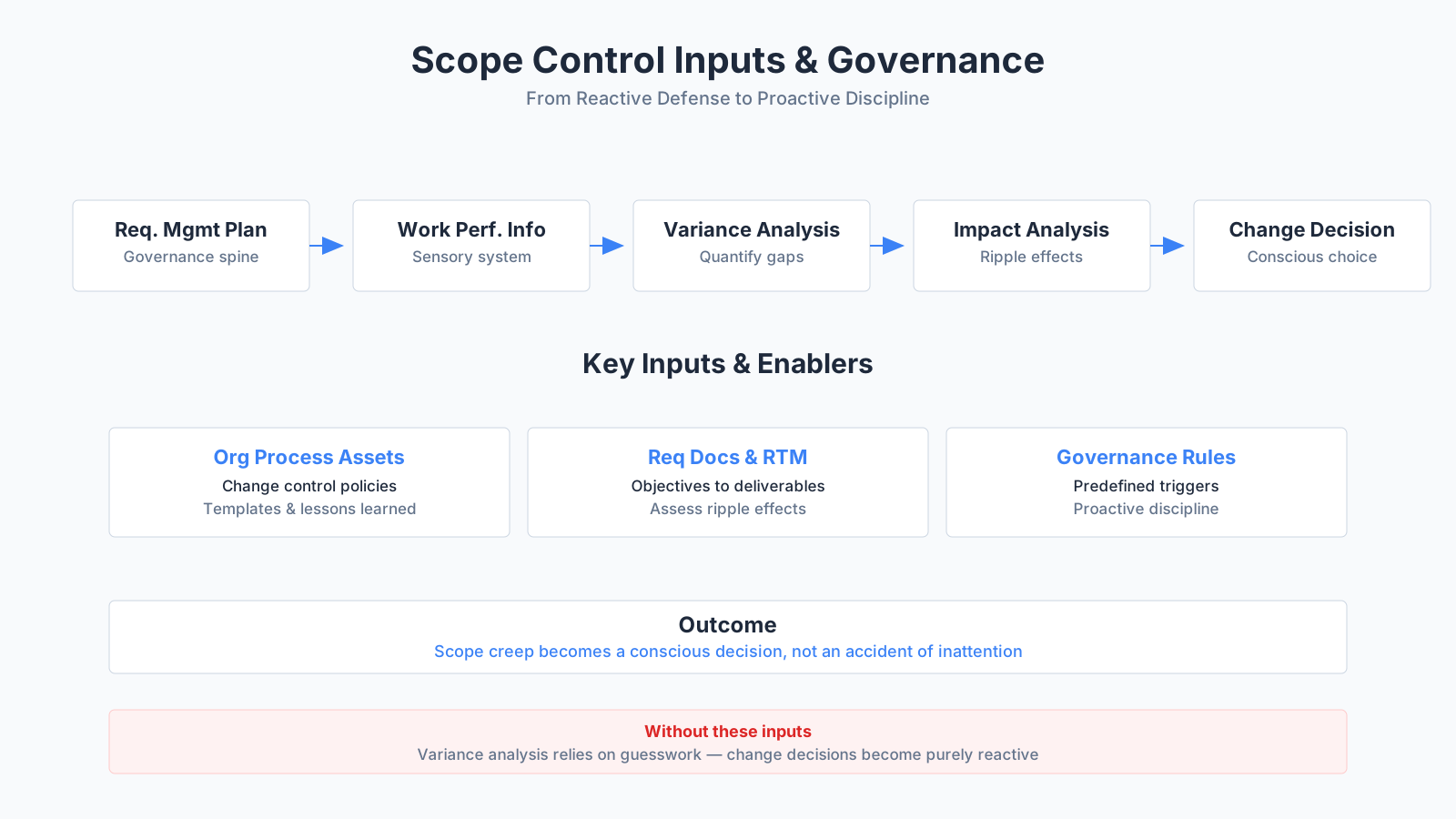
Before any meaningful control can happen, a project manager must gather the right raw materials. The scope control inputs described in standard project management frameworks form a constellation of information that paints a real-time picture of what is unfolding versus what was planned. Without these inputs, variance analysis would be guesswork, and change decisions would be purely reactive. The first of these, the project management plan, acts as the overarching guide. Within it lies the requirements management plan, which spells out the rules of engagement for handling scope changes. It describes how requirements activities will be planned, tracked, and reported, how changes to product, service, or result requirements will be initiated, how impacts will be analyzed, and the authorization levels required to approve those changes. This is the governance spine of scope control, without which every deviation becomes a subjective negotiation.
The requirements management plan is not just a document to be filed away. It forces the project team to agree, early on, on the escalation thresholds, the forms to use, and who gets to say yes when a new feature suddenly seems indispensable. A project manager who skips detailing this plan often finds herself in endless hallway conversations where stakeholders chip away at the scope baseline centimeter by centimeter. What appears minor can accumulate into a significant drift if there are no pre-defined authorization levels to halt it. The plan also sets the cadence for tracking and reporting requirements status, which directly feeds the monitoring rhythm of scope control.
Alongside the management plan, the project manager constantly receives work performance information. This is the raw, unfiltered data about project progress: which deliverables have started, their progress, and which deliverables have finished. It is the ground truth that either confirms that the project is on track or signals that something has veered off course. When a deliverable that was supposed to be half-done is barely ten percent complete, that discrepancy becomes a trigger for deeper investigation. The information may arrive from team members, automated tracking tools, or inspection reports, but its value is only realized when it is compared against the scope baseline in a structured way.
Then there is the pair of artifacts that anchor every scope-related decision: the requirements documentation and the requirements traceability matrix. The documentation captures every need, wish, and constraint in tangible form, ideally with enough specificity to be testable. The traceability matrix links each requirement back to a business objective and forward to a deliverable, creating a web that shows the consequences of changing any single item. When a stakeholder suggests cutting a feature to save time, the matrix reveals which tests, which user stories, and which higher-level goals would be orphaned. It transforms scope control from a binary accept-or-reject decision into a nuanced analysis of interconnected impacts.
Organizational process assets round out the input set. These are the existing formal and informal scope control-related policies, procedures, and guidelines that the organization has accumulated, as well as the monitoring and reporting methods already in use. They might include a standard variance threshold that triggers management attention, templates for scope change requests, or historical databases of similar projects that show how often late-stage additions caused rework. Tapping into these assets saves the project manager from reinventing the control process and ensures consistency across a portfolio. The assets also embed lessons from past failures, essentially encoding the organization’s institutional memory about what works and what doesn’t in keeping scope in check.
The Project Management Plan and the Requirements Management Plan
Digging into the project management plan reveals that it is not a static binder but a dynamic constellation of subsidiary plans. The requirements management plan, specifically, holds the playbook for how scope control will be executed day to day. It addresses the delicate question of authorization levels: does a minor change to a non-functional requirement need a change control board review, or can the project manager approve it unilaterally? Without this clarity, control becomes either overly bureaucratic for trivial adjustments or dangerously lax for significant expansions. The plan also defines how the analysis of impacts will be conducted, meaning it sets up the workflow for assessing knock-on effects on cost, schedule, risk, and quality before any change is approved.
A practical layer that the requirements management plan adds is the reporting rhythm. It might mandate weekly requirement status meetings where the team reviews which requirements are stable, which are under discussion, and which have crept in informally. This cadence prevents the scenario where a project manager discovers scope ballooning only when the budget is already half-spent. By describing how changes to product, service, or result requirements will be initiated, the plan channels emergent needs through a formal gate rather than letting them seep into the work through casual emails.
Yet, the plan is only as effective as its adoption. Many teams treat it as a compliance checkbox during planning and never refer to it again. A project manager who truly controls scope brings the requirements management plan back into every control cycle, using it to determine if a variance needs a change request or if it’s just a performance issue that can be corrected without rebaselining.
Work Performance Information as a Reality Check
Work performance information arrives in fragments: a developer reports completion of three user stories, a testing lead flags that two integrations are delayed, a supplier confirms that a component will ship next Tuesday. Assembling these fragments into a coherent picture of scope status is the project manager’s ongoing task. This information is not sanitized; it contains the noise of daily project life. The real skill lies in filtering the signal from the work performance information, identifying which data points indicate a genuine scope deviation and which are simply normal execution variation that the schedule buffer can absorb.
The information often reveals patterns that staring at a Gantt chart would miss. If the same type of deliverable consistently starts later than planned across multiple work packages, it might suggest not a resource problem but an underlying scope ambiguity that makes the team hesitate. That subtle clue can prompt a review of the requirements documentation to see if the acceptance criteria are clear enough. Thus, work performance information serves as a continuous health check that goes beyond simple binary metrics.
It also creates accountability. When the information shows that a deliverable is finished ahead of schedule, the project manager can verify that the scope was fully met before celebrating. Early completion sometimes indicates that the team cut corners and omitted features, which is a scope control red flag as serious as a delay.
Requirements Documentation and the Requirements Traceability Matrix
If the requirements management plan provides the rules, the requirements documentation and traceability matrix provide the terrain. The documentation, when properly maintained, gives the baseline against which all performance is measured. But it is not a set of frozen commandments. It must be updated as approved changes are incorporated, so that at any moment it reflects the current understanding of what the project must deliver. Outdated requirements documentation is a liability that leads to control decisions based on a phantom scope.
The requirements traceability matrix is the project manager’s map of dependencies. It shows that requirement R-47 is satisfied by design element D-12 and verified by test case T-89. When a stakeholder asks to drop R-47 to save two weeks, the matrix instantly reveals that D-12 and T-89 would be affected, and possibly a regulatory compliance link that the stakeholder was not considering. This kind of rapid cross-referencing turns scope control from a defensive posture into an informed negotiation. It also discourages frivolous changes because the requester sees the full ripple effect laid bare.
Honestly, this is where many projects stumble. They create a traceability matrix during planning and then never update it, so it becomes a museum piece. By the time a scope question arises, the matrix is so stale that it misleads rather than helps. The act of maintaining the matrix is itself a scope control activity, because updating it forces the team to constantly reconcile new work with existing linkages.
Organizational Process Assets that Govern Control
Organizational process assets bring the weight of collective experience. They include things like a standard change request form, a rubric for categorizing variance severity, or a policy that any scope change exceeding five percent of the baseline budget requires executive sponsor approval. These assets reduce ambiguity and make scope control consistent across projects, so a project manager transitioning from one initiative to another does not have to establish entirely new rules.
Less formal assets can be equally powerful. An organization might have an unwritten rule that the product owner cannot alter the scope during the last two weeks of a release cycle, a guideline born from a painful late-stage disaster. While these casual norms can be fragile, they shape the real-world behavior of stakeholders. A savvy project manager identifies both the formal and informal assets early and uses them to anchor every control discussion. When a stakeholder pushes back on a scope denial, referencing the company’s own historical asset data on rework rates can be far more persuasive than quoting a textbook.
Yet assets can also become a trap if they encode an overly rigid process that chokes agile adaptation. The project manager has to balance the discipline of the organizational process assets with the flexibility needed to respond to legitimate new insights, which is where the art of scope control really lives.
Key Takeaways on Scope Control Inputs
- Real-time scope picture
- Scope control inputs integrate baseline plans with actual performance data, enabling a live comparison that reveals unfolding variances and emerging trends.
- Scope management plan definition
- The requirements management plan structures the lifecycle of requirements, covering planning, tracking, reporting, and change initiation, while also defining impact analysis workflows and the approving authorities required for changes.
- Early agreement on thresholds
- The plan ensures early alignment on escalation thresholds, standard change request forms, and the designated individuals or boards authorized to approve scope modifications.
- Consequences of skipping planning
- Without a detailed scope management plan, scope creep often enters through informal conversations, as stakeholders’ casual requests quietly erode the scope baseline.
- Traceability and impact analysis
- The requirements traceability matrix ties each requirement to business objectives and deliverables, while the plan prescribes structured workflows for evaluating the ripple effects on cost, schedule, risk, and quality before changes are approved.
Variance Analysis as the Engine of Scope Control
Once all the inputs are assembled, the central technique that transforms them into actionable insight is variance analysis. This technique uses project performance measurements to assess the magnitude of variation from the original scope baseline. It is not simply noting that something is off; it is quantifying how far off, in which direction, and with what consequences. The process peers into the gap between what was planned and what has actually been accomplished, then forces a structured inquiry: Is this a one-time blip, a systemic trend, or a fundamental misunderstanding of the scope?
Variance analysis begins with a comparison between planned technical performance and actual technical performance. For instance, if a software module was supposed to process ten thousand records per minute and only achieves four thousand, the variance is clear. But scope variance can also be qualitative, like a deliverable that meets all functional specs but ignores an implicit usability requirement that the requirements documentation failed to capture properly. Spotting that softer variance requires a project manager who can read between the lines of status reports and bring in stakeholder feedback that might not be reflected in the formal metrics.
The analysis must then decide whether the variance is acceptable or demands action. A tiny deviation that will self-correct with no intervention might be noted and tracked but not escalated. A moderate variance that signals a creeping expansion of features, however, could trigger a formal change request even if the numbers still look small, because the trend line predicts a much larger problem down the road. The scariest variances are those that seem positive. A team announcing they added extra capabilities beyond the approved baseline has, in fact, created an unauthorized scope increase that will consume testing resources, inflate maintenance costs, and set a precedent for future gold-plating.
The power of variance analysis comes from its neutrality. It does not assign blame; it simply reveals the gap. That allows the project manager to have difficult conversations with developers, sponsors, or vendors without it feeling like a personal attack. When the data shows that a deliverable is underperforming against the scope statement, the conversation shifts from opinion to evidence. The project manager can say, “The variance on this requirement is thirty percent, and here are the three likely root causes,” instead of “You didn’t build what I asked for.” That subtle shift keeps the control process professional and solution-oriented.
Measuring the Magnitude of Scope Deviation
Quantifying the deviation involves selecting the right yardstick. Sometimes it is a simple binary: a feature is present or absent. Other times, it is a percentage completion against a detailed work breakdown structure element. In engineering projects, scope deviation might be expressed as the number of technical specifications not met. The project manager must resist the temptation to use a single metric that masks complexity. A deliverable could be ninety percent feature-complete yet missing the one critical compliance requirement that makes the entire output unusable, which means the variance is effectively one hundred percent for the business value stream.
Measurement also involves comparing the variance against predefined thresholds that the project management plan or organizational process assets have set. A variance that breaches a threshold automatically triggers escalation, but project managers should watch for variances that are consistently hovering just below the trigger point. That pattern can indicate that someone is gaming the system by breaking a large change into smaller, apparently harmless fragments that individually slip under the radar.
Determining the Root Cause of Variance
Identifying that a variance exists is the easy part; tracing it to its root cause demands analytical rigor. The cause could lie in ambiguous requirements, where stakeholders and developers formed different mental models of what a deliverable should do. It could lie in optimistic estimating that never had a realistic chance of being achieved within the documented scope. It could stem from external forces like a regulatory shift that silently altered the compliance boundary after the baseline was approved. Without root cause analysis, corrective actions become whack-a-mole, fixing symptoms while the underlying disease spreads.
The project manager can draw on techniques like the five whys or a fishbone diagram, but the real insight often comes from talking directly to the people doing the work. A developer might mention that they assumed a certain integration would be handled by another team, an assumption never verified against the requirements documentation. That single conversation reveals a scope control failure not in execution but in handoff communication. The root cause then points to a preventive action: tightening the traceability matrix to capture interface requirements explicitly rather than leaving them to assumption.
Deciding on Corrective or Preventive Action
Once the cause and degree of variance are clear, the project manager must decide whether corrective or preventive action is required. Corrective action realigns the work with the scope baseline, such as reassigning tasks to get a delayed deliverable back on track. Preventive action aims to stop a foreseeable deviation before it occurs, perhaps by adding a quality review checkpoint early in the next phase based on the current pattern of defects. Both types of action may require a change request if they alter the project management plan or the baseline itself, which feeds directly into the output stream of scope control.
The decision point often divides the experienced project manager from the novice. A novice might jump straight to a change request, formally expanding scope to match what was actually built, thereby rewarding poor execution. An experienced hand will first see if the work can be brought into compliance without blessing the deviation. That might mean rejecting the extra slick animation a designer added because it was outside scope, even if it looks impressive. It is a delicate balance, because some emergent features genuinely add value, and a change request to incorporate them may be the right answer. But the default posture of scope control is to resist unauthorized expansion and force it through the change control gate so that it gets the same scrutiny as any other scope change. This is where some modern methodologies, including the business value-oriented approach, treat scope change not as a failure but as user feedback that reveals previously hidden needs, while still demanding formal evaluation of its impact on value and waste.
Producing Outputs that Drive Informed Decisions
The outputs of controlling scope are not just paperwork; they are the levers that drive informed decisions across the entire project. When variance analysis completes, it generates work performance measurements, sparks change requests, triggers updates to plans and documents, and feeds the organizational learning loop. Each output has a distinct audience and a distinct purpose, yet they knit together to form the project’s steering mechanism.
Work performance measurements distill the raw work performance information into a format that stakeholders can digest. This is the planned versus actual technical performance data, presented with enough context to make it actionable. It is what gets reported at governance meetings, enabling sponsors to see whether the project’s scope health is robust or deteriorating. The measurements also flow into the project management information systems, creating trend lines that predict future variances before they become crises.
Change requests represent the most visible output. They are the formal proposal to modify the scope baseline or other components of the project management plan. A change request can be preventive or corrective action, or a defect repair, and it must be processed through the Perform Integrated Change Control process. The output of scope control provides the trigger, but it does not grant approval. That approval lives with the change control board or the authorized individual. This separation is crucial: scope control identifies the need; integrated change control decides whether to meet it. Without that firebreak, project managers would be constantly redefining the project’s boundaries on the fly, which erodes the very concept of a baseline.
When an approved change request affects the project scope, the scope baseline must be updated. The scope statement, the work breakdown structure, and the WBS dictionary are revised and reissued. If the scope change ripples into cost and schedule, those baselines are revised and reissued as well. This is not a trivial administrative step; releasing a new baseline resets the yardstick against which future variance will be measured. If the project manager neglects to update the schedule baseline after adding features, the team could technically be on time by the old baseline while spiraling hopelessly late in reality. The baseline update is the act of making the change official and communicating that the project has a new set of expectations.
Project documents also get caught in the update wave. Requirements documentation and the requirements traceability matrix must reflect the new reality so that future scope control cycles operate on accurate data. Organizational process assets updates capture the causes of variances, the corrective action chosen and the reasons, and other lessons learned from the scope control exercise. This knowledge then fertilizes future projects, gradually sharpening the organization’s ability to estimate, define, and protect scope.
Work Performance Measurements as Stakeholder Intelligence
Work performance measurements take the messy stream of work performance information and turn it into structured insight. They compare planned versus actual technical performance, but they also highlight trends such as the rate at which scope-related defects are being discovered. A project that sees a rising defect rate in scope-critical features is signaling that the requirements are either poorly understood or that quality control is slipping. The measurements enable a project manager to make a data-backed case for pausing new development until the root causes are fixed, a recommendation that would seem extreme without the supporting numbers.
These measurements do not stay within the project team. They are communicated to stakeholders in a format that suits each audience. A sponsor might receive a dashboard showing a green, yellow, or red status for scope health, while the product owner gets a detailed breakdown of requirement completion percentages. The communication aspect is as important as the measurement itself, because scope control only works if the people who can approve resources and trade-offs understand the current state.
Change Requests Initiating Formal Amendments
The issuance of a change request is the moment where scope control hands off to the broader governance framework. A change request can take many forms: it might propose a corrective action to bring an underperforming component back into spec, a preventive action to avert a known risk, or a defect repair to fix something that was built wrong. The scope control process does not judge the merit of the request; it identifies the need and ensures the documentation is complete. Then the request enters the integrated change control process, which evaluates impact on scope, cost, schedule, risk, quality, and other constraints before approving or rejecting it.
This handoff is where many project managers feel a loss of control, but it is actually a safeguard. Requiring integrated review prevents the project manager from single-handedly expanding scope under pressure from a powerful stakeholder. The change control board, ideally a cross-functional group, provides a check against optimistic assumptions. The output of scope control delivers not just the request but also the supporting variance analysis that justifies why a change might be necessary, making the board’s deliberation faster and more fact-based.
Revising the Project Management Plan and Associated Baselines
When a change request is approved and it affects the project scope, the project management plan receives its update. The scope baseline is the most obvious revision: the scope statement gets edited, the WBS gets new elements or renumbered, and the WBS dictionary receives updated descriptions. But a scope change almost never travels alone. Adding a new feature may require additional budget for materials and additional weeks in the schedule, so the cost baseline and schedule baseline are also revised and reissued. This integrated update ensures that all three baselines remain aligned, which is essential for earned value management and other performance tracking techniques.
The reissuance of baselines is a serious event. It signals to the entire team that the old plan is now obsolete and that future performance will be measured against a new standard. Communication around this reissuance must be clear and immediate, because team members working off outdated WBS versions will deliver the wrong things. It also resets stakeholder expectations, which can be a politically sensitive moment. The sponsor who approved the change must now accept that the project’s total cost and finish date have legitimately shifted, and that this shift is not a performance failure but a deliberate scope adjustment.
Updates to Project Documents and Organizational Process Assets
Beyond the formal baselines, a host of project documents need refreshing. The requirements documentation captures the revised requirement set, and the requirements traceability matrix absorbs new linkages or removes deprecated ones. A seemingly minor update to a traceability matrix can prevent the team from testing a requirement that no longer exists or from overlooking a new dependency that the change introduced. The discipline of updating these documents is what keeps the project’s informational foundation solid for the next round of scope control.
Organizational process assets updates often get the least attention but pay the biggest long-term dividends. Recording the causes of variances and the corrective actions taken builds a knowledge base that can shorten future projects’ learning curves. If a variance was traced back to ambiguous wording in a contract, that finding can be turned into a checklist item for procurement reviews organization-wide. The process assets also capture the reasoning behind chosen corrective actions, which helps future teams avoid repeating a decision that seemed logical at the time but turned out to be suboptimal. In this way, controlling scope on today’s project quietly sharpens the organization’s entire project management capability.
Key Takeaways on Scope Control Outputs
- Performance measurements guide governance decisions
- Variance analysis yields work performance data that is reported at governance meetings, allowing sponsors to clearly see whether scope health is improving or declining.
- Change requests require formal processing
- All change requests, whether preventive, corrective, or defect repairs, must follow the Perform Integrated Change Control process to preserve the integrity of the project baselines.
- Baseline updates prevent false progress
- Neglecting to update baselines after scope additions creates a misleading sense of on-time performance while the actual delivery timeline continues to slip.
- Lessons learned inform future decisions
- Updates to organizational process assets document variance root causes, the chosen corrective actions and their rationale, and other insights that enrich decision-making in future projects.