When you’re figuring out how to document project roles and responsibilities, you’re dealing with one of those foundational tasks that can make or break coordination later on. The goal is disarmingly simple: every work package needs an unambiguous owner, and every team member needs to know exactly what they are supposed to do, when they need to consult someone, and where the buck stops. What complicates this is that projects are inherently cross-functional, often virtual, and filled with specialists who report to different functional managers. So the documentation has to be both precise and adaptable. The major frameworks recognize this and offer a toolkit of formats that fall into three broad categories: hierarchical charts, matrix‑based charts, and text‑oriented descriptions. In addition, certain responsibilities naturally get embedded in subsidiary plans like the risk register, the communication plan, and the quality management plan. Each of these methods illuminates a different slice of the accountability puzzle, and experienced project managers learn to layer them rather than rely on just one.
Getting this wrong doesn’t just create confusion. It breeds the kind of quiet dysfunction where people wait for decisions that nobody believes they are authorized to make, and where duplicated effort sits next to gaping holes in coverage. When you document roles and responsibilities thoroughly, you’re essentially building the project’s nervous system. You’re defining who perceives a risk and who decides about it, who translates a scope change into a new technical requirement, and who simply needs to be kept in the loop. The formats you choose will depend on project size, team distribution, and the complexity of stakeholder relationships. And sometimes the right answer is a mix, a high‑level organizational breakdown structure supplemented by detailed RACI charts for critical work packages, with text‑based role descriptions that capture qualifications and authority boundaries.
There’s a deeper reason that documentation matters beyond clarity. It’s about psychological safety and professional respect. When a developer knows that another senior engineer is accountable for the module’s architecture, they can focus on implementation without second‑guessing design decisions that aren’t theirs. When a sponsor understands from a RACI that they are merely informed about testing, not accountable for it, they are less likely to meddle and slow things down. So the act of documenting roles is also an act of setting expectations and protecting the team’s autonomy. The source notes outline three primary documentation types, and we’ll unpack each one, but keep this human dimension in mind. It’s not just about filling in cells; it’s about building a shared mental model of how the project works.
Project Roles and Responsibilities: Key Topics at a Glance
| Key Concept | Summary |
|---|---|
| Ownership | Every work package demands a single, accountable owner; each team member requires explicit task direction and a clear escalation route. |
| Dysfunction | Ambiguous ownership creates silent dysfunction: decisions stall, effort is duplicated, and coverage gaps emerge unnoticed until they damage delivery. |
| Hybrid Approach | The optimal model fuses an OBS with detailed RACI matrices and narrative role descriptions that capture qualifications, decision authority, and boundaries of responsibility. |
| OBS Charts | Hierarchical OBS charts give project managers a high-level ownership map by role or department, avoiding premature task-level assignments. |
| Work Packages | Work packages partition the project into manageable work buckets, each assigned to an accountable owner who can delegate internal tasks while retaining end accountability. |
| WBS Conversations | The WBS hierarchy forces explicit ownership agreements at every boundary-crossing module, resolving territory ambiguity before work begins. |
| Resource Planning | Aligning charging codes with OBS nodes simplifies resource leveling, cost roll-up, and time tracking, embedding financial control naturally into the organisation structure. |
| Common Mistake | Treating the OBS as a static org chart overlooks dynamic formations like tiger teams and cross-functional squads that need their own temporary ownership mapping. |
How to Document Project Roles and Responsibilities Using Hierarchical Charts
Hierarchical charts offer a top‑down visual map that connects positions, deliverables, and resources in a way that mirrors how organizations think. They’re especially comfortable for senior stakeholders because they resemble org charts. The project manager can use hierarchical charts to document project roles and responsibilities at a high level, showing who owns broad areas of work without getting bogged down in task‑by‑task assignment. Three distinct hierarchical tools appear in practice: the work breakdown structure, the organizational breakdown structure, and the resource breakdown structure. Each serves a unique purpose, and when used together they create a three‑dimensional view of accountability that spans deliverables, departments, and resource types.
How the WBS Documents Project Roles and Responsibilities
The work breakdown structure is primarily a deliverable‑oriented decomposition, not a role chart. But its very structure implies ownership. When you break a new product development project down into work packages like “market requirements finalised,” “industrial design prototype,” and “regulatory compliance dossier,” you are implicitly saying, “These are the buckets of work that someone must own.” In many projects, the WBS becomes the skeleton on which higher‑level responsibility assignments are hung. A competent project manager will annotate each work package with a named owner or a responsible unit, effectively turning the WBS into a responsibility map. That practice of assigning responsibilities in a WBS is straightforward but surprisingly often overlooked, especially when the WBS is created by a planner who doesn’t have enough authority to designate owners.
One nuance here is that the WBS shows responsibility at a work package level, not at an activity level. So it’s useful for defining who manages the work but not who executes the specific tasks inside it. For example, the “software backend integration” work package might be owned by the lead architect, but inside that package there are coding tasks, peer reviews, and deployment steps performed by other individuals. The WBS won’t show those distinctions. It simply says that the lead architect is on the hook for the whole package being completed. That’s a critical psychological shift: the WBS as a responsibility framework is about outcomes, not task completion. The lead architect could delegate, but they remain the single point of contact for that piece of scope.
Many project managers hesitate to mark up the WBS because they worry it will make the chart too cluttered or because they haven’t yet confirmed resource availability. The real trick is to treat the WBS owner annotations as living information, updated when resource assignments solidify, not as a pristine document frozen at baseline. A common pitfall is leaving ownership ambiguous on work packages that sit at the intersection of two teams. The WBS, because it’s a hierarchy, naturally forces those awkward conversations: is the customer onboarding module owned by the product team or the commercial operations team? Documenting that decision early, right on the WBS, can prevent months of shadow conflicts.
Organizational Breakdown Structure for Documenting Roles
Where the WBS looks at the project through the lens of deliverables, the organizational breakdown structure (OBS) looks at it through the lens of the permanent organization. It’s arranged by department, unit, or team, with project work packages listed underneath each organisational node. This inversion is powerful because it lets functional managers see, at a glance, all the project commitments their people are carrying. From a role documentation perspective, the organizational breakdown structure for team roles creates an interface between project work and line management authority. IT can see every infrastructure work package it’s responsible for across all active projects. Procurement can see exactly which contracts are in their court.
The OBS also serves as a negotiation tool during resource planning. When a department head looks at their slice of the OBS and sees that two work packages are scheduled concurrently, each requiring a scarce network security specialist, the conversation about levelling or adjusting the schedule becomes concrete. It’s no longer an abstract resource conflict; it’s a visible overload on a specific organizational branch. This is where the hierarchical nature of the OBS really pays off. You can roll up responsibilities to division level for executives, then drill down to team level for detailed assignment discussions. And because the OBS links work directly to departments, it seamlessly feeds into the cost control process. Charging codes often align with OBS nodes, so time tracking and cost accumulation become natural extensions of the role documentation rather than separate administrative exercises.
A frequent mistake with the OBS is treating it as a static organisation chart and forgetting that projects involve temporary structures like tiger teams or cross‑functional squads. In those cases, the OBS needs a “virtual team” node that doesn’t correspond to any permanent department. That’s perfectly valid. The point is not to force the project into the org chart but to make visible where responsibility sits relative to the organisation’s power structure.
Resource Breakdown Structure Documents Roles and Resources
The resource breakdown structure (RBS) is the third hierarchical sibling, and it shifts the perspective again. It breaks down the project by resource type, grouping together all welders, all Python developers, all test environments, or all heavy‑lift helicopters, regardless of where they sit in the WBS or the OBS. For documenting roles, the RBS is less about who is responsible and more about what categories of resources carry out the work and how they are distributed. Tracking resource breakdown structure responsibilities helps a project manager see whether a critical resource type is over‑taxed across multiple work streams, even if those streams are managed by different organisational units.
A construction project might deploy welding crews across hull fabrication, superstructure assembly, and piping installation. Those crews appear in different WBS branches and possibly under different OBS departments, but in the RBS they are all “welders.” This aggregation is invaluable for role documentation because it reveals where a specific role type is stretched thin. If the RBS shows that diving supervisors are allocated to four simultaneous saturation diving operations, the project manager doesn’t need a complex earned value analysis to smell trouble. The RBS also aligns beautifully with the organisation’s financial systems because resource types often map to cost categories and rate cards. So when you document that a particular work package requires a senior geologist, you can immediately pull the cost rate and check availability against the RBS’s total demand for senior geologists.
One often‑overlooked advantage of the RBS is that it can track non‑human resources that carry their own “responsibility” in a practical sense. If a specialised testing rig must be shared between two product lines, the RBS documents that dependency and implicitly assigns the role of sequencing access. Nobody might be formally titled “rig scheduler,” but the RBS makes that need so obvious that someone will inevitably be assigned to manage it. The documentation doesn’t always require a formal title; sometimes it just requires making the constraint visible.
Key Insights on Hierarchical Charts
- Top-down visual responsibility map
- Hierarchical charts establish a top-down visual framework that connects roles, deliverables, and resources, allowing project managers to clarify strategic ownership without becoming entangled in granular tasks.
- WBS defines deliverable ownership
- The work breakdown structure is a deliverable-focused decomposition whose work packages inherently define discrete scopes of work that require unambiguous ownership.
- Owner annotations prevent missing accountability
- A capable project manager annotates each work package with a specific individual or responsible unit, transforming the WBS into an accountability map, though this step is often omitted when the creator lacks the authority to assign ownership.
- Living documents for accountability
- WBS owner annotations must be maintained as dynamic records that evolve when resource commitments become firm. Integrating the WBS with the Organizational Breakdown Structure yields a multidimensional accountability view across deliverables, departments, and resource types.
Matrix‑Based Charts to Document Project Roles and Responsibilities
When you need to assign specific individuals or groups to specific activities and leave zero room for the “I thought you were doing it” syndrome, you turn to matrix‑based formats. The responsibility assignment matrix, universally called a RAM, connects work packages or activities on one axis with project team members or groups on the other. This is where project roles and responsibilities documentation becomes precise, actionable, and testable. On larger projects, a RAM might exist at multiple levels: a high‑level version that assigns organisational units to WBS components, and a lower‑level version that drills into the tasks within a single work package. The matrix structure immediately exposes two dangerous conditions: an activity with no assigned resource at all, and an activity with multiple people all listed as “accountable.” The latter is a recipe for deadlock.
The RACI chart, probably the most recognised instantiation of the RAM, adds the dimensions of Responsible, Accountable, Consulted, and Informed. The letters are not interchangeable. Responsible means the person doing the work. Accountable, crucially, means the one person who signs off on the work and bears the consequences of failure. Consulted are those whose input is sought before a decision or action. Informed are those kept up to date after the fact. This four‑way split forces a discipline that casual conversation rarely achieves. Imagine a typical activity like “Define product backlog priorities.” In a RACI, the product owner might be accountable, the lead developer responsible for proposing technical feasibility, the UX lead consulted, and the customer support manager informed. Without that matrix, the meeting invitations tend to multiply and everyone feels entitled to veto.
But the RACI is only one flavour of RAM. A project manager might use designations like “Lead,” “Resource,” “Approver,” or even “Safety Observer” if the context demands it. The matrix structure itself is more important than the specific letters. What matters is that every row has exactly one accountable cell, and that the consulted and informed lists are realistic. Over‑populating the informed column with a dozen people who don’t really need the update erodes the value of the matrix. People learn to ignore the communication stream, and the chart becomes wallpaper. So documenting roles via a RAM is as much about editing out unnecessary involvement as it is about adding required participation. The discipline of having to put a letter in a cell forces those decisions.
How a RACI Chart Documents Project Roles and Responsibilities
A RACI chart makes the RACI technique to document project roles transparent and auditable. The classic layout puts activities down the left column and names or roles across the top, with appropriate letters in the intersecting cells. Take a straightforward sequence: Define, Design, Develop, Test. In a RACI for a small team, Ann might be accountable for Define and Test, Ben accountable for Design and Develop, with Carlos responsible for the hands‑on work in Design and Develop, Dina responsible for Test, and others informed or consulted as needed. This example, drawn from the source, shows how the matrix elegantly separates strategic oversight from execution. Ann, accountable for Test, doesn’t necessarily run the tests, but she ensures they happen and accepts the results. Dina, responsible for Test, is the one at the keyboard checking the cases.
What makes this so powerful in practice is how it prevents the diffusion of accountability. Human nature tends to assume that if something is important, multiple people should be accountable. But accountability doesn’t scale that way. When two people are both marked “A” for the same activity, each subconsciously assumes the other will handle the hard parts, and the activity drifts. A properly maintained RACI chart is an antidote to this. It says, “If this deliverable fails, there is exactly one person who will stand up in the post‑mortem.” That’s not about blame; it’s about clarity. It also protects the responsible people by giving them a clear escalation point. Carlos as responsible for development knows that Ben is accountable, so when Carlos hits a technical roadblock that requires a scope trade‑off, he goes to Ben, not to a committee.
Beyond RACI: Customising Matrix‑Based Role Documentation
Not every project fits neatly into the RACI model. In environments where decisions require multiple hierarchical approvals, you might add an “Approve” dimension. In safety‑critical industries, a “Safety Verifier” role can be added. The matrix format bends without breaking. Some project managers prefer a RASCI variant that adds Support, to indicate people who provide an ancillary service without being fully responsible. The key is to customise responsibility assignment matrices without overcomplicating the notation. If your matrix has seven letters and the team can’t remember what “S3” means, you’ve lost the plot. The documentation must reduce cognitive load, not add to it. That’s why seasoned practitioners often stick with the standard RACI and use a supplementary text document to explain any idiosyncratic additional roles.
Where RACI and similar matrices truly shine is on projects that mix internal and external resources. When contractors, vendors, and client‑side staff all appear in the same matrix, the boundaries of each party’s responsibilities become contractually visible and socially enforceable. A client team member marked as “A” for “Accept delivery milestone” cannot later claim they didn’t know they had to approve the handover. An external consultant marked as “C” knows they are consulted, not a decision maker. This is especially valuable in large public‑sector or regulated projects where oversight bodies may audit the assignment matrix. The mere existence of a signed‑off RACI can deflect a lot of finger‑pointing during audits. And when the team composition changes, which it inevitably does, updating the matrix becomes a low‑effort process that brings newcomers up to speed rapidly.
Text‑Oriented Formats for Detailed Role Documentation
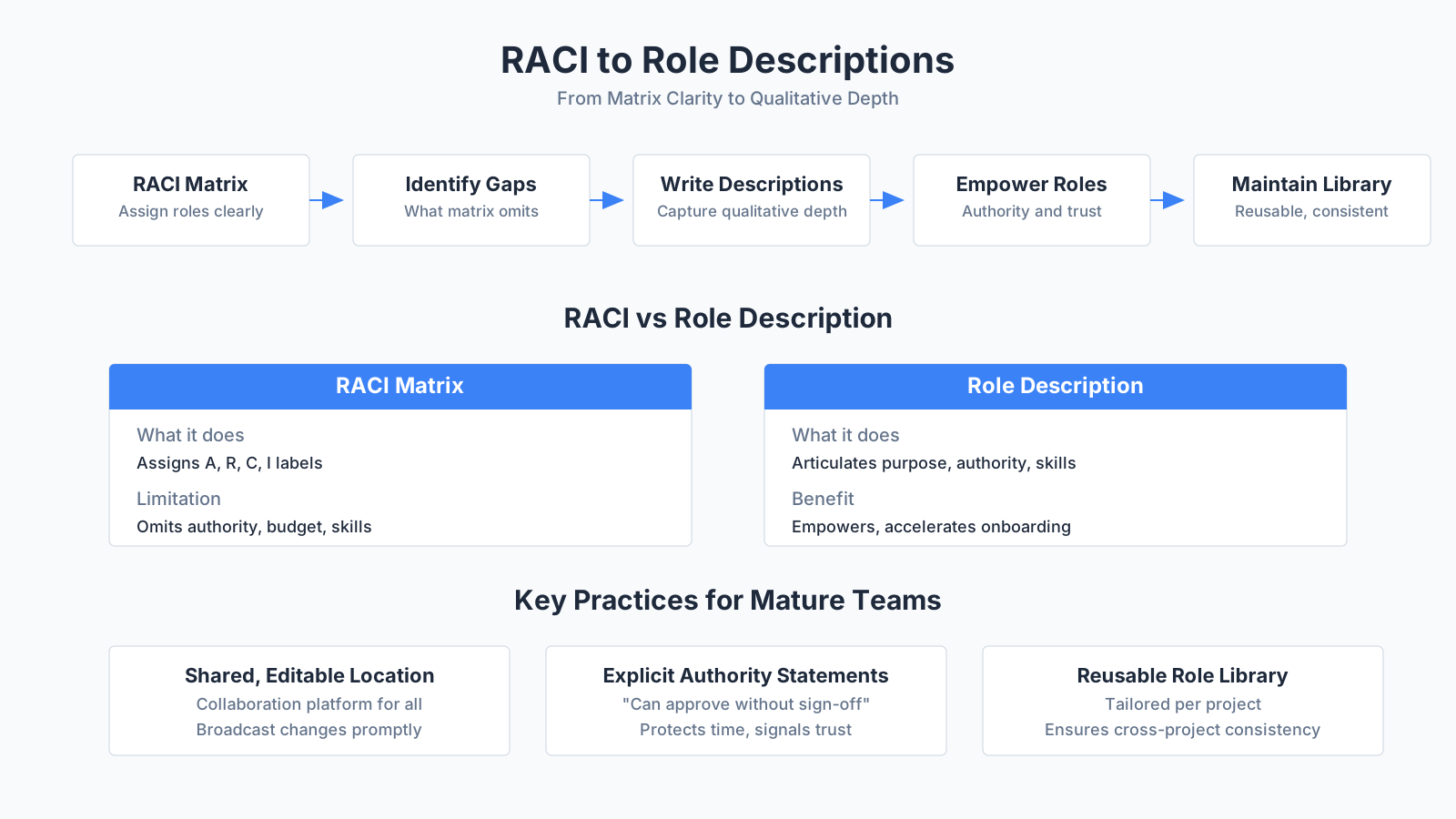
Sometimes a matrix cell just isn’t enough. When a role carries complex authority limits, specific competency requirements, or detailed escalation paths, you need prose. Text‑oriented formats, often called position descriptions or role‑responsibility‑authority forms, spell out the boundaries in outline form. They provide the detailed role descriptions for project teams that complement the high‑level allocation from a RAM or OBS. These documents are particularly valuable for roles that don’t fit standard job titles, like “Integration Champion” on a merger project or “Community Liaison” on an infrastructure build. Instead of expecting people to infer their duties from a two‑letter code, you give them a concrete list of what they can decide, what they must escalate, and which competencies they need to demonstrate.
A good role description will typically cover the purpose of the role, the specific responsibilities broken into logical groupings, the authority the role holder has (spending limits, sign‑off rights, access to confidential data), and the qualifications or experience expected. In a project context, these descriptions are often lighter than permanent job descriptions because roles are temporary. But that doesn’t mean they can be vague. “Manage stakeholder expectations” is not a responsibility; it’s an aspiration. A competent text document will say, “Convene the stakeholder advisory group monthly, prepare a variance report comparing actual benefits to business case projections, and escalate any deviation greater than ten percent to the sponsor within forty‑eight hours.” That level of specificity makes the role auditable and trainable.
Position Descriptions as Living Documentation
One of the hidden benefits of text‑oriented formats is their evolution. During the project lifecycle, a person in a role encounters situations that weren’t anticipated. The boundary between “decide locally” and “escalate” gets tested. Those lessons learned, when captured and folded back into the role description, become an asset for the next project. Using position descriptions to document project responsibilities turns them into templates that grow more precise and battle‑tested with each iteration. In matrix organisations where people cycle on and off projects, having a library of refined role descriptions dramatically reduces the start‑up learning curve. A new data migration lead can read the description from the previous migration project, see that they need to coordinate with the legacy system owner for data profiling, and avoid the week of discovery that their predecessor spent.
There is a practical art to writing these at the right altitude. Too detailed, and they become a maintenance burden that nobody updates. Too vague, and they offer no protection against scope creep. The sweet spot is a description that a competent professional can read in ten minutes and feel confident they understand the boundaries of their role. It should answer the question, “What decisions can I make without checking with anyone?” That’s the authority section’s real job. If it says, “Can re‑sequence non‑critical path activities up to five working days without sponsor approval,” the role holder has clarity and the sponsor is shielded from trivial decisions. If it’s silent on the matter, the safe default is to escalate everything, which slows the project to a crawl.
Leveraging Text Formats for Team Onboarding
New team members joining mid‑project often receive a pile of documents, but a crisp role‑responsibility‑authority form can cut through the noise. When someone knows exactly what they’re accountable for, who they consult, and what their spending authority is, they can start contributing meaningfully in their first week. You can even document team responsibilities with text-based templates that include a “handover checklist” section, listing whom to meet and which systems to access. This is not fluffy orientation; it’s risk management. The period when a new person is learning their role is when errors proliferate. A well‑crafted text document shrinks that vulnerable window.
In virtual teams spread across time zones, text descriptions perform another function: they serve as a stable reference when synchronous communication is scarce. A developer in Dublin finishing their shift can consult the description of the “Release Manager” role and know that a specific approval is required before they deploy to production, even if the release manager in Vancouver is asleep. The documentation bridges the asynchronous gap. And because the text format is searchable and can be version‑controlled, it’s far easier to audit than a whiteboard snapshot. For teams practicing agile methods, the role description might live as a wiki page rather than a formal document, but the content serves the same purpose: defining what “Done” means for that role’s responsibilities.
Prose Formats Clarify Complex Roles
- Text formats for complex roles
- Position descriptions and role-responsibility-authority forms employ structured prose to define authority boundaries, required competencies, and escalation protocols, capturing the nuances of roles that elude conventional job titles.
- Core elements of role descriptions
- An effective role description clarifies the role's purpose, organizes responsibilities into logical groupings, specifies authority such as spending limits and sign-off rights, and outlines the required qualifications and experience.
- Descriptions as reusable templates
- Refined role descriptions evolve into battle-tested templates that accelerate onboarding in matrix organizations, enabling a new lead to assimilate duties directly from a predecessor's documentation.
Embedding Role Documentation in Other Project Management Plans
Not all role information sits in the core responsibility documents. Important pieces of the puzzle are scattered throughout subsidiary plans, and a systematic project manager learns to harvest them into a coherent picture. The risk register assigns an owner to each identified risk. The communication plan designates who is responsible for producing, disseminating, and receiving specific communication artefacts. The quality management plan names those accountable for quality assurance activities and those performing quality control checks. These are not afterthoughts; they are integral to documenting project roles in risk and quality plans. When you neglect to cross‑reference them, you risk having a team member who is accountable for a work package in the RACI but who, according to the risk register, also owns a critical risk they’ve never been briefed on.
The risk register is a particularly interesting case because risk ownership is distinct from task responsibility. The risk owner monitors the risk environment, implements response strategies, and triggers contingency plans. This person needs to have enough authority to commit resources and enough access to information to spot emerging threats. Often the risk owner is not the person doing the work that would be affected. For instance, a procurement manager might own the risk of a supplier’s financial instability even though the engineers are the ones integrating the supplier’s parts. That ownership designation belongs in the risk register, not in the RACI for engineering activities. And because risk owners are typically named individuals, the register acts as a natural roll‑up of high‑stakes accountability roles that span multiple WBS elements.
Communication Plan and Role Designation
The communication plan is another place where role documentation quietly happens. When a plan states, “Monthly steering committee report prepared by PMO analyst, reviewed by program manager, approved by sponsor,” it’s assigning roles for a specific information flow. Those designations are as real as any responsibility assignment matrix and should be consistent with it. If the RACI says the sponsor is merely informed on a particular work stream, but the communication plan shows the sponsor approving that stream’s status report, there’s a conflict that will surface as confusion. Mapping communication plan role assignments back to the primary role documentation is a quality check that too few project managers perform. It takes thirty minutes and can uncover hidden misalignments that would otherwise fester for months.
In large programs, the communication plan role designations scale to include entire communication teams that manage stakeholder bulletins, community consultation, and internal newsletters. Each of those roles requires the same clarity as a technical role, but they are often left vague because they seem “soft.” That’s a mistake. A communication lead who doesn’t know whether they are authorised to draft a press release without legal review will either delay critical announcements or expose the organisation to reputational risk. So the discipline of specifying roles in the communication plan is not bureaucracy; it’s risk management applied to information flows.
Quality Plan Responsibilities
Quality assurance and quality control roles are similarly distributed. The quality plan might designate a separate quality assurance team responsible for process audits, while the production team performs quality control inspections on deliverables. Those roles may not appear in the general RACI because they are tied to a specific management plan. Documenting quality assurance and control roles in projects within the quality plan ensures that the independence required for auditing is preserved. A developer cannot audit their own code and also be the person accountable for the audit’s findings. The quality plan makes that separation explicit and assigns names or groups to each quality activity. Once again, cross‑referencing is essential. If the quality plan assigns a “QA Lead” who is not listed anywhere in the project’s resource breakdown structure or OBS, you have a phantom role, and either the QA will be under‑resourced or the plan is fiction.
Wise project managers use these embedded role assignments as a source of truth to validate the central role documentation. They walk through the risk register, the communication plan, and the quality plan, and for each named role they ask, “Does this person know they hold this responsibility, and is it reflected consistently in the RACI or OBS?” Mismatches are almost inevitable on complex projects with many contributors, but finding them during planning is vastly cheaper than finding them during execution when someone says, “That wasn’t my job.” The real value of role documentation, then, lies not in any single tool but in the web of consistent assignments that stretches across all the planning artefacts.
Integrating Role Documentation Across Methodologies and Teams
The documents and charts we’ve discussed are neutral enough to work in traditional, agile, and hybrid settings, but the way you use them shifts with context. In a large predictive project governed by PMBOK processes, the WBS, OBS, and RACI are formal baselines that go through a change control process. In a Scrum environment, you likely won’t have a WBS at all, but you still need to document roles like Product Owner and Scrum Master, and the Developers’ collective accountability. Agile teams often keep a lightweight RAM on a team wiki that maps user story epics to small squads, and they define a Definition of Ready that includes role‑based checkpoints like “UX review completed” or “Architecture approval by tech lead.” The integrating role documentation in agile projects isn’t about removing structure; it’s about making the structure visible and adaptable without heavy overhead.
Cross‑functional teams, whether agile or not, bring their own dynamics. The Business Value‑Oriented Project Management approach highlights that cross‑functional composition is a critical success factor, and it insists on making responsibilities transparent through tools like a Transparent Board of Project Issues where any role can raise concerns before work proceeds. In such a setting, role documentation goes beyond static assignments. It becomes a living agreement about who can flag a blocker, who validates a resolution, and who ultimately decides to accept or reject a work item. The documentation artifacts might be lightweight, perhaps a shared online spreadsheet with RACI columns tied to each sprint backlog item, but the principle of unambiguous ownership remains as strict as ever. What changes is the frequency and formality of updates.
When teams are distributed across multiple vendors and internal departments, the importance of a common role documentation standard increases dramatically. Different organisations use different terms. One vendor’s “project lead” might be another’s “technical account manager.” A shared RACI or OBS built on agreed terminology prevents semantic confusion from camouflaging accountability gaps. The process of building that common document often reveals that two groups assumed the other was handling a particular integration activity, simply because they used different labels for the same scope. By forcing translation into a single matrix, the project manager surfaces those assumptions and gets them resolved before work begins. That’s the hidden negotiation value of role documentation.
There is also a connection to resource procurement. When you document that a specific role requires competencies that no current team member possesses, you trigger a hiring or contracting decision. The position description text format feeds directly into a statement of work for a contractor or a job requisition for a new hire. So role documentation isn’t just a planning artifact; it’s an input to procurement. Getting the description right at the planning stage avoids a situation where you hire a specialist who then discovers that their real authority doesn’t match what they were told, which is a sure path to early departure and rework. The upfront investment in clarity around roles pays dividends throughout the entire project lifecycle, from staffing to acceptance to lessons learned.
Key Insights on Flexible Role Documentation
- Context drives documentation formality
- In predictive, PMBOK-aligned projects, WBS, OBS, and RACI act as formal baselines governed by change control, whereas agile teams rely on lightweight, adaptive artifacts such as team wiki RAMs and role-specific checkpoints.
- Agile maintains strict ownership principles
- Agile environments avoid heavy overhead while preserving unambiguous responsibility, using shared spreadsheets with RACI columns, Definition of Ready criteria, and publicly visible issue boards.
- Common standards reveal hidden gaps
- When multiple vendors and departments collaborate, building a shared role documentation standard often uncovers that teams apply inconsistent labels to the same tasks, each assuming the other holds ownership.