Every project, regardless of size or industry, operates with two distinct but deeply intertwined sets of processes. Project management processes keep the initiative on track—planning, monitoring and controlling work to meet objectives. Product-oriented processes, on the other hand, actually create the thing the project exists to deliver, whether that is a building, a software application, a research report, or a new service. Recognizing how these two process categories differ, and where they intersect, is one of those foundational insights that separates a novice coordinator from a seasoned project manager. The distinction shapes everything from scope definition to resource allocation, and failing to grasp it often leads to beautifully managed projects that produce entirely the wrong outcome.
Project Management vs. Product-Oriented Processes: Summary
| Key Concept | Summary |
|---|---|
| Product-oriented processes | These processes directly generate the project’s tangible output, whether it be a constructed facility, a deployed software system, a finalized research report, or an operational service. |
| Technical definition | Product-oriented work is governed by domain-specific technical requirements, such as welding procedure specifications, user acceptance test scripts, or clinical trial validation protocols. |
| Work decomposition | A reliable work breakdown structure demands deep knowledge of the underlying construction or development sequence; absent that, planning becomes speculation rather than a credible schedule. |
| Project management contrast | Project management processes handle planning, budgeting, and coordination, but neglecting product-specific details can cause critical gaps, such as a six-month regulatory approval that stalls launch. |
| Stakeholder engagement | Effective stakeholder engagement requires systematically mapping influence, interest, and impact to ensure that pivotal individuals, like an IT director, are engaged early and do not emerge as late-stage blockers. |
| Complexity drivers | When practitioners note that a house is more complex than a shed, they are highlighting intricate product-oriented processes such as electrical wiring and HVAC integration, not simple scheduling or budgeting challenges. |
| Predictive interactions | In predictive environments, earned value analysis can reveal cost overruns, compelling engineering teams to simplify material specifications while preserving required quality and performance standards. |
| Process evolution | Shifting to a new product category, such as moving from small-molecule drugs to biologics, fundamentally transforms product-oriented processes and enforces markedly tighter quality-control regimes. |
Understanding How Project Management Processes Differ From Product-Oriented Processes
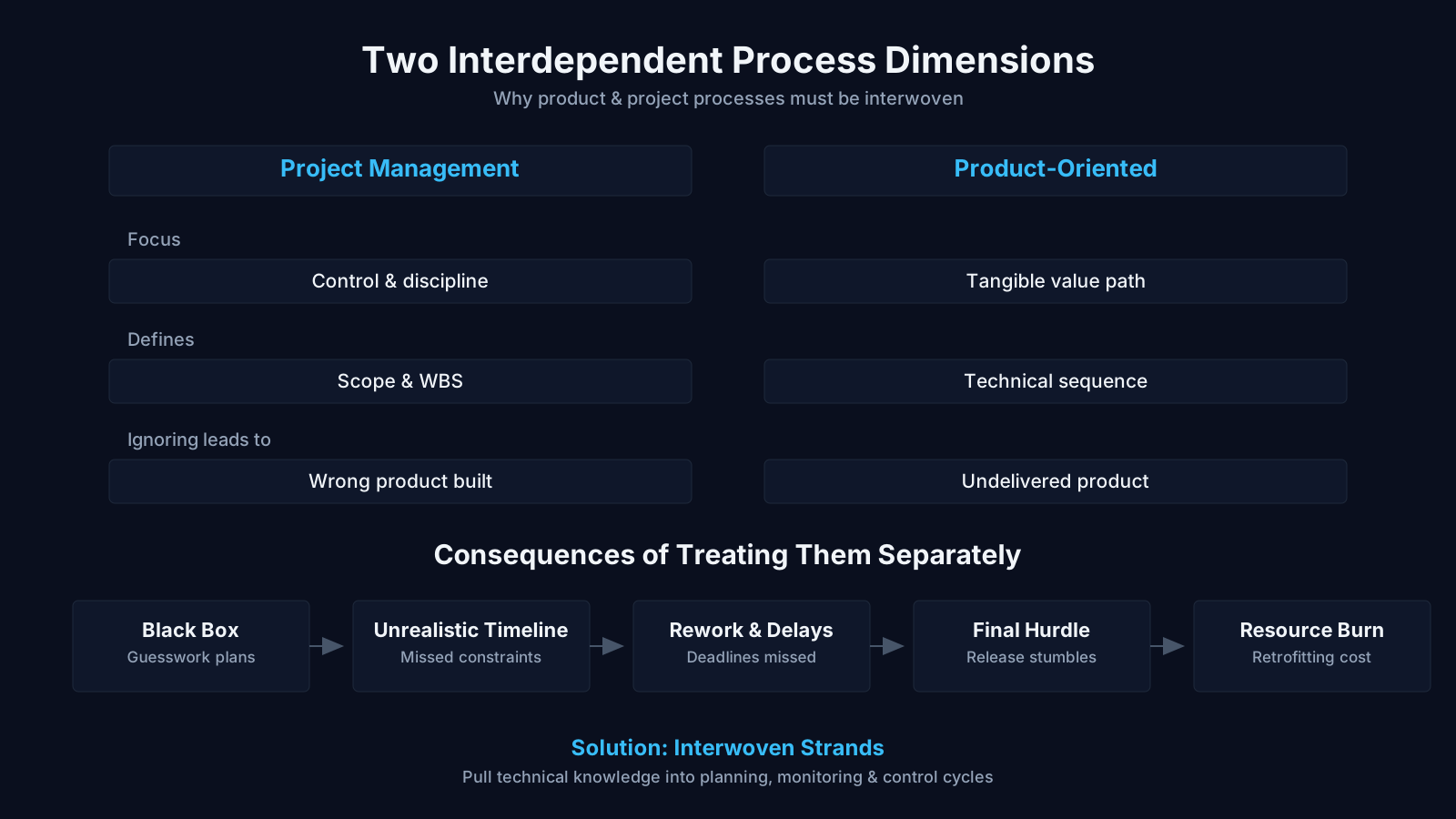
The fundamental split between project management processes and product-oriented processes lies in their purpose. Project management processes are the universal engine that drives a project through its life cycle: initiating, planning, executing, monitoring, and closing. They apply globally and across industry groups, so a risk identification workshop in a pharmaceutical trial follows similar logic to one in an IT infrastructure upgrade. Product-oriented processes are the domain-specific activities that build, assemble, or configure the actual deliverables. These processes are defined by the technical nature of the work: welding protocols in shipbuilding, user testing scripts in a mobile app launch, or clinical trial validation steps. What trips up many practitioners is thinking one can function meaningfully without the other. In truth, the scope of a project cannot be defined without some basic understanding of how to create the specified product. If you do not know the sequence of construction tasks required to build a bridge, you cannot decompose the work into a credible work breakdown structure; the project management processes will be planning based on guesswork.
Imagine a team tasked with developing an electric vehicle charging station network. The project management processes—schedule development, cost budgeting, stakeholder communication—are relatively similar to those used in opening a chain of retail stores. But the product-oriented processes are entirely different: electrical load calculations, site surveys for grid capacity, firmware integration with payment systems, and safety certification testing. A project manager who ignores the product-oriented dimension might produce a flawless Gantt chart that completely misses a six-month regulatory approval step embedded in the hardware certification process. The schedule looks pristine, but the project fails. This is why the standard explicitly states that the project manager should not ignore product-oriented processes, even though the standard itself only describes the project management ones.
The Nature of Project Management Processes
Project management processes ensure the effective flow of the project throughout its existence. They encompass the tools and techniques involved in applying the skills and capabilities described across knowledge areas like scope, schedule, cost, quality, resource, communication, risk, procurement, and stakeholder management. These processes are grouped into logical phases—initiating, planning, executing, monitoring and controlling, and closing—that repeat and interact throughout the project. In a predictive life cycle, they flow linearly with feedback loops; in an adaptive environment, they happen in rapid iterations. Regardless, they exist to answer questions like: Are we doing the right things? Are we on schedule? Are we within budget? Have risks materialized? Who needs to know what, and when?
A common misconception is that project management processes are nothing but administrative overhead. When applied with appropriate rigor, they actually reduce chaos. Consider a large merger integration project. The project management process of identifying and engaging stakeholders is not about sending a spreadsheet of names; it is about systematically mapping influence, interest, and impact so that a mid-level IT director who controls access to legacy data does not become a blocker at the eleventh hour. This process applies whether the product being created is a combined legal entity or a consolidated software platform. The management processes are domain-agnostic, but their effectiveness depends on the team’s willingness to tailor them to the situation rather than following a template dogmatically.
Product-Oriented Processes: Building the Output
Product-oriented processes specify and create the project’s product. They are typically defined by the project life cycle and vary dramatically by application area. In construction, they include surveying, excavation, foundation pouring, framing, and finishing. In pharmaceutical development, they encompass preclinical research, Phase I through Phase III trials, regulatory submission, and manufacturing scale-up. In a digital marketing campaign, they involve content creation, A/B testing, ad placement optimization, and analytics configuration. The complexity and sequencing of these processes directly influence the overall complexity of the project. When someone says a house is more complex to build than a shed, they are not talking about the project management processes—planning a shed still requires a schedule and budget—they are talking about the vastly more intricate product-oriented processes needed to wire electrical systems, install HVAC, and meet building codes.
The critical point here is that a project manager cannot remain oblivious to these technical processes and hope to define scope accurately. The notes emphasize that the scope of the project cannot be defined without some basic understanding of how to create the specified product. This does not mean the project manager must be an expert carpenter or a cancer researcher. It means they need enough literacy to ask the right questions and to translate technical sequences into manageable work packages. A software project manager who does not understand the difference between frontend and backend development, or who has never heard of integration testing, will struggle to structure sprints meaningfully or to assess whether a delay in one component genuinely threatens the critical path. The product-oriented processes give the work its shape; the project management processes then wrap around that shape to provide control and visibility.
The Critical Overlap Between Management and Product Processes
These two process types overlap and interact throughout the life of a project. A change in the product scope—triggered by a new regulatory requirement or a customer insight—immediately activates the project management process of integrated change control. Conversely, a risk identified during a monthly status review might lead the technical team to alter a product-oriented process, such as adding additional prototype testing cycles. The overlap is not a one-time handoff; it is a continuous, iterative dance. In an Agile context, each sprint review is a moment where product-oriented processes (the working increment) and project management processes (reviewing progress against the product backlog and adjusting plans) converge explicitly. In a predictive setting, the interaction might be less visible but still present: an earned value analysis that reveals a cost overrun in the fabrication phase forces the engineering team to reevaluate whether a particular material specification can be simplified without compromising quality.
Failing to recognize this overlap leads to two classic pathologies. The first is when project management processes are treated as a parallel universe that does not touch the actual work—teams hold status meetings but never connect the dots to technical roadblocks. The second is when product-oriented processes swallow the project whole, with the technical lead assuming that if the product is good, the management side will take care of itself. Both result in beautifully managed failures or chaotic success. The most effective teams operate with a dual lens, constantly asking how a change in one domain ripples into the other.
Why Product-Oriented Processes Vary by Industry
The techniques and tools involved in product-oriented processes shape the project’s complexity in ways that generic management frameworks cannot fully capture. In the notes, the example given is that construction techniques and tools influence the overall complexity of a house to be built. The same principle holds across every domain. If a pharmaceutical company shifts from small-molecule drugs to biologics, the product-oriented processes change fundamentally—cell culture replaces chemical synthesis, and the quality control regime becomes far more stringent. The project management processes remain recognizably the same, but they must adapt to a reality where product testing cycles are measured in months, not days. Similarly, a software firm moving from a monolithic architecture to microservices sees its product-oriented processes split into independent deployment pipelines, which in turn forces the project management side to rethink resource allocation and release coordination.
This variance explains why industry experience is often valued in project management hiring. It is not that the principles of risk management are different; it is that the specific product-oriented processes generate unique classes of risk that an outsider might miss. A construction project manager knows that weather delays are not just a scheduling inconvenience—they can degrade curing concrete, triggering a cascading set of rework steps that are themselves product-oriented processes with strict tolerances. A non-specialist would simply note the delay and adjust the timeline, missing the technical consequence entirely.
Core Takeaways on Process Differences
- Universal project management processes
- Core phases like initiation, planning, and closure remain structurally identical across all industries, enabling seamless transfer of scheduling logic and governance frameworks between fields.
- Product-oriented processes are technical specifics
- These processes are defined by domain-specific technical requirements, so the precision of a shipbuilding welding procedure bears no resemblance to the iterative user testing scripts that drive software development.
- Ignoring product processes causes flawed plans
- Even a meticulously timed Gantt chart collapses when it ignores critical product activities, such as the six-month regulatory certification stage that must precede hardware release.
- Stakeholder engagement requires systematic mapping
- Systematic analysis of each stakeholder's influence, interest, and impact prevents figures like the IT director who controls legacy data access from becoming unexpected late-stage bottlenecks.
- Predictive settings tie analysis to technical choices
- In predictive frameworks, earned value analysis is not a purely financial exercise; it directly exposes the technical trade-offs in material selection and quality specifications, prompting concrete design re-evaluations.
Selecting and Balancing Processes for Project Success
The notes outline four things a project team must do for a project to be successful. First, they must select appropriate processes required to meet the project objectives. This selection is not a matter of opening a methodology book and applying everything. It involves judgment: a two-week internal process improvement effort does not need a formal procurement management plan, while a multi-billion-dollar infrastructure program certainly does. Second, the team must use a defined approach that can be adopted to meet requirements—meaning the approach is not just chosen but actively adapted as the project unfolds. Third, they must comply with requirements to meet stakeholder needs and stakeholder expectations, which often means regulatory or contractual mandates that introduce mandatory product-oriented verification processes. Fourth, they must balance the competing demands of scope, time, cost, quality, resources, and risk to produce the specified product, service, or result.
That balancing act is where the two process families collide most vividly. Product-oriented processes often drive scope and quality imperatives that push cost and time outward. Project management processes provide the mechanisms to negotiate those tensions, but only if they are informed by a realistic grasp of what the product-oriented workflows actually require. A safety-critical medical device cannot simply skip a sterilization validation step because the schedule is tight; the project management processes must adjust the timeline or reallocate resources elsewhere, never pretending that the product-oriented reality can be wished away.
A practical scenario illustrates this. In an automotive launch program, the product-oriented processes include crash testing, durability testing, and emissions certification. These have fixed lead times and are often performed by external labs with their own backlogs. The project management processes must build the schedule around these immutable technical milestones, not the other way around. When a project manager presents a timeline that compresses the testing window, an experienced engineer will immediately flag it as unrealistic—not because the Gantt chart is flawed, but because the product-oriented process has a physical constraint that management processes cannot override. The two domains must be aligned from the start, and that alignment starts during scope definition.
Tailoring Project Management Processes to Fit the Work
Tailoring is often discussed as if it were a nice-to-have, but in reality it is a survival mechanism. The notes are unequivocal: it is not expected that the knowledge, skills, and processes described should always be applied uniformly. The project manager, in collaboration with the project team, is responsible for determining which processes are appropriate and the appropriate degree of rigor for each process. This tailoring exercise must consider the specific product-oriented processes at play. A project that relies heavily on iterative prototyping, for example, might need lightweight change control because product-oriented experimentation inherently generates frequent adjustments. In contrast, a project producing a physically immovable structure would demand rigorous change management because any late-stage alteration to the product-oriented process of steel erection could be astronomically expensive.
Organizational process assets provide guidelines and criteria for tailoring the organization’s processes to the specific needs of the project. These assets include templates, historical information, lessons learned, and policies. A mature organization will have built up a library of such assets from past projects, and these often encode both project management process adaptations and product-oriented checklists. For example, a company that repeatedly builds chemical processing plants will have a standard set of project management templates that incorporate regulatory submission milestones, which are themselves driven by product-oriented testing protocols. The enterprise environmental factors—market conditions, organizational culture, legal restrictions—further constrain tailoring options. A project in a highly unionized environment might need to adapt procurement management processes to accommodate labor agreements, which in turn affect the scheduling of product-oriented installation work.
One trap is to assume that tailoring means skipping processes entirely. True tailoring means scaling the rigor, not eliminating the function. A small internal software tool still needs some form of risk identification, even if it is a whiteboard session rather than a formal quantitative analysis. The product-oriented processes—coding, testing, deployment—still need to be integrated into a schedule, even if that schedule is a simple Kanban board. The project manager’s role is to prevent the management processes from becoming a burden while ensuring they remain useful. When tailoring is done well, the team barely notices the management layer; they simply have clarity about priorities, dependencies, and upcoming decisions.
The Universal Reach of Project Management Processes
Project management processes apply globally and across industry groups, which is both a strength and a potential weakness. It means a project manager can transition from one sector to another and still recognize the fundamental logic of planning, executing, and monitoring. But it also means that the processes can feel generic if not grounded in the specific product-oriented realities of the project. The notes acknowledge that it is not expected these processes be applied uniformly; instead, the project manager determines the appropriate degree of rigor. That determination cannot happen in a vacuum—it must be informed by the characteristics of the product being created. A project to organize a large conference involves product-oriented processes like speaker curation, venue logistics, and attendee registration. The risk management process from the generic PM framework still applies, but it will look very different when tailored to the reality that a keynote speaker falling ill has a different impact profile than a server outage during an online ticket sale.
Because project management processes are universal, they are often the first thing organizations attempt to standardize through a project management office or a common methodology. This is sensible, but the standardization must leave room for adaptation. A common mistake is to impose a single detailed template suite on projects of vastly different types—the same risk register format for a software upgrade and a skyscraper construction. The software team will rightfully resent the overhead, and the construction team may find the template insufficient. The solution is not to abandon standardization, but to build tailoring guidance directly into the organizational process assets, providing decision trees or scaling rules that consider both the size of the project and the nature of its product-oriented processes.
The Project Manager’s Role in Bridging Both Worlds
A project manager who focuses exclusively on the management layer becomes a clerical administrator, not a leader. Conversely, one who dives only into product-oriented details may excel at technical coordination but lose sight of stakeholder communication and strategic alignment. The real skill lies in being able to toggle between the two perspectives and to facilitate conversations where technical specialists and business stakeholders understand each other. This is why the notes explicitly state that the project manager should not ignore product-oriented processes. The PM does not need to be the most technically skilled person in the room—and often should not be—but must possess enough literacy to translate technical constraints into management decisions and vice versa.
Consider a project to implement a new enterprise resource planning system. The product-oriented processes include data migration, module configuration, integration testing, and user training. The project manager may not know how to write SQL scripts, but they need to understand that data cleansing is a prerequisite for migration, that migration itself can uncover data quality issues, and that these issues can spiral into scope changes if the business decides to fix legacy data problems during the project. If the PM treats data migration as a black-box task on the schedule, they will repeatedly be caught off guard when delays occur. But if they invest a little effort in understanding the product-oriented flow, they can anticipate those bottlenecks and build realistic contingency buffers. This investment pays off not just in planning but also in risk management: knowing that the deployment of a new payment module requires certification from a third-party auditor shifts a task from a simple go-live checklist item to a critical-path milestone with an external dependency.
Common Missteps When Separating Process Types
One of the most pervasive missteps in project execution is treating project management processes as a separate, standalone activity that can be delegated to a coordinator while the technical team handles the real work. This artificial split creates an information vacuum where status reports rely on gut feelings rather than evidence, and decisions are made without understanding the technical trade-offs. In the opposite direction, a product-focused team that disdains management processes often ends up with uncontrolled scope creep, because every small technical improvement gets folded in without a formal assessment of impact on time and budget. Both extremes are symptoms of the same underlying failure: not seeing the two process families as complementary systems that must interoperate.
Another common pitfall is the assumption that product-oriented processes are fixed and immutable. In reality, they can and should be subject to improvement and adaptation, just like project management processes. A manufacturing plant building a new production line might apply lean principles to streamline the physical assembly sequence—a product-oriented process improvement that reduces cycle time and directly impacts the project schedule. The project manager should encourage such improvements, not resist them, while ensuring the management processes capture the updated baseline. When teams are empowered to improve both types of processes simultaneously, projects deliver better products faster and with less waste.
When the Product Itself Reshapes the Management Approach
There are situations where the very nature of the product-oriented processes forces a fundamental rethinking of project management. In creative industries like film production or video game development, the product is intangible and emergent; creative iterations are not a sign of failure but an essential part of the creative act. Applying rigid change control to a film script that is still being refined by the director would be absurd, yet the project must still manage budget and release dates. The management processes adapt by adopting rolling wave planning, building in slack for creative exploration, and using frequent prototypes as progress milestones rather than formal deliverables. The same dynamic appears in research projects, where the product-oriented processes are investigative and unpredictable, and traditional earned value management breaks down because you cannot define a stable baseline for discovery work. In these contexts, the project manager leans heavily on lightweight management processes that emphasize learning and decision gates over task completion tracking.
The crucial insight is not that one process type is more important than the other; it is that the dominant process type often dictates the rhythm of the project. When product-oriented processes are highly stable and repeatable—like pouring concrete for a highway—the management processes can be structured and predictive. When product-oriented processes are experimental and uncertain, the management processes must become more adaptive and feedback-driven. This alignment is what project management methodologies often refer to as the project life cycle selection, but at a deeper level it reflects a recognition that the management skeleton must fit the product body.
Core Insights on Bridging Worlds
- Toggling between two perspectives
- The project manager's primary skill is fluidly shifting between granular product details and high-level management concerns, while facilitating dialogue that enables technical specialists and business stakeholders to genuinely understand each other.
- Technical literacy over deep expertise
- Rather than being the most technically skilled person in the room, a project manager needs sufficient technical literacy to translate constraints into actionable management decisions and to convert strategic objectives into clear technical requirements.
- Technical knowledge sharpens risk management
- Grasping technical dependencies, such as a new payment module requiring third-party auditor certification, turns a seemingly simple checklist item into a critical-path milestone dictated by an external dependency.
- Avoiding the artificial process split
- Treating project management as a detached coordination function creates an information vacuum filled by guesswork; conversely, a product-focused team that rejects management processes often endures uncontrolled scope creep without assessing its impact on schedule or budget.
Integrating Process Perspectives for Better Results
The notes remind us that the standard describes only the project management processes, but the practitioner must not let that limit their attention. An obsession with perfect process compliance can mask the fact that the product is not meeting stakeholder needs. The ultimate measure of project success is not whether every required meeting was held and every template filled out; it is whether the specified product, service, or result was delivered and whether the competing demands were balanced effectively. That balancing act cannot happen without a robust appreciation for the product-oriented work. It demands that project teams select appropriate processes, use a defined approach that adapts, comply with requirements, and constantly adjust the trade-offs among scope, time, cost, quality, resources, and risk.
Wise project managers build their teams to include deep technical expertise precisely so they do not have to carry the full weight of product-oriented knowledge alone. They create environments where product leads explain technical constraints in business terms, and where project management controls are seen as enabling structures rather than bureaucratic hurdles. The best project reviews often start with a product demonstration, not a variance report, because seeing the actual output triggers richer discussions about whether the management processes are supporting the work correctly. This practice blurs the artificial line between the two process categories and reminds everyone that the project’s purpose is to create something specific, not merely to execute a plan.
In methodologies that emphasize business value, the integration goes even deeper. When a project adopts a business-value-oriented mindset, every process—whether product-oriented or management-oriented—is scrutinized for whether it directly contributes to the delivered value. This perspective tends to weed out superfluous management artifacts and also challenges product-oriented processes that are over-engineered relative to the value they generate. It becomes natural to ask not just “are we building the product right?” but “are we sure this product-oriented testing phase adds enough value to justify its two-week duration?” That line of questioning can only arise when the team has clarity on both how the product is created and how it is being managed, and when those two dimensions are discussed in the same conversation.
Enterprise environmental factors and organizational process assets continue to exert influence throughout, as the notes indicate. A risk-averse organizational culture might demand more rigorous management oversight, while a mature set of historical product data might allow lighter management processes because past performance is well understood. The project manager who integrates both process perspectives becomes adept at reading the organizational context and adjusting the dual approach accordingly. They recognize that the same product-oriented process—say, a software code review—can be wrapped in heavy management rituals in a regulated industry and in lean, peer-driven practices in a startup, without the technical essence of the review changing. The goal is a seamless fit where the management layer adds clarity without friction, and the product layer delivers quality without hidden chaos.
Ultimately, the difference between project management processes and product-oriented processes is not a dry academic distinction. It is the difference between the map and the terrain. The map—the project management process framework—helps you navigate and communicate about the journey. But the terrain—the actual work of making the product—dictates where you can walk, how fast you can move, and what obstacles you will encounter. The skilled project manager understands both, and more importantly, understands that you cannot draw a useful map unless you have studied the terrain. When that integration is achieved, the project stands a genuine chance of delivering what was promised, on time and within budget, while keeping the team sane in the process.