Managing a project team goes beyond simple task assignment; it is a continuous cycle of observing performance, resolving conflict, and adjusting plans to enhance productivity. Effective team management for project managers requires a foundation in communication, leadership, and the practical application of structured processes. Project managers who master this discipline create an environment where issues are spotted early, team members feel valued, and the project's objectives stay firmly in focus. The goal is not merely to track work but to actively shape the team's dynamics so that collective output exceeds the sum of individual contributions.
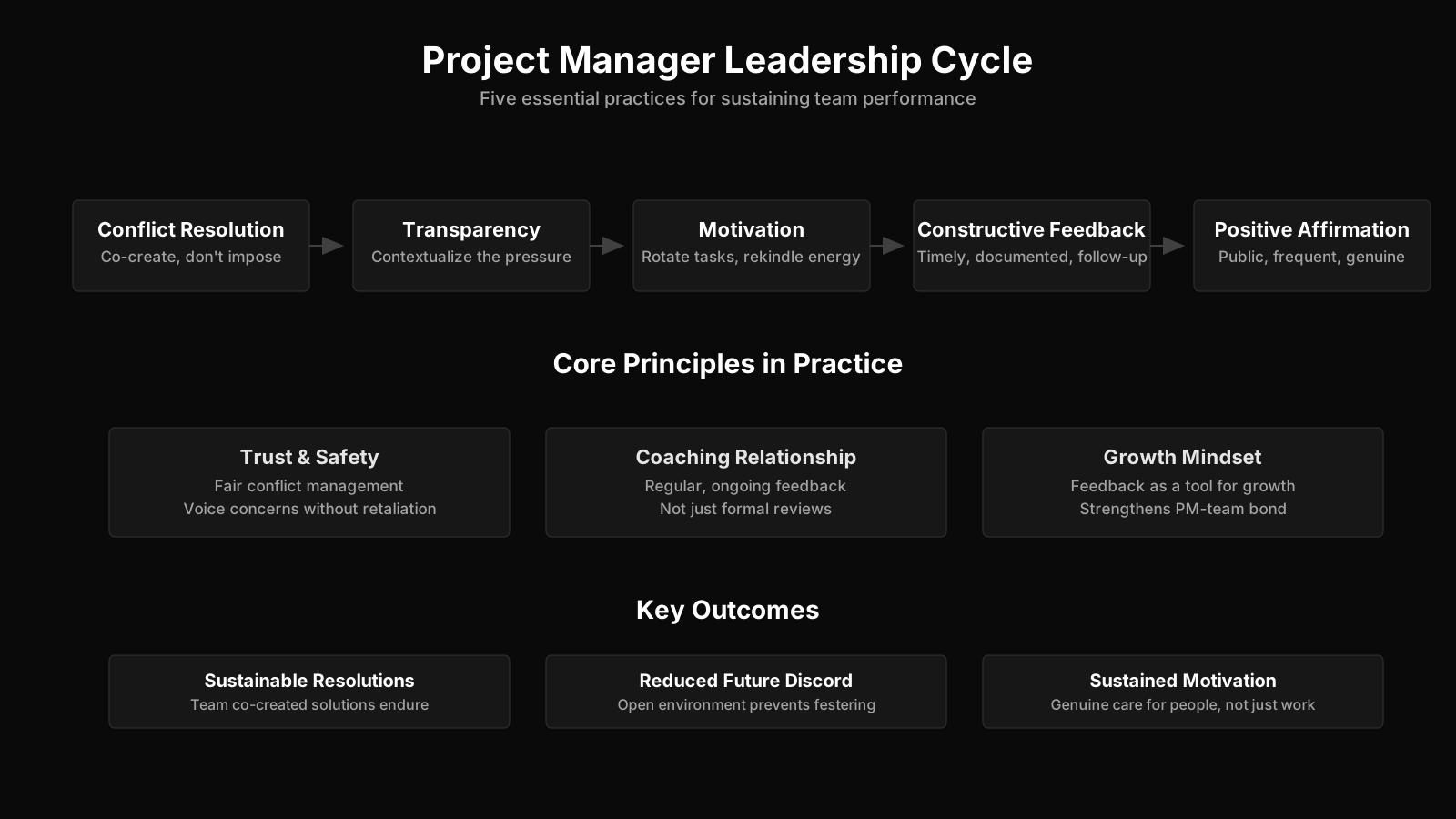
Project Team Management: Key Topics Summary
| Key Concept | Summary |
|---|---|
| Team Management | Managing a project team is a continuous cycle of monitoring performance, resolving conflicts, and adapting plans to maintain and elevate productivity. |
| Core Skills | Effective team management rests on clear communication, decisive leadership, and the disciplined application of structured processes to guide daily work. |
| PMBOK Context | The team management process operates within the Executing process group and is deeply interwoven with the Resource Management knowledge area. |
| Observation Points | Each status meeting, one-on-one, and informal conversation provides critical signals about team dynamics, surfacing issues before they escalate. |
| Change Requests | Change requests frequently originate from team management when the human resource plan must be revised due to a key departure or sustained underperformance. |
| Trust and Safety | Fostering trust yields a team that voluntarily raises concerns early, openly acknowledges mistakes, and sees excellent performance recognized in real time, fueling continuous improvement. |
| Plan Alignment | Every decision to replace a member, adjust reporting lines, or create a new role must be validated against the human resource plan to preserve strategic coherence. |
| Cultural Tools | Overlooking organizational traditions, such as a newsletter mention to celebrate small wins, deprives the team of a valued form of recognition that strengthens morale. |
Understanding the Team Management Process
The project team management process sits within the Executing process group of the PMBOK framework and intersects heavily with the Resource Management knowledge area. But you do not need to be a framework purist to appreciate what is really happening here. At its core, this process is about translating plans into living, breathing interactions and making sure that the people side of the project does not become the bottleneck. It demands that you constantly compare what you planned for your human resources with what is actually unfolding on the ground.
Many project managers mistakenly treat team management as a reactive function. Something goes wrong, someone conflicts, a deliverable slips, and only then does the manager step in. The smarter approach is to build a management rhythm that continuously takes the team's temperature. In practice, this means that every status meeting, every one-on-one, and even casual chats in the hallway become data points that feed your understanding of team health. The process officially involves tracking performance, giving feedback, resolving issues, and managing changes. But underneath that dry list is a much richer reality. You are constantly asking yourself: Are people clear on what they need to do? Is anyone silently struggling? Are we rewarding the right behaviors?
A project manager who understands this process knows that team management is not a separate activity from technical project work. It weaves through everything. When you review a schedule variance, you might be seeing a warning sign about resource overload rather than poor estimation. When you hear tension in a meeting, you are likely glimpsing a conflict that, if left untouched, will fester into a formal dispute. The process encourages you to connect these dots. It provides the structured permission to act on hunches and soft signals before they become hard problems.
Documented outputs matter, of course. Change requests arise from team management because you may need to adjust the human resource plan when a key person leaves or underperforms. Lessons learned flow into the organization, enriching its process assets for future projects. But the more immediate payoff is the intangible one: a team that trusts its leader enough to raise issues early, that feels safe admitting mistakes, and that knows high performance will be noticed in the moment, not just in an end-of-project review. This is the real engine of project success.
Key Insights on Team Management
Critical Inputs to the Team Management Process
Before you can effectively steer the team, you need reliable information. The team management inputs form the evidential backbone that prevents your decisions from becoming guesswork. Without these inputs, a project manager might overcorrect based on anecdote or fail to detect a decline in morale until it is too late. Letting the data speak does not mean ignoring intuition; it means grounding that intuition in something solid.
Project Staff Assignments
This input sounds almost too basic to mention, yet it is where alignment starts. The project staff assignments document lists the people actually allocated to the project. It is not just a roster of names. It represents the culmination of negotiation, acquisition, and pre-assignment decisions. When you open this document, you should see not only who is on the team but also any known constraints attached to them. Maybe a developer is only available three days a week. Perhaps a subject matter expert was promised only for the design phase. These details become anchoring points when you later assess whether performance issues stem from individual capability or simply from an overloaded schedule.
Savvy project managers revisit this assignment sheet whenever they notice friction. If a team member keeps missing deadlines, the first question is not "What is wrong with this person?" but rather "What did we initially agree this person would do, and does their current workload reflect that agreement?" Comparing the assignment sheet against the actual work distribution often reveals a mismatch that no amount of motivational speech can fix.
The Human Resource Plan
The human resource plan lives inside the project management plan and defines roles, responsibilities, reporting relationships, and the staffing management plan. This is not a static artifact that you file away after the kickoff meeting. Every time you consider replacing a team member, adjusting reporting lines, or adding a new role, you loop back to this plan. The staffing management plan, in particular, outlines how team members will be brought on board, ramped up, and later released. It is your operational script for resource lifecycle events.
When a project starts bleeding talent unexpectedly, the human resource plan tells you whether you have a backup resource or if you need to trigger the acquisition process again. It also provides the criteria for recognition and rewards that you will later customize. Without this plan, recognition becomes arbitrary and sometimes even counterproductive because it rewards behaviors the project did not actually need.
Team Performance Assessments
These assessments can be formal or entirely informal. They serve as an ongoing evaluation of the team's collective performance and its ability to interact productively. You might be comparing the team's behavior today against the team charter or against ground rules established at the outset. The purpose is not to build a dossier for HR; it is to spot patterns that require intervention. Are people collaborating less than they were a month ago? Has silence replaced debate in technical discussions? Those are red flags that a performance assessment picks up.
Many project managers conflate team performance assessments with individual performance reviews. They are different beasts. A team performance assessment looks at the system of interactions, not at person A versus person B. For example, you might notice that the quality assurance specialists and the developers are not communicating early enough, leading to late-stage rework. That is a team dynamic problem, not an individual fault. The assessment tells you to modify communication channels or introduce cross-functional stand-ups. This is one of the most overlooked opportunities in project management because it is easier to blame individuals than to fix the system.
Performance Reports
Performance reports provide a snapshot of current project status relative to forecasts. They pull in data from scope verification, schedule control, cost control, and quality control. When you are managing the team, you are not just staring at percentages. You are reading the subtext. A schedule variance might indicate that the development team is putting in heroic hours but still slipping, suggesting a systemic over-commitment rather than a motivation gap. A quality control report showing a spike in defects might point not to laziness but to unclear specifications that frustrate the team.
These reports help you in two distinct ways. First, they let you compare actual performance against the thresholds that trigger recognition. If the team has been working weekends to meet an important milestone, the cost performance data shows the extent of that sacrifice, giving you a factual basis for a reward. Second, they allow you to forecast future human resource needs. If the scope is steadily creeping and the team's velocity is flat, you know you will need additional resources soon. Without performance reports, that decision would be purely political or intuitive.
Organizational Process Assets
Every organization has its own set of cultural and procedural assets that shape team management. These include everything from templates for recognition certificates to bonus structures, corporate apparel, and internal newsletters. They might also encompass lessons-learned databases that reveal how past teams responded to similar challenges. A project manager who ignores these assets walks into a culture blind. For example, if the organization has a long-standing tradition of celebrating small wins with a newsletter mention, failing to leverage that tool deprives the team of a reward they genuinely value.
These assets also include the policies around bonus allocation or performance appraisal cycles. You need to know the constraints before you promise anything. There is nothing more demotivating than telling a team member "I will make sure you get a spot bonus for this" only to discover that the fiscal year's bonus pool is already locked. Process assets ground your recognition and reward strategies in organizational reality.
Powerful Tools and Techniques for Team Management
Moving from inputs to action, the project team management techniques you choose will determine how well you translate information into improved performance. There is no single magical tool; the art lies in blending formal and informal methods. The three techniques that anchor this process are observation and conversation, project performance appraisals, and conflict management. They each operate at a different level of formality, and together they create a safety net that catches issues whether they surface loudly or silently.
Observation and Conversation
Observation is the most underused management tool because it feels passive. But sitting in a team meeting and noticing who speaks and who stays silent is not passive at all. It is diagnostic. A project manager who observes that a junior analyst has stopped asking questions might uncover a culture where asking for clarification is subtly punished by impatient colleagues. Walking around and chatting with team members, what some call management by walking around, lets you track progress toward deliverables and pick up on accomplishments that never make it into formal reports. Those small wins, code that compiled on the first try, a clever workaround for a vendor delay, are exactly the raw material for meaningful, in-the-moment recognition.
Conversation, as simple as it sounds, requires skill. You are not just being friendly. You are probing for barriers, checking for alignment, and gauging emotional tone. A quick exchange by the coffee machine might reveal that a team member is spending three hours a day on a manual data entry task that could easily be automated if someone just flagged it. Without that conversation, the waste would continue and the team member would grow increasingly disengaged. The key is frequency and genuine curiosity. When team members realize that your questions are not interrogations but sincere attempts to understand their world, the quality of information you receive improves dramatically.
Project Performance Appraisals
Performance appraisals during a project serve objectives that go well beyond year-end HR rituals. A well-run appraisal clarifies roles and responsibilities at a granular level. It is an opportunity to wipe the slate clean on fuzzy expectations. Often team members are underperforming not because they lack ability but because they genuinely do not know what success looks like for the current phase. The appraisal conversation allows you to reset that picture.
Constructive feedback within an appraisal is also a chance to discover unknown or unresolved issues. A team member might admit, "I have been struggling because I do not have access to the latest version of the design document." That is not a performance shortcoming; it is a process blockage. The appraisal becomes a conduit for surfacing obstacles that the project manager can then remove. Developing individual training plans is another natural output. If a team member wants to stretch into a new skill area, the appraisal provides a structured moment to formalize that development path. Setting specific goals for the next period turns the appraisal from a backward-looking critique into a forward-looking agreement.
The need for formal versus informal appraisals depends on the project length, complexity, organizational policy, and the quality of everyday communication. A short, fast-paced Agile project might rely on frequent retrospectives and daily stand-up feedback, making a formal sit-down appraisal redundant. A multi-year infrastructure megaproject, on the other hand, probably demands formal appraisal cycles aligned with organizational HR calendars. The mistake many project managers make is treating the tool as binary: either all informal or all formal. The best approach often mixes both, with light-touch check-ins every few weeks and a more structured discussion at major phase gates.
Conflict Management
Conflict is not a sign of a broken team; it is a sign that passionate, intelligent people have different perspectives. The sources of conflict, scarce resources, scheduling priorities, personal work styles, are woven into the fabric of project life. Solid ground rules and communication plans reduce unnecessary friction, but they never eliminate conflict entirely. When managed well, conflict becomes a catalyst for innovation. The team that argues constructively about technical trade-offs often arrives at a solution that no single person could have envisioned alone.
A project manager's first instinct in a conflict should not be to silence it or issue a decree. The better response is to diagnose. Is this conflict over a genuinely scarce resource that requires a trade-off? Then the resolution involves presenting data and facilitating a negotiation. Is it a personality clash masked as a task dispute? Then the solution may need more team-building and a reset of behavioral expectations. The project manager who hides from conflict lets it metastasize into resentment that poisons collaboration. The one who wades in early, not to assign blame but to understand interests, can turn a potential team fracture into a stronger bond.
There is a subtle art to knowing when to step in and when to let the team self-correct. If a conflict remains contained and the team is working through it productively, intervening prematurely can infantalize the group. But if you see the conflict beginning to affect deliverables or if one party is clearly being marginalized, your intervention becomes a leadership responsibility. The goal is always to model the behavior you want to see: direct, respectful, and focused on the work product rather than on personalities.
Key Insights on Blended Management Techniques
- Blend formal and informal methods
- Because no single management tool provides complete oversight, merging formal and informal approaches creates a safety net that catches issues whether they surface loudly or subtly.
- Active observation in meetings
- Actively observing who speaks and who stays silent during meetings can surface cultural dysfunctions, such as a junior analyst who stops asking questions to avoid being chastised by impatient colleagues.
- Management by walking around
- Through casual, spontaneous conversations, managers can track progress toward deliverables, uncover small victories that never appear in formal reports, and deliver meaningful recognition at the moment it matters most.
Outputs That Fuel Continuous Improvement
The process is not over when the team delivers. The team management outcomes include change requests, updates to the human resource plan, resolved issues, inputs to performance appraisals, and a refreshed trove of lessons learned. Each of these outputs is a thread that connects the current project to the next one. Ignore them and you condemn future project managers to repeat your mistakes.
Change requests triggered by team management are particularly interesting. They often stem from a recognition that the original plan no longer matches reality. Perhaps you discover that a key team member cannot perform at the expected level without additional training, so you request a budget change to cover that training. Or you realize that the workload is unsustainable and you need to adjust the scope baseline. These change requests are not admissions of failure; they are evidence that you are actively managing rather than blindly following a flawed plan.
Updating the human resource plan means that you are archiving what actually happened with the team. Who left early, who was brought in late, which roles turned out to be misestimated, all of this becomes institutional knowledge. When a similar project launches, the planner can look at your updates and avoid the same staffing pitfalls. Resolved issues, especially those documented with their root causes, build a library of solutions. Inputs to performance appraisals ensure that the organization recognizes genuine contributors, not just the people who happened to be visible. And lessons learned, capture the real story behind the metrics. They document the team management strategies that worked and the ones that did not, turning your project into a case study for the entire organization.
Recognition and Motivation Strategies
One of the most counterintuitive truths about team management is that recognition delivered during the project lifecycle has far more impact than grand awards at the end. The recognition in project teams should be timely, specific, and tied to actual achievements. A quick public acknowledgment in a daily stand-up that a developer solved a stubborn integration problem does more for morale than a generic "great job everyone" email sent after the product ships.
Challenging assignments can be a form of recognition in themselves. When you trust a team member with a high-visibility task that stretches their skills, you are signaling respect for their capability. The key is to match the challenge to the individual's aspiration. A junior tester who wants to move into business analysis will see a small requirements-gathering task as a reward. The same task assigned to a senior developer who sees it as administrative busywork will backfire. Project managers must therefore treat work allocation as a motivational tool, not just a resource-leveling exercise.
The staffing management plan often includes baseline reward criteria, but effective managers customize those within the project's reality. If the plan talks about bonuses for early delivery, but the team's real sacrifice was in maintaining quality under impossible deadlines, you tailor your recognition narrative accordingly. You might not be able to change the bonus formula, but you can craft the public story that captures the team's actual heroism. That story, told in a newsletter or a website update, can become part of the organizational memory.
Simple artifacts from organizational process assets, certificates of appreciation, a mention in an internal newsletter, even corporate apparel given at the right moment can carry surprising weight. The trick is to avoid treating these as routine. A certificate handed out thoughtlessly feels like bureaucratic theater. The same certificate presented in a team meeting with a specific, heartfelt account of why this person made a difference becomes a keepsake. Motivation is not bought with trinkets; it is communicated through the authenticity of the gesture.
Core Takeaways on Recognition
- Timely recognition beats final awards
- Recognition offered while work unfolds sustains momentum and reinforces desired behaviors far more effectively than grandiose awards reserved for project completion.
- Specific public praise matters
- A specific, public shout-out in a daily stand-up for solving a stubborn problem builds a culture of immediate appreciation that a delayed, generic email cannot match.
- Tasks can serve as rewards
- Entrusting someone with a high-visibility or skill-stretching task signals deep confidence, but its impact depends entirely on aligning the challenge with the individual's career aspirations; what energizes one person can inadvertently demotivate another.
- Adapt recognition to real sacrifices
- Effective managers craft recognition narratives that honor actual team sacrifices rather than leaning on generic reward templates, and they find that simple artifacts (certificates, newsletters, corporate apparel) carry surprising weight when anchored to those authentic stories.
Navigating Performance and Conflict Challenges
Even with the best techniques and inputs, things go wrong. The performance issues in project teams often appear first as a subtle drop in energy. A team member who was once proactive starts waiting to be told what to do. Another who used to challenge ideas constructively begins to simply nod along. These are early warning signs that the management process needs to kick in at a higher intensity.
Common pitfalls abound. One classic mistake is to assume that a single formal appraisal will fix entrenched underperformance. Performance is a stream, not a snapshot. If you have been silent about a problem for six months and then ambush the person with a negative review, you have failed in your ongoing management duty. The appraisal should confirm a narrative that the team member already knows because you have been having regular conversations. Another pitfall is to focus so much on the underperformers that the solid, reliable core of the team feels invisible. This is why the observation tool is so critical: you must manually scan for the quiet achievers and make sure they get their share of sunlight.
Conflict challenges are equally nuanced. A project manager who leaps to resolve every disagreement with a compromise can train the team to avoid real debate. The result is a superficial harmony that masks unresolved tensions and leads to groupthink. The better path is to distinguish between cognitive conflict, disagreements about the work itself, and affective conflict, personal animosity. Cognitive conflict should be amplified and facilitated because it improves decisions. Affective conflict needs to be contained and resolved because it destroys trust. Many inexperienced managers treat both types the same, either crushing healthy debate or tolerating toxic personal attacks. Learning that distinction transforms your ability to manage conflict.
Another conflict pitfall is ignoring the structural roots. If two team members are constantly at odds because their roles have overlapping responsibilities, no amount of mediation will fix the underlying system. The project manager must be willing to adjust the human resource plan, clarify role boundaries, or even redefine the workflow. Temporary fixes like "just try to get along" are a recipe for chronic dysfunction. The willingness to make structural changes based on conflict diagnosis is what separates effective team managers from those who merely hope for peace.
Integrating Team Management with Other Project Processes
Team management never operates in a vacuum. It actively feeds and draws from scope, schedule, cost, quality, and risk processes. The cross-functional team management approach recognizes that every decision you make about the team ripples across the project. When you approve a change request to add a specialist, you are also affecting cost and schedule. When you resolve a conflict that had been delaying a critical path activity, you are directly influencing schedule performance. This interconnectedness means that team management should be represented in integrated change control discussions.
The link to quality management is especially strong. A team that feels supported and recognized is more likely to take pride in its work, leading to fewer defects and higher compliance with specifications. Conversely, a demoralized team will produce lower quality even if the technical processes remain the same. When you review quality metrics, ask what the team's emotional state was during that period. You might find a correlation that no process audit would reveal.
Agile environments handle this integration differently. Instead of a separate "Manage Project Team" process, the daily scrum, retrospectives, and sprint reviews embed team management into the rhythm of delivery. The Scrum Master or Agile coach essentially performs the observation, feedback, and conflict resolution functions continuously. The principles are identical, but the form is less bureaucratic. That does not make it easier; it just makes it more frequent and less documented. For a traditional project manager transitioning to Agile, the challenge is to maintain the rigor of team management without the comfort of formal appraisals and documented plans. The answer usually lies in making retrospectives deeply honest and in building psychological safety that enables open conversation.
From a BVOP perspective, cross-functional teams are not just a nice-to-have but a core success factor. BVOP emphasizes that when teams are truly cross-functional, many conflicts that arise from handoffs and functional siloes simply never materialize. Employee-created tools are treated as formal products, which means that team management must also acknowledge and celebrate grassroots innovation. If a team member builds a script that automates a repetitive report, that effort deserves the same recognition as a customer-facing feature. This philosophy keeps the team engaged and directly links team management to value delivery.
Core Takeaways on Team Integration
Sustaining High-Performance Teams Over Time
The biggest test of team management is not launching a new team but keeping a seasoned team from burning out or growing complacent. High-performance team sustainability requires the project manager to constantly refresh the challenge level and maintain a compelling sense of purpose. After a long stretch of delivery, even the most dedicated team will start to coast if the work becomes routine. This is when you use your performance reports to look ahead and identify upcoming milestones that can reignite energy.
Rotating team members into new roles, when feasible and aligned with individual development plans, injects fresh learning into the group. It also builds resilience because more people understand multiple parts of the system. The staffing management plan becomes a living document that you update to reflect these rotations. This is not the same as disrupting a stable team for the sake of change. It is a deliberate, small-scale intervention designed to prevent the ossification that kills innovation.
Sustaining performance also means managing the emotional toll of long projects. Projects that run for years can resemble a marathon with no finish line in sight. Team members may experience the project equivalent of the "wall" that endurance athletes hit. At that point, the typical recognition levers lose their power because the team is fundamentally exhausted, not underappreciated. The project manager must then shift from motivational language to resource management, possibly negotiating for additional staff, mandating time off, or adjusting the schedule to create breathing room. Recognizing when to rest the team is as important as knowing when to push them.
Common Pitfalls in Team Management and How to Avoid Them
Despite everything the frameworks teach, the common team management mistakes are remarkably consistent across industries. One is the over-reliance on tools and templates at the expense of human connection. A project schedule can show that a task is on track while the person doing the task is quietly falling apart. Tools should complement, not replace, conversation. Another mistake is treating all team members with a uniform management style. Some people need detailed direction; others feel micromanaged by the same level of oversight. Differentiating your approach based on individual competence and commitment is not favoritism, it is situational leadership.
Project managers also frequently misdiagnose the cause of underperformance. They see a missed deadline and immediately assume a motivational problem. Often the root cause is an unclear requirement, an outdated assumption, or a dependency that was not communicated. Before initiating a difficult performance conversation, exhaust the possibility that the system, rather than the individual, is broken. This saves relationships and gets to the real fix faster.
Another subtle pitfall is allowing the halo effect to distort performance appraisal. A team member who delivered a brilliant presentation three months ago might still be riding on that reputation even though her recent work has been mediocre. You must train yourself to evaluate performance on the most recent data, not on an accumulated reputation. This is where the observation and conversation technique, coupled with hard data from performance reports, becomes indispensable. The data will tell you that the spike in quality happened before the presentation, not after. Without that, your appraisal is just a popularity contest.
Finally, many project managers underestimate the corrosive impact of unresolved conflict on team performance. They hope it will blow over. It rarely does. Unresolved conflict consumes cognitive energy. Team members ruminate over the altercation rather than focusing on their work. By stepping into the discomfort early, you not only restore productivity but also signal that your commitment to a healthy team culture is non-negotiable. This is a leadership act, not a procedural one, and it is often the moment when a project manager earns the trust that makes all other management activities easier.
