The risk register is a cornerstone of project management, but its effectiveness hinges entirely on the precision of the language used to describe each entry. When team members and sponsors look at a risk register, the phrasing of a risk shapes their understanding, determines the urgency of response, and ultimately dictates whether the risk is taken seriously. The fundamental question, "How should I phrase a risk when adding it to my risk register?" is more than a matter of form—it is the difference between a register that gathers dust and one that actively protects the project. Many project managers recall the advice to describe risks in as much detail as possible, yet the practical application of that advice remains elusive. A risk stated too vaguely might as well not be listed at all, because it fails to trigger any specific action. On the other hand, a risk that is overly wordy without a logical structure can confuse stakeholders and dilute the focus. The challenge lies in striking the right balance between completeness and clarity, using a syntax that everyone on the project can interpret the same way.
The process of phrasing a risk begins long before you type a sentence into a spreadsheet. It starts with a mental dissection of an uncertain event into its constituent parts. What exactly are we worried about? What would cause it? And what would be the actual harm if it materialized? Without separating these elements, risk statements default to generic warnings that nobody owns. I have seen registers filled with phrases like "vendor delay" or "resource shortage" that get ignored meeting after meeting because they do not specify which vendor, which resource, or what delay actually means for the project timeline. The purpose of this article is to break down the anatomy of a well-phrased risk, identify common traps, and provide concrete methods you can use today to upgrade the quality of every entry in your risk register.
How to Phrase a Risk: Quick Summary Table
| Key Concept | Summary |
|---|---|
| Phrasing Matters | The phrasing of a risk separates a register that drives preemptive action from a static list that teams dismiss as bureaucratic overhead. |
| Vague Risk Descriptions | Generic entries such as 'vendor delay' undermine the register by omitting critical specifics: which vendor, which deliverable, and the quantified impact on the critical path. |
| Flawed Mitigation Strategies | Poorly constructed risk statements push teams toward symptom-level fixes while obscuring root causes, and they signal to risk owners that the entry lacks actionable substance. |
| Stakeholder Confidence | Sponsors and clients gauge project governance through the register; a precisely worded risk paints a concrete, credible picture of potential loss, building support for contingency reserves. |
| Three-Part Structure | Every risk follows a tripartite structure: a definitive cause, an uncertain event that may occur, and a measurable impact on at least one project objective, such as scope, time, cost, or quality. |
| Quantified Risk Statement | A strong risk statement anchors cause and event in specificity, then quantifies the effect, for example: a critical-path delay of three weeks and an unbudgeted cost of $20,000. This precision turns uncertainty into a business case for mitigation. |
| Consistent Phrasing | Inconsistent phrasing across registers forces program managers to exert excessive cognitive effort simply to interpret entries, slowing threat recognition and raising the risk of overlooked exposures. |
Why Risk Phrasing is the Hidden Lever of Risk Management
Most project teams spend far more time debating probability and impact scores than they do on the actual wording of the risk. That is a mistake. The phrasing of a risk is what gives those scores their context, and without that context, the numbers become arbitrary. When you write phrasing a risk when adding it to your risk register with precision, you are effectively creating a contract for the response. The wording defines the scope of what can happen and sets the boundaries for the response strategy. A poorly worded risk can lead a team to spend effort mitigating a symptom rather than the root cause, or can cause a risk owner to dismiss the entry because it does not feel like a real, actionable threat.
Consider what happens at the portfolio level. A program manager reviewing dozens of project risk registers needs to be able to scan risk statements and quickly grasp the nature of each threat. If risks are phrased inconsistently—some as full sentences, some as bullet-like fragments, some mixing causes and effects—the cognitive load becomes enormous. The result is that important risks slip through the cracks, not because they were unrated, but because they were incomprehensible at a glance. Phrasing, therefore, is not just a local nicety for the project manager; it is a strategic communication tool that travels upward through the governance hierarchy.
The Cost of Vague Risk Statements
Vague risk statements create a false sense of security. A risk entry that simply says "budget overrun" tells the reader nothing about the mechanism that would cause the overrun, nor about the magnitude. The project manager might have a clear mental picture, but that picture is invisible to everyone else. As the project progresses and team members rotate, the institutional memory of what that risk really meant disappears. New team members will interpret "budget overrun" through their own experience, which may be completely different from the original intent. This ambiguity leads to mismatched expectations about which risk responses are appropriate.
A related cost is the dilution of accountability. When a risk statement is vague, it becomes impossible to assign a meaningful owner, because nobody can see exactly what they are supposed to own. The risk owner needs a concrete scenario that they can monitor. If all they have is a two-word label, they will rely almost entirely on intuition to determine whether the risk is materializing, and intuition varies wildly from person to person. The register becomes a bureaucratic exercise rather than a decision-making tool.
How Poor Phrasing Erodes Stakeholder Trust
Stakeholders, especially sponsors and clients, often read risk registers to understand what could go wrong. When they encounter poorly phrased risks, they lose confidence in the project team's ability to foresee and manage obstacles. A risk like "low team morale" might be real, but phrased so abstractly, it sounds like hand-waving. The stakeholder may then question the rigor of the entire risk management process. In contrast, a detailed, cause-and-effect statement signals that the team has done its homework and that the risk is based on observable conditions, not just anxiety.
There is also a psychological effect. A precisely worded risk is more likely to be accepted as a legitimate concern that warrants resources. When you present a risk to a steering committee, the clarity of your phrasing determines whether you get a budget for mitigation or a skeptical glance. The same underlying threat, phrased differently, can produce drastically different outcomes in terms of buy-in, simply because the well-phrased version paints a vivid, credible picture of the potential damage.
Core Takeaways on Risk Statement Precision
- Precise phrasing creates a response contract
- Well-crafted risk language explicitly defines the risk’s perimeter and conditions, turning probability and impact scores into reliable triggers for response actions.
- Poor wording misdirects mitigation efforts
- Ambiguously stated risks lead teams to waste effort on visible symptoms rather than underlying causes, and they often prompt risk owners to disregard the entry as unactionable.
- Consistent phrasing supports governance review
- Uniform, logically structured risk statements accelerate scanning across multiple registers for program managers and safeguard institutional knowledge when team members transition.
Dissecting a Risk into Its Component Parts
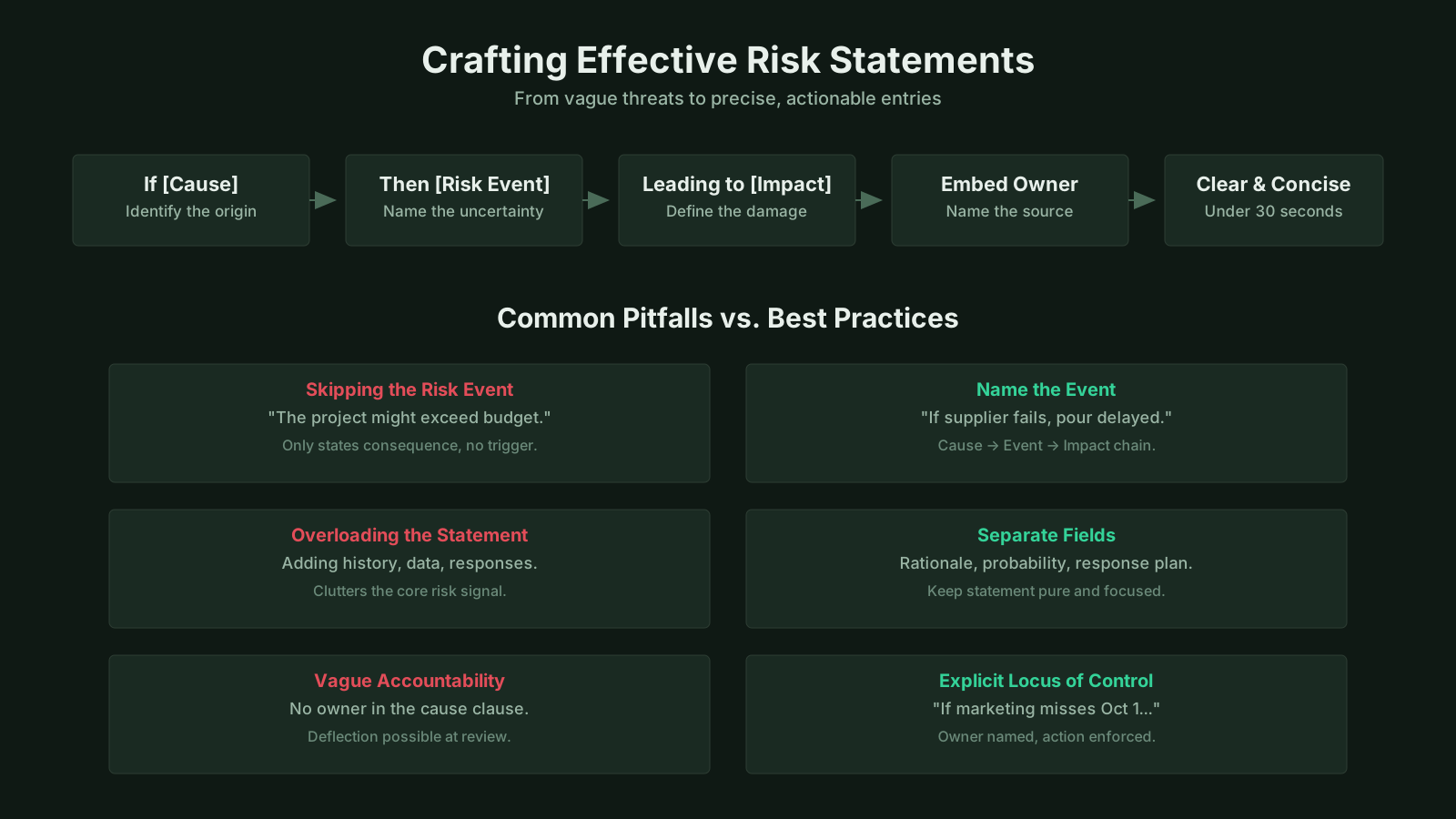
At its core, a risk is an uncertain event or condition that, if it occurs, has a positive or negative effect on one or more project objectives. The most widely used format for capturing this in a registry entry breaks the risk down into three parts: cause, risk event, and effect. This structure, sometimes called the risk metalanguage, provides a natural scaffolding for phrasing. You state what existing condition or trigger might cause something to happen, then you describe the uncertain event itself, and finally you outline the consequence on the project. This approach forces you to think in a chain of causality, which is the only way to design an effective response.
The cause is the factual, existing circumstance or the future condition that could trigger the risk. It is often something you can already observe or measure, like a supplier's fragile financial position or a team member's notice period ending soon. The risk event is the uncertain moment when the cause actually produces a deviation from the plan. It is the pivot point—the thing that might happen. The effect is the impact on project objectives such as schedule, cost, quality, or scope. Separating these three elements also helps you assign owners appropriately: the person monitoring the cause might be different from the person responsible for the response.
The Cause-Risk-Effect Structure in Practice
Let us examine how this plays out with a common project risk. Instead of writing "key person leaves", a well-phrased risk statement using the cause-risk-effect approach would read: "Because the lead architect has not yet signed the contract extension and has an active job offer from a competitor (cause), the project may lose her expertise during the detailed design phase (risk event), resulting in a three-week schedule slip and an estimated $20,000 cost increase for knowledge transfer and replacement onboarding (effect)." The immediate improvement is obvious: everyone knows exactly what is being watched, what could go wrong, and what is at stake. The response strategy can now be tailored to the cause—perhaps negotiating the contract extension or preparing a shadowing plan.
This structure also forces you to be honest about whether you truly understand the risk. If you cannot articulate the cause, you are not dealing with a risk but with a general anxiety. If you cannot specify the effect, you cannot prioritize the risk relative to others. Many project managers initially resist this format because it feels verbose, but the verbosity is a feature, not a bug. It removes guesswork and ensures that the risk register can stand alone as a reference without needing the author present to explain it.
Using If-Then Scenarios to Sharpen the Risk Event
One technique that reinforces the cause-risk-effect format is to phrase the risk event as an "if-then" scenario, even if you do not use those exact words in the final entry. Mentally, you ask: If [cause occurs or persists], then [risk event happens], which would lead to [effect]. This mental model helps you verify that the cause is directly linked to the event and that the event is indeed uncertain, not a certainty. For example, "If the software vendor does not deliver the API module by March 15, then the integration testing phase will be delayed, causing the go-live date to slip by two weeks." The "if" clause is the trigger, the "then" clause is the risk event, and the "causing" clause is the effect. This phrasing has the additional benefit of making the risk testable: you can set up a monitoring indicator for the vendor delivery date.
What if the cause is not a single event but a gradual erosion of a condition? The same logic applies. You can phrase it as: "If the remaining contingency reserves drop below 5% of the total budget before the start of the construction phase (cause), then any subsequent unforeseen cost spike (risk event) will force the project to defer scope items, potentially extending the schedule by three months (effect)." The "if" is a threshold, not a discrete event. That kind of precision allows the team to set a clear tripwire for escalation, long before the risk materializes.
Common Mistakes That Corrupt Risk Register Phrasing
Even experienced project managers can fall into patterns that weaken their risk statements. One of the most pervasive mistakes is mixing risks with issues. A risk is something that has not yet happened, whereas an issue is an event that has already occurred or is certain to occur. When you phrase a risk, you must use language that preserves its uncertain nature. A statement like "the supplier has gone bankrupt" belongs in the issue log, not the risk register. A risk would be "the supplier may go bankrupt before the final delivery." The marker of uncertainty is crucial because it signals to the reader that proactive action is still possible.
Another common error is using subjective or unquantifiable language. Words like "significant," "major," or "substantial" mean different things to different people. If you must use them, anchor them with a metric. Instead of "major budget impact," say "a cost overrun exceeding $50,000, representing a 7% deviation from the cost baseline." The numbers do not have to be surgically accurate at the identification stage; they are estimates that can be refined. But without any number, the risk is impossible to rank against other risks in a quantitative risk analysis.
Failing to Separate Multiple Risks in One Entry
It is surprisingly common to find a risk register entry that reads like a laundry list of fears. For example, "If the client changes requirements, the team may get overloaded, quality may drop, and the deadline may be missed." That single sentence actually contains at least three distinct risk events with different causes and effects. Overloaded team, quality erosion, and deadline slippage are not the same thing, and they require different responses. When you bundle multiple risks together, you make it impossible to assign a single owner or a coherent mitigation strategy. The register becomes cluttered with composite risks that nobody can address holistically. The fix is to split such entries into separate rows, each with its own cause-event-effect chain.
Splitting risks also improves traceability. If a risk is a composite, and later you realize that quality did not drop but the deadline was missed, was the risk realized or not? The ambiguity makes lessons-learned analysis impossible. A clean register, with one atomic risk per row, allows you to track which risks materialized, which responses worked, and which assumptions proved false. It turns the register into a learning repository, not just a compliance artifact.
Omitting the Effect or Downplaying the Real Impact
Sometimes risk statements focus heavily on the cause and event but leave the effect as an afterthought. A risk that says "the testing phase may take longer than planned" omits the effect entirely. Why does it matter if testing takes longer? Will it delay the release? Will it require expensive overtime? Will it force a reduction in scope? The effect is the reason anyone should care about the risk, and it must be stated explicitly. Without it, the risk owner cannot assess the severity and the project sponsor cannot allocate resources.
Another subtle variation of this mistake is to describe the effect in terms of the response rather than the objective impact. For instance, "we may need to hire additional testers" is not an effect; it is a potential response. The effect is the underlying harm to the project objectives. Describing the harm first and then the possible response keeps the register clean and maintains the distinction between risk and risk response. The register is a record of risks, not a placeholder for the response plan, which belongs in a separate column or a linked document.
Core Takeaways on Risk Phrasing
- Preserve the uncertainty marker
- Risk descriptions should always convey uncertainty; a categorical statement such as “the supplier has gone bankrupt” signals a current problem that belongs in the issue log, not the risk register, where phrasing must keep open the possibility of preventive action.
- Quantify impacts precisely
- Vague terms like “significant delay” or “major cost increase” lack shared meaning; replace them with quantified thresholds, for example, “a cost overrun exceeding $50,000, equivalent to a 7% variance from the cost baseline,” so that escalation triggers are unambiguous.
- Avoid bundling multiple risks
- Listing several concerns together in one row, such as team overload, quality erosion, and schedule slippage, dilutes accountability and makes it impossible to design a focused response plan.
- Maintain one risk per row
- Assigning each discrete risk to its own row creates an auditable record: the team can see which risks actually occurred, which mitigation actions proved effective, and which underlying assumptions turned out to be invalid.
Tailoring Risk Phrasing to the Project's Methodology
The core principle of clear cause-risk-effect statements applies universally, but the way you embed these statements into your workflow varies across methodologies. In a traditional waterfall project, the risk register is often a formal document created during the Identify Risks process and maintained throughout the project. The phrasing in such a context tends to be more structured and comprehensive, fitting into a template that also includes categories, probability, impact scores, and response plans. The risk statement column is typically a full sentence or short paragraph, and it is expected to be self-contained. Reviewing these statements happens during periodic risk reviews, and the audience includes people who may not be involved in daily activities.
Agile projects take a different approach. The risk register may be less formal, perhaps a section on a team wiki or a running list in a backlog. Yet the need for clear phrasing does not diminish. In fact, because Agile teams rely on fast decision-making and face-to-face communication, a poorly phrased risk can get overlooked even faster. An Agile team might keep risks as user stories or acceptance criteria, and they still benefit from the cause-effect format. For example, a risk phrased as: "Given the team is down to one database expert with no backup (cause), when the expert falls ill (risk event), then the sprint goal for the database migration is jeopardized (effect)." That phrasing makes it immediately visible in the daily stand-up and triggers a conversation about cross-training.
Program and Portfolio-Level Risk Phrasing
When risks roll up from multiple projects into a program risk register, the phrasing must be even more disciplined. A program risk might be "If Project Alpha and Project Beta both go live in Q3 without integrated identity management (cause), then user access conflicts may occur (risk event), causing a 15% increase in help desk calls and a potential reputational damage for the entire program (effect)." Notice that the cause references multiple project-level deliverables. The phrasing must make these interdependencies explicit so that the program manager can coordinate responses across project boundaries. In a portfolio context, risks might be phrased in terms of strategic objectives rather than project metrics, but the underlying need for a clear causal chain remains.
In such multi-level environments, one trap is that risks get paraphrased as they are escalated, losing the original specificity. A project-level risk of "concrete pour delay due to rain" might become "weather-related schedule risk" at the program level, which is nearly useless for governance. The solution is to train everyone who touches the register to preserve the cause-effect chain and to add context about the specific project and the escalation trigger. A well-phrased escalated risk still paints a clear picture of the originating project and the exact mechanism of failure.
Quantified Loss and Alternative Phrasing Approaches
Some advanced risk management frameworks push the phrasing beyond qualitative descriptions to include explicit quantified loss estimates. In Business Value-Oriented Project Management (BVOPM), for instance, product risk management requires risks to be accompanied by quantified "Loss size" units, which are used for dynamic filtering and prioritization. This extends the phrasing task: you must not only describe the cause, event, and effect, but also attach a specific loss value that can be compared objectively across the entire program. The phrasing then becomes something like: "If the user acceptance testing reveals a critical defect in the payment module (cause), then the release may be recalled (risk event), resulting in a direct loss of $120,000 in remediation costs and a 10-point drop in customer satisfaction index (effect). The estimated Loss size is 130 units." While not every organization uses such a system, incorporating a quantifiable loss anchor into the phrasing elevates the conversation from subjective worry to measurable exposure.
What matters is not the exact unit but the principle of moving from ambiguity to precision. A risk that merely mentions a "potential delay" without a magnitude cannot be stacked against other risks that do specify a loss. Even if your organization does not demand a BVOPM-style loss size, you can still embed a quantitative estimate of the effect in the phrasing itself. The moment you attach a number to the consequence, the risk becomes real to decision-makers.
Building a Phrasing Discipline in Your Team
Getting individuals to write clear risk statements is not a one-time training event. It is a cultural shift that requires templates, feedback loops, and a willingness to reject poorly phrased entries during risk workshops. One effective practice is to include a risk statement review as a standing agenda item in the first five minutes of any risk identification session. When someone proposes a risk, the facilitator asks: "What is the cause? What exactly are we uncertain about? And what specifically would happen to the project?" The group then jointly refines the phrasing until it meets a predefined standard. This peer review not only improves the current entry but also subtly teaches everyone the structure over time.
Templates help, but only if they are simple. A spreadsheet with columns labeled "Cause," "Risk Event," and "Effect" can be too rigid if it forces people to chop sentences into fragments that lose coherence when read separately. An alternative is to have a single "Risk Statement" column but provide a sample structure and require that the statement clearly distinguishes the three elements. The rule of thumb: if a stranger reading your risk register cannot answer those three questions within fifteen seconds for each risk, the phrasing needs work.
Conducting a Risk Phrasing Audit
If you inherit a risk register, do not assume the existing entries are good just because they have been there for months. Set aside an hour to audit the phrasing. Read each risk aloud and ask yourself if you understand what you would do tomorrow to monitor it. If the answer is no, flag it for rewriting. Common red flags include risks that start with "Lack of..." (which is a problem, not a risk), risks that are actually assumptions stated negatively, and risks that include the word "may" but no trigger condition. Flagging these patterns is the first step toward cleaning the register.
During the audit, you might also discover that some risks are duplicated because different team members phrased the same underlying concern differently. For example, "software integration may fail" and "the APIs may not be compatible" might be the same risk seen from two angles. Consolidation is only possible if each risk is phrased with enough detail to reveal the overlap. The audit, therefore, is not just about correctness but about coherence. A register with thirty unique, crisply phrased risks is infinitely more valuable than one with eighty ambiguous ones.
Training Stakeholders to Read (and Expect) Good Risk Phrasing
It is not enough for the project manager and the risk owner to appreciate good phrasing. Sponsors and other stakeholders must also learn to demand it. When a sponsor asks for a risk summary and receives a list of terse labels, they may not realize that the missing detail is a problem. You can gradually raise the bar by presenting risks in the full cause-risk-effect format during status meetings, even if the formal register uses a shorthand. Over time, stakeholders begin to expect that level of clarity and will push back on vague entries, which reinforces the desired behavior across the entire project ecosystem.
This is particularly important in organizations where the project management office maintains a lessons-learned repository. If risks are submitted in a cleaned-up, well-phrased format, future project managers can use them as a starting point for their own risk identification. The repository becomes a library of specific scenarios rather than a collection of buzzwords. Good phrasing thus pays forward, making every subsequent project a little smarter about what could go wrong.
Core Takeaways on Phrasing Discipline
- Cultural shift, not one-time training
- Clear risk statements demand structured templates, iterative feedback loops, and a workshop culture that actively challenges vague entries, embedding phrasing discipline into daily practice rather than depending on a single training event.
- Peer review as a standing agenda item
- Reserving the first five minutes of every risk identification session for joint statement review turns phrasing into a collective habit, sharpening everyone's ability to meet the standard through consistent, shared practice.
- Flexible format with a fifteen-second test
- A single Risk Statement column guided by a sample structure preserves narrative flow that rigid three-column formats break, while a practical test verifies clarity: a statement passes only if an unfamiliar reader can spot the cause, event, and effect within fifteen seconds.
- Recognize common audit red flags
- Inherited risk registers often contain entries that lead with ‘Lack of,’ frame mere negative assumptions as risks, or rely on ‘may’ without a defined trigger condition, each a clear sign of weak phrasing that must be challenged.
Operationalizing Risk Phrasing in Your Daily Workflow
The moment you discover a new risk is rarely the best moment to craft its final phrasing. Identification often happens in the middle of a heated discussion or during a brief conversation. The key is to capture the raw observation immediately, then later refine it into a structured statement. A whiteboard note that says "vendor constraint – Jan delivery" can be turned into a proper risk after the meeting, using the cause-event-effect structure. This two-step process prevents the loss of emerging risks while also ensuring that what ultimately goes into the register meets the quality standard.
Once a risk is in the register, its phrasing is not set in stone. As the project evolves, the cause might change, the event might become more or less likely, or the effect might morph. The risk statement should be updated to reflect this new understanding, with a note about why the phrasing changed. This versioning is especially valuable during the project closure phase, when the team analyzes which risks materialized and why. A static, poorly written risk statement gives you no insight into the evolution of the threat. A well-maintained one becomes a narrative of what the team knew and when they knew it.
Linking Risk Phrasing to Response Planning
A risk statement should make the response planning almost obvious. If you have clearly articulated the cause, the natural mitigation is to address or monitor that cause. If the effect is a specific cost overrun, the contingency reserve can be sized accordingly. The link between phrasing and response is so tight that some risk management practitioners advocate writing the response strategy directly from the cause and effect without any intermediate brainstorming. For example, from the cause "the specialized pump has a 12-week lead time and the supplier has a history of late deliveries," the response might be "order the pump early and identify a secondary supplier with a shorter lead time." You can see how the phrasing practically hands you the response on a plate.
When a risk statement fails to generate a specific response, it is usually a sign that the phrasing is still too abstract. If your risk management plan lists "monitor" as the response for half the risks, it is not because monitoring is always sufficient; it is because the entries do not provide enough detail to design a targeted action. Refining the phrasing often reveals that a risk can be transferred, avoided, or mitigated in a way that was not previously visible. This is the ultimate test: a well-phrased risk statement makes the next step obvious, while a poorly phrased one leaves you staring at it, unsure what to do.
When to Bend the Rules on Formal Phrasing
I will admit, there are moments when the perfect cause-risk-effect sentence feels like overkill. In rapid brainstorming sessions or on small, informal projects, you may simply jot down a few keywords and trust that the team shares enough context to interpret them correctly. The danger is that this trust can be misplaced. Even a co-located team with high cohesion can misinterpret a shorthand risk weeks later when the original discussion has faded from memory. My rule of thumb is: if the risk has a potential impact above a certain threshold—say, any risk that could delay a milestone by more than a day—it deserves a full phrased statement. For truly trivial risks, a concise label might suffice, but only if the register is a living document that is reviewed frequently by the same people. In any distributed or multi-stakeholder environment, stick to the structured phrasing.
There is also a situational nuance when risks are captured in real-time collaborative tools like digital whiteboards. The initial capture might be informal, but the tool itself can enforce a structure by having designated sections for cause, event, and effect. Some teams use a Mad Libs-style prompt: "Because ____, an uncertain event ____ might occur, leading to ____." This gamifies the process and makes it acceptable to fill in the blanks quickly, without sacrificing the underlying logic. It is a practical compromise between speed and rigor.
Using Risk Phrasing to Surface Hidden Assumptions
One of the most valuable side effects of rigorous risk phrasing is that it brings unstated assumptions into the open. When you try to articulate the cause of a risk, you often find yourself writing something like "if the assumption that the client will provide data by February 1st proves false." That assumption, which may not have been documented anywhere else, is now a visible node in the project's causal map. You can then decide whether to treat the assumption itself as a risk, add it to the assumption log, or take proactive steps to validate it. In this way, the risk register becomes not just a list of threats but a mirror reflecting the project's underlying uncertainties.
Assumption-based risks are particularly dangerous in multi-vendor programs where each party assumes the other is handling a dependency. A risk statement like "the interface specification from the external design partner may be delayed, which would cause the development team's sprint to fail" makes the dependency explicit. The phrasing acts as a contract between teams, creating a shared understanding that can then be verified in integration meetings. Without such explicit wording, each team might privately believe the other is responsible for tracking the interface delivery, and the real risk goes unmanaged.
Key Insights on Risk Phrasing
- Assumptions become visible
- Articulating a risk's cause forces hidden assumptions into the open, transforming them into distinct, traceable nodes in the project's causal map.
- Assumptions are actionable findings
- Surfaced assumptions become actionable inputs: teams can elevate them to risks, log them for ongoing monitoring, or launch validation efforts to preempt dependency failures.
- Register mirrors project uncertainties
- A meticulously structured risk register serves as a dynamic mirror of the project’s core uncertainties, transforming a static threat list into an evolving picture of systemic exposure.
- Multi-vendor dependency hazards
- In multi-vendor programs, assumption-based risks become particularly hazardous because each organization may silently rely on others to manage critical shared dependencies, often without explicit confirmation.
- Explicit wording builds contracts
- A precisely worded risk statement operates as a mutual contract between teams, forging a shared understanding that is then verified through structured integration reviews.
Phrasing Risks for Positive Opportunities
Although this discussion has focused on threats, the same phrasing principles apply to opportunities—risks that may have a positive effect on project objectives. The structure flips slightly, but the discipline remains. For an opportunity, you still identify a cause (a favorable condition or trigger), an uncertain positive event, and a beneficial effect. For example: "If the early construction completion of the adjacent building releases skilled labor into the market ahead of schedule (cause), the project may be able to hire a full crew at standard rates (opportunity event), reducing the labor cost estimate by 8% (effect)." The phrasing is no less detailed than for a threat. The key difference is that the response strategy aims to exploit, enhance, or share the opportunity rather than mitigate it.
Project managers often neglect opportunity phrasing because the default mindset is defensive. But a well-phrased opportunity can energize a team just as effectively as a threat can focus them. When the risk register contains opportunities that are as concretely worded as the threats, it transforms the document from a catalog of doom into a balanced portfolio of uncertainties. It also reminds stakeholders that risk management is about maximizing the chances of project success, not just avoiding failure.
Overcoming Resistance to Detailed Risk Phrasing
You will encounter pushback. "This takes too long," some team members will say. "We don't need a graduate thesis for every risk." The counterargument is that the time spent phrasing a risk is trivial compared to the time lost if the risk materializes and nobody had a clear understanding of what hit them. A crisp, detailed risk statement might take two minutes to write instead of fifteen seconds for a sloppy one. If you have thirty risks, that is an hour of concentrated thinking. Compare that to one day of unplanned firefighting because a risk was misunderstood, and the return on investment is obvious. The real obstacle is not time but habit.
Another form of resistance comes from the belief that uncertainty cannot be expressed precisely because it is, by definition, uncertain. This is a confusion between precision of language and precision of prediction. You can be extremely precise about what you are uncertain about, without claiming to know the future. In fact, the whole discipline of risk management rests on that very distinction. A precise risk statement says, "We do not know whether X will happen, but we know that if it does, the impact will be Y within a range of Z." That is a responsible admission of uncertainty, not a pretense of foresight.
Core Takeaways: Risk Phrasing Value
- Time cost rebuttal
- The two minutes required to articulate a detailed risk statement pale in comparison to the extended firefighting that ensues when an ill-defined risk materializes.
- Clear risk statements prevent ambiguity
- A precise, specific risk description aligns the entire team on the nature of the threat, whereas a vague one breeds confusion and leaves the team scrambling when the risk strikes.
- Hour of analysis versus firefighting day
- Drafting thirty clear risk statements consumes about an hour; a single misunderstood risk can easily consume a full day of reactive crisis resolution, making the upfront investment unequivocally justified.
- Language precision vs. prediction
- Objections rooted in uncertainty often conflate precise language with precise forecasting; effective risk management, however, hinges on clearly distinguishing description from prediction.
- Responsible uncertainty admission
- A well-phrased risk statement transparently acknowledges uncertainties in occurrence while specifying the likely impact range, a responsible practice that avoids pretending to predict the future.
The Long-Term Payoff of Getting Risk Phrasing Right
When you look back at the end of a project, the risk register should read like a story of everything that could have gone wrong and everything the team did about it. That story is only worth telling if each entry is self-contained and intelligible. Projects that have a well-phrased risk register build institutional memory that outlasts the project itself. The next project manager who takes on a similar initiative does not have to start from scratch. They can scan the old register, see patterns, and adapt the risks to the new context. This reuse is possible only because the original risks were written in a way that captures the full logic, not just the label.
Getting risk phrasing right also elevates your professional credibility. Colleagues notice when your risk register is a cut above the usual half-finished documents. It signals that you think rigorously about uncertainty and that you respect the intelligence of your stakeholders enough to give them complete information. In a field where so many processes degrade into box-ticking exercises, a meticulously phrased risk register stands out as a genuine act of professional craftsmanship.