Project managers often ask what is the difference between contingency reserves and management reserves. These two types of financial buffers serve different purposes, live in different parts of the project budget, and follow different approval rules. Understanding that distinction is critical for earned value management, risk response planning, and financial control. Contingency reserves are allowances for unplanned but potentially required changes that can result from realized risks identified in the risk register. Management reserves, by contrast, are budgets reserved for unplanned changes to project scope and cost.
Mixing up these two concepts leads to misallocated funds, broken baselines, and confusing performance reports. A project manager who spends management reserve on a known risk, or tries to cover an unknown scope change with contingency reserve, undermines the entire control system. The separation is not just academic. It determines who has spending authority, what appears in earned value calculations, and how the project sponsor views financial risk.
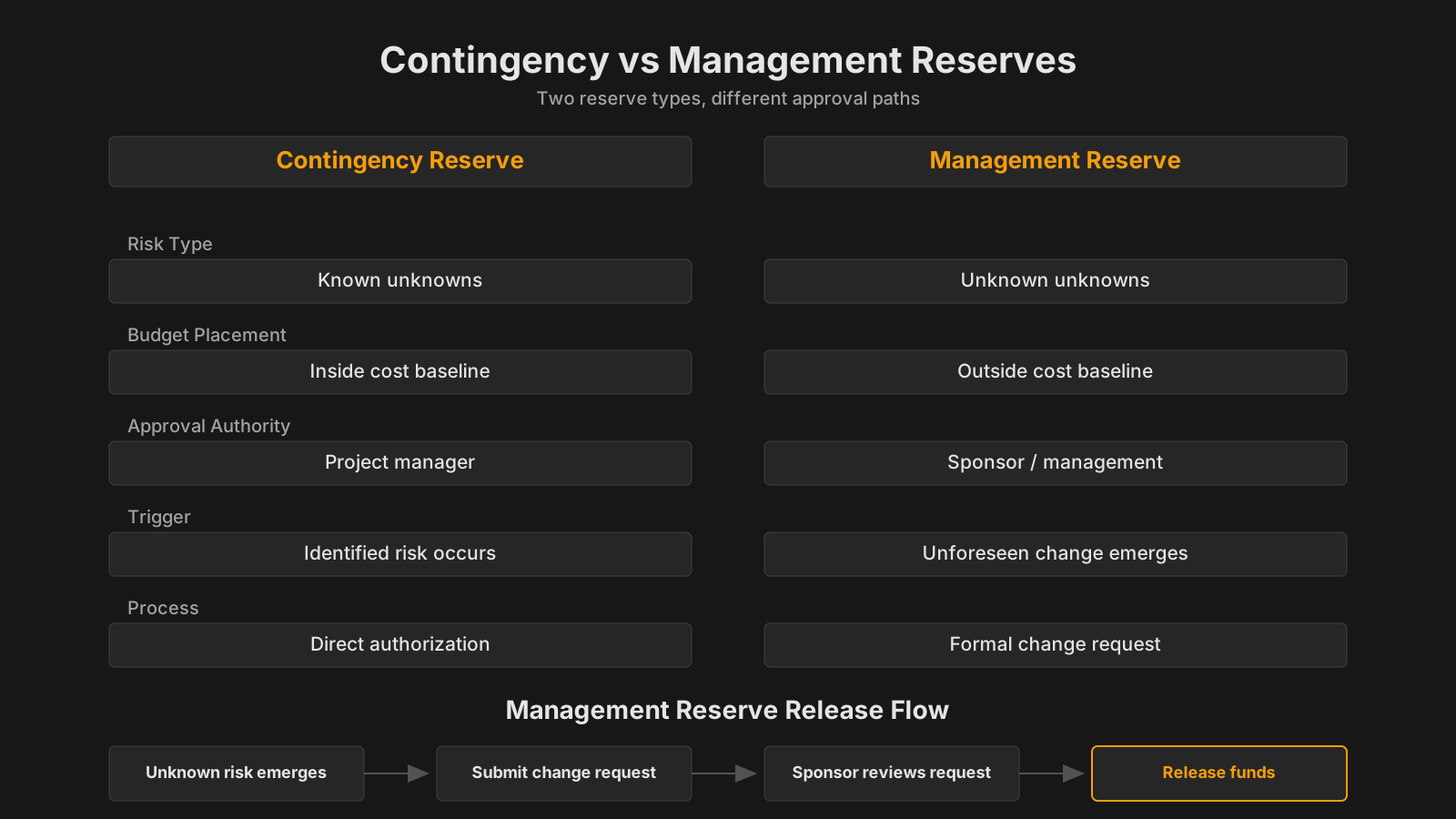
Key Differences Between Contingency and Management Reserves
| Key Concept | Summary |
|---|---|
| Contingency Reserve | Contingency reserve is a budget allowance set aside for identified risks that have materialized, enabling timely response to unplanned but necessary cost or schedule adjustments already captured in the risk register. |
| Reserve Calculation | Quantitative techniques such as expected monetary value analysis and Monte Carlo simulation translate identified risk probabilities and impacts into a defensible reserve amount, replacing guesswork with data-driven estimation. |
| Risk Response Costs | Beyond covering direct risk impacts, contingency reserve also funds residual risk exposure and the execution of pre-approved risk responses when trigger conditions are met. |
| Management Reserve | Management reserve addresses unknown scope changes and events outside the original risk register, including regulatory shifts, executive-driven reprioritization, or other unanticipated strategic adjustments. |
| Reserve Misuse | Using management reserve for known risks or contingency reserve for unknown scope changes undermines accountability and distorts performance baselines, weakening the overall project control system. |
| Decision Authority | Clearly segregated reserves enable the project manager to act on realized risks immediately, reducing response time by removing the need for sponsor approval on contingency drawdowns. |
| Management Reserve Sizing | The size of the management reserve reflects the organization's risk appetite, historical project performance, and the degree of external uncertainty such as market volatility or regulatory complexity. |
| Advanced Modeling | Advanced techniques such as decision tree analysis and integrated cost and schedule simulation model how multiple risks interact, providing a more realistic view of required budget buffers. |
What Are Contingency Reserves?
A contingency reserve definition describes an allowance for unplanned but potentially required changes that can result from realized risks identified in the risk register. The key phrase here is "identified risks." These are not unknown unknowns. They are risks that have been captured, assessed, and assigned response strategies during the risk management processes. For example, if a project team knows that a key supplier has a history of late deliveries, a contingency reserve might cover the cost of expedited shipping or temporary replacement parts if that risk materializes.
Contingency reserves do not exist independently. They are directly linked to the risk register, which serves as the inventory of known threats and opportunities. Without a risk register, there is no legitimate basis for a contingency reserve. The reserve amount is not a guess; it is derived from the probability and impact of the identified risks, often through quantitative techniques like expected monetary value analysis or Monte Carlo simulation. This linkage is what separates contingency reserves from generic "padding" that some teams add to estimates.
The Relationship Between Contingency Reserves and the Risk Register
Every contingency reserve line item should trace back to one or more entries in the risk register. When a risk is identified, the project team assesses its probability and impact, and then plans a risk response. That response might be to accept the risk, transfer it, mitigate it, or avoid it. If the chosen strategy still leaves residual risk exposure, or if the response itself costs money when triggered, a contingency reserve covers that cost. The risk register becomes the controlling document for the reserve.
Consider a software project that has identified a risk of a critical third-party API failing during integration. The team plans a mitigation strategy: build a fallback adapter. The cost of developing that adapter only if the API fails is a contingent cost. The contingency reserve funds it. If the risk never occurs, the reserve remains unspent. But the reserve exists because the risk was identified and analyzed beforehand. That is the essence of contingency planning.
How Contingency Reserves Are Calculated and Allocated
Calculating contingency reserves requires more than picking a round percentage. Common methods include expected monetary value, which multiplies the probability of each risk by its cost impact and sums the results. More sophisticated approaches use decision tree analysis or Monte Carlo simulation to model the combined effect of multiple risks on the project budget. The output is a risk-adjusted cost estimate that feeds into the cost baseline.
Project managers also allocate contingency reserves at different levels of the work breakdown structure. Some reserves sit at the activity level, covering specific risks tied to a task. Other reserves are held at the project level, covering risks that affect multiple work packages or that cannot be easily localized. This layered approach gives control to the people closest to the work while still providing a central buffer for broader uncertainties. The allocation should reflect the risk ownership structure defined in the risk management plan.
Contingency Reserves in the Cost Baseline and Earned Value
Contingency reserves are included in the cost baseline. That means they are part of the performance measurement baseline, the time-phased budget against which project performance is measured. In earned value terms, the planned value for each work package includes the contingency reserve allocated to that work package. When a risk does not occur, the unspent contingency shows up as a favorable cost variance. When a risk does occur, the actual cost draws down the reserve, and the earned value reflects the completed work.
Because contingency reserves are inside the baseline, the project manager typically does not need a change request to use them. The authority was already granted when the baseline was approved. This is a major practical advantage. The project manager can respond to realized risks quickly, without waiting for sponsor approval, as long as the risk is in the risk register and the reserve was allocated for that purpose. This speed matters when a risk materializes and the team needs to act immediately.
Key Takeaways on Contingency Reserves
- Reserves tied to risk register
- Contingency reserves are funded allowances for unplanned cost or schedule impacts that arise directly from risks already identified, analyzed, and recorded in the project's risk register.
- Quantitative methods set reserve size
- The reserve amount is derived from the quantified probability and impact of identified risks, typically using expected monetary value analysis or Monte Carlo simulation, rather than from subjective guesswork.
- Distinct from generic padding
- Because contingency reserves are tied to specific entries in the risk register and cover residual risk exposure and the cost of risk responses, they are not the same as the generic padding that some teams add to estimates without analytical support.
What Are Management Reserves?
The management reserve definition refers to a budget reserved for unplanned changes to project scope and cost. Unlike contingency reserves, management reserves are not tied to specific identified risks. They exist to absorb events that were not anticipated during risk identification. These events can include regulatory changes, unexpected market shifts, executive-driven scope changes, or any other deviation that falls outside the original risk register.
Management reserves operate at the governance level of the project. They are controlled by senior management or the project sponsor, not by the project manager acting alone. The amount of management reserve is often determined by the organization's risk appetite, historical performance on similar projects, and the level of uncertainty surrounding the project's external environment. It is a financial cushion for the truly unknown, not for the known but unmanaged.
Approval and Authorization for Management Reserve Spending
The project manager may be required to obtain approval before obligating or spending management reserve. This is not a universal rule, but it is common practice in mature project organizations. The approval authority typically rests with the project sponsor, a steering committee, or a change control board. The reason is simple: management reserve is outside the project manager's delegated authority because it was not part of the approved cost baseline.
When a project encounters an unplanned scope change, the project manager documents the change, estimates the cost impact, and submits a request to the approving authority. If approved, the management reserve is released, and the project manager can proceed. This process often triggers a baseline revision, because the new scope or cost needs to be incorporated into the performance measurement baseline. Until that approval happens, the project manager cannot spend the management reserve, even if the need is urgent.
Management Reserves in the Total Project Budget
Management reserves are not part of the cost baseline but may be included in the total budget for the project. The cost baseline is the approved time-phased budget that excludes management reserve. The total project budget equals the cost baseline plus the management reserve. For example, if the cost baseline is one million dollars and the management reserve is one hundred thousand dollars, the total budget is one point one million dollars. That extra one hundred thousand is visible to the sponsor but hidden from earned value measurements.
This distinction matters for financial reporting. The project manager reports earned value against the cost baseline, not against the total budget. The management reserve appears as a separate line item in the project funding requirements. Organizations that roll management reserve into the baseline without a change request are effectively removing the governance layer that makes management reserve meaningful. The separation is deliberate and must be preserved.
Management Reserves and Earned Value Measurements
Management reserves are not included as part of earned value measurement calculations. This means they do not affect planned value, earned value, actual cost, cost variance, schedule variance, cost performance index, or schedule performance index. The performance measurement baseline excludes management reserve entirely. A project can be on schedule and under budget relative to its baseline while still having consumed a large portion of its management reserve. That is why management reserve consumption is tracked separately.
When management reserve is used, it typically triggers a change request to incorporate the new work into the baseline. At that point, the released funds are moved from management reserve into the cost baseline, and they become part of earned value calculations. Until then, the funds sit outside the baseline and do not influence performance metrics. This is a deliberate control mechanism: it forces the organization to formally acknowledge that the project's scope or cost has changed, rather than silently absorbing the change into performance variances.
The Difference Between Contingency Reserves and Management Reserves
The key difference between contingency reserves and management reserves is that contingency reserves address identified risks from the risk register, while management reserves address unplanned changes to scope and cost that were not previously identified. This distinction drives everything else: approval authority, budget placement, and earned value treatment. Understanding this difference prevents project managers from misusing one reserve for the other.
Think about it this way. Contingency reserve answers the question, "What if this known risk happens?" Management reserve answers the question, "What if something we never thought of happens?" The first is about preparation. The second is about adaptability. Both are necessary, but they cannot be interchanged without breaking the project's control system.
Difference Between Contingency Reserves and Management Reserves in Risk Coverage
The risk coverage difference is the most fundamental. Contingency reserves cover risks that have been identified, assessed, and logged in the risk register. Each contingency reserve line item has a traceable risk entry. Management reserves cover unplanned changes that are not in the risk register. These can be new regulatory requirements, a sudden change in organizational priorities, a natural disaster that was not considered a realistic threat, or a competitor's action that changes the project's viability.
When a project team does a thorough risk identification process, it reduces the need for management reserve because more uncertainties become known risks with contingency reserves. But no risk identification process is perfect. There will always be unknown unknowns. Management reserve exists for those. The boundary between the two reserves is the risk register. Anything inside it belongs to contingency. Anything outside it belongs to management.
Difference Between Contingency Reserves and Management Reserves in Approval Authority
Contingency reserves are typically within the project manager's authority to use. Since they are part of the cost baseline, the project manager has already been given the power to spend them when the corresponding risk occurs. No additional approval is needed at the time of use. Management reserves, by contrast, often require approval from the sponsor or another governing body before the project manager can obligate or spend them. This is because management reserve spending represents a change to the approved project scope or cost.
This difference in authority reflects the level of trust and delegation in the project. The project manager is trusted to manage known risks. Unknown changes that alter the project's fundamental parameters need a higher level of scrutiny. In practice, some organizations give the project manager a small pre-approved management reserve for minor unplanned changes, but the principle remains: management reserve is a governance tool, not a project manager's discretionary fund.
Difference Between Contingency Reserves and Management Reserves in Budget Placement
The budget placement difference is straightforward but often misunderstood. Contingency reserves are included in the cost baseline. Management reserves are not included in the cost baseline, but they may be included in the total project budget. The cost baseline is the approved version of the time-phased project budget, excluding management reserve. The total budget includes both. This means the project manager reports performance against the cost baseline, while the sponsor monitors the total budget including management reserve.
Visually, you can think of the cost baseline as a stack of planned expenditures over time. Contingency reserve is embedded within that stack, spread across the activities it is meant to protect. Management reserve sits above the stack as a separate line item. It is not time-phased in the baseline because it is not tied to specific work packages. Only when a change request is approved does a portion of management reserve move down into the baseline and become time-phased.
Difference Between Contingency Reserves and Management Reserves in Earned Value
The earned value treatment difference is a direct consequence of the budget placement difference. Because contingency reserves are part of the cost baseline, they are included in earned value measurement calculations. Planned value, earned value, and actual cost all include the relevant contingency amounts. This means that using contingency reserve for a realized risk does not automatically distort performance metrics; it was already planned for.
Management reserves, since they are not part of the cost baseline, are not included in earned value calculations. They do not affect CPI, SPI, CV, or SV until a change request moves them into the baseline. When that happens, the baseline is revised, and the new funds become part of planned value and earned value from that point forward. This creates a clean audit trail: performance variances before the change reflect the original plan; variances after the change reflect the new plan. Without this separation, it would be impossible to tell whether a variance was caused by poor performance or by an unplanned scope change.
Key Insights on Reserve Distinctions
- Identified versus unidentified risks
- Contingency reserves are allocated to risks captured in the risk register, whereas management reserves absorb unforeseen work that was not anticipated during planning.
- Contingency reserve spending authority
- Since contingency reserves are built into the cost baseline, project managers hold preapproved spending authority to deploy them when the associated identified risk materializes.
- Management reserve as governance tool
- Management reserves sit under the authority of governance bodies rather than project managers, serving as a structured safeguard for unforeseen events rather than discretionary project funding.
- Risk identification reduces reserve need
- A rigorous risk identification process converts many uncertainties into documented risks, which reduces dependence on management reserves because a larger share of items qualifies for contingency coverage.
Practical Application of Contingency and Management Reserves
Effective reserve management best practices require project managers to establish clear rules for when each reserve type can be accessed, who approves the access, and how the use is documented. Many projects fail not because they lacked reserves, but because the reserves were muddled together. Separating contingency and management reserves from the start prevents confusion during execution.
In practice, this means creating a reserve management section in the project management plan. It should define the risk register as the sole authority for contingency reserve use, specify the approval chain for management reserve, and outline how reserve usage will be tracked in the accounting system. Without this written guidance, project teams will default to whatever is easiest, which usually means using whichever reserve is most accessible, regardless of its intended purpose.
How Project Managers Use Contingency Reserves in Practice
When a risk is identified and a contingency reserve is allocated, the project manager monitors the risk trigger. If the trigger occurs, the risk response is executed, and the associated costs are charged against the contingency reserve. The risk register is updated to reflect the realized risk and the response taken. The earned value system captures the actual cost, and the performance variance reflects the planned contingency that was consumed.
A construction project might have a contingency reserve for weather delays. If a storm hits, the project manager uses the reserve to pay for rescheduling, overtime, or temporary protective measures. That is a known risk materializing. The cost is not a surprise; it was planned. The project manager does not need to ask for permission. The key is that the risk register documented the weather delay risk, including its probability, impact, and planned response, before the storm occurred.
How Management Reserve Approval Works in Real Projects
When an unplanned change appears, the project manager first determines whether it falls within the existing risk register. If it does not, it is a candidate for management reserve. The project manager then prepares a change request describing the new scope or cost, the reason it was not identified earlier, the estimated impact, and the recommended funding source. This request goes to the sponsor or change control board.
The approving authority evaluates the request against the organization's strategic priorities and risk appetite. If approved, the management reserve is released, and the project baseline is updated through formal change control. The project manager can then spend the funds. This process can take days or weeks, depending on governance. That delay is intentional. Management reserve spending should force a strategic conversation about whether the project should continue in its new form.
Common Pitfalls and Misconceptions in Reserve Management
One common pitfall is treating management reserve as extra contingency reserve. A project manager who has exhausted the contingency reserve for a known risk may tap management reserve without a change request, reasoning that the money is available. That violates the governance structure. Management reserve is for unknown unknowns, not for known risks that were underestimated. If a known risk costs more than planned, the correct response is to update the risk register, reassess the risk, and potentially revise the baseline through change control.
Another misconception is that contingency reserve can cover any unexpected event. Some project managers treat contingency reserve as a general buffer for scope changes, schedule slips, or quality failures. That is wrong. Contingency reserve is tied to specific risks in the risk register. If a new scope requirement appears, it is not a known risk. It belongs to management reserve. Using contingency reserve for unplanned scope changes hides the scope change from governance and distorts earned value measurements.
Reserve Practices in Agile and Hybrid Environments
Agile projects often do not maintain formal contingency reserves in the same way as traditional predictive projects. Instead, they use timeboxing, backlog prioritization, and iterative delivery to absorb uncertainty. A sprint buffer or release buffer may serve a similar function to contingency reserve, providing capacity for known variability in velocity. However, the concept of management reserve still exists at the product or program level, where unplanned changes to the product vision or regulatory environment may require additional funding.
Hybrid projects combine both worlds. They may keep a contingency reserve for known technical risks in a critical path workstream, while maintaining a management reserve at the program level for changes that emerge from stakeholder feedback or market shifts. The distinction remains the same: known risks go to contingency, unknown changes go to management. The vocabulary may differ, but the underlying control principle does not.
Framework Context: PMBOK, PRINCE2, and BVOP
The PMBOK reserve analysis guidance situates contingency and management reserves within the project cost management knowledge area, specifically the Determine Budget and Control Costs processes. PMBOK also links reserve analysis to the Perform Quantitative Risk Analysis process, where expected monetary value and simulation techniques help size contingency reserves. Management reserves, however, are more closely tied to overall project funding and governance.
Understanding where reserves fit in the broader project management framework helps practitioners apply them consistently. The PMBOK Guide treats reserve analysis as a tool and technique in several processes, but the conceptual home of contingency reserve is the cost baseline, while management reserve sits outside it in the project funding requirements. PRINCE2 and Business Value-Oriented Project Management offer related but distinct perspectives.
Reserve Analysis in the PMBOK Guide
In the PMBOK framework, reserve analysis is used during Estimate Costs and Determine Budget. During Estimate Costs, contingency reserves may be added to activity cost estimates to account for identified risks. During Determine Budget, the cost baseline is assembled by aggregating activity cost estimates and contingency reserves. Management reserves are not part of this baseline; they are added later to arrive at the total project budget. The Control Costs process monitors the use of reserves and compares performance against the baseline.
The PMBOK Guide also connects reserve analysis to risk response planning. When the team plans responses to identified risks, they may assign contingency funds to specific risk response strategies. This creates a direct line from risk identification through risk response to budget allocation. Management reserve, by contrast, is not directly linked to a specific risk response. It is a higher-level funding source for changes that require project re-planning.
PRINCE2 Risk Budget: A Related Concept
PRINCE2 uses a risk budget to fund responses to threats and opportunities that have been identified and analyzed. This is similar to contingency reserve in PMBOK. The PRINCE2 risk budget is part of the project budget and is managed by the project manager within agreed tolerances. PRINCE2 also uses the concept of change budget for unplanned changes, which aligns more closely with management reserve. However, PRINCE2 places stronger emphasis on management by exception, so the approval thresholds for using these budgets are defined by the project board.
Practitioners moving between PMBOK and PRINCE2 environments often find that the underlying ideas are the same, but the terminology and governance structures differ. A PRINCE2 risk budget is functionally equivalent to a contingency reserve, while a PRINCE2 change budget serves a role similar to management reserve. The key is to map the local terminology to the fundamental distinction between known risks and unplanned changes.
BVOP Perspective on Reserves and Product Risk Management
Business Value-Oriented Project Management treats product risk management separately from general project risk, using quantified Loss size units and dynamic filtering to decide which product risks get funded. This contrasts with traditional contingency reserves that often rely on aggregate percentage-based estimates. Defect analysis in BVOP uses predefined root-cause categories, which can feed into more precise reserve sizing for quality-related risks. A project operating under BVOP principles would size its contingency reserves based on quantified loss exposure, not on a blanket percentage of the cost estimate.
Key Takeaways on Reserve Frameworks
- PMBOK reserve analysis placement
- The PMBOK Guide integrates reserve analysis into the Estimate Costs, Determine Budget, and Control Costs processes within the cost management knowledge area, and connects it to Perform Quantitative Risk Analysis to derive defensible contingency reserve levels.
- Contingency versus management reserves
- Contingency reserves are embedded within the cost baseline to cover identified risks, while management reserves remain outside the cost baseline within project funding requirements and are subject to broader organizational governance for unforeseen exposures.
- Distinct BVOP risk funding view
- Business Value-Oriented Project Management establishes a clearer boundary by separating product risk management from general project risk, and uses quantified Loss size units with dynamic filtering to determine which product risks receive funding, offering a perspective that differs materially from PRINCE2 and PMBOK.
Decision Guidance for Project Managers
Practical criteria for distinguishing contingency and management reserves start with one question: was the risk identified in the risk register? If yes, contingency reserve applies. If no, management reserve is the appropriate source. Project managers should build this question into their change control and risk response procedures.
This single question eliminates most confusion. It forces the project team to check the risk register before spending any reserve. If the risk is there, the contingency reserve is the right tool, and the project manager has authority to act. If the risk is not there, the change is unplanned, and management reserve with its approval process is the correct path. The question is simple, but the discipline required to ask it consistently is not.
Questions to Distinguish Between Reserve Types
Beyond the risk register question, project managers should ask a few more targeted questions when deciding which reserve to use. Does the event change the project scope or just realize a planned risk? Does the event require a change to the project baseline? Is the funding already time-phased in the cost baseline? Is the spending authority already delegated to the project manager? The answers to these questions lead inevitably to one reserve or the other.
For example, a realized risk that was in the risk register does not change scope, does not require a baseline change, and is already time-phased in the cost baseline. The project manager has authority. That is contingency reserve. A new regulatory requirement that was never identified changes scope, requires a baseline change, and is not time-phased. The project manager needs approval. That is management reserve. The decision tree is clear once the questions are asked.
Integrating Reserves into Project Controls
Project controls should track contingency reserve and management reserve separately in the accounting system. Each reserve should have a unique cost code or project identifier. Contingency reserve usage should be recorded as a risk response execution, not as a change request. Management reserve usage should always be recorded as a change request, with the associated baseline revision. This separation creates an audit trail that supports earned value analysis and stakeholder reporting.
Monthly project reviews should report both the cost baseline performance and the status of the management reserve. A project may be on budget against its baseline while consuming management reserve rapidly. That is a signal that the original assumptions are no longer valid. Similarly, a project may be over budget against its baseline but still have a healthy management reserve. That is a different situation. Reporting both lines gives the sponsor a complete picture of financial health.
Final Guidance on Contingency and Management Reserves
The difference between contingency reserves and management reserves is not a trivial accounting detail. It is the structural separation between known risks and unknown changes. Contingency reserves belong to the project manager and the risk register. Management reserves belong to the sponsor and the change control board. Contingency reserves live inside the cost baseline. Management reserves live outside it, in the total budget but not in earned value.
Every project manager should document these rules in the project management plan before execution begins. The risk register must be maintained diligently, because it is the boundary between the two reserve types. When a risk occurs, use contingency. When an unplanned change appears, use management. When in doubt, ask the one question that resolves the matter: was it in the risk register? That discipline protects the project's financial integrity and keeps the governance structure intact.
