The question of what characteristics does an effective project manager need is not resolved by a list of technical skills or a single certification. Effective project management draws on three distinct but interconnected characteristics: knowledge, performance, and personal attributes. Each characteristic addresses a different part of what a project manager must be able to do, and all three must operate together for consistent delivery. Area-specific skills and general management proficiencies may be necessary for a given project, but they sit alongside these three foundational characteristics rather than replacing them.
Organizations often confuse the presence of one characteristic with overall effectiveness. A project manager who knows the PMBOK processes inside out may still fail in front of stakeholders. Another who executes with remarkable discipline may still alienate the team. The three characteristics provide a diagnostic lens that helps clarify where a project manager is strong, where they are weak, and what development will actually move the needle.
This article examines each characteristic in turn, then shows how they reinforce one another during real project work. Along the way it points out common pitfalls in how companies evaluate and develop project managers, because the way we assess these characteristics directly shapes who gets promoted and why some projects underperform despite having credentialed leaders.
Key Characteristics of Effective Project Managers: Summary
| Assessment Dimension | Key Insight |
|---|---|
| Credential Overreliance | Organizations often assess project managers on certifications and job titles rather than on demonstrated ability to deliver results under real project conditions. This bias distorts promotion decisions and helps explain why some initiatives underperform despite having formally certified leaders. |
| Applied Competence | Genuine project management expertise is not vague familiarity. It is the working command of the processes, tools, techniques, and principles required to govern project initiation, planning, execution, monitoring, and closure effectively. |
| Technical Acumen | A capable project manager understands the purpose of a work breakdown structure, the impact of task dependencies, earned value calculations, and when a risk response should be escalated rather than simply accepted. |
| PMBOK Knowledge Domains | In predictive environments, expertise spans the core knowledge areas of scope, schedule, cost, quality, resources, communications, risk, procurement, and stakeholder management. |
| Stakeholder and Interpersonal Competence | A third critical domain covers stakeholder and interpersonal knowledge, including communication channel design, influence mapping, and expectation management across dispersed and cross functional teams. |
| Loss of Practical Currency | Project managers who drift into purely administrative roles may retain credentials while losing the working recall needed to facilitate a risk workshop or defend a schedule rationale to a skeptical sponsor. |
| Observable Performance Indicators | Effective project managers produce credible baselines, status reports that surface meaningful variances, meeting structures that drive decisions, and issue logs that track resolution progress rather than merely listing problems. |
| Evidence Based Evaluation | More reliable evaluation comes from reviewing past work products, asking follow-up questions about how candidates handled failed deliverables, and observing candidates facilitate real planning or status discussions. |
What Characteristics Does an Effective Project Manager Need? The Three Core Dimensions
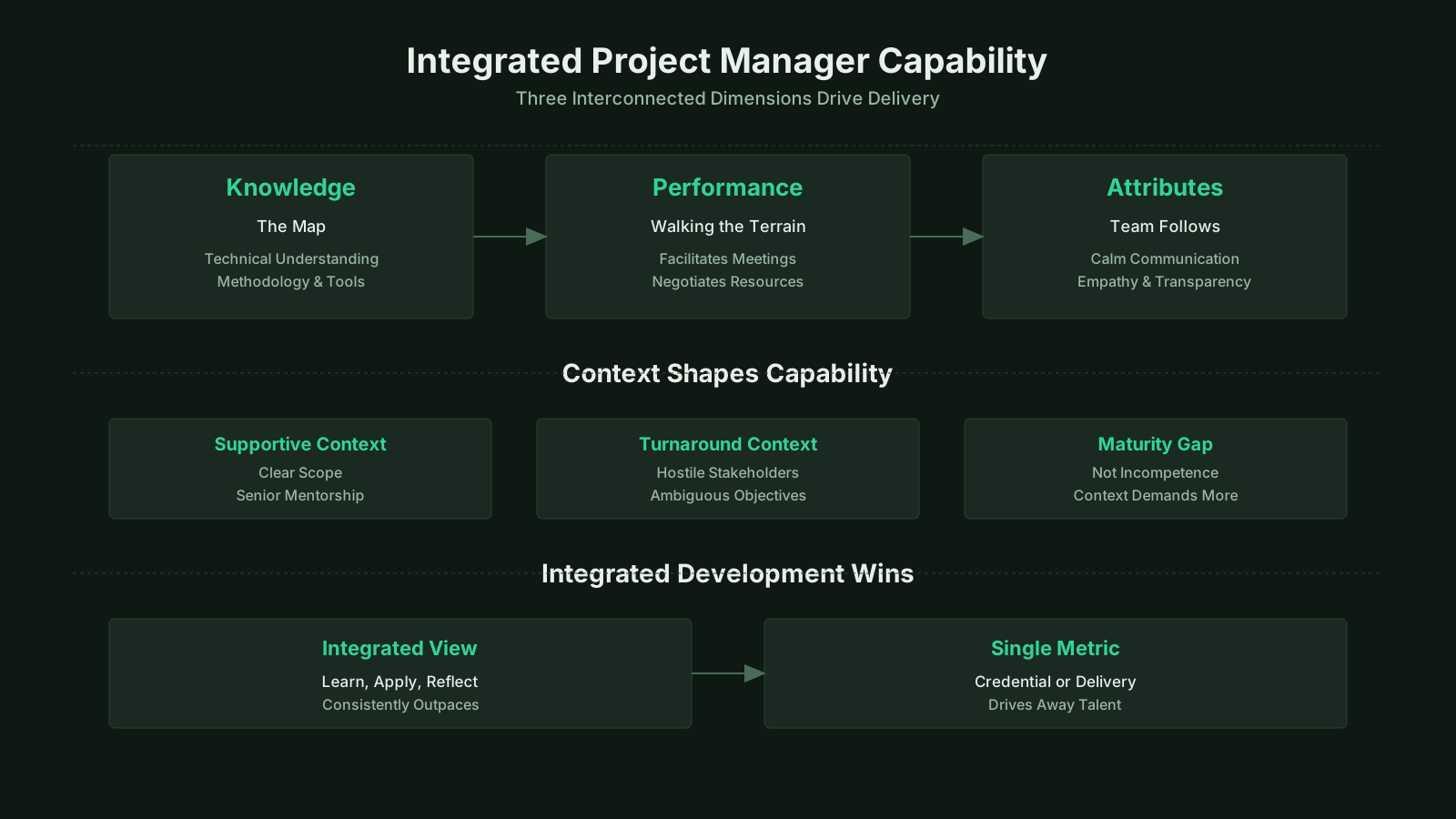
The three characteristics that answer the question are knowledge, performance, and personal behavior. The phrase effective project manager characteristics often gets used loosely, but breaking it into these three dimensions gives it useful structure. Knowledge covers what the project manager understands about project management. Performance covers what the project manager can accomplish by applying that knowledge. Personal characteristics cover how the project manager behaves while leading the team and balancing constraints.
Each dimension addresses a different failure mode. A project manager can possess extensive knowledge yet freeze when a sponsor asks for a recovery plan because they have never applied the risk response tools in a live environment. Another project manager might perform well on paper, hitting milestones and managing scope, but leave a trail of disengaged team members because their interpersonal approach is overly directive. The three characteristics therefore serve as a diagnostic framework rather than a checklist.
It is worth pausing on the fact that these characteristics are not substitutes for domain expertise or general management proficiency. The source material specifically notes that these characteristics are required in addition to area-specific skills and general management proficiencies. A pharmaceutical project manager still needs to understand regulatory pathways, and a digital transformation lead still needs to understand vendor contracting. The three characteristics do not replace those; they elevate them from raw competence to consistent delivery.
Organizations sometimes collapse this framework into a single question: "Can this person deliver?" That question is too narrow. Delivery depends on knowledge, execution, and behavior operating in concert. When one is missing, the other two must compensate, and that compensation creates hidden risks. For example, a project manager with weak knowledge but strong performance and personal skills may drive the wrong plan confidently. A project manager with deep knowledge and strong personal skills but weak performance may inspire the team while the schedule quietly slips. The framework only works when all three are evaluated as a set.
Core Insights on PM Effectiveness
- Three defining dimensions
- Effective project managers are assessed across knowledge, performance, and personal behavior, giving organizations a structured way to evaluate professional capability.
- Knowledge versus application gap
- Performance captures what a project manager can actually accomplish by applying knowledge, since expertise alone does not guarantee effective decisions or action under pressure.
- Behavior shapes team engagement
- Personal characteristics determine how a project manager leads and communicates under constraints, directly shaping team morale, trust, and sustained commitment.
- Supplemental to domain expertise
- These three characteristics are required alongside technical and general management skills, so project managers must also develop deep expertise in their specific industry.
Project Manager Knowledge Requirements: Understanding the Discipline
Knowledge, as a characteristic of effective project managers, refers to what the project manager actually understands about project management. This is not a vague familiarity with concepts; it is a working command of the processes, tools, techniques, and principles that shape how projects are initiated, planned, executed, monitored, and closed. Project manager knowledge requirements therefore span the full project lifecycle and include both the standard frameworks organizations adopt and the tailored versions those frameworks require in specific contexts.
In a traditional PMBOK-oriented environment, this knowledge includes the core knowledge areas such as scope, schedule, cost, quality, resource, communications, risk, procurement, and stakeholder management. A knowledgeable project manager understands what a work breakdown structure is for, why dependencies matter in sequencing, how earned value calculations work, and when a risk response should be escalated rather than accepted. The knowledge is not simply memorization; it is the ability to explain why a particular tool fits a particular situation.
Core Project Manager Knowledge Areas in Project Management
Project manager knowledge about project management often gets tested against process groups and knowledge areas, but in practice it extends into several connected domains. One domain is planning knowledge: the ability to decompose scope, estimate durations, sequence activities, and assemble a baseline that can be tracked. Another domain is control knowledge: understanding variance analysis, forecasting, change control, and issue management. A third domain is interpersonal and stakeholder knowledge: knowing how communication channels work, how to map influence, and how to manage expectations across dispersed teams.
The depth of knowledge needed shifts by project type. On a predictive construction project, critical path method and resource leveling are central. On an adaptive software project, backlog refinement, iteration planning, and cumulative flow diagrams take priority. An effective project manager does not need to know every tool in every framework, but they do need to know enough to select the right tool and to recognize when a tool is being misapplied. The knowledge characteristic includes this diagnostic awareness.
Many practitioners confuse knowledge with certification. Certification can demonstrate that a person passed an exam, but it does not guarantee that the knowledge remains current or that the person can retrieve it under pressure. Knowledge decays when it is not used. Project managers who move into pure administrative roles may still hold credentials while losing the working recall needed to facilitate a risk workshop or defend a schedule rationale to a skeptical sponsor. This is why knowledge must be refreshed through deliberate practice and exposure to new project types.
In PRINCE2 environments, knowledge is often organized around principles, themes, and processes rather than the PMBOK knowledge areas, but the underlying demand is similar. The practitioner must understand the logic of continued business justification, management by stages, and defined roles and responsibilities. These are not isolated facts; they form a coherent governance logic. A project manager who can recite the PRINCE2 principles but cannot explain how they shape a stage boundary decision has knowledge that is still incomplete.
Common Knowledge Misconceptions for Project Managers
One common misconception is that project manager knowledge is mostly about software tools. Gantt charts, Kanban boards, and reporting dashboards are output mechanisms, not the underlying discipline. A person can be fluent in Microsoft Project or Jira and still lack knowledge about dependency logic, buffer management, or risk identification. Tool proficiency is a useful supplement, but it is not the same as project management knowledge. Organizations that evaluate knowledge primarily through tool usage often end up with project managers who can update a plan beautifully while missing the analytical reasoning behind it.
Another misconception is that knowledge is fixed once a methodology is learned. In reality, effective project managers update their knowledge as project environments evolve. Hybrid delivery models, remote collaboration patterns, and new contracting approaches all reshape what practitioners need to know. The knowledge characteristic is not static. It includes the willingness to learn, unlearn, and reconcile conflicting advice from different frameworks. This does not mean chasing every new trend; it means maintaining enough fluency to choose intelligently among established and emerging practices.
What this really means in practice is that knowledge is like a mental toolbox. A project manager who only knows one way to estimate durations will apply that method to every project, even when the team has little historical data and the work is highly uncertain. A project manager with broader knowledge will recognize that analogous estimating, parametric estimating, and three-point estimating serve different conditions, and they will switch tools accordingly. The toolbox analogy also explains why knowledge alone is insufficient: owning a high-quality wrench does not mean a person can loosen a corroded bolt without applying the right technique and force.
Another subtle knowledge gap appears when project managers learn frameworks in isolation. They may understand risk management as a set of processes but fail to connect it to schedule contingency, procurement terms, or stakeholder communication preferences. Effective knowledge is networked, not fragmented. The project manager sees how a change in one knowledge area ripples into others. That integrated mental model is what allows them to anticipate secondary effects before they become visible to the team.
Project Manager Performance Competencies: Applying Knowledge to Deliver Results
Performance refers to what the project manager is able to do or accomplish while applying project management knowledge. This is where theory meets execution. Project manager performance competencies are observable through decisions, artifacts, facilitation, and outcomes rather than through credentials or stated understanding. A project manager who knows the purpose of a risk register but cannot run a risk identification session that extracts real risks from a hesitant team is still at the knowledge level. Performance closes that gap.
Performance includes both the tangible products of project management work and the less tangible acts of leadership in execution. A project manager performing effectively produces baselines that are credible, status reports that surface real variances, meeting structures that drive decisions, and issue logs that track resolution instead of merely listing problems. These outputs may sound administrative, but they require judgment. A baseline that is perfectly formatted but built on unrealistic assumptions is a performance failure, not a formatting success.
How Project Manager Performance Shows Up in Daily Project Work
Daily performance manifests in small, repeated behaviors. When a team member raises a new dependency, a performing project manager does not just note it; they assess whether it affects the critical path, whether it changes risk exposure, and who needs to be informed. When a sponsor challenges a schedule, a performing project manager can explain the assumptions behind the estimate and offer trade-off scenarios instead of becoming defensive. These micro-decisions accumulate into the project's overall trajectory.
In predictive environments, performance often involves maintaining baselines, analyzing earned value, managing change requests, and holding people accountable to commitments. In adaptive environments, performance looks different: facilitating sprint planning, removing impediments, protecting the team from scope instability, and ensuring that each iteration delivers usable value. The common thread is that the project manager is actively applying knowledge to real work, not just observing from the sidelines.
Performance also includes the ability to adapt when the original plan stops reflecting reality. A project manager can have a fully approved baseline in month one and a completely invalid plan in month three if assumptions change. The performance characteristic includes recognizing when replanning is needed and having the confidence to raise that issue early, even when stakeholders prefer to continue with the original plan. This is one of the most difficult performance behaviors because it often invites conflict, yet it is precisely what separates effective project managers from those who simply keep the plan updated until the project fails.
In business value-oriented project environments, scope change is often treated as user feedback rather than a failure of planning. That shift changes what strong performance looks like. The project manager is expected to absorb new information without defensiveness, reassess priorities quickly, and keep the team focused on value delivery rather than baseline preservation. It is a different kind of performance discipline, one that values responsiveness over rigidity while still maintaining enough stability to avoid chaos.
Distinguishing Knowledge from Performance in Project Manager Evaluation
The distinction between knowledge and performance is often blurred during hiring and promotion decisions. Interviewers ask scenario questions and treat good answers as evidence of performance, but a well-rehearsed answer only proves knowledge of the scenario, not applied capability. A better signal comes from examining past work products, asking follow-up questions about how the person actually handled a specific failed deliverable, or observing the candidate facilitate a real discussion. Without that probing, organizations may hire project managers who can talk elegantly about risk management but cannot facilitate a risk conversation when a senior stakeholder dominates the room.
Performance is also contextual. A project manager who performed well on a small internal project may struggle on a large, multi-vendor program because the scaling demands are different. That does not mean the person lacks performance competence; it means the competence has not yet been developed in that context. Effective organizations calibrate performance expectations against project complexity. They look for evidence that the person can translate knowledge into action at the required scale, not just that they have done so somewhere before.
A practical test of performance is whether the project manager leaves behind traceable evidence of management actions. Decisions are documented, risks have owners and dates, changes are assessed for impact before approval, and team members understand their accountabilities. When these traces are missing, the project may still appear to be moving, but that movement is often reactive rather than managed. Performance is the difference between a project that succeeds because conditions happen to be favorable and one that succeeds because someone actively steered it through uncertainty.
Honestly, this is where many project manager development programs fall short. They provide the knowledge and then assume performance will follow. It does not. Performance requires repeated application, feedback, and the willingness to make mistakes in controlled environments. Organizations that rotate junior project managers through progressively larger assignments, with structured coaching, build performance far more reliably than those that simply pay for another certification.
Key Insights on Performance Competencies
- Performance observable through actions
- Competence is demonstrated through observable decisions, facilitation quality, and tangible work products rather than asserted through credentials or theoretical understanding.
- Effective behaviors vary by environment
- Capable project managers establish credible baselines, surface actual variances, drive decisions in meetings, and track issue resolution while adapting their approach to predictive or adaptive project environments.
- Courage to raise replanning early
- Effective project managers recognize when a plan needs to be revised and raise the issue promptly even in the face of stakeholder resistance, because protecting an unrealistic baseline until failure occurs reflects a breakdown in performance.
Personal Effectiveness Characteristics of an Effective Project Manager
The personal characteristic refers to how the project manager behaves when performing the project or related activity. Personal effectiveness characteristics of project managers encompass attitudes, core personality traits, and leadership, which includes the ability to guide the project team while achieving project objectives and balancing project constraints. This dimension is often the hardest to assess because it plays out in interpersonal moments that are not captured by project documents or dashboards.
Personal effectiveness is not about being likable, although likability can help. It is about the consistency and appropriateness of behavior under pressure. A project manager who remains calm and clear when a critical vendor misses a milestone is demonstrating personal effectiveness. A project manager who redirects blame, avoids difficult conversations, or becomes defensive when challenged is demonstrating the opposite. These behaviors shape team trust, sponsor confidence, and ultimately the quality of information flowing to the project manager.
Leadership and Behavioral Attributes of Effective Project Managers
Leadership within the personal characteristic includes several observable behaviors. One is the ability to set direction without micromanaging: the project manager clarifies objectives, boundaries, and decision rights, then allows team members to do their work. Another is the ability to influence without formal authority, which is especially important in matrix organizations where team members report to functional managers. A third is the ability to absorb ambiguity and communicate provisional plans without pretending certainty that does not exist.
Core personality traits linked to personal effectiveness include integrity, resilience, curiosity, and self-awareness. Integrity shows up when the project manager tells a sponsor that the timeline is at risk even when it would be easier to wait. Resilience shows up when a phase gate rejection forces significant rework. Curiosity drives continuous learning about the team's work, the customer's needs, and the organizational context. Self-awareness helps the project manager recognize their own triggers, biases, and communication habits, which prevents personal blind spots from becoming project risks.
Personal effectiveness also includes the ability to balance competing constraints rather than optimizing for one at the expense of all others. Scope, schedule, cost, quality, risk, and stakeholder expectations interact constantly. A project manager who always prioritizes schedule may deliver on time with unacceptable defects. A project manager who always prioritizes quality may never finish. The personal characteristic includes the judgment to know when a constraint can flex and when it cannot, and the courage to explain that trade-off clearly.
Business value-oriented approaches place a premium on cross-functional teams as a core success factor. That raises the bar for personal effectiveness because the project manager must foster collaboration across functional boundaries without formal control. It means reading different professional cultures, translating between technical and business perspectives, and building a shared sense of ownership even when team members have competing functional loyalties.
Personal Effectiveness in Different Project Environments
In highly structured, predictive environments, personal effectiveness may be expressed through disciplined adherence to process, formal communication, and careful expectation management. In adaptive environments, personal effectiveness may look more like servant leadership: the project manager removes obstacles, fosters psychological safety, and allows the team's expertise to shape the solution. The behavioral core is similar, but its expression shifts. An effective project manager reads the environment and adjusts their style without abandoning their values.
One common pitfall is confusing personality type with personal effectiveness. A naturally extroverted project manager is not automatically better at stakeholder engagement, and an introverted project manager is not automatically worse. Personal effectiveness is about behavior, not temperament. The source material is explicit on this point: personal effectiveness encompasses attitudes, core personality characteristics, and leadership. It does not prescribe one personality type. Teams respond to genuineness, consistency, and respect more than to charisma alone.
What this really means in practice is that personal effectiveness operates like a shock absorber in a vehicle. The project hits bumps: a critical resource leaves, a stakeholder changes direction, a vendor underperforms. The project manager's behavior determines how much of that disruption is transferred to the team and stakeholders. A skilled shock absorber compresses, absorbs energy, and returns to a stable state. An unskilled one amplifies the jolt, sometimes making a manageable problem feel like a crisis. This analogy also clarifies why personal effectiveness cannot be replaced by process alone, because no process can regulate a project manager's emotional reactions or interpersonal choices in real time.
Feedback is essential for developing this dimension. Without candid input from team members, peers, and sponsors, a project manager may not realize that their behavior is creating friction. The perception gap can be significant: a project manager might believe they are being appropriately rigorous while the team experiences them as inflexible. Structured feedback mechanisms, including retrospective conversations and 360-degree reviews, help close that gap.
Integrating Knowledge, Performance, and Personal Characteristics in Practice
The three characteristics do not operate as separate boxes. They interact continuously. A balanced project manager skill set combines deep knowledge, demonstrated performance, and personal effectiveness in ways that reinforce one another. Knowledge informs better performance choices; performance builds the confidence and credibility needed for personal influence; personal effectiveness creates the psychological safety that allows knowledge to be shared and applied honestly.
Consider how the same project challenge looks through each lens. A project is trending late. The knowledge lens asks whether the project manager understands critical path analysis, crashing, fast-tracking, and resource leveling. The performance lens asks whether the project manager can actually model the alternatives, present them to the sponsor, and execute the chosen recovery plan. The personal lens asks whether the project manager can hold the team accountable without demoralizing them, and whether they can tell uncomfortable truths to stakeholders. A project manager with only one or two of these lenses will produce an incomplete recovery.
The integration is particularly visible during stakeholder negotiations. Knowledge tells the project manager what levers exist: scope trade-offs, delivery phasing, additional funding, or acceptance of higher risk. Performance enables the project manager to prepare a clear options analysis with defensible impact estimates. Personal effectiveness allows the project manager to read the room, adapt the message, and maintain relationships even when saying no. If any one component is missing, the negotiation either fails technically, fails socially, or fails to move to action.
Why Project Manager Effectiveness Requires Balance Across All Three Characteristics
Balance matters because imbalance creates predictable failure patterns. A knowledge-heavy but performance-weak project manager becomes a library of best practices that the team ignores because nothing gets operationalized. A performance-heavy but knowledge-weak project manager may drive execution efficiently but steer toward the wrong solution, mistaking activity for progress. A personal-effectiveness-heavy but knowledge- and performance-weak project manager can win trust and still fail to deliver because neither the plan nor its execution is sound. The three characteristics form a system, and systems fail at their weakest link.
This systems view has implications for how organizations should develop and evaluate project managers. Instead of asking only whether a person has the right certification or whether they have delivered similar projects, leadership should examine each dimension separately and then look at how they connect. A development plan might pair formal training for knowledge, stretch assignments for performance, and coaching or feedback loops for personal effectiveness. Isolating the dimensions makes improvement more tractable than vague advice like "be more strategic" or "step up your leadership."
Another implication is that project manager effectiveness is not binary. A project manager can be highly effective in one project context and ineffective in another because the demands on the three characteristics shift. A newer project manager might perform well in a supportive environment with clear scope and senior mentorship, then struggle when placed in a turnaround project with hostile stakeholders and ambiguous objectives. That is not necessarily a sign of incompetence; it is a sign that the three characteristics have not yet matured to the level that context demands. Organizations that understand this nuance can assign project managers to roles that stretch without breaking them.
Core Insights on Skill Integration
- Balanced skills reinforce each other
- Strong technical knowledge directly improves the quality of performance decisions, credible execution builds the trust needed for personal influence, and consistent personal effectiveness creates the psychological safety that allows honest knowledge sharing and practical application.
- Distinct functions of each lens
- The knowledge lens identifies the full set of available levers, including scope trade-offs and risk acceptance, the performance lens translates those levers into defensible analyses of options, and the personal lens enables accountability through candid stakeholder communication.
- Assess dimensions separately and together
- Effective evaluation requires assessing each dimension independently and then analyzing how they interact, because certifications and similar project experience often fail to capture the underlying skill integration needed for sustained performance.
Developing the Characteristics of an Effective Project Manager
Developing project manager characteristics requires intentional practice across all three dimensions, not just annual training hours. Knowledge develops through structured learning, exposure to case studies, and deliberate study of frameworks and tools. But knowledge acquisition without application degrades quickly. Pairing formal training with real project work, even on small subsets of a project, converts inert information into usable knowledge.
Performance develops through progressive responsibility. A junior project manager might first manage a small work package, then a subproject, then an entire project with multiple stakeholders. Each step adds complexity and forces the person to apply knowledge under conditions of ambiguity, resource constraints, and competing priorities. Feedback is essential at each stage. Without feedback, project managers may repeat flawed performance patterns, mistaking reinforcement for competence.
Personal effectiveness development is often the most neglected because it touches identity and behavior. Coaching, 360-degree feedback, deliberate reflection, and exposure to different team dynamics all contribute. Some organizations still treat leadership as an innate trait, but the source material frames personal effectiveness as a characteristic that can be developed. This is promising: behaviors can be learned, practiced, and reinforced, just like any other professional skill.
One practical exercise is to conduct a structured self-assessment across the three dimensions after each significant project phase. The project manager asks: What did I know that helped? What did I actually do with that knowledge? How did my behavior help or hinder the team? Documenting the answers builds a personal improvement loop that is more useful than a generic lessons-learned database. It also makes the three characteristics visible, measurable, and manageable.
Mentoring adds another layer. A more experienced project manager can demonstrate how knowledge, performance, and personal behavior combine in real situations. Watching someone facilitate a difficult steering committee meeting teaches more than reading about stakeholder engagement. Observing how a mentor prepares a risk response and then delivers it under pressure reveals the performance dimension in action. The personal dimension is often transmitted through such close observation because behavioral norms are rarely captured in process documents.
The answer to what characteristics does an effective project manager need is deceptively simple on the surface: knowledge, performance, and personal effectiveness. What makes it difficult is that these three cannot be acquired once and then ignored. They interact, degrade without use, and shift in relevance across project contexts. The most effective project managers treat all three as living capacities, deliberately strengthened through study, application, and reflection. Organizations that build evaluation and development systems around this integrated view will consistently outpace those that still reduce project manager capability to a single credential or a single successful delivery.