The typical reporting relationships for a project manager are not fixed across organizations. They are shaped by the structure of the enterprise, the type of project, and the level at which strategic accountability sits. A project manager might report to a functional manager in one company, a program manager in another, or a portfolio manager in a large enterprise where projects are grouped by strategic objectives. This variation exists because the project manager's role itself is fluid. Sometimes the role emphasizes administrative coordination within a department, while at other times it demands cross-functional delivery under a broader program umbrella.
What really matters is how the reporting line affects decision rights, resource access, and the ability to escalate risks. A reporting relationship is not just a box on an org chart. It determines who sets performance expectations, who resolves conflicts, and who ultimately signs off on major changes. If the line is not clear, the project manager can be left guessing where to go for direction when a project hits a wall. That confusion can cause delays, budget overruns, and stakeholder frustration. The following sections break down the typical patterns and explain why each arrangement exists.
Summary: Typical Project Manager Reporting Relationships
| Reporting Line | Summary |
|---|---|
| Role Scope and Variation | The project manager's role can range from administrative coordination within a single department to leading cross-functional delivery under a broader program or portfolio structure. |
| Authority and Decision Rights | The reporting line determines who sets performance expectations, resolves competing priorities, and approves material changes to scope, budget, or schedule. |
| Matrix Reporting Dynamics | In matrix or projectized environments, the project manager often reports to a program or portfolio leader accountable for business outcomes rather than to a functional or administrative manager. |
| Extended Governance | Steering committees, executive sponsors, and change control boards frequently exercise decision authority or influence beyond the project manager's immediate supervisor. |
| Cross-Functional Bottleneck Risk | A single functional reporting line can become a bottleneck when the project spans multiple departments and that manager lacks authority to direct resources or resolve issues outside their own function. |
| Functional Alignment | A project manager may appropriately report to the head of human resources when the initiative demands deep HR domain expertise and primarily affects HR policies, systems, or processes. |
| Rapid Functional Issue Resolution | A functional manager can accelerate resolution of issues related to policy interpretation, data access, resource availability, and compliance within that function. |
| Operational Performance Priorities | An operations manager typically prioritizes throughput, service levels, customer satisfaction, and operational risk, with close attention to fulfillment speed, warehouse productivity, and process reliability. |
The Typical Reporting Relationships for a Project Manager in Different Organizational Contexts
Organizational design is the starting point. The single most influential factor is the organization's overall structure and governance arrangements. Some companies are organized around functions such as finance, engineering, and marketing. Others are organized around products, customer segments, or geographic markets. These choices cascade down to the project manager's reporting line. In a functional hierarchy, the project manager almost naturally reports to a functional manager because that manager owns the administrative area where the project resides. In a matrix or projectized environment, the reporting line may bypass functional management entirely and connect the project manager to a program or portfolio leader who owns outcomes rather than administrative functions.
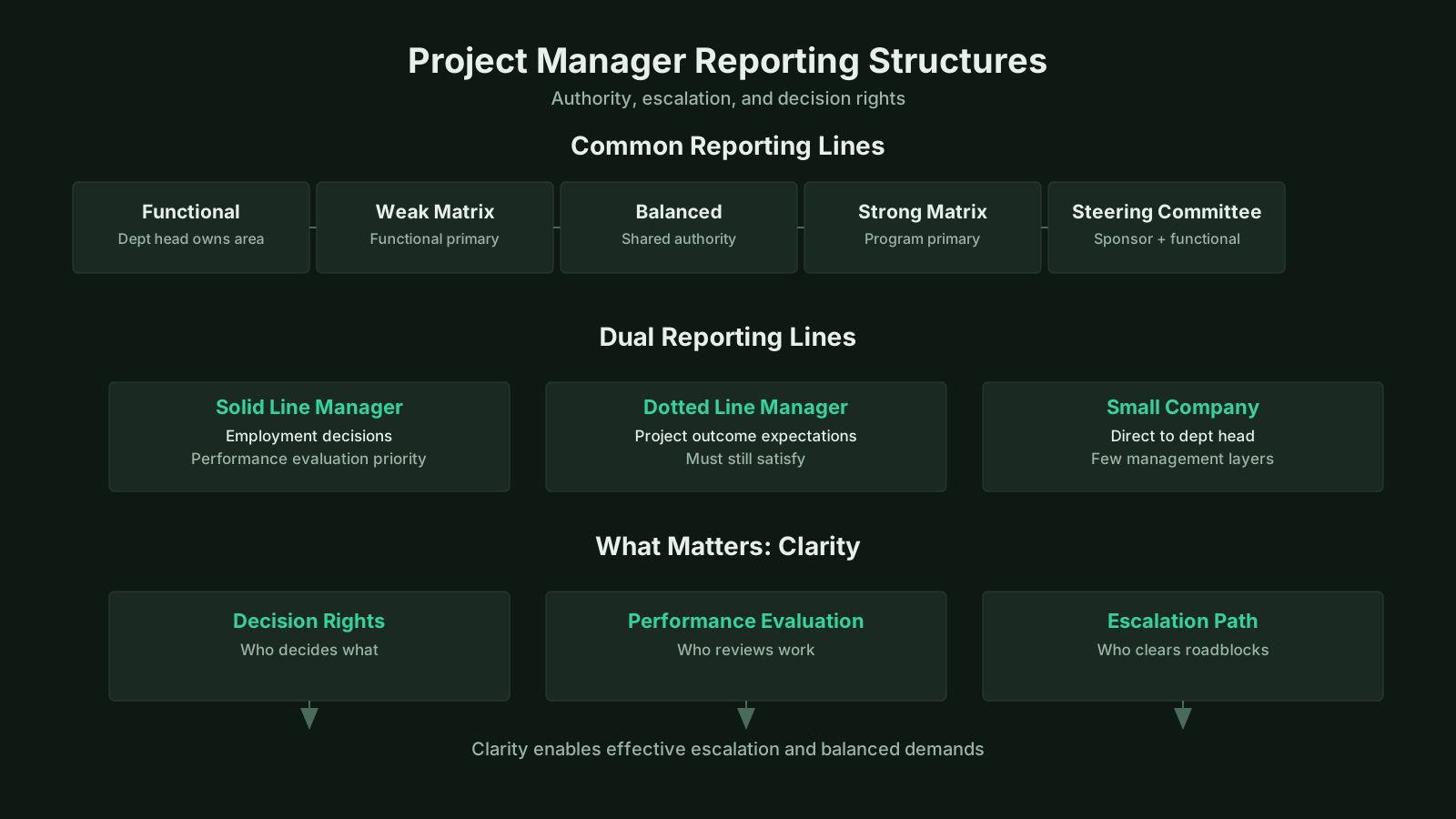
Governance arrangements add another layer. Beyond the immediate supervisor, projects often have steering committees, sponsors, and change control boards that exert influence over the work. The reporting relationship can be formal or informal, direct or dotted. A project manager might have a solid line to a functional manager and a dotted line to a program manager, or the reverse. These nuances affect how the project manager prioritizes demands from different stakeholders and how performance is evaluated. The more complex the governance environment, the more important it becomes to define the primary reporting path clearly.
Enterprise-wide projects add a further twist. When a project cuts across multiple departments, reporting to a single functional manager can create a bottleneck because that manager may lack authority over resources in other functions. This is why many organizations shift reporting upward to a portfolio or program manager for cross-cutting initiatives. That leader is expected to see across silos and make trade-off decisions that individual functional managers cannot. The project manager then works within a structure that explicitly recognizes the project's enterprise implications.
Key Insights on Reporting Relationships
- Structure shapes reporting lines
- An organization's structure and governance model are the strongest determinants of a project manager's reporting line, with relationships varying according to whether the company is organized around functions, products, customer segments, or geographic markets.
- Functional and matrix differ
- In a functional hierarchy, a project manager typically reports to a functional manager; in matrix or projectized settings, however, the reporting line often leads to a program or portfolio leader who is accountable for outcomes rather than administrative functions.
- Influence beyond the supervisor
- Steering committees, sponsors, and change control boards shape project decisions beyond the formal supervisor, and cross-departmental initiatives can create bottlenecks when a single functional manager lacks authority over resources in other departments.
Reporting to a Functional Manager
A functional manager reporting relationship places the project manager inside a specific administrative or operational unit. The functional manager is typically focused on providing management oversight for an administrative area. That could be human resources, information technology, finance, or engineering, depending on the organization. When a project manager reports to this person, the project usually aligns closely with the department's functional responsibilities. The functional manager approves budgets, assigns staff, and monitors whether the project adheres to departmental policies and standards.
This arrangement works well for projects that are mostly confined to one function. Imagine a project to upgrade the company's payroll system. The project manager might report to the head of human resources because the work requires deep HR knowledge and affects primarily HR processes. The functional manager can quickly resolve issues related to policy interpretation, data access, and staff availability. There is no need to escalate across multiple silos because the project lives almost entirely inside one department.
There is a downside, though. A functional reporting relationship can limit the project manager's authority when the project needs cooperation from other departments. The functional manager cannot simply command resources from another function without negotiating through peer managers. The project manager may find that cross-functional tasks stall because no single authority owns the entire project. In such cases, organizations often add a steering committee or shift the reporting line to a program manager who sits above the functional managers.
Distinguishing Functional Managers from Operations Managers
The distinction between functional management and operations manager responsibilities can sometimes blur in practice. Functional managers provide management oversight for an administrative area. Operations managers, by contrast, are responsible for a facet of the core business. A core business facet might be manufacturing operations, logistics, customer service delivery, or retail branch operations. These managers are accountable for the day-to-day activities that generate value for customers. Their perspective is often more external and revenue-centric than that of a functional manager, whose focus may be internally oriented toward support and policy.
Why does this matter for a project manager? Because reporting to an operations manager creates a different emphasis than reporting to a functional manager. An operations manager will typically care about how the project affects throughput, service levels, customer satisfaction, and operational risk. A functional manager may care more about compliance, resource utilization, and departmental process consistency. Neither is wrong, but the project manager needs to understand which lens the boss is using. That understanding shapes how progress is reported, how risks are framed, and how trade-off recommendations are made.
Consider a project to implement a new inventory tracking system. If the project manager reports to the logistics operations manager, the conversation will focus on warehouse speed, stock accuracy, and order fulfillment. If the project manager reports to the IT functional manager, the conversation may shift toward system integration, data architecture, and technical standards. The same project can look very different depending on the reporting relationship. This is why clear organizational definitions are valuable.
Key Insights on Manager Roles
- Core oversight distinction
- Functional managers supervise administrative support functions, while operations managers own the business-critical activities that deliver products and services, including manufacturing, logistics, customer service, and retail operations.
- Operations managers generate value
- Because operations managers are accountable for the daily workflows that directly create customer value, their perspective is typically more externally oriented and revenue driven than that of functional managers.
- Divergent priorities and focus
- Operations managers concentrate on throughput, service quality, customer satisfaction, and operational risk, whereas functional managers prioritize regulatory compliance, efficient resource allocation, and consistent departmental processes.
- Impact on project communication
- These contrasting perspectives shape how progress is reported, how risks are framed, and how trade-offs are recommended, so a logistics operations manager will usually emphasize warehouse throughput, inventory accuracy, and order fulfillment performance.
Reporting to a Program Manager
A program manager reporting line becomes common when a project is part of a coordinated set of related initiatives. In this structure, the project manager may be one of several project managers who report to a program manager. The program manager is responsible for achieving benefits that require multiple projects to work together. Each project contributes a piece of the overall capability or outcome. The program manager coordinates interdependencies, resolves conflicts among projects, and ensures that the collective output aligns with the program's objectives. In larger enterprises, this program manager may be ultimately responsible for enterprise-wide projects that deliver a set of related benefits.
The project manager in this setup still owns the day-to-day management of the individual project. Scope, schedule, budget, and quality remain the project manager's direct concerns. But the reporting relationship to the program manager adds an expectation of upward transparency. The project manager must share risks, timeline deviations, and resource constraints that could affect other projects in the program. The program manager then makes decisions that optimize the whole program, even if those decisions are suboptimal for one particular project.
Working closely with a program manager to achieve project objectives is not just a reporting formality. It is an operational necessity. The project manager needs the program manager to clear cross-project dependencies, allocate shared resources, and adjust priorities when the program strategy shifts. If the project manager ignores that relationship and treats the project as standalone, schedule conflicts and duplicated work become almost inevitable. The program manager also provides air cover when functional managers push back on resource commitments.
From a BVOP perspective, program reporting relationships can also involve non-financial program benefits like employee engagement and future risk reduction. A program manager who tracks these benefits may expect the project manager to report not just on deliverables but also on team morale, knowledge retention, and process improvements. Those soft indicators may influence whether the program continues or changes direction. It adds a layer of measurement that goes beyond traditional time and cost reporting.
Reporting to a Portfolio Manager
A portfolio manager reporting line places the project manager within a strategic investment review and prioritization context. A portfolio is a collection of projects, programs, subsidiary portfolios, and operations managed as a group to achieve strategic objectives. The portfolio manager is not necessarily concerned with the day-to-day execution of any single project. Instead, that leader evaluates whether the project continues to merit its funding, whether it aligns with changing business priorities, and whether resources should be shifted to higher-value initiatives.
When a project manager reports to a portfolio manager, the focus often shifts from tactical delivery to value justification. The project manager must articulate the project's expected benefits, current risk level, and ongoing strategic relevance. Reporting is typically periodic and structured around stage gates or portfolio reviews. The project manager may still have a functional manager or program manager for day-to-day supervision, but the portfolio manager holds ultimate accountability for enterprise-wide investment decisions.
This reporting structure can feel distant. The portfolio manager may not understand the technical details of the project or the daily operational challenges. That is frequently by design. The portfolio manager's job is to allocate capital and attention across a broad set of initiatives, not to solve project-level problems. The project manager therefore needs to be concise and outcome-oriented in communications. Saying that the project is on schedule is not enough. The project manager must explain whether the business case still holds and what new risks might erode value.
In organizations where the portfolio manager is ultimately responsible for enterprise-wide projects, the project manager's reporting relationship may be partially matrixed. The portfolio manager may rely on program managers to provide detailed oversight while retaining final authority over go/no-go decisions. This layered approach prevents the portfolio manager from becoming a bottleneck for operational issues while keeping strategic control centralized.
Key Insights on Portfolio Reporting
- Portfolio context defined
- A portfolio consolidates projects, programs, and ongoing operations under shared strategic objectives, positioning each initiative within a structured investment review process that evaluates collective value creation.
- Portfolio manager's strategic focus
- Rather than overseeing daily project execution, the portfolio manager scrutinizes funding proposals for strategic alignment, expected returns, and efficient resource distribution across the portfolio.
- Shift to value justification
- When reporting to a portfolio manager, the project manager shifts from communicating task level progress to presenting a clear case for the initiative's expected benefits, risk exposure, and continued strategic alignment.
- Structured periodic reporting
- Portfolio reporting occurs at predetermined intervals linked to stage gates or portfolio reviews, where the portfolio manager holds ultimate investment accountability even when functional or program managers supervise daily work.
- Capital allocation perspective
- Because the portfolio manager distributes capital and leadership attention across a wide set of initiatives, the project manager must frame updates in strategic terms that highlight value, risk, and alignment rather than technical specifics or routine operational issues.
Organizational Structure and Reporting Lines
The reporting relationships for a project manager shift significantly across these organizational structure types. Reporting lines are strongly influenced by whether the organization operates as a functional, matrix, or projectized environment. In a functional organization, project managers usually have limited authority and report directly to a functional manager. In a matrix organization, they may have two reporting relationships: one to a functional manager and one to a project or program manager. In a projectized organization, the project manager often reports to a program manager, portfolio manager, or executive-level sponsor, with little functional oversight.
The PMBOK framework treats organizational structure as an enterprise environmental factor. It is not something the project manager can easily change, but it is something the project manager must understand to operate effectively. The reporting line is part of that factor. In a weak matrix, the project manager might actually be more of a project coordinator or expediter, with very little formal authority. In a strong matrix, the balance shifts toward project authority, and the reporting line may be predominantly to a program or portfolio manager. These distinctions are not academic; they determine how the project manager secures resources, manages team performance, and escalates issues.
Project manager reporting relationships in functional organizations
In a purely functional organization, the project manager is often a part-time role. A departmental employee may be assigned to lead a process improvement initiative while still reporting to their functional manager. The reporting relationship is straightforward because the project sits entirely within the same administrative area. The functional manager controls the budget, allocates the team, and resolves conflicts. The project manager's authority is limited to coordinating tasks and tracking progress. There is usually no separate project office or program layer to report to.
This can work for small, well-defined projects that do not require cross-functional coordination. But for anything larger, the structure breaks down quickly. The project manager has no authority over people outside the function, and the functional manager may not have the breadth to make enterprise-wide decisions. If a project in finance needs help from IT, the project manager has to go through the finance manager, who then negotiates with the IT manager. This indirect communication slows the project and increases the chance of misalignment.
Project manager reporting relationships in matrix organizations
Matrix organizations deliberately split authority between functional and project lines. A project manager in a matrix environment may report to a functional manager for administrative purposes and to a program or portfolio manager for project direction. This dual reporting creates both strengths and tensions. The functional manager ensures the project manager adheres to departmental standards and has access to specialized staff. The program or portfolio manager ensures the project aligns with broader strategic goals. The project manager must serve two masters, which can be difficult when their priorities conflict.
The specific balance depends on whether the matrix is weak, balanced, or strong. In a weak matrix, the functional manager holds most of the power, and the project manager's reporting line is primarily functional. In a strong matrix, the program or project management office holds more power, and the project manager may report mainly to a program manager. The balanced matrix sits somewhere in between. The reporting relationship should be documented clearly so the project manager knows where to go for different types of decisions.
Project manager reporting relationships in projectized organizations
In a projectized organization, most work is performed through projects rather than ongoing functional operations. The project manager typically has a high degree of authority over the team, budget, and schedule. Reporting lines tend to be vertical within the project management structure. A project manager may report to a program manager if the project is part of a program, or to a portfolio manager if the project is part of a broad investment portfolio. In smaller projectized firms, the project manager might report directly to an executive or the CEO.
This structure eliminates many of the cross-functional reporting ambiguities found in matrix organizations. The project manager does not have to negotiate with multiple functional managers for resources because project resources are dedicated. However, the reporting relationship to a program or portfolio manager still requires the project manager to think beyond the individual project. Program and portfolio leaders evaluate performance not just on project delivery but on how well the project contributes to the overall portfolio benefits.
Reporting to a Project Management Office
A PMO reporting relationship can take several forms depending on the maturity of the project management office. In some organizations, the PMO is primarily a support function that provides templates, training, and reporting standards. In that case, the project manager may have a dotted reporting line to the PMO while maintaining a solid line to a functional or program manager. In other organizations, the PMO is a delivery center of excellence with direct authority over project managers. The project manager then reports directly to the PMO director, who assigns the project manager to different initiatives and evaluates performance.
This arrangement standardizes how projects are run. The PMO can enforce consistent risk management, schedule tracking, and status reporting across all projects. A project manager who reports to the PMO benefits from a clear career path within project management and access to centralized tools and methodologies. At the same time, the PMO may add administrative overhead if it focuses too heavily on process compliance. The project manager can feel pulled between the PMO's reporting requirements and the practical needs of the project sponsor or program manager.
In practice, many organizations blend the PMO reporting line with a program or portfolio line. The PMO may own the project manager's professional development and methodology adherence, while the program manager owns delivery outcomes and benefit realization. This dual reporting works only if the PMO and the program manager agree on expectations. If they do not, the project manager can be caught between competing standards and performance reviews.
Key Takeaways on PMO Reporting Structures
- Varying PMO authority levels
- A PMO may operate as a supportive function with dotted-line oversight, or as a centralized command structure where project managers report directly to the PMO director, and this positioning significantly shapes escalation paths and decision rights.
- Trade-offs of PMO oversight
- Reporting to a PMO offers consistent tools, methodologies, and professional development tracks, but it can introduce administrative overhead and tension when PMO compliance mandates diverge from sponsor expectations or delivery priorities.
- Split ownership of duties
- The PMO generally owns professional development and methodology compliance, while the program manager or sponsor retains accountability for delivery results and measurable benefit realization.
Authority, Governance, and the Project Manager's Role
The reporting line directly affects project manager authority and governance expectations. A project manager who reports to a functional manager often has to rely on that manager to exercise formal authority over the team. The project manager may coordinate work, track issues, and prepare status reports, but decisions about resource assignments and disciplinary actions rest with the functional manager. This can be frustrating for project managers who feel accountable for outcomes without having real authority over the people doing the work.
When the reporting line goes to a program manager or portfolio manager, the project manager may gain more formal authority but also face higher expectations for strategic alignment. The program manager may delegate day-to-day project decisions to the project manager, while retaining the right to intervene on major scope changes or cross-project conflicts. The project manager is expected to manage the project autonomously within agreed tolerances and to escalate only when necessary. This is closer to the PRINCE2 model, where the project manager reports to a project board and operates within delegated limits.
Governance bodies also shape the reporting relationship. A project steering committee may be the ultimate authority for significant decisions, even if the project manager reports to a functional manager. In that case, the reporting line is operational rather than strategic. The project manager provides updates to the functional manager regularly, but major issues go to the steering committee. This layered governance can work well if roles are clear. Problems arise when the project manager is unsure whether to escalate an issue to the functional manager, the program manager, or the steering committee first.
Sponsorship is another variable. The project sponsor is usually a senior leader who champions the project and protects it from organizational obstacles. The sponsor may not be the project manager's direct manager, but the sponsor often has significant influence over the project's continuation. In some structures, the project manager reports directly to the sponsor, which can create a fast decision-making path but may bypass operational oversight. The reporting relationship is therefore not just about the line on the chart; it is about how authority flows in practice.
Common Pitfalls in Reporting Relationships
One of the most frequent problems is the presence of unclear reporting relationships. When a project manager has a solid line to a functional manager and a dotted line to a program manager, expectations can diverge. The functional manager may expect the project manager to prioritize departmental tasks, while the program manager expects full attention on the project plan. The project manager is caught between conflicting demands and may default to pleasing the person who writes the performance review. That may not be the person who owns the project outcome.
Another pitfall is assuming that reporting relationships are static. Organizations restructure frequently, especially during mergers, leadership changes, or strategic shifts. A project manager who was reporting to a program manager in one quarter may suddenly find themselves reporting to a portfolio manager or back to a functional manager. When this happens, the project plan and communication cadence often need to be adjusted. If nobody updates the governance documents, the project team may continue operating under outdated assumptions.
There is also a common misconception that a higher reporting line automatically means more authority. Reporting to a portfolio manager does not necessarily give the project manager more control over team members or technical decisions. The portfolio manager may be too senior to engage with day-to-day project issues, leaving the project manager with less immediate support. Conversely, reporting to a functional manager can sometimes provide faster decision making because the functional manager is closer to the work. The fit matters more than the level of the title.
Dual reporting can become particularly messy when key performance indicators are misaligned. If the functional manager evaluates the project manager on billable hours or departmental compliance, while the program manager evaluates on milestone delivery and benefit realization, the project manager will constantly have to choose which metric to optimize. A well-designed reporting structure aligns these evaluation criteria. If it does not, the project manager should raise the issue early rather than trying to satisfy both sides silently.
Key Insights on Reporting Hazards
- Unclear reporting relationships
- Dual reporting lines to functional and program managers create conflicting expectations that force project managers to navigate divergent priorities without clear authority.
- Performance review leverage
- Because performance evaluations hinge on a single manager's assessment, project managers tend to prioritize that manager's expectations over a balanced response to all stakeholders.
- Stale governance documentation
- Frequent organizational restructures caused by mergers or leadership changes create a mismatch between actual reporting lines and outdated governance documents, which misleads project teams.
- Misconception about authority
- A reporting line to a more senior manager does not by itself give project managers greater control over team members or technical decisions.
- Competing evaluation metrics
- Functional managers who track billable hours and program managers who track milestone delivery create conflicting incentives that force project managers into recurring trade-offs with no fully satisfactory outcome.
Aligning Project Plans with Program and Portfolio Objectives
The reporting relationship becomes operationally important when aligning project plans with program objectives requires continuous coordination. The project manager works closely with the portfolio or program manager to achieve the project objectives and to ensure the project plan aligns with the overarching program plan. This is not a one-time alignment at project initiation. It is an ongoing conversation. Program plans change as other projects deliver results, as risks materialize, and as stakeholder priorities shift. The project manager must adjust the project plan accordingly, sometimes sacrificing local efficiency for program-level benefit.
In practice, this means the project manager needs regular access to the program manager. Weekly or biweekly checkpoint meetings are common. The project manager brings schedule variances, resource conflicts, and change requests to these meetings. The program manager can then decide whether to reallocate resources, delay dependent projects, or escalate to the portfolio level. Without a direct reporting relationship, this coordination becomes slower because it has to pass through multiple layers of functional management.
The alignment also extends to reporting formats. A project manager reporting to a program manager often has to report against program-level milestones and benefits, not just project deliverables. The report may need to show how the project's outputs feed into the program's capability roadmap. This requirement pushes the project manager to understand the broader context. It is not enough to say that a software module was delivered on time. The project manager must also explain how that module enables a later phase of the program or avoids a known risk.
Portfolio alignment introduces an even broader view. The portfolio manager may ask whether the project still fits the current strategic priorities. A project that was critical six months ago may become less relevant if market conditions change or if another initiative already delivered the expected benefit. The project manager reporting to a portfolio manager must be prepared to justify continued investment. That can be uncomfortable, but it forces a level of rigor that reduces wasted effort.
Agile and Alternative Reporting Relationships
In Agile environments, the project manager reporting relationships often become less formal but still follow an underlying ownership pattern. Many Agile teams operate without a traditional project manager. Scrum, for example, distributes project management responsibilities between the Product Owner and the Scrum Master. The Product Owner owns the product backlog and prioritizes value. The Scrum Master coaches the team and removes impediments. In this context, the reporting line for a project manager may not exist because the role itself has been absorbed or renamed.
However, larger Agile initiatives often retain project or program management roles at the coordination level. A project manager in an Agile environment might report to a program manager, a release train engineer, or an Agile delivery lead. The reporting relationship focuses less on command and control and more on alignment with value streams and delivery cadence. The project manager, if present, acts as a servant leader who supports the team and communicates progress upward. This can feel ambiguous because the traditional hierarchy is flattened, but someone still owns the budget and strategic accountability.
PRINCE2 offers a more formal alternative. In that framework, the project manager reports to a project board made up of an executive, a senior user, and a senior supplier. The board sets direction and makes decisions at stage boundaries. The project manager has delegated authority to manage day-to-day work within tolerances. This reporting relationship is clear and structured, which appeals to organizations that want strong governance without a matrix of conflicting functional and program managers. It also separates strategic decision making from operational project management in a way that reduces ambiguity.
The choice among these alternatives depends on the organization's risk appetite, culture, and delivery maturity. Some companies embrace Agile reporting structures to speed up decision making. Others retain hierarchical reporting to a functional or program manager because they need tight control over budgets and compliance. There is no universal best practice. What works is a reporting line that matches how the organization actually makes decisions, not how it draws org charts.
Key Takeaways on Agile Reporting
- Flattened but persistent ownership
- Agile structures reduce formal hierarchy in daily reporting, yet financial and strategic accountability remains firmly assigned to named individuals.
- Scrum's distributed PM duties
- Scrum intentionally divides project management between the Product Owner, who prioritizes business value, and the Scrum Master, who coaches the team and clears obstacles to delivery.
- Coordination roles persist at scale
- At scale, Agile programs frequently maintain project or program managers to coordinate dependencies, release planning, and delivery across multiple teams.
- Alignment over command and control
- Agile reporting structures prioritize value streams and delivery cadence over positional authority, positioning project managers as servant leaders who enable team autonomy and keep stakeholders informed.
- Governance without matrix conflicts
- A single, clearly defined reporting line provides the governance discipline many organizations require while avoiding the competing priorities that arise in dual reporting structures.
Practical Questions to Clarify Reporting Lines
Given the variety of possible arrangements, project managers should ask a few direct questions when taking on a new project. Who is the primary reporting manager for this assignment? Is there a secondary or dotted reporting line? Which manager controls the budget and resource allocations? Which manager will conduct the performance review? These questions may sound bureaucratic, but they prevent confusion later. Oddly enough, many project managers never ask them until a conflict forces the issue.
A useful approach is to document the reporting relationship in the project charter or project management plan. This does not need to be a legal document. A simple statement of who the project manager reports to, who the sponsor is, and how escalations should flow can save weeks of delay. It also helps the project team understand who has authority to approve changes. When the team sees a clear escalation path, they spend less time guessing and more time delivering.
The conversation should also cover what the reporting manager expects in terms of frequency and format. A functional manager may want weekly status updates focused on resource utilization. A program manager may want milestone-based reporting focused on interdependencies. A portfolio manager may only want updates at stage gates or when the business case changes. The project manager must adapt to these expectations while still maintaining one consistent narrative about the project's health.
Finally, project managers should revisit the reporting relationship whenever the project moves into a new phase or when the organizational structure changes. A relationship that worked during planning may not work during execution if the project begins to affect multiple business units. The goal is not to seek a promotion or escape accountability. The goal is to ensure that the person with the authority to clear roadblocks is also the person receiving the information they need to do so.