Most professionals intuitively grasp that a project is a temporary endeavor, but the nuanced distinctions among project management, program management, and portfolio management are often muddled in day-to-day conversation. Understanding how project, program, and portfolio management differ is not just academic—it directly shapes governance, funding, and resource allocation decisions that can make or break an organization’s strategic ambitions. When a senior executive lumps unrelated initiatives into a single “program” simply because they share a budget line, or when a PMO tries to manage a portfolio with the same level of detail as a project, the resulting friction wastes time and obscures the very value these structures are meant to deliver. These three domains exist in a tightly coupled hierarchy, with distinct responsibilities, planning horizons, and success measures, yet they must communicate seamlessly to align daily work with long-term goals.
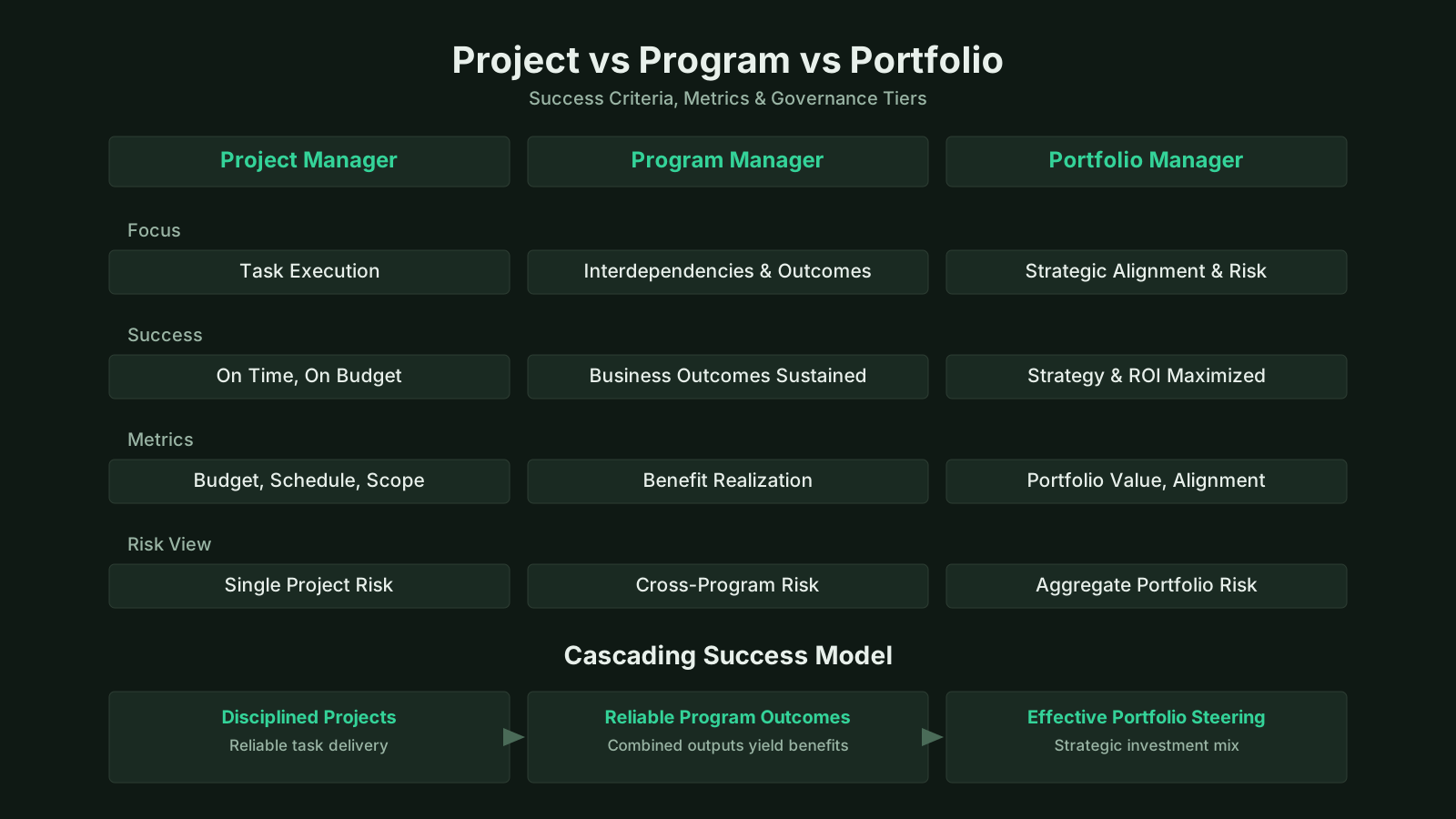
Project, Program, and Portfolio Management: Key Differences
| Key Concept | Summary |
|---|---|
| Strategic Hierarchy | Portfolio, program, and project management form an integrated hierarchy where distinct responsibilities, time horizons, and success metrics depend on seamless communication to connect tactical execution with long-term strategic objectives. |
| Information Flow | Governance decisions, funding allocations, and change approvals flow downward from portfolio to project tiers, while resource demands, progress reports, and impact analyses stream upward for consolidated evaluation. |
| Portfolio Management | Portfolio management orchestrates the full portfolio set, encompassing the identification, prioritization, authorization, and governance of initiatives to deliver measurable business objectives. |
| Governance Cycle | A mature governance cycle incorporates stage-gate reviews, resource capacity modeling, and weighted scoring models that evaluate and rank proposed initiatives against strategic criteria. |
| Portfolio Toolsets | Portfolio managers employ investment dashboards, risk-reward bubble charts, and trend analyses to monitor performance and detect early indicators of eroding business value. |
| Value Management | Modern value-focused practices quantify business value at the portfolio level; sustained declines prompt reassessment or termination of underperforming components. |
| Program Management | A program synchronizes related projects to unlock synergies and realize benefits that cannot be achieved by managing each project separately. |
| Core Intent | The defining trait of these structures is intent, not scale: strategic alignment transforms an arbitrary collection of initiatives into a cohesive investment thesis. |
The Strategic Hierarchy: From Organizational Goals to Deliverable Work
In any mature organization, strategies and priorities flow downward through progressive elaboration while performance reports and change requests travel upward. The portfolio sits at the apex, translating broad strategic objectives into a selected set of investments. Programs group related projects that together produce benefits beyond what any single project could achieve alone, and projects represent the concrete, time-bound efforts that generate deliverables. Information moves in both directions: high-level governance, funding decisions, and disposition on requested changes cascade from portfolio to project levels, while resource needs, status updates, and impact assessments roll up for aggregate review. This bidirectional flow is what keeps organizational planning grounded in reality instead of wishful thinking.
Consider an infrastructure firm pursuing the strategic goal of maximizing return on its investments. Its portfolio might span oil and gas, power, water, roads, rail, and airports—none of which are inherently interdependent, yet they compete for capital and talent. By grouping all power projects into a power program and all water projects into a water program, the firm gains a layer of coordination that optimizes shared resources and technology platforms. The portfolio manager can then evaluate each program’s aggregate performance and shift funding when, say, the rail program’s risk profile suddenly spikes. Without the portfolio tier, the organization would struggle to balance such disparate bets against a unifying financial target.
A common misunderstanding is that the portfolio simply aggregates all projects. The defining characteristic is not scale but intent: strategic alignment across portfolio, program, and project levels is what turns a random collection of initiatives into a coherent investment thesis. The portfolio function constantly asks whether each component still serves the evolving business strategy, and it has the authority to terminate, pause, or redirect work that no longer fits. That is a fundamentally different mindset from project management, which focuses on finishing what was started according to plan. This distinction is often where governance breakdowns occur because the same individuals might hold multiple roles and fail to shift their mental models.
The Standard for Portfolio Management from PMI clarifies that a portfolio is a collection of projects, programs, subsidiary portfolios, and operations managed as a group to achieve strategic objectives. The projects and programs within a portfolio need not be interdependent—in fact, frequently they are not related at all. Their common thread is the organizational capacity they consume and the strategic returns they are expected to produce. When two projects share only a client or a technology platform, grouping them as a program causes confusion about interdependencies that do not exist. The right structure is a portfolio, where each item stands on its own merit and competes for resources based on value contribution.
Core Insights on Strategy Cascading
- Bidirectional Information Flow
- Strategic direction and funding decisions flow downward from portfolio to programs and projects, while resource requirements, progress updates, and outcome evaluations ascend for integrated oversight and adaptive steering.
- Portfolio as Strategic Apex
- The portfolio acts as the governance apex, converting broad organizational strategy into a deliberate investment mix and retaining the authority to halt, defer, or reallocate resources when initiatives diverge from strategic intent.
- Programs Coordinate Related Projects
- Programs bundle interdependent projects within a coordinating layer that maximizes the value of shared resources and technology platforms, producing collective outcomes that no single project could achieve independently.
- Dynamic Funding and Risk Response
- The portfolio manager continuously monitors each program’s consolidated performance and reallocates capital when a specific program, such as rail, encounters a sudden spike in its risk profile.
- Intent Defines the Hierarchy
- Consistent strategic alignment across portfolio, program, and project levels transforms a scattered group of initiatives into a coherent investment thesis, making purpose rather than scale the true distinguishing factor.
Portfolio Management: Curating Investments to Maximize Strategic Return
Portfolio management is the centralized oversight of one or more portfolios, encompassing the identification, prioritization, authorization, and ongoing control of work to achieve specific business objectives. Its primary focus is not on how individual projects execute but on whether the right projects are being conducted at all. Portfolio managers continuously scan the external and internal environment, adjusting the mix as market conditions, regulatory demands, and risk appetites shift. They are less concerned with a single project’s schedule variance and more attentive to whether the cumulative return on the entire portfolio is on track to meet the strategic plan.
This perspective requires portfolio management to align projects with strategic business goals through rigorous evaluation mechanisms. A typical governance cycle includes stage-gate reviews, resource capacity modeling, and weighted scoring models that pit proposed initiatives against one another. The infrastructure firm mentioned earlier might use a scoring system that weighs financial return, strategic fit, risk exposure, and regulatory compliance. A road project might score lower on return but higher on strategic fit if the government is about to announce a major infrastructure policy shift. Such tradeoffs cannot be optimized at the project level; they demand the aggregate view that only portfolio management provides.
At the same time, portfolio managers do not manage project teams. They may coordinate a small staff of portfolio analysts who consolidate performance data, run what-if scenarios, and prepare decision packages for executives. The portfolio manager’s toolset includes investment dashboards, bubble charts mapping projects on risk versus reward, and trend analyses that flag when a program’s business value indicators begin to deteriorate. In some contemporary practices, such as those aligned with value-oriented management, portfolio-level monitoring tracks business value points whose persistent decline can trigger a re-evaluation or even closure of underperforming components. The critical skill is pattern recognition across a wide field of activities, not deep diving into a single work breakdown structure.
Success in portfolio management is measured in terms of aggregate performance—overall return on investment, strategic contribution, and realized benefits across the portfolio components. The portfolio manager is accountable for the health of the entire investment mix, meaning that even if one project fails spectacularly, the portfolio can still succeed if the gains elsewhere outweigh the loss. This contrasts sharply with project management, where a failed project is a definitive black mark. Thinking in portfolio terms demands a comfort with probabilistic outcomes that many project managers find unsettling at first.
Program Management: Orchestrating Interdependent Projects for Synergy
A program is a group of related projects managed in a coordinated way to obtain benefits and control not available when they are managed individually. The relationship among these projects is based on a common outcome or collective capability. A classic illustration is a new communications satellite system, with separate projects for satellite design, ground station design, satellite construction, ground station construction, system integration, and satellite launch. None of these projects alone delivers a functioning satellite communication service; the value emerges only when all are integrated and operational. Program management ensures that the interdependencies are not left to chance.
Program management is the centralized coordinated management of a program to achieve strategic objectives and benefits. The program manager’s role is distinctly different from that of a project manager. Program management coordinates interdependent projects by resolving resource conflicts that span component boundaries, aligning the strategic direction as organizational priorities shift, and managing change within a shared governance structure. For the satellite system, a delay in ground station construction might force a resequencing of integration testing. The program manager negotiates these adjustments across project managers who might each be optimizing their own scope, budget, and timeline without regard for the system-level impact.
It is here that a subtle but vital distinction emerges. If the relationship between a set of projects is only that of a shared client, a common vendor, a similar technology, or a pooled resource pool, the effort should be managed as a portfolio, not a program. PMI’s standards draw this line clearly. For instance, an IT department that runs ten separate application development projects for different business units might group them into a portfolio for resource allocation purposes, but calling it a “digital transformation program” confuses everyone when the projects have no functional integration. The test is whether the intermediate outputs must be synchronized to produce a higher-order benefit; if not, treat the collection as a portfolio.
Program managers develop the overall program plan and create high-level plans that guide detailed planning at the component level. They do not typically get into the daily task assignments of individual projects—that remains the project manager’s domain—but they set the rhythm for major milestones, integration points, and benefit realization reviews. Their success is measured not by on-time feature delivery but by the degree to which the program satisfies the needs and benefits for which it was undertaken. In the satellite example, success means reliable communications coverage with the expected bandwidth, not merely that the launch vehicle left the pad on schedule. This shift from output to outcome is what makes program management both challenging and powerful.
Key Program Management Insights
- Program definition and purpose
- A program is a structured collection of interdependent projects that delivers benefits and strategic control unattainable when the individual projects are managed in isolation.
- Common outcome foundation
- Projects within a program are connected by a shared outcome or integrated capability, not by surface-level similarities such as a common client, vendor, or technology.
- Satellite system illustration
- The communications satellite example demonstrates that separate projects like satellite design, ground station construction, and system integration generate value only when their outputs converge into a single, operational system.
- Program manager coordination role
- Program managers resolve cross-project resource conflicts, realign strategic direction as priorities shift, and orchestrate change through a shared governance framework while negotiating with project managers whose focus remains naturally confined to their own scopes.
- Portfolio versus program distinction
- Projects linked solely by a shared client, vendor, technology, or resource pool lack the functional interdependence that defines a program and are more appropriately managed as a portfolio.
Project Management: Temporary Endeavors with Defined Outcomes
At the foundational level, a project is a temporary endeavor undertaken to create a unique product, service, or result. Its objectives are defined, though scope is progressively elaborated throughout the project life cycle. Project management applies knowledge, skills, tools, and techniques to meet these objectives. The project manager leads the project team, manages constraints, and communicates with stakeholders. In the PMBOK framework, this falls under the entirety of the five process groups and ten knowledge areas, from developing the project charter to closing the project.
The planning dimension is where many of the distinctions from program and portfolio management become tangible. Project management delivers defined objectives within constraints of scope, time, cost, quality, and risk. The project manager progressively elaborates high-level information from the project charter into detailed work breakdown structures, schedules, and budgets. This granularity is both a strength and a trap—projects can become so inwardly focused that they miss signals from the program or portfolio level about strategic shifts that should trigger a change request or even an early termination. Strong project managers learn to keep one eye on their immediate deliverables and another on the broader organizational context.
Change is expected in projects, and project managers establish processes to keep it managed and controlled. Integrated change control ensures that proposed modifications are evaluated for impact across all constraints before being approved or rejected. This discipline is necessary, but it can also become brittle if the project manager resists changes that would better serve the program outcome. A good program manager understands this tension and works to create governance mechanisms that allow rapid escalation of decisions that affect multiple projects. The project manager’s focus remains on delivering the product scope as baselined, but with the recognition that the baseline itself might need to shift if the program’s benefit case evolves. Signals from the program or portfolio level about strategic shifts that should trigger a change request are a crucial part of this process.
Success in project management is measured by product and project quality, timeliness, budget compliance, and degree of customer satisfaction. These metrics are precise and readily quantifiable, which is why organizations often default to them even when evaluating higher-level structures. Yet a project can meet every one of its success criteria and still be part of a failed program or portfolio. The satellite launch project, for example, might deploy the payload perfectly on time and under budget even if the overall communications system never achieves its operational goals because of a design flaw in another component. The project manager is not accountable for that system-level failure, but the distinction must be clearly understood by sponsors who might otherwise misattribute blame.
How Scope, Change, and Planning Vary Across the Tiers
Perhaps the most practical way to internalize the differences among the three levels is to examine how they handle scope, change, and planning. Scope management differences across project, program, and portfolio contexts reveal fundamentally different mindsets. A project’s scope is progressively elaborated and bounded by a defined set of deliverables. A program’s scope is broader, encompassing the sum of its component projects plus the integration work, and it is oriented toward achieving strategic benefits. A portfolio’s scope is business-scoped—it changes as the organization’s strategic goals evolve, and it can include ongoing operations, not just finite projects.
Scope
Project scope management involves decomposing the work into a WBS, verifying deliverables, and controlling scope creep. The project manager girds against uncontrolled expansion because it directly threatens the triple constraint. In a program, scope is managed at a higher level through a program scope statement that defines the capability being built across components. The program manager is less concerned with individual feature lists and more focused on ensuring that the combined outputs will realize the intended organizational benefits. Any change to one project’s scope is assessed not only for its own impact but for how it ripples through interdependent components. At the portfolio level, scope is fluid; the portfolio manager continuously adds, modifies, or removes components based on strategic alignment, risk appetite, and resource capacity. The very concept of a baseline scope is foreign to the portfolio tier—it would be like trying to freeze a stock portfolio’s composition for a year and still expect it to meet target returns.
This layered approach to scope often causes friction during annual planning cycles. When a business unit pushes for a new project inclusion, the portfolio manager might approve it because it fits the evolving strategy, but the program manager then must absorb it into an existing program structure, potentially disrupting component project plans. The project manager finds out about the addition only after the fact and must scramble to re-plan. Tight integration between these scope management processes is what separates organizations that adapt smoothly from those that lurch from crisis to crisis.
Change
Change management follows a similar pattern of widening perspective. Project managers expect change and implement formal change control. Program managers expect change from both inside and outside the program and prepare to manage it across multiple interrelated projects. This means they must anticipate that market conditions, technology shifts, or regulatory updates might force a change in the program’s direction that no individual project could accommodate on its own. They maintain a program-level change log and governance board that can make tradeoff decisions across the entire effort.
Portfolio managers operate in a state of continual environmental monitoring. They do not manage change requests in the traditional sense; instead, they rebalance the portfolio as the strategic landscape shifts. A sudden economic downturn might cause them to shelve speculative ventures and concentrate resources on cash-cow programs. A new competitor entering the market might accelerate a product development program while delaying an infrastructure upgrade. The portfolio’s composition is perpetually provisional. This can be jarring for program and project managers who want stability, but it is essential for organizational agility. The interdependence of these change processes means that a change at the portfolio level can cascade into dozens of project-level change requests almost overnight, requiring robust communication channels and a shared understanding of priorities.
Planning
Planning granularity decreases as one moves up the hierarchy. Project managers progressively elaborate high-level information into detailed plans, creating baselines for scope, schedule, and cost. Program managers develop the overall program plan and create high-level plans that guide detailed planning at the component level, but they avoid the temptation to micromanage project schedules. Their planning integrates milestones, interdependency management, resource leveling, and risk response across the component projects. Portfolio managers do not create detailed plans at all; they create and maintain the processes and communication structures necessary to aggregate performance data and support portfolio decision-making. Their “plan” is a dynamic picture of investment allocation and expected returns, refreshed periodically rather than baselined once.
Organizations often stumble when they attempt to apply project-level planning rigor to the portfolio. Detailed Gantt charts for hundreds of projects obscure the strategic picture and consume enormous effort to maintain. A portfolio dashboard with key performance indicators, risk heat maps, and trend lines is far more useful for executive decisions. Conversely, a project that tries to operate with only high-level fuzzy milestones will quickly lose control of its scope and budget. Matching the planning approach to the level of abstraction is a fundamental governance design principle.
Core Takeaways on Tier-Based Scope Management
- Project scope is detail-driven
- Project managers decompose scope through a WBS, verify deliverables against requirements, and tightly control scope creep to keep each effort precisely on track.
- Program scope pursues strategic benefits
- Program scope is captured in a high-level statement that defines the collective capability delivered across components, prioritizing integrated business outcomes over individual feature lists.
- Portfolio scope is continuously fluid
- Portfolio managers continuously add, modify, or remove components based on shifts in strategic alignment, risk appetite, and resource capacity; a fixed scope baseline is incompatible with the need for ongoing strategic optimization.
Differentiating Management, Success Criteria, and Monitoring Practices
The differences in management style, success measurement, and monitoring are equally pronounced and often overlooked in competency models. Monitoring and control practices adapt from projects to portfolios in ways that challenge managers who move between tiers without retraining their instincts.
Management
Project managers manage the project team to meet project objectives. They are directly involved in assigning tasks, resolving interpersonal conflicts, and motivating individuals toward a concrete deliverable. Program managers manage the program staff and the project managers, providing vision and overall leadership rather than task-level oversight. They create the conditions for project success, remove organizational impediments, and ensure that the component teams collaborate effectively. In the satellite program, the program manager does not tell the ground station design team how to lay out their circuit boards; instead, they broker the interface agreements between the ground station team and the satellite bus team so that communication protocols align.
Portfolio managers may manage or coordinate portfolio management staff, but their primary role is analytical and advisory. They prepare portfolio reviews, facilitate governance board meetings, and model investment scenarios. Their leadership is exercised through influence and data-driven recommendations rather than direct authority over execution teams. A portfolio manager who starts directing project teams is overstepping boundaries and undermining program and project managers, a mistake that breeds resentment and confusion.
Success
We have touched on success measurement already, but the contrast demands explicit emphasis. Project success is operational: did we deliver the right product, on time, within budget, and to the customer’s satisfaction? Program success is benefit-oriented: did the program satisfy the needs and benefits for which it was undertaken? Portfolio success is strategic: did the aggregate performance of the portfolio components meet the organization’s strategic goals? These are not merely different metrics; they represent different time horizons and different value equations. A program might deliver all its planned benefits but still be part of a portfolio that underperforms because other programs failed. A project can be successful even if its parent program is cancelled, provided the project itself met its objectives before cancellation was ordered.
This nested accountability creates a natural tension. Program managers depend on project managers to deliver the components that generate benefits, so they often advocate for project stability and resist portfolio reprioritization that would disrupt their plans. Portfolio managers, meanwhile, are tasked with optimizing the whole, which sometimes means sacrificing a healthy program for a more urgent strategic need. Organizations that lack mature governance frameworks find these conflicts becoming personal and political rather than being resolved through transparent tradeoff analysis.
Monitoring
Project managers monitor and control the work of producing the specific products, services, or results the project was chartered to deliver. They track schedule progress, cost expenditures, quality metrics, and risk triggers. The level of detail is granular, often down to individual work packages. Program managers monitor the progress of program components to ensure the overall goals, schedules, budgets, and benefits of the program will be met. They focus on milestone achievements, dependency management, and aggregated cost and schedule variances. If one project is slipping, the program manager assesses whether the slack in other projects can absorb the delay or whether intervention is required.
Portfolio managers monitor aggregate performance and value indicators. They are less interested in the percentage of tasks completed in a project and far more interested in whether the expected net present value of a program is holding steady or declining. Trend analysis, earned value management at the program and portfolio levels, and scenario modelling are the tools of choice. A portfolio manager might notice that a particular program’s benefit realization is lagging behind projections for three consecutive quarters and escalate a recommendation to repurpose its resources. This kind of monitoring requires a blend of financial acumen and strategic thinking that is outside the typical project manager’s daily scope.
Common Pitfalls and Real-World Misconceptions
It is startling how often organizations slip into patterns that undermine the very distinctions they have built. One of the most pervasive errors is treating a program as simply a large project. When an organization takes on a major initiative—say, an enterprise resource planning implementation—and appoints a “program manager” who then proceeds to manage a detailed project schedule with thousands of WBS elements, the program’s coordination and benefit-realization functions atrophy. The individual workstreams lose their identity as semi-autonomous projects, and the whole effort becomes a monolithic, unmanageable beast. Misconceptions about project, program, and portfolio management often stem from a failure to recognize that each level requires a distinct set of competencies and a different span of control.
Another frequent pitfall is the portfolio that exists only on paper. An organization creates a portfolio register listing all active projects and programs, but the portfolio management function is not resourced or empowered to make real decisions. Project selection continues to be driven by whoever shouts the loudest, resources are allocated based on historical inertia, and no component is ever terminated because there is no governance body with the authority to do so. This leads to a dangerous condition where the aggregate demand for resources far exceeds capacity, yet no prioritization occurs. Project throughput slows to a crawl, and the strategic value of the portfolio evaporates because the organization is trying to do everything and succeeding at nothing.
There is also a tendency to confuse the roles. A senior project manager promoted to program manager often struggles to let go of the details and adopt a facilitative, visionary stance. A portfolio manager who comes from a strong project control background might over-engineer the portfolio dashboard with low-level metrics that distract from strategic decision-making. These transitions are not automatic; they require deliberate development and, ideally, a period of co-management or mentorship to internalize the new mindset. Some organizations even structure their career paths such that program and portfolio roles are lateral moves from project management rather than vertical promotions, to underscore the difference in skill set rather than a simple increase in seniority.
Frameworks like PRINCE2 handle some of these tensions by explicitly separating the project board’s direction from the project manager’s day-to-day management, and by recommending programme management as a distinct layer for coordinating related projects. Agile at scale frameworks, such as SAFe, introduce portfolio and program constructs (program being analogous to the Agile Release Train) but often merge the concepts in ways that can blur the traditional distinctions. The core lesson remains: the triad of project, program, and portfolio management is not a hierarchy of titles but a layering of perspectives, each with its own processes, artifacts, and success logic. When the layers are aligned, strategy flows smoothly into execution and learning flows back up, creating an adaptive, resilient organization.
Core Misconceptions in Management Layers
- Program managed as an oversized project
- When organizations assign a program manager to track thousands of work breakdown structure elements, the resulting project-level detail overwhelms strategic coordination and benefit realization, transforming the program into a single, unmanageable initiative.
- Portfolio function without real authority
- Without sufficient resources and decision-making authority, a portfolio registration merely catalogs active initiatives while investment choices are swayed by the most vocal stakeholders, legacy commitments persist unchecked, no project is ever discontinued, and demand consistently outstrips capacity without any prioritization framework.
- Distinct skills across management levels
- Because project, program, and portfolio management require distinct competencies and scopes of authority, leading organizations treat program and portfolio roles as lateral career shifts rather than vertical promotions, and established frameworks such as PRINCE2 intentionally separate strategic board direction from day-to-day project execution.