Understanding how human resource planning interacts with other project management processes is essential to building a coherent project plan that balances talent, cost, and schedule. The Develop Human Resource Plan process from the Project Management Institute's framework does not operate in isolation; it sits at the intersection of resource estimation, organizational context, integration management, and cost control. At its simplest, the process takes initial human resource requirements and organizational guardrails as inputs, then produces a human resource plan that becomes both a component of the overall project management plan and a key driver of the project budget. But the reality is far more iterative, with feedback loops that touch nearly every knowledge area. Getting these interactions right determines whether a project ends up with a well‑staffed team or a mismatch between ambition and available talent.
When project managers talk about human resource planning, they are referring to the activities that identify and document project roles, responsibilities, required competencies, and reporting relationships, along with the timeline for bringing people onto the project and releasing them. This is not an academic exercise. Every piece of the plan, from the hierarchical chart that shows who reports to whom to the role descriptions that define what a senior engineer actually does on Tuesdays, becomes real the moment project execution begins. The connections to other processes are what make those plans actionable and realistic. Without a strong link to activity resource estimates, the plan becomes a wishlist. Without feeding into cost estimates, the plan fails to secure the necessary funding. And without being integrated into the overall project management plan, the staffing approach drifts away from the project's scope and schedule baselines.
Key Interactions: Human Resource Planning and Other Project Processes
| Key Concept | Summary |
|---|---|
| HR Plan Process | The Develop Human Resource Plan process formalizes project roles, required competencies, reporting structures, and accountability as an integral subsidiary plan within the project management plan. |
| Activity Resources | Estimate Activity Resources generates the initial demand signal specifying personnel types, quantities, and durations, which HR planning synthesizes into a cohesive staffing architecture. |
| Feedback Loops | Human resource planning and activity resource estimation engage in continuous negotiation where skill gaps or availability conflicts prompt schedule and work-structure revisions. |
| Environmental Factors | Organizational culture, employment contracts, labor market conditions, and regulatory frameworks constrain the HR plan, requiring their translation into resource calendars and contingency actions. |
| Process Assets | Standardized role templates, historical team performance data, and formal acquisition protocols embed institutional memory that helps avert recurring staffing mistakes. |
| Plan Integration | When assembled into the overall project management plan, the human resource plan must synchronize with the scope baseline, project schedule, and communications plan. |
| Cost Management | The human resource plan drives the project budget by feeding detailed staffing requirements into cost estimates, thereby securing the financial resources needed for talent acquisition. |
| Staffing Plan | The staffing management plan delineates how resources will be acquired, onboarded, developed, and released across the project life cycle. |
| Organizational Context | Functional hierarchies demand formal, time-sensitive resource negotiation timelines, whereas projectized structures allow earlier commitment and tighter staffing control. |
| Iterative Nature | Human resource planning continuously iterates across knowledge areas, balancing talent availability, cost constraints, and schedule demands throughout the project lifecycle. |
How Human Resource Planning Interacts with Key PM Processes
At the core of the interaction lies the flow of information between planning processes. The Develop Human Resource Plan process, part of the Project Resource Management Knowledge Area in the Planning Process Group, does not start with a blank sheet. It receives structured inputs that define what is needed and what is possible. The most immediate of these is the output from activity resource requirements , which arrives from the Estimate Activity Resources process. This is the first direct link, and it sets the foundation for every subsequent decision about staffing. Without it, resource planning would be a guessing game.
The initial list of human resources that comes out of Estimate Activity Resources is raw and activity‑specific. For a bridge construction project, the activity 'pour concrete pier footings' might list two concrete laborers and one formwork supervisor for three days. For a software module, it might specify a backend developer and a UI designer for two sprints. These requirements are aggregated across all project activities, but they are not yet organized into a coherent staffing plan. That aggregation is where human resource planning adds value, translating a messy collection of job titles and time estimates into a structured view of roles, responsibilities, and team composition.
How Human Resource Planning Interacts with Activity Resource Estimation
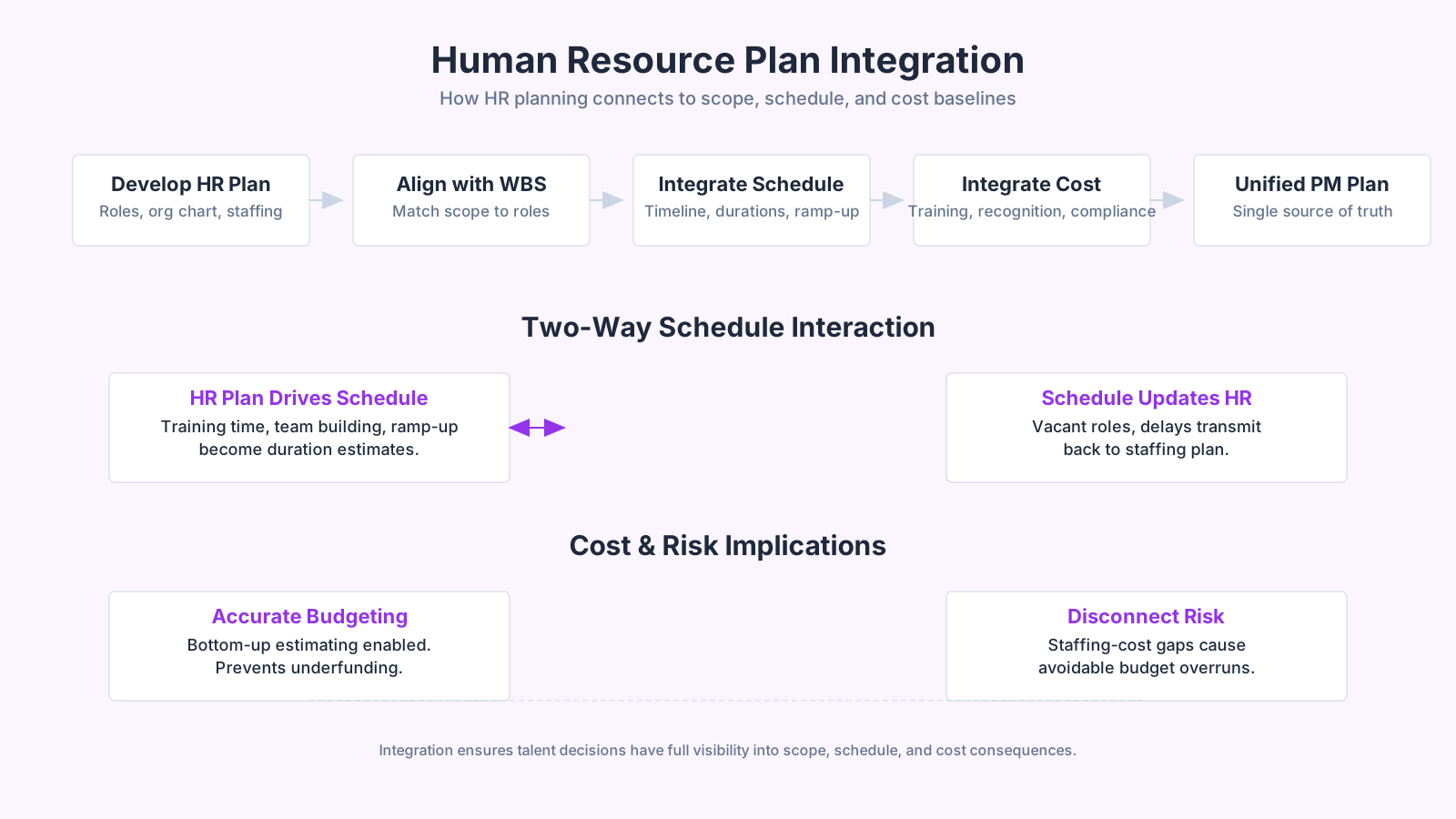
The relationship between human resource planning and activity resource estimation is symbiotic, not linear. Estimate Activity Resources provides the initial demand signal: what type of people, in what approximate quantity, and for how long. The Develop Human Resource Plan process takes that demand and layers on organizational realities. It might discover that the specified number of senior architects cannot be hired within the project timeline, or that the only available experts are in a different time zone, which would affect communication and working hours. Those constraints then feed back into activity resource estimates, sometimes causing revisions to the activity list or schedule. The interaction between human resource planning and activity resource estimation is therefore a continuous loop, especially in projects where resource availability is volatile.
This loop is often underestimated during project initiation. Managers might accept the first cut of activity resource requirements as fixed, but once the human resource plan highlights a skill gap or a resource conflict, the entire schedule can shift. Practical experience shows that the most successful projects treat this interface as a negotiation. The resource plan doesn't just receive inputs; it also pushes back, forcing the project team to rethink how work is structured. For instance, if a specialized tester is only available part‑time, the project schedule might need to be elongated, or the testing activity itself might be broken into smaller chunks to match the resource's calendar. That kind of iterative refinement is what transforms a theoretical plan into a workable one.
Leveraging Enterprise Environmental Factors and Organizational Process Assets
Beyond the immediate activity-level data, human resource planning pulls heavily from the broader organizational environment. Enterprise environmental factors, such as the company's culture, existing employee contracts, marketplace labor conditions, and even government regulations, impose boundaries on what is possible. Organizational process assets, like historical project team performance data, standard role templates, and formal resource acquisition procedures, provide the recipe book for how staffing has been done before. Together, these inputs shape the human resource plan in ways that are often invisible until something goes wrong.
Consider an organization that mandates a rigid functional hierarchy, where all engineers report through a department head and cannot be assigned full‑time to a project without formal negotiation. That cultural factor forces the human resource plan to include detailed resource calendars, negotiation timelines, and even contingency plans for when the functional manager pulls a resource back. On the other hand, a projectized organization with dedicated teams will allow the resource plan to lock in commitments much earlier. The Develop Human Resource Plan process must absorb these factors and translate them into concrete elements like the staffing management plan, which spells out how resources will be acquired, managed, and released.
Organizational process assets play a quieter role but can be just as influential. Templates for role descriptions, for example, ensure that a 'senior developer' is defined consistently across projects, with the same set of competencies and experience levels. Without such standardization, the activity resource requirements from different work packages might use inconsistent titles, leading to confusion when the project manager tries to staff the team. Historical records on team velocity or defect rates can also inform how many people are actually needed to achieve a given output, correcting any optimism that crept into the initial estimates. These assets are not mere paperwork; they are the institutional memory that prevents the same staffing mistakes from repeating.
How Human Resource Planning Interacts with the Develop Project Management Plan Process
Once created, the human resource plan does not stand alone. It becomes a subsidiary part of the overall project management plan, which is assembled during the Develop Project Management Plan process. This integration is not a simple cut‑and‑paste job. It requires checking that the staffing ramp‑up aligns with the project schedule, that the roles defined in the human resource plan match the scope baseline's work breakdown structure, and that the reporting relationships do not conflict with the communications management plan. The project management plan is the single source of truth for the project, so any inconsistency among its components can cause ripple effects during execution.
For example, if the scope baseline includes a large data migration phase scheduled to start in month three, but the human resource plan shows that the database specialists arrive only in month four, then someone must adjust either the schedule or the resource acquisition plan. This sort of cross‑checking happens during the integration meeting where the project manager reviews all subsidiary plans for coherence. The human resource plan also needs to mesh with the risk management plan: if the project relies on a scarce skill set, the resource plan might include fallback strategies such as contracting or cross‑training, which then get reflected in the risk register.
In many organizations, this integration step is where human resource planning first gains visibility at the governance level. The project sponsor and steering committee review the integrated plan, and any resource‑related concerns become immediately apparent, such as unrealistic expectations about internal staff availability or budget line items that seem insufficient to attract the required talent. The act of merging the human resource plan into the larger plan forces these conversations early, rather than allowing them to surface as crises later.
How Human Resource Planning Interacts with Cost Estimation
The link between human resource planning and cost estimation is one of the most tangible interactions in project management. People cost money, sometimes more than any other resource category. The human resource plan identifies not only the types and quantities of personnel but also when they will be involved and for how long, as well as any special compensation, training, or travel requirements. The Estimate Costs process takes this information, applies resource rates and any escalation clauses, and builds the staffing portion of the project budget. A weak human resource plan leads to a weak cost estimate, almost inevitably.
Imagine a project that needs a cybersecurity expert for two critical months during the design phase. If the human resource plan merely notes 'consultant' without specifying the seniority or the market rate, the cost estimator will plug in a generic number that might be half of reality. Similarly, if the plan includes a ramp‑up period where new team members need safety training or a two‑week orientation before they become productive, those non‑productive hours must be priced into the cost estimate. Otherwise, the budget will be missing the hidden costs of bringing people up to speed. This is where the staffing management plan's detail on training and team building activities directly translates to dollar values.
Beyond direct salaries, the human resource plan may trigger cost items for rewards and recognition, travel, relocation, or even severance costs for temporary assignments. In projects that span international borders, the plan might call for per diem allowances, housing stipends, and airfare. Each of these elements is derived from the roles and timelines documented in the human resource plan, and they must be fed into the cost baseline. The interaction also works in reverse: if the cost estimate comes back too high, the project manager might revisit the human resource plan to see if roles can be combined or timelines compressed, which then loops back to activity resource estimates and possibly the schedule. This economic feedback mechanism is one of the clearest examples of how integrated planning disciplines each other.
All these interactions demonstrate that human resource planning is not a standalone activity. It is woven into the fabric of project planning, pulling data from upstream processes and feeding critical decisions downstream. The project manager who treats it as a bureaucratic form‑filling exercise will quickly discover that the schedule, budget, and risk profile are built on sand. Conversely, those who invest time in aligning human resource planning with activity estimation, organizational realities, integration, and cost management build a project foundation that can withstand the pressures of execution.
Core Insights on HR Planning Interactions
- Activity requirements as foundation
- The Develop Human Resource Plan process draws on activity resource requirements from Estimate Activity Resources, which capture the unfiltered staffing demand that HR planning then transforms into a structured team blueprint.
- Continuous information loop
- HR planning and activity resource estimation interact through a continuous feedback cycle, where organizational constraints drive revisions to activity estimates, schedules, and work breakdown structures until a feasible staffing plan crystallizes.
- Organizational environment boundaries
- Enterprise environmental factors such as corporate culture, employment contracts, labor market conditions, and regulatory requirements establish the boundaries within which the HR plan must operate to be viable.
- Standardization through process assets
- Organizational process assets, including role description templates and historical staffing data, enforce consistent role definitions across projects, preventing mismatched titles and ambiguous competency expectations.
Practical Dynamics and Common Pitfalls in Human Resource Planning Interactions
While the data flow diagram makes the connections appear orderly, actual projects are messy. Human resource planning interacts with other processes in real time, often under pressure, and the shortcuts taken during these interactions are the source of many project failures. One of the most common pitfalls is treating the inputs as frozen once the initial plan is approved. Resource calendar constraints , for instance, can change overnight when a key team member resigns or when the organization reassigns staff to a higher‑priority initiative. If the human resource plan was built on the assumption of full‑time availability, the ripple effects through schedule, cost, and risk plans can be severe.
Another frequent issue arises from the interface with procurement management. Many projects rely on contracted resources for specialized skills. The human resource plan must anticipate the procurement lead times for acquiring these external staff, which ties into the project schedule. If the procurement process takes six weeks to bring on a contractor, but the resource plan shows the contractor starting in four weeks, the schedule is already broken before execution begins. This procurement‑resource interaction is often overlooked because the two domains sit in different knowledge areas, and the project manager assumes the staffing management plan will magically align with procurement timelines.
When Activity Resource Estimates Change Mid-Project
Changes happen. A stakeholder may request a new feature that requires skills not previously identified, or a technical discovery reveals that the original activity resource estimates were far too optimistic. In such cases, the human resource plan must be updated, which then triggers updates to the cost baseline and the project schedule. The formal change control process is the mechanism for handling this interaction, but many project teams bypass it when the impact seems small, such as adding one more developer. The result is a gradual divergence between the documented plan and reality, which erodes the project management plan's credibility.
Smart project managers build a feedback loop between human resource planning and the control processes. They use performance reports to detect when actual resource utilization deviates from the plan and then initiate a review of activity resource estimates. For example, if a software team is consistently missing sprint goals despite being fully staffed, the underlying assumption about productivity might be wrong. That insight feeds back into the human resource plan, possibly adjusting the number of developers or the required seniority for future phases, which then updates cost and schedule forecasts. This kind of learning loop is not spelled out in most textbooks, but it is what separates mature project organizations from immature ones.
The Danger of Ignoring Organizational Constraints
Organizational constraints are not just background noise; they can entirely invalidate a human resource plan if not assessed early. A company that has a policy of internal mobility only once per year, for example, will not be able to staff a project that starts mid‑year with people from other departments unless an exception is granted. That political negotiation must happen before the plan is baselined, and the outcome affects the entire integration. Failing to account for it leads to a plan that looks perfect on paper but cannot be executed.
The same applies to enterprise environmental factors like labor laws. In some countries, hiring temporary workers involves mandatory training, insurance, and statutory benefits that add both time and cost. The human resource plan needs to capture these nuances because they directly feed into cost estimates and schedule durations. Project managers who come from a head office environment and parachute into a foreign subsidiary often learn this the hard way, finding that their neat staffing timeline is blown apart by a three‑week government‑mandated safety orientation. The interaction between human resource planning and regulatory reality is a discipline in itself, and it requires local expertise.
The Feedback Loop with Risk Management
Human resource planning also maintains a bidirectional relationship with risk management. The risk register may identify threats related to staff attrition, skill shortages, or conflicts between team members, and the human resource plan must include response strategies for those risks. Conversely, the act of creating the human resource plan can uncover new risks, such as the realization that a single person holds critical knowledge with no backup, which then gets added to the risk register. This interaction shows that the human resource plan is not just a static document; it is a living artifact that informs and is informed by the project's risk posture.
For instance, if the project is located in an area with a high turnover rate for certain professions, the staffing management plan might include an aggressive retention component with bonuses and rapid replacement procedures. Those bonus costs go into the cost estimate, and the replacement timeline alters the schedule. The risk response plan then monitors early warning indicators of turnover. All these links are tied together by the human resource plan's content. When a project manager updates the risk register after a new threat is identified, they should immediately check whether the human resource plan remains adequate. Without that discipline, the response might be documented without the resources to execute it, rendering the risk plan hollow.
Human Resource Planning Interactions in Agile and Business Value-Oriented Contexts
In traditional project management, human resource planning often follows a predictive cycle, with roles defined upfront and staffed accordingly. Agile frameworks, however, turn some of these interactions on their head. The emphasis shifts from specifying individual job titles for each activity to forming a stable, cross‑functional team that owns the work. Cross‑functional team composition becomes the central focus of human resource planning, because the team is expected to have all the skills needed to deliver increments without handoffs. This changes the way human resource planning interacts with activity estimation and cost management.
Rather than estimating resources at the activity level in detail, Agile teams often estimate work in story points or ideal days, and the human resource plan is about maintaining a dedicated team with consistent membership. The interaction with activity resource estimation becomes less about counting bodies for specific tasks and more about ensuring the team's capacity matches the backlog's velocity. In Scrum, for example, the development team is fixed after the initial formation, and the product owner and scrum master focus on protecting that team's composition. The human resource plan, then, is less a dynamic staffing document and more a team charter that defines roles and responsibilities within a stable unit.
How Human Resource Planning Interacts with Cost Estimation in Agile
Cost estimation in Agile often uses simple burn rates based on team size and duration, rather than detailed per‑role rates. The human resource plan therefore feeds into the budget as a straightforward multiplication of team cost per sprint times the number of sprints. Any changes to the team, such as needing to bring in a specialist for a spike, must be reflected in the cost estimate and can trigger a conversation about whether to reduce scope or extend the timeline. Because the team is cross‑functional, the cost per sprint is relatively stable, which simplifies the interaction but also makes the human resource plan's definition of team composition critical. If the wrong skills are included or excluded, the cost estimate will be off for the entire project.
Business Value-Oriented Project Management and Human Resource Planning
Looking beyond mainstream Agile, the Business Value-Oriented Project Management (BVOPM) methodology introduces additional layers to this interaction. BVOPM mandates cross‑functional teams not as an option but as a core success factor. The human resource plan in such an environment must consider that team members are expected to work across traditional boundaries, and that the planning process itself uses relational effort points rather than precise hourly estimates. This affects the upstream interaction with activity resource estimation because the estimates are expressed in relative terms, and the human resource plan is tasked with assembling a team that can meet the effort profile without being tied to fixed job descriptions.
In BVOPM, the cost interaction also takes a subtle shift. Instead of building cost estimates from detailed resource rates, the human resource plan focuses on maintaining a team whose output is measured in business value points. The cost of the team is then compared to the value delivered, and if the business value points start to decline, the project may be put into a review process. The human resource plan thus interacts not only with cost but also with the value management process, creating a triangle of staffing, budget, and value outcomes that demands continuous alignment. That is a more fluid interaction than traditional models, and it requires a project manager who is comfortable with ambiguity and regular replanning.
Core Insights on Agile HR Planning
- Cross-functional team focus
- Agile HR planning prioritizes assembling a cohesive, cross-functional team endowed with the full spectrum of required capabilities, thereby eliminating the traditional practice of slotting job titles into discrete activities.
- Capacity-based resource estimation
- Agile teams forgo granular, activity-by-activity headcount planning and instead size work in story points or ideal days, aligning the team’s stable velocity with the prioritized backlog’s demand.
- Burn rate cost modeling
- Agile cost estimation is derived by multiplying the steady-state team’s cost per sprint by the total number of sprints, which elevates team composition to a pivotal factor in budget fidelity.
- Relational effort points in BVOPM
- The Business Value-Oriented Project Management (BVOPM) methodology substitutes standard hourly estimating with relational effort points and mandates cross-functional collaboration that transcends traditional role silos.
- Staffing-budget-value alignment triangle
- BVOPM establishes a perpetual alignment triangle connecting staffing levels, budget, and value delivery, where a sustained drop in business value points automatically initiates a formal project re-evaluation.
Ensuring Coherent Interactions Through Integrated Planning
All these interactions point to a simple truth: human resource planning cannot succeed in a silo. The most effective project managers treat the entire planning process as an ecosystem where each component informs the others. Integrated planning discipline means that when you adjust the schedule, you immediately revisit the staffing management plan, and when you re‑estimate costs, you confirm that the human resource plan still supports those numbers. It is a habit, not a one‑time event.
To strengthen these interactions, many organizations adopt project management software that links resource assignments to tasks and costs in real time. That technological linkage helps enforce the connections, but it is not a substitute for critical thinking. The project manager still needs to challenge whether the activity resource requirements make sense given the organizational culture, whether the cost per hour reflects market rates for the required skills, and whether the integration of the human resource plan into the overall project management plan has been reviewed by every relevant stakeholder. The human resource plan sits in a web of dependencies, and a break in any one link can cause cascading failures.
Regular integrated change control meetings, where resource, cost, schedule, and risk changes are discussed simultaneously, are one practical way to maintain these interactions. Instead of updating each plan separately, the team reviews the knock‑on effects across all baselines. When a resource is pulled from the project, the discussion immediately covers how the schedule will be impacted, what the cost implications are for finding a replacement, and what new risks are introduced. This keeps the human resource plan alive and relevant, rather than letting it become a forgotten appendix to a static project plan.
The human resource planning process is not a finish line to cross during project initiation; it is a continuous dialogue with the rest of the project management disciplines. By understanding and actively managing the inputs from activity resource estimation and organizational factors, and by ensuring the outputs feed accurately into cost estimation and the project management plan, the project manager builds a resilient structure that can adapt to the inevitable surprises of execution.