Project management can feel like a dense web of documents, meetings, and tracking tools, but underneath that complexity sits a remarkably clear structure. The project management profession organizes its core activities into five categories known as the Project Management Process Groups: Initiating, Planning, Executing, Monitoring and Controlling, and Closing. Understanding the five process groups in project management gives project managers, sponsors, and team members a shared language for moving from a rough idea to a completed deliverable. These groups are not random headings; they reflect a logical flow that starts with authorization and ends with formal closure. The definitions in professional standards describe each group by the kinds of processes it contains and the purpose those processes serve.
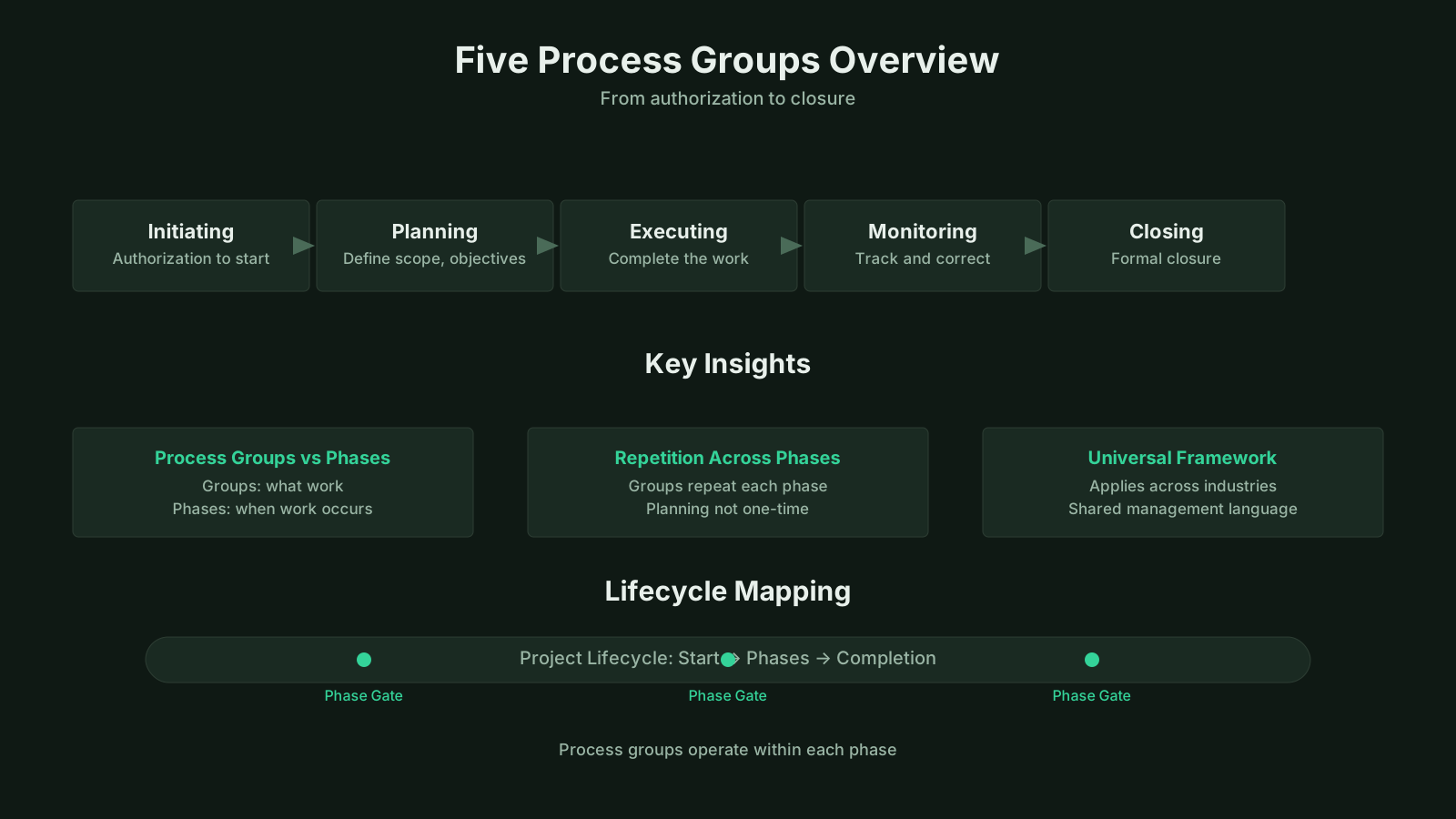
The five process groups have clear dependencies and are typically performed in the same sequence on each project. They are also independent of application areas or industry focus, which means the same high-level grouping applies whether the work involves software, construction, research, or service delivery. However, the process groups are not project phases. When large or complex projects are separated into distinct phases, all of the process groups would normally be repeated for each phase or subproject. Individual process groups and their constituent processes are often iterated prior to completing the project. This iterative quality is easy to overlook when the framework is presented as a simple five-step sequence.
The Five Project Management Process Groups: Key Summary
| Key Concept | Summary |
|---|---|
| Five Process Groups | The initiating, planning, executing, monitoring and controlling, and closing groups establish the complete lifecycle for managing project work. |
| Common Framework | They provide project managers, sponsors, and team members with a shared vocabulary and consistent structure for moving from concept to completed deliverable. |
| Cross Industry Applicability | This high level grouping applies consistently across software, construction, research, and service delivery, regardless of application area or sector. |
| Overlapping and Iterative | The process groups are not strictly sequential. Planning may reveal the need to revise initiating decisions, and execution often triggers additional planning. |
| Consequences of Skipping Phases | Executing without adequate planning typically leads to rework, while failing to formally close leaves unresolved issues and undocumented lessons. |
| Key Output of Initiating | Initiation produces formal authorization, supported by a clear business need, identified stakeholders, and a documented intended outcome. |
| Business Value Focus | A value driven approach requires structured stakeholder input validation and a transparent issue board where all roles can surface concerns before authorization. |
| Broader Monitoring Scope | Effective monitoring goes beyond plan variance, because team stress, shifting customer tone, and small unresolved issues may reveal early warning signs of larger problems. |
What Are the Five Process Groups in Project Management?
The five process groups in project management are the initiating process group, the planning process group, the executing process group, the monitoring and controlling process group, and the closing process group. Each one contains a set of processes performed to achieve a specific objective in the project lifecycle. The sequence moves from obtaining authorization, through defining and performing the work, to closing the project or phase. That sequence has a logical dependency: you cannot formally close work that has not been performed, and execution benefits from a plan that has been thought through. At the same time, real-world projects rarely proceed through the groups only once in a neat line.
It is tempting to think of these five groups as a simple timeline, but that would miss something important. The process groups describe categories of project management work, not sequential project phases. A large or complex project may be separated into distinct phases, and all of the process groups would normally be repeated for each phase or subproject. Even within a single phase, individual process groups and their constituent processes are often iterated prior to completing the project. A planning activity may reveal a need to return to an initiating decision, and execution may trigger additional planning before a major deliverable is built.
The Core Purpose of the Five Process Groups in Project Management
Each process group exists because a project needs a different type of management attention at different points. Authorization requires a different mindset than detailed planning. Performing work requires coordination, while tracking work requires analysis. Closing calls for verification and handoff. Grouping processes this way helps practitioners avoid applying the wrong tool at the wrong time. A project manager who tries to execute before planning will likely face rework, while a team that never formally closes may leave loose ends. The structure also makes it easier to assign responsibilities, select appropriate techniques, and evaluate whether the right management activities are being performed.
Core Takeaways on Process Groups
- Five sequential process groups
- The five process groups are Initiating, Planning, Executing, Monitoring and Controlling, and Closing, with each one containing processes that serve a distinct objective within the project lifecycle.
- Logical dependency between groups
- The groups follow a logical progression in which work moves from authorization to definition and execution, and only work that has actually been performed can be formally closed.
- Repetition across phases
- On large or complex projects, the work is typically divided into distinct phases or subprojects, and the complete set of process groups is repeated for each phase rather than completed only once.
- Iteration within single phases
- Within a single phase, the process groups are frequently iterated because planning may reveal a need to revisit earlier initiating decisions, and execution may trigger additional planning before a major deliverable is produced.
Initiating Process Group: Obtaining Authorization
The initiating process group includes those processes performed to define a new project or a new phase of an existing project by obtaining authorization to start the project or phase. In real terms, this is where an idea becomes a formal enough commitment that resources can be assigned and a project manager can begin work. The key output is authorization, but the work behind it often includes understanding the business need, identifying key stakeholders, and documenting enough about the intended outcome to justify the investment. This group is not about detailed solution design; it is about establishing legitimacy and initial boundaries. Without clear authorization, a project can drift, lose sponsorship, or start with unresolved expectations.
The Initiating Process Group within the Five Process Groups in Project Management
Authorization happens before detailed planning, but the boundary is not always clean. Someone has to say yes to the project, but that yes may depend on a rough estimate, a risk appetite check, or an initial feasibility review. The initiating process group is often small in terms of process count, yet it carries heavy influence. If the wrong project is authorized, excellent planning and execution will still deliver the wrong result. Practitioners sometimes rush through this group because it feels administrative, but skipping stakeholder alignment here tends to create disputes later. In many organizations, a project charter or similar document captures the authorization decision and gives the project manager the authority to apply resources.
Some modern project management approaches add even more explicit structure to this early decision point. Business Value-Oriented Project Management, for example, emphasizes formal stakeholder input validation and a transparent board of project issues where all roles can raise concerns before authorization. The idea is to surface objections while they are still cheap to address. That broader input does not replace the initiating process group; it strengthens the authorization decision by making the basis of commitment more visible. A sponsor may still decide to proceed, but the decision is better informed.
Planning Process Group: Defining Scope, Objectives, and Action
The planning process group includes those processes required to establish the scope of the project, refine the objectives, and define the course of action required to attain the objectives that the project was undertaken to achieve. Planning is where the project team converts a broad authorization into a workable roadmap. Scope, schedule, cost, quality, resources, communications, risk, and procurement are all examined with enough detail to guide execution. The plan itself is not the end goal; the end goal is a shared understanding of what will be done, how it will be done, and what conditions might change that understanding. Good planning reduces uncertainty, but it does not eliminate it, because no plan can fully predict reality.
The Planning Process Group within the Five Process Groups in Project Management
In practice, planning is rarely a single event at the beginning of a project. The planning process group is revisited whenever new information demands a course correction. A team may start with a high-level plan, then refine it as requirements become clearer. That iterative behavior is consistent with the idea that individual process groups and constituent processes are often iterated prior to completing the project. Planning processes also interact heavily with monitoring and controlling processes, because actual performance data often reveals planning assumptions that were too optimistic. The better the planning, the fewer surprises during execution, but there is a real risk of overplanning when teams treat the plan as more important than the project outcome.
Business Value-Oriented Project Management offers a slightly different lens on planning. It uses relational effort points instead of purely time-based estimates and warns about the known inaccuracy of work breakdown structures when they become too granular too early. Its five-level scope scale, from definite to unlikely, treats scope change as user feedback rather than a sign of failure. This aligns with the broader planning principle that the plan should support decision making, not become a rigid contract. A construction project may need detailed drawings early, while a software project may benefit from a rolling plan that gains precision as the product evolves. The planning process group accommodates both styles as long as scope, objectives, and the course of action remain clear enough to coordinate the work.
Planning Process Key Takeaways
- Scope, objectives, and action
- The planning process group defines the project scope, sharpens the objectives, and establishes the course of action required to deliver the outcomes the project was initiated to achieve.
- Shared understanding is the goal
- The plan document is not the end goal; the end goal is a shared understanding of the work to be done, how it will be done, and what circumstances might revise that understanding.
- Uncertainty reduced, not eliminated
- Effective planning reduces uncertainty without eliminating it, because no plan can fully predict real-world conditions and the process groups are often revisited before the project is complete.
- Monitoring reveals optimistic assumptions
- Planning processes are closely linked with monitoring and controlling processes, since actual performance data frequently reveals planning assumptions that proved overly optimistic.
- Overplanning and context-specific methods
- Overplanning becomes a risk when teams prioritize the plan over the project outcome; planning methods should match the context, since construction requires detailed early drawings, software development benefits from rolling plans, and estimation should use relative effort points rather than time-based units to avoid overly detailed work breakdown structures.
Executing Process Group: Completing the Work
The executing process group includes those processes performed to complete the work defined in the project management plan to satisfy the project specifications. This is where deliverables are produced, team members are directed, resources are applied, and quality activities are performed. Execution consumes the largest share of project budget and time in most projects, but it is not a mechanical process of following the plan. It involves constant coordination, stakeholder engagement, and real-time problem solving. The project manager is not simply checking off tasks; they are managing interfaces among people, tools, suppliers, and changing conditions. That sounds straightforward. It rarely is, because the plan changes the moment work begins and the team faces decisions nobody anticipated.
Coordination and Delivery in the Executing Process Group
Execution draws on the outputs of planning and creates the data that feeds monitoring and controlling. The team uses the project management plan, approved changes, and organizational process assets to produce deliverables. But execution also generates new information: risks materialize, technical problems emerge, and stakeholders change their expectations. That is why the executing process group is tightly linked to the monitoring and controlling process group, even though they are described as separate categories. A project manager rarely completes all planning before executing; in many projects, detailed planning for one deliverable overlaps with execution of another. This overlap is a natural part of managing complex work and is explicitly recognized by the iterative nature of process groups.
On the execution side, some contemporary approaches view team-created tools and open-source software as formal products, not informal side effects. Business Value-Oriented Project Management also treats cross-functional teams as a core success factor. That perspective matters because execution quality depends heavily on who does the work and how they collaborate. A cross-functional team with the right skills can absorb change more easily than a group that is rigidly siloed. In practical terms, the executing process group is not just about producing outputs; it is about enabling the people doing the work to make good decisions within the boundaries set by the plan.
Monitoring and Controlling Process Group: Tracking and Regulating Performance
The monitoring and controlling process group includes those processes required to track, review, and regulate the progress and performance of the project; identify any areas in which changes to the plan are required; and initiate the corresponding changes. This group runs alongside the other process groups, especially execution, because it provides the feedback loop that keeps the project on course. Monitoring is not the same as micromanaging. It is about comparing actual performance against the plan, identifying variances, and understanding whether those variances matter. Controlling then takes action when performance drifts outside acceptable limits. The goal is not to prevent all change; the goal is to ensure that changes are deliberate, evaluated, and aligned with project objectives.
How Monitoring and Controlling Feeds Back into Other Groups
Without monitoring and controlling, the other process groups would operate blindly. Initiating may authorize something that later proves unworkable, planning may rely on outdated assumptions, and executing may produce work that does not meet specifications. Monitoring and controlling processes create the evidence needed to make timely decisions. This includes measuring schedule and cost performance, validating scope, controlling quality, managing changes, and monitoring risks. When a variance appears, the project manager may recommend corrective action, preventive action, or a change request. That recommendation flows back into planning or executing as appropriate. In this way, monitoring and controlling is not a separate stage; it is an ongoing management layer that surrounds the project.
There is also a less visible side to monitoring that experienced project managers learn to watch. Business Value-Oriented Project Management introduces the concept of process damage as invisible organizational harm and tracks business value points where persistent decline may signal possible closure. Even outside that specific framework, a project that looks green on schedule and cost may still be damaging relationships, creating rework, or eroding stakeholder confidence. Good monitoring and controlling therefore includes qualitative signals as well as quantitative ones. A project manager who only watches the plan and ignores the team's stress level, the customer's shifting tone, or the accumulation of small unresolved issues may miss the early warning signs of a much larger problem.
Core Insights on Project Monitoring
- Feedback loop for course
- Operating in parallel with other process groups, particularly execution, monitoring and controlling establishes a continuous feedback loop that keeps the project aligned with its plan and objectives.
- Variance identification and action
- This process group systematically compares actual performance against the project baseline, detects variances, and initiates corrective actions whenever results fall outside predefined tolerance thresholds.
- Deliberate change management
- Rather than eliminating change entirely, the goal is to ensure that every proposed change is carefully evaluated, intentionally approved, and aligned with the project's strategic objectives.
- Scope of control activities
- Its scope includes measuring schedule and cost performance, validating deliverables against scope, controlling quality, managing change requests, and tracking risk exposure throughout the project lifecycle.
- Watch beyond schedule metrics
- A project that appears on track with respect to schedule and cost may still be undermining stakeholder trust or team cohesion, so project managers must remain alert to early warning signs such as rising team stress and unresolved conflicts.
Closing Process Group: Formalizing Completion
The closing process group includes those processes performed to finalize all activities across all process groups to formally close the project or phase. Closure is often underappreciated because the team has already delivered the main output, but it serves essential purposes. Formal closure confirms that the project or phase is finished, documents the final state of deliverables, releases resources, and captures lessons learned. It also provides a clean handoff to operations or to a subsequent phase. Without closing processes, projects can linger indefinitely with unresolved contracts, incomplete documentation, and ambiguous ownership of the result. A disciplined closeout is not bureaucracy for its own sake; it is the mechanism that turns a completed deliverable into an accepted, usable outcome.
Beyond the Final Deliverable: Closing Activities
Closure involves more than a final meeting. The project manager must verify that all project work is done and that deliverables meet acceptance criteria. Financial accounts may need to be closed, contracts finalized, and archival records organized. The project team may be released to other work, and the product or service transitions to those who will operate it. Lessons learned are documented and shared so that future projects can avoid the same mistakes. In a phased project, the closing process group for one phase feeds into the initiating process group for the next. This repetition is part of what distinguishes process groups from project phases; the same closing activities are performed at the end of each phase or subproject when the overall initiative is large or complex.
Closing also has a strategic dimension. Business Value-Oriented Project Management includes non-financial program benefits such as employee engagement and future risk reduction in its realization sets. That means the value of a project is not fully captured by the immediate deliverable alone. A project that formally closes while documenting how it strengthened a team's capability or reduced uncertainty for future work may contribute more than the original business case suggested. Practitioners who rush closure to move to the next project often forfeit this learning and demobilization value. A deliberate closing process group ensures that the project's end is just as managed as its beginning.
Dependencies and Sequencing of the Process Groups
The five process groups have clear dependencies and are typically performed in the same sequence on each project. That sequence starts with initiating and moves through planning, executing, monitoring and controlling, and closing. However, "typically" is an important word. The order is not a rigid waterfall because processes within the groups can overlap and repeat. Monitoring and controlling runs concurrently with planning and executing, not after them. Planning may be revisited during execution when new information emerges. Initiating may be repeated at the start of a new phase. The dependency is logical: you cannot formally close before you have done something to close, and planning before authorization would be premature. But within that logic, there is considerable room for iteration.
A simple way to picture this is a home renovation. The owner first authorizes the work, the contractor then plans the sequence of demolition, electrical, and finishing work, the crew performs the work, and someone checks progress against the schedule and budget. Finally, the owner signs off and the contractor closes out permits. But the contractor does not wait until the entire plan is perfect before starting demolition. Once demolition reveals unexpected plumbing, planning is repeated for that part of the project. Monitoring happens throughout, not only at the end. Each process group has a logical place in the flow, yet the flow allows loops and overlaps that mirror real-world uncertainty. That is why the guidance says individual process groups and constituent processes are often iterated prior to completing the project.
Why Process Group Dependencies Matter for Project Success
Understanding these dependencies helps project managers avoid two common mistakes. The first mistake is treating each group as a separate phase with hard boundaries. The second mistake is ignoring the sequence altogether and jumping into execution without proper authorization or planning. Both errors create avoidable problems. A phased approach can still be useful for large projects, but even then each phase contains all five process groups. The dependency is not about waiting for one group to finish before starting the next; it is about ensuring that the outputs of one group are available when another group needs them. For example, executing needs the plan, monitoring needs performance data from executing, and closing needs acceptance evidence from monitoring and controlling.
Key Takeaways on Process Group Order
- Consistent five-group sequence
- The five process groups are always applied in a consistent sequence, beginning with Initiating and progressing through Planning, Executing, Monitoring and Controlling, and Closing.
- Flexible, not rigid waterfall
- Individual processes within the groups often overlap and recur, which means planning can be revisited during execution as new information emerges.
- Logical dependency between groups
- The sequence reflects practical dependencies because planning before the project is formally authorized would be premature, and formal closure cannot happen until the work is completed.
- Iteration mirrors project reality
- The process groups are frequently iterated before project completion, and understanding these dependencies helps project managers avoid two common mistakes.
Process Groups Are Not Project Phases
One of the most persistent misunderstandings about project management process groups is the idea that they are the same as project phases. They are not. Project phases are divisions within a project where extra control is needed to manage the completion of a major deliverable. Process groups are categories of project management processes. The source material is explicit: when large or complex projects are separated into distinct phases, all of the process groups would normally be repeated for each phase or subproject. A project phase may contain all five process groups. A process group, by contrast, is not a phase of the project lifecycle in the same sense, because it does not describe a time period with a specific deliverable at the end.
Think of a project divided into a design phase and a build phase. During the design phase, the team still needs authorization to begin that phase, plans the design work, performs the design activities, monitors design quality, and formally closes the design phase. The same pattern repeats in the build phase. The phases are design and build, but the process groups are initiating, planning, executing, monitoring and controlling, and closing. Confusing these two concepts leads to flawed schedules, missing processes, and poor governance. It is also why a project manager may be asked to manage a phase as a mini-project, with its own charter and closure.
Common Pitfalls When Applying the Five Process Groups
One common mistake is to treat the sequence of process groups as a strict linear progression. That leads teams to delay execution until every planning detail is finalized, which can cause unnecessary delays. It also leads to the opposite error: jumping into execution without enough planning because the team assumes the process groups are optional. Neither extreme works well. The process groups are meant to be tailored, not skipped. A small internal project may need a brief initiating discussion and a lightweight plan, while a high-risk project may need extensive planning and formal phase gates. The key is to scale the rigor of each group to the project's complexity, uncertainty, and stakes.
Another pitfall is underinvesting in monitoring and controlling because the team sees it as overhead. A project without meaningful tracking may feel efficient until problems compound. By the time the issue becomes visible, options are narrower and costs are higher. Experienced project managers know that monitoring does not have to be heavy to be effective. Simple weekly reviews, variance thresholds, and clear escalation paths can provide enough control without creating a reporting burden. The point is not to produce reports; the point is to make timely decisions. When monitoring catches a small drift early, the team can correct course with minimal disruption.
Closing is another area where projects quietly fail. Teams deliver the product, move on to the next assignment, and leave contracts, documentation, and lessons unaddressed. The result is often a project that looks done but still has open items that resurface later. Formal closeout may seem tedious, but it prevents ambiguity about who owns the result. It also creates the final record that future audits and handoffs require. A project manager who builds closing activities into the schedule from the start is more likely to complete them. Treating closure as an afterthought almost guarantees it will be rushed.
Key Insights on Process Group Pitfalls
- Never treat groups as linear
- Applying the five process groups as a fixed sequence often leads teams to postpone execution or skip planning altogether, so the groups should be tailored to the project context instead of treated as a rigid checklist.
- Scale rigor to project needs
- The level of rigor applied to initiating, planning, and controlling should reflect the project's complexity, uncertainty, and potential impact, ranging from lightweight plans for small internal efforts to formal phase gates for high risk initiatives.
- Lightweight monitoring is enough
- Effective oversight rarely depends on heavy reporting, because simple weekly reviews, clear variance thresholds, and well-defined escalation paths can maintain control while protecting team capacity.
- Early detection lowers costs
- Detecting minor deviations early through consistent monitoring expands the team's options and enables corrective action with minimal disruption before small issues escalate into larger problems.
- Balance planning and execution
- Teams perform best when they avoid both extremes of waiting for flawless plans and acting prematurely, since either tendency erodes the practical value that the process groups are meant to provide.
Applying the Five Process Groups Across Different Environments
The source material states that the five process groups are independent of application areas or industry focus. That independence is one reason the framework is so widely used. A pharmaceutical regulatory submission, a highway expansion, and a marketing campaign all need some form of authorization, planning, execution, tracking, and closure. The specific activities within each group will differ, but the underlying management purpose remains the same. This universality helps project managers move between industries, but it also requires judgment. The process groups are not a detailed recipe; they are a high-level pattern that must be interpreted in context.
In Agile environments, practitioners often note that planning and execution overlap more deliberately, and monitoring is embedded in short feedback loops. A sprint review is a form of monitoring and controlling, while a release plan is part of planning. But even in Agile, the project or product initiative still begins with some form of authorization, whether that is a product vision, a funded backlog, or a team charter. And closure still matters when the initiative ends or moves into a new phase. The process groups do not dictate a Waterfall approach; they describe management activities that can be performed iteratively and incrementally. Many Agile teams still recognize the same categories, even if they use different terminology.
Using the Five Process Groups as a Management Discipline
The real value of the five process groups is that they create a consistent management discipline for complex work. By separating authorization, planning, execution, tracking, and closure, the framework helps project managers see what type of attention is needed at any moment. It also makes the project's status more communicable. A sponsor can understand that the team is still in initiating because key stakeholders have not approved the charter. A team member can understand why a planning session is being repeated after a scope change. The five groups provide a mental model that remains useful even when the project environment changes.
This discipline does not require a heavy process burden. It requires knowing which questions to ask at each stage. Who has authorized this work? What exactly are we trying to achieve? Are we producing what the plan intended? How do we know we are on track? What remains open before we can call this done? Those questions are simple, but they become powerful when applied consistently across a portfolio of projects. They also help senior leaders see where a project may be getting stuck. A project that spends too long in initiating may have unresolved sponsorship. A project that never reaches closure may have unclear acceptance criteria. The process groups give those patterns a name.
Ultimately, the five process groups are not just a chapter in a project management standard. They are a practical way to organize attention, decisions, and accountability. A project manager who understands them deeply can adapt the framework to almost any context without losing the core logic. The initiating process group secures the right to begin. Planning defines what success looks like and how to reach it. Executing produces the result. Monitoring and controlling keeps the effort honest. Closing locks in the value and allows the organization to move forward. Together, they form a complete loop that turns resources into outcomes, and outcomes into organizational learning.
Core Insights on Process Discipline
- Consistent management discipline
- The five process groups provide a consistent governance framework that brings order to complex work, regardless of project type or scale.
- Attention guidance at each stage
- By distinguishing authorization, planning, execution, tracking, and closure, the framework directs a project manager's focus toward the most relevant activities at each point in the project life cycle.
- Communicable project status
- The process groups make project status easier to communicate by giving sponsors and team members a clear reason for repeating a planning session after a scope change.
- Adaptable without heavy burden
- The discipline relies on asking the right questions at each stage rather than imposing heavy process overhead, so it remains effective even as project conditions shift.