The process of monitoring and controlling project work sits at the heart of every project manager's daily reality. It is the continuous, integrative oversight function that ensures the project stays aligned with its objectives, and yet it is often mistaken for a reactive audit or a simple status check meeting. In the PMBOK framework, Monitor and Control Project Work belongs to the Monitoring and Controlling Process Group and is part of the Project Integration Management knowledge area. Its purpose is to track, review, and report overall progress against the project management plan, and it serves as the primary mechanism for identifying variances that might demand corrective or preventive action. Many project professionals learn the inputs and outputs for the PMP exam but then struggle to translate them into the messy, non-linear flow of real projects.
Monitoring and Controlling Project Work: Summary
| Concept | Summary |
|---|---|
| Process Purpose | The Monitor and Control Project Work process systematically tracks progress against the project management plan, serving as the primary mechanism for detecting variances and determining whether corrective or preventive actions are needed. |
| Performance Reports | Performance reports consolidate raw execution data such as completed deliverables, actual costs, and remaining duration estimates into structured insights on work package health and progress trends. |
| Data vs. Information | Work performance data are raw observations like hours logged; work performance information contextualizes those data points against baselines to produce metrics such as schedule variance and cost performance indices. |
| Organizational Assets | Organizational process assets help project managers diagnose recurring variances by retrieving similar past issues and their documented root causes, enabling faster, evidence based resolution. |
| Plan Comparison | Continuous comparison of current performance reports with the project management plan, while integrating environmental factors and historical organizational insight, forms the core of effective monitoring. |
| Risk Register | An apparently alarming variance can be promptly contextualized through the risk register, which may reveal that a pre planned contingency response is already addressing the triggering event. |
| Reporting Rules | Ambiguous reporting rules lead to inconsistent completion percentages across team members, rendering performance reports unreliable and distorting the true project status. |
| Variance Analysis | Skilled interpretation of performance reports depends on trend and variance analysis to distinguish isolated anomalies from systemic problems, drawing on experience and historical data comparisons. |
The Critical Inputs That Feed the Monitor and Control Process
Every monitoring effort begins with a set of raw materials, and the quality of those inputs directly determines how accurately a project manager can sense trouble or opportunity. The project management plan is the most comprehensive input to monitor and control project work, functioning as a detailed map of where the project ought to be at any given moment. It includes all subsidiary plans for scope, schedule, cost, quality, resources, communications, risk, procurement, and stakeholder engagement, along with baselines for scope, schedule, and cost. A project manager cannot detect a deviation without first having a clear, approved baseline to compare against. The plan also describes how the monitoring and controlling work itself will be executed, including the frequency of performance reviews, the metrics to be tracked, and the thresholds that trigger escalation. In practice, too many teams treat the project management plan as a static artifact created at the end of planning and then rarely consulted again. When that happens, the monitor and control process becomes directionless, relying on gut instinct rather than a structured comparison of actuals to the plan.
Performance reports, often called work performance information, are the next necessary ingredient. These reports consolidate raw data collected during execution, such as the number of deliverables completed, actual costs incurred, and the remaining duration estimates for active work packages. The PMBOK framework distinguishes between work performance data, which are raw observations like a team member logging eight hours on a task, and work performance information, which contextualizes that data with a baseline, like showing that the task is now two days behind schedule. In a typical construction project, performance reports might come from daily site logs and weekly earned value analyses. In a software development project using Scrum, they could emerge from burn-down charts, velocity trends, and cumulative flow diagrams. The critical insight here is that the reports must be frequent enough to allow timely intervention but not so granular that they distract the project manager from forward-looking problem solving. If reports arrive only at the end of a phase, the cost of correction may already be too high.
Enterprise environmental factors and organizational process assets complete the picture of what feeds the monitor and control work. Environmental factors include the organization’s existing infrastructure, market conditions, government regulations, and the risk tolerance of key stakeholders. These elements are not under the project manager’s control, but they shape what is realistic to expect. A project in a heavily regulated pharmaceutical environment will need to monitor compliance indicators with a level of rigor that a small internal marketing project might never require. Organizational process assets, by contrast, represent the history and learned patterns of the organization itself: past project archives, standardized templates, change control procedures, and the lessons learned repository. When a project manager notices that actual cost performance is deviating in a familiar pattern, organizational process assets can suggest whether the root cause is likely an estimating error, a resource competency gap, or a supply chain delay, simply by surfacing similar variances from previous initiatives. Ignoring these inputs leaves a project manager blind to organizational patterns that seasoned colleagues would have recognized immediately.
The interplay among these inputs is not sequential but simultaneous. A project manager constantly compares the current performance reports against the project management plan while filtering both through the lens of what is possible given the environmental factors and what has been recommended by past organizational experience. A sudden supplier lead time increase might look catastrophic if judged only against the schedule baseline, but a quick check of the risk register, part of the project management plan, might reveal that a contingency response was already planned for just such an event. In that single moment, the monitor and control process shifts from sounding an alarm to executing a prepared strategy, and that smooth pivot is only possible because all four input categories were actively maintained.
Project Management Plan as the Baseline for Control
The project management plan is not merely a document to be read once and shelved; it is the active anchor point for every monitoring activity. Its subsidiary plans must contain measurable performance indicators. For example, the schedule management plan defines the acceptable variance thresholds before schedule compression techniques are triggered. The cost management plan sets the funding limits and the rules for when contingency reserves can be accessed. Without these built-in decision rules, the project manager will waste precious time seeking approval for common variances that should have been pre-authorized. A well-structured plan also includes the methodology for measuring progress, such as fixed-formula milestones, weighted milestones, or percent complete rules. If the plan leaves those rules vague, different team members will report the same work package at wildly different completion percentages, and the resulting performance reports will mislead rather than inform.
A common oversight occurs when project managers pour energy into creating the plan but then fail to keep it updated as approved changes are made. Suppose a change request is approved that adds a new software module and extends the deadline by three weeks. If the project management plan is not immediately revised to reflect that new baseline, all subsequent performance reports will incorrectly flag a three-week delay as a problem. The plan becomes a source of noise rather than a source of truth. This dynamic is why Monitor and Control Project Work outputs include project management plan updates, but the discipline of actually applying those updates is what separates effective project managers from those who merely document problems. The plan must be a living artifact, version-controlled and communicated so that every stakeholder is reacting to the same authorized snapshot.
Performance Reports and the Art of Reading Variance
Performance reports bring the numbers to life, but interpreting them requires an understanding of trend analysis, variance analysis, and the subtle art of distinguishing between a one-time anomaly and a systemic problem. A cost variance of three percent might be statistically insignificant in a small project but could represent hundreds of thousands of dollars in a megaproject. Similarly, a schedule variance that disappears when the next work package finishes ahead of time might not need any corrective action at all. Many inexperienced project managers react too early, introducing unnecessary changes that create more turbulence. The real skill lies in recognizing when a variance is persistent and causally linked to a deeper issue, such as an under-estimated scope or a team that is consistently slower than planned due to skill gaps.
Performance reports should also include forecasts: the estimate at completion derived from actual cost performance and remaining work estimates. That forward-looking component is what separates monitoring from simple reporting. When a project manager presents a monthly review that highlights last month’s cost overrun but says nothing about where the project will end if the trend continues, the report fails its primary purpose. The monitor and control process must convert historical data into predictive insight, and that shift requires a firm grasp of earned value management principles or at least a consistent trend extrapolation method. For teams that do not use earned value, a basic burn-up chart showing planned versus actual deliverables over time can serve the same function, as long as it is updated weekly and discussed openly.
Enterprise Environmental Factors and Organizational Process Assets in Context
Environmental factors often constrain what corrective actions are available. If a government agency suddenly changes a permitting requirement, the project might not be able to accelerate certain activities no matter how many resources are thrown at them. The monitor and control process must account for these external constraints and avoid recommending actions that are impossible to execute. Similarly, organizational process assets provide a historical library of what has and has not worked before. A project manager who notices that stakeholder acceptance reviews are taking twice as long as planned can consult previous project closure reports to find that the organization’s legal department requires a mandatory review cycle that was never included in the schedule estimate. This kind of institutional memory, codified in the process assets, prevents the project manager from misdiagnosing the problem as a stakeholder engagement failure when it is actually a process compliance requirement that must be factored into the next baseline.
Sometimes the most valuable organizational process asset is a set of informal heuristics that senior practitioners carry in their heads but that never get written down. The monitor and control process benefits when the organization invests in capturing those insights in checklists or decision trees that can be referenced during status review meetings. Without that, a new project manager might spend months rediscovering patterns that are already well known within the organization, leading to repeated delays and unnecessary escalations. The inputs are not just documents; they are the organizing intelligence of the entire project management community within the company.
Summary: Essential Monitoring Inputs
- Project management plan serves as roadmap
- The project management plan consolidates subsidiary plans, baselines, and explicit monitoring protocols, defining review cycles, key performance indicators, and escalation thresholds to guide consistent oversight.
- Raw data versus contextual information
- Work performance data are unprocessed field observations; work performance information enriches them with baseline comparisons, such as identifying that a critical task has slipped two days, turning raw numbers into actionable insight.
- Reports balance timeliness and focus
- Performance reports must arrive frequently enough to trigger rapid corrective action yet stay concise, shielding the project manager from low-level noise that would dilute attention needed for proactive problem solving.
- Historical assets and risk register aid interpretation
- Organizational process assets can highlight recurrent variance patterns from earlier initiatives, while a quick check of the risk register often reveals that an unforeseen supplier delay already has a predetermined contingency response, accelerating decision making.
The Tool You Already Have: Expert Judgment in Action
It can be surprising to see that the sole tool listed in the PMBOK for Monitor and Control Project Work is expert judgment. Expert judgment drives the entire monitor and control process, yet many practitioners underestimate its rigor and treat it as a catch-all that excuses a lack of structured analysis. In reality, expert judgment means drawing on the specialized knowledge of individuals or groups who have deep experience in the project’s domain, in risk analysis, in schedule recovery techniques, or in the specific technology being deployed. It is not a casual opinion; it is the disciplined application of pattern recognition built over years of observing similar projects succeed and fail. When a seasoned construction manager looks at a weekly progress report and says the productivity rate is too low for the concrete pour to finish on time, he is triangulating against dozens of previous pours under comparable weather and crew conditions. That judgment is far more precise than any spreadsheet formula.
Expert judgment can be applied in multiple forms: facilitated workshops where project control specialists brainstorm corrective actions, one-on-one consultations with a subject matter expert who can interpret an unusual cost variance, or even a formal Delphi technique where anonymous input is gathered to avoid groupthink. The key is to structure the judgment so that it is evidence-based and traceable. Instead of asking a senior engineer what should be done about a three-week delay, the project manager should present the performance data, the constraints imposed by environmental factors, and the lessons from similar past projects, then ask for a recommended course of action along with the assumptions behind it. That output can be documented and later evaluated, which transforms gut instinct into auditable expertise.
A common misconception is that expert judgment is only needed when problems arise. In truth, it is equally critical during the interpretation of benign-looking reports that might hide emerging risks. A procurement specialist might notice that a supplier’s lead time has crept from four to six weeks over the last three orders, a pattern that looks acceptable if each order is viewed in isolation but signals a systemic capacity issue. The project manager without that specialist’s judgment will only react when the delivery is already late. Expert judgment, therefore, infuses the entire monitoring cycle, from selecting which metrics matter most to deciding when a variance is large enough to warrant a change request.
Organizations that rely heavily on junior project managers often suffer from a lack of accessible expert judgment because they have not created formal mentoring structures or decision review boards. The solution is not to add more tools but to create deliberate intersections between experienced professionals and the monitoring data. A weekly risk review board that includes a senior engineer and a contract specialist can provide the expert judgment that keeps the project on track, even if those individuals are not part of the core team. This practice ensures that the monitor and control process remains connected to organizational wisdom rather than floating as an abstract analytical exercise.
Transforming Insights into Action: Outputs of the Monitor and Control Process
The outputs of Monitor and Control Project Work are where the analysis crystallizes into concrete steps that alter the project’s trajectory. Change requests are the primary actionable output and they represent the formal mechanism for proposing modifications to any aspect of the project. These requests might suggest corrective actions to bring performance back in line with the plan, preventive actions to ensure that a potential problem never materializes, or defect repairs to fix a nonconforming deliverable. The critical difference between a change request generated here and one that emerges from less formal channels is that it is rooted in a systematic comparison of actual performance against the baseline. The request typically arrives with supporting evidence: a cost variance report, a trend chart, a risk assessment update, and a recommendation from a subject matter expert.
Change requests flowing from the monitor and control process are then routed to the Perform Integrated Change Control process, where they are evaluated, approved, or rejected. This handshake between the two integration processes is one of the most delicate points in project governance. If Monitor and Control Project Work generates too many low-quality change requests, such as requests for schedule extensions for every minor variance, the change control board becomes overwhelmed and starts rejecting requests without proper review. Conversely, if the monitor and control process fails to submit a necessary change request because the project manager hopes the variance will self-correct, the project drifts silently toward failure. The right balance is achieved when the project manager uses variance thresholds defined in the project management plan to filter out noise, ensuring that only significant and persistent deviations trigger formal change proposals.
Project management plan updates are the second essential output. Whenever a change request is approved through integrated change control, the project management plan must be revised to reflect the new reality. But plan updates also occur without a formal change request when the monitor and control process reveals that subsidiary plans need refinement. For instance, if performance reports consistently show that risk responses are costlier than expected, the risk management plan might need its contingency reserve calculation formulas adjusted, even if no single change request is filed. This proactive updating prevents the plan from becoming a fossilized document that misleads everyone who references it. The act of updating itself forces the project manager to confirm that all stakeholders understand the revised baseline and that no contradictory assumptions remain.
Project document updates complete the output set. These are the less formal but equally crucial revisions to the issue log, the lessons learned register, the risk register, the milestone list, and any other file that tracks project status. When a variance signals that a risk’s probability has increased, that risk must be reevaluated and the risk register updated accordingly. When a delivered component fails quality inspection, the defect is logged and analyzed for root cause, potentially leading to an update in the quality checklists. Without these document updates, the project manager accumulates institutional knowledge that sits in personal email folders rather than in a shared repository. In a few months, when a similar issue arises, the team starts from scratch instead of building on previously recorded insights. The discipline of updating project documents is quiet and invisible, but it is the difference between a learning organization and one that repeats the same mistakes.
The Subtle Power of Document Updates
Project document updates are often treated as administrative housekeeping, but they play a far more strategic role. Imagine a project where the issues log is meticulously maintained throughout the monitor and control cycle. When a recurring problem surfaces, such as a stakeholder who always requests last-minute changes during review cycles, the log will show the pattern over time. At the project’s closure, that log becomes a rich source for lessons learned, not vague recollections but timestamped, fact-based records. Similarly, updating the assumption log when a previously held assumption proves false, for example, that a key resource would be available full-time, prevents the plan from silently drifting on a foundation that everyone knows has cracked. The project manager does not need a formal change request to correct an assumption, but failing to record the correction in the assumption log leaves the team operating on two different versions of reality.
Many organizations create elaborate document management systems but fail to enforce the simple behavior of logging updates in real time during status reviews. The project manager can make this expectation tangible by dedicating the last ten minutes of every monitoring meeting to a live update of the risk register and issues log, with the team present and contributing. That brief practice transforms document updates from an afterthought into a core monitoring activity. Over the life of the project, the cumulative value of these incremental document updates far outweighs any single monumental report.
Change Requests as a Pathway to Value Preservation
Change requests generated by the monitor and control process should be framed not as admissions of failure but as tools to preserve business value. In an Agile context, the team might discover during a sprint review that a feature, as described in the backlog, will not meet user needs as originally thought. The resulting change request to the product backlog and potentially to the project scope baseline is a positive course correction that prevents wasted development effort. The monitor and control process provides the factual basis for that request, linking the user feedback to the original planned scope. In predictive environments, change requests often emerge from earned value analysis that reveals a negative cost or schedule variance that cannot be absorbed within the existing budget or timeline. In both paradigms, the request is a signal that the project is learning and adapting, not that it is failing to plan.
The danger arises when change requests are used to conceal poor initial estimating rather than to respond to genuine environmental shifts. A project manager who repeatedly requests schedule extensions because the original baseline was unreasonably optimistic is not effectively monitoring; the baseline itself was invalid. This is a reminder that the monitor and control process can only be as good as the project management plan it references. Sometimes the most honest output is a recommendation to cancel the project and rebase the entire initiative, though that is a nuclear option rarely pursued until damage is already deep. The integrity of the process depends on the project manager’s willingness to confront the truth that the data reveals, even when it is uncomfortable.
Key Insights on Process Outputs
- Change requests as primary output
- Change requests formalize proposals for corrective actions, preventive actions, or defect repairs, each grounded in objective evidence collected through systematic comparison of actual performance against the baseline.
- Balancing request quality and volume
- Project managers apply variance thresholds defined in the project management plan to filter out normal fluctuations, ensuring that only significant, persistent deviations trigger formal change proposals.
- Project document updates matter
- Equally vital but less formal are updates to project documents such as the issue log, lessons learned register, risk register, milestone list, and assumption log whenever prior assumptions are proven false.
Connecting Monitor and Control with the Broader Project Ecosystem
Monitor and Control Project Work does not operate in isolation. It feeds directly into other monitoring and controlling processes, such as Control Scope, Control Schedule, Control Costs, and Monitor Risks, but it also has a reciprocal relationship with the directing and managing of project work. The integration of monitoring with execution is what keeps a project alive, because the reports generated during monitoring inform the daily decisions made during execution. If a weekly earned value report shows a negative cost performance index, the project manager might direct the team to postpone non-critical activities and redirect resources during the coming week. That direction then alters the next week’s performance data, creating a continuous feedback loop. When this loop is broken because reports come too slowly or are ignored, the project drifts into a reactive mode where problems are discovered only when they become visible to stakeholders outside the team.
From a PRINCE2 perspective, the equivalent control mechanisms are embedded in the Controlling a Stage and Managing a Stage Boundary processes. The Project Manager uses highlight reports to inform the Project Board of progress, and the Board exercises control by reviewing those reports and authorizing the next stage. The principle is the same: regular, fact-based oversight ensures that the project does not continue blindly beyond a point where the business case remains valid. The formal output of a PRINCE2 stage boundary could trigger an exception plan if tolerances are forecast to be exceeded, which parallels the change request output in the PMBOK model. The two frameworks use different terminology but arrive at the same truth that continuous monitoring coupled with tight governance is essential for project health.
In highly adaptive environments, monitoring can feel less formal but is equally rigorous. Scrum teams inspect their progress every twenty-four hours in the daily scrum and adapt at the end of each sprint during the sprint review and retrospective. The product owner, representing the stakeholder voice, monitors the product increment and the release burn-down to decide when the project has delivered sufficient value to be closed or pivoted. The integration occurs transparently because the monitoring activities are built into the cadence of the work rather than layered on top as a separate administrative function. Still, the underlying logic of comparing actual progress to a plan, even a flexible one, and generating changes to the backlog or the release plan, mirrors the same inputs-tools-outputs structure. The project management plan might be less document-centric, but the product roadmap, sprint goals, and definition of done collectively serve as the plan that performance is compared against.
Practical Implementation and Avoiding Common Pitfalls
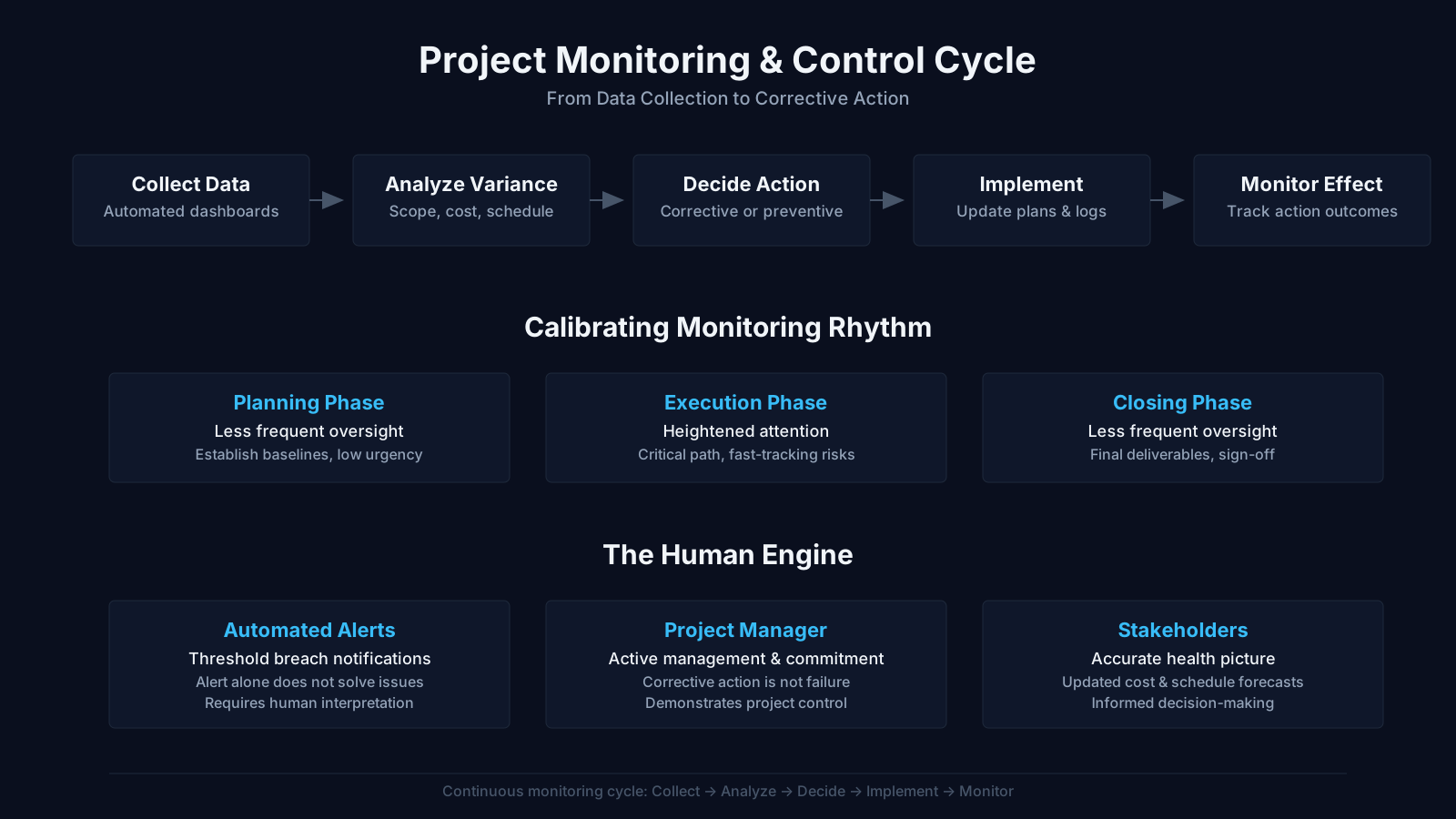
Translating the formal model of monitor and control into daily practice requires an understanding of where real-world projects break down. Successful project monitoring hinges on establishing a rhythm that matches the project’s pace. Weekly status meetings with a standard agenda, automated dashboard updates that pull data from work management tools, and monthly deep-dive variance analysis sessions provide a layered cadence that catches small issues before they become large. The project manager must resist the temptation to treat monitoring as a mere reporting exercise for the sponsor. It is first and foremost a diagnostic tool for the core team. When team members feel that the status data is being used against them, they will sanitize their updates, and the entire monitoring system collapses into a performance theater where everything is perpetually green until it suddenly implodes.
A common pitfall is metric fixation without context. A project that reports a schedule performance index of 0.95 might be in excellent shape if the delayed tasks are not on the critical path and the float is abundant. Another project with the same SPI might be in crisis because the work that is late is the only remaining path to the finish. The numerical indicator alone is meaningless without the project manager’s interpretation of what tasks are actually delayed and what that means for the overall network logic. Similar caution applies to cost variance: an unfavorable variance might be the result of a deliberate decision to accelerate a critical activity by paying overtime, a decision that ultimately saves far more money than the overtime costs. The monitor and control process must incorporate the narrative behind the numbers, not just the numbers themselves.
Another vulnerability is the gap between when data is collected and when it is acted upon. In a fast-paced software project, a weekly cycle might be too slow. Some teams implement a daily check of the cumulative flow diagram, with a rule that if the work-in-progress exceeds a certain threshold, the team stops starting new work and focuses on finishing existing items. That rule is a form of automated change request embedded in the team’s process. It clips the feedback loop to near real-time. In contrast, in a large infrastructure project, daily monitoring of every single package would be impossible, so a rolling wave approach is used: near-term work is monitored at the weekly level, while work further in the future is monitored at the monthly milestone level. The project’s size, complexity, and risk profile determine the appropriate granularity.
Dealing with the Human Side of Monitoring
The most resistant friction in monitoring and controlling project work is not technical but psychological. Team members may feel surveilled, stakeholders may demand more detail than is useful, and sponsors may panic at the first sign of a yellow indicator, triggering unnecessary escalation. The project manager must consciously build a culture where variance is seen as information, not blame. When a senior developer reports that a task took longer than estimated because an unanticipated technical debt needed to be addressed, the project manager should respond by thanking them for the honest update and facilitating a discussion on how to adjust the remaining estimates. If that response becomes the norm, the quality of performance data will be infinitely more reliable than in an environment where people are punished for reporting delays.
Equally important is managing upward communication. Sponsors often receive a dashboard with red, yellow, green indicators and assume that any yellow requires immediate intervention. The project manager must pre-educate the sponsor on the meaning of thresholds and the difference between a controlled variance and a runaway trend. A yellow indicator on a monthly report might be a deliberate flag that the team is monitoring closely and has a contingency plan, not a cry for help. Without that shared understanding, the monitor and control process can turn into a source of friction between the project manager and the governance body, leading to micromanagement that undermines team autonomy. Setting up a simple one-page variance explanation form that accompanies each status report can bridge that communication gap effectively.
When Monitoring Signals That the Project Should Close
One of the hardest outputs to generate from the monitor and control process is a recommendation to terminate the project. The data may show a consistent and uncorrectable decline in earned value performance, or external environmental factors, such as a sudden regulatory ban, may render the project’s business case invalid. In such moments, the project manager must be willing to present the information to the sponsor without softening the message. The organizational process assets often include closure guidelines and governance criteria for project termination, but many organizations lack the courage to act on them. The monitor and control process, if functioning properly, will surface the irreversible divergence from the business case and formally document it. The decision to close is ultimately a governance decision, but the project manager’s responsibility is to ensure that the data leading to that decision is unambiguous and properly archived.
In the BVOP methodology, this threshold is made explicit through the concept of Business Value Points. If monitoring reveals a persistent decline in the points delivered per unit of effort, the methodology prescribes a serious evaluation of project viability, including the possibility of closure before further resources are consumed. This is not presented as failure but as a disciplined stewardship of organizational resources. The same waste-conscious thinking identifies process damage, the invisible organizational harm caused by prolonged mediocre projects, as a factor that monitoring must detect. While the PMBOK does not use the term “process damage,” the principle aligns with the idea that the project manager must act in the best interest of the broader organization, not just advocate for a single project’s survival.
Essential Insights on Practical Monitoring
- Layered monitoring cadence
- Weekly status meetings, automated dashboard updates, and monthly variance analysis establish a rhythm that surfaces emerging deviations early, enabling corrective action before minor glitches compound into serious setbacks.
- Avoid performance theater
- When team members sense that status data will be used against them, they sanitize updates and mute early warning signals; the project manager must therefore build trust and frame monitoring as a genuine mechanism for improvement, not a punitive reporting drill.
- Interpret metrics with context
- A schedule performance index of 0.95 can indicate a healthy project if delayed tasks lie off the critical path and ample float remains, proving that numerical indicators only acquire real value when filtered through the logic of the project network.
- Judge variance thoughtfully
- An unfavorable cost variance often reflects a deliberate choice to accelerate a critical activity through overtime, a decision that can ultimately deliver downstream savings far greater than the overtime premium paid.
- Right-size monitoring intensity
- Monitoring frequency must match project scale: agile teams thrive on daily cumulative flow checks and work-in-progress limits, while large infrastructure programs call for a rolling wave approach that tracks near-term work weekly and future phases monthly.
Embedding Monitoring Discipline in Organizational Culture
Ultimately, the monitor and control process lives or dies by organizational habit. Organizations that embed monitoring into their culture treat status reviews not as bureaucratic overhead but as the primary mechanism for steering. They invest in reliable data collection tools, they train project managers to interpret variance with nuance, and they reward the early surfacing of problems rather than the artful concealment of issues. In contrast, organizations that see monitoring as a box to check before a steering committee meeting will generate reports that look good on paper but offer no real insight. The difference shows up in the project document updates: in a disciplined culture, the lessons learned register is thick with meaningful entries; in an empty culture, it contains a single sentence written at the end, “everything went fine.”
Technology can assist but not substitute for this discipline. Automated dashboards that integrate with enterprise project management information systems can collect work performance data in near real-time, compute cost and schedule variances, and generate alerts when thresholds are breached. Yet the human act of interpreting why a threshold was breached and what should be done about it remains the project manager’s core responsibility. An alert that fires at three in the morning because a contract delay pushed a milestone beyond the acceptable variance does not by itself solve anything. The project manager must still evaluate whether the delay is real or a data entry error, assess the impact on dependent activities, and decide whether to initiate a change request or invoke a pre-planned risk response. The tool provides the signal; the expert judgment provides the meaning.
Finally, the personal discipline of the project manager in scheduling uninterrupted time for monitoring is often the single greatest variable. A calendar packed with stakeholder meetings, team conflict resolution, and procurement negotiations will squeeze out the quiet analysis required to truly understand performance trends. Many experienced project managers block a recurring half-day each week for nothing but variance analysis, trend review, and plan updating. That block is sacred and non-negotiable. They treat it with the same gravity as a client presentation. It is during those quiet hours that a subtle shift in a supplier’s delivery pattern is noticed and addressed before it becomes a headline. The structures of inputs, tools, and outputs are merely the framework; the human attention behind them is the real engine of effective monitoring and control.