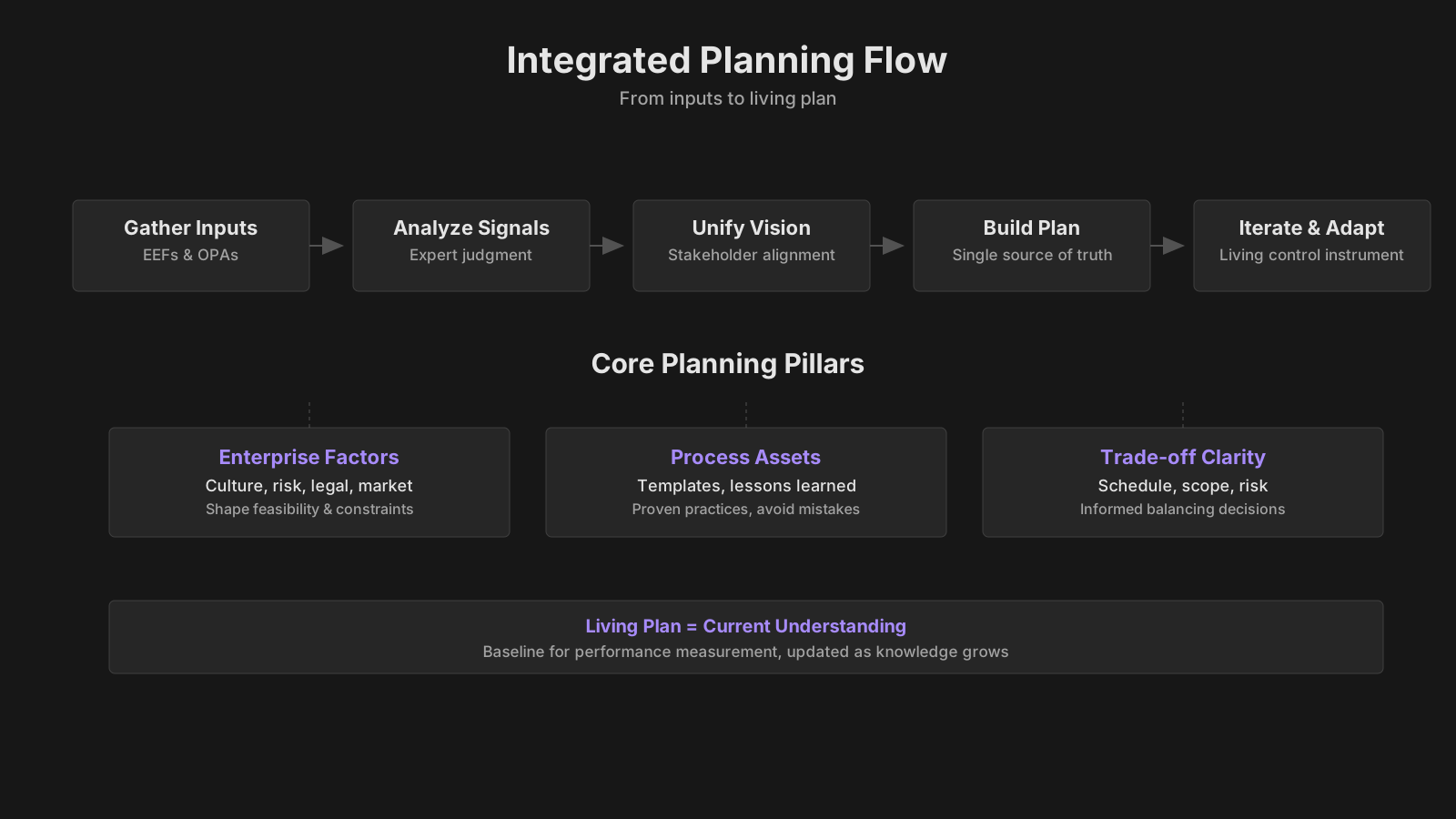
Creating a project management plan demands more than filling in a template. It is a deliberate process of weaving together strategic direction, operational constraints, and stakeholder expectations into a unified roadmap. In the PMBOK framework, this is captured in the Develop Project Management Plan process, part of the Planning Process Group and the Integration Management knowledge area. The act of creating the plan is not a one-time event but the start of a living document that will be progressively elaborated as the project unfolds and more detail becomes available. If you have ever stared at a blank project management plan template and wondered where to begin, the answer lies in understanding the inputs that feed into it and the expert judgment that shapes it into something actionable.
At its core, creating a project management plan involves documenting the actions needed to define, prepare, integrate, and coordinate all subsidiary plans. Those subsidiary plans cover scope, schedule, cost, quality, resources, communications, risk, procurement, and stakeholder engagement. The project management plan is the integration point, the single source of truth that shows how all the pieces fit together. Before you can pull it all together, though, you need the right raw materials. The process brings together what might seem like a disjointed collection of documents and environmental signals and synthesizes them into a coherent strategy. Understanding what each input contributes is the first step toward building a plan that actually works in practice rather than sitting on a shelf.
Project Management Plan: Key Steps at a Glance
| Key Concept | Summary |
|---|---|
| Living Document | The project plan originates as a foundation and matures through progressive elaboration, continuously incorporating new insights and refined details as the project advances. |
| Core Inputs & Expert Judgment | Building a robust, actionable plan starts with a disciplined analysis of foundational inputs and the strategic application of expert judgment to synthesize them into a coherent execution roadmap. |
| Central Function | The plan serves as the primary integration mechanism, detailing the actions required to define, prepare, coordinate, and align all subsidiary plans into a unified whole. |
| Subsidiary Plan Coverage | Spanning the full project management spectrum, these subsidiary plans address scope, schedule, cost, quality, resources, communications, risk, procurement, and stakeholder engagement, forming the operational backbone. |
| Plan Input Categories | The PMBOK defines four input categories for plan development: the project charter, outputs from other planning processes, enterprise environmental factors, and organizational process assets, each contributing essential constraints and perspective. |
| Project Charter | The charter formally authorizes the initiative and provides high-level strategic justification, measurable objectives, key deliverables, major milestones, a summary budget, and an initial risk assessment that frame the entire planning effort. |
| Charter Alignment | Anchoring the plan to the charter ensures that every scope, schedule, and resource decision stays directly linked to a validated business case, guarding against scope creep and misaligned priorities. |
| Organizational Process Assets | Organizational process assets encompass standardized guidelines, plan templates, historical performance data, change control procedures, and a configuration management knowledge base, enabling consistency and institutional learning. |
Inputs You Need to Create a Project Management Plan
Every meaningful plan starts with a clear grasp of the project management plan inputs. These inputs are not arbitrary checkboxes. They represent the organizational context, the historical record, the formal authorization, and the partial planning outputs that begin to take shape early in the project lifecycle. Without them, the plan would be little more than guesswork. The PMBOK identifies four categories of inputs that must be considered when developing the project management plan: the project charter, outputs from other planning processes, enterprise environmental factors, and organizational process assets. Each of these plays a distinct role in making the plan both feasible and aligned with the larger organizational environment.
The Project Charter as the Foundation to Create a Project Management Plan
The project charter is often described as the project’s birth certificate. It formally authorizes the project’s existence and gives the project manager the authority to apply organizational resources to project activities. When you sit down to create the project management plan, the charter provides the high-level strategic justification, measurable project objectives, key deliverables, major milestones, a summary budget, and a preliminary risk assessment. All of these set the boundaries within which the detailed plan must operate. Ignoring the charter is like trying to navigate without a destination. The plan can only be as coherent as the mandate it is built upon.
The charter also clarifies the project’s relationship to the organization’s strategic goals. A project that is poorly aligned with business objectives will eventually lose support, no matter how carefully its schedule is crafted. By anchoring the plan to the charter’s purpose and justification, the project manager ensures that every decision about scope, timing, and resources can be traced back to a legitimate business need. This is not just a theoretical exercise. In practice, project managers frequently refer back to the charter when stakeholder requests threaten to pull the plan in conflicting directions. The charter’s constraints, assumptions, and high-level risks become the first guardrails for the detailed planning that follows.
Incorporating Planning Outputs to Create a Project Management Plan
The project management plan is an integrative document, meaning it does not stand alone. It draws heavily on the outputs from many of the planning processes that occur in parallel or iteratively. These include the subsidiary management plans for scope, schedule, cost, quality, human resources, communications, risk, procurement, and stakeholders, as well as the three baselines (scope, schedule, and cost). Each of these outputs is a building block. The Develop Project Management Plan process pulls them together, resolves conflicts among them, and ensures consistency. This is where the plan stops being a set of independent documents and becomes a unified whole.
An output from the scope planning process, for example, will define how the scope will be defined, validated, and controlled. That directly influences the schedule management plan, because every activity must tie back to a deliverable. Similarly, the cost management plan must align with the resource management plan and the procurement strategy. The integration requires cross-checking and often some back-and-forth adjustments. In real projects, the schedule baseline might need revision after the risk register identifies high-impact threats that necessitate contingency buffers. That iterative refinement is a normal part of the planning process, and it is exactly why the project management plan is progressively elaborated. It absorbs these updates without breaking its overall coherence.
Leveraging Enterprise Environmental Factors to Create a Project Management Plan
Enterprise environmental factors (EEFs) encompass all the conditions that surround and influence the project but are not under the direct control of the project team. They include governmental or industry standards, the project management information system (PMIS), organizational structure and culture, infrastructure, and personnel administration policies. When creating the project management plan, ignoring these factors is not an option. They shape the plan in subtle yet powerful ways. The PMIS, for instance, determines which scheduling tools and configuration management systems are available, and that directly affects how the schedule management plan and the change control approach can be designed.
Organizational culture is another environmental factor that often flies under the radar. In a highly hierarchical organization, the project plan may need detailed approval workflows and formalized communication channels. In a more collaborative, flat culture, the same plan might emphasize self-organizing teams and informal decision-making, provided that governance requirements are still met. Infrastructure, including existing facilities and capital equipment, can constrain what can be produced and when, so the plan must reflect those realities. Personnel administration rules, such as hiring guidelines and performance review cycles, influence how quickly the team can be ramped up and what skill levels are realistically available. All of these elements feed into the expert judgment that tailors the plan.
Organizational Process Assets that Help You Create a Project Management Plan
Organizational process assets (OPAs) represent the accumulated wisdom and formalized procedures of the performing organization. These include standardized guidelines, work instructions, proposal evaluation criteria, performance measurement criteria, project management plan templates, change control procedures, historical information from past projects, and a configuration management knowledge base. When you create a project management plan, leveraging OPAs is one of the most efficient ways to avoid reinventing the wheel. Templates, for example, provide a consistent structure and remind you of components you might otherwise overlook. Change control procedures explain exactly how modifications to official documents are approved and validated, saving you from having to invent a process from scratch.
Historical information and lessons learned are perhaps the most underutilized OPAs. Past project files often contain baselines, risk registers, network diagrams, and records of what went wrong. Reviewing them can surface recurring risks, realistic productivity rates, and the typical sources of scope creep in your organization. If a previous project in a similar domain consistently underestimated testing efforts, that pattern should inform your schedule and cost baselines. Configuration management knowledge bases ensure that when you pull a template or a standard procedure, you are working from the correct version. This sounds trivial, but using an outdated change control procedure that no longer matches organizational policy can cause serious compliance issues down the line.
Essential Inputs for Project Planning
- Project charter authority
- The project charter formally authorizes the initiative, establishing its strategic justification, objectives, key deliverables, milestones, budget, and high-level risks, and acts as the enduring reference point that keeps every element of the plan tightly aligned with core business needs.
- Other planning outputs
- The project management plan integrates subsidiary management plans for scope, schedule, cost, quality, resources, communications, risk, procurement, and stakeholders, together with the scope, schedule, and cost baselines, forming a cohesive framework for performance measurement and control.
- Enterprise and asset context
- Enterprise environmental factors, such as the project management information system, shape tool availability and organizational constraints, while process assets contribute historical records, templates, and governance guidelines that anchor the plan in realistic and proven execution practices.
Using Expert Judgment to Create a Project Management Plan
Gathering inputs is only the starting point. What transforms a collection of documents and environmental signals into a usable project management plan is the deliberate application of expert judgment in project management planning. Expert judgment is the primary tool and technique defined in the Develop Project Management Plan process. It is not a mystical quality but a structured reliance on the knowledge and experience of individuals or groups who have specialized expertise in the domain, the organization, or the specific type of project at hand. This expertise is used to tailor the planning process, develop technical and management details, determine resource and skill requirements, define the appropriate level of configuration management, and decide which documents will be subject to formal change control. Without this human layer of interpretation, the plan would be a mechanical aggregation of templates and standards, disconnected from the messy realities of project execution.
Expert judgment can come from a wide range of sources. The project manager themselves brings experience from similar projects. The project team members understand the technical work and the practical constraints. Consultants or subject matter experts can fill knowledge gaps, especially in highly specialized fields. The project management office, if one exists, often provides consistent methodological guidance. Even industry groups and external professional networks can offer insights that prevent the plan from becoming insular. The key is to bring these perspectives together in a deliberate way, not simply to ask for opinions but to structure the conversation around specific planning decisions.
Tailoring the Process to Create a Project Management Plan
Not every project needs every subsidiary plan elaborated to the same depth. A small, low-risk internal initiative does not require the same level of procurement planning complexity as a multimillion-dollar construction project with dozens of vendors. Expert judgment is called upon to decide how much effort to invest in each planning component. Tailoring the process means identifying which elements of the organization’s standard planning framework are truly necessary and which can be simplified or combined. This is not about cutting corners but about avoiding unnecessary bureaucracy that adds no value. The decision to condense the risk management plan into a simple risk register rather than a full-blown quantitative analysis process is a typical tailoring choice facilitated by expert judgment.
Tailoring also extends to the methodology. A project that is new product development with high uncertainty might benefit from an adaptive life cycle and rolling wave planning, where detailed plans are only developed for the near term. Expert judgment helps determine the correct cadence and level of detail. The choice of planning approach fundamentally alters the structure of the project management plan. In a hybrid environment, some deliverables might be planned using predictive methods while others are managed with agile practices, and the plan must describe how governance will bridge the two. That decision cannot be scripted in a generic guideline. It requires someone who understands both approaches and can assess the specific nature of the deliverables and stakeholder expectations.
Determining Resources and Skills to Create a Project Management Plan
The plan cannot be created in a vacuum regarding who will do the work. Part of developing the plan involves using expert judgment to determine the required resources and skill levels for the project activities. This is not the same as creating the resource management plan in detail, but it sets the overarching direction. The project management plan must outline the general resource strategy, the types of expertise needed, and any constraints related to availability. Expert judgment evaluates whether the organization can supply the necessary skills internally or whether external hiring or contracting will be required. It also helps anticipate training needs if the team lacks certain competencies.
This determination feeds directly into the cost and schedule baselines. If a critical skill set is scarce, the plan may need to build in time for recruitment and onboarding. The level of oversight required depends on the team’s experience. A seasoned team might need less formal status reporting, while a newly formed team might require stricter checkpoints. Honestly, underestimating the impact of skill gaps is one of the most frequent reasons project plans unravel during execution. When the plan ignores the reality that the organization’s standard performance data came from highly experienced teams and the available team is relatively junior, the schedule baseline is immediately compromised. Expert judgment surfaces these awkward truths before they become crises.
Setting Up Change Control to Create a Project Management Plan
A critical outcome of the Develop Project Management Plan process is defining the configuration management approach and identifying which project documents will be subject to formal change control. Expert judgment is essential here because the answer varies dramatically between projects. A plan that subjects every minor meeting note to a formal change control board will choke on its own bureaucracy. Conversely, a plan that treats the scope baseline as casually editable invites uncontrolled scope creep. The right balance is context-dependent. The project management plan must spell out the steps for modifying official standards, policies, plans, procedures, and project documents, including how changes will be approved and validated.
Configuration management is about more than just change control. It ensures that every team member is working from the correct version of a document and that baselines are protected from unauthorized modification. The plan should detail the configuration management system to be used, including how baselines are established, how changes are tracked, and how version histories are maintained. This is the mechanism that keeps the progressively elaborated plan from becoming an unmanaged mess. Expert judgment weighs the complexity of the project, the regulatory environment, and the risk appetite of the organization to define a level of configuration management that is robust without being oppressive. The decision about which documents fall under formal change control is particularly sensitive. Typically, the project management plan itself, the baselines, and any subsidiary plans that directly affect the baselines are subject to rigorous control. Yet supporting details like detailed estimates or work assignment logs might be managed with lighter touch. Getting that classification right is a mark of a well-honed planning instinct.
One subtle aspect that trips up many practitioners is the distinction between updating the plan and changing the plan. Regular status updates, such as reporting actual completion dates, are not plan changes. They are just data. But altering the approved schedule baseline to reflect a revised approach requires formal change control. The project management plan must make that boundary crystal clear, and expert judgment sets those rules. When the plan is then executed, the Perform Integrated Change Control process will use the procedures defined here to evaluate, approve, and communicate changes. This forward-thinking integration is what separates a static document from a living governance framework.
The act of creating the plan culminates when all these pieces snap into a single, coherent artifact. But it does not end there. The plan is not frozen. It will be revisited, updated, and refined as the project advances. The inputs and expert judgment that shaped its initial version continue to inform its evolution. Every new risk that emerges, every environmental shift, every lesson learned during execution can trigger updates that flow through the same change control process you embedded in the plan. In that sense, creating a project management plan is not just about writing a document. It is about establishing the mechanism by which the project’s direction can be continuously steered without losing sight of its original mandate.