What are the main objectives of developing a project team? The answer is rarely a single target. It is a combination of competency growth, trust building, and cultural cohesion that directly influences project performance. Developing the project team is the process of improving the competencies, team interaction, and the overall team environment to enhance project performance. Teamwork is a critical factor for project success, and developing effective project teams is one of the primary responsibilities of the project manager. This article examines those objectives in a structured way, moving from individual skill development to the broader team conditions that make consistent delivery possible.
Project Team Development Objectives: Key Summary
| Key Concept | Summary |
|---|---|
| Team Development | The article traces team development from individual skill acquisition to the systemic conditions that enable consistent delivery under pressure. |
| PRINCE2 Context | PRINCE2 environments provide structured stages and defined roles, yet deliberate team development remains vital for translating that governance into reliable performance. |
| Learning Approach | Development occurs primarily during project execution, shaped by feedback loops, conflict resolution, and emerging skill gaps rather than being limited to the initial kickoff workshop. |
| Manager Responsibility | Project managers are accountable for deliberately building a collaborative environment and sustaining motivation through challenging assignments and growth opportunities. |
| Facilitation | Facilitation involves removing structural barriers, ensuring smooth information flow across roles, and enabling collaborative problem solving. |
| Stakeholder Influence | Stakeholder influence depends on explicitly linking team capability to outcomes stakeholders prioritize, including reduced delays, lower rework, and more predictable delivery. |
| Performance Impact | Investing in skill growth reduces errors, accelerates decision loops, lowers cost, and improves quality in project deliverables. |
| Cross-Training | Cross-training is strengthened by rotating pair assignments, structured role shadowing, and short working sessions facilitated by experienced staff. |
Identifying the Main Objectives of Developing a Project Team
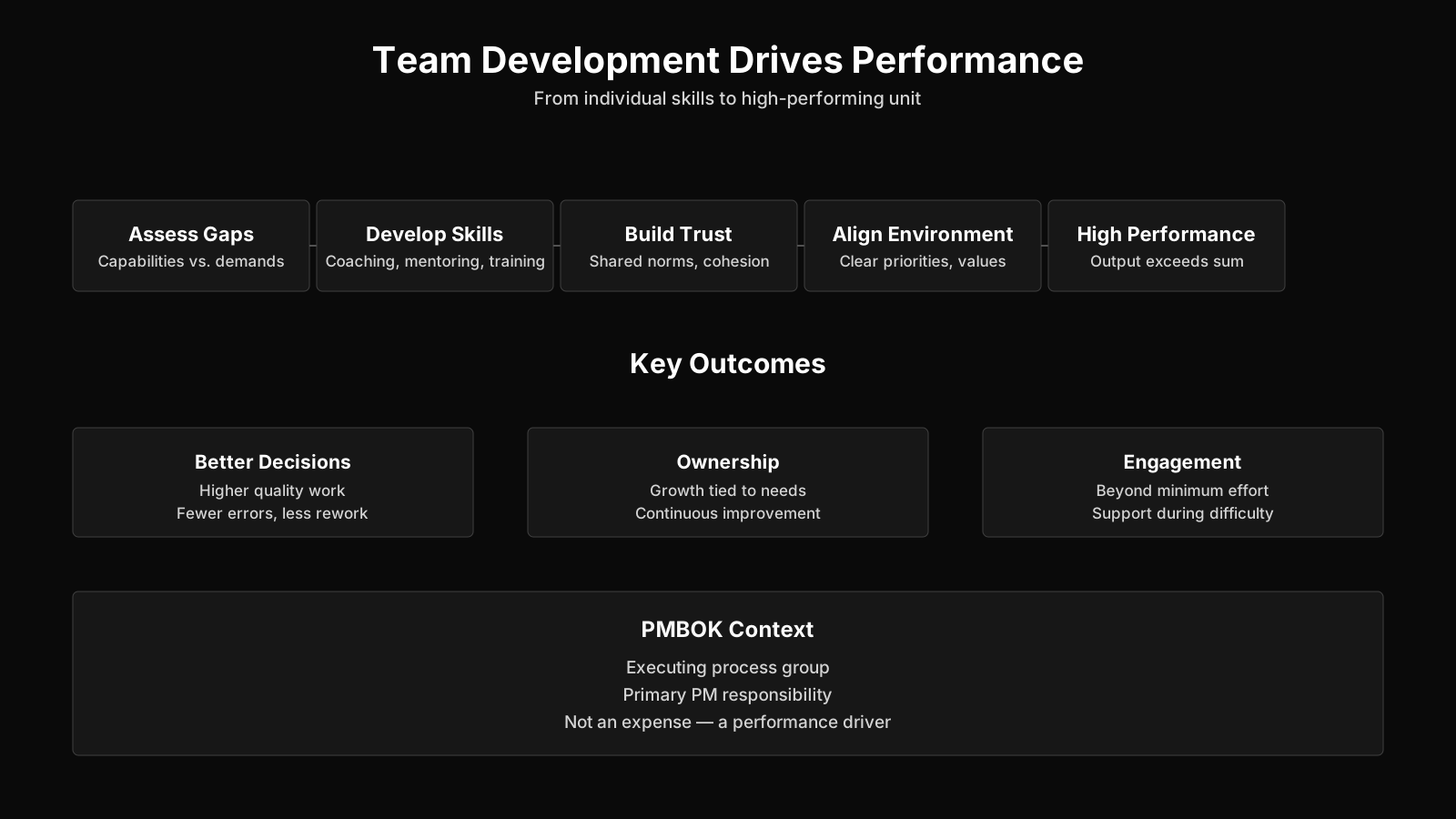
The phrase “main objectives of developing a project team” tends to blur together several distinct improvement areas. In project management practice, the process is understood as improving the competencies, team interaction, and the overall team environment. Improving competencies, team interaction, and the overall team environment sits at the core of team development because each element supports the other two. A skilled individual cannot perform well in a distrustful group, and a highly cohesive group still needs specific competencies to deliver project work. Recognizing this interplay helps project managers avoid treating team development as an isolated training event.
Where Team Development Fits in Project Management
In the PMBOK framework, developing the project team falls under the Executing process group and the Project Resource Management knowledge area. That placement matters because it signals that team development is not a one-time planning activity. It occurs while project work is underway, which means the project manager has to balance team-building efforts with the pressure of actual delivery. In PRINCE2 environments, the concept appears less explicitly as a named process, but the principle of managing people through controlled stages and defined roles supports the same underlying need. Agile methodologies handle team development through continuous collaboration, retrospectives, and the deliberate formation of cross-functional units.
What this really means in practice is that team development cannot be scheduled once at the start and forgotten. A project manager may run an initial kickoff workshop, but the real development happens in the feedback loops, conflict moments, and skill gaps that emerge during execution. For example, a team might begin a software rollout with strong individual technical skills but poor coordination. If the project manager waits until the next formal training session to address that, the project has already absorbed the cost of misunderstandings and rework. Team development therefore lives inside the daily work rhythm, not outside it.
Why Team Development Remains a Primary Responsibility of the Project Manager
Teamwork is a critical factor for project success. That may sound obvious, but many project managers still treat people issues as secondary to scheduling, scoping, and budgeting. The source material is explicit on this point: developing effective project teams is one of the primary responsibilities of the project manager. This responsibility includes a range of deliberate actions, from creating an environment that facilitates teamwork to continually motivating the team by providing challenges and opportunities. When team development is sidelined, even a well-planned project can suffer from communication breakdowns, unresolved conflict, and individual withdrawal.
Project managers should create an environment that facilitates teamwork. That means more than encouraging people to get along. Facilitation involves removing structural barriers, ensuring that information flows across roles, and making space for collaborative problem-solving. A project manager who hoards information or allows one team member to dominate discussions is not facilitating teamwork, even if the group appears polite. The real test is whether team members can raise concerns, challenge assumptions, and share partial work without fear of blame. That environment is built through consistent small actions rather than a single team-building event.
The project manager should request management support and influence the appropriate stakeholders to acquire the resources needed to develop effective project teams. This is not a sign of weakness. Team development often requires budget for facilitation, access to learning platforms, and time away from billable work. Without stakeholder support, the project manager may be left trying to improve team dynamics with no actual resources. Influencing stakeholders means articulating the link between team capability and project outcomes in terms they care about: fewer delays, lower rework, and more predictable delivery.
Core Insights on Team Development Objectives
- Interconnected improvement areas
- Effective team development integrates individual competencies, team interactions, and the working environment so that progress in one area consistently reinforces the others.
- Execution phase focus in PMBOK
- PMBOK assigns team development to the Executing process group, which signals that capability building occurs continuously during active project delivery rather than as a preliminary planning exercise.
- Approach varies by methodology
- PRINCE2 integrates team development into controlled stages and clearly defined role structures, whereas Agile methods cultivate it through iterative retrospectives, sustained collaboration, and cross-functional team composition.
- Real development during delivery
- Lasting team growth arises from the feedback loops, conflict resolution, and skill gaps that surface during real delivery, rather than from introductory workshops or standalone training sessions.
Improving Knowledge and Skills of Team Members
One of the clearest objectives of developing a project team is to improve knowledge and skills of team members. The purpose is not development for its own sake. It is specifically tied to increasing the team's ability to complete project deliverables while lowering costs, reducing schedules, and improving quality. When a project manager invests in skill growth, the return shows up in fewer errors, faster decision loops, and a reduced need for external escalation. Skills in this context include both technical capabilities and the softer competencies that allow people to work with one another effectively.
Improving Knowledge and Skills as One of the Main Objectives of Developing a Project Team
The objective of improving knowledge and skills often appears in training plans, but the real mechanism is less formal. Team members learn through task assignments that stretch their existing capabilities, through exposure to different parts of the project, and through structured feedback after key deliverables. For instance, a junior analyst on a construction project may start by tracking materials but gradually take on cost estimation under the guidance of a senior planner. That shift is team development in action. It increases the junior analyst's ability to complete future deliverables while giving the project a more flexible resource base.
Lowering costs is a direct consequence when team members become more capable. A team that understands the full workflow can identify waste, avoid redundant work, and make better upstream decisions that reduce downstream fixes. Similarly, reducing schedules becomes possible when fewer tasks stall because someone lacks the necessary know-how. Improved quality follows when team members can self-check their work and understand how their output affects the next stage. These outcomes do not happen automatically after a single training course; they require repeated practice and feedback embedded in project work.
Lowering Costs, Reducing Schedules, and Improving Quality
The three performance outcomes tied to this objective are lowering costs, reducing schedules, and improving quality. They are often treated as competing constraints, but skill development influences all three positively. A team with stronger analytical skills may spot a design conflict before construction begins, avoiding a costly change order later. A developer who knows how to write automated tests will reduce the schedule impact of regression testing. A procurement specialist who understands contract terms can prevent quality disputes before they reach the supplier. None of these examples requires a named case study; they are everyday patterns in well-managed projects.
Here is where things get interesting: many project managers confuse activity with development. Sending people to a workshop or buying an online course does not by itself improve knowledge and skills in a way that changes project performance. The transfer of learning back to the project is the critical step. Without follow-up assignments, coaching, and a safe space to apply new methods, the training investment leaks away. The project manager therefore has to plan for application, not just attendance. That distinction separates meaningful team development from box-ticking exercises.
Skill gaps should be identified from project performance data, not just self-reports. A team member may say they are comfortable with a tool, but repeated rework in that area suggests otherwise.
Individual productivity improves in a cohesive culture because people spend less time second-guessing their colleagues or protecting themselves from blame. Team productivity improves because work flows more smoothly across roles. Team spirit is the visible energy that shows up as voluntary collaboration, a sense of shared identity, and pride in the project outcome. Cooperation is not forced through rules; it becomes the default mode because the team has internalized the benefits of mutual support.
Cross-Training and Mentoring to Share Knowledge and Expertise
One of the most practical ways to build a cohesive culture is through cross-training and mentoring between team members. The source material identifies this as a specific benefit of dynamic team culture. Cross-training means that team members learn enough about each other's roles to fill gaps when needed and to understand the constraints their colleagues face. A business analyst who understands the basics of database design will write better requirements. A developer who understands the user's workflow will build more usable features.
Mentoring goes further by pairing less experienced team members with more experienced ones in a sustained relationship. Mentoring is not the same as supervision. It is a developmental exchange where the mentor shares context, shortcuts, and judgment, while the mentee brings fresh questions and new perspectives. This sharing of knowledge and expertise reduces single points of failure and prepares the team for unexpected absences. It also builds the trust that feeds the previous objective, creating a reinforcing loop between skill development, trust, and culture.
A project manager can encourage cross-training by rotating pair assignments, inviting team members to shadow different roles during low-risk periods, and asking experienced staff to host short working sessions. The key is to make knowledge sharing part of the workflow rather than an extra burden. If mentoring is treated as an add-on to already full workloads, it will be the first thing dropped when deadlines approach. For example, pairing a quality assurance analyst with a business analyst for two days during requirements gathering can produce better test scenarios and a shared vocabulary that lasts for the rest of the project.
The Project Manager's Role in Achieving Team Development Objectives
None of these objectives will be achieved without deliberate effort from the project manager. The project manager is expected to create an environment that facilitates teamwork and to sustain that environment throughout the project. This involves a mix of motivation, feedback, support, recognition, and influence. It is not a passive role. The project manager actively shapes the conditions under which the team either thrives or stagnates.
Continually Motivating the Team Through Challenges and Opportunities
Motivation in team development is not a one-time speech. The project manager should continually motivate the team by providing challenges and opportunities. This means assigning tasks that stretch individual capabilities without overwhelming them. A challenge that is too easy leads to boredom; a challenge that is too hard leads to frustration and disengagement. The right challenge sits at the edge of current ability, where the team member has to think differently but still has enough support to recover from mistakes.
Opportunities matter just as much. Team members need chances to take on new responsibilities, lead a small workstream, or present to stakeholders. These opportunities are forms of development in themselves. They build confidence and expand the team's capacity. A project manager who hoards interesting work for a few trusted individuals is not developing the team; they are developing a dependency. Spreading opportunities across the team may create short-term inefficiency, but the long-term gain is a more resilient and capable group.
Providing Timely Feedback and Support
Providing timely feedback and support is another requirement for effective team development. Feedback that arrives weeks after a task is completed has limited value because the context has faded. Timely feedback lets the team member connect the observation to the specific behavior or output. It should be specific enough to be actionable. Saying “good job” is pleasant but not developmental. Saying “your risk register update helped us catch a scheduling conflict early” tells the team member exactly what to repeat.
Support means more than being available. It means noticing when a team member is stuck and offering help before the delay becomes a crisis. Support can be technical, such as arranging an expert consultation, or emotional, such as acknowledging a difficult stakeholder interaction. A project manager who supports the team during struggle builds trust and demonstrates that development is a shared priority. This is particularly important when a team member tries something new and fails. How the project manager responds to that failure shapes whether the team continues to innovate or retreats into safe, low-risk behavior.
Recognizing and Rewarding Good Performance
Recognizing and rewarding good performance reinforces the behaviors that team development aims to promote. Recognition does not have to be financial. Public acknowledgment in a team meeting, a written note to the team member's functional manager, or a simple thank-you tied to a specific outcome can be powerful. The key is that recognition aligns with the actual objectives of team development. If the project manager only rewards individual heroics, teamwork will not improve. If the project manager only rewards speed, quality may suffer.
Reward systems can accidentally undermine team development if they only measure individual output. A sales commission structure that rewards individual deals above team support will weaken the very collaboration the project manager is trying to build. The project manager may not control the formal reward system, but they can add recognition for shared behaviors: flagging a risk early, helping a colleague meet a deadline, or documenting a process for others. Those small acknowledgments send a clear signal about what the team values.
Key Insights on Team Development
- Sustaining a collaborative team environment
- A skilled project manager deliberately cultivates the conditions for effective teamwork by blending motivation, timely feedback, practical support, genuine recognition, and subtle influence at every stage of the project.
- Ongoing motivation through challenges
- Sustaining motivation requires consistent, deliberate action rather than a single inspirational moment; project managers achieve this by assigning work that stretches each person's capabilities while remaining within their capacity to succeed.
- Balancing challenge and support
- The most effective assignments push team members just beyond their current comfort zone, prompting them to adopt new approaches while ensuring they have enough support to learn from mistakes without slipping into either boredom or frustration.
- Growth opportunities and specific feedback
- Providing opportunities to lead workstreams or assume broader responsibilities strengthens the team's long-term resilience, and precise recognition such as acknowledging a well-maintained risk register signals exactly which behaviors should be repeated.
Managing Cultural Diversity in Global Project Teams
Today project managers operate in a global environment and work on projects characterized by cultural diversity. This reality makes team development both more complex and more valuable. Team members often have diverse industry experience, multiple languages, and sometimes operate in a team language that is different from their native one. The project management team should capitalize on cultural differences rather than ignore them or treat them as obstacles.
Working in a Team Language and Diverse Industry Backgrounds
A team language is the common language used for project communication, even when it is not the native language of many team members. This creates a specific development challenge. Team members may miss subtle meanings, hesitate to speak up, or agree to ambiguous requirements because they do not want to appear difficult. The project manager can address this by encouraging clarification questions, using written summaries after verbal discussions, and allowing time for non-native speakers to process information before decisions are finalized.
Diverse industry experience is another asset that often goes untapped. A team member from manufacturing may see a process constraint that a software specialist misses. A team member with public-sector experience may anticipate regulatory approval delays that others do not consider. Team development should create space for these perspectives to surface. When the team is dominated by one industry or one function, the project loses access to valuable alternative viewpoints. Capitalizing on this diversity is not about celebrating difference in the abstract; it is about extracting practical insight that improves project decisions.
Sustaining the Team Throughout the Project Life Cycle
The project management team should focus on developing and sustaining the project team throughout the project life cycle. Team development is not a phase with a clear end date. The team changes as the project moves from planning to execution to closing, and the development approach must change with it. Early on, the focus may be on building shared understanding and setting norms. During execution, the focus shifts to skill application, conflict management, and performance feedback. Near the end, the focus often turns to knowledge transfer and preparing team members for the next assignment.
Sustaining the team also means promoting working together interdependently in a climate of mutual trust. Interdependent work is different from simply dividing tasks and combining outputs at the end. It requires continuous coordination, shared problem-solving, and a mutual awareness of how each person's work affects the others. A climate of mutual trust allows that coordination to happen without excessive formal controls. When trust is absent, managers add more checkpoints, reports, and approvals, which slows everything down and signals distrust. The result is a self-reinforcing spiral in the wrong direction.
Consider a distributed team working across three time zones. The project manager notices that one region consistently waits for instructions instead of taking initiative. Rather than labeling the team as passive, the manager investigates and learns that in that regional culture, questioning a senior colleague is considered disrespectful. The manager then adjusts the meeting format to gather written input before verbal discussion and explicitly invites dissent. That small adaptation turns a perceived weakness into a source of diverse ideas. The team language and cultural difference become part of the team's strength instead of a recurring frustration.
Practical Applications and Common Misconceptions in Project Team Development
Team development is easy to describe but difficult to implement well. Many practitioners hold misconceptions that undermine project team development. One common misconception is that team development is primarily a collection of social events or trust falls. While social activities can help, the real work happens in the daily interactions around project tasks. Another misconception is that high-performing teams do not need development. In reality, even experienced teams need recalibration when the project context changes.
Applying Team Development Across Different Project Types
The objectives of developing a project team apply across all project types, but the methods differ. In a long infrastructure project, team development may involve formal training, cross-discipline site visits, and scheduled mentoring relationships. In a short software project, team development may rely more on pair programming, frequent retrospectives, and rapid feedback loops. In a research or innovation project, team development may focus on psychological safety, because experimentation and failure are part of the work.
Despite these differences, the underlying objectives remain the same: improve knowledge and skills, strengthen trust and agreement, and create a dynamic and cohesive culture. A project manager should not copy a team development approach from one project to another without considering the context. The team's current maturity, the project's duration, the industry, and the cultural mix all shape which techniques will work. A rigid, one-size-fits-all program often produces compliance without real development.
Pitfalls That Undermine Team Development Objectives
A frequent pitfall is treating team development as a series of isolated events rather than an ongoing process. A kickoff workshop or an annual training day may create temporary goodwill, but it does not change daily behavior. The project manager then declares the team developed and moves on to other priorities. Within weeks, old habits return because no structures reinforced the new behaviors. Team development is closer to physical conditioning than to a vaccine. It requires continuous attention to maintain its effects.
Another pitfall is ignoring the role of conflict. Some project managers mistakenly believe that a cohesive team never argues. They suppress disagreement and reward superficial harmony. That approach lowers conflict in the short term but raises it later, when unresolved issues resurface with more intensity. A well-developed team disagrees openly and resolves differences constructively. The absence of visible conflict is not the same as agreement; it often means people have stopped voicing their concerns.
A third pitfall is failing to involve the team in its own development. If the project manager dictates every training topic and team-building activity, the team may participate passively. Development works better when team members have a voice in identifying their own skill gaps and preferred learning methods. That participation builds ownership and makes the development effort more relevant to the actual work. It also reinforces the culture objective by demonstrating that the team's judgment is respected.
Agile and Business Value-Oriented Perspectives on Team Development
In Agile environments, team development manifests differently from traditional staged approaches. Agile teams rely on self-organization, frequent retrospectives, and the deliberate formation of cross-functional units to build competence and trust continuously. The retrospective is a built-in mechanism for team reflection and improvement. Instead of waiting for an annual review, the team examines its interaction patterns after each iteration and adjusts. That rhythm supports the objective of improving team interaction through rapid feedback.
A common pitfall in Agile is treating the retrospective as a complaint session. The team raises issues, but nothing changes. Over time, team members stop participating because they see no link between reflection and action. The project manager or Scrum master must ensure that at least one improvement item is tested in the next iteration. That small loop sustains team development through continuous adjustment.
Business Value-Oriented Project Management (BVOPM) also treats employee-created tools and open-source software as formal products and mandates cross-functional teams as a core success factor. This perspective reinforces the idea that team outputs matter beyond the immediate deliverable. When a team creates a reusable tool during a project, that tool can become a valuable asset for future work. Cross-functional teams support the knowledge-sharing and trust objectives by bringing different expertise into close daily contact. The project manager can adopt these ideas without abandoning the core objectives from the source material.
Key Takeaways on Team Development
- Social events are not enough
- Meaningful team development emerges from the daily interactions and collaboration required to deliver project work, rather than from social gatherings or trust-building exercises.
- Recalibration for experienced teams
- Experienced teams also benefit from revisiting and adjusting their development practices whenever project scope, constraints, or working conditions shift.
- Methods vary by project type
- Infrastructure projects tend to emphasize formal training and mentoring, software teams often depend on pair programming and structured retrospectives, and research environments prioritize psychological safety, but all three approaches target the same core developmental goals.
- One-off events lack lasting impact
- Kickoff workshops and annual training events can generate short-term enthusiasm, yet they rarely translate into sustained changes in how team members work together day to day.
Measuring Progress Toward the Main Objectives of Developing a Project Team
Because team development is partly intangible, many project managers struggle to measure it. Yet progress toward the main objectives of developing a project team can be observed through changes in team behavior and project performance. Skill development shows up in fewer errors and faster task completion. Trust shows up in earlier risk reporting and more direct communication. Cohesive culture shows up in voluntary collaboration and the willingness to share knowledge. These indicators are not perfect, but they are visible to an attentive project manager.
Linking Team Growth to Project Performance Outcomes
The clearest evidence of team development is a change in project performance outcomes. Lower costs, reduced schedules, and improved quality are the specific outcomes tied to the knowledge and skills objective. When a project consistently meets its estimate ranges, the team likely has the competence to complete deliverables efficiently. When quality inspections find fewer defects, the team has internalized the relevant standards. When schedules compress without burnout, the team has found better ways to coordinate work. These are lagging indicators, but they confirm that the development effort is producing results.
Trust and agreement are harder to measure directly, but their effects are not invisible. A team with high trust reports risks earlier, which means the project manager has more time to respond. A team with strong agreement spends less time re-litigating decisions and more time executing them. A team with low trust hides bad news, which leads to sudden surprises late in the project. Observing the flow of information across the team is one of the most reliable ways to assess trust and agreement without relying on self-reported surveys alone.
Indicators of Trust, Cohesion, and Skill Enhancement
Skill enhancement can be observed through the increasing independence of team members. Early in a project, a junior team member may require frequent check-ins and detailed instructions. As development progresses, that person asks more informed questions and proposes solutions instead of waiting for direction. The project manager can track this by noting the type of support requested over time. A shift from “how do I do this” to “which of these two options is better” indicates growing competence.
Cohesion indicators include the speed at which new team members become productive. In a cohesive culture, an experienced team member can bring a newcomer up to speed without a formal onboarding process because the team has clear norms and shared practices. Another indicator is the way the team responds to pressure. A cohesive team communicates more, not less, when deadlines tighten. A fragmented team withdraws into individual tasks and stops sharing information. Trust indicators include the willingness to ask for help and to admit mistakes. When those behaviors increase, the team development objectives are being met.
Surveys can be useful, but they have limitations. A team may rate trust highly because they fear looking bad, or because the questions are leading. Triangulating survey results with observed behaviors is more reliable. If a team rates communication as excellent but the project manager sees repeated email escalations, the survey result may reflect aspiration rather than reality. Measurement should combine perception data with project-level signals. That combination gives a more honest picture of whether the team is actually moving toward lower costs, reduced schedules, and improved quality.
Ultimately, the main objectives of developing a project team are not separate initiatives. They interact. Better skills lead to more confidence, which supports trust. Trust enables honest feedback, which accelerates skill growth. Both feed a cohesive culture that makes cross-training and mentoring natural rather than forced. A project manager who understands this interaction can prioritize team development not as an expense to be minimized but as a driver of every project performance metric that matters.