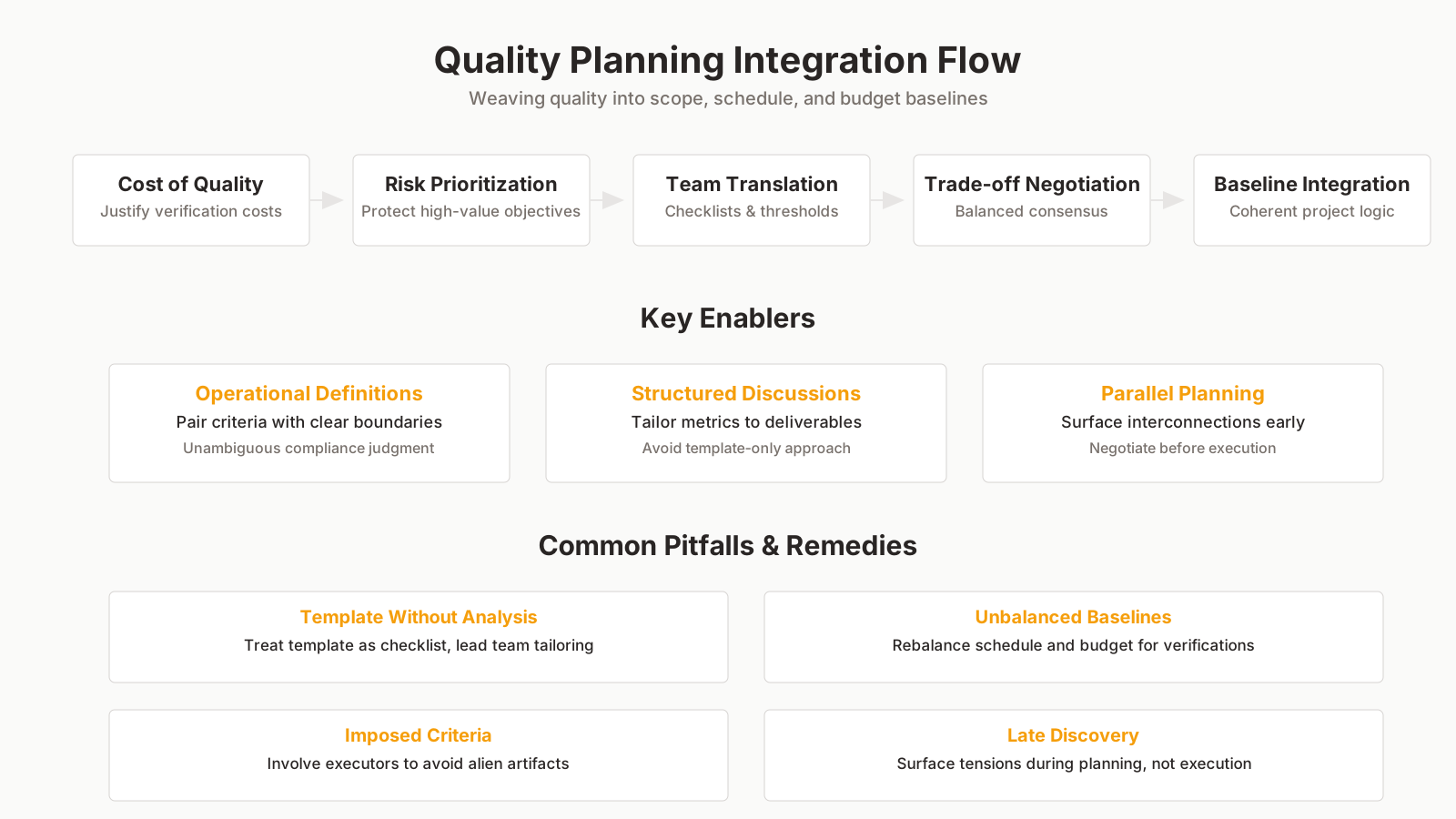
Developing a quality management plan can feel like a puzzle when you first encounter the list of inputs and techniques that the process demands. It is not a standalone activity that you can delegate to a spreadsheet and revisit a week before delivery. Quality planning is the process of identifying quality requirements and standards for the project and its deliverables, and then documenting precisely how the project will demonstrate compliance with those standards. When done thoughtfully, it knits together the acceptance criteria buried in the scope statement, the risk tolerance expressed in the risk register, and the performance thresholds hidden in the cost and schedule baselines. The plan that emerges is less a static document and more a decision framework that shapes how the team works every day. What makes this exercise tricky is that quality planning should be performed in parallel with other planning processes: a change in product specifications to meet a quality standard often ripples into cost estimates, task durations, and risk probability assessments. Ignoring that interconnectedness is one of the fastest ways to produce a plan that looks good on paper but collapses under real-world pressure.
Key Steps to Build Your Quality Management Plan
| Key Concept | Summary |
|---|---|
| Plan Quality Process | This process surfaces the inherent tensions among scope, risk, cost, and schedule, compelling stakeholders to negotiate these trade-offs transparently and preempt the rework that arises from unexamined assumptions. |
| Quality Management Plan | A rigorous framework for translating nebulous expectations into explicit, measurable acceptance thresholds and verification protocols, ensuring quality is assessed against objective benchmarks. |
| Template Pitfall | Adopting a template from organizational process assets without deliberate tailoring bypasses the analytical rigor that elevates a perfunctory document into a plan that genuinely directs quality efforts. |
| Parallel Planning | Quality planning must evolve concurrently with scope, schedule, and cost baselines, because each specification shift cascades into revised effort estimates, resource needs, and risk profiles that sequential planning cannot accommodate. |
| Living Artifact | An initial plan’s incompleteness is acceptable only if it functions as a living document, systematically enhanced through iterative cycles as new requirements and performance data emerge. |
| Metrics Clarity | When the quality management plan defines metrics ambiguously, quality control teams inevitably track irrelevant attributes or interpret findings inconsistently, eroding the reliability of quality evaluations. |
| Inputs Value | Inputs are strategic raw material rather than procedural checklists; they dictate which analytical methods to employ and the depth of investigation required, so bypassing them is akin to designing infrastructure without geotechnical surveys. |
| Architectural Decisions | Selecting a modular architecture may streamline certain acceptance criteria, but it frequently introduces interface complexities that demand additional inspection activities to mitigate emergent integration risks. |
Understanding Quality Management Planning
Project management frameworks consistently place quality planning within the Planning Process Group, nested inside the Project Quality Management knowledge area. Its position there is not arbitrary. The moment you start defining acceptance criteria and work breakdown structure elements, you are implicitly making quality trade-offs. The Plan Quality process, as described in the standard, forces those trade-offs into the open so that the project team, sponsor, and key stakeholders can negotiate them consciously rather than discover them later through rework and warranty claims. Quality management plan development is the structured effort to convert vague expectations like "the software should be fast" into measurable thresholds and verification methods. Many practitioners shortcut this by grabbing a template from the organizational process assets library and calling it done, but that misses the analytical heavy lifting that separates an acceptable plan from a genuinely useful one.
The Plan Quality Process in the Project Lifecycle
You do not schedule a single planning meeting, draw up a quality management plan, and lock it away. The inputs to this process evolve as the scope becomes sharper, risks crystallize, and stakeholder preferences shift. That is why the official guidance insists that quality planning runs concurrently with the other planning knowledge areas. For instance, a decision to adopt modular architecture in a construction project might reduce the number of acceptance criteria you need to track individually, but it could also introduce new interface risks that demand additional inspection activities. The plan you produce at first pass will be incomplete, and that is fine as long as you treat it as a living artifact that gets refined during iterative planning cycles.
Quality Planning Versus Quality Assurance and Control
Confusing the planning aspect with the execution-oriented processes is common. Quality planning answers the question "What does good look like and how will we know?" Quality assurance, in contrast, is the systematic auditing of whether the processes themselves are capable of delivering that goodness. Quality control is the operational inspection of specific deliverables against the metrics defined during planning. If your quality management plan fails to articulate the metrics clearly enough, the quality control team will end up measuring the wrong attributes or interpreting results inconsistently. That cascade of confusion is the root of countless rework cycles, so the planning phase must supply the unambiguous language that the other two processes depend on.
Core Insights on Quality Planning
- Planning group placement defines scope
- Quality planning resides in the Planning Process Group of the Project Quality Management knowledge area, establishing quality strategies before any execution activities commence and preventing reactive fixes later.
- Trade-offs surface during definition
- Explicitly defining acceptance criteria and work breakdown structure components brings latent quality trade-offs to the surface, enabling stakeholders to negotiate and align before work begins to avoid costly rework.
- Vague expectations become measurable thresholds
- The quality management plan converts vague desires such as "the software should be fast" into specific, measurable thresholds and verification methods, removing subjectivity from quality decisions.
- Templates circumvent analytical heavy lifting
- Relying on a template from organizational process assets circumvents the analytical rigor needed to tailor the plan to the project’s unique quality risks, resulting in a checklist rather than a strategic asset.
- Plan evolves with project information
- The quality plan evolves as a living document during iterative planning, continuously refined as scope clarity improves, risks materialize, and stakeholder priorities shift, preserving its relevance throughout the project.
Core Inputs That Shape Your Quality Strategy
Every piece of information that feeds into Plan Quality carries a set of constraints and clues about where quality risks are lurking. The most powerful inputs are those that already describe what the project will produce and under what conditions success will be declared. Inputs to the quality management plan are not optional checklists; they are the raw material that determines which tools you will use later and how deep your analysis needs to go. Skipping an input, or treating it superficially, is like designing a bridge without studying the soil reports because the baseline schedule says you should be pouring concrete by Tuesday.
Scope Baseline as the Foundation
The scope baseline delivers the project description, the major deliverables, and the acceptance criteria. The acceptance criteria element is the bridge between the customer's mental model of success and the engineer's specification sheet. When a scope statement says "the pump must operate continuously for 10,000 hours without maintenance," that is both an acceptance criterion and a quality requirement. The work breakdown structure, which is also part of the scope baseline, tells you which work packages will need dedicated quality controls. A work package for installing pressure sensors, for example, implies a need for calibration checks that you would not apply to a package for painting a non-structural surface. If the WBS is poorly decomposed, the quality planning process will struggle to assign the right verification activities at the right level of detail.
Stakeholder Register and Acceptance Criteria
The stakeholder register is more than a list of names and influence ratings. It encodes divergent quality expectations. The operations team might prioritize durability, while the marketing group cares about aesthetic finish, and the procurement department obsesses over supplier certification. A quality management plan that only reflects the loudest stakeholder will alienate others later, triggering change requests that could have been preempted. During quality planning, you map the acceptance criteria not only to deliverables but also to the stakeholders who will validate them, even if some of those stakeholders do not sit in the steering committee. Doing this systematically often exposes hidden criteria like ease of maintenance or noise levels that appear nowhere in the formal scope statement but are deeply held expectations.
Performance Baselines and Risk Data
The cost performance baseline and the schedule baseline inject realism into quality ambition. If the acceptance criteria demand a six-sigma tolerance on a machined part, the cost of achieving that tolerance needs to be reflected in the cost baseline. A schedule that compresses testing windows to meet a market launch date will limit the types of quality control sampling that are feasible. The risk register, meanwhile, flags uncertainties that directly affect quality confidence. A risk entry describing the possibility of a supplier’s raw material batch variability should trigger a requirement for incoming material inspection in the quality management plan. Without that cross-reference, the risk response stays theoretical while the quality plan remains blissfully unaware of the threat.
Organizational Context: EEFs and OPAs
Enterprise environmental factors and organizational process assets often go underutilized because they feel like administrative overhead. Yet a government agency’s regulatory constraints may dictate mandatory quality audit frequencies that override what the team would prefer to do. Organizational process assets such as historical data from similar projects, standardized checklists, and corporate quality policy handbooks can dramatically accelerate planning, but only if they are actively consulted rather than blindly applied. The risk is that a template designed for a high-reliability aerospace project gets reused on a digital marketing campaign, injecting excessive formality that wastes time. Smart practitioners filter the organizational assets through the lens of the current project’s specific scope and risk profile.
Tools and Techniques for Crafting a Quality Management Plan
The toolbox available for quality planning is broad, and picking the right combination is what separates a superficial quality management plan from one that genuinely guides behavior. Some tools are analytical, others are visual, and a few come embedded in proprietary frameworks that your organization might already mandate. The deliberate act of choosing which quality planning techniques to apply forces you to confront the trade-off between the cost of planning and the cost of failure. It also shapes the conversation you will have with the team about what quality means in practical, measurable terms.
Cost-Benefit Analysis and the Cost of Quality
Cost-benefit analysis in quality planning weighs the investment in prevention and appraisal activities against the expected savings from reduced rework, warranty claims, and customer dissatisfaction. The cost of quality framework breaks this down further into conformance costs (prevention and appraisal) and non-conformance costs (internal and external failure). When a project manager argues for adding an extra prototyping iteration, they are making a cost of quality argument even if they never use the term. The quality management plan should document these threshold decisions so that, later, when someone questions why the project is spending money on seemingly redundant inspections, the rationale is traceable to a quantified risk reduction rather than vague good practice.
Statistical and Analytical Methods
Control charts introduce the language of process stability into the planning phase. By defining upper and lower control limits for a measurable characteristic, such as the response time of a customer service interface, you set boundaries that will later trigger root cause analysis if breached. Design of experiments is less commonly used but extraordinarily powerful when the project involves developing a new product whose optimal characteristics are unknown. It systematically varies multiple factors to identify the combination that yields the best outcome, feeding the quality plan with statistically sound specification targets. Statistical sampling, on the other hand, addresses the practical impossibility of testing every single unit when production volumes are high, allowing the plan to specify acceptance sampling levels that balance cost and confidence.
Flowcharting, whether in the form of process maps or value stream diagrams, forces visibility into the sequence of activities that generate the deliverable. It exposes handoffs, decision points, and potential failure modes that the team might otherwise overlook. A simple flowchart of the product release process could reveal that no one has defined who reviews the final compliance certificate, a gap that translates directly into a missing quality role in the management plan.
Benchmarking and Proprietary Methodologies
Benchmarking compares actual or planned project practices to those of comparable projects, either within the organization or from industry leaders. The output is not a copy-paste target but a reference point that informs whether the quality metrics you propose are ambitious, reasonable, or naive. Proprietary quality management methodologies, such as Six Sigma, Lean, or the business value-oriented project management approach that includes separate product risk management with quantified loss sizes, bring structured problem-solving routines into the planning environment. If your organization mandates such a methodology, the quality management plan must align with its terminology and analytical cycles. But the plan should also interpret those methodologies in light of the project’s unique deliverables; a Six Sigma DMAIC sequence designed for manufacturing may need adaptation for a software development context where iteration cycles are shorter.
Core Insights on Quality Planning Tools
- Cost of quality trade-offs
- A thorough cost-benefit analysis in quality planning compares prevention and appraisal expenditures with the projected savings from fewer rework events, warranty claims, and customer dissatisfaction; documenting the rationale for each cost-quality threshold in the plan creates an auditable decision trail.
- Control limits and sampling
- Defining upper and lower control limits on measurable characteristics sets predefined boundaries that trigger root cause analysis when violated; statistical sampling then specifies acceptance levels that reconcile cost constraints with the required level of confidence when testing every unit is impractical.
- Adapting proprietary methodologies
- While frameworks such as Six Sigma and Lean furnish structured problem-solving routines, the quality management plan must adapt them to the project's unique deliverables, reshaping DMAIC to fit shorter software iteration cycles without diluting analytical rigor.
The Deliverables: Quality Management Plan and Supporting Artifacts
What emerges from the Plan Quality process is not a single document but a constellation of interconnected artifacts. The quality management plan itself functions as the parent document, describing how the project will implement the quality policy and how the team will manage quality assurance and control. Yet without the companion metrics, checklists, and process improvement plan, the management plan remains an abstract policy statement that nobody can operationalize. Outputs of the quality planning process become the instruments that the project team uses daily to confirm that the work being produced matches the intent that was ratified during planning.
Quality Metrics and Checklists
Quality metrics turn ambiguous quality goals into numeric or categorical indicators. A metric like "number of defects per thousand lines of code" is useless unless the plan defines what constitutes a defect and which lines of code are in scope. The plan should specify the measurement method, the acceptable range, and the frequency of measurement for each metric. Quality checklists are the on-the-ground translation of those metrics, giving inspectors and peer reviewers a simple, structured way to verify that a deliverable meets all the necessary attributes. The risk with checklists is that they can foster a mindless tick-box culture if they are not periodically audited for relevance. An effective quality management plan therefore includes a clause that checklists will be reviewed and pruned at every phase gate.
Process Improvement Plan and Document Updates
The process improvement plan details the steps for analyzing project processes to identify wasted effort and opportunities for enhancement. It establishes the boundaries of what will be measured at the process level, the baselines against which improvements will be compared, and the metrics such as cycle time or changeover time that will indicate whether the process is getting healthier or sicker. This artifact is often neglected because the immediate pressure is on product quality, but projects with unstable processes bleed quality in ways that product checks alone cannot catch. Finally, the planning effort triggers updates to other project documents. Stakeholder registers may gain new quality-specific responsibilities, risk registers expand with secondary quality risks, and scope documents sharpen as ambiguous acceptance criteria get rewritten into testable statements. These document updates are not administrative trivia; they are the connective tissue that ensures the quality management plan does not float in isolation.
Common Misconceptions and Practical Challenges
Even experienced project managers repeatedly stumble over a handful of assumptions that drain the life out of quality planning. One of the most pervasive is the belief that the quality management plan exists solely to satisfy an auditor or a governance gate. Quality planning pitfalls almost always trace back to treating the plan as a compliance chore rather than a steering tool. When the plan is written in generic language and filed away, the gap between the team’s daily decisions and the documented quality objectives widens until quality control starts fighting fires that the plan could have prevented.
Overreliance on Templates Without Tailoring
Templates are seductive because they promise completeness with minimal effort. The problem is that a template designed for an enterprise resource planning implementation will carry process rigor assumptions that might strangle a rapid prototyping project. When you copy a quality management plan from a previous initiative and change only the project name, you inherit metrics like “concrete compressive strength testing” for a web development effort, which is absurd but surprisingly common in diluted form. Tailoring does not mean rewriting the template from scratch; it means interrogating every section and asking whether the prescribed activities actually reduce the risk of delivering a product that fails to meet the acceptance criteria. If the answer is no, those activities become process waste, and the plan should slim them out accordingly.
Ignoring the Iterative Nature of Quality Planning
It is tempting to finalize the quality management plan before execution begins and then lock it in a configuration management vault. But as requirements evolve, as they almost always do, the plan must evolve with them. A change request that adds a new reporting module to a software project, for example, introduces a new set of acceptance criteria and likely a new set of data accuracy metrics. If the quality management plan remains frozen, the new module will be tested against the obsolete criteria, and the gap will surface only during user acceptance, which is the most expensive moment to find it. Building a rhythm of reviewing the quality plan alongside the risk register during every major status review keeps the two artifacts in sync and prevents quality from becoming a ghost objective that nobody can quite remember why they committed to.
Quality Planning Pitfalls Unpacked
- Compliance chore misdirection
- The most pervasive pitfall is relegating the quality management plan to a compliance checkbox for auditors, rather than leveraging it as a dynamic instrument that actively guides project execution and decision-making.
- Generic plans widen gaps
- Vague, shelved quality plans create a widening gap between daily decisions and documented objectives, forcing quality control to descend into reactive firefighting rather than proactive prevention.
- Untailored template inheritance
- Blindly replicating a quality plan from a prior project transplants irrelevant processes and metrics, such as adopting construction material testing criteria for a software context, which distorts performance evaluation and undermines relevance.
- Tailoring requires interrogation
- Effective tailoring demands scrutinizing each template section to determine if the prescribed activity genuinely mitigates the risk of delivering a product that would not meet acceptance criteria, rather than preserving steps out of habit.
- Frozen plans cause late failures
- A quality plan that never evolves causes teams to test against outdated benchmarks, and these misalignments surface only during user acceptance, when defect resolution carries the highest cost.
Connecting Quality to the Bigger Picture
Quality management planning does not end with the production of a document; it weaves itself into the fabric of every other knowledge area. The cost of conformance and non-conformance flows into the project budget. The time required for inspections and rework shapes the schedule. The residual product risks that remain after quality planning influence procurement decisions and communication strategies. Integrating quality management with project planning means that a change in one dimension reverberates predictably through the others because the quality plan has established the rules of engagement in advance.
Quality and the Triple Constraint
The classic constraint triangle of scope, time, and cost is where quality often gets silently sacrificed. When a schedule slips, testing windows shrink, but the quality management plan contains the originally agreed sampling frequency, which now cannot be met. Without built-in mechanisms for negotiating those trade-offs transparently, the project manager faces a choice between reporting a variance or quietly reducing inspection coverage and hoping nobody notices. The quality management plan can preempt this by defining what minimum viable quality assurance looks like under various constraint scenarios, turning a moral dilemma into a documented, approved contingency.
Agile Perspectives on Quality Planning
In adaptive life cycles, the rhythm of quality planning shifts from an upfront monolithic activity to a just-in-time elaboration. The definition of done, which each sprint team maintains, is effectively a miniature quality management plan for an increment. Yet the same principles apply: the acceptance criteria in the product backlog items dictate the quality thresholds, and the team’s testing strategy, whether test-driven development or exploratory testing, corresponds to the how-we-demonstrate-compliance portion of a traditional plan. The key difference is that the quality management plan in an Agile context is more likely to be a set of team-level agreements rather than a formal artifact approved by a steering committee. The risk is that those agreements remain undocumented tribal knowledge, which creates a fragility when team members rotate. A lightweight charter of quality practices, updated each release, bridges the gap between agility and the need for institutional memory.
Sustaining Quality Through the Project Lifecycle
Producing a quality management plan is an achievement, but maintaining its relevance until project closure is the real measure of mastery. The plan should function as a living document that reflects the project’s accumulated understanding of what quality risks are real and which controls are actually effective. Maintain the quality management plan through scheduled reviews that examine not only whether the metrics are within tolerance but also whether the metrics themselves still capture what matters to the stakeholders. A metric that was critical during design may become irrelevant during deployment, and holding onto it adds measurement overhead without benefit.
Continuous Improvement and Lessons Learned
Part of sustaining quality is feeding the lessons from quality assurance audits and quality control results back into the planning logic. If a particular inspection step consistently passes with zero findings, that data should trigger a discussion about whether the step can be scaled back or replaced with a lighter sampling regime. Conversely, if a certain type of defect keeps surfacing despite controls, the quality management plan might need to introduce a new upstream prevention activity, such as a peer review before the work product reaches formal inspection. These adjustments are the real output of a process improvement plan that is taken seriously rather than relegated to a slide deck. When the project closes, the final version of the quality management plan, annotated with what worked and what did not, becomes a valuable organizational process asset for future teams, far more useful than the original template that started the journey.
Key Insights on Sustaining Quality
- Plan as living document
- A quality management plan must evolve continuously, incorporating the team's deepening understanding of which risks are genuine and which controls truly mitigate them.
- Review metrics themselves
- Scheduled plan reviews should examine whether current metrics still reflect stakeholder priorities, rather than simply confirming that measured values stay within tolerance.
- Retire obsolete metrics
- Metrics that were critical during design often lose relevance in deployment, so continuing to track them adds measurement overhead without delivering value.
- Feed lessons back into plan
- Quality assurance audit findings and quality control results should drive plan adjustments, such as scaling back inspection steps that consistently pass or instituting upstream peer reviews for recurring defect types.
- Final plan as org asset
- The annotated final quality management plan, capturing both successes and failures, becomes a valuable organizational process asset for guiding future projects.