Every project begins with a question that seems deceptively simple: “How much will this cost?” The answer, of course, is never simple. A cost estimate is a prediction, one that relies on whatever information is available at a particular moment. In the earliest stages of a project, that information is almost always incomplete, vaguely defined, and full of assumptions that have not yet been tested. The result is a figure that carries a significant margin of uncertainty. That uncertainty is not a sign of incompetence or poor planning. It is a natural consequence of decision-making under imperfect knowledge, something that every experienced project manager learns to navigate rather than eliminate. Yet early cost estimates often get treated as firm commitments, setting up a mismatch between their intended purpose and how they are ultimately judged.
Consider the typical trajectory. A business case needs a number, so a rough calculation is produced. Stakeholders latch onto that number, and before long it becomes the baseline against which future performance is measured. When later, more detailed estimates diverge, the reaction is often surprise or disappointment. This pattern is so common that it has become one of the most persistent sources of friction in project governance. To understand why early cost estimates are so unreliable, and what we can realistically do about it, we need to look closely at how estimates are constructed, how they evolve, and what factors most influence their accuracy.
Summary: How Reliable Are Early Project Cost Estimates?
| Key Concept | Summary |
|---|---|
| Uncertainty | Uncertainty is inherent in cost estimating due to incomplete information; seasoned project managers apply probabilistic techniques to manage unknowns rather than attempting elimination. |
| Estimation Process | Developing a cost estimate requires identifying viable alternatives, evaluating trade-offs, and integrating risk factors that may shift financial baselines over the project lifecycle. |
| Effort-Based Units | Effort-based units, such as person-hours, neutralize currency volatility, enabling consistent cross-border program comparisons unaffected by exchange rate fluctuations. |
| Cost Components | A comprehensive cost estimate covers direct labor, materials, equipment, contracted services, and facilities, plus often overlooked items like inflation allowance and contingency reserves. |
| Contingency | Contingency is a risk-adjusted reserve quantified through rigorous analysis of identified threats, not through arbitrary allocation or guesswork. |
| Frameworks | PMBOK places cost estimating within the Planning Process Group's Project Cost Management knowledge area; PRINCE2 embeds it in the Plans theme through product-based planning and progressive elaboration. |
| Agile Estimating | Agile cost forecasting extrapolates from empirical metrics: team velocity, story points, and iteration cadence, producing adaptive estimates that refine with demonstrated progress. |
| Iterative Refinement | Cost estimates are refined iteratively as scope clarity matures and resource plans solidify; initial broad confidence intervals narrow through ongoing validation. |
The Nature of Project Cost Estimates
A cost estimate is a quantitative assessment of the likely costs for the resources required to complete project activities. It is not a single static number but an approximation that reflects the depth of knowledge available at the time it is created. The process of developing a cost estimate involves identifying and considering different costing alternatives, weighing trade-offs, and factoring in risks that might shift financial requirements later on. This means that from the very beginning, an estimate is more of a well-reasoned hypothesis than a precise forecast.
Cost estimates can be expressed in units of currency, such as dollars, euros, or yen, but in some organizations they are presented in staff hours or staff days. Using effort-based units can be particularly helpful in international programs where exchange rate fluctuations might otherwise distort comparisons between projects. Regardless of the unit, the estimate must account for all resources that will be charged to the project. This includes direct labor, materials, equipment, contracted services, facilities, and less visible elements like an inflation allowance and contingency costs. Contingency, often misunderstood, is not a random buffer but a quantified reserve tied to identified risks, something that is derived from rigorous analysis rather than guesswork.
Within the PMBOK framework, cost estimating sits in the Planning Process Group under the Project Cost Management knowledge area, specifically the Estimate Costs process. It feeds directly into the Determine Budget process and establishes the foundation for cost baselines and performance measurement. In PRINCE2, the equivalent activity appears within the Plans theme, though PRINCE2 emphasizes product-based planning and the use of management stages to refine estimates progressively. Agile environments, by contrast, do not typically produce a single upfront cost estimate for an entire initiative. Instead, cost is extrapolated from team velocity, story points, and the known iteration cadence, producing forecasts that are inherently iterative and tied to empirical progress. None of these frameworks claims to eliminate early uncertainty; each provides mechanisms to manage it.
Practitioners often note that the main challenge in early estimation is not the mathematics but the assumptions. The cost of a piece of custom software, for instance, depends heavily on how many detailed interfaces are needed, whether the team will be co-located, and what legacy systems must be integrated. At project initiation, many of these variables are still ambiguous. The estimator therefore works with a set of provisional hypotheses, each of which carries its own risk of being wrong. The estimate becomes a composite of these hypotheses, and its reliability is only as strong as the weakest assumption.
Core Takeaways on Cost Estimates
- Estimates are evolving approximations
- A cost estimate is a quantitative snapshot of current knowledge that must factor in alternatives, trade-offs, and risks, all of which can reshape financial requirements as the project evolves.
- Currency or effort-based units
- Cost estimates can be expressed in currency or in effort-based units such as staff hours and days; relying on effort-based units is especially valuable for international programs, as it eliminates exchange rate distortions in comparisons.
- Contingency is a calculated reserve
- Contingency costs represent a calculated reserve, grounded in identified risks and rigorous analysis; they accompany direct labor, materials, equipment, and inflation allowances in the estimate and are never an arbitrary buffer.
The Iterative Refinement of Cost Estimates
Cost estimates should be refined during the course of the project to reflect additional detail as it becomes available, meaning that early cost estimates carry a wide uncertainty band that narrows only after scope, requirements, and resource plans have matured. The typical pattern shows a rough order of magnitude estimate in the initiation phase with a range of approximately plus or minus fifty percent. Later, as more information is gathered and analyzed, the range can shrink to plus or minus ten percent. This progression is not linear, nor is it guaranteed; it depends on the rigor with which the team revisits and updates its assumptions.
In some organizations, formal guidelines dictate when such refinements are permitted and what degree of accuracy is expected at each stage gate. A feasibility study might only require a ROM estimate, while a project entering detailed design must present a definitive estimate with a much tighter tolerance. These rules are not arbitrary. They align with the principle of progressive elaboration, a concept deeply embedded in standard project management methodologies. The cost estimate evolves as the project plan evolves, and trying to force a definitive number too early can lead to severe rework and credibility loss when the true costs emerge later.
The Rough Order of Magnitude (ROM) Estimate
The ROM estimate is the quintessential early estimate, developed when little more than a high-level concept is available. Its purpose is not to secure a final budget but to inform a go/no-go decision or to help compare alternative investment options at the portfolio level. Despite its inherent imprecision, the ROM serves a vital function. It puts a preliminary price tag on an idea and forces the organization to confront whether the potential benefits justify further investigation. The ±50% range can feel shockingly broad to executives who prefer single-point numbers, but it is a realistic reflection of how little is truly known at that stage. Trying to narrow the range prematurely often means hiding uncertainty rather than resolving it.
From ROM to Definitive Estimate
As the project moves through its project life cycle, scope definition deepens, delivery methods are selected, and resource requirements become clearer. At that point, estimators can shift from analogous estimating, which relies on historical data from similar projects, to more detailed techniques like bottom-up estimating that aggregates costs from work package level details. The transition can be gradual. A preliminary estimate after initial requirements gathering might be ±25%, and by the time the project management plan is fully baselined, the estimate might settle at ±10%. This shift is not just a matter of better numbers; it reflects transformed project knowledge. The initial ballpark figure has done its job by enabling early strategic alignment, and the refined figure now supports budgetary control and performance measurement.
It’s a humbling moment when you have to tell a sponsor that your previous number might need to double, but that conversation becomes far easier when the stakeholder understands that the earlier number was always intended to carry a wide confidence interval. Smart organizations train their decision-makers to ask not just “What is the number?” but also “What is the confidence level and what assumptions does it rest on?” This small behavioral shift can prevent a great deal of downstream conflict.
Factors That Shape Early Cost Estimate Accuracy
The quality of information available during initial planning is the single most influential factor determining how close an early estimate will be to the final actual cost. When the scope is clear, when the technology is mature, and when the delivery team has relevant experience, an early estimate can be remarkably accurate. But when the project is breaking new ground, the uncertainty multiplies rapidly. The availability of costing alternatives, such as make versus buy or buy versus lease decisions, introduces additional variability. Each alternative carries its own cost profile and risk exposure, and until those choices are settled, the estimate remains contingent.
Another powerful shaper of accuracy is the treatment of risk. Contingency reserves for known risks and management reserves for unknown unknowns must be embedded in the estimate, but the methodology for sizing these reserves differs across organizations. Some use a flat percentage of total cost; others perform detailed Monte Carlo simulations to derive probabilistic ranges. The more sophisticated the risk analysis, the more transparent the uncertainty becomes, but also the more complex the communication challenge. A probability distribution might be statistically robust, but it can be bewildering to a board member who just wants a single budget figure.
Resource sharing arrangements can also distort early estimates. When project personnel are split across multiple initiatives, the effective full-time equivalent cost can be difficult to pin down. Equipment that is leased rather than purchased introduces monthly cost variables that depend on usage duration. These sourcing decisions are often tentative during project initiation, yet they have a disproportionate impact on the bottom line. The process of identifying and considering costing alternatives is therefore not a one-time activity; it is an ongoing evaluation that must be revisited each time the estimate is updated.
Key Takeaways on Estimate Accuracy
- Information quality drives accuracy
- Early estimate accuracy depends more on the quality of initial planning information than any other factor: a clearly defined scope, mature technology, and a team with relevant experience enable remarkably close alignment with final costs.
- Costing alternatives add variability
- Make-or-buy and buy-or-lease decisions inject variability because each alternative's distinct cost structure and risk profile leave the estimate provisional until a definitive path is selected.
- Reserve sizing methods vary
- While contingency reserves for known risks and management reserves for unforeseen unknowns are essential components of any estimate, practices vary widely: some organizations apply flat percentages of total cost, while others employ Monte Carlo simulations to develop probabilistic ranges.
- Update cycles require reassessment
- Assessing costing alternatives must be treated as a recurring exercise, embedded in each estimate update, rather than a single decision point, to account for evolving project conditions.
Cost Trade-Offs, Risks, and Their Influence on Initial Figures
When building an early cost estimate, cost trade-offs and risk assumptions directly affect estimate reliability because they determine which resources will be charged and under what conditions. The decision to make a component in-house rather than buy it from a vendor can dramatically change labor costs and timeline dependencies. Leasing equipment instead of purchasing outright shifts the cost structure from a capital expenditure to an operating expense that recurs over time. Sharing specialized personnel with another project might reduce hourly costs but increase schedule risk if that person becomes overcommitted. Each of these trade-offs introduces a set of assumptions that the estimate depends on, and if those assumptions prove wrong later, the estimate becomes unreliable.
The PMBOK framework integrates these considerations through the Estimate Costs process, which explicitly calls out the need to consider multiple alternatives and document the underlying rationale. PRINCE2 similarly emphasizes the importance of analyzing options within the Business Case before committing substantial resources. In Agile contexts, make-or-buy decisions often happen at the team level during release planning, relying on the product owner’s vision and the scrum master’s awareness of technical debt. Regardless of the methodology, the quality of the trade-off analysis during the earliest stages has a lasting impact. Poor decisions made under time pressure can embed costs that are impossible to recover later.
One lens that some modern methodologies bring to this challenge is the emphasis on formal stakeholder validation before project authorization. According to a business value-oriented approach, a transparent board of project issues is established where all roles can raise concerns before the estimate is finalized. This practice ensures that assumptions about resource sharing, leasing, and outsourcing are cross-examined by people who understand the operational realities. When project managers present early cost figures without this level of scrutiny, the estimate might reflect a single optimistic viewpoint rather than a balanced organizational consensus.
Misconceptions and Pitfalls in Early Cost Estimation
A recurring problem in project environments is that early estimates are frequently mistaken for fixed budget targets. This happens partly because organizational cultures reward certainty and partly because stakeholders have a natural tendency to anchor on the first number they hear. The psychological phenomenon of anchoring means that even when the estimator clearly communicates a range, the listener’s mind will gravitate toward the lower bound. Consequently, when the cost inevitably grows as details emerge, the project is branded as over budget, even though the original figure was never meant to be a precise commitment.
Here's something many project managers get wrong: they treat the ROM as a safe number that will only decrease as efficiency improves. In reality, early estimates for complex projects almost always increase with time, because the initial scope was incomplete and risks were underestimated. The planning fallacy, a well-documented cognitive bias, leads people to underestimate costs and overestimate benefits even when they have access to historical data that suggests otherwise. Without deliberate countermeasures, this bias seeps into cost estimates and creates an optimism gap that only closes painfully later.
Another common pitfall is the mechanical application of reserve percentages without reflection. A blanket ten percent contingency might be sufficient for a project with well-understood technology, but it can be dangerously inadequate for a first-of-its-kind initiative. Misconceptions also arise around the role of inflation allowances. Some estimators apply a generic inflation rate without considering that different cost elements, such as software licenses and construction materials, are subject to very different price escalation patterns. These oversights might seem small in isolation, but they compound as the estimate is aggregated, eroding its overall reliability.
Organizations that treat early estimates as performance baselines inadvertently create incentives for estimators to pad their numbers, leading to a culture of distrust and gamesmanship. Once the numbers become political, the technical integrity of the estimate disintegrates. The real skill lies in separating the estimate as a planning tool from the budget as an authorization document, and making sure everyone involved understands the difference.
Key Takeaways on Estimation Pitfalls
- Early estimates mistaken for fixed budgets
- Stakeholders often anchor on the initial number and gravitate toward the lowest end of any range, creating a perception of overspending when estimates naturally expand as project scope becomes clearer.
- The planning fallacy drives cost growth
- Estimates for complex initiatives tend to rise over time as initial scope is refined and risks become more apparent, even when comparable historical data suggests otherwise.
- Generic inflation and baseline misuse
- Blanket inflation assumptions fail to account for varying escalation trajectories across cost categories, while repurposing early projections as performance benchmarks fosters budget padding and a culture of tactical maneuvering.
Practical Approaches to Managing Early Estimate Variability
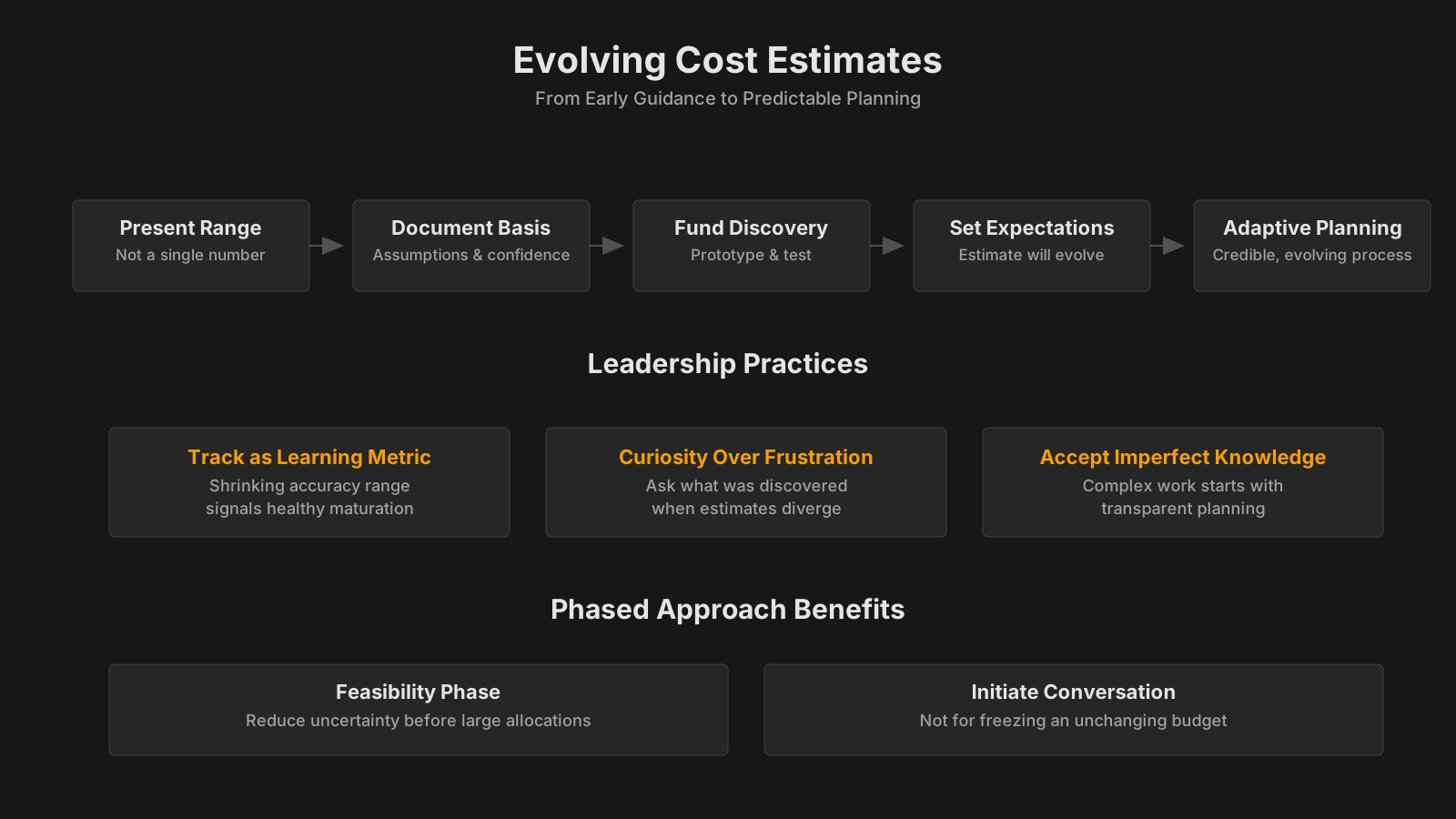
Proactively communicating estimate limitations reduces stakeholder friction and sets more realistic expectations for project performance. Instead of presenting a single figure, effective project managers present a range accompanied by a confidence statement and a list of key assumptions. This approach invites stakeholders to question the assumptions rather than the estimator’s competence, turning the early estimate into a conversation rather than a verdict. Some organizations formalize this by requiring a cost management plan that defines at which gates estimates will be refined and what tolerance thresholds will trigger escalation.
Agile teams handle early estimate variability through iterative delivery and continuous forecasting. They might produce an initial backlog estimate using relative sizing, then calculate a likely cost range based on the known burn rate of the team. As sprints progress and actual velocity data accumulates, the forecast tightens naturally without the need for a separate formal estimate update gate. This organic refinement process is one of the reasons agile approaches are attractive for projects with high uncertainty. The estimate is never treated as final until the work is done.
A practice that can improve the reliability of early estimates is the use of reference class forecasting. Rather than building an estimate solely from bottom-up components, the team identifies a group of similar past projects and examines the distribution of their actual costs relative to their initial estimates. This external view helps counteract the inside-view biases that cause overoptimism. Even a simple historical database of past ROM estimates and their final outcomes can provide a reality check that no amount of financial modeling can replicate.
Some frameworks advocate for explicitly scoring the certainty of scope items using a scale. For example, a five-level scope scale ranging from Definite to Unlikely can be applied to each deliverable, with cost implications tied to that certainty level. Items rated as Unlikely carry a much wider cost band and may even be excluded from the baseline to avoid contaminating the estimate with speculative work. This method treats scope change as feedback rather than failure, allowing the estimate to evolve without penalty. When combined with relational effort points, where tasks are compared against one another rather than estimated in absolute hours, the early cost picture becomes a flexible tool that supports decision-making without pretending to be precise.
Project managers would do well to treat early cost estimation as an ongoing risk management activity. Each assumption is a risk, and each trade-off is a decision that carries financial consequences. Documenting these elements explicitly, reviewing them at each major milestone, and communicating their status to stakeholders transforms the estimate from a static guess into a living artifact that reflects the project’s evolving understanding of itself. This, ultimately, is the path to greater reliability—not by eliminating uncertainty, but by making it visible, manageable, and subject to collective oversight.
The ability to produce and refine cost estimates with integrity is what separates a bureaucratic project function from a genuine project delivery capability. Early estimates will never be perfectly reliable, but they can be perfectly honest. When an organization learns to respect the uncertainty band, to ask the right questions about assumptions, and to avoid punishing estimators for the natural limits of foresight, it builds a culture in which early estimates serve their true purpose: enabling informed decisions under uncertainty, one iteration at a time.