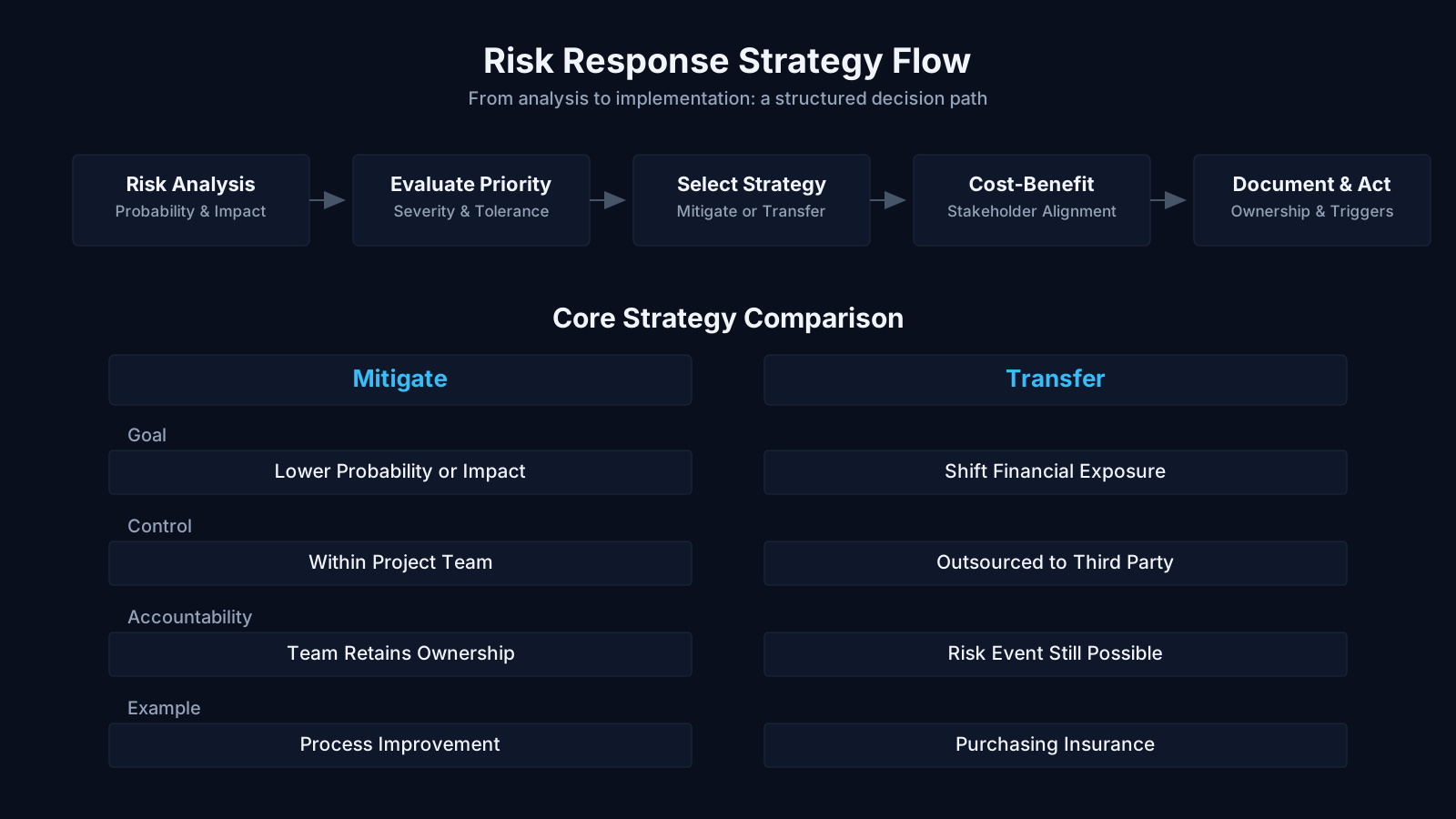
When a project faces a threat, the project manager and the team need a clear, well-understood menu of possible countermeasures. The PMBOK® Guide’s Plan Risk Responses process, which sits within the Planning process group of the Project Risk Management Knowledge Area, defines four fundamental strategies for handling negative risks: avoid, transfer, mitigate, and accept. These same categories appear in a range of global standards, from PRINCE2’s risk theme to iterative Agile practices, though each framework adjusts the labels slightly. The four strategies give a project the skeleton of a risk response plan, one that can be fleshed out with concrete actions, cost estimates, and assigned owners. This article concentrates on threats, the events that could harm project objectives, and walks through each strategy with enough practical detail to turn textbook definitions into day-to-day decision-making. Accept, it should be noted, can also be deployed for positive risks or opportunities, but that dual nature does not change the core logic of its threat-facing form.
Key Topics: Responding to Project Threats
| Key Concept | Summary |
|---|---|
| Plan Risk Responses | The PMBOK Guide identifies four primary strategies for negative risks: avoid, transfer, mitigate, and accept, each applied according to risk exposure and organizational appetite. |
| Avoidance Tactics | Avoidance tactics can range from modifying the technical approach or redefining scope to expanding the schedule, bringing in specialized expertise, or cancelling the project outright. |
| Sponsor Oversight | The approval to avoid a risk lies with the project sponsor and governance board, as this decision reallocates resources and recalibrates stakeholder expectations. |
| Agile Avoidance | Agile teams avoid risk by removing high-risk user stories from the backlog or declining feature spikes that carry excessive, unquantifiable uncertainty. |
| Material Substitution | A pharmaceutical project can avoid trial-phase failure by substituting a thoroughly documented raw material, even if the switch prolongs formulation development. |
| Site Relocation | An infrastructure project in an earthquake-prone area might relocate the facility to a geologically stable zone, completely neutralizing the seismic threat. |
| Commercial Purchase | A software project can bypass security vulnerabilities by purchasing a rigorously tested commercial library instead of building a custom module from scratch. |
| Capability Assignment | Avoidance often demands injecting specialized in-house expertise or structuring a contract that places accountability on the party best equipped to prevent the risk entirely. |
How to Avoid Threats in Project Risk Management
A risk avoidance strategy in project management is the only approach that fully removes a threat from the risk register. It does not merely soften the blow or share the pain with someone else; it changes the project management plan so that the threat can no longer affect the objectives. This goes well beyond selecting a safer supplier or adding a few extra tests. Avoidance can mean altering the technical approach, redefining the scope, pulling in additional expertise, extending the schedule to derisk a critical path, or, in extreme cases, cancelling the project altogether. The decision sits squarely inside the domain of the project sponsor and the governance board because it can redirect resources and reset expectations across multiple stakeholder groups.
In the PRINCE2 methodology, avoid is the direct equivalent, and it is applied through the Risk theme when a risk’s expected impact is judged intolerable relative to the project’s risk appetite. Agile environments, though they rarely use the formal label, perform avoidance constantly by removing risky stories from the backlog or choosing not to pursue a feature spike that reveals too much uncertainty. A product owner might decide that a particular integration with an unstable third-party API simply is not worth the exposure, and the squad avoids the threat by dropping that capability from the current increment. The mechanism is less ceremonial but no less real.
Criteria That Justify an Avoidance Response
Avoidance is not a soft option. It typically absorbs budget, time, or scope that the business might have preferred to use elsewhere. The threat has to be severe enough that its occurrence would break a binding constraint: a regulatory deadline, a fixed-price contractual commitment, or a safety parameter that cannot be negotiated. When a pharmaceutical project discovers that a proposed raw material has unknown long-term stability characteristics, switching to a widely documented alternative avoids the risk of a trial-phase failure, even though the new material may extend formulation work by several weeks. The logic holds: the project cannot afford the downside, so it pays the price of avoidance upfront.
Another condition that pushes toward avoidance is low risk tolerance on the part of key stakeholders. A public-sector infrastructure project in an earthquake-prone zone, for instance, might eliminate the threat of seismic damage by relocating the entire facility to a geologically stable area, even if that means a longer environmental approval cycle. That is a strategy-level change, not a technical tweak. The spectre of catastrophic failure simply does not leave room for a mitigation plan that says “we will reinforce the foundation.”
Concrete Ways Projects Shut Down Threats Before They Manifest
Risk avoidance often looks like a change in strategy. A construction firm facing an uncertain labour market in a foreign country might abandon that location entirely and build in a different region, altering the project’s entire footprint. The threat disappears because the conditions that created it are no longer part of the equation. On a smaller scale, a software project that originally planned to develop a custom authentication module might avoid the security vulnerabilities inherent in home-grown code by purchasing a well-maintained commercial library. The scope is technically reduced, but the project gains certainty.
Extending the schedule is another classic avoidance play. If a project must deliver a new medical device and the regulatory clearance timeline is unpredictable, padding the schedule to accommodate the worst-case scenario avoids the risk of a missed launch date, though it may strain the organisation’s market-entry ambitions. Sometimes the most clean-cut avoidance tactic is simply to acquire missing expertise. Bringing a seasoned data engineer onto a team that was planning to wing a complex data migration eliminates the threat of a failed conversion because the capability now sits in-house rather than being a risky dependency on trial-and-error learning.
Common Misunderstandings About Risk Avoidance
Many project teams conflate avoidance with prudence in general. They label any conservative decision as “avoiding risk” when in reality they are merely mitigating or accepting a less flashy version of the same vulnerability. True avoidance means the threat no longer appears on the risk register because the conditions that gave it life have been structurally removed. Reducing the probability of a data breach by adding firewall rules is mitigation, not avoidance, because the threat of a breach still exists. Eliminating the collection of sensitive data entirely, by contrast, is avoidance, because there is nothing left to be breached.
Another misstep is treating avoidance as the default reaction to any threat that makes someone uncomfortable. Overusing avoidance can gradually hollow out a project’s value proposition, stripping away the very elements that justified the investment. A product team that avoids every technical risk ends up delivering a bland, late, over-budget offering that nobody wants. Organisations that punish project managers for any risk event, no matter how well managed, unintentionally incentivise unnecessary avoidance that starves the portfolio of innovation. The right question is not “can we avoid this?” but “does the value we protect by avoiding outweigh the value we forfeit?”
Something that catches new project managers off guard is how political an avoidance decision can become. Telling a sponsor that the only safe path is to drop a pet feature or delay a public milestone takes more than risk analysis, it takes negotiation skill and a robust business case for the alternative. Without that, avoidance morphs into a blame game where the risk manager is seen as over-cautious rather than prudent. Seasoned practitioners learn to package avoidance proposals as value-preservation moves, quantifying the potential loss that the organisation would swallow if the threat materialised, and framing the avoided risk as a cost-benefit trade-off rather than a retreat.
Key Insights on Avoidance Responses
- Avoidance changes the project plan
- Avoidance requires altering the project management plan to remove a threat's ability to affect objectives, typically by changing the technical approach, redefining the scope, or extending the schedule.
- Sponsor and governance board authority
- The authority to avoid a threat rests with the project sponsor and governance board, since this decision can redirect resources and reset expectations across all stakeholder groups.
- Methodologies and practical applications
- PRINCE2 applies avoidance through its Risk theme when a threat's impact is intolerable, Agile teams remove risky backlog stories to eliminate exposure, and real-world measures include substituting raw materials, relocating facilities, and building schedule buffers.
Using a Risk Transfer Strategy to Shift Ownership of Threats
A risk transfer strategy shifts the financial consequences and response ownership of a threat to a third party. The original risk does not vanish, and the project team still needs to manage the relationship with the party that takes on the exposure. What changes is who pays when things go wrong. Transfer works especially well for threats that carry a severe financial sting but a low probability, the kind that a single project cannot absorb without breaking its budget but that an insurer, with a wide pool of clients, can bear comfortably. Construction projects, large events, and high-value logistics operations lean heavily on this approach.
How Contracts Become Transfer Mechanisms
Insurance is the most familiar transfer instrument. A project pays a premium, and in return the insurer agrees to cover defined losses from fires, natural disasters, or liability claims. The threat of a workshop burning down mid-project still exists, but the financial impact gets moved off the project’s balance sheet. Performance bonds, warranties, and guarantees work similarly. A supplier that provides a performance bond essentially stakes its own money on meeting a deadline or quality standard; if it fails, the bond pays out, and the project recovers a portion of the resulting costs without having to chase the supplier through litigation.
Contractual structures are even more surgical. A fixed-price contract transfers cost overrun risk from buyer to seller. The seller takes on the uncertainty of labour rates, material price hikes, and productivity fluctuations, and the buyer’s exposure is capped at the agreed price. A cost-plus contract, by contrast, shifts cost risk back to the buyer, because the seller is reimbursed for actual costs plus a fee, making the buyer the bearer of any cost blowout. When a buyer possesses unique capabilities or knowledge that the seller lacks, a savvy project procurement team sometimes drafts a contract that transfers a specific piece of work, and its associated risk, back to the buyer, letting the party best equipped to control the risk hold it.
Why Transfer Is Not a Silver Bullet for Risk Management
A transfer does not make a threat go away, and it certainly does not remove the project’s accountability for the outcome. If a critical supplier goes bankrupt despite holding a performance bond, the project still faces a delayed deliverable and a scramble for alternatives. The bond may cover some financial damages, but reputational harm, timeline slippage, and the cost of re-procurement can easily surpass the compensation. Transfer, therefore, asks the project team to evaluate the counterparty’s capacity to carry the risk realistically. Handing a high-impact threat to a tiny subcontractor with thin capital reserves is not a transfer strategy; it is a gamble that the subcontractor will not break.
Another common pitfall is forgetting that transfer carries a premium, and that premium eats into the project’s contingency or profit margin. Insuring every possible threat would drain the budget dry and still leave the project with a pile of administrative work. The discipline is in separating risks where transfer makes financial sense, because the premium is small relative to the potential loss, from risks that are better held and managed internally. PRINCE2 treats transfer as one of the standard response types but emphasises that it must be accompanied by a clear understanding of who owns the residual risk and how the transfer will be monitored. Agile contexts rarely use formal insurance contracts, but they practice a cultural form of transfer when they outsource a complex component to a specialist vendor under a service-level agreement that includes penalty clauses.
What Transference Cannot Do
There is a persistent myth that passing a risk contractually means washing your hands of it. Compliance and ethics risks cannot be transferred because the project’s licence to operate remains with the primary organisation. No contract term can outsource a criminal liability or a regulatory sanction. Even financial risk transfer has its limits: a foreign-exchange hedge may lock in a rate, but if the counterparty defaults, the project faces the raw exposure anyway. The project manager’s job is to maintain a watchful eye on transferred risks just as they would on any other, updating the risk register when signals suggest the transfer mechanism is under strain.
Contract lawyers sometimes joke that risk transfer is the art of making two parties sign a document, each believing the other is holding the bag. When both sides understand the risk clearly and price it correctly, transfer works smoothly. When the party taking it on underestimates the exposure, what seemed like a clean transfer can turn into a messy dispute that costs far more than the original threat ever would have. That is why thorough due diligence on insurers, bonding companies, and key vendors is not a procurement formality; it is a risk management activity that underpins the entire transfer strategy.
Applying Risk Mitigation Techniques to Reduce Threat Exposure
Project teams use risk mitigation techniques to lower the likelihood of a threat materialising or to lessen its potential damage if it occurs. Unlike avoidance, mitigation does not eliminate the risk from the plan; it shrinks the residual risk to a level that the organisation can comfortably absorb. That often means moving a threat from the red zone of the probability-impact matrix into the yellow or green, where standard contingency reserves and management attention become sufficient. PMBOK groups mitigation under the Plan Risk Responses process, right alongside the other response strategies, and it is the most widely applied countermeasure because it aligns with the natural instinct to do something proactive rather than simply watch and wait.
Why Timing Matters More Than the Technique
Early action is the soul of successful mitigation. Fixing a design flaw during the requirements phase costs a fraction of what it would cost to rework components after fabrication has begun. That simple economic truth pushes mitigation activities to the front of the project lifecycle. Prototyping is a classic early mitigation: a team builds a limited-functionality version of a product to test a risky assumption, reducing the probability that a full-scale rollout will fail spectacularly. The same logic applies to conducting more tests, adopting less complex processes, or running a pilot deployment in a low-stakes environment before a wide release.
Waiting until a threat has already triggered is not mitigation; it is recovery. The distinction matters because recovery actions are almost always more expensive, more disruptive, and more visible to stakeholders. A project that mitigates supply-chain disruption by qualifying a second source of critical components months before the primary supplier stumbles will experience a gentle switchover. The project that waits and then scours the spot market in desperation pays a premium and loses credibility. That is why seasoned risk managers treat mitigation budgets not as optional spending but as an investment that buys schedule and stakeholder confidence.
Mitigation Patterns Across Different Industries
In engineering-heavy projects, designing redundancy into a system is the go-to mitigation for component failure. A data centre that runs on N+1 power architecture can lose a generator without interrupting operations, so the impact of a generator failure drops to nearly zero even though the threat of individual unit breakdowns remains. A manufacturing project might mitigate the risk of a new production process delivering inconsistent quality by first running a small-scale pilot line, identifying the operating parameters that produce acceptable output, and only then scaling up. The pilot itself does not guarantee success; it reduces the probability that the full investment will produce nothing but scrap.
Software projects rely on a different set of mitigation rhythms. Conducting code reviews and running automated test suites reduces the likelihood that a regression defect will slip into a release. Choosing a more stable, well-supported open-source framework instead of a bleeding-edge library lowers the probability of encountering undocumented bugs or sudden abandonment by maintainers. Spike solutions, borrowed from Agile, are timeboxed investigations designed to reduce uncertainty around a risky technical approach. A team that spends a two-week spike figuring out whether a proposed algorithm can meet performance requirements avoids the risk of a multi-sprint death march down the wrong path.
Distinguishing Mitigation from Contingency Plans
A subtle but persistent confusion in many project rooms is the blurring of mitigation and contingency. Mitigation happens before the threat fires; contingency plans describe what the team will do after it fires. Reducing the risk of a server outage by adding load balancers and failover clusters is mitigation. Writing a runbook that tells the operations team exactly how to restore service when an outage occurs is a contingency plan, and it sits under the acceptance response, not mitigation. Keeping this division clean prevents double-counting of residual risk and stops teams from believing they have mitigated a threat when all they have done is written a recovery script that will still cost them hours of downtime.
In some frameworks, like Business Value-Oriented Project Management, product risk management uses quantified loss size units to sharpen mitigation priorities. A threat that could cause a loss of fifty units against a product’s business value gets a different level of mitigation investment than one causing a loss of five hundred units, and dynamic filtering regularly recomputes those numbers as the project environment shifts. Such quantification helps avoid the common trap of over-mitigating low-impact risks simply because they are easy to fix while under-investing in larger-but-harder risks that require uncomfortable conversations or cross-departmental coordination.
Key Insights on Risk Mitigation
- Reduces risk without eliminating it
- Mitigation brings residual risk down to a tolerable level within the organization's risk appetite, whereas avoidance removes the threat from the project plan entirely.
- Moves threats down the risk matrix
- Effective mitigation relocates a threat from the high-probability, high-impact red zone into the moderate yellow or low green zones, where standard contingency reserves and routine management oversight become sufficient.
- Core PMBOK response strategy
- PMBOK classifies mitigation under the Plan Risk Responses process, where it stands as the most widely applied strategy because it channels the instinct to act into concrete, proactive steps that lower threat probability or impact.
- Early intervention saves significant cost
- Correcting a design flaw during the requirements phase costs a fraction of what rework demands once fabrication has begun, so early detection multiplies the cost-effectiveness of any mitigation effort.
- Prototyping and pilots test assumptions
- Limited prototypes, small-scale pilot lines, pre-qualified backup suppliers, and mature, stable frameworks all reduce the likelihood of large-scale failure by validating critical assumptions and creating fallback options before full rollout.
Understanding Risk Acceptance as a Response to Threats
Sometimes the most appropriate response is a deliberate risk acceptance strategy, where the project team decides not to alter the plan and instead deals with the threat if and when it materialises. This is not a passive shrug; it is a conscious decision taken after evaluating that the cost, time, or disruption of other responses outweighs the potential impact, or that no practical avoidance, transfer, or mitigation option exists. The risk remains on the register, monitored periodically, with clear triggers that signal when the threat has started to crystallise.
Passive versus Active Acceptance
Passive acceptance is the quieter cousin. The team documents the risk and essentially decides that no specific contingency reserve or pre-planned action will be set aside. If the threat triggers, the team will deal with it using whatever resources are available at the time, probably through a change request or a reallocation of existing budget. This approach works for low-probability, low-impact risks where the overhead of planning for every minor eventuality would overwhelm the project’s administrative capacity. It is honest simplicity, but it does require that the team not be caught completely off guard when a passively accepted risk turns real.
Active acceptance, on the other hand, is the most common strategic form. The project sets aside a contingency reserve of time, money, or resources specifically earmarked to handle the accepted threats should they occur. That reserve is not a slush fund for any unexpected problem; it is a calculated buffer built from the expected monetary value of the threats on the active-acceptance list. When a team actively accepts the risk of a critical piece of equipment failing just before a go-live event, they might allocate a small fund to rent a backup unit and train a couple of staff to install it within hours. The reserve is there, but it remains untouched unless the trigger fires.
Building Contingency Reserves That Match the Exposure
Quantifying the right size of a contingency reserve forces the project team to think in terms of probability and impact, not just gut feel. For a single threat, the reserve could be set at the estimated cost of the impact if the probability of occurrence is moderate. When multiple accepted threats exist, a simple sum of individual expected values often overstates the needed reserve because it is unlikely that all of them will fire simultaneously. Skilled risk managers model the collective exposure using ranges and correlation assumptions, arriving at a figure that balances protection and cost-efficiency. PRINCE2’s approach to risk budget follows a similar logic, recommending that a project’s risk budget be based on an aggregated assessment of all acceptance-level threats rather than arbitrary percentages.
The Business Value-Oriented Project Management perspective adds another layer by linking loss size units directly to business value points. A product risk that could decrease user retention by a quantifiable margin gets a loss size estimate that helps the team decide not only whether to accept the threat but also how much reserve to park against it. Because BVOPM tracks business value over the product lifecycle, a persistent decline in value points might trigger a review of whether previously accepted threats, now amplified by changing market conditions, need to be moved into the mitigation or avoidance column. This dynamic filtering keeps the acceptance decision alive rather than letting it fossilise in a six-month-old risk register.
What Active Acceptance Demands from the Team
Acceptance does not mean forgetfulness. Every actively accepted threat needs a trigger condition that is unambiguous enough that anyone on the team can recognise it and raise the alarm. “Vendor delivery delayed by more than five working days” is a trigger; “vendor seems unreliable” is not. The team also needs a clear owner who is responsible for monitoring the threat and invoking the contingency reserve when the trigger fires. That owner often is the same person who would manage the response, ensuring a seamless handoff from monitoring to action.
Acceptance works best when paired with a rhythm of regular risk reviews. A threat that was acceptable at the planning stage because the project had abundant schedule float might become unacceptable six months later when the critical path has tightened. A quarterly risk re-evaluation that re-reads every accepted threat through the lens of current project data is not bureaucracy; it is the only thing that stops acceptance from becoming neglect. Some project offices embed this by giving each accepted risk an expiry date, after which it must be re-assessed or closed, a practice that borrows from the idea of risk aging used in enterprise risk management.
There is a temptation in high-pressure environments to label almost everything as “accepted” simply because the project does not have the bandwidth to design a fancier response. That is a red flag. When acceptance becomes a dumping ground for risks the team does not want to think about, the project is effectively flying blind. A healthy risk culture distinguishes between strategic acceptance, where the math justifies the decision, and avoidance-by-omission, where nobody wants to invest the effort. The difference often surfaces during a crisis, when a strategic acceptance triggers a well-funded, rehearsed contingency plan, and a default acceptance triggers panic.