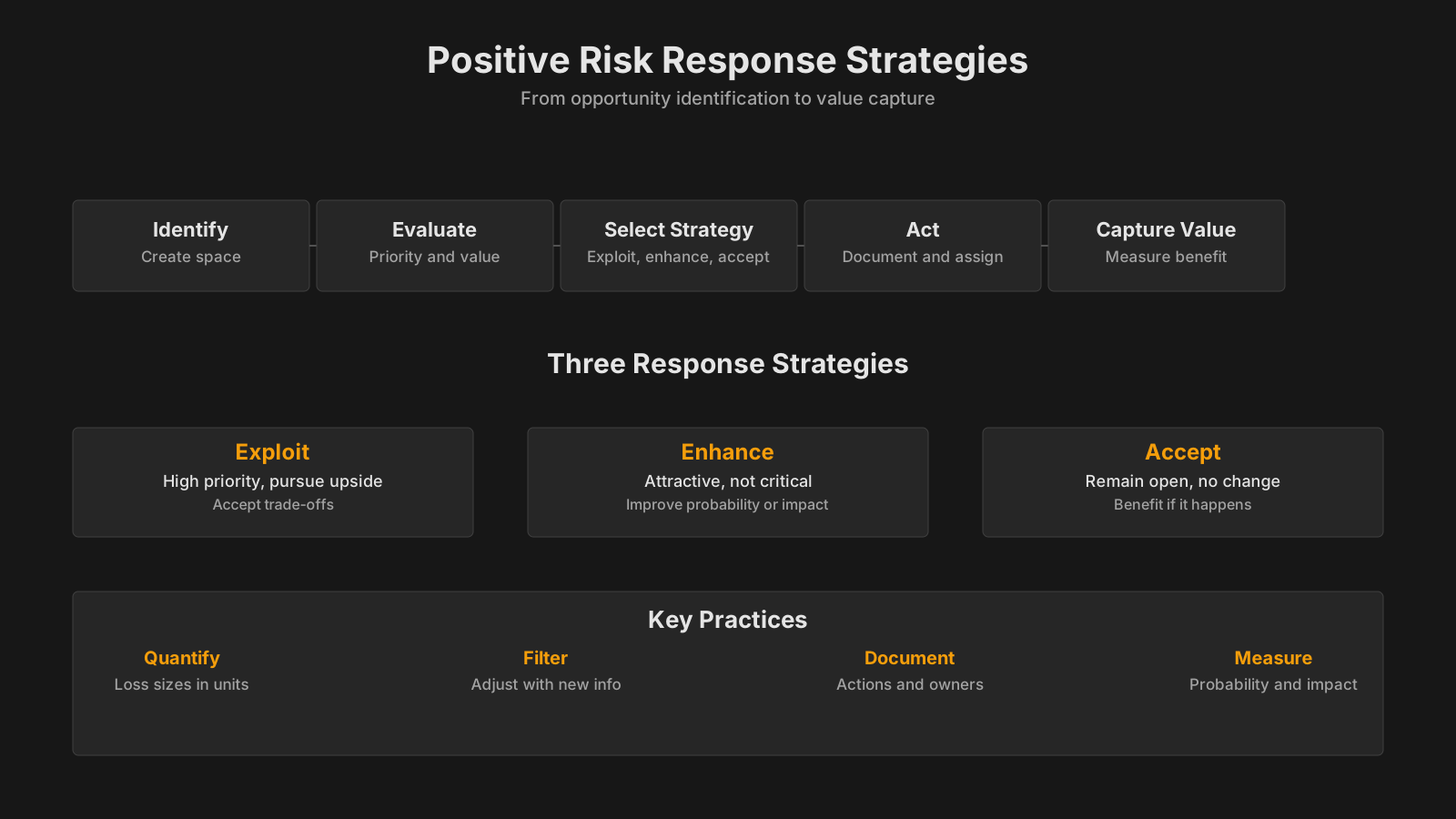
What are the best strategies for positive project risks? This question matters because most project teams still treat risk as purely negative. A lower supplier quotation, an earlier regulatory approval, or a sudden availability of scarce expertise can all lift a project beyond its original baseline. The four primary response strategies are exploit, share, enhance, and accept. Each strategy has a distinct logic, timing, and set of trade-offs that project managers must understand.
Positive Project Risk Strategies: Key Topics at a Glance
| Key Concept | Summary |
|---|---|
| Positive Risks | Positive risks, or opportunities, are uncertain events or conditions that, if they materialize, create favorable deviations in project scope, schedule, cost, or quality. |
| PMBOK Context | Within PMBOK aligned project management, this concept is addressed in the Plan Risk Responses process of the Project Risk Management knowledge area. |
| Threat Bias | Project teams commonly concentrate on threats because their consequences are immediate and visible, whereas opportunities demand deliberate, proactive effort to convert potential upside into measurable value. |
| Missed Opportunities | Missed opportunities seldom appear as red flags in status reporting the way a slipped milestone does, which allows them to remain invisible until the window for capture has closed. |
| Process Gap | When opportunity identification and response planning are absent from risk workshops, teams almost always underinvest in positive risks because the process creates no structured space for capturing and acting on them. |
| Exploit Response | An exploit response commits resources, realigns plans, and takes decisive action to ensure the favorable outcome occurs, rather than merely increasing its probability. |
| Practical Example | If a team identifies that a newer software library could materially reduce development time, exploiting that opportunity means making an immediate technical shift, allocating developers, and completing adoption before the current sprint closes. |
| When to Use | Exploit is most appropriate when the opportunity is strongly aligned with project objectives, the potential upside is substantial, the required investment is manageable, and the team has high confidence it can directly trigger the favorable outcome. |
Understanding Positive Project Risks
In formal project management frameworks, risk is not limited to negative events. A positive project risk, also called an opportunity, is an uncertain event or condition that, if it occurs, has a beneficial effect on one or more project objectives. Positive project risks are uncertain events or conditions that, if they occur, have a beneficial effect on project objectives such as scope, schedule, cost, or quality. This may sound simple, but many teams struggle to treat opportunities with the same rigor they apply to threats. The mental shift is significant because risk registers often become lists of things to avoid rather than lists of things to pursue.
The concept belongs to the Plan Risk Responses process within the Project Risk Management knowledge area in PMBOK-oriented practice. During this process, the project team decides how to address individual risks and overall project risk. For negative risks, responses typically include avoid, transfer, mitigate, and accept. For positive risks, the responses are exploit, share, enhance, and accept. Note that accept appears on both sides, which is one of the reasons practitioners sometimes confuse the intent behind acceptance. On the threat side, accepting means deciding not to actively respond unless a trigger occurs. On the opportunity side, accepting means staying open to a benefit without altering current plans to chase it.
Why Positive Risks Get Less Attention
Many project cultures are wired for loss prevention. Stakeholders often ask what could go wrong before they ask what could go better. That bias is understandable because threats can cause immediate visible damage, while opportunities require proactive effort to convert into actual gains. Furthermore, a missed opportunity rarely shows up as a red flag in status reports the way a delayed milestone does. This creates a practical asymmetry. Teams that do not deliberately include opportunity identification and response planning in their risk workshops will almost always underinvest in positive risks, not because the opportunities are absent but because the process does not create space for them.
A useful mindset is to treat every significant project assumption as having two sides. If an assumption proves false, it could be a threat. If it proves more favorable than expected, it could be an opportunity. For example, an assumption about shipping lead time might create a schedule threat if it lengthens or an opportunity if it shortens. By framing assumptions this way, a project team can begin to surface positive risks without inventing unlikely scenarios. This also connects risk identification to the project's planning assumptions, which is where many latent opportunities first become visible.
In Agile environments, opportunities are often discovered through rapid feedback. A feature that performs better than expected with users may create an opportunity to expand scope or accelerate a release. However, the formal response still needs to be chosen deliberately. Agile teams may not use the same risk register language, but the same four strategies apply when deciding what to do with a favorable discovery. This connection helps bridge traditional and agile risk thinking.
Core Insights on Opportunities
- Defining positive project risks
- Positive risks represent uncertain events that can improve project performance across scope, schedule, cost, or quality if they occur.
- Threat bias in risk registers
- Many teams analyze opportunities with less rigor than threats, so their risk registers become lists of what to avoid rather than what to pursue.
- Acceptance on the opportunity side
- Accepting an opportunity involves remaining open to a potential benefit without altering existing plans to actively pursue it.
- Process gap for positive risks
- Teams underinvest in positive risks because their risk workshops do not deliberately make room for opportunity identification and response planning.
Exploit Strategy for Positive Risks
The exploit response strategy is the most direct way to handle a positive project risk. It is selected when the organization wants to ensure that the opportunity is realized rather than merely hoped for. The exploit response strategy eliminates the uncertainty associated with a particular upside risk by making the opportunity definitely happen. This means the project team commits resources, adjusts plans, or takes actions that guarantee the favorable outcome, not just increase its likelihood. It is the positive counterpart to the threat response strategy of avoidance, which seeks to eliminate a threat rather than reduce its probability.
For example, if a project team identifies that using a newer software library could reduce development time, exploiting that opportunity would involve immediately changing the technical approach and assigning developers to adopt that library before the current sprint ends. The team does not wait to see if the library proves faster. They restructure the work so that the faster path becomes the plan of record. That is the core distinction. Exploit changes the project plan to incorporate the opportunity as a certainty, even though the underlying event originally carried uncertainty. The resource commitment is often significant, but the expected payoff justifies that commitment.
When to Use Exploit Response
Exploit is appropriate when the opportunity is highly aligned with project objectives and the organization has both the resources and the risk appetite to commit fully. It works best when the upside is large, the cost of pursuit is moderate, and the team has high confidence that the favorable event can be triggered by its own actions. If the opportunity depends heavily on external conditions that the project cannot control, exploit may be less suitable because eliminating uncertainty may be impossible. In such cases, enhance or share might be better choices.
A common mistake is to treat exploit as a default for any positive risk. Just because an opportunity is attractive does not mean the project should restructure its baseline to capture it. Exploiting an opportunity often consumes management attention and may disrupt other planned work. If the team chooses to exploit a secondary opportunity, it can create opportunity cost that outweighs the benefit. Practitioners should evaluate whether the expected gain justifies the disruption to the project's current commitments. That evaluation should include a realistic view of the remaining uncertainty. Even when exploit actions are taken, there can still be residual risks in execution, such as integration problems or delayed training.
The exploit strategy also influences project baselines. Once the decision is made, the project plan, schedule, and sometimes cost estimates need to be updated to reflect the new approach. If a team exploits a favorable exchange rate by locking in a currency contract, the cost baseline should reflect the locked rate. This update is not a sign of poor planning; it is a deliberate response to an identified opportunity. Governance bodies often require documentation of the decision and the expected benefit so that the change can be validated against project objectives later.
Share Strategy for Positive Risks
The share response strategy for positive risks is not about transferring blame or pushing responsibility away. It involves allocating some or all of the ownership of an opportunity to a third party who is best able to capture the opportunity for the benefit of the project. Sharing a positive risk means allocating some or all of the ownership of the opportunity to a third party who is best able to capture the opportunity for the benefit of the project. This might sound similar to transferring a threat, but the objective is the opposite. In threat transfer, you move potential negative consequences to another party, often through insurance or penalties. In opportunity sharing, you partner with another party to jointly pursue a benefit that neither could fully realize alone.
A typical setting for sharing is when a project team lacks specialized expertise, market access, or capacity to exploit an opportunity fully. Suppose a new technology could dramatically improve the product, but the project organization does not have the manufacturing capability to scale it. Sharing the opportunity with a partner that has spare production capacity and distribution channels can increase the total value captured. The project may receive part of the upside through better pricing, faster delivery, or licensing terms. The key is that the partner is selected because they are genuinely better positioned to capture the opportunity, not simply because the project wants to reduce its own workload.
Structuring a Shared Opportunity
Sharing positive risks often requires more formal arrangements than other response strategies. Contracts, memoranda of understanding, joint ventures, or performance-based incentives can define how the value will be divided and how decisions will be made. Without clear agreements, the shared opportunity can quickly become a source of conflict. A common pitfall is assuming that both parties view the opportunity the same way. The project may want faster delivery, while the partner may want longer production runs to absorb fixed costs. Those incentives overlap but do not perfectly align. The sharing agreement must acknowledge those differences and set up governance mechanisms to handle them.
From a portfolio perspective, sharing can also be used internally between projects within the same organization. If one project discovers an opportunity that could benefit another project but does not have the resources to exploit it, the opportunity can be shared with that other project. This avoids duplication and allows the organization to capture value at the program level. In program management, shared opportunities often appear as joint initiatives across component projects. The program manager may facilitate the allocation of ownership so that the project with the best capability takes the lead. This is a practical form of positive risk sharing even without a formal external contract.
Sharing is not the same as delegation. In delegation, one party assigns a task but retains accountability. In opportunity sharing, the parties jointly own the upside and often share the risk of not capturing it. That nuance matters because teams sometimes think of sharing as handing off a chance to someone else and then forgetting it. The original project still needs to monitor the opportunity and ensure the partnership is delivering the expected benefit. If the partner fails to capture the opportunity, the project may need to fall back on another response or accept the lost benefit. So sharing carries a coordination burden that is easy to underestimate.
Core Takeaways on Opportunity Sharing
- Sharing means joint pursuit
- Sharing a positive risk means assigning ownership of an opportunity to a third party that is best positioned to capture its value for the project.
- Contrast with threat transfer
- Unlike transferring negative consequences through insurance or penalties, opportunity sharing builds a partnership to jointly pursue a benefit that neither party could realize on its own.
- Best for capability gaps
- Sharing is most appropriate when the project team lacks specialized expertise, market access, or capacity to exploit an opportunity, for example scaling a new technology without in-house manufacturing capability.
- Formal structures required
- Contracts, memoranda of understanding, joint ventures, or performance-based incentives formally define how value is divided and how decisions are made within a shared opportunity.
Enhance Strategy for Positive Risks
The enhance response strategy is for positive risks that are attractive but not certain enough or large enough to justify a full exploit response. It modifies the size of an opportunity by increasing its probability of occurrence or its potential positive impact. Enhancing a positive risk means modifying the size of an opportunity by increasing its probability or positive impact and by identifying key drivers of those positive outcomes. In PMBOK terms, enhance is the positive counterpart to mitigation for threats. While mitigation seeks to reduce probability and impact of a negative risk, enhance seeks to raise them for an opportunity.
Enhance often begins with driver analysis. The project team asks which underlying conditions make the opportunity more likely or more valuable. For example, if a favorable supplier discount depends on ordering a higher volume, the team might increase its order quantity to trigger that discount. That action does not guarantee the discount was originally uncertain, but it deliberately increases the chance. If the opportunity is a possibility of early completion due to a simplified design, the team might assign more experienced engineers to that design stream to boost the probability of finding a faster solution. Alternatively, if an opportunity could produce extra revenue from a feature, the team might broaden the feature's scope to increase the impact if the feature succeeds.
Probability versus Impact Enhancement
Project teams often focus only on increasing probability and overlook impact. But impact enhancement can be equally valuable. Increasing the positive impact might involve adding complementary capabilities, scaling the solution to more user groups, or extending the benefit window. Suppose a favorable regulatory change would reduce approval time. Enhancing the impact might mean preparing additional submissions in parallel so that, if the expedited approval occurs, multiple product lines benefit at once. This amplifies the value of the same underlying event. The two dimensions should be evaluated separately because they have different costs and different drivers. Sometimes raising probability is cheap, while raising impact is expensive, or vice versa.
A significant pitfall in enhance is drifting into over-optimism. Because enhancement actions make an opportunity look more favorable, the team may start treating the enhanced opportunity as a certainty. That leads to unrealistic baselines. The practitioner should track the actions taken separately from the residual risk. If the team increased order volume to trigger a supplier discount, the cost of holding additional inventory is a new risk that should be managed. Enhance almost always creates secondary risks, and those secondary risks can sometimes offset the benefit. The point of enhance is to tip the balance, not to ignore the remaining uncertainty.
Enhancers also work well in iterative environments. Agile teams might enhance an opportunity by increasing user involvement or by creating a spike to test a promising technical path early. The spike reduces uncertainty about a favorable approach, making the opportunity more likely to be captured later. That early learning is a form of probability enhancement. It is not a guarantee of success, but it increases the confidence needed to pursue the opportunity further.
Accept Strategy for Positive Risks
The accept response strategy for opportunities is often misunderstood as doing nothing, but it is actually a deliberate decision to remain open to a positive risk without actively pursuing it. Accepting a positive risk means being willing to take advantage of an opportunity if it occurs, but not actively pursuing it. Accept can be used for both positive and negative risks. On the positive side, acceptance is the appropriate choice when the opportunity is unlikely, the potential benefit is small, or the cost of pursuit is too high relative to the upside.
There are two forms of acceptance: passive and active. Passive acceptance for opportunities means taking no action now and simply recognizing that if the favorable event occurs, the team will react then. Active acceptance involves preparing a contingency reserve or a planned response that can be triggered if the opportunity materializes. For positive risks, a contingency reserve might be a small budget or extra buffer held aside to be used only if the opportunity appears. The project team documents the trigger conditions and predefined actions so that when the window opens, they can move quickly without going through a lengthy approval cycle.
Active Acceptance for Opportunities
Active acceptance can be a highly disciplined strategy. The project manager identifies early warning indicators that signal the opportunity is becoming available. For example, if a technology vendor is rumored to release a new component that would reduce costs, the team might prepare a purchase order draft and the decision authority needed to execute it if the component ships by a certain date. If the component is released, the team takes advantage. If not, no material resources have been wasted. This approach preserves optionality while ensuring the project can act before the opportunity expires. The key is to make the trigger explicit and to assign responsibility for monitoring it.
A common mistake is to use accept as a label for every positive risk that the team does not want to think about. That converts acceptance into an excuse for neglect. Effective acceptance still requires periodic review of the risk register. Opportunities that were accepted because they were unlikely may become more likely as project conditions change. If so, the project manager should revisit whether accept remains the right strategy or whether enhance or exploit now makes sense. Acceptance is not a static decision. It should be revalidated at status meetings and major phase transitions.
Accept also has a role when exploring an opportunity would divert effort from more critical project objectives. The discipline of accepting an opportunity, even a valuable one, recognizes that not every good thing should be chased. This mirrors the principle that project success requires prioritization. Accepting is not pessimism; it is a conscious choice about resource allocation. That said, the team should still document why the opportunity was accepted, so that future stakeholders understand the reasoning rather than assuming the opportunity was missed by oversight.
Key Insights on Accepting Opportunities
- Deliberate choice, not inaction
- Accepting a positive risk is a conscious decision to remain receptive to an opportunity rather than actively chasing it.
- Passive versus active acceptance
- Passive acceptance means waiting to respond if the opportunity materializes, whereas active acceptance establishes a contingency reserve and a predefined response beforehand.
- Prepared triggers speed response
- Documenting trigger conditions, early warning indicators, and pre-approved actions enables the team to respond quickly when the opportunity emerges and to reassess whether acceptance remains the most suitable strategy.
How to Choose the Best Positive Risk Strategy
Selecting the best positive risk strategy depends on the opportunity's probability, impact, timing, cost of response, and the project's broader risk appetite. Choosing the best positive risk strategy requires comparing probability, impact, response cost, and alignment with project objectives. These factors are not always quantifiable, but even a qualitative assessment helps clarify which of the four strategies is most appropriate. The choice should never be based on the opportunity's attractiveness alone; it must be grounded in the project's constraints and the organization's willingness to commit resources.
The decision process often starts with the opportunity's expected value, calculated as the product of probability and impact. High probability and high impact opportunities are usually candidates for exploit, provided the project can influence the trigger. Moderate probability or moderate impact opportunities may justify enhance, because the team can invest in raising those values. Opportunities that require capabilities beyond the project team's reach may be better suited to share. Low probability or low impact opportunities are typically accepted. This straightforward matrix is a useful starting point, but it has limits. Real opportunities do not always fit cleanly into one quadrant because the cost and timing of the response also matter.
Decision Factors Beyond Probability and Impact
Project managers should also consider the urgency of the opportunity. Some positive risks have a short window of availability. If a favorable market condition is expected to last only a few weeks, the team cannot spend a long time negotiating a sharing agreement. In that case, exploit or accept may be more practical than share or enhance. Timing interacts with the project's phase. An opportunity identified during early planning may allow the team to restructure the baseline with less disruption, while the same opportunity discovered during late execution may be too expensive to exploit. Phase sensitivity is often overlooked in risk response planning.
The risk owner's capability matters too. A high-value opportunity assigned to a team that lacks the skills or authority to pursue it will not be realized no matter which strategy is chosen. Before selecting exploit, the project manager should verify that the risk owner understands the actions needed and has the influence to implement them. For share, the partner's reliability and contractual alignment must be assessed. For enhance, the team needs data on the key drivers and the authority to adjust plans. Accept requires patience and monitoring discipline. Strategy selection is therefore not just about the risk itself; it is also about the organization's readiness to execute the chosen response.
Integrating Positive Risk Strategies into Project Risk Management
Positive risk strategies do not exist in isolation. They are part of a broader risk management process that begins with identification and ends with monitoring and control. Integrating positive risk strategies into the project risk management process requires updating the risk register, assigning risk owners, and monitoring triggers. The plan risk responses process produces these documented decisions, but the execution happens through ongoing project work. Without integration, the chosen strategy remains an abstract label and the opportunity is likely to be lost.
The project risk register should record each positive risk, its probability and impact assessment, the selected response strategy, the risk owner, and the specific actions to be taken. It should also note any residual risk remaining after the response and any secondary risks introduced by the response actions. Monitoring positive risks is just as important as monitoring threats. A risk owner should watch for the triggers that indicate the opportunity is becoming more or less likely. When an exploit action is completed, the project should verify that the opportunity was actually captured and that the expected benefit is reflected in actual performance data.
Connecting with Other Project Management Processes
Positive risk responses have direct links to project scope, schedule, cost, and procurement management. An exploit decision may change the work breakdown structure by adding activities needed to capture the opportunity. A share decision typically creates a new procurement or partnership arrangement. Enhance actions may require budget reallocation to fund driver analysis or pilot tests. Accept decisions often create contingent plans that sit outside the normal baseline until triggered. The integrated change control process should be used when any of these decisions alter approved baselines. A change request should document how the positive risk response affects project objectives and how the benefit will be measured.
In PRINCE2 environments, risk responses are addressed within the risk theme, which recognizes that risk can have both negative and positive consequences. The project board typically reviews significant opportunities and decides how far the project should go in pursuing them. The language differs, but the underlying logic is consistent with PMBOK. Agile frameworks often embed opportunity response within iteration planning and backlog refinement. A team may pull an enhancement spike into a sprint to increase the odds of capturing a technical opportunity. The four strategies remain useful even when the process wrapper changes. The important thing is that someone has explicitly decided what to do with each identified opportunity.
In Business Value-Oriented Project Management, product risks are managed separately from project risks, with loss sizes expressed in quantified units and filtering adjusted as new information emerges. That approach can sharpen positive risk responses by separating the value of the product opportunity from the delivery execution risk. This is helpful because an opportunity may be highly attractive at the product level but difficult to capture at the project level. Keeping those views distinct prevents the team from confusing a good product idea with a feasible project response.
Key Insights on Positive Risk Integration
- Integration through ongoing execution
- While the Plan Risk Responses process establishes the intended approach, integration is achieved through continuous project execution as teams update the risk register, assign ownership, and monitor response triggers.
- Complete risk register records
- Each positive risk should be recorded with a complete profile that includes probability and impact ratings, the selected response strategy, risk ownership, specific actions, residual exposure, and any secondary risks created by the response.
- Verify opportunity capture after exploit
- Once an exploit action is completed, project teams should confirm that the opportunity has actually materialized and that the anticipated benefits are evident in actual performance measurements rather than assumed.
- Links to other management processes
- Positive risk responses have direct implications for scope, schedule, cost, and procurement management because exploit decisions may reshape the work breakdown structure and enhance actions may require shifts in budget allocation.
- Product risks managed separately
- In Business Value-Oriented Project Management, product risks are handled separately from project risks, with loss sizes expressed in quantified units and filtering criteria adjusted as new information emerges.
Common Mistakes When Responding to Positive Risks
A frequent pitfall is treating positive risks as the mirror image of negative risks without adjusting the governance and communication around them. Common mistakes in positive risk response include over-exploiting weak opportunities, neglecting accepted risks, and failing to monitor shared opportunities. This leads to wasted resources and lost value. Teams sometimes celebrate the identification of an opportunity and immediately assign an exploit action, even when the evidence is thin. That enthusiasm can create more problems than the opportunity would have solved.
Over-exploiting weak opportunities is particularly common in organizations that reward action over judgement. A project manager may feel pressure to show initiative by pursuing every favorable signal. But an opportunity with low probability and modest impact may not justify the cost of restructuring the baseline. The discipline to accept such an opportunity, document it, and move on is often more valuable than visible activity. Another mistake is treating enhanced opportunities as certainties. When the team raises the probability from low to medium, the risk is not gone. Baselines should still reflect the remaining uncertainty, not the most optimistic outcome.
Avoiding Response Strategy Drift
Response strategy drift happens when a team selects one strategy but then behaves as if it selected another. For example, a risk owner may say the opportunity is accepted, but then quietly spends time trying to enhance it without formal approval. Or a team may claim to exploit an opportunity but fail to update the schedule to reflect the new approach. This drift creates confusion because the risk register no longer matches reality. Regular risk reviews should compare the documented strategy with the actual actions being taken. If the strategy has changed, update the register. If the actions have drifted, either realign them or formally change the response. That alignment is what keeps risk management credible.
Governance around positive risks can also be underdeveloped. Many project boards have clear escalation paths for threats but not for opportunities. A significant opportunity may need rapid approval to allocate funds or sign a partnership agreement. If the governance process is too slow, the window may close. Project managers should identify which positive risks are likely to require executive decisions and pre-arrange the approval path. This is a form of active acceptance applied at the governance level, making the organization ready to move when the opportunity appears. Without that readiness, even a well-chosen exploit strategy can fail at the approval gate.