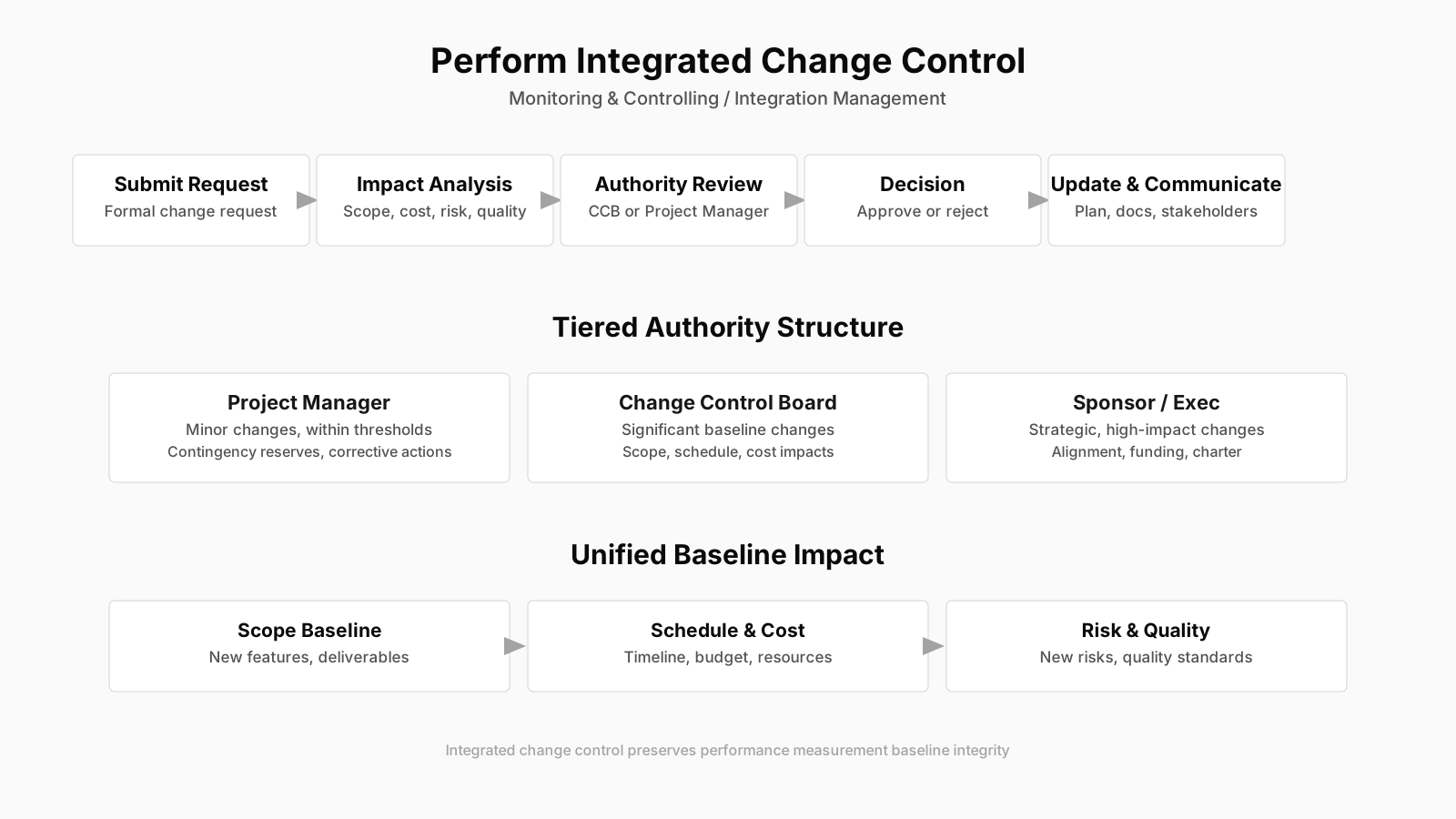
The way projects absorb, evaluate, and authorize modifications to their agreed-upon baselines sits at the core of disciplined project management. When practitioners ask how do you carry out integrated change control, they are probing a formal process that the Project Management Body of Knowledge names Perform Integrated Change Control, positioned within the Monitoring and Controlling Process Group and the Integration Management Knowledge Area. It is the decision-making engine that prevents scope creep from becoming a silent project killer, while still allowing the kind of adaptive flexibility that complex initiatives actually require. The process does not say no to every change. It says, let us examine the impact before we adjust our course.
Integrated Change Control: Summary of Key Steps
| Key Concept | Summary |
|---|---|
| Integrated Change Control | Perform Integrated Change Control is a structured PMBOK process situated in the Monitoring and Controlling Process Group and Integration Management Knowledge Area, governing how change requests are systematically reviewed and resolved. |
| Core Purpose | This process functions as a disciplined decision-making framework that curbs uncontrolled scope expansion while preserving the project's capacity to adapt to emerging requirements in complex initiatives. |
| Plan Reality | The initial project plan captures the understanding and assumptions at the moment of approval, rather than a guaranteed prediction of future outcomes. |
| Process Function | The integrated change control process thoroughly assesses all change requests targeting project documents, deliverables, or baselines, and formally approves, rejects, or defers each one based on a predefined evaluation framework. |
| Integrated Review | The review is integrated by design, requiring a holistic assessment of how a change ripples through scope, schedule, cost, quality, resources, and risk, rather than being evaluated in isolation. |
| Ripple Effects | Seemingly minor changes can unleash cascading consequences: broken data interfaces, elongated sprints, postponed testing, budget overruns, and heightened regulatory exposure. |
| Uncontrolled Projects | Projects that bypass structured change control appear faster but accumulate design debt and unspoken expectation gaps that invariably surface when remediation is far more expensive. |
| Expert Judgment | Expert judgment integrates diverse insights from consultants, stakeholders, professional associations, industry groups, SMEs, and the PMO to enrich the evaluation of complex change requests, reducing the risk of oversight. |
What Is Integrated Change Control?
Anyone who has managed a project of nontrivial scale quickly learns that the original plan is a snapshot of understanding at a single point in time, not a prophecy. Stakeholders discover new needs, technical constraints surface, regulations shift, and competitive pressures emerge. The integrated change control process exists to review all requests for modifications to project documents, deliverables, or baselines, and to approve, reject, or defer them in a structured manner. It is called integrated precisely because the review must consider the full web of consequences across scope, schedule, cost, quality, resources, and risk, rather than treating a change as a narrow, isolated adjustment.
In the PMBOK framework, Perform Integrated Change Control sits in the Monitoring and Controlling Process Group, meaning it is applied continuously throughout the project lifecycle, not just at predetermined gates. This contrasts with the sequential thinking that sometimes creeps into less mature organizations, where change control is mistakenly seen as a periodic checkpoint. Every significant variance from the baselines must pass through this process, whether it originates from a stakeholder request, a regulatory mandate, a risk response, or a quality issue discovered during inspection.
The inputs to the process include the project management plan, work performance reports, change requests, and the enterprise environmental factors and organizational process assets that shape how decisions are made. The outputs produce approved change requests that feed into the Direct and Manage Project Work process, as well as updates to the project management plan and project documents. This continuous loop of assessment and integration is what keeps the project’s trajectory aligned with its business case, even when the path shifts dramatically.
The Process Group and Knowledge Area Context
Understanding why integrated change control belongs to Integration Management clarifies much of the confusion practitioners have about the process. Integration Management is not about doing one more thing alongside scope, schedule, or cost management. It is the coordinating function that ensures all the other knowledge areas pull in the same direction. When a change request arrives, it is tempting to analyze it solely through a scope lens—does this feature belong? But integrated change control forces the project manager and the change control board to trace the secondary and tertiary effects across the entire project system.
For example, a stakeholder may request adding a single compliance report to the deliverables. That looks like a small scope change. A purely scope-focused review might approve it quickly. But integrated analysis reveals that the new report requires a data feed that the architecture does not yet support, which triggers a technical design change, which extends the development sprint, which delays integration testing, which consumes budget for extended team availability and risks a regulatory deadline. The process ensures those interconnected threads are made visible before any decision is taken. In Agile environments, the discipline of looking at holistic impact still applies, even if the change is handled through backlog refinement rather than a formal change control board.
Why Formal Change Control Matters Beyond Paperwork
There is a persistent misconception that integrated change control is bureaucratic overhead, something that slows teams down. That criticism misses the reality that projects without structured change control do not move faster; they simply accumulate unresolved design debt and unspoken expectation gaps that erupt later in the lifecycle, when correction costs are orders of magnitude higher. The formality of the process is not an end in itself but a mechanism for creating transparency. Every stakeholder, from the sponsor to the most junior developer, can understand what was decided, why it was decided, and what the ramifications are.
This transparency also protects the project team from the phenomenon of “death by a thousand change requests.” Uncontrolled, informal changes pile up, each individually defensible but collectively devastating. Integrated change control provides the thread that connects them, making the cumulative burden visible in a way that gut feel never can. When the project’s performance baseline starts to drift, the audit trail of approved changes becomes a diagnostic tool, not just an administrative record.
Core Takeaways on Integrated Change Control
- Continuous process within project lifecycle
- The Perform Integrated Change Control process is continuously active throughout the project lifecycle as part of the Monitoring and Controlling Process Group, ensuring that changes are managed in real time rather than deferred to specific checkpoints or phase gates.
- Reviews all change requests
- It examines all change requests affecting project documents, deliverables, or baselines, whether initiated by stakeholders, driven by regulatory requirements, triggered by risk responses, or identified through quality concerns, and then approves, rejects, or defers each one.
- Considers full consequences
- The process is termed integrated because it evaluates the interconnected impacts of any change on scope, schedule, cost, quality, resources, and risk, preventing isolated adjustments that could destabilize the project.
- Uses key inputs for decisions
- Critical inputs such as the project management plan, work performance reports, change requests, enterprise environmental factors, and organizational process assets provide the necessary context and governance structure to support informed change decisions.
Leveraging Expert Judgment for Effective Change Decisions
No project manager, no matter how seasoned, possesses the depth of knowledge required to fully assess every type of change request that a complex project generates. This is why expert judgment in integrated change control is listed as a primary tool and technique. Expert judgment brings in the specialized perspectives that the core project management team may lack, particularly when a change touches on arcane technical details, regulatory requirements, industry standards, or market dynamics outside the immediate domain of the team.
According to the PMBOK framework, expert judgment can be sourced from consultants, stakeholders including customers or sponsors, professional and technical associations, industry groups, subject matter experts, and the project management office. The key is not simply to consult these sources informally, but to integrate their insights directly into the decision-making fabric, sometimes by including them on the change control board itself. When a proposed modification to a bridge design arrives, the structural engineer’s voice must carry weight equal to the cost controller’s. When a pharmaceutical project faces a new regulatory requirement, the compliance officer’s expertise must shape the evaluation before any schedule implications are discussed.
Sources and Selection of Experts
The challenge is not finding experts; it is selecting the right combination of expertise for the specific change. A common error is relying too heavily on the project team’s internal judgment alone, which can create a dangerous echo chamber where shared assumptions go untested. For technical changes, external subject matter experts or specialized consultants can surface risks that an in-house team might overlook simply because they are too close to the daily work. For changes driven by customer or sponsor requests, direct stakeholder involvement in the review provides nuanced understanding of the underlying business need, which can prevent gold-plating solutions that exceed what is actually required.
Industry groups and professional associations offer a different kind of expert judgment, one grounded in benchmarks and cross-project patterns. They can quickly tell a change control board whether a similar modification has been attempted in comparable projects and what the typical outcomes were. The project management office contributes enterprise-wide expertise, ensuring that the change aligns with portfolio priorities and that lessons from past projects are not forgotten. When all these sources feed into a single decision, the quality of the outcome improves dramatically, not because one voice was loudest, but because the collective understanding was deeper.
When Expert Judgment Becomes a Bottleneck
Like any powerful tool, expert judgment can become a liability if it is invoked indiscriminately or if experts are not given clear decision criteria. Some organizations make the mistake of forwarding every change request to a panel of technical specialists who then debate nuances for weeks, while the project waits. Integrated change control demands that the threshold for seeking expert judgment be calibrated. Minor administrative changes might require only the project manager’s approval, while changes affecting safety, regulatory compliance, or strategic alignment demand the full weight of expert consultation.
Another subtle risk involves experts who are deeply invested in the existing solution. When a change request challenges a architectural decision they championed, their judgment can become advocacy for the status quo rather than objective assessment. Effective change control boards mitigate this by ensuring that multiple, potentially conflicting expert perspectives are heard, and that the final decision rests on objective criteria tied to project success measures, not on individual reputation.
Running Change Control Meetings and Board Reviews
The other core technique for carrying out integrated change control is the change control meetings to approve change requests. A change control board is the formal body responsible for meeting, reviewing submitted change requests, and rendering decisions. Its existence does not automatically guarantee good outcomes; its structure, composition, and operating rhythm determine whether decisions are timely, well-informed, and aligned with the project’s objectives. The board’s roles and responsibilities must be clearly defined and agreed upon by appropriate stakeholders, because ambiguity at this level leads to power struggles, decision paralysis, or rubber-stamping.
These meetings are not spontaneous brainstorming sessions. They work from a structured agenda where each change request is presented with supporting documentation that includes a description of the change, its justification, an impact analysis spanning relevant baselines, and a recommended decision. The board’s deliberation must be recorded meticulously, and all decisions—approved, rejected, or deferred—must be documented and communicated to stakeholders for information and follow-up actions. This documentation serves as the authoritative record that protects both the project team and the stakeholders when questions arise later about why a particular path was chosen.
Defining the Board’s Membership and Authority
Who sits on the change control board is not a trivial question. There must be sufficient authority to make binding decisions without escalating every issue to the sponsor, but also sufficient diversity of perspective to catch the second-order effects that a single-function review would miss. In many organizations, the board includes the project manager, key stakeholders, technical leads, and representatives from functional areas such as finance, legal, and operations. In larger programs, a tiered structure emerges: minor changes can be handled by a core board, while major changes that alter the project’s business case or breach contingency reserves go to an executive board with higher authority.
The board’s authority is defined in the project’s governance plan. Without that clarity, team members might start treating the board as an advisory group, making de facto decisions outside the formal process. That erosion of authority is dangerous because it reintroduces the very ambiguity that integrated change control was designed to eliminate. When everyone knows exactly which decisions require board approval and which can be made at the project manager’s discretion, the process accelerates rather than decelerates.
Documenting and Communicating Decisions
The phrase “documented and communicated to stakeholders” can sound like dry administrative instruction, but in practice it is one of the most critical safeguards in the entire process. A change control decision that sits in meeting minutes but never reaches the procurement team, the testing group, or the customer support organization creates a dangerous fracture in project reality. Different parts of the extended team end up working toward different baselines, unaware that the plan has shifted. Effective communication means that approved changes trigger updates to the project management plan, relevant subsidiary plans, and project documents, and that these updates are visible to everyone whose work might be affected.
Modern project information systems make this distribution near-instantaneous, but the human element remains. It is not enough to post a decision in a shared repository; the project manager must verify that key individuals have absorbed the implications. A brief verbal confirmation with a team lead after a scope change, or a quick check-in with a vendor after a schedule revision, bridges the gap between formal documentation and practical implementation. This kind of follow-up is rarely named in methodology guides, but experienced project managers know it makes the difference between a smoothly absorbed change and one that causes weeks of avoidable rework.
Change Control Board Key Insights
- Structure determines board success
- The effectiveness of a change control board hinges on a deliberate structure, well-defined membership, and a consistent operating cadence, ensuring clear stakeholder roles and preventing dysfunction such as power struggles, decision paralysis, or perfunctory approvals.
- Documented requests and impact analysis
- Every change request is submitted with comprehensive documentation including its description, justification, cross-baseline impact analysis, and a recommended course of action, while board discussions and decisions are meticulously recorded to preserve a clear audit trail.
- Tiered escalation and decision communication
- Larger programs adopt a tiered governance model, with a core board managing minor changes and an executive board overseeing major decisions; however, all outcomes must be promptly communicated across affected teams to maintain a unified project reality and prevent misalignment.
Integrating Change Control with Baselines and Configuration Management
Change control does not operate in a vacuum; it continuously interacts with the project’s baselines and with configuration management. When we talk about integrated change control with project baselines, we are acknowledging that every approved change must trigger a formal baseline update. The scope baseline, schedule baseline, and cost baseline are not static documents but living representations of the project’s current authorized plan. Without this linkage, the project loses the ability to measure performance meaningfully. Earned value analysis, for instance, becomes nonsense if the budget baseline does not reflect the work actually approved.
Configuration management adds another dimension. It is concerned with the identification, documentation, and control of the functional and physical characteristics of the project’s products. When a change request modifies a deliverable’s specification, configuration management ensures that the version history is preserved, that related documentation is updated, and that the entire system remains consistent. Perform Integrated Change Control and configuration management are separate but complementary processes, and their handoff points must be clearly defined to prevent misalignment where an approved design change is not reflected in the technical documentation, or vice versa.
The Timing of Baseline Revisions
A practical question that often arises is when exactly to update the baselines after a change is approved. Updating too early, before the change is actually implemented, can introduce premature optimism into performance reports. Updating too late leaves the project operating against an obsolete baseline, making performance metrics misleadingly negative or positive. The standard practice is to update the affected baselines immediately upon approval of the change request, while ensuring that the performance measurement system can distinguish between work performed under the old baseline and work performed under the new. This preserves the integrity of historical data while allowing forward-looking projections to be accurate.
Some organizations use a technique of baseline snapshots, freezing the baseline at a point in time while overlaying a forecast that incorporates approved changes. This allows them to report both the original commitment and the current plan, a level of transparency that sophisticated sponsors value. It also provides a natural platform for lessons learned, because the gap between the original baseline and the final outcome, explained by a catalog of approved changes, tells a clear story about project evolution.
Configuration Verification Audits
An often overlooked aspect of integrated change control is the role of configuration verification audits. After changes are approved and implemented, someone must verify that the delivered product conforms to the updated requirements and that all documentation is consistent. This audit step closes the loop, ensuring that the change control process did not just produce a decision but actually delivered a coherent outcome. It also serves as a quality check on the change control process itself, revealing whether decisions were implemented faithfully or whether informal workarounds crept in around the edges.
When audits uncover discrepancies, the root cause often traces back to a communication failure, not a technical error: the change was approved in a board meeting, the new specification was updated, but the testing team was never informed that the acceptance criteria had shifted. Integrated change control, properly executed, would have prevented that gap through its documented communication step. The presence of recurring discrepancies in audits is a strong signal that the board’s communication protocol needs strengthening.
Overcoming Common Challenges in Implementing Change Control
Even when the theory is well understood, carrying out integrated change control in real projects is messy. One of the most persistent challenges of integrated change control is the cultural resistance that frames the process as an obstacle rather than a protection. Teams that equate agility with an absence of process often bristle at the idea of formal change requests and board meetings, seeing them as relics of waterfall thinking. This tension can be resolved only by demonstrating that integrated change control, when streamlined appropriately, reduces rework and surprises far more than it slows delivery.
A related challenge is the sheer volume of change requests in large or complex projects. If the board becomes a triage center overwhelmed by minor cosmetic adjustments, its capacity for thoughtful deliberation on strategic changes evaporates. The solution is a tiered authority model, where routine changes within predefined thresholds are delegated to the project manager or team leads, and only those with significant impact reach the board. The definition of “significant” must be unambiguous, usually expressed in terms of percentage deviation from baseline metrics or a non-negotiable list of affected areas such as safety or regulatory compliance.
Another implementation pitfall involves treating integrated change control as a purely procedural activity, stripped of human judgment. Checklists and impact assessment templates are valuable, but they cannot replace the nuanced conversation where a board member asks, “What problem are we really trying to solve, and is this change the best way to solve it?” When the process becomes a mechanical approval engine, it starts approving changes that fit the paperwork but undermine the project’s objectives. The best boards retain a healthy skepticism and a willingness to push back on poorly justified requests, even when the documentation looks complete.
In the Business Value-Oriented Project Management approach, the idea of “process damage” adds a layer of urgency. Process damage refers to the invisible organizational harm that accumulates when changes are handled haphazardly—teams lose trust in the plan, informal shadow processes emerge, and the project’s value trajectory becomes untraceable. Additionally, the BVOP concept of tracking Business Value Points reminds us that a persistent decline in delivered value, visible through a series of approved but poorly conceived changes, may signal that closure is the more responsible decision than continued patchwork. These are not academic notions; they are grounded in the everyday reality that projects sometimes continue long after they should have been stopped, supported by a change control process that approves too readily.
Key Insights on Change Control Challenges
- Cultural resistance to formal process
- Change control is often misread as a bureaucratic hurdle; effective leaders demonstrate that a streamlined process prevents costly rework and surprises far more than it impedes delivery momentum.
- Tiered authority model
- A tiered model delegates routine changes within clearly defined thresholds to project managers or team leads, reserving board involvement solely for high-impact issues, with unambiguous criteria for what constitutes a significant deviation.
- Preventing board overload
- When boards are inundated with minor cosmetic requests, their capacity for thoughtful deliberation on strategic changes evaporates; threshold filters must rigorously screen out trivial items to safeguard decision quality.
- Value of nuanced conversation
- While checklists and impact-assessment templates standardize the evaluation, only a nuanced boardroom dialogue can test whether a proposed change genuinely solves the underlying problem, ensuring decisions are grounded in insight rather than mere compliance.
- Process damage and value tracking
- Haphazard change handling erodes trust and breeds shadow processes; persistent declines in Business Value Points often signal that project closure is a more responsible choice than prolonging a cycle of makeshift corrections.
Adapting the Process for Agile and Hybrid Environments
The question of how you carry out integrated change control takes on a different texture in Agile and hybrid projects, where baselines are intentionally fluid and scope is expected to evolve. In these settings, the formal change control board may be replaced by a product owner empowered to make scope decisions within a sprint or iteration, while changes that affect architectural runway, regulatory compliance, or budget reserves still escalate to a governance layer. The principle of integrated assessment does not disappear; it just manifests through different mechanisms such as backlog refinement sessions that include cross-functional input, sprint reviews that serve as de facto change validation checkpoints, and rolling wave replanning that continuously integrates feedback.
The danger in Agile contexts is not too much process, but too little mindfulness about cross-team impact. A product owner who approves a story without understanding the downstream architecture work it triggers is engaging in a miniature version of the same fragmented change control that the integrated process was designed to prevent. Successful hybrid approaches maintain a lightweight but clear definition of which decision tier handles which type of change, and they keep a single source of truth for all approved modifications, even if that source is a living backlog rather than a formal change log. The communication requirement remains just as important, because Agile’s rapid cadence can outpace the team’s ability to absorb the implications of accumulated changes.
Lightweight Decision Frameworks That Still Integrate
Some teams experiment with decision frameworks that borrow from integrated change control but strip out the formal board meetings. They use asynchronous tools where a change proposer posts a structured impact summary, relevant experts weigh in within a timebox, and the decision-maker records the outcome. When executed rigorously, this approach can be faster and just as thorough, but it demands a high level of discipline in writing clear impact analyses. Without the synchronous discussion that a board meeting provides, subtle misunderstandings can go undetected until the change is implemented. Hybrid models that combine a short synchronous review for complex changes with asynchronous approvals for simple ones often hit the sweet spot.
Another adaptation is the use of change budget pools for Agile teams. Instead of approving each scope swap individually, the team receives a buffer of budget or story points that it can autonomously use to incorporate stakeholder feedback, with the understanding that any drawdown beyond that buffer triggers a formal integrated change control review. This preserves the rapid responsiveness that Agile values while protecting the project’s macro-level commitments. It is a practical compromise that acknowledges both the need for speed and the reality that no project has infinite capacity.
Sustaining Decision Quality Over the Project Lifecycle
Sustaining the quality of integrated change control decisions is not a set-it-and-forget-it affair. Early in the project, the change control board is typically sharp and engaged, but as the project grinds through its middle phases, meeting fatigue sets in and the temptation to skim impact analyses grows. The process must be actively maintained, with periodic retrospectives on the board’s own effectiveness. Are decisions being made in a timely manner? Are rejection rates too high because impact analyses are insufficiently detailed, or too low because the board is approving changes to avoid conflict? Is the communication loop consistently closing, or are several approved changes floating in limbo?
One marker of a maturing project management capability is the ability to tune the change control process mid-project without abandoning its core principles. If the board finds itself overwhelmed, it proposes a threshold adjustment. If stakeholders complain about turnaround time, it streamlines the submission template or allocates faster expert availability. These adjustments are themselves a form of change request, and they should be processed through the same integrated change control discipline. That recursive quality—using the process to improve the process—is a hallmark of sophisticated project governance.
In projects where regulatory or contractual obligations demand immaculate records, the integrated change control documentation becomes a legal as well as managerial asset. It demonstrates that the project acted with due diligence, that all impacts were considered before authorizing changes, and that stakeholders were kept informed. This dimension, rarely discussed in introductory courses, can be the deciding factor in audit outcomes or contractual disputes. It elevates the process from a project management tool to an organizational shield.
Key Takeaways on Decision Quality
- Active process maintenance
- Sustained attention to the change control process is essential, as board engagement often weakens during a project’s middle stages, leading to review fatigue and superficial assessment of impact analyses.
- Periodic effectiveness retrospectives
- Regular retrospectives should probe whether high rejection rates stem from insufficient impact analysis detail or from a desire to avoid conflict, and verify that approved changes are consistently communicated and tracked throughout execution.
- Documentation as legal asset
- For projects governed by regulatory or contractual obligations, thorough change control documentation serves as a legal safeguard, evidencing due diligence and often proving decisive in audits or contractual disputes.
Practical Steps for the Project Manager
For the project manager on the ground, carrying out integrated change control translates into a set of repeatable actions. First, ensure that the change request form captures enough information to support an integrated assessment: description, justification, alternatives considered, and a preliminary impact statement covering relevant baselines and risk implications. Second, route the request to the appropriate experts before the board meeting so that informed discussion can occur, not hurried discovery. Third, facilitate the board meeting to balance thoroughness and momentum, guiding the conversation to the critical cross-area impacts without allowing tangential debate. Fourth, document the decision and its rationale immediately, then trigger the communication cascade that updates plans, documents, and stakeholders. Finally, verify through audits or spot checks that the approved change was implemented as intended and that its effects match the impact analysis.
Each of these steps looks simple on paper, but they are routinely compromised by schedule pressure, political dynamics, or simple oversight. The project manager’s role as the process steward is to hold the line on quality without becoming an obstruction. That requires enough interpersonal skill to push back when a sponsor wants to bypass the board, enough analytical skill to spot a superficial impact analysis, and enough organizational awareness to know which experts will actually read the request versus those who will forward it unexamined. It is a role that blends facilitation, auditing, and diplomacy.
When things go wrong—when an approved change causes an unanticipated cost overrun or a schedule slip—the discipline of integrated change control provides the audit trail that enables a constructive post-mortem rather than a blame exercise. The board can look back at the decision record and ask: was the impact analysis wrong, did we fail to consult the right expert, or did an external factor emerge that no one could have foreseen? That kind of learning loop sharpens the process for the next project and for the remainder of the current one.