Projects rarely fail because of technical incompetence. More often than not, the root cause lies in a widening gap between what the project delivers and what the people with power, influence, and interest expect it to deliver. To prevent that gap, you must manage stakeholder expectations as a deliberate, continuous process, not as an afterthought. This process, formally described in project management frameworks as managing stakeholder engagement or managing stakeholder expectations, involves actively communicating with stakeholders, understanding their needs, addressing concerns as they arise, and guiding their perception of project outcomes, trade-offs, and progress.
A project manager who treats stakeholder expectations like a static requirement written at the start of the project is setting up for disaster. Stakeholders change their minds; new stakeholders emerge; organizational priorities shift. The only way to stay in control is to weave expectation management into the fabric of daily project work, using a structured set of inputs and producing concrete outputs that keep the project aligned with the people who matter most. The project management discipline provides exactly that structure, with specific artifacts that serve as both the raw material and the result of managing expectations.
Key Topics: Managing Stakeholder Expectations
| Key Concept | Summary |
|---|---|
| Expectation Management | Proactively engaging stakeholders to discern their priorities, resolve concerns, and shape their confidence in project outcomes is critical for maintaining strategic alignment and preventing drift. |
| Core Inputs | The stakeholder register and project management plan are living artifacts that require continuous refinement to anchor stakeholder expectations in actual project capacity and constraints. |
| Stakeholder Register | A robust register captures each stakeholder's vested interests, influence levels, expectations, and disposition, functioning as a dynamic heat map of emerging risks and priorities. |
| Contradictions | Surfacing conflicting expectations early and codifying them in the register enables candid dialogue and resolution before misalignment escalates into blame or rework. |
| Strategy Triggers | The communication strategy must embed escalation thresholds, triggers for senior leadership engagement, and adaptive frequency adjustments grounded in real‑time sentiment analysis. |
| Clear Strategies | Stakeholder engagement strategies must be concise and unambiguous, empowering every team member with immediately actionable guidance for consistent, high‑quality interactions. |
The Core Inputs to Manage Stakeholder Expectations
You cannot manage what you do not understand, and that is why the critical inputs like the stakeholder register and project management plan serve as the foundation for any effective expectation management effort. These inputs are not simply documents to be filed away; they are living artifacts that you interrogate, update, and reference every time you engage with a stakeholder. When you walk into a meeting with a sponsor or a functional manager, the contents of these inputs shape what you say, what you negotiate, and what you promise.
The formal process outlines six key inputs: the stakeholder register, the stakeholder management strategy, the project management plan, the issue log, the change log, and organizational process assets. Each plays a distinct role in giving you the information you need to keep expectations aligned with reality, and each has to be maintained with a level of rigor that matches the complexity of your stakeholder landscape.
How the Stakeholder Register Helps You Manage Expectations
At the most basic level, the stakeholder register lists the individuals, groups, and organizations that can affect or be affected by the project. But a high-quality register goes far beyond names and titles; it captures each stakeholder’s interests, their level of influence, their expectations, and their attitude toward the project. Without this structured intelligence, any attempt to manage expectations degenerates into guesswork. You might end up over-communicating with people who already support the project while neglecting those whose silent resistance could derail you later.
Consider a scenario where you are implementing a new customer relationship management system across a midsize company. The sales vice president is listed in the register with high influence and a positive attitude, but her expectation is not just that the system be deployed on time. She implicitly expects the new CRM to integrate seamlessly with the legacy order management tool her team relies on. If the register only says “supports project” without surfacing that hidden dependency, you will discover it only when she explodes at the user acceptance testing demo. By actively probing for such details and updating the register, you transform it from a static inventory into a real-time map of pressure points.
The stakeholder register also helps you identify coalitions and conflicts among stakeholders. You might notice that the IT director, listed as resistant, expects that no new infrastructure will be purchased, while the sales VP, as a supporter, expects a cloud-based solution that inevitably requires new subscriptions. Bringing these contradictory expectations into the open early, and documenting them in the register, allows you to facilitate a direct conversation before either party starts to blame the project for failing to deliver the impossible. The register becomes your early warning system.
Leveraging the Stakeholder Management Strategy to Manage Expectations
While the register tells you who the stakeholders are and what they want, the stakeholder management strategy defines your plan of action for engaging them. This strategy outlines the desired level of engagement for each stakeholder, the communication approach, and the specific actions you will take to increase support or mitigate resistance. The strategy takes the raw data from the register and turns it into a practical roadmap that directly shapes how you manage expectations.
Too many project managers treat the strategy as a one-time checkbox exercise. They draft it during planning, get it approved, and then never look at it again. Expectation management, however, demands a dynamic strategy. A stakeholder who was merely supportive during initiation might become a vocal opponent if a schedule slip impacts their quarterly target. Your strategy must then shift from simply informing that stakeholder to actively negotiating trade-offs and finding a new balance. The strategy should include triggers for when to escalate, when to involve senior leadership, and how to adjust the frequency and format of communication based on emerging sentiment.
In the BVOP methodology, the planning documents that guide stakeholder engagement must be so concise that even a brand-new team member can read them and understand the engagement approach. This emphasis on brevity and clarity ensures that stakeholder strategies are not opaque, multi-page documents that sit in a shared folder but are instead accessible guides that every team member can use to align their day-to-day interactions with the project’s broader relationship goals.
Using the Project Management Plan to Manage Expectations
The project management plan might seem like an odd input for managing expectations because it is usually thought of as a tool for directing the team’s work. Yet it functions simultaneously as a contract of sorts with stakeholders. It specifies the scope baseline, schedule, cost, quality standards, and risk thresholds that the project promises to deliver. Every conversation about stakeholder expectations eventually circles back to whether the project is meeting those baselines. If a stakeholder expects a feature that is not in the work breakdown structure, you point to the plan. If they expect delivery two months earlier than the schedule baseline allows, you point to the plan.
Relying on the project management plan to set boundaries is only effective if stakeholders actually understand it. You cannot just hand them a Gantt chart and assume they grasp the implications. Part of managing expectations is translating the plan’s dense, technical content into terms that resonate with each stakeholder’s interests. The marketing director does not care about critical path methodology; she cares that the campaign launch date will be untouched. The procurement lead does not care about earned value analysis; he cares that the vendor contracts align with the project’s budget reserves. By continuously referencing the plan in language stakeholders can absorb, you reinforce the shared baseline and reduce the likelihood of them developing unrealistic assumptions on their own.
You might figure that once a project plan is approved, expectations are set. But that precise moment is when the real work of managing them begins. Stakeholders immediately start interpreting the plan through their own lenses, often imagining deliverables that were never committed. A steady drumbeat of plan-based communication prevents those fantasies from taking root.
The Issue Log as a Tool to Manage Expectations
Issues are points of contention, open questions, or risks that have already materialized. The issue log is a living record of these items, with assigned owners and target resolution dates. From an expectation management perspective, the issue log is a transparency engine. When a stakeholder raises a concern, you log it. When you log it, it becomes visible. When it becomes visible, the stakeholder knows it is being taken seriously, even if resolution takes time. That alone can prevent a minor worry from escalating into a crisis of confidence.
Imagine a project where the data migration team encounters an unexpected legacy format that will delay integration testing by a week. The business sponsor had already publicly committed to a go-live date based on the original schedule. By immediately logging the finding as an issue, sharing the log with the sponsor, and walking her through the impact, you manage her expectation to accept the new reality before she hears about it from another source. The log then tracks the resolution steps, showing her that you are not just raising problems but actively solving them.
The issue log also serves as an audit trail of expectation-related conversations. If a stakeholder later claims they were never informed about a delay, you can point to the log entry, the date it was opened, and the distribution record. This is not about playing defense; it is about maintaining credibility. When stakeholders see that you document issues relentlessly, they begin to trust that you will not hide bad news, which paradoxically makes them more tolerant of bad news when it comes.
How the Change Log Impacts Managed Expectations
Every change request that enters the project’s formal change control process leaves a trace in the change log. This log records what was requested, who requested it, the impact assessment, the decision, and the resulting updates to baselines. Managing expectations means ensuring that stakeholders understand that a change is not just an idea or a favor but a formal transaction that shifts the project’s commitments. When they demand a new feature, the change log becomes your most honest tool for resetting their expectations about cost, time, or scope.
Without a visible change log, the project can silently morph into something that no longer matches what was initially promised. Stakeholders might assume that small additions can be absorbed without consequence. Over time, the cumulative effect erodes the schedule and budget, and suddenly nobody’s expectations are being met. By processing every alteration through the change log and communicating the aggregate impact, you force a collective reckoning: either we accept the delays, we add resources, or we drop lower-priority work. The log makes the trade-offs explicit.
A product owner in an Agile project might argue that a formal change log is unnecessary because the backlog is inherently adaptive. Even in that context, a simplified log of major directional shifts can serve the same expectation-setting function. When the sprint review reveals that three user stories were dropped to accommodate a new critical feature, recording that decision prevents the false expectation that those stories will magically reappear later without displacing something else.
Organizational Process Assets and Their Role in Managing Expectations
Organizational process assets include templates, historical project documents, lessons learned, policies, and any structured knowledge from previous projects. These assets give you a head start in anticipating what stakeholders will expect, based on what has happened before. If every software project in your organization historically triggers intense security review expectations from the compliance team, you can look at past issue logs and stakeholder registers to see how those expectations were managed and incorporate that pattern into your own stakeholder strategy from day one.
Using organizational process assets also brings consistency to expectation management across projects. When a sponsor sees that your communication approach mirrors what worked on the last successful initiative, they are more likely to trust the process. This is particularly valuable in program or portfolio environments where the same executives interact with multiple project managers. If one PM handles expectations with constant ad-hoc emails and another uses structured weekly dashboards, the resulting confusion can damage the entire portfolio’s credibility.
Lessons learned from closed projects are perhaps the most underused asset in this context. They often contain frank assessments of where stakeholder expectations diverged and why. Reviewing those records during the initiation of a new project can surface patterns like “the operations team always underestimates the effort of parallel testing” or “the CFO will demand a post-implementation audit no matter what.” Armed with that foresight, you can preemptively include those points in your initial expectation-setting conversations and avoid repeating the same misunderstandings.
Core Takeaways on Stakeholder Inputs
- Living artifacts, not static files
- Treat these inputs as living documents that demand active review and recalibration with each stakeholder interaction, never as one-time archives.
- Six distinct formal inputs
- Together, the stakeholder register, stakeholder management strategy, project management plan, issue log, change log, and organizational process assets form a coordinated system that continuously synchronizes stakeholder expectations with the project's actual trajectory.
- Register maps hidden pressure points
- A meticulously kept stakeholder register records interests, influence, expectations, and attitudes, enabling you to uncover conflicting demands and concealed interdependencies long before they escalate into conflicts.
- Strategy guides daily interactions
- The stakeholder management strategy serves as a concise operating manual that specifies engagement intensity, communication channels, and specific actions, empowering every team member to consistently align daily interactions with strategic relationship objectives.
Key Outputs That Result from Managing Stakeholder Expectations
The process of managing expectations is not just about talk; it produces tangible outputs such as change requests and project plan updates that alter the trajectory of the project and feed back into the planning and execution cycle. These outputs serve as proof that stakeholder engagement has real consequences. Without them, you risk creating a parallel world where conversations happen but nothing in the formal project artifacts ever changes, leading to a dangerous disconnect between what people believe and what the documented plan actually commits to.
The four outputs identified in the process are updates to organizational process assets, change requests, project management plan updates, and project document updates. Each captures a different dimension of how stakeholder expectations, once surfaced and negotiated, reshape the project’s formal landscape.
Change Requests That Reflect Managed Expectations
Change requests are the most decisive output of managing expectations because they directly modify the project’s authorized baselines. When a stakeholder’s expectation cannot be met within the current constraints and you decide to accommodate it anyway, a change request formalizes that decision. That request, once approved, triggers a cascade of updates that keep the project aligned with the new reality. But the act of preparing the change request itself also serves as an expectation-setting mechanism. By presenting the impact analysis, you force the requester and the decision-makers to confront the true cost of what they are asking.
Imagine a project sponsor who has come to expect a particular analytics dashboard that was never part of the scope. After several discussions, you agree that it will be added, but you document the change request with a clear impact: the launch will be delayed by three weeks and the budget will be increased. The sponsor’s expectation shifts from “I want this extra thing” to “I am willing to accept the trade-off.” The change request becomes the documented handshake that prevents future arguments about why the project finished late or over budget.
Change requests also provide a mechanism for managing expectations across multiple stakeholders. A single request often triggers a chain of consequences that affect different groups differently. By circulating the request and its approved impact, you ensure that the IT team, the training department, and the operations group all adjust their own plans accordingly. Without this output, each group would independently update their mental model of the project, leading to a fractured understanding.
Project Management Plan Updates That Cement Managed Expectations
When a change request is approved, the project management plan must be updated to reflect the new scope baseline, schedule, cost estimate, or other affected subsidiary plans. This is not just a clerical task. The updated plan becomes the single source of truth that resets everyone’s expectations to the new negotiated agreement. Stakeholders who were involved in the change see their concerns formalized; stakeholders who were not involved see the ripple effects and can raise new issues if they now feel misaligned.
These updates often go beyond simple data changes. They require re-communicating the revised plan to all affected parties, holding alignment meetings, and sometimes re-baselining with formal approval. The act of updating the plan is also a psychological reset. It tells the project team and stakeholders that the old constraints no longer apply and that new performance metrics will be measured against the updated baseline. Failing to update the plan after managing expectations is like negotiating a new price for a car but never updating the sales contract. The earlier agreement continues to cast a shadow, and someone will inevitably point to the original document as evidence that you are not delivering what was promised.
Project Document Updates That Help Manage Expectations
Aside from the plan itself, many other project documents need to be updated as expectations shift. The stakeholder register might add new contacts or revise influence ratings. The issue log might close resolved items and open new ones. The risk register may see probability or impact scores change because a stakeholder’s emerging concern introduces a new threat. These document updates are the granular evidence that expectation management is a continuous cycle rather than a one-off event.
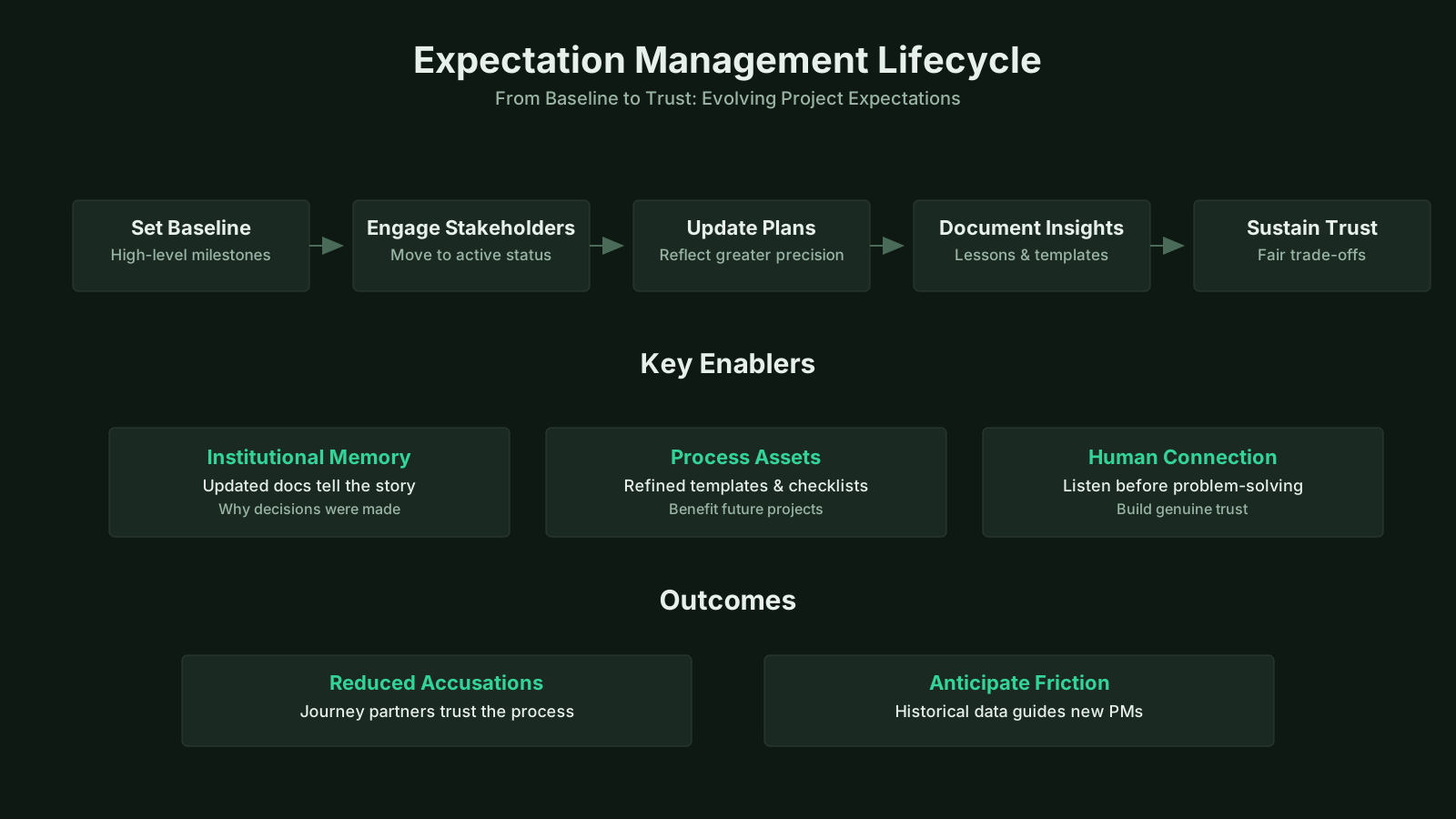
For instance, after a difficult workshop with the compliance team, you might update the stakeholder engagement plan to increase the frequency of their involvement, moving them from “consulted” to “actively engaged” status. You might also log a new risk that their expectations around audit readiness will trigger additional document review cycles. These updates, while small individually, accumulate into a body of evidence that you are proactively adapting to stakeholder sentiment. They also prevent institutional memory loss; if a new project manager takes over, the updated documents tell the story of how expectations have evolved and why certain decisions were made.
Organizational Process Assets Updates from Managing Expectations
The experience of managing expectations on one project should not vanish when that project closes. Updates to organizational process assets, in the form of new lessons learned, refined templates, or revised procedures, allow future projects to benefit from your hard-won insights. If you discovered that the procurement department consistently expected earlier vendor selection than your schedule allowed, documenting that gap and suggesting a revised stakeholder engagement checklist saves the next project manager from the same firefight.
These asset updates are often neglected because project teams are eager to move on to the next assignment. But they represent the long-term value of expectation management. When a portfolio or program office systematically captures how expectation gaps were identified and resolved, it builds institutional capability. New project managers can look at historical data to understand the typical expectation profiles of internal business partners, anticipate where friction will occur, and design their communication plans accordingly. The output from your project becomes raw material for the next project’s stakeholder management strategy, creating a virtuous cycle.
Embedding Continuous Practices to Manage Stakeholder Expectations
The tools and documents are necessary but insufficient by themselves. Real expectation management happens in the daily rhythm of continuous practices of expectation management that blend structured inputs with human judgment. You cannot afford to wait for a formal gate review or a status meeting to reset expectations; by then, the damage may have already solidified into resentful silence or open conflict. The process must become a reflex, woven into every interaction.
One practical approach is to treat every single stakeholder conversation as a micro-cycle of the process. Before the meeting, you review the stakeholder register and any open issues related to that person. During the conversation, you listen for expectations, test them against the project management plan, and log any new concerns into the issue log. After the meeting, you decide whether a change request is warranted or whether the existing plan can absorb the expectation. This might sound overly systematic, but experienced project managers do it almost unconsciously. The difference is that making it explicit ensures nothing falls through the cracks when pressure mounts and time is scarce.
Another continuous practice is to use the concept of progressive elaboration to manage expectations around uncertainty. Early in the project, when details are fuzzy, you communicate ranges rather than precise dates. As the work package planning matures, you narrow those ranges. By openly sharing the evolution of certainty, you condition stakeholders to accept ambiguity at the start without feeling misled later. The project management plan initially contains high-level milestones with wide confidence intervals; as you update it through the execution phase, you reflect greater precision. Stakeholders who have accompanied you on that journey are far less likely to accuse you of broken promises than those who only received a single-point estimate at the beginning.
It is also vital to recognize that managing expectations is not the same as pleasing everyone. Some expectations are incompatible; some are unreasonable. The process equips you with the evidence and the structured communication channels to say no credibly. When a department head demands that your project take on a task that clearly falls outside the business case, you can reference the change log impact assessment, the project management plan scope baseline, and the stakeholder register to show that accommodating their request would harm other critical stakeholder interests. That is not stonewalling; it is professional expectation management that protects the project’s viability.
Finally, the line between managing expectations and managing relationships is thin. You can follow every process step perfectly and still fail if you deliver information without empathy. Stakeholders are not machines that receive updates and recalculate their expectations accordingly. They have emotions, political pressures, and personal stakes. Sometimes you need to spend twenty minutes listening to a manager vent about a resource shortage before you can even begin to discuss the formal issue log. That listening is not wasted time; it is the emotional groundwork that makes the formal process possible. Expectation management, at its deepest level, is about sustaining trust so that when trade-offs must be made, the people involved believe they have been treated fairly.
Key Insights on Continuous Expectation Management
- Daily rhythm over formal reviews
- Expectation management thrives in the daily interplay of structured inputs and human judgment, whereas formal gate reviews often allow unresolved tensions to harden into silence or open conflict.
- Every conversation as micro-cycle
- Every stakeholder conversation becomes a micro-cycle when you prepare by reviewing the stakeholder register and open issues, test expectations against the project management plan during the discussion, and capture new concerns immediately afterward.
- Progressive elaboration for uncertainty
- Progressive elaboration lets you transparently reveal how certainty evolves, conditioning stakeholders to accept early ambiguity without feeling misled when specifics eventually firm up.
- Precision grows through execution
- The project management plan begins with broad milestones and wide confidence intervals, then gains precision through iterative updates during execution, reflecting the team’s deepening understanding.
- Documented evidence for scope pushback
- When facing an out-of-scope request, you can reference the change log’s impact assessment, the scope baseline, and the stakeholder register to demonstrate objectively that accommodating it would undermine commitments to other critical stakeholders.