Project phases are one of those concepts that look simple on the surface but become more interesting the moment a project manager tries to map out a real initiative. They are divisions within a project where extra control is needed to effectively manage the completion of a major deliverable. Understanding what project phases are and how they relate to each other shapes how work is planned, reviewed, and handed off across the entire effort.
A phase is not just a block of time on a schedule. It is a structural unit within the project life cycle that lets the team and the sponsor step back, evaluate progress, and decide whether the next major piece of work should proceed. Because phases operate at a high level, they create natural boundaries that support governance without dictating every task or activity.
The relationship between phases depends on how the project is structured. Many projects complete phases one after another, while others allow phases to overlap in specific situations. Either way, the way those boundaries are managed has a direct effect on risk, communication, and the quality of the final deliverable.
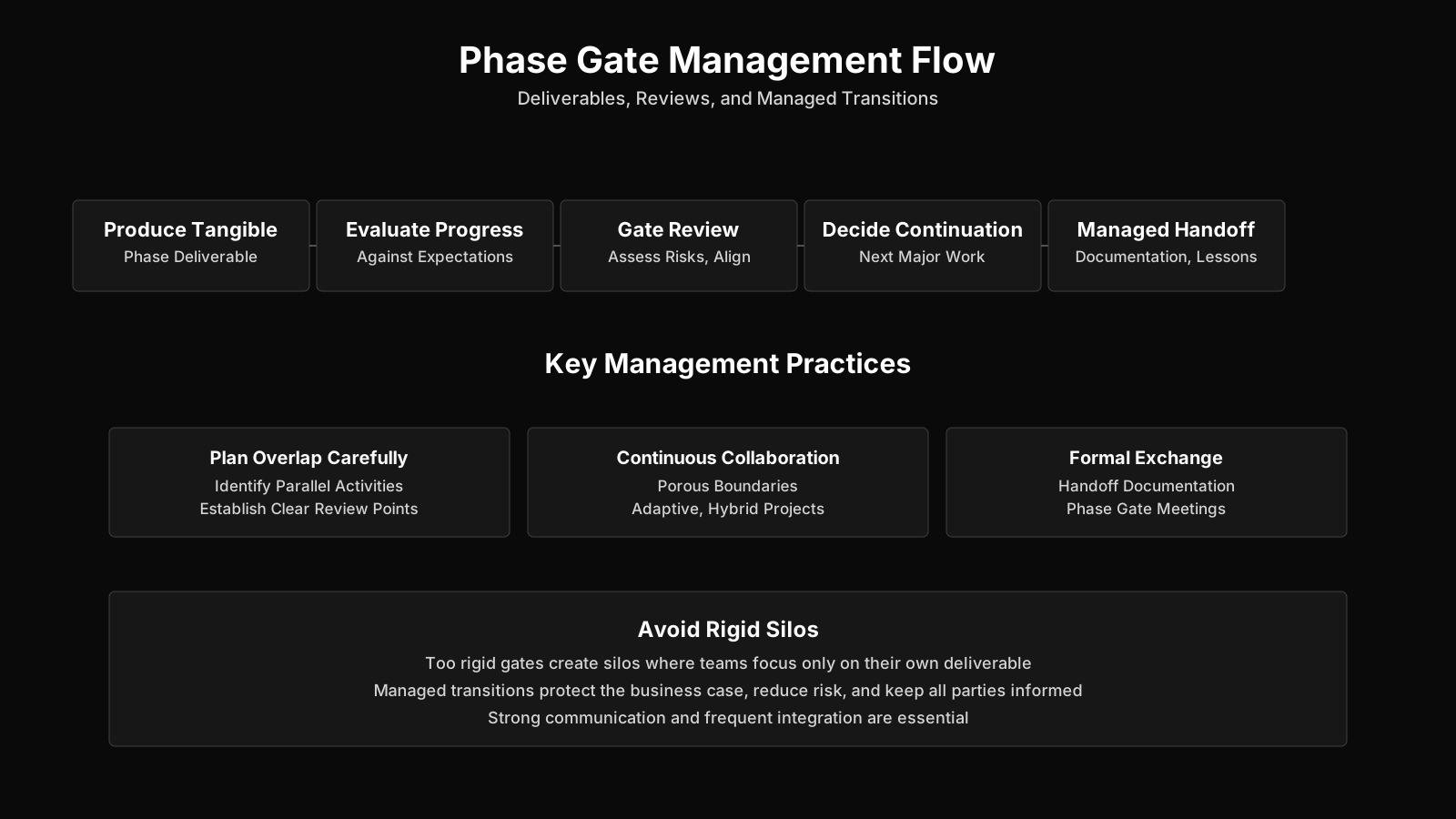
Project Phases and How They Relate: Key Topics Summary
| Key Concept | Summary |
|---|---|
| Phase Definition | A phase is a distinct segment of the project life cycle that applies targeted control to complete a major deliverable or outcome. |
| Phase Purpose | Phases create structured review points where the project team and sponsor can assess progress, confirm continued alignment, and decide whether to authorize the next major body of work. |
| Governance | Phase boundaries support effective governance by enabling oversight at key milestones without prescribing how individual tasks should be executed. |
| Life Cycle Models | Phase-based segmentation remains a consistent control mechanism across predictive and hybrid life cycle models, though the sequence and character of phases may differ. |
| Phase Relationships | Sequential phase relationships are common in construction and engineering, where later phases depend on the completeness and quality of earlier deliverables. |
| Phase Exits | At the close of a phase, especially in sequential life cycles, completed work is formally handed off and the viability of the overall effort is reassessed before proceeding. |
| Phase Gates | During a phase gate review, the project manager presents completed deliverables, current performance, updated forecasts, key risks, and any changes introduced since the previous review. |
Defining Project Phases and Their Role in the Project Life Cycle
In project management, a phase is defined as a division within a project where extra control is needed to effectively manage the completion of a major deliverable. The high level nature of project phases makes them an element of the project life cycle, not a collection of detailed work packages. This distinction matters because it places phases above the day to day task level where most execution happens.
Project phases allow the project to be segmented into logical subsets for ease of management, planning, and control. When a project is large or complex, trying to manage it as one undifferentiated mass of work becomes overwhelming. Breaking the effort into phases creates manageable chunks that can be planned and reviewed with the appropriate level of attention.
Each phase focuses on a major deliverable or objective that contributes to the overall project outcome. The deliverable may be a completed design, a working prototype, a constructed component, or an accepted set of requirements. What makes it a phase rather than a simple task grouping is the degree of control required to ensure that the deliverable is completed correctly before moving forward.
Why Project Phases Belong to the Life Cycle
The project life cycle describes the series of phases that a project passes through from start to completion. Phases are the visible building blocks of that life cycle. Different life cycle models may arrange phases differently, but the concept of phase based segmentation remains consistent across most predictive and hybrid approaches.
Because phases are high level, they do not specify every activity or work package. That detail lives in the project management plan, the work breakdown structure, and the schedule. The phase structure sits above those artifacts and gives the project manager and sponsor a way to assess whether the project is still worth continuing at key intervals.
Core Insights on Project Phases
- Phase definition and purpose
- A project phase is a distinct segment of a project that demands additional control to verify completion of a major deliverable, such as an approved design, a functioning prototype, or a validated requirements set, before work can proceed.
- High-level life cycle element
- Project phases function at the strategic level of the project life cycle, setting them apart from detailed work packages and positioning them above the day-to-day task level where the bulk of execution takes place.
- Logical subsets for control
- Dividing large or complex projects into logical, phase-based subsets creates manageable units that can be planned, reviewed, and controlled with focused oversight, preventing the burden of managing an undifferentiated stream of work.
- Control-driven phase distinction
- A grouping qualifies as a genuine phase when the level of control required to verify its deliverable is substantial, and although life cycle models sequence phases differently, phase-based segmentation remains a consistent principle across most predictive and hybrid approaches.
How Project Phases Relate to Each Other in Sequential and Overlapping Structures
Project phases are typically completed sequentially, but they can overlap in some project situations. Understanding the difference between sequential and overlapping project phases helps a project manager choose the right structure for the project context. The relationship between phases is not fixed; it is a deliberate design decision based on risk, time pressure, and dependency.
When phases are sequential, the close of a phase ends with some form of transfer or handoff of the work product produced as the phase deliverable. This phase end represents a natural point to reassess the effort underway and to change or terminate the project if necessary. Sequential phases create clear boundaries where stakeholders can evaluate what has been accomplished before authorizing the next phase.
Sequential phase relationships are common in construction, engineering, and other industries where a later phase depends heavily on the completed output of an earlier phase. You cannot begin building the foundation until the design is stable, and you should not begin detailed design until requirements are approved. The handoff between phases becomes a formal control point that protects the project from moving forward on a weak foundation.
Project Phases in Sequential Structures
In a sequential structure, each phase starts only when the previous phase has been formally closed and its deliverable accepted. The phase exit acts as a gate that must be passed before the next phase can begin. This prevents premature work on later activities that may need to be redone if earlier decisions change.
The downside of strict sequential phases is that the project may take longer because later work waits for earlier work to finish. In some cases that wait is necessary to avoid expensive rework. In other cases it creates idle time for resources that could otherwise begin preliminary work on the next phase.
Project Phases in Overlapping Structures
Overlapping project phases allow certain activities from a later phase to begin before the previous phase is fully complete. This can shorten the overall schedule and accelerate delivery. For example, procurement of long lead items might begin while the design phase is still being finalized, provided the relevant specifications are stable enough to proceed.
Overlap introduces additional coordination risk because assumptions made in the later phase may need to change if the earlier phase produces unexpected results. The project manager has to manage the interface between phases carefully and ensure that information flows fast enough to keep overlapping work aligned. Not every project can tolerate this level of ambiguity.
Phase Exits, Gates, and Decision Points as Control Mechanisms
At the end of a phase, especially when phases are sequential, the project reaches a point where work is handed off and the effort itself is reassessed. These points are referred to as phase exits and stage gates, though they may also be called milestones, phase gates, decision gates, or kill points. The variety of names reflects the same core idea: a formal moment where sponsors and stakeholders decide whether the project should continue, change direction, or stop.
This phase end represents a natural point to reassess the effort underway and to change or terminate the project if necessary. The phrase kill point is blunt but accurate because it acknowledges that continuing a project is not always the right decision. If the business case has weakened, the risks have grown beyond tolerance, or the deliverable no longer aligns with strategy, the phase gate is the place to make that call.
Phase gates are not merely administrative checkpoints. They are governance mechanisms that protect the organization from sunk cost thinking. Without a formal gate, projects tend to drift forward because stopping feels like failure. A well run phase gate creates a legitimate opportunity to ask hard questions without implying that the project team has underperformed.
What Happens at a Phase Gate
At a phase gate, the project manager typically presents the phase deliverable, the current status, updated forecasts, key risks, and any changes that have emerged since the last review. The sponsor or governance body then decides whether to approve the next phase, request changes, or terminate the project. The decision is not just about technical completeness; it also considers whether the expected business value still justifies the remaining investment.
Practitioners familiar with PRINCE2 will recognize a similar control point in the management stage boundary, where the project board decides whether to authorize the next stage. The terminology differs, but the purpose is the same: do not commit to the next major block of work until the current block has been properly reviewed.
Key Takeaways on Phase Gates
- Formal project decision points
- Phase exits, also called stage gates, milestones, or kill points, serve as structured decision points where sponsors and stakeholders determine whether a project should proceed, pivot, or be terminated.
- Kill points justify termination
- The term kill point exists because continuing a project is not always the right choice; termination becomes necessary when the business case erodes, risks exceed acceptable thresholds, or the deliverable no longer supports strategic objectives.
- Gates prevent project drift
- Without formal gates, projects tend to continue by default because stopping can feel like failure; a well-run phase gate provides a legitimate forum for raising difficult questions without implying that the team has underperformed.
- Gate review covers key items
- At each phase gate, the project manager presents the phase deliverable, current status, updated forecasts, key risks, and recent changes, mirroring PRINCE2's management stage boundary where the project board authorizes the next stage.
Characteristics That Define a Project Phase
Regardless of the number of phases comprising a project, all phases have similar characteristics. The first is that the work has a distinct focus of each phase, meaning it differs from any other phase in what it is trying to achieve. This focus often involves different organizations and different skill sets, which is why phase boundaries can feel like organizational shifts as well as technical shifts.
A design phase may be led by architects and engineers, while a construction phase is led by builders and site managers. The deliverables, the language, the risks, and the success criteria all shift. Recognizing these differences helps the project manager plan for resource transitions and communication adjustments between phases.
The second characteristic is that the primary deliverable or objective of the phase requires an extra degree of control to be successfully achieved. That extra control may come in the form of more frequent reviews, stricter acceptance criteria, formal signoffs, or dedicated quality assurance activities. The phase structure signals to everyone that this work cannot be managed as business as usual.
Why Focus and Control Go Together
When a phase has a distinct focus, it becomes easier to assign accountability and measure progress. The project manager can define what done means for that phase and hold the appropriate people responsible for delivering it. The extra control is not about bureaucracy; it is about ensuring that a major deliverable is truly complete before the project moves on.
Without that control, a phase can drift into the next one with unresolved issues that eventually resurface as costly changes. The phase boundary forces the organization to confront those issues while they are still relatively cheap to fix.
Project Phases Versus Project Management Process Groups
A project phase is not a Project Management Process Group. This is one of the most persistent confusions in project management education. The project management process groups are initiating, planning, executing, monitoring and controlling, and closing. They describe types of work that happen throughout the project, not sequential divisions of the project life cycle.
Within each project phase, the project manager and team repeat processes across all five Process Groups. A single phase may begin with initiating activities to clarify the phase scope, move through planning and execution, and close with monitoring and controlling feeding into formal closure. The repetition of processes across all five Process Groups is a core point in Chapter 3 of the PMBOK Guide.
This means a project with four phases does not have four initiating processes or four closing processes only at the project level. Each phase has its own initiating, planning, executing, monitoring and controlling, and closing processes applied at a scale appropriate to that phase. The project as a whole also has an initiating process to authorize the project and a closing process to formally end the entire effort.
Why the Distinction Matters
Honestly, the distinction trips up even experienced practitioners. People sometimes say the project is in the executing phase, which confuses process groups with phases. A phase may be called execution, but execution as a process group is happening in every phase where work is being produced. The phase name describes the major deliverable or focus, not the type of process work.
Understanding the difference prevents a project manager from treating a phase as a process box on a diagram. It also explains why a phase can have its own closure even though the project is not finished. The phase closure is a handoff point, while project closure is the final release of resources and acceptance of the overall deliverable.
Key Insights on Process Groups
- Process groups repeat within each phase
- The five process groups represent recurring categories of work rather than sequential stages of the life cycle, and teams apply all five within every project phase at a level of effort proportionate to that phase.
- Phase closure is a handoff point
- Closing activities at the end of each phase transfer deliverables and accountability to the next phase, while project closure formally releases resources and confirms acceptance of the final deliverable.
- Project level has its own processes
- The overall project has its own initiating process to authorize the full effort and a closing process to formally conclude it, distinct from the phase level processes executed throughout the project.
Factors Influencing the Number of Phases and Degree of Control
The number of phases, the need for phases, and the degree of control applied depend on the size, complexity, and potential impact of the project. There is no universal answer for how many phases a project should have. A small internal process improvement may be managed as a single phase, while a large infrastructure program may require many phases separated by formal decision gates.
Selecting the right number of phases is a judgment call that balances control against overhead. More phases mean more review points, more documentation, and more opportunities for stakeholders to influence direction. Fewer phases mean less control but faster movement through the work. The project manager must match the phase structure to the risk profile of the project.
Complexity plays a major role. When the project involves multiple organizations, regulatory constraints, or high technical uncertainty, additional phases provide points where the project can be revalidated before committing more resources. High potential impact raises the stakes of getting the deliverable right, so extra control is justified.
Balancing Control and Overhead
That balance is harder than it looks. Too many phases can create decision fatigue and slow the project down with repeated gate reviews that add little value. Too few phases can leave the project without a natural point to stop and reassess, allowing problems to compound until they become very expensive.
The phase structure should reflect the genuine decision points in the project, not an arbitrary template. If a major deliverable is complete and its acceptance will significantly influence what happens next, that is a good candidate for a phase boundary. If the work is continuous and low risk, forcing a phase gate may create unnecessary friction.
Managing Phase Transitions and Handoffs
When phases are sequential, the close of a phase ends with some form of transfer or handoff of the work product produced as the phase deliverable. Managing phase transitions and handoffs well is often the difference between a smooth project and one where critical information gets lost between teams. The handoff is not just a document being emailed; it is a transfer of responsibility, knowledge, and accountability.
The work product may be a design document, a physical prototype, a tested module, or an approved plan. Whatever the form, the receiving phase needs enough context to understand what was produced, what decisions were made, and what constraints remain. If that context is missing, the next phase starts with a partial understanding of the deliverable and a higher risk of rework.
Phase transitions are natural points to reassess the effort underway and to change or terminate the project if necessary. That reassessment is more useful when the handoff materials are complete and accurate. A gate review based on incomplete information may approve a phase that should have been stopped or changed.
Handoff Artifacts and Acceptance
Formal handoffs usually include acceptance criteria, signoff records, and any open issues or assumptions that carry forward. The project manager should ensure that the accepting party understands the state of the deliverable and the implications of accepting it. Acceptance at a phase boundary does not necessarily mean the work is perfect; it means the work is good enough to proceed under the agreed conditions.
Overlap and Handoff Complexity
When phases overlap, handoffs become more fluid and less formal. Later phase work may begin before earlier phase deliverables are fully accepted, which means assumptions and preliminary information flow in both directions. The project manager has to track which parts of the earlier phase are stable enough to support later work and which parts remain subject to change.
Key Insights on Phase Handoffs
- Handoffs transfer responsibility and knowledge
- A phase handoff transfers ownership, decision context, and accountability between teams, rather than merely passing a document along.
- Missing context creates rework risk
- Without a clear record of what was produced, which decisions were locked in, and which constraints still apply, the next phase begins with incomplete context and a significantly higher chance of rework.
- Phase boundaries enable project reassessment
- Phase transitions offer a structured opportunity to reassess project viability, adjust direction, or stop work before additional resources are committed.
- Acceptance supports progressive project flow
- Formal acceptance criteria and signoff records establish that the work meets the agreed standard for progression, while early downstream activities can begin under clearly documented assumptions that flow in both directions.
Practical Applications and Common Pitfalls in Phase Structuring
Phase structuring is applied in almost every project environment, from construction and software development to organizational change and product launch. The key is to use phases as decision points rather than as cosmetic labels on a Gantt chart. One of the most common phase structuring pitfalls is treating phase gates as a rubber stamp exercise where the project continues no matter what the review reveals.
Another frequent pitfall is designing phases based on the organizational chart rather than the deliverable logic. A phase may be handed off between departments simply because that is how the company has always worked, even when the work would benefit from more integrated collaboration. The distinct focus of each phase should be driven by the deliverable, not by internal politics.
Some practitioners also confuse phases with calendar periods or reporting cycles. A phase is not the same as a quarter or a sprint. While a phase may align with a reporting period by coincidence, its defining feature is the completion of a major deliverable that requires extra control. If no major deliverable is completed, adding a phase boundary adds no value.
Avoiding Mechanical Application
In Agile environments, the formal phase gate may be replaced by a review of the product increment, but the governance impulse remains the same: stop, inspect, and decide. The structure may be lighter, but the need to verify that value is still being delivered does not disappear. Teams that skip all phase like reviews can lose sight of whether the product direction remains valid.
The best approach is to let the project context drive the phase structure. Large, high impact, high uncertainty projects generally need more formal phases and gates. Small, low risk, well understood projects may need only a few checkpoints. Applying a heavy phase structure to a small project creates unnecessary overhead, while applying a light structure to a complex project invites uncontrolled drift.
How Project Phases Support Governance and Value Delivery
Project phases are fundamentally a governance tool. They give sponsors, executives, and other stakeholders defined moments to evaluate whether the project is still worth continuing. This governance and value delivery function is what separates a phase from a simple work package. A phase gate is not just a technical review; it is a business decision point.
At each phase boundary, the organization can ask whether the expected benefits still justify the remaining investment. Market conditions may have changed, competitors may have moved, or internal priorities may have shifted. The phase structure ensures those questions are asked before more money and time are committed to the next block of work.
Some value oriented approaches take this further. Business Value-Oriented Project Management, for example, treats persistent decline in business value points as a signal for possible closure at phase boundaries. The idea is that a phase gate should not only verify technical completeness but also confirm that the business case remains healthy.
Phase Reviews as Value Checkpoints
Effective phase reviews combine deliverable acceptance with a broader look at value, risk, and strategic alignment. The project sponsor plays a critical role here because the sponsor is accountable for realizing the benefits the project was approved to deliver. The project manager provides the performance data, but the sponsor owns the decision to continue.
Non financial factors also matter at phase boundaries. Stakeholder confidence, regulatory compliance, team capacity, and organizational readiness can all influence whether the next phase should proceed. A phase gate is an opportunity to integrate these perspectives rather than simply checking whether the schedule is on track.
When phases are designed thoughtfully, they create a rhythm of delivery and reflection. Each phase produces something tangible, and each phase boundary forces the organization to look at that tangible result and decide what it means for the future. That rhythm is one of the most practical reasons to understand project phases and how they relate to each other.
Key Takeaways on Phase Governance
- Phases as governance checkpoints
- Each phase functions as a governance checkpoint where sponsors and executives can confirm the project remains viable and aligned with business objectives before committing further time and capital.
- Phase gates as business decisions
- A phase gate is a business decision point at which the organization reassesses whether the expected benefits continue to justify the remaining investment, considering changes in market conditions, competitive dynamics, or internal priorities.
- Phase reviews as value checkpoints
- Effective phase reviews integrate deliverable acceptance with an assessment of value, risk, and strategic alignment, making the project sponsor accountable for realizing the benefits approved at each gate.
