What's the difference between a lead and a lag in project scheduling? In simple terms, a lead accelerates a successor activity by allowing it to start earlier than the dependency would otherwise permit, while a lag delays the successor activity by inserting waiting time into the relationship. The project management team determines dependencies that may require a lead or a lag to accurately define the logical relationship. The use of leads and lags should not replace schedule logic, and activities and their assumptions should be documented. This distinction matters for schedule accuracy, risk visibility, and stakeholder communication. A lead or lag is always attached to a logical relationship between two activities, never to an activity in isolation.
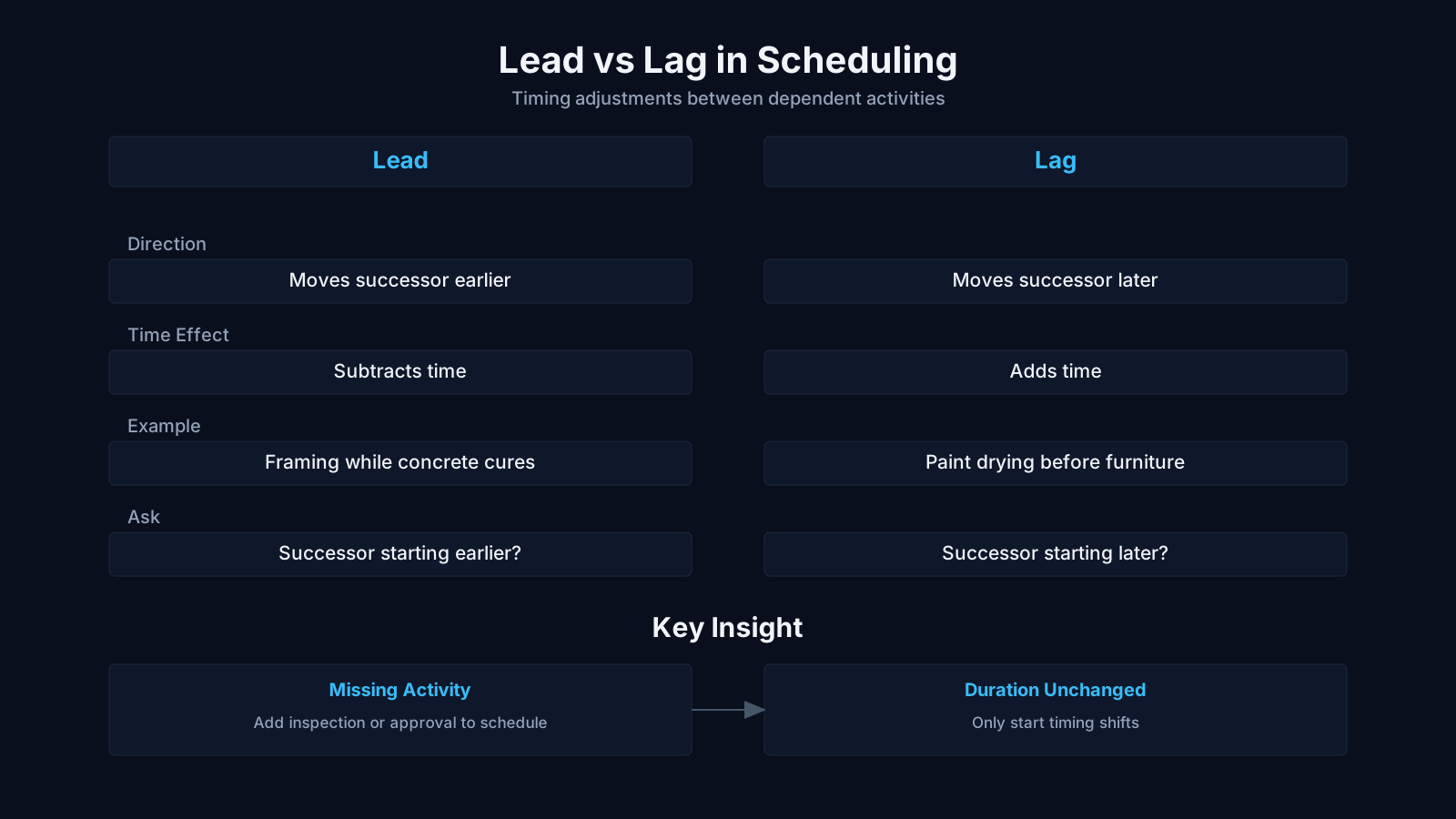
Lead vs. Lag in Project Scheduling: Summary
| Key Concept | Summary |
|---|---|
| Lead | A lead compresses the schedule by allowing a successor activity to begin before the predecessor is fully complete, creating controlled overlap where downstream work can safely start. |
| Lag | A lag introduces a deliberate delay between a predecessor and a successor, adding a finite waiting period to the dependency relationship to reflect real-world timing constraints. |
| Dependency Analysis | The project team assesses each dependency to determine whether a lead or lag more accurately models the handoff, resource availability, and timing constraints between activities. |
| Lead in Practice | A landscaping crew mobilizes while interior punch list items are still being completed, enabling exterior work to overlap the final phase of building construction without compromising quality. |
| Lag in Practice | A technical writing team begins editing a large deliverable 15 days after drafting starts, reflecting a documented production handoff and review ramp-up period. |
| Purpose of Lag | Lags commonly represent concrete delays such as concrete curing, regulatory approval cycles, material delivery lead times, or sequential review stages required before dependent work can proceed. |
| Schedule Logic Integrity | The source explicitly cautions that leads and lags should complement, not substitute for, sound schedule logic; they cannot repair flawed dependency sequencing or missing activities. |
| Documentation Requirements | Every lead and lag assumption, including specific durations such as a fifteen-day draft production lag, must be captured in the schedule basis documentation to support schedule quality and auditability. |
Lead vs Lag in Project Scheduling: Core Definitions
Before comparing the two modifiers, it helps to understand the basic dependency relationships they attach to. A finish-to-start relationship means a successor cannot begin until a predecessor finishes. A start-to-start relationship means a successor cannot begin until a predecessor begins. Project schedulers also use finish-to-finish and start-to-finish relationships, but the source examples focus on finish-to-start and start-to-start pairings. Leads and lags act as time adjustments on these relationships.
A lead allows an acceleration of the successor activity. On a project to construct a new office building, landscaping could be scheduled to start 2 weeks prior to the scheduled punch list completion. This is shown as a finish-to-start relationship with a 2-week lead. In practice, the landscaping crew arrives while the final interior punch list items are still being completed, so the exterior work overlaps the tail end of construction.
A lag directs a delay in the successor activity. For example, a technical writing team can begin editing the draft of a large document 15 days after they begin writing it. This is shown as a start-to-start relationship with a 15-day lag. Editing cannot start immediately when writing starts because the writers need enough draft material to make editing productive.
The core difference between a lead and a lag in project scheduling is direction of time adjustment. A lead subtracts time from the relationship, pulling the successor earlier. A lag adds time, pushing the successor later. Both changes remain anchored to the same predecessor and successor pair.
What Is a Lead in Project Scheduling?
A lead in project scheduling is a negative time offset applied to a dependency relationship. Rather than waiting for the predecessor to fully finish, the successor can begin some number of days before that finish. The office building example illustrates this: landscaping starts two weeks before punch list completion. The finish-to-start relationship still exists, but the lead modifies the timing.
Leads often represent overlap or fast-tracking decisions. A team might compress the schedule by starting design review before the full design package is finalized. The risk is that rework may occur if the predecessor work changes after the successor has already started. Therefore, leads carry an inherent assumption about stability of upstream deliverables.
What Is a Lag in Project Scheduling?
A lag in project scheduling is a positive time delay inserted between predecessor and successor activities. The technical writing example shows a start-to-start relationship with a fifteen-day lag. The editing team does not begin when writing begins; they wait until enough draft content exists. Lags often represent waiting periods, curing times, approval cycles, or simply the natural pacing of dependent work.
Unlike a lead, a lag does not require overlapping work. It creates a buffer of time without adding a separate activity. Some schedulers prefer to model waiting time as an explicit activity, while others use a lag for simplicity. The choice affects how visible the wait is in the schedule network diagram.
Essentials of Lead and Lag
- Dependency relationship basis
- Leads and lags are time adjustments that modify dependency relationships, most commonly in finish-to-start and start-to-start relationships.
- Lead accelerates successor start
- A lead moves a successor activity to an earlier point than its dependency would normally allow, such as starting landscaping two weeks before the punch list is completed.
- Lag delays successor timing
- A lag inserts a defined waiting period after the predecessor's start, as when editing begins 15 days after writing starts to ensure enough draft material is ready.
- Direction defines the difference
- The core distinction between lead and lag is the direction of the schedule adjustment. Lead shifts successor work earlier, while lag defers it.
How Lead and Lag Affect Schedule Logic
Schedule logic is the foundational sequence of dependencies that determines the order of activities. Leads and lags are modifiers to that logic, not replacements for it. The source notes explicitly warn that the use of leads and lags should not replace schedule logic. If the logical relationship itself is wrong, no amount of lead or lag time will fix it. This sounds obvious until a schedule starts slipping and someone adds a lag to hide the problem.
Consider the construction example. If landscaping is linked to building construction with a finish-to-start relationship and a two-week lead, the scheduler is asserting that the predecessor is punch list completion and the successor is landscaping. The lead simply shifts the successor left. If the scheduler instead used an incorrect predecessor, such as interior painting, the lead would create a misleading date and hide the real dependency.
The technical writing example similarly depends on correct logic. Editing starts after writing starts, not after writing finishes. That start-to-start relationship captures the reality that editing can begin while writing is still underway. The fifteen-day lag then represents the time needed to produce enough draft content. Without the lag, editing would start on day one of writing, which is unrealistic because there would be nothing to edit.
Leads and lags also interact with critical path calculations. A lead can shorten the total duration if it reduces a critical path segment. A lag can lengthen it. However, these modifiers do not create float; they alter timing based on the specified relationship and duration. Schedule network analysis treats them as part of the dependency calculation.
One practical rule is to document assumptions behind every lead and lag. If a two-week lead assumes landscaping can begin before final punch list completion, stakeholders need to know that. If a fifteen-day lag assumes writers produce enough draft material, that assumption belongs in the schedule documentation. Without this, future schedulers cannot trace why the timing looks the way it does.
Why Lead and Lag Should Not Replace Schedule Logic
Schedule logic describes why work happens in a specific order. Leads and lags describe how much time shifts around that order. When a scheduler adds a large lag to force a date, it often masks a missing dependency or a missing activity. The schedule might look correct on paper but will not hold up during execution. Team members may see waiting time that no one can explain, which erodes confidence in the plan.
A better approach is to first establish all true predecessor and successor relationships. Then evaluate whether overlap or delay is needed. If a delay represents real work, such as a curing period or a review cycle, consider whether it deserves its own activity. If it is purely a time offset, a lag is appropriate. This analytical sequence keeps the schedule defensible.
Lead and Lag in Finish-to-Start and Start-to-Start Relationships
Finish-to-start relationships are the most common dependency type in project scheduling. Adding a lead to a finish-to-start relationship allows the successor to start before the predecessor finishes, creating overlap. Adding a lag to a finish-to-start relationship delays the successor after the predecessor finishes. The source building example uses a finish-to-start with a lead.
Start-to-start relationships are useful when two activities can begin in parallel but the successor needs some initial progress from the predecessor. The source writing example uses a start-to-start with a lag. This combination ensures editing starts only after writing has produced enough material. Both relationship types can use leads or lags, but the interpretation changes slightly based on the relationship direction.
Practical Applications of Lead and Lag in Project Scheduling
Real-world lead and lag examples in project scheduling show up across many industries. Construction schedules use leads for overlapping trades and lags for curing concrete or waiting for inspections. Engineering projects use leads to start procurement before drawings are fully approved. Software teams sometimes use lags for testing after code is written, or leads to begin test planning before development finishes.
The office building example from the source is a classic finish-to-start with a lead. Punch list completion is the predecessor, landscaping is the successor, and the two-week lead lets landscaping begin before punch list work wraps up. This is an overlap that makes practical sense because exterior landscaping does not depend on every interior punch list item being done. Some parts of the site are ready for planting while interior snags are still being resolved.
The technical writing example is a start-to-start with a lag. Writing and editing are separate activities but tightly coupled. The writers need a head start before editors can review their output. The fifteen-day lag reflects the time it takes to produce enough draft content. Without that lag, editors would sit idle waiting for material or would start reviewing very early drafts and waste effort.
Procurement schedules often use lags after placing an order to account for supplier lead time. Manufacturing schedules might use a lag between production and packaging. Marketing projects sometimes use leads to start creative development before brand guidelines are completely finalized. In every case, the lead or lag represents a real timing adjustment, not an arbitrary date shift.
In Agile environments, formal leads and lags are less common because work is planned in short iterations and dependencies are managed just in time. However, Agile teams still encounter waiting periods and overlap. A kanban board might show a work item waiting for review, which is conceptually a lag. A Scrum team might start the next sprint's refinement before the current sprint ends, which is a lead-like overlap. The terminology differs, but the underlying scheduling dynamic remains.
Lead and Lag in Construction Project Scheduling
Construction is where many people first encounter lead and lag. A lead often indicates fast-tracking, where successor trades start before predecessor trades fully complete. A lag often represents mandatory waiting time, such as concrete curing before form removal. In the source example, landscaping starts two weeks before punch list completion, which is a lead. Schedulers must verify that the overlap does not create unsafe congestion or damage finished work.
The construction schedule's critical path may shift depending on how leads and lags are applied. If landscaping is on the critical path, pulling it forward by two weeks could shorten the project. If it is not critical, the lead may simply reduce float and create more schedule risk later. This is why lead and lag decisions belong in the schedule model with assumptions documented.
Lead and Lag in Documentation and Technical Writing Projects
Documentation projects rely heavily on start-to-start and finish-to-start relationships. Writing and editing can overlap, but only after enough draft exists. The source example uses a fifteen-day lag on a start-to-start relationship. That lag gives writers time to produce content before editors begin. A lead might be used to start formatting near the end of writing, even before the final draft is complete.
These timing adjustments help avoid idle time for editors and ensure quality. But the assumptions must be clear. How much draft material is enough? What happens if writers are delayed? The fifteen-day lag is not a guarantee; it is a planning assumption that may need adjustment as the project unfolds.
Lead and Lag in Action
- Construction scheduling examples
- Construction schedules frequently use leads to overlap sequential trades and compress overall duration, while lags protect time-sensitive activities such as concrete curing, permit reviews, and inspections.
- Engineering procurement lead
- Procurement for long-lead equipment often starts before final drawing approval by applying a lead to the design-to-procurement dependency, reducing total project delivery time without waiting for complete engineering sign-off.
- Software workflow timing
- Software teams commonly insert a lag between code completion and formal testing to allow for environment provisioning or build stabilization, while leads let test planning begin before development work is fully finished.
- Office building overlap example
- A classic finish-to-start lead appears when site landscaping begins two weeks before the interior punch list is complete, because exterior work can proceed independently of remaining interior corrections.
- Agile dependency management
- Agile teams rarely formalize leads and lags because short iterations, continuous planning, and just-in-time coordination absorb dependency offsets without requiring explicit schedule logic.
Common Misconceptions About Lead and Lag in Project Scheduling
Several misconceptions about lead and lag in project scheduling persist even among experienced practitioners. One common error is thinking that a lead is simply negative lag. While they are opposites in sign, the underlying dependency relationship must still be valid. Changing a lag to a lead without checking the relationship can produce impossible sequences.
Another misconception is that leads and lags are free float. They are not. Float is the amount of time an activity can be delayed without affecting successor dates or the project finish. A lead or lag is a planned time modifier on a specific relationship. It consumes or creates scheduling room, but it does not automatically grant flexibility to the activity owner.
Some schedulers believe that adding a lag is safer than adding an activity because it is simpler. This can be true for small waiting periods, but large or complex waits deserve their own activity. An explicit wait activity makes the wait visible on the schedule and allows resource assignment, progress tracking, and risk analysis. A lag hides the wait inside a relationship line, which can be overlooked during status reviews.
There is also confusion about negative lag. A lead is sometimes called negative lag in scheduling software. That terminology is mathematically accurate, but it can confuse stakeholders. Saying "we have a two-week lead" is clearer than saying "we have negative two weeks of lag." Teams should adopt language that makes the schedule direction obvious.
Finally, some project managers treat leads and lags as a way to force dates that management wants to see. That is dangerous. If a lead or lag does not correspond to a real physical or procedural condition, it becomes an artificial constraint. The schedule may meet expectations on paper but fail during execution because the work cannot actually happen that way.
Lead and Lag vs. Schedule Compression Techniques
Schedule compression techniques such as fast-tracking and crashing often involve leads, but they are not the same thing. Fast-tracking is the practice of overlapping phases or activities that would normally be sequential. A lead can represent that overlap in the schedule model. Crashing adds resources to shorten durations, which may reduce the need for leads or lags. Understanding these distinctions prevents schedule manipulation from being hidden inside dependency modifiers.
When a project is behind schedule, a project manager might apply a lead to start a successor earlier. That decision should come from a formal schedule compression analysis, not a quick edit to the relationship. The risk of rework and coordination issues increases with every lead. Therefore, leads should be justified by feasibility, not used as a cosmetic fix for a late predecessor.
When a Lag Is the Wrong Modeling Choice
A lag is the wrong choice when the waiting time represents a distinct deliverable or stage with its own owner and progress. For example, waiting for a regulatory approval is not just a time delay; it is a process that may be expedited or may slip. Modeling that wait as a lag makes it invisible to stakeholders who manage approvals. Creating a separate approval activity with a duration, owner, and status is far more useful.
Likewise, a lag that stretches into weeks or months should raise a red flag. It may indicate a missing dependency, an absent resource, or a risk that has been silently embedded in the schedule. Investigating long lags often uncovers schedule logic problems that were papered over with time offsets.
Lead and Lag Across Different Project Management Frameworks
Project management frameworks approach lead and lag with varying degrees of formality. In PMBOK, leads and lags are part of the Project Schedule Management knowledge area, specifically within the Sequence Activities and Develop Schedule processes. A lead is described as the amount of time a successor activity can be advanced with respect to a predecessor activity, while a lag is the amount of time a successor activity will be delayed. These definitions align with the source examples.
The PMBOK guidance emphasizes that dependency determination may require a lead or lag to accurately define the logical relationship. It also warns that leads and lags should not replace schedule logic. This is a direct framing of the source notes. The schedule management plan may define the rules for using leads and lags, including authority levels for applying them and documentation requirements.
PRINCE2 does not use the terms lead and lag as prominently as PMBOK. Its product-based planning approach focuses on product dependencies and the order of delivery. However, practitioners often encounter the same timing issues. When a PRINCE2 plan shows a product flow, the overlap or delay between products may be expressed as a lead or lag in the underlying schedule tool. The concept exists even if the terminology is less formalized in the method.
Agile frameworks have a different relationship with leads and lags. In Scrum, work is planned within timeboxes, and dependencies between stories or tasks are meant to be minimized. Lead time and cycle time are different concepts from schedule leads and lags. Lead time measures the total time from request to delivery, while cycle time measures active work. These are metrics, not relationship modifiers. That distinction often confuses people moving between traditional and Agile scheduling contexts.
Kanban systems may exhibit lag-like behavior when work waits in a queue before the next stage can pull it. A service-level expectation may define how long work should wait before being acted upon. That is a lag in a process sense, but it is not encoded as a relationship modifier in a network diagram. The same underlying timing pressure exists, but the management response differs.
In critical path method scheduling, leads and lags directly affect the forward and backward pass calculations. A lead on a critical path relationship can reduce the project duration. A lag on a critical path relationship can extend it. Schedulers must include these modifiers when computing early and late dates. Failing to do so yields incorrect float values and a misleading critical path.
Where Lead and Lag Fit in the PMBOK Scheduling Processes
In the PMBOK framework, the Sequence Activities process produces a project schedule network diagram. Dependencies are identified and characterized as mandatory, discretionary, external, or internal. Leads and lags are then applied where needed as part of defining the relationship. The Develop Schedule process incorporates these modifiers into the schedule model to calculate dates and critical paths.
This placement matters because it shows that leads and lags are scheduling inputs, not standalone tasks. They do not appear as activities on a work breakdown structure. They exist only in the dependency links between activities. Documenting them in the schedule data and assumptions log is essential for maintaining traceability and supporting schedule reviews.
Lead and Lag in Agile and Hybrid Environments
Hybrid projects often combine a traditional schedule baseline with iterative delivery. In such settings, leads and lags may appear in the high-level release schedule but not in sprint-level task boards. The high-level plan might show a two-week lag between completion of discovery work and the start of detailed design. At the sprint level, the team simply picks up the next item when ready, without a formal lag encoded in a tool.
Agile coaching sometimes discourages leads and lags because they can introduce unnecessary constraints in an environment that values responding to change. However, ignoring real timing constraints can lead to overcommitment. The practical middle ground is to make dependencies visible, whether through a schedule modifier, a kanban wait state, or a conversation during sprint planning. The team should decide the level of formality based on project complexity and stakeholder needs.
How Frameworks Treat Lead and Lag
- PMBOK formalizes lead and lag
- PMBOK defines lead as the amount of time a successor activity may be advanced relative to its predecessor, and lag as a required delay before a successor can begin, integrating both into the Sequence Activities and Develop Schedule processes.
- Governance through schedule management plan
- The schedule management plan establishes controls for using leads and lags by defining approval authority, documentation requirements, and the specific conditions under which these schedule offsets may be applied.
- PRINCE2 uses product-based planning
- PRINCE2 prioritizes product dependencies and delivery sequence, so any overlap or delay between products is modeled as a lead or lag within the scheduling tool rather than treated as a separate planning activity.
- Agile methods minimize dependencies
- Scrum structures work in timeboxes and actively reduces dependencies between stories, while Kanban makes lag-like waiting visible when work items queue before moving to the next stage.
- Critical path calculations affected
- In critical path method scheduling, lead and lag values directly affect the forward and backward pass calculations, changing the computed early and late dates, total float, and overall project duration.
Documenting Lead and Lag in the Schedule Baseline
A reliable schedule baseline must document lead and lag values explicitly. The source notes state that activities and their assumptions should be documented. This is not optional detail. A schedule with unexplained leads and lags becomes difficult to review, audit, or update. Stakeholders, auditors, and future project managers need to understand why an activity starts early or late.
Documentation should include the predecessor and successor activity identifiers, the relationship type, the lead or lag value and unit, and the rationale or assumption behind the timing offset. For the office building example, the documentation might note that landscaping can start two weeks before punch list completion because exterior areas are accessible and weather permits. For the technical writing example, the fifteen-day lag assumes writers produce enough draft content per day.
Schedule tools usually store lead and lag as attributes of the dependency link. Some tools express a lead as negative lag. The scheduler should configure the tool to display leads clearly and avoid confusion with negative numbers. Reports and dashboards should show key leads and lags so that stakeholders can see where overlap or waiting time is planned. Hidden modifiers create surprises during execution.
Change control processes should govern modifications to leads and lags after the baseline is approved. Changing a lag from five days to ten days may extend the project, so it should follow the same change request process as any other schedule change. Removing a lead because of safety concerns should be documented and communicated. These changes affect dates, resource loading, and risk exposure.
Assumption log entries often support lead and lag decisions. If landscaping depends on weather conditions, that assumption belongs in the assumption log. If editing requires a certain number of draft pages per day, that belongs there too. When assumptions change, the lead or lag may need to change. The assumption log and schedule model must be reviewed together to keep the plan coherent.
How to Communicate Lead and Lag to Stakeholders
Stakeholders rarely need to see every lead and lag in the schedule, but they do need to understand the ones that affect milestone dates. A project manager might explain that landscaping starts two weeks early to help meet the target completion date, but this creates a risk if punch list issues delay the predecessor. That explanation turns a schedule technicality into a meaningful trade-off.
Using simple language helps. Instead of saying "we have an FS relationship with a two-week lead," say "landscaping will overlap with the final building checks by two weeks." Instead of saying "SS plus fifteen days lag," say "editing will begin fifteen days after writing starts." Clear communication reduces misunderstandings and makes schedule reviews more productive.
Reviewing Leads and Lags During Schedule Control
During schedule control, project managers should monitor whether leads and lags are still valid. A lag that made sense at planning time may become obsolete when work patterns change. A lead that assumed upstream stability may need to be removed if predecessor work is slipping. Regular schedule updates should include a quick review of active leads and lags, not just activity percent complete.
When earned value analysis shows schedule variance, leads and lags can be part of the diagnosis. A negative lag mistake in the baseline can distort performance measurements. Correcting that error may change the planned dates and recover lost schedule credibility. Documenting the correction in the change log is just as important as the correction itself.
Key Differences Between Lead and Lag in Project Scheduling
The most fundamental lead and lag differences relate to direction of time adjustment. A lead pulls the successor activity earlier, creating overlap with the predecessor. A lag pushes the successor activity later, creating a pause after the predecessor or after a start event. In the source examples, landscaping moves earlier with a two-week lead, while editing moves later with a fifteen-day lag. This directional difference changes the risk profile of the schedule.
Choosing between a lead and a lag starts with the real-world condition. If two activities can overlap without compromising quality or safety, a lead may be appropriate. If a successor must wait for a material, approval, or elapsed time, a lag is likely appropriate. Schedulers should not force either modifier simply to adjust dates. The modifier should emerge from the nature of the work.
Both leads and lags must be monitored continuously. A lead introduces rework risk if the predecessor changes. A lag introduces idle time and potential resource gaps. Neither is inherently better. The correct choice depends on the dependency, the timing constraints, and the project team's ability to coordinate overlapping or delayed work.
Decision Criteria for Lead and Lag in Project Scheduling
When evaluating whether to apply a lead, ask whether the successor can truly begin before the predecessor finishes. What would be the rework cost if the predecessor work changes? Are resources available early? Does the team have a mechanism to communicate partial completion? If the answers are positive, a lead may add value. The office building example meets these criteria because landscaping and punch list work occupy different areas and can progress without interfering.
When evaluating whether to apply a lag, ask whether the delay is a fixed elapsed time or an activity with its own ownership. For pure elapsed time, such as curing or a simple waiting period, a lag is appropriate. For a review or approval process, an explicit activity is usually better. The technical writing example uses a lag because the delay is a simple matter of producing enough draft material, not a separate process with a distinct owner.
How Lead and Lag Affect Project Risk
Every lead carries overlap risk. Starting landscaping early may be fine until punch list work spills into the landscaping area and damages new plantings. Every lag carries delay risk. If the writing team produces less draft material than expected, editing may sit idle longer than planned, or editors may start with incomplete content and require rework. A schedule risk analysis should consider these modifiers as risk sources, not just schedule arithmetic.
Communicating these risks is part of schedule management. Stakeholders tend to focus on finish dates, but the assumptions behind leads and lags reveal why the date may hold or slip. A project manager who can explain that the finish date depends on a two-week lead in landscaping has set the stage for more transparent trade-off discussions if the overlap becomes unsafe.
Documentation, as noted earlier, is the glue that holds these decisions together. A lead or lag without an assumption is like a contract without terms. It may work for a while, but when something goes wrong, there is no basis for resolution.
Key Insights on Lead and Lag
- Direction defines the time adjustment
- A lag intentionally delays the successor activity to create a required pause, whereas a lead accelerates it to create overlap, as when landscaping shifts two weeks earlier while editing waits fifteen days.
- Real-world conditions guide the choice
- Project teams typically apply a lag when the successor depends on materials, approvals, or elapsed time, and apply a lead when activities occupy different areas and can proceed without interference, as illustrated in the office building example.
- Schedule risk profile changes accordingly
- A lag introduces schedule risk when the predecessor underdelivers, because downstream resources may remain idle longer than planned or begin work with incomplete content and then require rework, which changes the overall risk profile of the schedule.