Managing change requests during procurement administration often feels like navigating a legal minefield while simultaneously keeping a project on schedule. Procurement contracts carry binding obligations, yet the dynamic nature of projects makes adjustments inevitable. A seemingly harmless verbal instruction to a supplier, a side conversation about delivering a bit faster, or an email suggesting a different material specification can all blossom into formal change requests that ripple through baselines and budgets. The way these change requests are identified, documented, evaluated, and resolved determines whether a procurement relationship strengthens or dissolves into claims and litigation. The PMBOK® framework provides a clear path: change requests that arise from the Administer Procurements process are fed into the Perform Integrated Change Control process for thorough review. However, there is a messy middle ground between a clean change order and a disputed constructive change where unresolved instructions and actions can seed conflict. This article explores exactly how change requests during procurement administration are handled, what makes constructive changes uniquely volatile, and why project correspondence forms the backbone of defensible decision-making.
How Procurement Handles Change Requests: A Summary
| Key Concept | Summary |
|---|---|
| Change Requests | Procurement change requests emerge from performance deficiencies, shifting requirements, or contractual gaps and must undergo formal processing to avoid uncontrolled deviations and disputes. |
| Administer Procurements | The Administer Procurements process governs ongoing contract execution through invoice verification, quality audits, and performance monitoring, functioning as the frontline mechanism for detecting necessary changes. |
| Project Correspondence | Emails, letters, meeting minutes, and daily logs systematically record constructive changes, creating an audit trail that connects informal events to the formal change control framework. |
| Change Control | All procurement change requests must pass through the Perform Integrated Change Control process to evaluate how they affect project baselines, the project management plan, and strategic objectives. |
| Constructive Changes | A constructive change is an implied contract modification resulting from buyer direction or seller conduct without a formal amendment, frequently breeding disputes over scope and entitlement. |
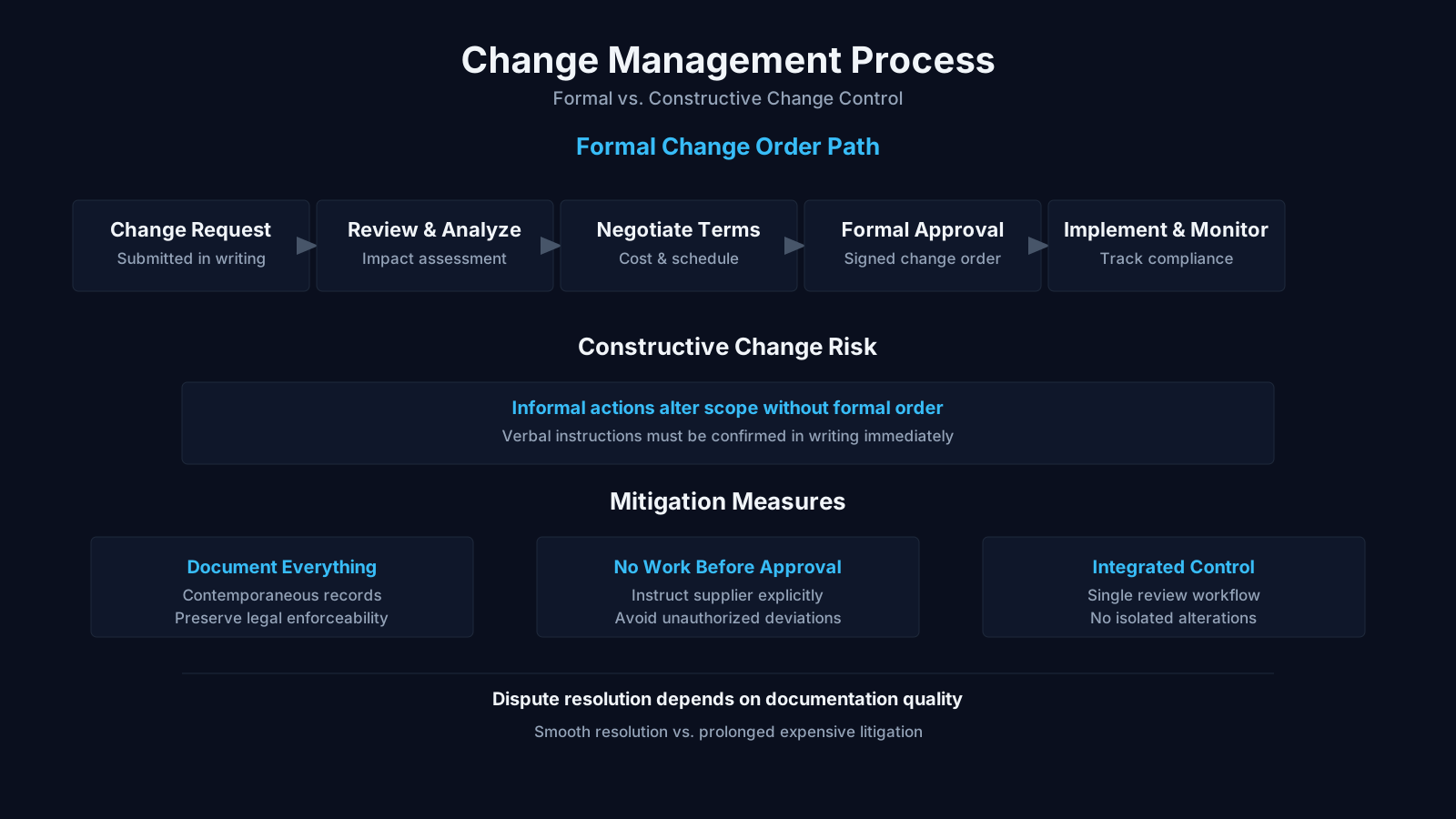
| Verbal Instructions | Informal verbal directives to suppliers can generate change requests; confirming them in writing immediately is critical for building a defensible, auditable record and mitigating claims. |
| Claims Prevention | Timely and detailed documentation of unresolved changes prevents constructive changes from escalating into formal claims and litigation, preserving both budget integrity and supplier relationships. |
| Baseline Adjustments | Approved procurement changes typically require updates to the procurement management plan, cost baseline, and related baselines to maintain accurate, integrated performance control. |
How Change Requests During Procurement Administration Develop
Change requests during procurement administration do not emerge from a vacuum. They often originate from performance discrepancies, evolving project needs, or ambiguities in contract language that surface during execution. When a project team administers a procurement relationship, monitoring performance, managing payments, and inspecting deliverables, it inevitably uncovers gaps between what was specified and what is actually required. This gap creates the initial spark for a change request. A supplier may identify a more efficient method that requires a deviation from the original statement of work. The buyer may realize that the contract's delivery schedule cannot support an accelerated program milestone stemming from a stakeholder mandate. In such moments, the notion that the contract can simply be amended arises, but turning that notion into an approved change involves a disciplined sequence of steps. The first critical step is recognition that a potential change exists, and that recognition is the domain of the Administer Procurements process. It is during the day-to-day stewardship of contracts that the seeds of change requests emerging in procurement administration are planted and sometimes left to grow unchecked.
Identifying Change Requests During Procurement Administration in the Administer Procurements Process
The Administer Procurements process sits inside the Project Procurement Management knowledge area. In many PMBOK editions, it is part of the Executing process group, while its monitoring counterpart may be called Control Procurements. Regardless of the exact label, the activities are intensely hands-on: reviewing seller invoices, conducting quality audits, tracking delivery progress, and managing correspondence. It is precisely during these routine tasks that a project manager or procurement officer spots the need for a change. A quality inspection might reveal that a supplied component no longer meets the updated technical standards mandated by a recent regulatory shift. The buyer might then informally tell the seller to halt production and switch to an upgraded material, intending to sort out the contractual details later. That direction constitutes the embryo of a change request. Even before the formal paperwork begins, the project correspondence should record the instruction because, at that moment, a potential constructive change has been triggered. The Administer Procurements process thus acts as the frontline sensor that identifies discrepancies, deviations, and directives that must be funneled into the project's change control machinery.
Documenting Change Requests During Procurement Administration with Project Correspondence
Requested but unresolved changes can include direction provided by the buyer, or actions taken by the seller, that the other party considers a constructive change to the contract. Since any of these constructive changes may be disputed by one party and can lead to a claim against the other party, such changes are uniquely identified and documented by project correspondence. That guidance from the source material cuts to the heart of procurement risk management. Think of a situation where a site supervisor tells a subcontractor to use a different cable routing method because the specified pathway is blocked by an unremovable utility. The sub proceeds, incurs extra labor, and later submits a bill. Without a written record of the instruction, the buyer can argue that the sub acted unilaterally. With a simple confirmatory email stating, "Per our verbal discussion, you are authorized to reroute the cable; this will be treated as a change request and priced accordingly," the ambiguity dissolves. Project correspondence, whether in the form of emails, formal letters, meeting minutes, or daily logs, serves as the unique identifier that ties an informal event to the formal change control process. It prevents constructive changes from becoming orphaned issues that later metastasize into claims.
Routing Change Requests During Procurement Administration Through Integrated Change Control
Once a change request has been identified and documented during procurement administration, it must enter the Perform Integrated Change Control process. This is the gateway through which all changes, regardless of their origin, are evaluated for their impact on the project management plan and its subsidiary components. A procurement change request does not exist in isolation; an alteration to the contract's scope, schedule, or cost can reverberate through the work breakdown structure, the risk register, and the stakeholder communication plan. The integrated change control board, or whichever authority is designated in the project governance, assesses the request against the current baselines. If approved, the procurement management plan may need updating, a formal change order is issued to the seller, and the cost baseline might be adjusted. A crucial nuance here is that the Perform Integrated Change Control process must also handle the constructive changes that were documented by correspondence. Even if the parties initially disagree on whether a change occurred, the documented request should be processed as a change candidate, with the dispute managed separately through the claims administration procedure if necessary. This keeps the change control pipeline clean and prevents back-channel modifications from undermining the project baselines.
Core Takeaways on Change Request Development
- Change requests emerge from execution gaps
- Discrepancies between contract specifications and operational needs become evident during routine procurement administration and serve as the primary catalyst for initiating change requests.
- Administer Procurements identifies potential changes
- Regular activities like quality audits, invoice reconciliation, and delivery monitoring enable the Administer Procurements process to detect contract deviations early and capture informal directives before they escalate.
- Correspondence documents constructive changes
- Project correspondence, including emails, meeting minutes, and daily logs, formally captures informal buyer directives and transforms them into documented change requests, thereby mitigating the risk of future disputes.
- Routing through integrated change control
- Following identification and documentation, procurement change requests are channeled through the Perform Integrated Change Control process, where their effects on project baselines and supporting plans are rigorously assessed.
The Constructive Change Dilemma in Procurement
One of the most treacherous concepts in procurement administration is the constructive change in procurement contracts. It is a change that the contract itself never formally records, but the actions or words of one party imply an alteration of the existing terms. Construction and defense contracting have a long history of constructive changes leading to claims, and yet many project managers outside those industries fail to recognize the pattern until it is too late. The source material explicitly highlights that direction provided by the buyer or actions taken by the seller can be perceived as a constructive change by the other party. This perception gap is what breeds disputes, and it is why the prompt documentation and unique identification of such changes are so essential.
What Constitutes a Constructive Change
A constructive change is not a formal amendment signed by both parties. It is, instead, a de facto modification of the contract's requirements that emerges from conduct. A classic example occurs when a buyer's technical representative, during a site visit, verbally instructs the contractor to perform additional testing that goes beyond the specification. The contractor complies, believing this direction is an official extension of the work. The buyer may later argue that no change order was issued, but the contractor has already performed the work and incurred costs. From the contractor's perspective, a constructive change has occurred. Similarly, if a seller decides to expedite shipping using air freight instead of sea freight to meet a tight schedule, and the buyer accepts the early delivery without objection, that action might be viewed by the seller as a constructive change entitling it to reimbursement. The element of unilateral action that the other party later tries to capitalize on or dispute is the hallmark of a constructive change.
Why Constructive Changes Lead to Claims
When a constructive change occurs and the performing party is not promptly compensated, the situation festers. The party that bore the extra cost will eventually seek restitution. If the other party refuses to acknowledge the change, a claim is born. Claims can escalate into formal disputes, triggering mediation, arbitration, or litigation. The expenses involved in resolving a claim often dwarf the initial cost of the change itself, and the relationship damage can be irreparable. The original project management note underscores that unresolved changes, including these constructive ones, must be uniquely identified and documented by correspondence precisely to keep them from turning into claims. By treating a constructive change as a change request and pushing it through integrated change control while also memorializing the directive in writing, the project team creates a defensible position. The project correspondence becomes the evidence that separates an authorized directive from an unsanctioned act.
Documentation as a Shield Against Disputes
Project correspondence is not just a clerical record; it is a strategic shield. Consider a scenario where a buyer's project manager sends a weekly status report that notes, "Client quality lead directed the fabrication shop to apply an additional coat of protective paint; change request being generated for cost and schedule impact." That sentence, embedded in a routine document, becomes the unique identifier that anchors the constructive change to a specific point in time and context. Later, when the seller's invoice arrives with an upcharge, the buyer cannot credibly claim ignorance. The documented correspondence demonstrates that the buyer's own agent initiated the change, that the project intended to process it formally, and that the performance was not a secret. This proactive documentation habit is what the source material demands when it says such changes are uniquely identified and documented by project correspondence. It is a simple practice that pays dividends in preventing disputes and, if a dispute does arise, in winning them.
Practical Considerations for Procurement Change Management
Sound procurement change management practices go beyond just following a flowchart; they require a proactive mindset that anticipates where changes might crop up and a disciplined approach to documenting everything. Many projects stumble because they treat procurement changes as an afterthought, letting procurement specialists handle them in isolation from the project's overall change control. This creates a disconnect where procurement may authorize a change that violates the project's cost baseline, or the project manager approves a scope change that demands a contractual amendment without informing the procurement team. The result is a fractured control environment where nobody has a complete picture, and somebody is going to get an unpleasant surprise when the invoices arrive. The integration of procurement change management with the Perform Integrated Change Control process is not a theoretical ideal; it is a practical necessity.
Contract Types and Their Influence on Change Requests
The nature of the contract fundamentally shapes how change requests during procurement administration are handled. In a firm-fixed-price contract, the seller bears most of the cost risk, so any deviation from the baseline scope is a potential gold mine for the seller to submit a change request seeking additional compensation. The buyer, on the other hand, will scrutinize each request to ensure it is a genuine change and not a scope clarification. The process tends to be more formal and adversarial. In a cost-reimbursable contract, where the buyer assumes cost risk, change requests might flow more freely because the buyer is paying for the work anyway, but proper authorization remains critical to prevent cost overruns from being unchallenged. Time and materials contracts sit somewhere in between, where changes to the rate or the number of hours can trigger control activities. Regardless of the contract type, the procurement management plan should specify the change request thresholds, the level of authority required for different magnitudes of change, and the required documentation. This up-front clarity eliminates much of the confusion that otherwise plagues procurement change control.
Pitfalls That Sabotage Procurement Change Control
Several common pitfalls consistently undermine the handling of change requests during procurement administration. First, project teams frequently fail to link procurement changes to the integrated change control process, assuming that a change that only affects the contract does not need project-level scrutiny. This assumption is almost always wrong. Second, verbal directions and informal emails are often ignored or taken at face value without being captured as potential change requests. The moment a buyer's representative says, "Go ahead and start the rework," a constructive change has potentially occurred, and if it is not documented, the project is exposed. Third, the procurement management plan sometimes lacks clear authority thresholds. A junior project engineer might authorize a change that exceeds their delegation, creating an unauthorized commitment that the organization later disowns. Fourth, insufficient documentation remains the root cause of countless disputes. A short, contemporaneous note in the project correspondence can prevent months of legal wrangling. Finally, procurement changes are occasionally managed through a parallel change process that never reconciles with the project's performance baselines, leaving the project manager with a distorted view of progress and cost.
Agile, PRINCE2, and BVOP Perspectives on Procurement Changes
In Agile environments, the relationship with procurement change can seem paradoxical because Agile values responding to change over following a plan. However, the contractual backbone still exists. Agile projects often use rolling wave contracts or master service agreements with flexible scopes, but any change that exceeds the contractual ceiling must still be processed as a change request. The product owner may prioritize a new feature that requires a supplier to pivot, and that instruction becomes a constructive change unless it is formalized through an amendment. PRINCE2 handles procurement changes through its issue and change control procedure. Any proposed modification to a supplier agreement is logged as a request for change and reviewed by the project board, ensuring that the commercial implications are weighed alongside scope and schedule impacts. From a BVOPM standpoint, unresolved procurement changes that linger as disputes exemplify what the methodology terms "process damage," invisible organizational harm that silently erodes business value. When change requests during procurement administration are not transparently tracked and resolved, they become waste, draining energy and money without adding functionality. BVOPM would advocate treating such issues as non-value-adding events that must be surfaced and eliminated quickly, reinforcing the need for rigorous documentation and integrated control.
Key Insights on Procurement Change Control
- Procurement changes demand integrated control
- Integrating procurement change management with the Perform Integrated Change Control process ensures contract modifications stay aligned with project baselines, minimizing the risk of unforeseen cost overruns and scope misalignment.
- Contract type determines change handling dynamics
- Firm-fixed-price, cost-reimbursable, and time and materials contracts each introduce unique change request dynamics; accordingly, the procurement management plan should define clear thresholds, authority levels, and documentation requirements at the outset to guide appropriate change responses.
- Meticulous documentation prevents costly disputes
- Verbal directions, informal emails, unauthorized commitments, and parallel change processes are common sources of disputes; maintaining contemporaneous records and clearly defined authority limits is therefore essential to protect the project from costly legal and contractual conflicts.
Ensuring Seamless Integration of Change Requests in Procurement
The final layer of handling change requests during procurement administration is the discipline of integration. No change request exists in a vacuum, and the procurement component cannot be severed from the project's nervous system. The project manager must ensure that the procurement management plan explicitly references the integrated change control process and that all procurement-related change requests, including constructive changes, flow through that unified channel. The contract administrators, buyers, and quality inspectors must be trained to recognize when a direction or an action crosses the line into change territory and to document it immediately. This cultural shift, moving from a reactive to a proactive documentation mindset, is perhaps the single most effective risk mitigation strategy in procurement administration. It transforms what could become a claim into a controlled, negotiated change that respects both the project's baselines and the contractual relationship. Without it, even the most sophisticated change control process will be undermined by the gremlins of undocumented directives and disputed commitments. In the end, handling change requests during procurement administration is not just a process, it is a habit of professional vigilance, anchored in the simple, powerful act of writing things down.