Evaluating seller proposals in complex procurements is not a task that falls to a single person with a checklist. When an organization issues a request for proposals and the responses come back addressing a carefully weighted set of criteria, the buyers face a decision that commits significant funds, shapes project timelines, and locks in relationships that will last months or years. The way those proposals are evaluated and the people involved in the evaluation directly determine whether the project starts with a solid supplier foundation or stumbles into misaligned expectations and contractual disputes. Understanding how this evaluation works and who should be at the table requires looking beyond spreadsheet comparisons into the governance structures, expert panels, and decision-making layers that turn a stack of vendor documents into a defensible award recommendation.
How to Evaluate Proposals and Who to Involve: At a Glance
| Evaluation Impact | Summary |
|---|---|
| Project-Defining Decision | The evaluation outcome commits substantial funds, defines project timelines, and locks in supplier relationships spanning months or years; it is the pivotal point where a project secures a solid foundation or incurs early disputes. |
| Governance Framework | Thorough evaluation moves beyond spreadsheet scoring to incorporate governance structures, expert panels, and layered decision-making that together transform vendor submissions into a defensible, justifiable award recommendation. |
| Subjective Drift | When evaluators treat written criteria as flexible guidelines and allow subjective preferences to override them, the resulting drift invites formal protests, erodes the integrity of the procurement, and devalues the effort invested in precise requirements specification. |
| PRINCE2 Alignment | Under PRINCE2, proposals are measured against the project product description and quality criteria defined in initiation documentation, with weightings often favoring team competence, relevant experience, and cultural alignment over technical feature counts. |
| Integrity Safeguards | Robust integrity safeguards mandate conflict-of-interest disclosures and enforceable confidentiality measures to prevent the exposure of one bidder's proprietary information to competitors, preserving a level playing field and legal compliance. |
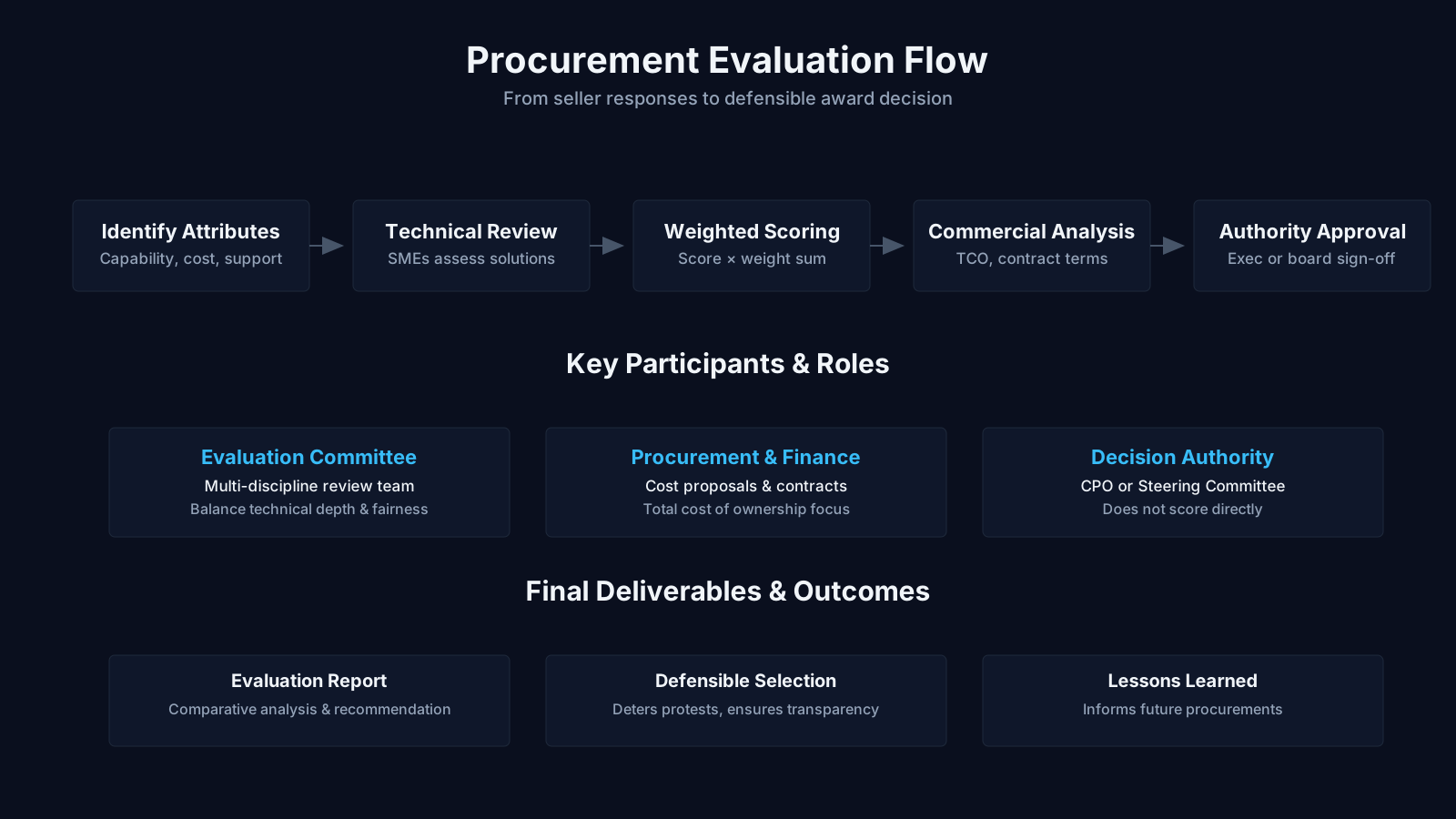
| Evaluation Process | The structured evaluation process progresses from a mandatory compliance gate through detailed scoring against weighted criteria, conduct of interviews or product demonstrations, to a consolidated recommendation submitted for executive approval. |
| Audit Trail | A legally mandated audit trail, especially in the public sector, reinforces governance by enabling project sponsors to reconstruct precisely why one vendor was selected over another, documenting the rationale at each decision point. |
| Decision-Making Rules | In complex procurements, the evaluation committee operates under a charter that codifies decision-making protocols, such as score averaging, consensus thresholds, and provisions for formal minority reports to capture dissenting perspectives. |
The Formal Evaluation Review Process in Complex Procurements
Procurement policies in mature organizations spell out a formal evaluation review process precisely because the stakes are too high for ad hoc judgments. This process is triggered when source selection depends on how sellers respond to predefined weighted criteria, a mechanism that separates objective scoring from gut feel. The weights themselves are defined during the procurement planning phase, often encoded in the solicitation documents so that every prospective seller understands how their proposal will be measured. When proposals arrive, the evaluation becomes a disciplined exercise in applying those weights consistently across all respondents. A common mistake is to treat the written criteria as merely directional and then drift into subjective preferences during the evaluation, which not only opens the door to protests and disputes but also undermines the investment the organization made in specifying its requirements upfront.
In the PMBOK framework, this activity sits squarely inside the Conduct Procurements process, which belongs to the Project Procurement Management knowledge area and aligns with the Executing Process Group. It is where the received proposals are reviewed, sellers are compared, and the team selects the seller that best fits the project's needs. The process includes obtaining seller responses, selecting a seller, and awarding a contract. However, evaluation itself is a sub-process that depends heavily on the earlier Plan Procurement Management outputs, particularly the source selection criteria and the procurement statement of work. Without that upstream clarity, the formal review process risks becoming a negotiation among internal stakeholders about what they actually wanted, rather than a verification of which seller can deliver it.
PRINCE2 environments handle this through the "Managing Product Delivery" and "Management Products" concepts, where the project manager must ensure that supplier proposals are assessed against the project product description and quality criteria defined in the project initiation documentation. The rigor is similar; the terminology shifts. In Agile procurement contexts, things can get messier because the scope is often deliberately incomplete at the outset. Even there, a structured seller proposal evaluation process is necessary, though the weighting might tilt toward team capability, cultural fit, and technical agility over fixed feature lists. The evaluation might include collaborative workshops or paid discovery sprints where sellers demonstrate their approach in real time. But the core concept of a formal, policy-driven review does not vanish; it adapts to the procurement's complexity.
Organizations that skip defining the formal evaluation process up front frequently pay for it later. When multiple bidders submit, the evaluation team gets drawn into comparing items that were never part of the original solicitation, and the weightings become meaningless. This is how a procurement intended to maximize technical superiority accidentally awards to the lowest bidder because the technical scores were applied inconsistently and someone influential argued that cost should really matter more. A formal process locks those decisions in early, so that the evaluation committee executes rather than debates.
Defining Weighted Criteria Before Inviting Seller Proposals
The weighted criteria are not just a scoring table. They represent the buyer's strategic priorities distilled into numbers. A project that must be operational by a regulatory deadline will assign high weight to schedule feasibility and compliance track record. A project where the product is an innovative solution might weight technical approach and R&D capabilities heavily, while cost takes a lower percentage. The definitions must be granular enough that different evaluators can read the same seller response and arrive at reasonably similar scores. When criteria are vague, for example "demonstrated experience," the scoring becomes a reflection of each evaluator's personal interpretation, which is the enemy of a defensible selection.
The weighting exercise also forces the internal team to resolve conflicts before the procurement goes live. The finance department might push for cost to dominate, while the engineering lead insists on technical depth. The procurement policy should require that these tensions be reconciled and documented in the solicitation, not during the evaluation. When this step is done well, the evaluation committee can focus on evidence rather than renegotiating internal priorities. The criteria become the shared language that all reviewers, regardless of their department, use to assess each proposal.
Establishing the Governance Backbone of Proposal Review
Beyond the criteria themselves, the formal process defines roles, responsibilities, and the sequence of activities. It answers who will read the proposals, who will score them, how consensus will be reached, who has veto power, and what documentation must be produced to support the final decision. The buyer's procurement policies often mandate that every evaluator sign a conflict-of-interest declaration and that the entire review preserves confidentiality so that one seller's proprietary information is not exposed to competitors. These are not bureaucratic formalities; they protect the organization from legal challenges and reputational damage.
The process typically includes a preliminary check for compliance with mandatory requirements, followed by detailed scoring against the weighted criteria, then perhaps interviews or demonstrations, and finally a recommendation that goes to management for approval. Each stage generates records that can be audited. In the public sector, this audit trail is often legally required, but even in private industry, it supports good governance and ensures that the project sponsor can trace exactly why one seller was chosen over another.
Key Insights on Evaluation Review Process
- Weighted criteria trigger formal review
- The formal evaluation process activates when source selection depends on suppliers’ responses to weighted criteria, replacing subjective intuition with a structured, defendable scoring method.
- Weights set during planning phase
- Evaluation weights are determined during procurement planning and embedded in solicitation documents, giving every prospective seller a clear, upfront understanding of exactly how their proposal will be scored.
- Subjective drift invites disputes
- Drifting away from written criteria toward subjective preferences invites protests and disputes while undermining the effort invested in defining precise, measurable requirements.
- PMBOK Conduct Procurements placement
- Within the PMBOK framework, evaluation review occurs in the Conduct Procurements process, part of the Project Procurement Management knowledge area and the Executing Process Group, and relies on outputs from Plan Procurement Management.
- PRINCE2 structured evaluation approach
- PRINCE2 requires project managers to evaluate supplier proposals against the project product description and quality criteria defined in the project initiation documentation, with weighting that may prioritize team capability, cultural fit, and technical agility.
The Role of the Evaluation Committee in Source Selection
The evaluation committee is the engine of the whole review. Its makeup is defined by the procurement policy and shaped by the specific procurement, and it carries the authority to examine proposals, apply the criteria, and arrive at a selection recommendation. The committee does not typically have final signing authority, though; it recommends, and management approves. This separation is deliberate and important. It ensures that the people who did the deep analytical work are not the same people whose judgment might be clouded by organizational politics or who control the budget, which can create a healthier check-point before the award.
Committees usually consist of individuals with direct knowledge of the project scope and the business needs behind the procurement. They might include the project manager, a lead engineer, a supply chain specialist, and a representative from the business unit that will use the deliverables. The committee's size matters; too few members and you miss critical perspectives, too many and you risk endless deliberation and diluted accountability. In complex procurements, the committee often operates under a charter that defines its decision-making rules, for instance whether scores are averaged, whether consensus is required, or whether a minority report must be documented.
Composition and Authority of the Committee
The authority of the evaluation committee is bounded by the procurement policy and the project charter. It can evaluate, score, clarify, and recommend, but it cannot typically negotiate contract terms or commit organizational funds. In some organizations, the committee has the power to shortlist sellers and then invite them to a competitive dialogue or a best-and-final-offer round, but the final award still rests with a higher authority. This structure prevents a group of technical specialists from inadvertently making commercial commitments they are not authorized to make.
The committee's composition should be documented before proposals are opened, so that there is no perception of stacking the team to favor a known vendor. A good practice is to include at least one member who is not an internal stakeholder but has procurement expertise, such as a contract officer or legal advisor, who can flag inconsistencies and ensure procedural fairness. This person also helps the committee understand when a seller's exception to terms and conditions represents a material risk rather than a minor deviation. The combination of domain experts and procurement professionals makes the proposal scoring and decision-making both technically sound and contractually aware.
How Expert Judgment Drives the Evaluation
Expert judgment is the primary tool used to evaluate seller proposals, and it is applied at multiple levels. Technical experts judge the feasibility and elegance of a proposed solution. Financial analysts assess cost realism and total cost of ownership. Legal advisors review compliance with statutory requirements and intellectual property implications. The committee synthesizes these expert opinions, using the weighted criteria as the common scoring framework. When expert judgment is properly channeled, it transforms subjective opinion into structured evidence, because each expert must point to specific passages in the proposal that justify a high or low score on a given criterion.
One of the hardest things for a committee to manage is when two experts disagree strongly on a score and both can cite reasonable evidence. The process should have a mechanism for such disagreements, perhaps a calibrated discussion where each expert presents their rationale and the committee decides by majority or consensus. Relying solely on averaged scores can mask serious concerns that one evaluator spotted and everyone else overlooked. A robust process sometimes requires that a low score on a critical criterion triggers an automatic deeper review, even if the overall average seems acceptable.
Involving a Multi-Discipline Review Team for Comprehensive Evaluation
No single function can fully understand a complex proposal. The procurement documents and the proposed contract address matters of engineering feasibility, legal compliance, financial stability, manufacturing scalability, and often research and development capability. This is why evaluations are frequently performed by a multi-discipline review team. Each discipline brings a lens that others lack. An engineer might find a technical approach brilliant but might not notice that the payment schedule exposes the buyer to severe cash flow risks, while a financial analyst could spot that risk but not realize that the proposed technology stack is already obsolete. The multi-discipline team stitches these perspectives together so the final picture accounts for the interplay between technical, commercial, and legal dimensions.
The challenge with multi-discipline teams is coordination and timing. Each reviewer needs access to the full proposal, but they must read it with their specific section in mind while also understanding how the pieces fit together. A common failure mode is to assign sections in isolation, so the technical reviewer never reads the financial appendix and misses the fact that the quoted bill of materials relies on a supply chain that the seller admits is unstable. The review protocol should therefore include cross-briefing sessions where team members share their findings and interrogate each other's assumptions before final scores are locked.
Why Expertise Must Cover Every Dimension of the Scope
Procurement documents often span multiple volumes, covering technical specifications, service level agreements, acceptance criteria, warranty terms, and compliance schedules. If the review team lacks expertise in any one of these areas, that dimension goes unevaluated, and the organization essentially buys it blind. For example, on a large infrastructure project, the proposals might include detailed designs, environmental impact mitigation plans, and subcontractor management approaches. Without an environmental specialist on the team, the buyer cannot validate whether the seller's mitigation measures will satisfy regulatory requirements. The gap might only surface after the contract is signed, when the project is already committed to a path that turns out to be non-compliant.
This is not about having a massive team; it is about mapping the procurement's scope to the necessary disciplines and ensuring every high-risk area has an owner. In some cases, the required expertise exists in-house; in others, the buyer may engage external consultants to fill gaps. The cost of bringing in a specialized reviewer for two weeks is negligible compared to the consequences of awarding a multi-million-dollar contract to a seller whose seismic engineering assumptions were never independently verified. The multi-discipline approach also spreads the accountability, which can feel uncomfortable but actually leads to better decisions because no single person's bias goes unchecked.
Functional Disciplines That Shape a Thorough Bid Review Team
The notes from practiced procurement professionals consistently list functions that go well beyond the obvious. Contracting experts know the legal framework and can evaluate the seller's terms and conditions against the buyer's standard clauses. Legal expertise may further address intellectual property ownership, indemnification, and dispute resolution procedures. Finance and accounting specialists assess the seller's cost structure, payment milestones, and financial health to determine whether the seller can survive the contract's duration. Engineering and design professionals scrutinize the technical solution for feasibility, maintainability, and compliance with standards. Research and development expertise becomes critical when the procurement involves innovation or unproven technology.
Sales and manufacturing perspectives also matter, though they are sometimes forgotten. A sales representative on the team can detect whether the seller's proposed delivery model is realistic based on industry patterns or whether the quoted lead times are typical. Manufacturing input becomes vital when the procurement involves physical products, as it can surface challenges with quality assurance, supply chain resilience, or mass-production ramp-up. Bringing all these functions together forms a multi-discipline bid review team that can catch the kinds of problems that hide in the gaps between specialties. The team should not just be listed on a roster; each member must have enough time allocated to read, analyze, and discuss, which is a planning oversight that dooms many otherwise well-intentioned evaluations.
Key Takeaways on Multidisciplinary Review
- Multidisciplinary perspectives prevent blind spots
- Bringing engineering, financial, and legal expertise together reveals hidden risks, such as conflicting technical specifications or unworkable liability clauses, that any single-discipline reviewer would miss.
- Integrated reading instead of isolated review
- Each reviewer must study the entire proposal through their own specialist lens and then join cross-briefing sessions to map how technical decisions cascade into financial obligations and legal exposures.
- Cross-briefing interrogates assumptions
- Structured sessions where team members present findings and rigorously challenge one another’s assumptions surface overlooked connections, such as a fragile supply chain hidden in a financial appendix that could compromise delivery.
- Missing expertise means buying blind
- When a review team lacks a critical domain expert, that whole dimension goes unevaluated, and the modest cost of engaging a specialist is negligible compared to the risk of awarding a major contract on untested assumptions.
Management Approval and the Final Award Decision
Once the evaluation committee completes its work and reaches a recommendation, the procurement policy typically requires management approval before the award is made. This step is more than a ceremonial sign-off. It provides a final check on whether the recommended seller fits within the organization's overall strategic and financial context. The management reviewer, often a procurement director or project sponsor, may not have been involved in the detailed proposal analysis, so they bring a fresh perspective on the evaluation committee's process and conclusions. They might ask whether the risk assessment was sufficiently conservative, whether the committee considered the seller's track record on similar projects, or whether the pricing aligns with the available budget and contingencies.
Management approval also serves as the internal point where organizational politics are acknowledged and managed. If a stakeholder who was not on the committee has objections, the approval stage gives them a structured channel to raise concerns without derailing the evaluation itself. The committee's documentation, including the scoring rationales and any dissenting opinions, becomes essential here. It allows the approving manager to see not just the outcome but the reasoning behind it, which builds confidence that the decision was made on merit rather than influence. Without that paper trail, the approval can become a rubber stamp or, worse, an opportunity for unwarranted second-guessing.
The Separation Between Committee Recommendation and Executive Sign-Off
This separation is a governance control that protects the organization in two directions. First, it prevents the evaluation committee from becoming a self-contained decision body that might inadvertently overlook broader business risks. The committee might be so focused on technical excellence that it recommends a seller with a fragile financial position, which the management reviewer catches. Second, it shields the committee from direct pressure. If a senior executive has a preferred vendor, that preference can be expressed through management review rather than during the scoring phase, preserving the integrity of the evaluation. If the management reviewer overrides the committee's recommendation, the rationale for that override must be documented, creating accountability at the highest level.
In some organizations, the management approval is tiered. For procurements above a certain dollar threshold, multiple levels of review are required, possibly including the CFO or a board procurement committee. This cascading approval aligns with financial delegation authorities and ensures that the same governance principles apply regardless of the specific seller. The project manager's role here is often to facilitate the handoff, presenting the committee's findings in a clear summary that highlights risks, tradeoffs, and the rationale for the recommended award. Clarity in this communication can make the difference between a quick, informed approval and a drawn-out cycle of questions and clarifications.
Ensuring Alignment with Organizational Procurement Governance Policies
Procurement governance policies exist to standardize how the organization spends its money across multiple projects and departments. These policies define who can evaluate, who can approve, what thresholds trigger what reviews, and how records must be kept. When a proposal evaluation team operates strictly within these policies, it strengthens the organization's overall procurement maturity. The committee's work becomes auditable, repeatable, and defensible if a protest arises. The policies also protect individual evaluators by placing their judgments within a sanctioned framework; they are not making arbitrary choices, they are applying the pre-approved criteria.
Failure to follow governance policies can have serious consequences beyond a single procurement. It can set a precedent that other project teams use to bypass controls, gradually eroding the integrity of the entire procurement function. The procurement governance policies are not there to slow things down; they are there to ensure that every dollar committed has been evaluated with appropriate rigor and that no single individual, however senior, can commit the organization to a contract without proper checks. Smart project managers lean into these policies rather than seeing them as obstacles, because they provide a clear script for what must happen and who must be involved, reducing ambiguity during a high-pressure phase of the project.
BVOPM methodology adds an interesting dimension here by emphasizing that planning documents, including procurement evaluation criteria, should be brief enough that even a new joiner can rapidly grasp the evaluation framework and contribute meaningfully. This principle can transform the governance step from a slow, documentation-heavy gate into a faster, trust-based review where the committee's summary is instantly comprehensible to an approving manager who was not in the room. When the committee's output is concise and value-focused, management approval becomes a genuine review rather than a decoding exercise.
Common Pitfalls When Evaluating Seller Proposals and Who Should Avoid Them
Even with a formal process, failures happen, and they usually trace back to a few predictable patterns. One of the most pervasive is confirmation bias among evaluators. An evaluator might have worked with a particular seller before or be impressed by a glossy presentation, and then unconsciously score that seller higher on every criterion, finding justifications that align with the initial favorable impression. This is not usually dishonest; it is a cognitive shortcut. A multi-discipline team can mitigate this if the scoring is done individually before any group discussion, because bias in one evaluator gets diluted by the independence of others. But if the team discusses first and then scores, the most charismatic voice can sway the entire group.
Another common trap is the hollow expert role. Someone is assigned to the team because their department insisted on representation, but they lack the specific expertise needed for this procurement. They might be a good engineer in one domain but know nothing about the niche technology being procured. Their scores end up being noise disguised as signal. Organizations sometimes resist bringing in an external subject matter expert because of the cost or because they feel it reflects poorly on internal capabilities. The fix is honest capability mapping before the evaluation starts. If the right expertise does not exist internally, hire it temporarily. Pretending otherwise is far more expensive in the long run.
A third pitfall is rushing the evaluation because the project timeline is slipping and the team feels pressure to get the contract signed. Under time duress, evaluators skim proposals, miss red flags, and default to scoring right down the middle because it is faster than deeply analyzing evidence. The project manager and sponsor must push back on unrealistic evaluation timelines during procurement planning. The schedule for the evaluation itself should be a required output of the plan, with enough days allocated for reading, scoring, interviews, and deliberation. When a schedule says "evaluate 500-page proposals from five sellers in three days," the process has already failed before the first proposal is opened.
Poorly managed evaluation criteria also create their own failures. When the criteria are defined as a long list of small, equally weighted items, the evaluation loses focus and everything looks moderately important, so nothing stands out. The team wastes time scoring minutiae while real differentiators get lost. A better approach is to have a small set of heavily weighted criteria that capture the project's true success factors, with lower-weighted items acting as qualifiers. This ensures that the evaluation process matches the actual value drivers, not a fictitious sense of thoroughness. The evaluation criteria pitfalls are avoidable if the team remembers that the point is not to produce a perfect spreadsheet but to identify the seller most likely to deliver project value.
Key Insights on Evaluation Pitfalls
- First impressions can skew evaluation scores
- Evaluators often form an early preference based on prior experience or a persuasive pitch, then unconsciously bias every score upward and retroactively construct reasoning to match that positive impression.
- Individual scoring dilutes collective bias
- Requiring team members to score individually before any discussion dilutes personal biases and prevents a single persuasive voice from dominating the evaluation.
- Missing expertise undermines evaluation
- Evaluation panels often consist of department representatives who lack the required technical depth, and organizations frequently forgo external experts to save costs or avoid admitting internal knowledge gaps.
- Time pressure leads to superficial reviews
- Under time pressure, evaluators skim documents, overlook warning signs, and default to mid-range scores because thorough analysis feels too slow, making a realistic evaluation timeline a critical deliverable of the planning phase.
- Weighted criteria surface best value
- Focusing on a few heavily weighted criteria that reflect genuine project drivers, while treating lower-weighted items as qualifying thresholds, steers the team away from common traps and toward selecting the supplier best positioned to deliver real value.
Connecting Proposal Evaluation to Broader Project Management Processes
Proposal evaluation does not exist in a vacuum. Its outcomes feed directly into the project's risk register, stakeholder communications, and the baseline schedule. When the evaluation flags a seller weakness, that weakness becomes a risk that the project must manage post-award. For example, if the evaluation team noted that the seller's key personnel have thin experience in the required regulatory environment, the project manager should log a risk for compliance delays and possibly build additional oversight activities into the project plan. Too often, the evaluation report is filed away after award and the valuable insights it contains are never transferred to the delivery team.
The connection to contract type selection is also crucial. The evaluation of proposals assumes a certain contract type that was described in the solicitation, whether fixed-price, time and materials, or cost-reimbursable. The sellers structure their proposals accordingly, and the evaluation criteria must be compatible with the chosen type. A fixed-price procurement calls for criteria that emphasize clarity of scope and cost certainty, while a time and materials evaluation should deeply assess the seller's productivity metrics and cost control reputation. If the project team chose a contract type without fully understanding how it would shape the evaluation, they might end up applying criteria that do not fit the commercial model, leading to a mismatch that surfaces only during contract execution.
The Intersection with Risk Management and Contract Types
Risk management and proposal evaluation are intertwined from the outset. Every seller's proposal presents a different risk profile. One seller might propose an aggressive schedule that could collapse under minor delays, while another includes generous buffers that cost more but reduce schedule risk. The evaluation criteria should have a risk dimension, perhaps under a "feasibility and risk assessment" weight, so that evaluators explicitly score the confidence they have in the seller's plan. Some teams go further and have the risk manager participate directly in the evaluation team, bringing risk thresholds and the project's risk appetite into the scoring conversations.
The contract type also acts as a risk allocation mechanism. Under a fixed-price contract, the seller assumes the cost risk, so the evaluation should focus on whether the seller has the financial strength to absorb potential overruns. Under a cost-reimbursable contract, the buyer retains cost risk, so the evaluation must scrutinize the seller's cost estimating and tracking capabilities with far greater intensity. Connecting these dots during evaluation prevents the awkward discovery after contract award that the supposedly low-risk fixed-price seller is actually a small firm that will fold at the first cost overrun. Experienced evaluators read proposals with the contract type in mind, looking for the specific signals that matter under that allocation of risk.
Agile Procurement and Iterative Proposal Reviews
In projects that use Agile delivery methods, the procurement of services often follows a different rhythm. Instead of a single comprehensive proposal, buyers might invite sellers to submit an initial outline and then participate in successive rounds of interviews, technical challenges, and collaborative specification sessions. The evaluation becomes iterative, with a progressively smaller pool of sellers as each round eliminates those who do not meet the evolving understanding of value. This approach blurs the line between evaluation and negotiation, but it still requires a formal selection framework to be defensible.
The multi-discipline team still operates, though its composition might shift between rounds. Early rounds might focus on culture and technical philosophy, evaluated by coaches and engineers, while later rounds bring in legal and finance to finalize terms with the last standing seller. The key is that even in Agile procurement, the organization must document the evaluation gates and the decision criteria for each round, so that the selection is not perceived as arbitrary. The same governance policies apply; they are just executed through a series of sprint-like review cycles rather than a single marathon session. The project manager's challenge is to keep the process moving without sacrificing the depth of expert judgment, and to ensure that the time-boxed nature of Agile does not become an excuse to skip rigorous financial or legal vetting.
Practical Implementation: Steps to Build a Reliable Proposal Evaluation Framework
Building a reliable framework starts not when the proposals arrive but months earlier, during procurement planning. The first step is to define the source selection criteria and their weights in collaboration with the stakeholders who will later sit on the evaluation committee. This early involvement creates ownership and surfaces hidden criteria that might otherwise emerge disruptively later. The criteria must be described in behavioral terms, so that evaluators can recognize evidence of a strong response rather than just a declaration of intent. For example, rather than "experience," a criterion could be "demonstrated completion of at least three projects of similar scope and complexity in the past five years, with client references provided."
The second step is to select the evaluation committee and any additional multi-discipline reviewers, mapping each required area of expertise to a named individual. This mapping should be reviewed by someone with procurement oversight to confirm that no critical gap exists. Each member then receives the evaluation criteria and a guide on how to apply scoring, including calibration across levels so that a "4" means the same thing to everyone. Calibration exercises using sample proposals or past examples can dramatically improve scoring consistency before the real proposals are touched.
During the evaluation itself, the framework should include time for individual reviews first, then structured group discussions. The facilitator, often the project manager or a procurement officer, must enforce the discipline of justifying scores against specific proposal content. A common framework failure is allowing vague group consensus to override individual concerns without documented justification. The group discussion should aim to understand differences, not to force uniform scores, though eventually a recommendation must emerge.
After the evaluation, the framework requires producing a recommendation report that summarizes the process, the scores, and the rationale. This report is what management uses for approval. The template for this report should be part of the framework from the start, so that the committee knows what they will need to produce and collects evidence accordingly. The final step is to conduct a brief lessons-learned session once the contract is signed, capturing what went well and what could be improved for the next procurement. This step is almost always skipped because the project is racing toward execution, but it is one of the highest-value investments in organizational learning that a project manager can make. A mature proposal evaluation framework is not static; it evolves with each procurement as the team discovers which criteria truly predicted seller performance and which were just noise.
BVOPM thinking encourages the team to examine the evaluation process itself for process damage, the invisible organizational harm that comes from overwork, perfectionism, or rejecting acceptable work. A proposal evaluation can easily tip into overwork if evaluators are asked to read documents they do not need, or if the criteria demand excessive detail that adds no value. Similarly, perfectionism can cause the team to extend the evaluation for weeks chasing diminishing returns, while the project timeline suffers. Keeping the framework lean, focused on business value points, and respectful of the human cost of prolonged evaluation is not just efficiency; it is risk management for the project team's own capacity.
Evaluating seller proposals and deciding who should be involved is as much an exercise in organizational design as it is in procurement. The formal processes, the weighted criteria, the evaluation committee, the multi-discipline review team, and the management approval layers form a system that must balance technical depth, commercial awareness, and procedural fairness. When that balance is achieved, the organization selects sellers that deliver value, and the project starts with confidence rather than hope.
Key Insights on Framework Building
- Framework building starts with procurement planning
- The evaluation framework must be designed well before proposals arrive, beginning with the collaborative definition of weighted selection criteria among the stakeholders who will later serve on the evaluation committee.
- Stakeholder involvement creates ownership and transparency
- Engaging future committee members in the criteria-setting process builds genuine ownership and brings unspoken assumptions to the surface before they can derail the evaluation.
- Criteria require behavioral, evidence-based descriptions
- Evaluation criteria should demand observable behaviors, such as demonstrating completion of three similar projects with verifiable references, rather than relying on vague claims of experience.
- Committee mapping and scoring calibration
- Committee selection maps every required area of expertise to a named individual, and all members receive scoring guides that calibrate their interpretations so that a score of four holds the same meaning for every evaluator.
- Facilitator enforces justified scoring and balance
- A facilitator must ensure that each score is tied directly to specific proposal evidence, preventing vague group consensus from overriding individual concerns without documented justification.