Project funding requirements answer a question that every sponsor and finance department will eventually ask: how much money does this initiative need, and when will it be drawn down? The answer is never a single number spat out by a spreadsheet. It lives in the interplay between carefully forecasted expenditures, contractual obligations that do not appear as immediate costs, and the organizational reality that cash rarely arrives in a smooth, continuous stream. Getting the calculation right means aligning the project’s cost baseline with a realistic disbursement schedule and then layering in the reserves that protect against unknowns. When project funding requirements are determined properly, the budget stops being an abstract accounting exercise and becomes a practical tool that keeps procurement, hiring, and equipment purchases on track.
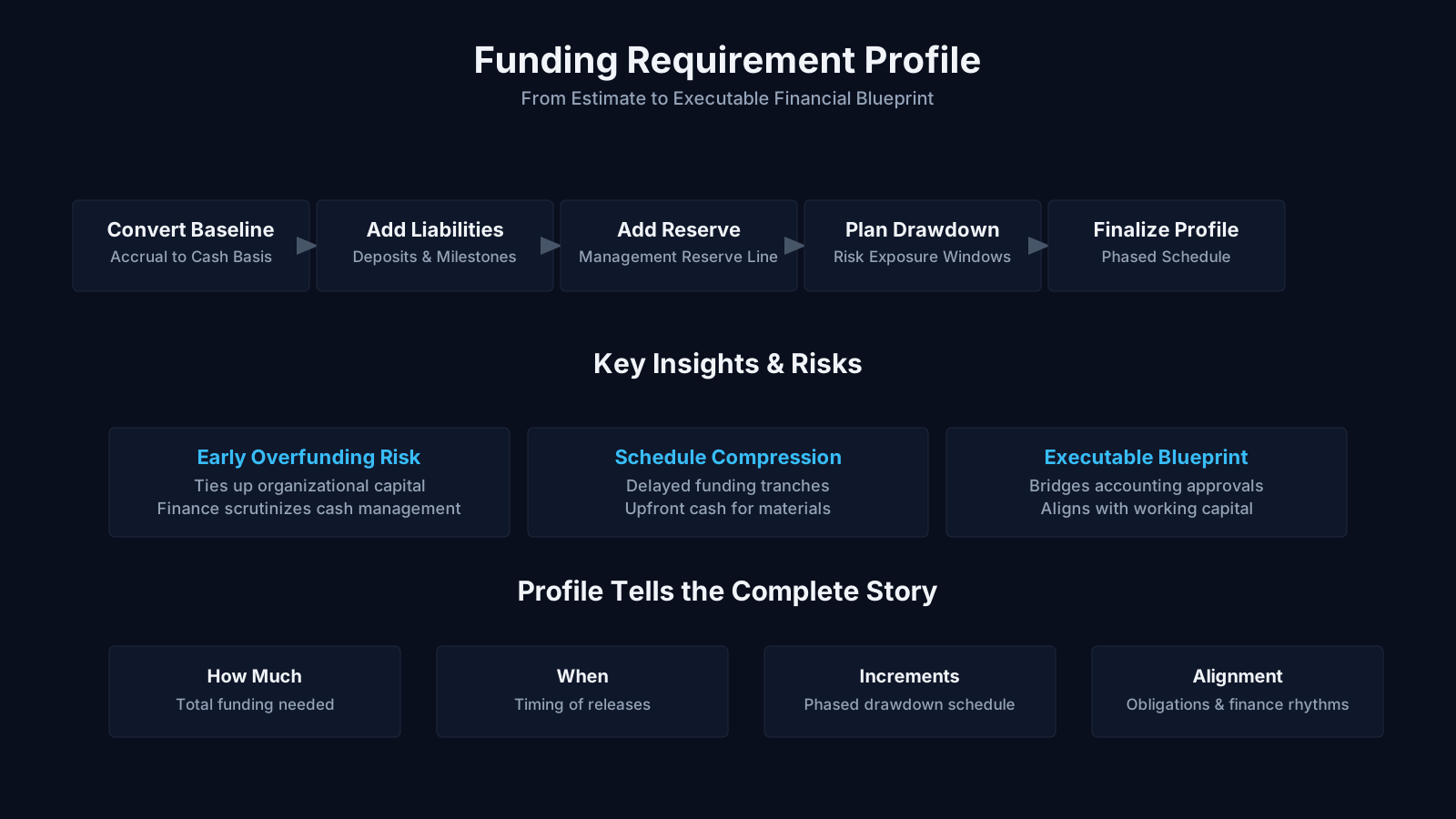
Project Funding Requirements: Key Steps Summary
| Cash Flow | Summary |
|---|---|
| Cash Flow Timing | Project viability hinges on reconciling forecasted expenditures with irregular cash receipts, while anticipating latent contractual obligations that can suddenly strain liquidity. |
| Budget Utility | A rigorously constructed budget serves as an operational compass, synchronizing procurement, staffing, and capital equipment outlays with the project’s evolving scope and constraints. |
| PMBOK Process | The PMBOK Determine Budget process consolidates activity-level cost estimates, layers contingency reserves, and time-phases the resulting baseline across the project calendar. |
| Contractual Liabilities | Long-term commitments such as multi-year maintenance contracts, facility leases, and guaranteed subcontractor minimums create deferred financial obligations that must be prefunded, not merely noted. |
| Funding Asymmetry | Overlooking the mismatch between expenditure outflows and cash availability can leave early supplier invoices unpaid, undermining stakeholder confidence even when schedule metrics appear healthy. |
| Baseline Development | Building a reliable cost baseline begins with bottom-up estimating, aggregates activity costs into work packages, and smooths expenditure curves to reflect scheduled start and finish dates. |
| Expenditure Profile | A step-shaped expenditure profile truthfully captures the lumpy consumption pattern of implementation work; it is not a planning flaw to be artificially flattened by finance smoothing. |
| Funding Requirements | The cost baseline must be segmented into sponsor-defined funding periods and translated into a precise periodic cash requirement statement that dictates the capital drawdown per interval. |
The Cost Baseline as the Primary Engine of Funding Estimation
Before anyone can talk about funding tranches or quarterly wire transfers, the project must have a fully developed cost baseline. This baseline is not simply a sum of all task estimates thrown into a single column. It is the time-phased, approved budget against which execution performance will be measured. The cost baseline as the primary input drives every downstream funding decision because it marries the work schedule with the authorized budget. In the PMBOK framework, the Determine Budget process produces this artifact by aggregating activity cost estimates, applying contingency reserves, and then distributing those values across the calendar according to the project schedule. Without a rigorously assembled baseline, any talk of funding requirements is guesswork dressed in financial language.
Defining the Cost Baseline and Its Components
The cost baseline contains all projected expenditures for the work packages and activities defined in the scope baseline. These numbers include direct labor, materials, equipment, subcontractor fees, and indirect costs that the organization allocates to the project. But there is a subtlety that newer project managers often miss. The baseline also incorporates anticipated liabilities, meaning future payment obligations that the project will definitely incur even if no invoice exists today. A signed purchase order for a piece of heavy machinery, for example, creates a liability. The cash might not leave the bank account for another three months, but the commitment is real and must be reflected in the funding profile. When practitioners skip this step, they produce funding requirements that look understated on a spreadsheet but cause panic when the payment date arrives.
Anticipated Liabilities and Their Impact on Cash Flow
Many organizations treat anticipated liabilities as a footnote in the risk register rather than a line item in the cost baseline, and that is precisely where projects get into trouble. These liabilities can include multi-year maintenance contracts tied to new equipment, lease agreements for temporary facilities, or guaranteed minimum payments to subcontractors even if their scope is partially delayed. What makes them tricky is that they do not map neatly to earned value metrics. A project might be 20 percent complete by earned value but already committed to 40 percent of its total funds because of these embedded obligations. Funding requirements that ignore this asymmetry will underdeliver liquidity during the early execution months, leaving the project manager scrambling to explain why invoices are going unpaid while the schedule shows healthy progress.
Developing the Cost Baseline in Real-World Settings
Building the cost baseline typically starts with bottom-up estimating, rolling up activity costs, and then smoothing the data through the scheduling tool so that expenses align with start and finish dates. In large programs, this process involves dozens of control accounts and cost accountants who argue over accrual methods. One nuance that surfaces repeatedly is the treatment of procurement lead times. When a long-lead item is ordered in month one but paid for in month five, the baseline must reflect that lag faithfully. The project manager who pushes back against finance’s desire to back-load payments uniformly learns quickly that a step-shaped expenditure profile is not a flaw; it is a truthful representation of how work actually consumes cash. Accuracy here pays dividends later when the periodic funding request must be defended against a skeptical portfolio board.
Core Insights on Cost Baseline Funding
- Cost baseline precedes funding decisions
- Only after a comprehensive cost baseline is established can funding tranches and payment schedules be structured with reliable cost projections, avoiding speculative commitments.
- Schedule-linked budget aggregation
- Per the PMBOK framework, the Determine Budget process consolidates activity cost estimates, adds contingency reserves, and spreads the total funding requirement over the project timeline.
- Anticipated liabilities included
- The cost baseline accounts for future financial commitments, including maintenance agreements, equipment leasing costs, and guaranteed subcontractor minimums, long before actual invoices are issued.
- Step-shaped expenditure profile
- Using bottom-up estimating and schedule-driven smoothing, the resulting step-shaped expenditure profile depicts actual cash consumption by work packages, offering a more realistic alternative to an artificially back-loaded spending curve.
Translating the Baseline into Periodic Funding Requirements
Once the cost baseline exists, the project team can slice it into the time intervals that the funding sponsor demands, whether quarterly, monthly, or aligned with fiscal years. Periodic funding requirements emerge from the time-phased cost baseline plus any adjustments needed to cover the gap between expenditure timing and cash availability. A common mistake is to present a simple cumulative cost curve and call it a funding plan. That curve, often an S-shape, shows when money is spent, but it does not necessarily match when the organization must make funds available. The treasurer’s office cares about the dates checks will actually leave the bank, not when a timesheet is approved. That discrepancy, small at first, can compound over a large portfolio and trigger liquidity crunches that have nothing to do with project performance.
Time-Phased Budgets and Incremental Disbursement
The heartbeat of incremental funding is the recognition that expenditures are not continuous. In practice, most projects see clusters of spending around procurement events, milestone payments, and seasonal resource ramp-ups. A construction project might need a massive infusion of cash at the foundation pour, then a quieter period while structural steel is fabricated offsite, followed by another spike when that steel is erected. The time-phased cost baseline reveals these patterns, and the periodic funding requirement takes that revelation and packages it into the trenches that the finance department can act on. Some organizations impose a quarterly release cadence. Others tie releases to earned value thresholds. Either way, the project manager must convert the detailed schedule into a plain-language statement of how much cash the business must set aside during each period, and the baseline is the only defensible source for that conversation.
Visualizing Funding as a Step Function
When the cost baseline is drawn as a cumulative chart, it slopes upward in a mostly smooth S-curve. The funding requirement, however, looks like a staircase. Each step represents a discrete infusion of funds that covers a future block of expenditures. The vertical rise of a step corresponds to the amount released, and the horizontal length corresponds to the period that tranche is intended to cover. Finance departments love this representation because it makes treasury management predictable. A project manager who can hand over a clear step chart, annotated with the assumptions behind each tranche, builds immediate credibility. It also reveals a truth that many sponsors resist at first: the total area under the funding steps is larger than the area under the cost curve because the project must hold enough cash to cover liabilities that precede the actual spend.
Why Continuous Funding Rarely Matches Organizational Reality
Imagine a sponsor who insists on a perfectly smooth monthly funding release that mirrors the project’s burn rate exactly. In theory, that minimizes idle cash. In practice, it creates a brittle plan that breaks the moment a vendor demands a 50 percent deposit on a custom component. Real project funding is lumpy because real procurement and real payroll cycles are lumpy. When a project manager blindly accepts a continuous funding model, they are implicitly agreeing to bridge any shortfall with reserves or frantic variance explanations. The periodic funding requirement, properly constructed, pushes back against that fantasy by demonstrating that the project needs larger, less frequent releases to honor its contractual commitments. Accepting this lumpiness is not a sign of poor planning; it is a sign that the plan has been stress-tested against actual payment terms.
Building the Total Funding Requirement with Precision
Moving from periodic slices to the total funding figure requires adding a component that sits outside the cost baseline entirely: management reserves. Total project funding requirements encompass the cost baseline plus management reserves, a reality that surprises many junior controllers who assume the two numbers are interchangeable. The cost baseline represents what the project team expects to spend to deliver the approved scope. Management reserves are funds set aside to handle unforeseen work that falls within the project’s charter but was not explicitly planned. These reserves are controlled by management, not the project manager, and they are drawn down only through a formal change control process when a new, unanticipated risk materializes. The total funds the organization must commit to the project are therefore higher than what appears in the detailed budget reports.
Adding Management Reserves to the Equation
Management reserves are the organization’s buffer against the unknown unknowns. A project might be building a software platform based on an industry-standard API, and the cost baseline includes contingency for integration delays. But if the API vendor suddenly deprecates a critical endpoint two months after the build starts, the resulting rework might be entirely outside the scope of the original contingency plan. That is exactly the scenario where management reserves kick in. The total funding requirement accounts for this buffer from day one, even though the funds may sit untouched for months. By including them, the organization avoids the painful ritual of going back to the board for supplementary funding when a legitimate but unforeseeable issue emerges. The amount is usually derived as a percentage of the cost baseline, though more mature organizations size it through a quantitative risk analysis that models the cost impacts of residual risks.
Distinguishing Between the Project Budget and the Cost Baseline
A frequent source of confusion on capital projects is the blurry line between the project budget and the cost baseline. The project budget is the broader envelope that includes both the cost baseline and the management reserves. When a sponsor signs off on the project budget, they are authorizing the total funds that the project may consume over its life. The cost baseline is the subset that the project manager is authorized to spend without escalation. This distinction matters deeply for funding requirements because the organization must have the entire project budget available as a committed pool, even if the releases are staggered. A funding plan that only accounts for the cost baseline will run out of headroom the moment the first management reserve draw is approved, forcing a scramble that puts supplier relationships at risk.
Typical Pitfalls When Calculating Total Funds
One of the quietest killers of funding accuracy is the omission of indirect costs that finance departments consider overhead but that the project genuinely consumes. Facilities charges, shared service center allocations, and even energy costs in a manufacturing trial can amount to a significant sum over a multi-year initiative. The project manager who builds the cost baseline from direct labor and materials alone will present a funding need that is structurally low. The correction, when it comes, often arrives late in the execution phase and triggers exactly the kind of adversarial budget negotiation that destroys team morale. Another pitfall is double-counting contingency reserves that have already been embedded in activity cost estimates. When the cost baseline rolls up activity contingencies and then someone adds an extra line for “overall project contingency,” the total funding requirement becomes inflated, making the project appear less viable than it truly is.
Key Insights on Total Funding
- Total funding equals cost baseline plus management reserves
- Total funding aggregates the cost baseline and management reserves, meaning the organization’s financial commitment exceeds the detailed project budget.
- Cost baseline vs. management reserves
- The cost baseline funds all planned work within the approved scope, whereas management reserves are designated for emergent work authorized by the project charter that falls outside the detailed plan.
- Reserve control and sizing
- Management, rather than the project manager, controls the reserves and releases them solely through formal change control; the reserve amount is typically calculated as a percentage of the cost baseline or determined via quantitative risk analysis.
How to Determine Project Funding Requirements in a Step-by-Step Flow
The path from a project charter to a sponsor-approved funding schedule is not a single calculation but a sequence of disciplined analyses. A systematic approach to determine project funding requirements starts with decomposing the work, estimating costs, and building the cost baseline, then overlaying the cash flow profile that respects organizational liquidity constraints. The project manager who treats this as a mechanical task misses the negotiation and alignment that go into every step. Finance needs to see conservative, defensible numbers. The sponsor wants assurance that reserves will not be consumed early. The procurement lead wants enough working capital in the right periods to lock in vendor discounts. A good funding requirement document, even if it is just a spreadsheet and a brief narrative, manages all of these competing interests without letting any single voice dominate.
Aligning Funding with Organizational Cash Flow Cycles
Large organizations plan their capital expenditures on annual or bi-annual cycles. A project that starts in March and needs two million dollars in July may be entirely acceptable on paper but impossible for a treasury department that has already committed its available cash to other obligations through the end of the fiscal year. The project manager who determines funding requirements in isolation, presenting an idealistic drawdown curve, will have their request rejected with little explanation. The smarter approach is to collaborate with the finance partner early, understand the capital planning calendar, and then shape the funding steps so that large calls on cash land in periods where liquidity exists. Sometimes this means accelerating some procurement to fit the fiscal year-end, or deferring a milestone payment by a month. Those small adjustments, made before the funding request is formalized, transform the document from a wish list into an approved schedule.
Validating Funding Needs with Stakeholders
Every dollar in the funding requirement must be traceable back to a deliverable or a risk response. That traceability is not just an audit requirement; it is the primary tool for building stakeholder confidence. When the project manager walks the sponsor through the cost baseline structure, pointing to the work packages that drive each spend spike and the specific liabilities that create pre-spend cash demands, resistance tends to melt. The key is to resist the temptation to bury assumptions in footnotes. Stakeholders who understand that a twenty percent early funding load is driven by a contractual deposit clause will accept it far more readily than they accept a vague line item labeled “mobilization.” This validation process also surfaces hidden disagreements about scope, because a stakeholder who questions a funding tranche often is really questioning whether the corresponding work is necessary. That conversation, had during the funding determination phase, saves months of rework later.
Navigating the Lumpy Reality of Project Funding
Professionals who come from an operational budgeting background often struggle with the step-function nature of project funding. Lumpy project funding is a direct consequence of liability-driven cash flow and not a sign of immature planning. In a factory, expenditures can be smoothed through just-in-time material ordering and steady-state staffing. Projects, by their temporary and unique nature, produce cost profiles that are inherently uneven. Accepting this intellectually and defending it politically require the project manager to own the narrative. When a corporate controller pushes back on a funding step that triples from one quarter to the next, the response must be grounded in the contract terms, the resource histogram, and the procurement plan, not in defensive deflections.
The Fallacy of Equating Lumpy Funding with Poor Planning
Early in my career I watched a senior program director dismantle a boardroom argument that a project’s sawtooth funding profile meant the project manager had failed to negotiate better payment terms. He pulled up the vendor contract, pointed to the milestone payment schedule that the board itself had approved, and noted that the funding spikes mirrored the acceptance milestones. The board had created the lumpiness by tying large disbursements to deliverables they wanted to inspect, and then they were criticizing the financial shape of their own decision. That kind of circular logic is surprisingly common. The project funding requirement is a mirror that reflects operational decisions about contracting, resourcing, and quality gates. If the stakeholders dislike the reflection, the solution is to change the underlying decisions, not to force the funding chart into an aesthetic straight line.
When Management Reserves Are Raided Prematurely
A darker version of the lumpiness problem occurs when a project runs into an early cash crunch and someone suggests tapping management reserves to smooth the funding curve. This is almost always a sign that the periodic funding requirement was understated in the early months and that the project is now using the wrong tool to fix the problem. Management reserves exist for unforeseen work, not for working capital shortfalls. Spending them on an overdue vendor payment burns the organization’s safety net and leaves the project exposed when a genuine scope divergence appears later. The project manager who allows this to happen has traded short-term liquidity for long-term vulnerability. The correct remedy is to re-forecast the funding requirement honestly, present the updated step chart, and let the governance body decide whether to accelerate a planned release or negotiate extended payment terms with the vendor.
Key Takeaways on Lumpy Funding
- Lumpy funding reflects liability-driven cash flow
- Uneven funding profiles are a direct consequence of contractual obligations and milestone-based payment structures, not a reflection of weak planning.
- Projects naturally produce uneven costs
- While repetitive operations smooth spending through just-in-time procurement and stable staffing, projects inherently create irregular cost patterns because each undertaking is temporary and non-recurring.
- Defend with contracts and resource plans
- When a controller challenges a steep funding step, the effective response is to cite the contract terms, resource histogram, and procurement plan, eliminating the need for defensive justifications.
- Change decisions, not the chart shape
- If stakeholders object to a sawtooth funding profile, the proper remedy is to re-forecast transparently and present an updated step chart, enabling governance to decide on accelerating deliverables or renegotiating payment terms rather than smoothing the data artificially.
How Funding Requirements Interact with Broader Project Controls
Funding requirements are not an isolated financial artifact; they feed directly into earned value management, risk management, and even the change control process. Project funding requirements influence earned value performance indicators because large, stepwise funding releases that exceed actual expenditures can create the illusion of financial health. The project might appear to be underrunning its budget when, in reality, the released funds are sitting idle but already committed. The cost variance looks favorable while the schedule variance might reveal that the work that should have consumed those funds is late. That mismatch is a red flag that the funding and execution rhythms have decoupled, and experienced program managers learn to watch for it before it corrupts the status reporting.
Earned Value Management and Funding Discrepancies
Under an earned value lens, the cost baseline provides the planned value curve, while the actual cost curve reflects cash outflows. The funding requirement curve, however, sits above both of those as a step function of available liquidity. A divergence between the funding curve and the actual cost curve is normal and expected up to a point, because projects always hold a small cash buffer. But when the gap persists and widens without a corresponding increase in the liability balance, the project is either hoarding cash that the organization could use elsewhere or it is concealing a procurement bottleneck that is holding up payments. The project manager who integrates funding requirement analysis with monthly earned value reviews catches these anomalies while they are still small enough to correct with minor schedule or payment adjustments.
Agile Environment Nuances for Funding
Agile projects, particularly those funded through a fixed-capacity model rather than a fixed-scope budget, still require a funding requirement. The mechanics differ slightly because the cost baseline is often expressed in terms of team run rates and forecasted sprint durations rather than detailed activity costs. Yet the same principle applies: total funds must cover the cost of sustaining the teams for the forecasted period plus any anticipated liabilities like cloud infrastructure commitments or tooling licenses. The periodic funding requirement in an Agile context might be tied to program increment boundaries or quarterly release planning cycles. What remains constant is the need to separate the cost baseline from management reserves and to present a step-function funding profile that the organization can accommodate. When an Agile release train scales from three teams to six mid-year, the funding requirement must reflect that ramp-up honestly, even if the backlog is not yet fully defined.
Connecting to Risk Management and Contingency Drawdowns
Funding requirements become operationally critical when active risk responses start consuming contingency reserves. A risk that was identified during planning, assigned a response budget, and triggered partway through execution will consume funds that were already in the cost baseline. The project manager does not need to inflate the total funding requirement for these known unknowns because the cost baseline already contains the contingency line item. What does require a funding adjustment, however, is a risk that was not identified, or a secondary risk that emerges from a response action. In those cases, the draw comes from management reserves, and the total funds committed to the project increase. The periodic funding steps may also need to be re-sequenced to accommodate the new cost profile. Maintaining a tight feedback loop between the risk register and the funding model ensures that these adjustments happen before, not after, the checks bounce.
Practical Realities That Shape Funding Requirement Accuracy
Even a perfectly structured funding analysis will fail if it does not account for the organizational culture around capital authorization. Organizational funding cadence and authorization thresholds often dictate the shape of the funding requirement more than the project’s intrinsic cash needs. Some firms require any single release above a certain dollar amount to be approved at the board level, which incentivizes project managers to break releases into smaller, more frequent steps. This fragmentation may protect the manager from scrutiny but it also creates a cash flow profile that no longer reflects the underlying procurement commitments. The project manager who understands these cultural forces can still negotiate a funding structure that is honest while being politically viable, perhaps by packaging multiple small releases into a single authorization request that mentions the underlying lump sum.
The Impact of Multi-Year Contracts and Retentions
In construction and large engineering projects, retention clauses hold back a percentage of each payment until the work is fully accepted. These retainage amounts are not a cost to the project, but they do impact the funding profile because the contractor will price the retainage into their bid and expect the project to have the cash on hand to release it eventually. The funding requirement must include the retention balance as a liability that will be drawn down at project close, otherwise the final period will show a cash shortfall that can delay handover. Planning for retention payments feels like parking funds for a distant future, but the alternative is a closing phase where the project cannot pay its final bills despite having a technically balanced budget. The cost baseline carries the retention amount as an anticipated liability, and the total funding requirement makes sure that cash is reserved.
Adjusting Funding When the Schedule Slips
A schedule delay of three months does not automatically reduce the total funding requirement. It reshuffles the periodic steps and, in many cases, increases the total because the project continues to incur indirect costs for the extended duration. The project manager who merely pushes all funding tranches forward by three months without recalculating will discover, often painfully, that the total funds are no longer sufficient to cover the extra rent, supervision, and financing charges. The correct approach is to re-estimate the cost of the delay and determine whether management reserves can absorb it or whether the project budget itself must be increased. This is not a funding requirement adjustment that can be made lightly, but ignoring it creates a silent deficit that grows until it can no longer be hidden.
Key Realities for Funding Accuracy
- Organizational culture shapes funding needs
- To be reliable, funding analysis must replicate the company's capital approval protocols rather than relying solely on the project's theoretical cash demands.
- Authorization thresholds drive release fragmentation
- When large expenditures require board approval, managers frequently break releases into smaller, incremental payments, distorting the actual cash flow profile from the underlying procurement plan.
- Fragmentation hides procurement commitments
- Splitting payments to circumvent approval thresholds shields managers from oversight, but the resulting fragmented funding stream no longer aligns with the real procurement commitments, risking liquidity gaps.
- Retention liabilities must be included
- Since contractors embed retention costs in their bids, the funding model must recognize the retained balance as a future cash draw at project completion; otherwise, the project will encounter a cash shortfall at final settlement.
- Recalculate when shifting tranches
- Merely delaying all funding by three months without recalculating the underlying cost base leaves the aggregate sum inadequate to absorb additional carrying costs, extended supervision, and financing charges.
Ensuring Funding Requirements Stay Defensible Throughout the Project Lifecycle
A project’s funding requirement is not a one-time output of the planning phase. Maintaining defensible project funding requirements through change control separates disciplined programs from those that endlessly chase supplementary budgets. Every scope change, every risk trigger, every procurement delay must be assessed for its impact on the funding steps and the total reserve buffer. When this assessment is built into the integrated change control process, the funding document evolves as a living record. The project manager who neglects this integration will find themselves presenting a funding forecast that was valid six months ago against a current reality that no longer matches it, an experience that destroys trust with the finance function and, over time, with the sponsor.
Using the Funding Requirement as a Communication Tool
Outside of the project team, very few stakeholders understand the difference between a cost estimate and a funding request. The periodic funding chart, presented with clear annotations of what each step pays for, becomes one of the most effective communication tools a project manager has. It tells the story of the project in financial terms, revealing when the heavy lifting occurs, when external dependencies will consume cash, and when the organization can expect a return to a lower burn rate. When the project hits a milestone and a previously reserved funding step is released as planned, that cadence reinforces the sponsor’s confidence. The funding requirement, far from being a dry accounting document, is actually a narrative of intent that the organization votes on with its treasure.
The Role of the Project Manager as a Cash Flow Steward
Ultimately, the project manager who determines funding requirements becomes a steward of the organization’s capital allocation, whether that role is explicit in the job description or not. Every dollar requested before it is needed ties up corporate resources that could be earning a return elsewhere. Every dollar requested too late puts supplier relationships and team morale at risk. The tension between these two failures is what makes the funding analysis so demanding. Getting it right requires technical skill with estimating and scheduling, political awareness of capital cycles, and the courage to present a lumpy, step-function requirement that reflects reality rather than a sanitized straight line. When all those elements come together, the funding requirement stops being a source of conflict and starts being the shared commitment that carries the project from authorization to benefits realization.