Figuring out how to reward project team members effectively often feels like navigating a minefield of good intentions gone wrong. A manager spots someone working late, pushes a spot bonus their way, and then wonders why the rest of the team suddenly seems deflated. The mechanics of recognition sit squarely inside the project performance appraisal process, the moment when formal and informal judgments about contribution get made. That process lives within the Manage Team component of project resource management, part of the executing phase where plans meet flesh-and-blood realities. If the yardstick for a reward is blurry, if it rewards symptoms rather than deliberate effort, if it ignores what a person actually values, the whole thing backfires. What follows unpacks the layers of effective team recognition, drawing on well-established practices from the PMBOK framework, observations from seasoned program managers, and a few hard-won truths about human motivation on real projects. A team member who willingly stretches to meet an aggressive deadline because the critical path depends on it is demonstrating the kind of discretionary contribution that merits recognition. That same person staying late because they underestimated their own task during planning is an entirely different matter. Project performance appraisals, conducted formally during the Manage Team process or informally through daily interactions, serve as the filtration mechanism that separates the two.
Rewarding Project Teams: Key Points Summary
| Recognition | Summary |
|---|---|
| Team Recognition | Effective team recognition integrates structured project management protocols, the nuanced judgment of experienced program managers, and evidence-based principles of intrinsic motivation. |
| Discretionary Effort | Discretionary effort that warrants recognition is exemplified by a team member voluntarily extending beyond defined scope to safeguard a critical path deadline, demonstrating commitment to collective success rather than individual convenience. |
| Performance Appraisals | Project performance appraisals, whether conducted formally during the Manage Team process or embedded in ongoing interactions, serve to distinguish substantive, high-impact contributions from those that are simply conspicuous. |
| Rewarding Behavior | Meaningful team rewards hinge on reinforcing constructive behaviors such as collaboration, initiative, and knowledge sharing, rather than merely celebrating outcomes that may mask unsustainable or short-term productivity. |
| Risk Identification | Timely risk flagging and early challenge of ambiguous requirements deserve explicit recognition, even if such interventions initially appeared to slow progress; these actions often prevent downstream crises. |
| Unrealistic Mandates | Teams should not be held accountable for missed deadlines when the failure stems from an unattainable executive mandate that defies physical or resource realities; recognizing their effort becomes a matter of fairness and retention. |
| Context Documentation | A robust recognition strategy incorporates contextual documentation that records the initial constraints and assumptions, ensuring that exceptional performance under unrealistic baselines is not inadvertently penalized when rewards are allocated. |
| Appraisal Logs | A candid appraisal log documenting scope evolution, faulty initial assumptions, and adaptive problem-solving transforms contentious performance discussions into objective, data-driven reviews that speak for themselves. |
Establishing a Foundation Based on Desirable Behavior and Performance Appraisals
The entire edifice of meaningful team rewards rests on a simple but frequently violated principle: you must be rewarding desirable behavior, not just outcomes that happen to look productive. Project performance appraisals, conducted formally during the Manage Team process or informally through daily interactions, serve as the filtration mechanism that separates the two. This discipline requires the project manager to examine the root cause of a given result before attaching a reward to it, something that sounds obvious in theory and gets trampled regularly under schedule pressure.
The PMBOK Guide places recognition and rewards squarely in the Executing process group, within the Develop Team and Manage Team processes of Project Resource Management. The logic is that appraisals feed directly into the reward system; you cannot reward what you do not evaluate. However, many project managers conflate the concept of an appraisal with a once-a-year HR ritual disconnected from the daily heartbeat of the project. That disconnect causes most of the trouble. When appraisals become detached from real-time observation, rewards become arbitrary, and the team learns that politics and visibility matter more than consistent, high-quality work. Effective project managers integrate micro-appraisals into every one-on-one conversation, linking feedback directly to the behaviors the project needs to succeed.
Distinguishing Desirable Behaviors from Symptoms of Poor Planning
The line between sacrifice and salvage is razor-thin. A developer who reworks a poorly defined module after a stakeholder clarification at the eleventh hour might be applauded for flexibility, but the deeper truth is that the clarification should never have arrived so late. When rewards land on the shoulders of those who repeatedly clean up systemic planning failures, the organization ends up reinforcing firefighting as a celebrated competency. This is not about punishing a team member who stays late to fix a problem that was not of their making; it is about making sure the recognition goes to the person who raised the risk early, or to the analyst who pushed back on ambiguous requirements weeks before, even if that pushback seemed inconvenient at the time. The appraisal process, therefore, must look upstream to the decisions and actions that prevented a crisis, not just the ones that resolved it.
Sometimes a project manager will notice a pattern: the same individuals consistently pull heroic all-nighters while others leave at five o’clock. A quick reward to the hero seems only fair. But a deeper dive often reveals that the hero’s original task breakdown was unrealistic, or that they refused to delegate, or that they ignored early warnings from quality checks. Rewarding that pattern trains the team to equate burnout with high performance. Instead, the appraisal system needs to calibrate rewards around the quality of planning, risk flagging, and realistic estimation. A team member who sends a one-line email on Monday afternoon predicting a Thursday crunch and suggesting a reprioritization meeting is displaying a far more valuable behavior than staying until midnight on Thursday.
Why Some So-Called Failures Should Not Be Punished
Equally destructive is the instinct to penalize a team member for consistently missing deadlines when the root cause lies in mandates pushed down by senior management that simply cannot be met within the laws of physics. Project managers often find themselves trapped between delivering bad news upward and protecting the team from unfair performance judgments. When a delivery milestone is imposed without genuine team input, the gap between expectation and reality will manifest as missed dates, and those misses will show up as “poor performance” on an appraisal form if nobody intervenes. The problem is not the team member; the problem is a systemic absence of realistic scope negotiation. Effective recognition strategy therefore includes a protective function: explicitly documenting the context in which results were achieved so that rewards are not unjustly withheld and, equally important, so that individuals are not demoralized by receiving no recognition when they actually performed remarkably well against an impossible baseline.
One of the more uncomfortable conversations a project manager will have involves explaining to a sponsor why a reward is going to someone whose deliverable was late. When the project manager has maintained an honest appraisal log that captures the sequence of scope changes, the unrealistic initial assumptions, and the team member’s adaptive problem-solving, that conversation becomes a matter of reading the data aloud. In many environments, doing this consistently transforms the reward system from a tool of pure performance management into a feedback loop that educates senior stakeholders about the true cost of their demands. That is a mature application of the performance appraisal process, the kind that seasoned program managers quietly rely on to keep their teams intact across multi-year initiatives.
Core Insights on Rewarding Behavior
- Reward root causes, not outcomes
- Project managers should first understand why a result occurred before attaching any reward, because celebrating superficially productive outcomes often reinforces systemic planning failures rather than the truly desirable behaviors.
- Appraisals need real-time observation
- Performance appraisals must operate continuously, integrating formal and informal everyday interactions during project execution, because reducing them to detached annual HR rituals causes rewards to become arbitrary and allows politics to outweigh consistent quality of work.
- Recognition should target problem prevention
- Organizations should publicly recognize individuals who surface risks early or question ambiguous requirements well ahead of deadlines, rather than those who heroically rescue projects after last-minute failures, because rewarding firefighting only entrenches it as a valued competency.
Tailoring Rewards to Individual Needs and Cultural Context
A reward, no matter how generous on paper, only functions as a motivator if it satisfies a need that the recipient personally values. This is one of those axioms that everyone nods at in a training session and then forgets the moment a standardized recognition program lands on their desk. Individually valued rewards demand that the project manager invest time in understanding what makes each team member tick. For one person, a public mention during a steering committee meeting might feel like a career highlight; for another, it might trigger acute embarrassment and a desire to never contribute again. The assessment of what counts as valuable requires ongoing curiosity and, quite often, a quiet conversation over coffee rather than a checkbox exercise.
The PMBOK framework acknowledges that recognition plans must be tailored, but the art lies in execution. Some team members crave formal credentials, certifications, or attendance at a premium conference; others would trade all of that for the chance to lead a small workstream and build a skill they can carry into their next role. The project manager who simply assumes that a cash bonus will drive everyone’s performance is operating on a dangerously narrow view of human motivation. Even within the same team, the differences can be stark. A junior analyst might be ecstatic about a two-hour mentoring session with a senior architect, while that same architect might view that as an obligation rather than a reward. The only way to know is to ask, and to ask before the moment of recognition, not during it.
Cultural Differences and the Danger of One-Size-Fits-All Recognition
Cultural context complicates reward tailoring in ways that cross-border project teams learn through painful missteps. In cultures that place high value on group harmony and collective achievement, singling out an individual for a “team member of the month” award can cause more discomfort than appreciation. The recipient might feel embarrassed, and colleagues might perceive the award as a disruption of the social fabric. Meanwhile, in highly individualistic environments, that same award might be the primary fuel for discretionary effort. Project managers leading distributed teams must calibrate recognition mechanisms to the cultural norms of each node in the communication network. This does not mean avoiding recognition entirely in collectivist settings; it means shaping it differently, perhaps by recognizing the entire subteam or by acknowledging contributions in a way that emphasizes how the person’s work strengthened the group.
Beyond national culture, organizational culture plays an equally decisive role. A firm that worships billable hours will reward long hours even if they are unproductive. A firm that preaches innovation but has never funded a single idea from a junior team member will find that any reward tied to “innovation” carries no credibility. Effective project managers map the stated values of the organization against the behaviors that actually get rewarded, and when a gap appears, they address it directly with sponsors rather than pretending the stated values are real. If the organization says it values quality but rewards only speed, the project manager who tries to use quality-based rewards will face resistance until that contradiction is surfaced and, ideally, resolved.
Connecting Rewards to Professional Growth and Autonomy
Many experienced project managers will tell you that the most potent non-monetary reward they can offer is the gift of a stretch assignment that builds competence and autonomy. When a team member is invited to draft a section of the business case that normally only senior staff touch, or to present a status update to a board-level stakeholder, the message is unmistakable: your development matters. This kind of reward functions on two levels. It recognizes past performance by entrusting the individual with something important, and it simultaneously invests in future capability. From a PMBOK perspective, this aligns neatly with the Develop Team process, which specifically targets competencies, team interaction, and the overall team environment. The reward is not an afterthought tacked onto performance; it is woven into the work itself.
Autonomy is another deeply personal reward that costs nothing except a project manager’s willingness to loosen the reins. Granting a trusted developer the freedom to choose their own technical approach within agreed constraints, without the usual barrage of check-ins, signals a level of confidence that a bonus check can rarely match. It works only when genuine trust exists; offering autonomy as a reward for mediocre work would be irresponsible. But when the appraisal process confirms sustained mastery, pulling back oversight becomes a powerful and sustainable reinforcer. The developer feels that their expertise is honored, and the project manager gains capacity to focus on other risk areas.
The Pitfalls of Win-Lose Rewards and the Power of Inclusive Recognition
Zero-sum recognition programs, where only a few people can “win” a monthly or quarterly award, quietly tear at the connective tissue of the team. Win-lose rewards undermine team cohesion by introducing artificial scarcity into an environment that depends on collaboration. When a “team member of the month” plaque rotates through the group, those who do not receive it often interpret the decision as a signal that their contributions went unseen, even if the project manager intends no such message. The competitive dynamic that emerges can discourage the very knowledge-sharing and peer support that distinguish high-performing teams from collections of individuals.
The damage intensifies when the criteria for the award are opaque or appear to be based on visibility rather than sustained value. A developer who quietly stabilized a brittle integration layer all month might be overlooked in favor of someone who gave a flashy demo to a senior stakeholder. Once the team perceives that political visibility drives rewards, the incentive to do the quiet, essential work evaporates. Project performance appraisals, if conducted with rigor, can counteract this by capturing contribution data that is invisible to the broader organization. The project manager’s job is to ensure that those quiet contributions are both documented and celebrated, not just privately thanked but visibly recognized in a way that does not set team members against each other.
Designing Reward Systems That Everyone Can Achieve
A far more sustainable approach shifts the focus from competitive scarcity to universal eligibility based on concrete, observable behaviors that align with project health. For example, turning in a weekly progress report on time, with accurate data and thoughtful commentary, is something every team member can do regardless of role. It is also a behavior that directly improves project transparency and reduces the project manager’s consolidation workload. When the project manager publicly thanks every person who submits the report before the deadline, and perhaps sends a small shared reward to the group when the collective compliance rate hits a threshold, the message becomes: we all win when we do the small things right. This transforms the reward system from a divisive contest into a shared ritual of accountability.
Inclusive recognition does not mean everyone gets a trophy for showing up. It means the project manager identifies a small set of recurrent, high-leverage behaviors that anyone can choose to perform, and then designs recognition around that chosen behavior rather than around a zero-sum metric. Other examples include responding to peer review requests within twenty-four hours, logging risks in the register before the weekly meeting, or mentoring a new team member through their first sprint. Because the bar is achievable and clearly defined, the team experiences frequent positive reinforcement, and the competitive tension shifts from intra-team rivalry to a collective ambition to keep the streak going. The side effect is a measurable improvement in the very project hygiene factors that often decay under pressure.
Recovering from a History of Poorly Designed Recognition
Project managers who inherit a team scarred by past zero-sum reward programs face a credibility gap that cannot be closed with a new policy announcement. The first step is often a candid retrospective, run informally or as a dedicated session, where team members can describe how previous recognition attempts made them feel. Listening without defensiveness is the most powerful reward the project manager can offer at that moment. Out of that conversation, the group can co-create a new recognition charter that defines what behaviors deserve acknowledgment and what form that acknowledgment should take. The simple act of involving the team in designing the system is itself a recognition of their collective wisdom.
From there, the project manager must be relentlessly consistent in applying the new approach. One misstep, such as reverting to a “hero of the sprint” award under stakeholder pressure, can undo months of trust repair. The underlying principle is straightforward but demanding: the system must reward the behaviors that sustain long-term project performance, not the behaviors that merely look impressive in a crisis. Over time, as the team sees that the new recognition patterns are genuine and stable, the old scars fade, and a healthier norm takes root. This norm becomes a protective factor when the project inevitably hits turbulence; the team has learned that reliable, collaborative effort, not frantic individual heroics, is what gets noticed.
Core Takeaways on Inclusive Reward Design
- Zero-sum rewards undermine collaboration
- When recognition is structured as a win-lose contest, it manufactures scarcity that corrodes trust; employees who are not selected often conclude that their efforts are invisible to leadership, which quietly erodes engagement.
- Competition stifles peer support
- Competition for scarce rewards suppresses the very behaviors that distinguish cohesive teams from disjointed groups, such as spontaneous knowledge sharing and mutual support, while allowing essential but low-visibility contributions to go overlooked.
- Universal eligibility drives collective wins
- Recognition programs designed for universal eligibility spotlight specific, repeatable actions rather than limited wins, creating a rhythm of positive reinforcement that redirects energy away from rivalry and toward collective goals.
- Rebuilding trust takes more than policy
- Managers taking over teams scarred by zero-sum rewards encounter a trust deficit that policy changes alone cannot repair; rebuilding confidence demands consistent, observable follow-through, not just well-intentioned statements.
Beyond Money: The Role of Intangible Rewards and Professional Growth
Money sits at the center of most reward conversations, and for good reason, it is a tangible, tradable asset that directly addresses financial security. Yet in the context of project work, where a significant portion of the team’s motivation comes from mastery and belonging, intangible rewards for project teams often carry a motivational payload that outlasts a cash payout. A public expression of genuine gratitude during a stakeholder review, a handwritten note that references a specific difficult problem the person solved, an unsolicited recommendation on a professional network, these gestures signal that the project manager saw the effort, not just the output. Money is easily forgotten; the feeling of being truly seen persists.
The project performance appraisal process offers a natural conduit for intangible rewards that are linked to documented achievement. When a project manager takes the time to write a detailed competency endorsement for a team member’s internal profile, citing specific deliverables and challenges overcome, that endorsement becomes a permanent career asset. It requires effort that busy project managers often skip, but skipping it is a missed opportunity. In organizations with rigid compensation bands, where salary adjustments are slow and bonus pools are small, these documented recognitions often carry more weight during promotion decisions than any amount of verbal praise.
Leveraging Public Recognition as a Positive Reinforcement Tool
Public recognition, when executed with precision and cultural sensitivity, functions as a multiplier of the intangible reward effect. Mentioning a team member’s contribution during an all-hands meeting, and more importantly, linking it to a business outcome that senior leaders care about, achieves two things at once. It reinforces the individual’s sense of impact and teaches the broader organization what good performance on this project looks like. The caution, always, is to ensure that the individual is comfortable with public acknowledgment. Some of the quietest contributors, who do the deepest analytical work, would prefer a private conversation that they can absorb without social pressure. The project manager’s willingness to adapt the delivery channel to the person is itself a mark of respect that enhances the reward.
In Agile environments, the sprint review and retrospective ceremonies provide ready-made platforms for public recognition that are baked into the cadence. A scrum master or product owner can use a slot in the review to call out specific instances of cross-functional collaboration, a difficult bug fix, or a proactive customer communication. Because this happens in a regular rhythm, recognition becomes habitual rather than exceptional. The team learns to look forward to these moments as part of the rhythm of delivering value, not as a sporadic leadership tactic. This rhythmic integration of public acknowledgment aligns with the Agile principle of valuing individuals and interactions, but it works only when the praise is specific and grounded in observable behavior, never generic.
Why Opportunity for Growth Often Outweighs Financial Bonuses
Ask a seasoned project manager what keeps high-caliber team members engaged during the long, grinding middle phases of a complex program, and money will rarely top the list. What comes up repeatedly is the chance to learn a technology that defines the next decade, to lead a work package that stretches their leadership abilities, or to interact directly with a demanding customer who forces them to deepen their domain knowledge. These opportunities feel like rewards because they represent an investment in the team member’s future market value. The project manager who structures the work breakdown in a way that deliberately rotates growth assignments, and then frames those assignments as recognition for consistent quality, transforms the project into a career accelerator.
This approach requires a careful balancing act between project delivery needs and individual development goals. A critical path task cannot always be assigned to a junior person who needs the growth experience, but a well-planned project contains plenty of buffers and less-critical work packages where developmental assignments can be safe. The key is to present the assignment as a reward earned through demonstrable reliability, not as a test with punitive consequences. When the team member sees that consistent delivery in simpler tasks unlocks access to more complex challenges, the link between performance and reward becomes intrinsic. The project manager’s role in the appraisal process then expands to include not just evaluation but talent curation.
Embedding Reward Strategy into Project Management Frameworks and Practices
A reward strategy that sits outside the formal project management framework feels like a gimmick; one that is deliberately woven into the process feels inevitable and fair. The Manage Team process within PMBOK provides the structural basis: project performance appraisals, issue logs, and the team performance assessments all feed into decisions about who gets recognized and how. When the project manager uses the work performance data flowing through these artifacts to anchor recognition, a structured reward strategy aligned with PMBOK becomes part of the governance fabric rather than a personal favor. The same principle applies in PRINCE2 environments, where the emphasis on product-based planning and stage assessments offers natural milestones at which to reflect on team contributions and calibrate rewards accordingly.
One practical technique involves adding a lightweight “recognition log” to the project’s configuration management artifacts. Every time a team member performs an action that meets the pre-defined criteria for desirable behavior, the project manager records it in a simple table with the date, the behavior, and the observed impact. This log serves three purposes: it prevents recency bias during formal appraisals, it provides concrete evidence when advocating for year-end bonuses or promotions, and it becomes a rich source of specific, personalized feedback that feels anything but generic. The overhead is minimal, but the discipline ensures that recognition does not evaporate in the rush of weekly execution.
Connecting Rewards to Waste Elimination and Value Delivery, a BVOPM Perspective
Modern project management methodologies like BVOPM emphasize the reduction of invisible organizational harm, including waste categories such as overwork, perfectionism on low-priority features, and rejected acceptable work. Rewarding behaviors that actively reduce this kind of waste aligns recognition directly with value delivery. For instance, when a developer recommends trimming a feature that would take forty hours to polish but would not move the needle on user satisfaction, that judgment call should be recognized as a contribution to business value, not as a lack of ambition. In BVOPM thinking, a team member who protects the project from process damage is performing a service that deserves at least as much acknowledgment as someone who delivers a flashy new module. Tying rewards to waste reduction changes the conversation from “what did you build” to “what did you preserve.”
This perspective also touches on team structure. BVOPM mandates cross-functional teams as a core success factor, and rewards can reinforce the behaviors that make cross-functionality work. When a business analyst volunteers to help a tester write automation scripts, or when a developer spends an hour explaining a technical constraint to the product owner in terms the product owner can use with stakeholders, these boundary-spanning actions keep the team fluid and fast. Recognizing them publicly not only reinforces the individual contributor but signals to the entire team that silo-busting is not just tolerated but rewarded. The project manager who integrates waste-focused and cross-functionality-focused recognition into the regular appraisal cadence creates a reward system that is intrinsically aligned with the project’s value-stream health.
Adapting Recognition Practices for Agile and Hybrid Environments
In pure Agile settings, the role of formal individual rewards often recedes in favor of team-based recognition, but that does not mean the individual disappears from view. Retrospectives provide a natural forum for the team to thank one another, and a skilled scrum master will gently ensure that the conversation surfaces specific contributions without turning into a competition. Some teams adopt a “kudos card” system where any member can write a short note of appreciation for a colleague and drop it into a shared box, with a selection read aloud at the end of each iteration. This democratizes recognition and removes the perception of manager favoritism. The project manager, or scrum master, ensures that these informal recognitions are captured and linked back to value delivery so they can inform more consequential decisions like performance reviews or bonus allocations that happen outside the sprint cycle.
Hybrid projects, where a predictive backbone coexists with iterative execution streams, require a dual-mode recognition strategy. For streams following a waterfall-like phase gate, the appraisal moments align with gate reviews and deliverable sign-offs. For iterative streams, the rhythm of sprint reviews and demos offers quicker feedback loops. The project manager must ensure that contributions in both modes are measured by criteria that respect the nature of the work. A developer who delivers a flawless requirements specification on a fixed-date milestone deserves recognition just as much as a developer who iterates a prototype through seven user feedback sessions. The appraisal and reward system must be ambidextrous, valuing both predictability and adaptability according to the context of each work package.
Core Insights on Reward Integration
- Rewards must align with the PM framework
- A reward strategy gains genuine credibility and fairness only when it is deliberately woven into the formal project management process rather than applied as a superficial incentive.
- Use PMBOK artifacts for recognition
- By tapping into the Manage Team process, project managers can anchor reward decisions in objective artifacts such as performance appraisals, issue logs, and team assessments, ensuring recognition reflects documented work rather than subjective impressions.
- Log behaviors to prevent bias
- Systematically recording each desirable behavior with its date and business impact safeguards against recency bias, builds a strong evidentiary foundation for bonus and promotion decisions, and enables highly personalized coaching.
- Value waste reduction in BVOPM
- Modern frameworks like BVOPM intentionally reward waste-eliminating actions, such as cutting low-impact features or lending expertise across roles, treating these contributions with the same significance as headline deliverables.
Sustaining a Culture of Recognition Through Economic Tumult and Team Churn
Reward systems face their hardest test not when budgets are flush but when the organization enters a cost-cutting cycle and formal awards freeze. During these periods, project managers who have built a reputation for genuine, behavior-specific recognition discover that their non-monetary toolkit retains its power. Sustaining a culture of recognition during tough times separates leaders who are merely administering a program from those who understand the deep human need to feel valued regardless of external circumstances. A project manager who continues to write detailed thank-you notes, to copy senior leaders on emails documenting team contributions, and to create stretch assignments that double as endorsements, will see retention and engagement hold steady even as bonus pools drain.
The arrival and departure of team members also stress a recognition culture. When a new member joins a project that already has established recognition norms, a deliberate onboarding conversation about how the team celebrates contributions accelerates integration. The project manager can share the recognition log and explain the specific behaviors that have been acknowledged in the past, giving the newcomer a clear playbook for what excellence looks like on this project. When a long-standing member leaves, a properly maintained recognition log becomes part of their exit narrative, giving them a portfolio of documented achievements they can carry into their next role. This turns departures, which often feel like losses, into moments where the team’s investment in thoughtful recognition pays a dividend in the form of an alumni network that remembers the project fondly and speaks well of it externally.
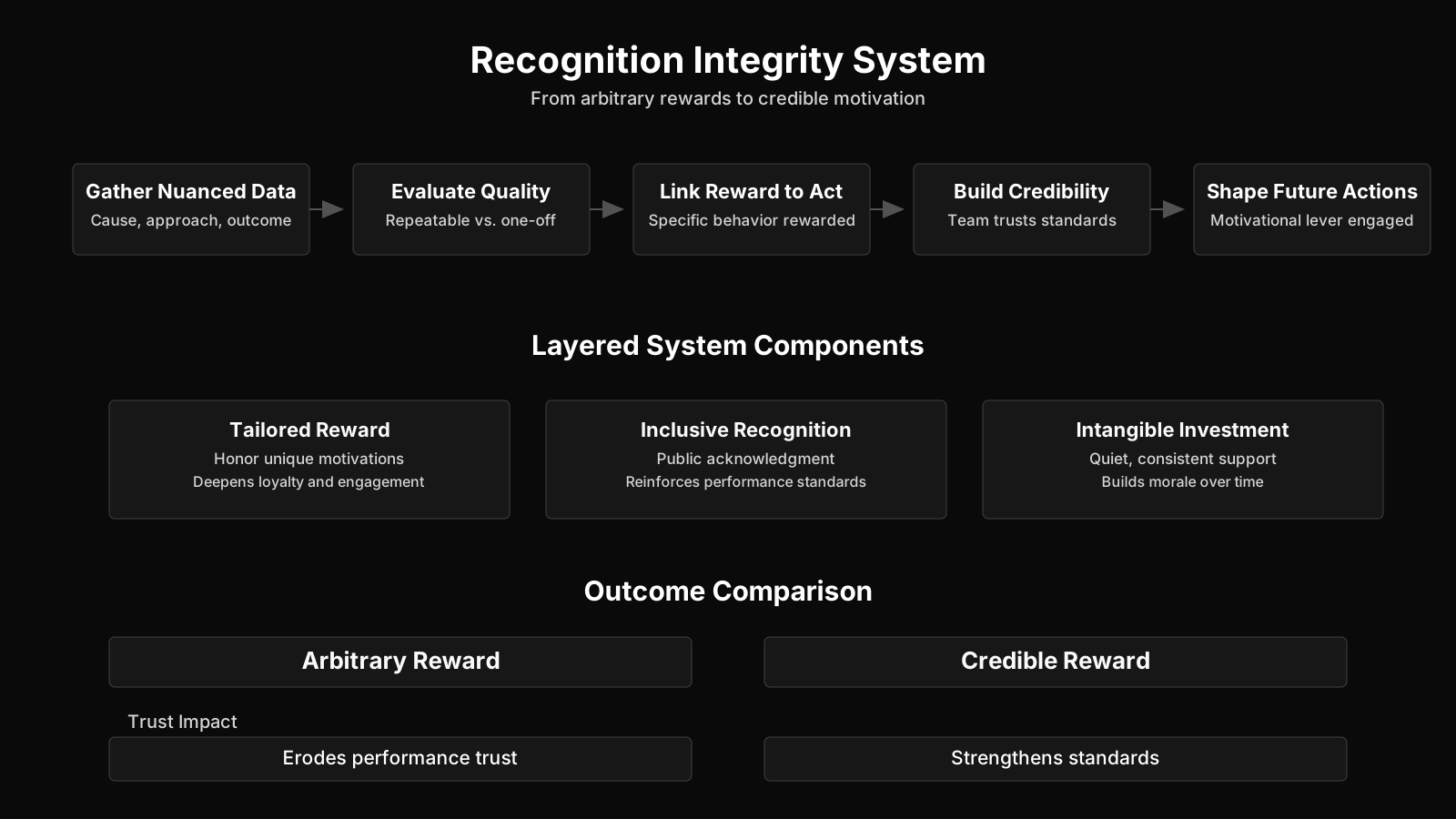
Over time, the accumulated effect of a deliberately constructed reward strategy is a linguistic and behavioral shift across the project community. Terms like “desirable behavior,” “zero-sum recognition,” and “individually valued reward” become part of the team’s shared vocabulary. New members absorb them naturally. Sponsors and senior leaders begin to notice that this project seems to have unusually low turnover and consistently high morale, and they start asking what the project manager is doing differently. When that moment arrives, the project manager can point not to a single initiative but to a layered system of appraisal, tailored reward, inclusive recognition, and intangible investment that has been operating quietly for months. That system, built on the fundamentals of project performance management and refined through practical experience, is what effective team rewards look like in practice, not in a textbook.